
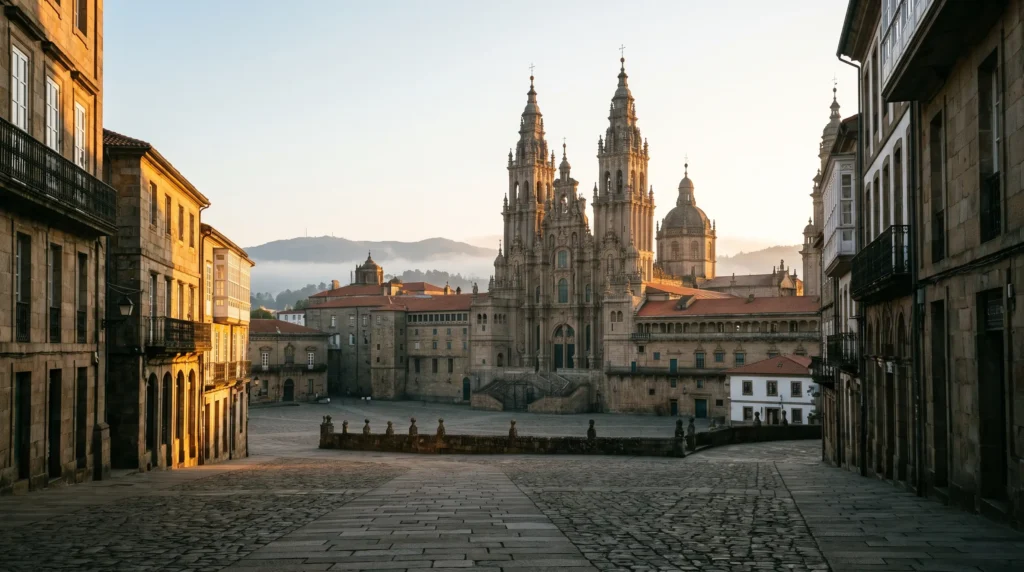
Santiago de Compostela Travel Guide — Where Every Road Ends at a Cathedral
I have watched a lot of people cry in a lot of city squares, but nowhere as reliably as the Praza do Obradoiro in the last hour of daylight. They arrive on foot, sometimes limping, often alone, and they stop dead in front of the cathedral like they’ve hit an invisible wall. That reaction is the whole story of Santiago de Compostela: this is a city built entirely around an arrival. For more than a thousand years, pilgrims have walked here from all over Europe to reach the reputed remains of the Apostle James, and the granite old town that grew up around his tomb is now a UNESCO World Heritage Site in its own right. You don’t need blistered feet or a religious bone in your body to feel it, either — I’ve brought skeptical friends who flew in for a long weekend and still got a lump in the throat under that baroque facade. What I’ll tell you honestly, though, is that this is also one of the wettest cities in Spain, the crowds now genuinely strain the old town in peak season, and the famous incense ritual you’ve seen on Instagram isn’t guaranteed to happen the day you show up. Let’s get into what’s actually true.
In This Guide
- Overview — Why Santiago de Compostela Is Still the End of the Road
- The Xacobeo Holy Year — Why 2027 Is a Big Deal
- Best Time to Visit Santiago de Compostela
- Getting There — SCQ Airport, Trains & the Camino Itself
- Getting Around — A City Built for Walking
- Neighborhoods — Casco Histórico, Ensanche & Beyond
- Culture & People — Galician, Not Just Spanish
- A Food Lover’s Guide to Santiago
- Off the Beaten Path
- Day Trips — Coast, Cape & Countryside
- Practical Information
- Budget Breakdown — What Santiago Actually Costs in 2026
- Frequently Asked Questions
Overview — Why Santiago de Compostela Is Still the End of the Road
Santiago de Compostela sits in the far northwest corner of Spain, in Galicia’s A Coruña province, and its entire identity traces back to a single claim made in the ninth century: that a hermit had found the tomb of Saint James the Greater in the surrounding oak forest. Bishop Theodemar of Iria Flavia endorsed the discovery under King Alfonso II of Asturias sometime between 818 and 842, and the settlement that grew up around it took its name — Compostela, likely from the Latin for “burial ground” — from that event. Within two centuries it was one of the three great pilgrimage destinations of medieval Christendom, alongside Jerusalem and Rome, and it has never really stopped being that.
The modern city carries roughly 101,000 residents and swells with a metro-area population near 184,000, but on any given afternoon the old town’s population is really “everyone who walked here.” The Cathedral of Santiago de Compostela anchors it all, and the granite streets, arcaded squares and monastery complexes packed around it earned UNESCO World Heritage status in 1985 as the Old Town of Santiago de Compostela, recognized for its architectural mastery, its influence on urban design across the Camino network, and its unbroken living association with the pilgrimage tradition.
What makes Santiago different from a typical “pretty old European city” stop is the arrival ritual baked into its geography: nearly every visitor who isn’t flying in for a weekend has just walked, in some cases for weeks, specifically toward this cathedral. That gives the city a strange emotional charge that Bruges or Toledo simply don’t have — and it also means the old town absorbs an enormous, steadily growing volume of foot traffic each year, which shapes everything from restaurant crowds to hostel bookings.
The Xacobeo Holy Year — Why 2027 Is a Big Deal
Every few years, when 25 July (the Feast of Saint James) falls on a Sunday, the Catholic Church declares a Jacobean Holy Year — Ano Santo Xacobeo in Galician — a tradition Pope Callixtus II established in 1122 after making the pilgrimage himself. The cathedral’s Holy Door (Porta Santa), normally sealed, is opened on the Praza da Quintana for the entire year, and pilgrims who visit, pray and receive the sacraments can obtain a plenary indulgence — a tradition unbroken since the 12th century.
The last Holy Year ran 2021–2022 (extended a year because of the pandemic); the next one lands in 2027. Practically, that means: book accommodation stupidly early if you’re aiming for that year, expect the Camino routes and the old town to be noticeably busier than the (already busy) recent record years, and expect the city’s calendar of concerts, processions and civic events to be built around it. If you’re not chasing the indulgence specifically, a non-Holy-Year visit is genuinely the calmer, cheaper choice.
Best Time to Visit Santiago de Compostela
Late May – June · The sweet spot
Warm days, long light, and the city hasn’t yet hit the peak-summer crush of the Feast of Saint James on 25 July. Rainfall is at its lowest annual point without being scorching.
July – August · Peak season
The Feast of Saint James on 25 July brings fireworks over the cathedral, concerts and the single busiest week of the year — book months ahead if you want to be here for it. August is hot for Galicia (still mild by Spanish standards) and thick with both pilgrims and beach-holidaying Spaniards passing through.
September – October · The insider’s window
Camino traffic thins, temperatures stay pleasant, and the harvest brings some of the year’s best seafood and wine. Many locals consider this the actual best month.
November – April · Wet season
Santiago’s oceanic climate means mild, genuinely wet winters — annual rainfall runs around 1,800mm, among the highest of any major Spanish city, and locals half-joke that an umbrella is part of the city’s coat of arms. It rarely gets cold enough for snow, and a rainy, half-empty Praza do Obradoiro under grey granite has its own moody appeal — just pack a real rain shell, not a folding umbrella that will die in the wind off the Atlantic.
Getting There — SCQ Airport, Trains & the Camino Itself
Santiago–Rosalía de Castro Airport (SCQ), sometimes still called Lavacolla after its home parish, sits about 12 kilometres from the city centre and is the second-busiest airport in northern Spain, handling close to 3 million passengers in a typical pre-pandemic year. It has direct connections to Madrid, Barcelona and other Spanish hubs plus a growing roster of seasonal European routes; most long-haul travelers connect through Madrid, Barcelona, or Porto in neighboring Portugal. A public bus and taxis run into the historic centre in well under half an hour.
By train, Santiago sits on Spain’s high-speed network with direct or connecting services from Madrid, and regional/high-speed lines link it to A Coruña, Vigo and the rest of Galicia — the compact modern station is a short walk or quick bus ride from the old town.
And then there’s the third option, which is really the point of the place for hundreds of thousands of people a year: walking in. Santiago is the terminus of the Way of St. James (Camino de Santiago), a network of pilgrimage routes converging here from across Europe. The classic Camino Francés runs roughly 800 kilometres from Saint-Jean-Pied-de-Port in France or Roncesvalles just over the Spanish border, through León, to the cathedral steps; the Camino Portugués climbs up from Porto or Lisbon; the Camino del Norte hugs the Basque and Cantabrian coast from Irún or San Sebastián; and the Camino Primitivo, the oldest of all the routes, dating to the ninth century, covers about 320 kilometres from Oviedo. To receive the official Compostela certificate at journey’s end, walkers need only complete the final 100 kilometres on foot (cyclists, 200km) — which is why the Galician town of Sarria, exactly that distance out, has become the single most popular starting point on the whole network.
Getting Around — A City Built for Walking
The old town is small, hilly, largely pedestrianized, and genuinely delightful on foot — you can cross the entire historic core in fifteen minutes, and you’ll want to, since half the appeal is getting quietly lost in granite lanes that all seem to funnel back toward the cathedral. Cobblestones get slick in the rain (which is often), so bring shoes with actual grip, not vacation sandals.
For the modern Ensanche district, the bus station, or the university campus further out, city buses (Tranvías de Santiago runs the local network) are cheap and frequent. Taxis are metered, plentiful, and reasonable for late-night returns or day-trip logistics. You will not need — and mostly cannot use — a rental car inside the old town itself; save that for the coastal and countryside day trips.
Neighborhoods — Casco Histórico, Ensanche & Beyond
Casco Histórico (Old Town)
The UNESCO-listed heart of the city and where you’ll spend most of your time: the cathedral, the four grand squares that ring it (Obradoiro, Quintana, Inmaculada, Praterías), the arcaded Rúa do Franco and Rúa Nova dining strips, and a maze of granite lanes packed with pilgrim albergues, tapas bars and stone churches. Stay here if you want to walk out your door straight into the postcard.
Praza do Obradoiro
Technically part of the old town but worth calling out on its own — this is the square where pilgrims arrive, framed by the cathedral’s baroque west facade, the Hostal dos Reis Católicos (a former royal pilgrim hospital, now a luxury parador hotel), the Pazo de Raxoi, and the university’s medieval college. Come at dawn or after 9pm to see it without the tour groups.
Praza da Quintana
The cathedral’s back square, split into an upper and lower level, home to the Holy Door that opens only in Xacobeo years. Quieter than Obradoiro, and a good spot to sit with a coffee and watch the city’s daily rhythm.
Ensanche
The 19th- and 20th-century “new town” spreading south and east of the historic core — wider streets, everyday shops, local bars with none of the pilgrim-menu pricing, and the Mercado de Abastos, the city’s working produce and seafood market. This is where actual Compostelanos do their shopping and where you’ll eat the best-value seafood in town.
Alameda Park & San Domingos de Bonaval
A green ridge on the old town’s southwestern edge with the city’s best skyline view of the cathedral towers over the rooftops — genuinely one of the best free photo spots in Spain. The adjoining former Dominican convent now houses the Museum of the Galician People and a peaceful, atmospheric cemetery.
University Quarter
Santiago’s university, founded in the early 16th century, still drives much of the city’s daily life outside pilgrim season — this is where the student-bar energy lives, particularly in the streets around Praza de Cervantes and toward Santo Agostiño.
Culture & People — Galician, Not Just Spanish
Galicia is one of Spain’s officially bilingual regions, and Galician (Galego) — a Romance language closely related to Portuguese — shares co-official status with Castilian Spanish here. Street signs, folk music, and a good chunk of daily conversation run in Galician, and the culture leans distinctly Celtic-Atlantic rather than the flamenco-and-bullfights image most visitors bring from central or southern Spain — think bagpipes (gaita), not castanets.
The rhythm of the city is set by two overlapping populations: the pilgrims passing through, often emotional, footsore and in no hurry, and the locals and students who actually live here and treat the cathedral square the way New Yorkers treat Times Square — a thing you walk past, not toward. The single defining civic and religious moment of the year is the Feast of Saint James on 25 July, with the Praza do Obradoiro fireworks display considered one of the best in Spain. If you can time a visit around it (and book far ahead), it’s worth it.
If you’re in the cathedral for a Pilgrim’s Mass, keep an eye out for the botafumeiro — the enormous silver censer that, on special occasions, is swung by a team of men on ropes in a wide, incense-trailing arc across the transept. It’s one of the most photographed rituals in European Catholicism, but it isn’t run at every Mass; check locally or budget a small optional donation if you specifically want to see it, and don’t count on it as guaranteed.
A Food Lover’s Guide to Santiago
Galicia is widely regarded as having Spain’s best seafood, and Santiago’s Mercado de Abastos is the place to see why — stalls stacked with percebes (goose barnacles), spider crab, and the region’s famous octopus, alongside a handful of counters where you can buy what you want and have it cooked on the spot.
The signature dish is pulpo á feira (“fair-style octopus”): boiled octopus sliced onto a wooden plate, dressed with olive oil, coarse salt and smoked paprika. Pair it with empanada gallega (a savory pie usually filled with tuna, pork or seafood in a sofrito), and finish with tarta de Santiago, the dense almond cake stamped with the Cross of Saint James that’s sold in nearly every bakery window in the old town. Wash it all down with a glass of Albariño, the crisp white wine of the neighboring Rías Baixas region, or a rougher local red served in a traditional white ceramic cup (cunca).
For the highest concentration of good, affordable tapas bars, head to Rúa do Franco and Rúa da Raíña in the old town, though prices there run a notch above the everyday spots locals actually use around the Mercado de Abastos and the Ensanche. A caña (small beer) or glass of wine with a free tapa is still standard practice in many bars — order a drink and see what turns up.
Off the Beaten Path
Colexiata de Santa María a Real do Sar
A 12th-century Romanesque church on the edge of the old town, famous for its visibly leaning, buttressed columns — a structural quirk that has fascinated architects for centuries and draws a fraction of the cathedral’s crowds.
Convento de San Paio de Antealtares
A working Benedictine convent behind the cathedral where cloistered nuns still sell homemade almond cookies and pastries through a small revolving hatch — a genuinely odd and lovely bit of everyday medieval survival in the middle of a tourist city.
Parque de Belvís
A steep, largely undiscovered green space just south of the centre with sweeping cathedral views and a fraction of the foot traffic of Alameda Park — bring a bottle of Albariño and watch the sunset.
Arrive at dawn
The single best “off the beaten path” move in Santiago costs nothing: be in the Praza do Obradoiro at sunrise, before the tour buses and even before most pilgrims finish their final kilometres. You’ll have the facade, and the emotional weight of the place, almost entirely to yourself.
Day Trips — Coast, Cape & Countryside
Fisterra (Finisterre) & Muxía
Many pilgrims don’t actually stop in Santiago — they keep walking to the Atlantic coast, following the Camino Finisterre route to Cape Fisterra, long believed by Romans and medieval Europeans to be the literal end of the known world (finis terrae). A rental car or organized tour covers the same coastline in a scenic day, with a lighthouse, a rugged cape, and — tradition holds — a spot where some pilgrims burn a worn-out piece of clothing to mark the journey’s true end. Muxía, a short drive up the coast, adds a dramatic clifftop sanctuary.
Rías Baixas & Combarro
South of Santiago, Galicia’s famous coastal inlets (rías) open up around Pontevedra and the postcard fishing village of Combarro, known for its shoreline hórreos (traditional raised granite granaries) built almost in the surf. This is also Albariño wine country — several bodegas offer tastings a short drive from the city.
A Coruña
Galicia’s largest city, on the coast north of Santiago, trades pilgrim energy for a proper Atlantic port city with a Roman lighthouse (the Tower of Hercules), a lively promenade, and excellent seafood of its own — a good contrast day if the old town’s crowds start to feel like a lot.
Cambados & the Rías Baixas wine route
The self-declared capital of Albariño, worth combining with the Combarro coast run for anyone who wants their day trip built around a wine tasting rather than a hike.
Practical Information
Money. Spain uses the Euro, adopted in 1999 with cash introduced in 2002; interestingly, Spain’s own 1-, 2- and 5-cent coins carry an image of the Santiago Cathedral facade, making this one of the few cities in the world stamped onto its own national currency. Cards are accepted almost everywhere in the old town; small rural albergues and market stalls may be cash-only.
Safety. Spain overall sits at a moderate travel advisory level, with the usual big-city cautions around pickpocketing in crowded tourist zones, transit hubs and demonstrations rather than anything specific to Santiago. The old town is genuinely relaxed by international standards; the main practical risk is a slick cobblestone underfoot after rain, not crime.
Health. No special vaccines are required for Spain beyond staying current on routine immunizations; standard travel-health advice (food and water precautions, insect protection if you’re heading into rural Galicia) applies. Pharmacies (marked with a green cross) are plentiful and pharmacists are a good first stop for minor pilgrim ailments like blisters.
Connectivity. An EU-roaming plan or eSIM covers you well; old-town Wi-Fi is generally solid, rural Camino stretches less so. Plugs: European two-round-pin (Type C/F), 230V. Time zone: Central European Time (CET/CEST), UTC+1/+2 with daylight saving.
Budget Breakdown — What Santiago Actually Costs in 2026
Santiago runs cheaper than Barcelona or Madrid, and pilgrim infrastructure (albergues, set-menu “menú del peregrino” lunches) keeps the floor especially low.
Budget (US$50–90/day): Pilgrim albergue dorm bed, market lunches or a fixed-price pilgrim menu, walking everywhere, a €1–2 city bus if needed.
Mid-range (US$130–220/day): Boutique old-town hotel or guesthouse, sit-down seafood dinners with Albariño, a guided Fisterra/Muxía day tour, entry to the cathedral museum and rooftop tour.
Luxury (US$350+/day): A stay at the Hostal dos Reis Católicos parador on Praza do Obradoiro itself, private guided Camino or wine-route day trips, tasting menus at the city’s top seafood restaurants.
Tipping is not obligatory in Spain — rounding up or leaving small change is normal, 5–10% for a standout meal. Cathedral entry itself is free; the rooftop tour, museum and Holy Door access carry separate ticket prices that are worth checking in advance, especially around the Feast of Saint James or in a Holy Year.
Planning Your First Trip to Santiago de Compostela
Most non-pilgrim visitors give Santiago two to three nights — enough for the cathedral, the four main squares, the market, and one full day trip to the coast at Fisterra or Muxía. If you want a taste of the Camino without committing to weeks of walking, consider tackling just the final short stretch from Sarria (the 100km minimum for a Compostela certificate) before flying home from SCQ. Santiago also pairs naturally with a wider Iberian loop — many travelers connect it with our Porto guide via the coastal Camino Portugués route, or continue on to our Portugal guide further south, or head east across the north coast toward our San Sebastián guide, tracing the Camino del Norte in reverse.
Frequently Asked Questions
Do I have to walk the Camino to visit Santiago de Compostela?
Not at all — you can fly into SCQ or take the high-speed train from Madrid and be standing in front of the cathedral within hours. Walking in is a specific, meaningful choice for many visitors, but plenty of people fly in for a long weekend and have a wonderful trip.
Do I need a visa?
US, UK, Canadian, Australian and most Western passport holders get visa-free Schengen entry for up to 90 days within any 180-day period. Check your specific passport’s current requirements before booking.
Is Santiago de Compostela safe?
Yes, by international standards it’s a relaxed, walkable, relatively low-crime city; standard advice about watching belongings in crowded areas and around the train/bus station applies, as it does across Spain.
Will I actually see the botafumeiro swing?
Maybe. The giant incense censer is a special-occasion ritual, not a daily guarantee at every Pilgrim’s Mass — check with the cathedral or your accommodation for the current schedule, and consider it a bonus rather than something to build your whole itinerary around.
How rainy is Santiago, really?
Genuinely rainy — annual totals around 1,800mm put it among Spain’s wettest major cities, concentrated especially from November through March. Pack real rain gear for any visit outside high summer.
What’s the minimum Camino distance if I only have a few days?
Walk from Sarria — it’s exactly the 100km required for the Compostela certificate and typically takes five to six days, which is why it’s now the single most popular starting point on the whole network.
Ready to Explore Santiago de Compostela?
A cathedral square that reduces strangers to tears, a coastline where the Romans thought the world ended, and octopus so good it justifies the flight on its own — Santiago rewards anyone willing to slow down for a couple of days. Just bring a proper rain jacket, and don’t schedule the botafumeiro as a sure thing.
Explore More
- Spain Travel Guide — the full country, from Madrid to the Mediterranean
- Porto Travel Guide — where the Camino Portugués begins
- San Sebastián Travel Guide — the Camino del Norte’s coastal starting point
- Portugal Travel Guide — continue south along the Iberian coast
How this guide was built
Published as part of Facts From Upstairs’ city guide series. Built from authoritative sources — UNESCO’s Old Town of Santiago de Compostela World Heritage inscription, Wikipedia’s entity pages for Santiago de Compostela, the Way of St. James, and the Jacobean Holy Year, the European Central Bank’s page on Spanish euro coinage, the US State Department’s Spain travel advisory, and the US CDC’s Spain traveler health page. Numeric and checkable claims carry inline citations.
More city guides you might like
Plan your trip to Santiago de Compostela
The booking tools we use ourselves. FFU may earn a commission at no extra cost to you.
Plan & book your trip to Santiago de Compostela
Booking through these searches supports our guides at no extra cost to you.
Curated multi-day tours to Santiago de Compostela — Exoticca →