
Sapporo Travel Guide — Snow Festivals, Miso Ramen & Japan’s Most Livable Northern City
I tell people Sapporo is what happens when you take everything you love about Japan and hand it more space to breathe. It’s the fifth-largest city in the country and the biggest one north of Tokyo, with nearly two million people — yet it still feels like a city that hasn’t finished stretching out, laid across a river-fan valley with mountains on three sides and, for roughly a third of the year, an honest amount of snow piled on every rooftop. This is where Japan sends its beer, its ramen and its winter Olympics highlight reel: Sapporo hosted Asia’s first Winter Games in 1972 , invented miso ramen in a shop that’s still standing, and throws a February snow festival that pulls more than two million visitors into one park. It’s also just a genuinely easy, comfortable city to be a tourist in — wide grid streets, an underground concourse for the brutal winters, and a food scene that punches so far above its size that Tokyo chefs quietly source Hokkaido ingredients. The catch is timing: come for the wrong week and you’ll miss the festival, the crab season, or the powder, so read the “when to go” section before you book anything.
In This Guide
- Overview — Why Sapporo Is Japan’s Most Livable Winter City
- The Sapporo Snow Festival — Book Around This
- Best Time to Visit Sapporo (Season by Season)
- Getting There — New Chitose Airport & the Rapid Train
- Getting Around — Subway, Streetcar & the Underground City
- Neighborhoods — Odori, Susukino, Maruyama & More
- Culture & People — Ainu Heritage, Frontier History & Festival Spirit
- A Food Lover’s Guide to Sapporo
- Off the Beaten Path
- Day Trips from Sapporo
- Practical Information
- Budget Breakdown — What Sapporo Actually Costs in 2026
- Frequently Asked Questions
Overview — Why Sapporo Is Japan’s Most Livable Winter City
Sapporo only became a city in the modern sense in 1869, when the Meiji government picked this stretch of the Toyohira River’s alluvial fan as headquarters for developing Hokkaido, then still a frontier. That late start is exactly why it feels different from Kyoto or Kanazawa: the streets were laid out from scratch on a wide American-style grid, there’s no ancient castle at the center, and the whole place has a frontier-town confidence rather than a shrine-town hush. It grew fast — city status came in 1922, and by the time it hosted the 1972 Winter Olympics, the first Winter Games ever held in Asia, Sapporo already had the infrastructure of a much older metropolis.
Today it’s Japan’s fifth-largest city and the anchor of Hokkaido, the northernmost of Japan’s main islands, with a population near 1.96 million in the city proper and roughly 2.66 million across the wider metro. The pitch for travelers is simple: this is Japan with the volume turned down and the nature turned up. You get the trains, the convenience stores, the vending machines and the impeccable service of anywhere else in the country, plus mountains visible from downtown, seafood markets selling that morning’s catch, and — this is the headline for a lot of visitors — genuinely serious snow, averaging around 4.8 meters a year.
What Sapporo isn’t is a bucket-list must-see on the level of Kyoto’s temples or Tokyo’s density. It rewards people who already want a Hokkaido trip and need a base, or who specifically want the Snow Festival, the ramen, the beer history, or an easy jump-off to Niseko’s powder. If none of that appeals, you can skip it and still have a great Japan trip. If any of it does, this is one of the most pleasant big cities in the country to actually live inside for a few days.
The Sapporo Snow Festival — Book Around This
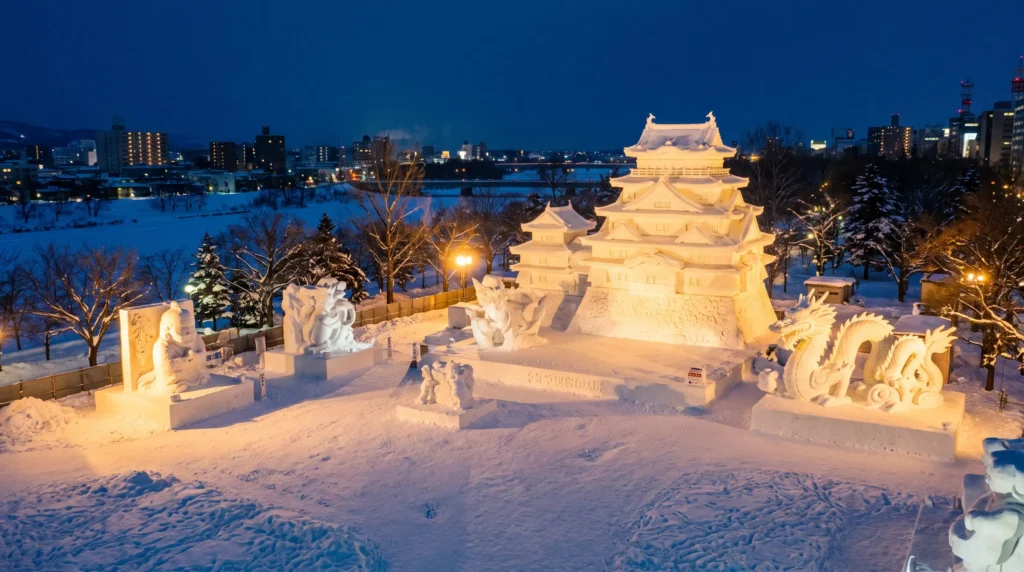
If there’s one date to build a Sapporo trip around, it’s the Sapporo Yuki Matsuri (Snow Festival), held annually over roughly a week in early February. It started small in 1950, when six local high school students built six snow statues in Odori Park; by 1955 the Japan Self-Defense Forces had gotten involved and started building on a genuinely massive scale, and the festival has been growing ever since. It now draws more than two million visitors and around 400 sculptures across three sites: Odori Park’s giant snow sculptures and international contest (running since 1974), Susukino’s intricate ice carvings, and the Tsudome site’s family-friendly snow slides and play zones.
The catch: hotel rooms in central Sapporo sell out weeks ahead of festival week, and prices spike accordingly, so book three-plus months out if you want the festival dates specifically. If you’d rather see the snow without the crowds, any week from mid-January through February gives you the same cold, clean streetscapes and hot ramen weather without needing a hotel reservation made in autumn.
Best Time to Visit Sapporo (Season by Season)
January – March · Deep winter (peak for snow)
Cold, often well below freezing, and the reason people come: the Snow Festival in early February, powder skiing at nearby Niseko and Rusutsu, and a downtown that turns genuinely magical after dark. Pack for real winter — proper boots, not fashion boots.
April – May · Shoulder spring
Snow clears, cherry blossoms arrive later than in southern Japan (often late April to early May), and crowds and prices both ease off. An underrated window for a first visit.
June – August · Cool-summer escape
While Honshu swelters through humid summer, Sapporo stays noticeably milder — one of the reasons Japanese travelers flee north in August. Long daylight hours, the Sapporo Summer Festival’s beer gardens in Odori Park, and lavender season in nearby Furano.
September – November · Autumn foliage
Crisp air, colorful maples in Hokkaido University’s grounds and Jozankei Onsen, and the last of the good hiking weather before winter locks back in. Late October can already bring the first snow.
Getting There — New Chitose Airport & the Rapid Train
New Chitose Airport (CTS), Hokkaido’s main gateway, sits about 45 minutes south of downtown and handled nearly 24 million passengers in 2024, making it one of Japan’s busiest airports. Domestically, the Sapporo–Tokyo Haneda route is one of the busiest air corridors on Earth, so connections from Tokyo run frequently and cheaply if you’re arriving via Narita or Haneda first. Internationally, New Chitose has regular service to Seoul, Taipei, Hong Kong, Shanghai, Singapore and Bangkok, plus seasonal routes to Vancouver, San Francisco and Sydney.
From the airport, JR Hokkaido’s Rapid Airport train runs directly into Sapporo Station in about 37 minutes — no transfers, no fuss, and it accepts the same IC cards (Suica, Kitaca) you’d use anywhere else in Japan. If you’re coming from Honshu overland rather than flying, the Hokkaido Shinkansen currently terminates at Shin-Hakodate-Hokuto, several hours south of Sapporo by connecting train — flying remains the faster option for almost everyone.
Getting Around — Subway, Streetcar & the Underground City
Central Sapporo is compact and walkable, and the parts that aren’t are covered by a clean three-line subway network: the Namboku (green), Tozai (orange) and Toho (blue) lines, 49 stations across roughly 48 kilometers of rubber-tired track — the only subway system on Hokkaido, and Japan’s only entirely rubber-tired one. All three lines meet at Odori Station, and the system carries around 630,000 riders a day. Single fares run ¥210–380 depending on distance, with an unlimited day pass at ¥830 and a cheaper weekend “Donichika” pass at ¥520 — both accept the same SAPICA, Kitaca or Suica card as everywhere else.
The real trick for winter visitors is the Sapporo Underground network — a heated pedestrian concourse linking Sapporo Station, Odori Station and the Susukino area, lined with shops, so you can cross a huge chunk of downtown without once stepping into the snow. Above ground, a legacy streetcar loop still circles part of the city center for short hops, and buses fill in everywhere else. Most visitors never need a car; rent one only if you’re heading out to Niseko, Furano or Shikotsu-Toya independently.
Neighborhoods — Odori, Susukino, Maruyama & More
Odori Park & Chuo-ku (city center)
The green spine that splits downtown in two, home to the Snow Festival’s main site, the Sapporo TV Tower, and the Summer Festival’s beer gardens. Chuo-ku, the surrounding central ward, holds the department stores, JR Tower and most business hotels — your default base.
Susukino
Sapporo’s — and arguably Hokkaido’s — biggest nightlife and dining district, a dense grid of ramen shops, izakaya, karaoke boxes and bars a short walk south of Odori. It’s touristy in patches but still where most of the city actually eats and drinks after dark.
Sapporo Station area
The transit hub, wrapped in the JR Tower shopping complex and the Stellar Place mall, with an observation deck up top for a free-ish city panorama. Convenient for connections but less atmospheric than Odori or Susukino.
Maruyama & Odori-Nishi
A leafy, upscale residential pocket west of downtown, home to Maruyama Park’s cherry blossoms, Hokkaido Shrine, and a small forested zoo. Popular with locals for a slower afternoon walk away from the crowds.
Nakajima Park & Sapporo Factory
Nakajima Park is the city’s other big green lung, good for a quiet stroll past traditional teahouses; nearby, Sapporo Factory occupies the old Sapporo Brewery grounds, now a shopping and dining complex built around the original red-brick buildings.
Hokkaido University area (Kita-ku)
North of the station, the university’s leafy campus — with its famous poplar avenue and elm-lined lanes — makes for one of the best free walks in the city, especially in autumn.
Culture & People — Ainu Heritage, Frontier History & Festival Spirit
Sapporo’s culture carries the double identity of its region: it’s unmistakably Japanese, but it’s also Hokkaido, the ancestral homeland of the Ainu, Japan’s indigenous people, whose language, worldview and craft traditions predate the Meiji-era settlers who founded the modern city. Roughly an hour from Sapporo, the Upopoy National Ainu Museum and Park in Shiraoi — which opened in 2020 as a national center for Ainu culture — is the best single place to learn this history properly, with exhibits on Ainu language, livelihoods and worldview alongside a reconstructed village.
Layered on top of that is the frontier-development culture of the 1870s onward — the same era that brought German-trained brewers to found what became Sapporo Breweries in 1876, Japan’s oldest beer brand. That mix of indigenous heritage and imported, Meiji-era Western influence still shows up in the city’s red-brick architecture, its grid streets, and its genuine enthusiasm for big public festivals — snow in February, beer and lilacs in summer, food festivals filling Odori Park most weekends from May through October.
A Food Lover’s Guide to Sapporo
Sapporo’s food reputation rests on cold-climate abundance: this is dairy country, crab country and, thanks to a happy postwar accident, ramen country. Miso ramen was invented here — the broth developed in 1958 by Morito Ohmiya, the founder of Aji no Sanpei, paired with noodles designed by Nishiyama Seimen. You can trace that lineage at Ganso Sapporo Ramen Yokocho, a cramped, steamy alley of roughly a dozen-plus ramen counters that has been serving bowls since 1951.
Beyond ramen: jingisukan (Genghis Khan barbecue), thin-sliced lamb and mutton grilled on a dome-shaped skillet, is Hokkaido’s signature meat dish and pairs unreasonably well with local beer. Seafood is a headline act too — king crab, sea urchin (uni), scallops and salmon roe (ikura) show up everywhere from convenience-store bentos to high-end sushi counters, most of it landed that morning at Nijo Market, the small central fish market a short walk from Odori. Soup curry, a Sapporo invention distinct from mainland Japanese curry, is worth seeking out on a cold day, and dessert culture runs deep thanks to Hokkaido’s dairy industry — soft-serve, cheese tarts and the Shiroi Koibito cookie brand all trade on the same reputation for rich local milk.
For a drink, the Sapporo Beer Museum, housed in the original 1876 brewery buildings on the Sapporo Factory grounds, tells the origin story of Japan’s oldest beer brand and pours fresh-brewed samples on-site.
Off the Beaten Path
Hokkaido University’s back campus
Everyone photographs the poplar avenue near the main gate; almost nobody walks the quieter northern half of campus, past the agricultural fields and the university museum, where you’ll mostly share the paths with cycling students.
Moerenuma Park
A city park designed entirely by sculptor Isamu Noguchi as a single land-art piece, complete with a glass pyramid and a man-made mountain built from repurposed waste — striking, uncrowded, and almost unknown outside Japan.
Jozankei Onsen
A hot-spring town tucked in the mountains under an hour from downtown, popular with locals for a half-day soak and river-gorge walk without the crowds of Hokkaido’s better-known onsen resorts.
Sapporo Factory’s brick quarter at off-hours
Visit the Beer Museum grounds on a weekday morning before the tour groups arrive, and the red-brick 1870s brewery buildings are close to empty.
Day Trips from Sapporo
Otaru
A former financial powerhouse turned canal town, about 25 minutes from Sapporo and home to around 107,000 people. Come for the Victorian-lamplit canal, glassblowing studios and some of Hokkaido’s best sushi, all inside a compact, walkable historic core.
Niseko
Hokkaido’s — and one of the world’s — best-known powder-skiing destination, famous for the ultra-light snow locals call “Japow” and now heavily developed with international, especially Australian, investment. It’s a doable winter day trip by bus or train, though staying a night or two lets you actually ski rather than just admire the mountain.
Shikotsu-Toya National Park
Caldera lakes, volcanoes and onsen towns within about an hour of the city — Lake Shikotsu’s startlingly clear water and Lake Toya’s resort towns are the two anchor stops, easily paired with a New Chitose Airport connection since the park sits between the two.
Upopoy (Shiraoi)
The National Ainu Museum and Park, about an hour from Sapporo and roughly 40 minutes from New Chitose Airport, making it an easy add-on for a layover or an arrival/departure day rather than a dedicated round trip.
Practical Information
Money. Japan remains a notably cash-based society even now, so keep yen on hand for small restaurants, older shops and some transit, alongside cards and IC cards for everything else. ATMs at 7-Eleven convenience stores reliably accept foreign cards.
Safety. The US State Department rates Japan at Level 1, “Exercise Normal Precautions,” its lowest risk tier — Sapporo is no exception, and violent crime against tourists is rare. Do take Japan’s strict drug laws seriously — even prescriptions legal at home, including some ADHD medications, can be illegal to bring in — and note that pocket knives over 5.5cm are also restricted.
Health. No special vaccines are required for Japan beyond staying current on routine immunizations; hepatitis A/B are sometimes recommended for travelers eating widely off the beaten path. Healthcare in Sapporo is excellent by any international standard. Remember traffic drives on the left — look right first when crossing.
Connectivity. An eSIM or pocket Wi-Fi router covers you the moment you land; Sapporo Station and most cafes have solid free Wi-Fi. Plugs: Japan uses Type A, 100V. Time zone: UTC+9, no daylight saving observed.
Budget Breakdown — What Sapporo Actually Costs in 2026
Sapporo runs cheaper than Tokyo or Kyoto for comparable quality, with the gap widest on hotels and narrowest on transit.
Budget (US$70–120/day): business-hotel capsule or hostel dorm, ramen and convenience-store meals, subway day pass, free walks in Odori and Maruyama Park.
Mid-range (US$150–280/day): a comfortable city-center hotel, a proper jingisukan or seafood dinner, Sapporo Beer Museum tour and tasting, a day trip to Otaru.
Luxury (US$400+/day): a ryokan or onsen resort night in Jozankei, omakase sushi built on that morning’s Nijo Market catch, a private Niseko powder day.
Snow Festival week runs noticeably above these ranges for lodging specifically — book early or expect a premium. Tipping isn’t expected anywhere in Japan, including Sapporo.
Planning Your First Trip to Sapporo
The classic first-timer pattern is city + snow, or city + coast: fly into New Chitose, spend two or three nights in central Sapporo covering Odori, Susukino and the ramen alley, then either head to Otaru for a canal-town day or up to Niseko for skiing, depending on the season. Four to five nights covers it comfortably; a week lets you add Upopoy or Shikotsu-Toya on the way to or from the airport. Pair it with our guides to Tokyo for the classic gateway city, Kyoto for temples and old-capital atmosphere, or Osaka for Japan’s other great food city — all an internal flight or Shinkansen-plus-flight away.
Frequently Asked Questions
Is Sapporo safe for tourists in 2026?
Yes — Japan overall sits at the US State Department’s lowest advisory tier, “Exercise Normal Precautions,” and Sapporo is a relaxed, low-crime city even by Japanese standards. Standard city sense — mind belongings on packed trains and in Susukino’s nightlife strip late at night — is enough.
Do I need a visa?
Travelers from the US, UK, EU, Canada and Australia can enter Japan visa-free for stays typically up to 90 days; bring a passport valid for your full stay and proof of onward travel if asked.
How many days do I need in Sapporo?
Two full days covers the city center — ramen alley, Odori Park, Susukino, the Beer Museum. Add a third day for Otaru, or three-plus more if you’re pairing it with Niseko skiing or a longer Hokkaido loop.
Is the Snow Festival worth planning a whole trip around?
If snow sculpture and ice-carving spectacle genuinely excites you, yes — it’s a singular event drawing over two million visitors for good reason. Just book lodging months ahead, since that week is Sapporo’s tightest and priciest for hotel rooms.
What’s the easiest way to get to Niseko from Sapporo?
Direct winter buses and seasonal trains connect Sapporo to Niseko in roughly two to three hours; renting a car gives more flexibility but winter driving in Hokkaido demands real experience with snow and ice.
Sapporo or Tokyo for a first Japan trip?
Tokyo if you want the classic first-timer itinerary and maximum sightseeing density; Sapporo if you specifically want snow, seafood, ramen history or a Hokkaido base — most first-time visitors do Tokyo (and often Kyoto) first, then add Sapporo on a return trip or a longer loop.
Ready to Explore Sapporo?
Snow sculptures taller than the crowds watching them, miso ramen invented three blocks from where you’re eating it, and mountains close enough to ski before lunch — Sapporo delivers a version of Japan that’s easier to move through and, in its own quiet way, just as memorable as the postcard cities. Time it around the festival, the crab season or the powder, and you’ll wonder why it isn’t higher on more people’s lists.
Explore More
- Tokyo City Guide — the classic Japan gateway, a flight or train away
- Kyoto City Guide — temples, old-capital atmosphere and a contrast to Sapporo’s frontier grid
- Osaka City Guide — Japan’s other great food city
- Hiroshima City Guide — history and memorial sites further south in Japan
How this guide was built
Published as part of Facts From Upstairs’ city guide series. Built from authoritative sources — Wikipedia entity pages for Sapporo, the Sapporo Snow Festival, New Chitose Airport, the Sapporo Municipal Subway, Otaru, Niseko, Upopoy, Sapporo Breweries, the Japanese yen and Japan Standard Time; the US State Department’s Japan international travel information page; the US CDC traveler page for Japan; and the official Sapporo Tourist Association (sapporo.travel) for ramen history. Numeric claims carry inline citations.
Sources cited on this page
- Wikipedia — Sapporo
- Wikipedia — Sapporo Snow Festival
- Wikipedia — New Chitose Airport
- Wikipedia — Sapporo Municipal Subway
- Wikipedia — Otaru
- Wikipedia — Niseko
- Wikipedia — Upopoy
- Wikipedia — Sapporo Breweries
- Wikipedia — Japanese yen
- Wikipedia — Time in Japan
- US State Department — Japan
- US CDC — Japan traveler page
- Sapporo Tourist Association — Ramen feature
More city guides you might like
Plan your trip to Sapporo
The booking tools we use ourselves. FFU may earn a commission at no extra cost to you.
Plan & book your trip to Sapporo
Booking through these searches supports our guides at no extra cost to you.