
Languages of Sierra Leone
All languages of Western Africa →fluent beta classical · classes by phone with Maya at ranas.ai/maya
Sierra Leone Travel Guide — Freetown Beaches, Rainforest Wildlife & West Africa’s Warmest Welcome
I’ll be honest about where this guide starts: most people who ask me about Sierra Leone are picturing headlines from twenty years ago, not the country as it actually is today. What’s actually there is one of the most underrated coastlines in West Africa — white sand beaches with barely another traveler on them, a rainforest complex that just became the country’s first UNESCO World Heritage Site, and a capital whose Krio culture earned it the nickname “the Athens of West Africa” for a very good reason. It’s also a country that requires real planning — visas, cash logistics, a rainy season that can strand you, patchy health infrastructure — and I’m not going to pretend otherwise. But if you go in with the right expectations, Sierra Leone rewards you with something increasingly rare: a genuinely warm welcome in a place tourism hasn’t yet reshaped.
In This Guide
- Overview — Why Sierra Leone Deserves a Second Look
- Independence Day & Freetown’s Lantern Parade
- Best Time to Visit Sierra Leone (Season by Season)
- Getting There — FNA, the Ferry & Overland Borders
- Getting Around — Poda-Podas, Okadas & Hired Cars
- Top Regions — Peninsula, Provinces & Rainforest
- Culture & People — Krio, Temne, Mende & Beyond
- A Food Lover’s Guide to Sierra Leone
- Off the Beaten Path
- Practical Information
- Budget Breakdown — What Sierra Leone Actually Costs in 2026
- Planning Your First Trip
- Frequently Asked Questions
Overview — Why Sierra Leone Deserves a Second Look
Sierra Leone sits on West Africa’s Atlantic coast between Guinea and Liberia, a country of roughly 8.5 million people packed into an area a bit smaller than South Carolina. It became independent from Britain on 27 April 1961, and that colonial history left an unusual legacy: English is the official language, but the street language nearly everyone actually shares is Krio, an English-based creole born in Freetown among freed and returning African settlers starting in 1792.
The geography does a lot of the selling on its own: savanna in the north, dense rainforest in the east and south, and a coastline studded with the kind of empty, palm-backed beaches that get quietly passed around by people who’ve actually been. The country’s flagship natural asset is the Gola-Tiwai Complex — Gola Rainforest National Park paired with Tiwai Island Wildlife Sanctuary — which became Sierra Leone’s first UNESCO World Heritage Site in 2025, home to western chimpanzees, pygmy hippos and one of the highest primate densities in Africa.
What Sierra Leone doesn’t have is tourism infrastructure to match — this is not a country where everything is arranged for you. Civil war in the 1990s and the 2014 Ebola outbreak both hit the country hard and both are firmly in the country’s past, but the recovery shows up in patchy roads, limited hotel stock outside Freetown, and a health system that falls short of what visitors from wealthier countries are used to. None of that should scare off a prepared traveler — it just means Sierra Leone rewards people who come with flexibility, decent trip insurance and low expectations for schedules.
Independence Day & Freetown’s Lantern Parade
If you can time a visit around one date, make it 27 April, Independence Day — the anniversary of Sierra Leone’s 1961 break from Britain, and the biggest patriotic date on the calendar. Expect flag-draped streets, parades and a national mood that’s easy for a visitor to get swept up in, right at the tail end of the reliable dry season.
The other spectacle worth knowing about is Freetown’s Lantern Parade, a century-old Krio tradition where community “Odelay” societies build enormous illuminated floats out of tissue paper, wood and wire and parade them through the streets at night to mark Eid-ul-Fitri, the end of Ramadan. Because it follows the Islamic lunar calendar, the exact date shifts every year — check ahead if you want to build a trip around it, but any night you catch one is a genuine cultural highlight most visitors to West Africa never see.
Best Time to Visit Sierra Leone (Season by Season)
December – February · Dry, dusty, and the classic window
This is peak season for a reason: reliably dry days, passable roads and the best conditions for beach time and wildlife viewing. The catch is the harmattan, a dusty wind blowing down from the Sahara that hazes the sky and can dull photos and long-distance views. Temperatures generally run 24–34°C.
March – April · The sweet spot
Harmattan haze clears, humidity is still manageable, and Independence Day (27 April) falls right at the end of this window. Still dry, still good roads, arguably the best light of the year.
May – October · Rainy season, avoid for overland travel
The rains build through May and June and peak hard in July and August, with the country receiving some of the highest rainfall totals in West Africa during these months. Unpaved roads — which is most of them outside Freetown — can become genuinely impassable, and travel outside the capital gets meaningfully harder. If you’re set on visiting during these months, stick to the Freetown Peninsula and build in slack for delays.
Getting There — FNA, the Ferry & Overland Borders
Freetown International Airport (FNA), still commonly called Lungi after the town it sits in, is the country’s only real international gateway, served by regional and continental carriers including Brussels Airlines, Ethiopian Airlines, Kenya Airways, Air Peace, Air Senegal, ASKY and Royal Air Maroc, with routings typically connecting through Brussels, Addis Ababa, Nairobi, Lagos, Dakar or Casablanca.
Here’s the part that catches first-timers: the airport sits across a wide estuary from Freetown itself, and there’s no bridge. You cross the Sierra Leone River by government ferry (about 45 minutes, sometimes longer) or a faster private water taxi (roughly 30–40 minutes); driving around by road takes several hours. Book your airport transfer through your hotel or a known operator in advance rather than improvising on arrival — this is the single most common logistics headache for visitors.
Overland, Sierra Leone borders Guinea to the north and Liberia to the southeast; both land crossings are used by regional travelers, but road conditions and border-post reliability vary enough that most leisure visitors fly in and out.
Getting Around — Poda-Podas, Okadas & Hired Cars
Public transport in Sierra Leone runs on shared minibuses known as poda-podas, plus shared taxis and motorbike taxis called okadas — cheap, everywhere, and not what most first-time visitors should rely on for cross-country trips. For anything beyond Freetown, hiring a car with an experienced local driver is the standard, sensible move; roads outside the capital are often unpaved and navigation without local knowledge is genuinely difficult.
Within Freetown itself, taxis (shared or “town trips”) and ride-hailing options cover most needs. To reach beach towns on the peninsula — Tokeh, Bureh, River No. 2 — a hired car or arranged transfer beats public transport for both time and comfort. If you’re heading into the provinces for wildlife (Tiwai Island, Outamba-Kilimi), budget extra travel days; distances that look short on a map can take most of a day on rough roads, especially outside the dry season.
Top Regions — Peninsula, Provinces & Rainforest
Freetown
The capital and cultural heart, founded in 1792 by freed African settlers and once nicknamed the “Athens of West Africa” for its role as a regional education hub, anchored by Fourah Bay College. Come for the old Krio clapboard architecture, the Cotton Tree landmark at the city’s founding site, the National Museum, and the sheer energy of a busy West African capital — but base most of your beach time on the peninsula, not in the city center.
Freetown Peninsula beaches
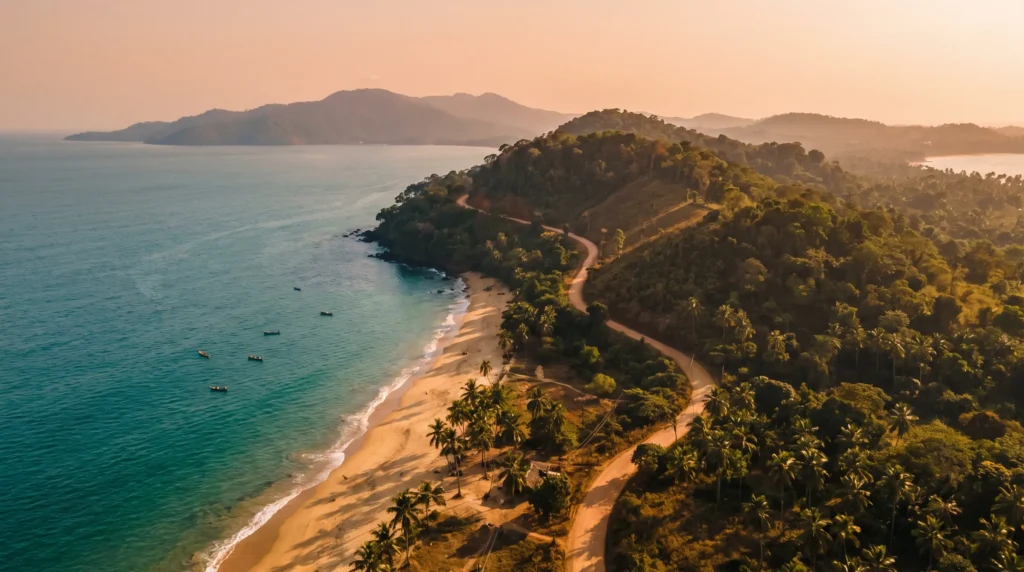
Less than an hour from the city center, the peninsula holds Sierra Leone’s best-known sand: Tokeh Beach, with white sand and turquoise water backing two of the country’s premier resorts; Bureh Beach, a 4-kilometre crescent that’s become the country’s surf capital, home to the community-run Bureh Beach Surf Club; and River No. 2 Beach, a quieter stretch where a freshwater river meets the Atlantic. Further options include Lakka, Kent and Black Johnson beaches, each with a slightly different character from calm lagoon water to dramatic dark sand.
Banana Islands
A small cluster of islands a short boat ride from the peninsula’s southern tip, mixing sandy beaches, thick vegetation and genuine history — an old church, a former slave-trading dock and Portuguese-shipwreck cannons among the ruins. A classic overnight or day-trip add-on to a Freetown Peninsula stay.
Tiwai Island & the Gola Rainforest
In the country’s south, Tiwai Island Wildlife Sanctuary and the adjoining Gola Rainforest National Park together form the Gola-Tiwai Complex, Sierra Leone’s first UNESCO World Heritage Site, inscribed in 2025 for outstanding biodiversity. Tiwai alone holds the country’s highest concentration of primates, including western chimpanzees and Diana monkeys, plus more than a hundred bird species — reached by dugout canoe, with basic tented camps for overnight stays.
Outamba-Kilimi National Park
A protected mix of woodland, savanna and riverine forest in the far northwest, explored on foot or by canoe safari with local rangers — elephants, chimpanzees and hippos are possible sightings, and crowds are essentially nonexistent.
Bo & the Southern Province
The country’s second city and a practical base for reaching Tiwai Island, with a calmer pace than Freetown and access to Mende cultural heartland.
Makeni & the North
A regional hub in Temne country, useful as a stepping-stone toward Outamba-Kilimi and the Guinea border, with far fewer visitors than the coast.
Culture & People — Krio, Temne, Mende & Beyond
Sierra Leone counts around 16 to 18 distinct ethnic groups, with the Temne (concentrated in the north) and Mende (concentrated in the south) as the two largest, alongside smaller groups including Limba, Kono and the historically influential Krio, descendants of freed African-American, Caribbean and “Liberated African” settlers who arrived between 1787 and 1885. Roughly 78% of the population is Muslim and about 21% Christian, and the country is notable in the region for genuinely easy religious coexistence — interfaith families and shared festival attendance are common rather than exceptional.
Krio, the English-based creole that grew out of Freetown’s settler communities, functions as the practical lingua franca for the vast majority of the population even though it’s nobody’s sole official language. Traditional “secret societies” like the Poro (men’s) and Bondo/Sande (women’s) still play a real role in rural community life and coming-of-age customs; as a visitor these are not spaces to intrude on, but their influence shows up respectfully in craft, masks and ceremony you may encounter at museums or festivals.
A Food Lover’s Guide to Sierra Leone
Cassava leaves — pounded, shredded and simmered into a rich green stew with red palm oil, onions, pepper, and fish or meat — are widely considered the country’s national dish, typically served over rice. Rice itself is the true staple across every region and every meal; many Sierra Leoneans consider a meal without it simply incomplete.
Sierra Leone’s take on jollof rice — the smoky, tomato-based rice dish contested across West Africa — leans on a distinctively smoky, moist style, usually served alongside a stew. Other staples worth seeking out include groundnut (peanut) stew, plasas made with potato or cassava leaves, fried plantain, and fufu made from pounded cassava. To drink, try poyo, a lightly fermented palm wine sold fresh in rural markets and along the coast — mild when freshly tapped, considerably stronger the longer it sits — alongside homemade ginger beer.
Off the Beaten Path
River No. 2 & the quieter peninsula beaches
Skip Tokeh’s resort crowd entirely and head to River No. 2, Black Johnson or John Obey — beaches where a beach hut, a grilled fish lunch and an empty horizon are still the norm rather than the exception.
Turtle Islands
A remote archipelago south of the peninsula, reached by boat, offering the kind of untouched, palm-lined isolation that’s genuinely hard to find on this coast anymore.
Bunce Island
An uninhabited island upriver from Freetown, once a major 17th–19th-century slave-trading station and a documented point of origin for many Gullah Geechee families in the American South — a sobering, important historical site currently on Sierra Leone’s UNESCO tentative list rather than fully developed for tourism.
Makeni’s Krio & Temne heartland
Northern towns around Makeni see a fraction of the visitors the coast does, and reward travelers willing to hire a driver and simply explore market towns, craft workshops and rural landscapes on their own schedule.
Practical Information
Money. Sierra Leone redenominated its currency in July 2022, replacing the old leone (SLL) with the new leone (SLE) at 1,000 to 1 — old notes stopped being legal tender in 2024, so confirm which “leone” a quoted price refers to if you’re ever unsure. Cards are accepted at some Freetown hotels and larger businesses but cash is essential everywhere else; bring US dollars in good condition to exchange, and note the roughly $10,000 limit on cash you can bring into the country.
Safety. The US State Department rates Sierra Leone at Level 2 (“Exercise Increased Caution”), citing crime — particularly robbery and assault in Freetown — and the potential for protests with little warning; it also advises against travel outside the Freetown peninsula after dark. The UK FCDO maintains its own detailed advisory and is worth checking directly before you travel, since specific risk areas are updated regularly.
Health. Yellow fever vaccination is legally required for entry and you’ll need to carry your certificate; malaria risk is present countrywide, so discuss antimalarial medication with a travel clinic before you go, and hepatitis A/B and typhoid vaccination are commonly recommended. Avoid swimming or wading in untreated freshwater due to schistosomiasis risk, and drink only bottled or properly treated water.
Connectivity & visas. Apply for your eVisa online in advance rather than counting on visa-on-arrival, which airlines can refuse to honor at boarding. A local SIM or eSIM covers Freetown and the peninsula reasonably well; connectivity thins out fast in the provinces. Plugs are UK-style (Type G), and the country runs on GMT, no daylight saving.
Budget Breakdown — What Sierra Leone Actually Costs in 2026
Sierra Leone isn’t a cheap backpacker destination the way some of its neighbors can be — limited tourism infrastructure keeps hotel and transport costs higher than the low cost of local food and labor might suggest.
Budget (US$40–80/day): guesthouse or simple beach hut, local food from markets and street stalls, shared poda-poda or okada transport, self-arranged beach days.
Mid-range (US$100–200/day): a comfortable Freetown Peninsula hotel or beach resort room, a hired driver for day trips, restaurant meals, a guided visit to Tiwai Island or the Banana Islands.
Luxury (US$300+/day): upscale peninsula beach resorts, private guided wildlife expeditions into Gola-Tiwai or Outamba-Kilimi, and chartered transport that sidesteps the harder logistics entirely.
Fixed costs to plan for: the eVisa fee (roughly $35 for African nationals, $100 for others), an airport security fee payable around your Lungi transit, and your ferry or water-taxi crossing each way. Tipping isn’t deeply entrenched but is appreciated for guides and drivers.
Planning Your First Trip to Sierra Leone
A sensible first-timer route: fly into FNA, cross the estuary to Freetown, and spend two or three nights on the peninsula beaches (Tokeh or Bureh) before heading south with a hired driver to Bo and on to Tiwai Island for two nights of rainforest and primates. Seven to ten days covers that comfortably without rushing the road time. Go in the December–April dry window if you can, and lean toward March–April to dodge the worst of the harmattan haze. If you’re building a wider West Africa loop, our Senegal guide and Ghana guide cover the region’s other standout coastlines and cultural hubs, both reachable on the same regional carriers that serve Freetown.
Frequently Asked Questions
Is Sierra Leone safe for tourists in 2026?
The US State Department rates it Level 2, “Exercise Increased Caution,” flagging crime (especially in parts of Freetown) and the potential for protests, and specifically advises against travel outside the Freetown peninsula after nightfall. Most visitors who stick to the peninsula beaches, use arranged transport and avoid walking around Freetown at night have straightforward trips — but check your own government’s current advisory before booking.
Do I need a visa?
Yes, unless you hold an ECOWAS-member passport. Apply for the eVisa online before travel; visa-on-arrival exists but airlines can deny boarding without a pre-approved visa, so don’t rely on it.
Do I need a yellow fever vaccine?
Yes — it’s a legal entry requirement, not just a recommendation, and you’ll need to show your certificate. Malaria prophylaxis is also strongly advised, since risk exists across the entire country.
What currency should I bring?
US dollars in good condition, to exchange for Sierra Leonean leones (SLE) on arrival — the currency was redenominated in 2022, so make sure any quoted price is in the current SLE, not old SLL. Cards work in a handful of Freetown hotels; cash is king everywhere else.
Sierra Leone or Ghana for a first West Africa trip?
Choose Ghana for smoother tourism infrastructure, more direct flights and an easier logistical on-ramp; choose Sierra Leone if you want emptier beaches, a rawer experience and don’t mind arranging more yourself. Many travelers now pair the two on one regional trip.
How do I get from the airport to Freetown?
Cross the estuary by government ferry (~45 minutes) or private water taxi (~30–40 minutes); arrange this through your hotel in advance rather than figuring it out on arrival.
Ready to Explore Sierra Leone?
Empty white-sand beaches an hour from a working capital, chimpanzees and pygmy hippos in a rainforest that just earned UNESCO recognition, and a culture that’s genuinely, unfussily glad to see you. Sierra Leone asks more of you as a traveler than its better-marketed neighbors — but that’s exactly why so few people have been, and why the ones who go tend to come back talking about it for years.
Explore More
- Senegal Travel Guide — Dakar’s coast and the region’s other cultural capital
- Ghana Travel Guide — West Africa’s easiest on-ramp for first-timers
- Accra City Guide — pair a Freetown beach run with Ghana’s capital
- Morocco Travel Guide — for a different, more built-up side of the continent
How this guide was built
Published as part of Facts From Upstairs’ country guide series. Built from authoritative sources — Wikipedia entity pages for Sierra Leone, its World Heritage Sites, the leone currency, Lungi/Freetown International Airport, Sierra Leonean cuisine, and Sierra Leone Creole (Krio) history; the US State Department’s Sierra Leone travel advisory; the UK FCDO’s Sierra Leone advisory; the US CDC traveler health page for Sierra Leone; the official Sierra Leone eVisa guidance via VSL Travel’s visitsierraleone.org; the Sierra Leone Tourism Board’s beaches and islands page; and the Sierra Leone Heritage project’s entry on Freetown’s Lantern Parade. Numeric and checkable claims carry inline citations.
Sources cited on this page
- Wikipedia — Sierra Leone
- Wikipedia — List of World Heritage Sites in Sierra Leone
- Wikipedia — Sierra Leonean leone
- Wikipedia — Lungi (Freetown) International Airport
- Wikipedia — Sierra Leonean cuisine
- Wikipedia — Sierra Leone Creole people
- US State Department — Sierra Leone travel advisory
- UK FCDO — Sierra Leone travel advice
- US CDC — Sierra Leone traveler health page
- VSL Travel — Sierra Leone eVisa guidance
- Sierra Leone Tourism Board — Beaches & Islands
- Sierra Leone Heritage — Lantern Parade
More country guides you might like
Plan your trip to Sierra Leone
The booking tools we use ourselves. FFU may earn a commission at no extra cost to you.
Plan & book your trip to Sierra Leone
Booking through these searches supports our guides at no extra cost to you.