
Languages of Mali
All languages of Western Africa →fluent beta classical · classes by phone with Maya at ranas.ai/maya
Mali Travel Guide — Timbuktu, the Great Mosque of Djenné, Dogon Country, and a Nation Currently Off the Map
I need to say this before anything else: Mali is not a country I can responsibly recommend booking a trip to right now, and burying that fact three paragraphs down to get to the fun stuff would be exactly the kind of travel-blog dishonesty I try never to do. Mali holds some of the most extraordinary cultural heritage on the entire continent — the mud-brick minarets of Djenné’s Great Mosque, the storied university city of Timbuktu on the edge of the Sahara, the cliffside Dogon villages of the Bandiagara Escarpment, and a musical tradition that gave the world Ali Farka Touré and Tinariwen. It also currently sits under a US State Department Level 4 “Do Not Travel” advisory and a UK Foreign Office recommendation against all travel to the entire country, because of active armed conflict, a very high kidnapping threat, terrorist blockades on major highways, and a military government that has run the country since back-to-back coups in 2020 and 2021. So consider this a cultural and historical briefing on a country worth understanding deeply — and worth visiting again one day — rather than an itinerary to book this year.
In This Guide
- Overview — A Landlocked Sahel Nation Under a Do-Not-Travel Advisory
- Festival in the Desert — A Legendary Event Now in Exile
- Best Time to Visit Mali (Season by Season)
- Getting There — Bamako’s Airport & the Current Reality
- Getting Around
- Top Regions — Bamako, Timbuktu, Djenné & Dogon Country
- Culture & People — Empire, Music & the Niger River
- A Food Lover’s Guide to Mali
- Off the Beaten Path
- Practical Information
- Budget Breakdown — What Mali Costs, For Context
- Frequently Asked Questions
Overview — A Landlocked Sahel Nation Under a Do-Not-Travel Advisory
Mali is a landlocked West African nation of roughly 25.2 million people, the second-largest country in West Africa by area at just over 1.24 million square kilometers, bordered by seven countries — Algeria, Niger, Burkina Faso, Ivory Coast, Guinea, Senegal and Mauritania. Its northern reaches disappear into the Sahara Desert; its south sits in the Sudanian savanna belt, watered by the Niger and Senegal rivers, which have anchored trade, farming and settlement here for over a thousand years. Mali became independent from France on 20 June 1960, inheriting a history that includes the medieval Mali Empire — whose 14th-century ruler Mansa Musa is remembered as one of the wealthiest individuals in history, and whose gold and salt trade routes made Timbuktu synonymous with unimaginable riches long before most of the wider world had mapped the region.
None of that historical weight changes the present situation. Mali has been governed by a military junta since back-to-back coups in August 2020 and May 2021, both led by Assimi Goïta, who was declared interim president in 2021 and formalized his position as Mali’s sixth president in July 2025 — while also taking on the role of defense minister in 2026 after his previous defense minister was killed in an attack. In January 2024, Goïta pulled Mali out of ECOWAS, the West African regional bloc, and co-founded the Alliance of Sahel States with the juntas of Burkina Faso and Niger — three neighboring countries now navigating remarkably similar security and political pressure together. Layered on top of that political backdrop is an active jihadist insurgency, with the group JNIM blockading highways and fuel convoys even around the capital, which is why both the US and UK governments currently rate the entire country as unsafe to visit.
So why write the guide at all? Because Mali’s cultural weight — Djenné’s mud-brick Great Mosque, Timbuktu’s manuscript libraries, the Dogon cliff villages of Bandiagara, and a musical lineage that shaped global blues and desert rock — deserves documenting honestly, not erasing, and because regional situations do shift over time. Treat everything below as a briefing on a country worth understanding, not a green light to plan a trip.
Festival in the Desert — A Legendary Event Now in Exile
For over a decade, the single best reason music lovers flew toward Timbuktu was the Festival au Désert (“Festival in the Desert”), founded in 2001 in Tin Essako and later held on the dunes just outside Timbuktu, blending traditional Tuareg music with international acts. Ali Farka Touré closed the festival annually from 2003 to 2006, and the final 2012 edition — before everything changed — featured Bono, Tinariwen and Bassekou Kouyaté sharing a stage under desert stars, drawing thousands of visitors and real income to local communities.
Weeks after that 2012 festival, a Tuareg uprising in the north was overtaken by hardline Islamist militants who banned music and artistic performance outright, and the festival has not returned to Malian soil since. Founder Manny Ansar didn’t let the idea die — he launched the “Caravane culturelle pour la paix,” a traveling version of the festival that has performed in refugee camps and partner festivals across the region, keeping Malian desert music alive in exile even while the original site remains out of reach. It’s as good a one-story summary of Mali’s last fifteen years as anything else in this guide: extraordinary culture, interrupted by conflict, persisting anyway just not at home.
Best Time to Visit Mali (Season by Season)
November – February · Cool dry season
Climatically the most comfortable stretch of the year in the Sahel — lower humidity, cooler nights, and the dusty harmattan wind blowing down from the Sahara. This window also overlaps with the Sahel’s annual meningitis-belt risk period, a factor the CDC flags for anyone planning ahead.
March – May · Hot dry season
The hardest months climatically, with daytime temperatures regularly climbing well into the 40s°C ahead of the rains — a punishing stretch even before factoring in the current security picture.
June – October · Rainy season
The Niger River rises and the Sahel greens up dramatically, but many secondary roads become difficult to pass, and this period carries the country’s malaria risk at its highest, alongside standing schistosomiasis risk in freshwater. Malaria transmission itself is present countrywide year-round, not just in the rains.
Getting There — Bamako’s Airport & the Current Reality
Modibo Keita International Airport (BKO), around 15 kilometres south of Bamako, is Mali’s main international gateway, opened in 1974 and substantially upgraded between 2007 and 2012 through a US$181 million Millennium Challenge Corporation project. In ordinary times, carriers including Air France (to Paris), Ethiopian Airlines (via Addis Ababa), Royal Air Maroc (via Casablanca), Air Sénégal and regional operator ASKY Airlines connect Bamako to the wider world.
What’s changed is who can realistically use those routes and what happens after landing. As of 1 January 2026, Mali suspended visa issuance to US citizens with limited exceptions, and both the US and UK advisories describe overland routes out of the country as actively dangerous — the FCDO specifically warns against attempting to leave Mali by land, citing terrorist attacks along national highways and JNIM blockades targeting fuel trucks. If you are reading this for planning purposes rather than curiosity, the realistic starting point is the Malian embassy or consulate covering your country, plus your own government’s current advisory page — not a general travel guide.
Getting Around
Under normal circumstances, Mali is connected by a mix of paved national highways radiating from Bamako and rougher regional roads, traveled by bush taxis, private minibuses (“Sotrama” in the capital) and river transport along the Niger — the traditional way to reach Mopti, Djenné and onward toward Timbuktu, historically by pinasse (a long wooden riverboat).
Right now, both the US and UK advisories specifically flag road travel, highway checkpoints and river routes in central and northern Mali as high-risk, with active combat between government forces and armed groups occurring regularly and roadblocks by armed groups common even close to Bamako. Any description of “how to get around” here has to be read as background on how the country functions, not a route plan to execute today.
Top Regions — Bamako, Timbuktu, Djenné & Dogon Country
Bamako
The capital and largest city, straddling the Niger River in the country’s southwest, home to the National Museum of Mali, a lively live-music scene that once made it a genuine stop on the world-music touring circuit, and most of the country’s diplomatic and NGO infrastructure. Both governments’ advisories note that violent crime, including kidnapping and armed robbery, is common here too — this is not a “safe capital, dangerous countryside” situation.
Djenné
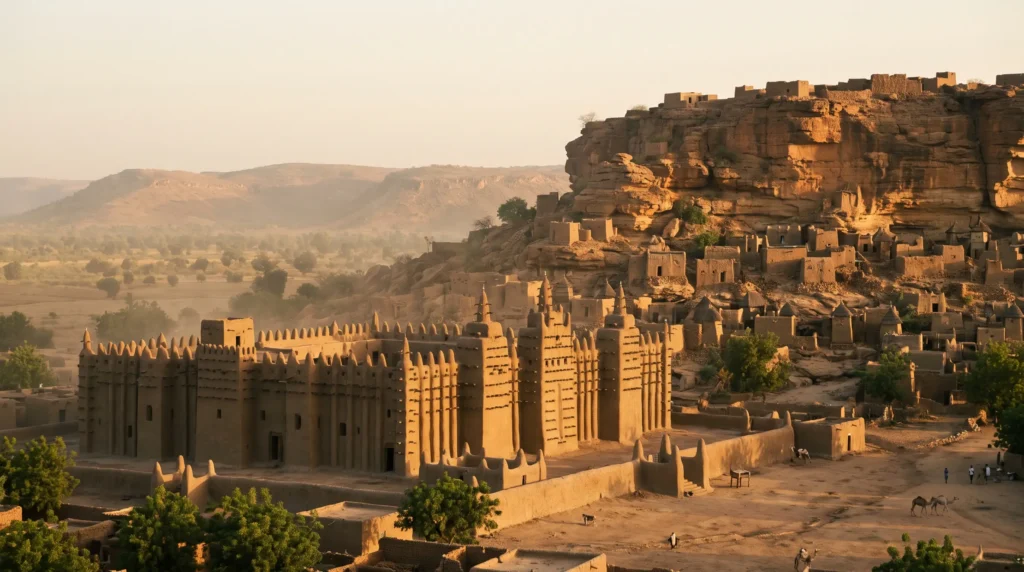
Home to the Old Towns of Djenné, UNESCO-inscribed in 1988 and centered on the Great Mosque of Djenné, rebuilt in its current form in 1907 and the largest mud-brick building on Earth — nearly 2,000 traditional banco (sun-dried mud brick) houses survive in the surrounding old town. Djenné is currently one of three of Mali’s four World Heritage sites listed on UNESCO’s List of World Heritage in Danger.
Timbuktu
The legendary trans-Saharan trading city, a UNESCO World Heritage site since 1988, once home to prestigious Islamic universities and hundreds of thousands of centuries-old manuscripts, plus three great mud-mosques. Timbuktu is also on the World Heritage in Danger list, a status driven by the 2012 occupation of northern Mali and the deliberate destruction of historic mausoleums during that period — a scar the city and UNESCO have been working to repair ever since.
Bandiagara Escarpment (Dogon Country)
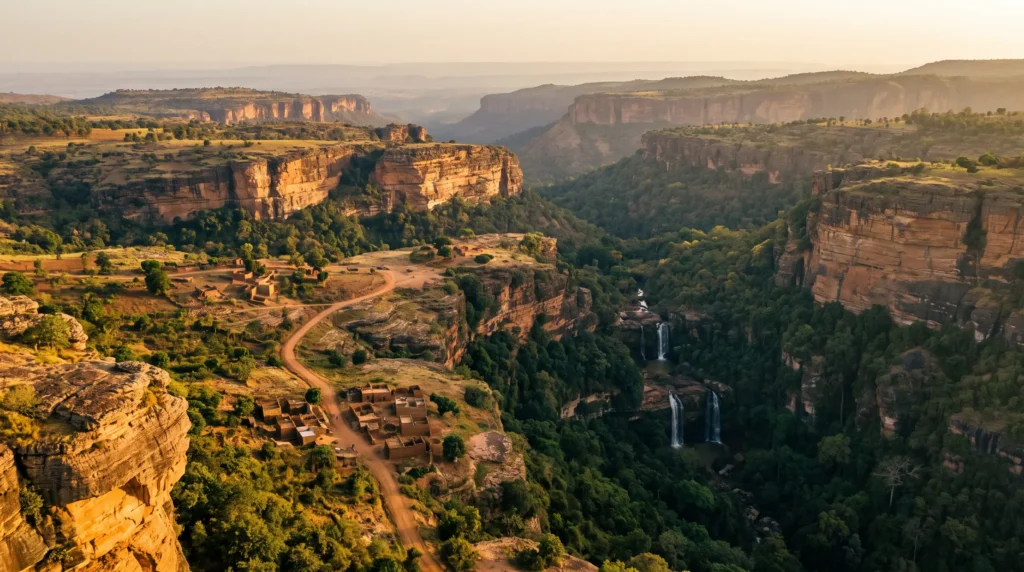
A roughly 150-kilometre sandstone cliff in central Mali, UNESCO-inscribed in 1989 as a mixed cultural-natural site, where the Dogon people have built cliffside and plateau villages, agricultural terraces and granaries tied to a rich cosmology for centuries. Dogon trekking was, for years, one of West Africa’s signature cultural experiences; it sits in the Mopti region, among the areas both governments currently flag as highest-risk.
Gao
The historic capital of the Songhai Empire in Mali’s northeast, home to the Tomb of Askia — a 17-metre pyramidal mud structure built in 1495, UNESCO-inscribed in 2004 and, like Djenné and Timbuktu, currently on the List of World Heritage in Danger.
Mopti
Known historically as “Venice of Mali” for its network of canals and river channels where the Niger and Bani rivers meet, and the traditional launch point for pinasse river trips toward Djenné and Timbuktu — river-based travel that is currently caught up in the same advisory picture as the rest of central Mali.
Culture & People — Empire, Music & the Niger River
Mali is home to remarkable ethnic diversity for a country of its size: the Bambara are the largest group at roughly 36% of the population, followed by the Fula, Senufo, Malinke, Soninke, Dogon, Songhai and Tuareg peoples, each with distinct languages, dress and traditions — thirteen national languages are recognized alongside French as the working language. Islam is the majority faith at roughly 96% of the population, coexisting historically with strong local traditions, particularly Dogon cosmology in the Bandiagara region.
Music carries outsized weight in Malian identity. The country produced Ali Farka Touré, whose fingerpicked guitar style drew direct lines between the Sahel and the Mississippi Delta blues, and Tinariwen, the Tuareg desert-rock collective whose sound grew directly out of the same Sahara that borders Mali’s north. That musical lineage traces back to a deeper griot (jeli) tradition — hereditary oral historians, praise-singers and musicians who have preserved Mali’s history, including the Mali Empire’s, across generations. The empire itself, at its 14th-century peak under Mansa Musa, was reportedly among the wealthiest states in the world, built on trans-Saharan gold and salt trade routes that ran directly through Timbuktu and Djenné.
A Food Lover’s Guide to Mali
The everyday staple is tô, a thick millet or sorghum paste eaten with a sauce — peanut sauce (tigadèguèna), okra sauce or leaf-based sauces are all common — much the way fufu anchors meals elsewhere in West Africa. Riz au gras (“fat rice”), cooked in tomato and meat or fish stock, is the celebratory dish for guests and holidays, and grilled capitaine (Nile perch) pulled straight from the Niger River is a signature of river towns like Mopti and Ségou.
Street food runs on grilled brochettes (meat skewers) and fried snacks, while fresh mango, shea products and bissap (hibiscus juice) round out the everyday food culture. Tea — three ceremonial rounds of strong, sweet green tea, a Saharan and Sahelian tradition shared with Mali’s northern neighbors — is as much a social ritual here as a beverage.
Off the Beaten Path
Essakane & the Festival au Désert site
The dunes outside Timbuktu where the Festival au Désert once drew Bono, Tinariwen and thousands of fans before the 2012 conflict ended the event’s run on Malian soil. A genuinely remarkable place in Malian cultural memory, currently inaccessible to foreign visitors under prevailing advisories.
Ségou
A calmer river city on the Niger, historic capital of the Bambara Empire, known for pottery workshops and an annual arts festival in ordinary years — historically considered one of the gentler introductions to Malian river culture.
Niger Inland Delta
A vast, seasonally flooded wetland around Mopti and Djenné that supports Fula herders, Bozo fishing communities and enormous flocks of migratory birds — an ecological centerpiece of the Sahel that functions independently of, but is currently affected by, the security situation around it.
Practical Information
Safety — read this first. The US State Department rates Mali Level 4, “Do Not Travel,” citing crime, terrorism, kidnapping, armed conflict and civil unrest, and bars its own government employees from traveling outside Bamako without special authorization. The UK FCDO advises against all travel to the entire country, citing JNIM blockades on routes in and around Bamako, a high threat of kidnapping and crime nationwide, and severely limited government support outside the capital. None of this is a guess — it’s the standing position of two governments’ foreign services, and it should be the starting point for any real decision.
Visa & entry. Mali suspended visa issuance to US citizens as of 1 January 2026; other nationalities should verify current rules directly with a Malian embassy rather than assume anything based on past practice. Proof of yellow fever vaccination is required for entry for all travelers.
Money. The West African CFA franc (XOF) is fixed at exactly 655.957 to the euro and shared across eight UEMOA states, including Mali, Senegal, Burkina Faso and Côte d’Ivoire. Mali runs largely as a cash economy outside a handful of Bamako hotels; card acceptance is limited.
Health. Yellow fever vaccination is required for entry and recommended for all travelers 9 months and older; malaria transmission occurs countrywide year-round and prescription antimalarial medication is recommended for all travelers, alongside hepatitis A/B, typhoid and dry-season meningococcal vaccination for the meningitis belt. Avoid swimming in untreated freshwater due to schistosomiasis risk.
Connectivity. Mobile data coverage concentrates around Bamako and secondary cities and thins out fast elsewhere. Time zone: GMT, no daylight saving. Plugs: mostly European two-pin (Type C/E), 220V.
Budget Breakdown — What Mali Costs, For Context
These figures describe typical Sahelian West Africa cost structures for reference only — they are not a recommendation to plan a trip under current advisories.
Budget: guesthouse rooms, street food (tô, brochettes, river fish), shared bush-taxi or river transport between towns — historically among the least expensive travel in West Africa.
Mid-range: private hotel rooms in Bamako or Ségou, restaurant meals, a hired driver or guide for day trips — the structure most independent travelers used before the security situation deteriorated.
Higher-end: Mali has very little dedicated luxury tourism infrastructure even in ordinary times; most higher spending historically went toward private drivers, river pinasse charters and specialist Dogon-trekking guides rather than resort-style stays.
Regardless of tier, the realistic “cost” to plan around right now is logistical and security support — vetted drivers, verified accommodation, embassy registration — rather than sightseeing spend.
Planning Your First Trip to Mali
Honestly: don’t plan a first trip right now. If you have a professional reason to travel — NGO work, journalism, a diplomatic posting — that’s a risk conversation to have directly with your embassy and a specialist security briefing, not with a travel blog. For everyone else, the realistic “plan” is to follow official advisories over time and revisit this guide if conditions change. In the meantime, our Senegal travel guide covers another Niger-basin, CFA-franc West African nation with a very different security profile, our Morocco travel guide covers the Sahara’s northern edge and the same trans-Saharan trade history from the other direction, our Ghana travel guide looks at West African gold-trade heritage under much calmer conditions, and our Chad travel guide covers another Sahel nation navigating similar regional pressures.
Frequently Asked Questions
Is it safe to travel to Mali right now?
No, according to both the US State Department (Level 4, Do Not Travel) and the UK FCDO (advises against all travel to the whole country), citing crime, terrorism, kidnapping and active armed conflict. Take that as the baseline answer, not a footnote.
Can US citizens even get a visa?
As of 1 January 2026, Mali suspended visa issuance to US citizens, with limited exceptions handled directly by the Embassy of Mali. This kind of rule can change quickly, so anyone with an actual need to travel should confirm directly with a Malian embassy rather than trust any guide, including this one.
What UNESCO World Heritage sites does Mali have?
Four: the Old Towns of Djenné (1988), Timbuktu (1988), the Cliff of Bandiagara / Land of the Dogons (1989), and the Tomb of Askia in Gao (2004). Three of the four — Djenné, Timbuktu and the Tomb of Askia — are currently listed on UNESCO’s List of World Heritage in Danger because of the country’s instability.
Is Mali politically stable right now?
No — the country has been under military junta rule since coups in 2020 and 2021, both led by Assimi Goïta, who formalized his position as president in July 2025 and withdrew Mali from ECOWAS in January 2024 to co-found the Alliance of Sahel States with Burkina Faso and Niger. Further political and security change is considered plausible by both advisory bodies cited above.
What currency does Mali use, and can I use US dollars or euros?
The West African CFA franc (XOF), fixed at 655.957 to the euro and shared across eight regional states. Foreign cash generally needs to be exchanged rather than spent directly, and the country runs largely on cash outside major Bamako hotels.
What’s actually worth knowing about, if not visiting?
The Great Mosque of Djenné, the largest mud-brick building on Earth; Timbuktu’s centuries-old manuscript libraries and university history; the Dogon cliff villages of Bandiagara; and a musical lineage — Ali Farka Touré, Tinariwen, the griot tradition — that has shaped global music far beyond Mali’s borders. All genuinely remarkable, and all worth reading about even while the country isn’t a realistic booking.
Worth Knowing, Not (Yet) Worth Booking
Mali holds one of West Africa’s richest cultural inheritances — a mud-brick mosque unlike anything else on Earth, a desert city that once anchored global trade in gold and knowledge, and a musical tradition that reshaped genres far beyond its borders. Right now, though, the responsible move is to read, appreciate and wait: check current US State Department and UK FCDO advisories before any West African Sahel trip, and treat this guide as background, not a booking prompt.
Explore More
- Senegal Travel Guide — another Niger-basin, CFA-franc West African nation, calmer conditions
- Morocco Travel Guide — the Sahara’s northern edge and the other end of the trans-Saharan trade route
- Ghana Travel Guide — West African gold-trade heritage under much calmer conditions
- Chad Travel Guide — another Sahel nation navigating similar regional pressures
How this guide was built
Published as part of Facts From Upstairs’ country guide series. Built from authoritative sources — the US State Department’s Mali travel advisory and international travel information pages, the UK Foreign, Commonwealth & Development Office’s Mali travel advice, the US CDC’s Mali traveler health page, and Wikipedia entity pages for Mali, its UNESCO World Heritage sites, the CFA franc, Modibo Keita International Airport, Assimi Goïta, and the Festival au Désert. Given the severity and fast-changing nature of the security and entry-policy situation, this guide leans on official government advisory pages rather than tourism-board sources, and numeric or checkable claims carry inline citations throughout.
Sources cited on this page
- US State Department — Mali travel advisory
- US State Department — Mali international travel information
- UK FCDO — Mali travel advice
- US CDC — Mali traveler health page
- Wikipedia — Mali
- Wikipedia — List of World Heritage Sites in Mali
- Wikipedia — CFA franc
- Wikipedia — Modibo Keita (Bamako–Sénou) International Airport
- Wikipedia — Assimi Goïta
- Wikipedia — Festival au Désert
More country guides you might like
Plan your trip to Mali
The booking tools we use ourselves. FFU may earn a commission at no extra cost to you.
Plan & book your trip to Mali
Booking through these searches supports our guides at no extra cost to you.