
Languages of Guinea
All languages of Western Africa →fluent beta classical · classes by phone with Maya at ranas.ai/maya
Guinea Travel Guide — Fouta Djallon Highlands, the Niger River’s Source & West Africa’s Least-Visited Coast
I’ll be upfront: Guinea is not an easy country to visit, and anyone who tells you otherwise is selling something. But it is also one of the last places in West Africa where you can hike for three days through canyon country and not see another traveler, where the source of the Niger River bubbles out of the ground in a highland village most maps barely acknowledge, and where the mountains everyone calls “the Switzerland of West Africa” earned the nickname honestly. Guinea shares its coast, its Fulani and Mandinka heartlands, and a chunk of its colonial French with Senegal next door, but it kept almost none of the tourism infrastructure — no beach resort strip, no well-worn backpacker trail, just canyons, waterfalls, chimpanzees, and a capital that works hard for its living. This guide is for the traveler who wants the real, unpolished version of West Africa and is willing to plan carefully to get it.
In This Guide
- Overview — Why Guinea Is West Africa’s Unpolished Highland Core
- Rainy-Season Waterfalls — Guinea’s Best Trade-Off
- Best Time to Visit Guinea (Season by Season)
- Getting There — Conakry’s One International Airport
- Getting Around — Bush Taxis, 4x4s & Patience
- Top Regions — Coast, Highlands, Savanna & Forest
- Culture & People — Fulani, Malinke, Susu & the Forest Peoples
- A Food Lover’s Guide to Guinea
- Off the Beaten Path
- Practical Information
- Budget Breakdown — What Guinea Actually Costs in 2026
- Frequently Asked Questions
Overview — Why Guinea Is West Africa’s Unpolished Highland Core
Guinea sits at the geographic heart of West Africa’s water supply. The Niger, Senegal, and Gambia rivers — three of the region’s defining waterways — all rise in Guinea’s highlands before fanning out across the continent, which is why French colonial geographers nicknamed it the “water tower of West Africa.” The country covers about 246,000 square kilometers and borders six other nations — Guinea-Bissau, Senegal, Mali, Ivory Coast, Sierra Leone, and Liberia — making it a hinge point of the region rather than an edge case.
Independence came on 2 October 1958, when Guinea became the only French West African colony to vote “no” in the referendum on staying within a French-led community — a decision that cost it French support overnight but made it the first of the region’s colonies to go fully independent. The decades since have been rocky, with three military coups (1984, 2008, and most recently 2021), and that political turbulence is a real reason Guinea never developed the tourism scaffolding you’ll find in Senegal or Ghana.
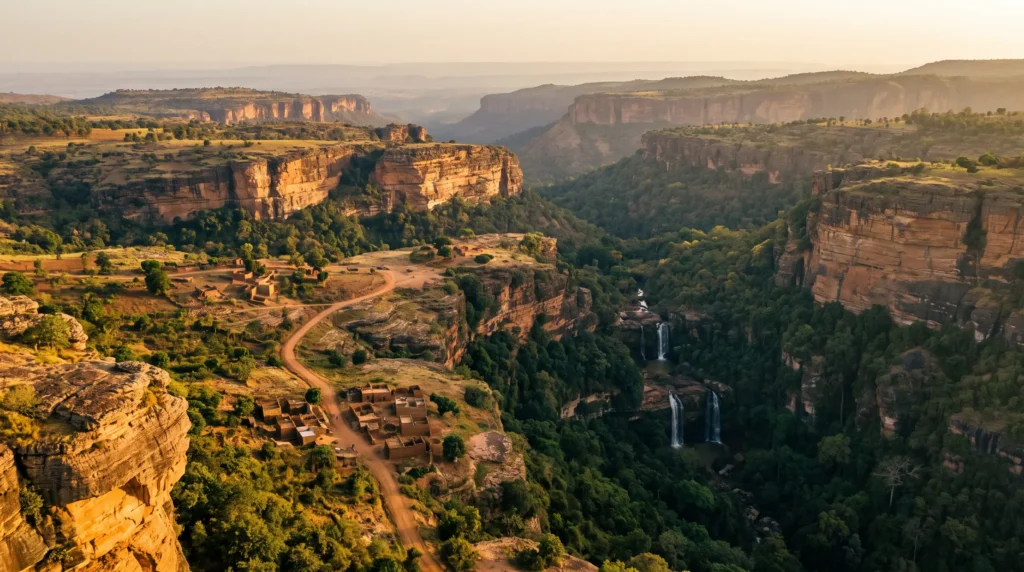
What you get instead is geography that hasn’t been smoothed over for visitors. Four distinct regions — the coastal lowlands around Conakry, the cool Fouta Djallon highlands, the savanna of Upper Guinea, and the rainforest of Guinée Forestière in the southeast — pack in cascading waterfalls, deep sandstone canyons, chimpanzee-inhabited forest, and a UNESCO-listed mountain reserve shared with Ivory Coast. None of it is set up for easy consumption. All of it rewards the traveler who shows up prepared.
Rainy-Season Waterfalls — Guinea’s Best Trade-Off
Here’s the catch worth knowing before you book: Guinea’s single most photogenic season is also its hardest one to travel in. The Fouta Djallon highlands earn their “water tower” reputation properly between June and October, when the Ditinn and Kambadaga waterfalls near Dalaba and Pita run at full volume and the Doucki canyon country turns lush and dramatic. The same rain that fills those falls also turns laterite roads to mud and can strand a 4×4 for hours outside Labé.
The honest compromise is late October to November: the rains are tapering off, the waterfalls are still running strong from the season’s accumulated water, and the roads have mostly dried out enough to travel. If you can only come in the bone-dry months of December through April, the falls thin out considerably — you’ll trade waterfall drama for reliable roads and clearer trekking weather. Neither season is wrong, but know which trade-off you’re making.
Best Time to Visit Guinea (Season by Season)
Late November – February · Harmattan dry season
The most comfortable window for trekking and road travel, though the Saharan Harmattan wind can fill the sky with a persistent dusty haze that dulls highland views and occasionally delays flights. Nights in the Fouta Djallon highlands get genuinely cool — pack a fleece.
March – May · Hot dry season
Temperatures climb, especially in Upper Guinea’s savanna interior, before the rains arrive. Roads are still in good shape; this is the shoulder window locals use for long-distance travel before the wet season closes in.
June – October · Rainy season
Heavy, near-daily rain across the country, at its most intense in the southeastern forest region. Waterfalls and rivers are at their most spectacular, but unpaved roads — which is most of them outside Conakry — become difficult or impassable, and this is also the period when Guinea’s meningitis risk in the northern savanna belt is lowest but malaria risk is highest. Budget extra days for delays if you travel now.
Getting There — Conakry’s One International Airport
Ahmed Sékou Touré International Airport (CKY), also known as Gbessia, is Guinea’s only real international gateway, sitting a few kilometers from downtown Conakry. There is no nonstop service from North America; the practical routings connect through European or regional African hubs — commonly Casablanca on Royal Air Maroc, Paris or Brussels, Dakar, Abidjan, or Istanbul. Expect immigration and baggage claim to take a while — budget close to an hour after landing.
Nearly every nationality needs a visa arranged before arrival. Guinea runs an official eVisa portal through its border police (paf.gov.gn) for around $80, typically issued for a 30-day single entry within about 72 hours of application — apply only through the official government site, since third-party sites charge steep markups for the same service. A valid International Certificate of Vaccination for yellow fever is required on arrival, and your passport needs at least six months’ validity plus a blank page. Overland entry is possible from Senegal, Mali, Ivory Coast, Sierra Leone, and Guinea-Bissau, but border posts are remote and road conditions vary enormously by season.
Getting Around — Bush Taxis, 4x4s & Patience
Domestic flights within Guinea are limited and unreliable, so overland travel is the default. Shared bush taxis (usually aging Peugeot 504s or minivans crammed well past capacity) link Conakry to Labé, Kankan, and N’Zérékoré, departing when full rather than on a fixed schedule — a six-hour drive can easily stretch to ten. For the highlands and canyon country, hiring a private 4×4 with a driver, arranged through a local guide or lodge, is the realistic option for anyone short on time or patience.
Within Conakry itself, shared taxis (usually yellow, marked by route) and moto-taxis cover the Kaloum peninsula and sprawl beyond it, though traffic on the single main corridor out of the city center is notoriously slow. Roads are paved and generally decent between major towns in the dry season; expect gravel, laterite, and washouts everywhere else, especially once the rains start.
Top Regions — Coast, Highlands, Savanna & Forest
Conakry & the Kaloum Peninsula
Guinea’s capital and by far its largest city, with roughly 3.4 million residents on a narrow 36-kilometer peninsula that started as a single island before sprawling inland. It’s a working port city, not a showcase — come for the sprawling Marché Madina, one of West Africa’s biggest markets, the Sandervalia National Museum’s collection of Guinean cultural artifacts, and the jumping-off boats to the Îles de Los just offshore.
Fouta Djallon (Labé, Dalaba, Pita, Doucki)
The cool highland heart of the country and its best-developed trekking region, reaching around 1,515 meters at Mount Loura. Base in Labé, Dalaba, or Pita and trek out to the Ditinn and Kambadaga waterfalls or the sandstone canyon country around the village of Doucki, often called the “Grand Canyon of Guinea” for its cliffs, natural pools, and chimpanzee-inhabited forest pockets.
Upper Guinea (Kankan & the Niger’s source country)
A hot savanna region and the historic heartland of the Malinke people, centered on Kankan, Guinea’s second city. This is also where geography gets genuinely remarkable: the Niger River, West Africa’s longest, rises from a spring at Tembakounda on the eastern edge of the Fouta Djallon highlands, barely 240 kilometers from the Atlantic, then runs inland away from the sea in one of the world’s strangest river courses before eventually reaching the ocean 4,180 kilometers later in Nigeria.
Guinée Forestière (N’Zérékoré & Mount Nimba)
The humid, densely forested southeast, ethnically distinct from the rest of the country (Kissi, Toma, and Guerze/Kpelle peoples) and home to Guinea’s only UNESCO World Heritage Site, the Mount Nimba Strict Nature Reserve, shared with neighboring Ivory Coast. The reserve’s peak, Mont Richard-Molard, tops out at 1,752 meters and shelters rare endemic species alongside tool-using western chimpanzees — but it’s also been on UNESCO’s endangered list since the early 1990s due to iron-ore mining pressure.
Basse-Guinée & the Îles de Los
The coastal lowlands north and south of Conakry, threaded with mangroves and low-key fishing towns like Boffa. Just offshore, the Îles de Los offer the closest thing Guinea has to beach downtime — a short boat ride from the capital, with a slower pace and none of the peninsula’s traffic.
Culture & People — Fulani, Malinke, Susu & the Forest Peoples
Guinea’s roughly 17.5 million people split across several major groups with distinct home regions: the Fulani (Fula/Peul, the largest group, concentrated in the Fouta Djallon highlands), the Malinke or Mandinka of Upper Guinea’s savanna, and the Susu along the coast around Conakry, with Kissi, Toma, and other forest peoples in the southeast. Islam is the dominant faith, practiced by roughly 85–90% of the population, mostly Sunni Maliki with strong Sufi traditions; the Fouta Djallon has been a stronghold of Islamic scholarship since the 1700s.
Guinea also punches well above its weight musically — Bembeya Jazz National and kora virtuoso Mory Kanté both put the country on the West African music map, and griot storytelling traditions from the old Malinke heartland (birthplace of the 13th-century Mali Empire under Sundiata Keita) run deep in Upper Guinea. Dress modestly, especially inland and in Fouta Djallon towns; greetings matter enormously here, and rushing straight to business before an unhurried greeting exchange reads as rude.
A Food Lover’s Guide to Guinea
Riz gras — rice cooked in a rich, oily tomato-and-meat or fish base, the West African cousin of jollof — is the closest thing Guinea has to a national dish, eaten everywhere from roadside stalls to family tables. Alongside it, fonio, an ancient gluten-free grain native to the region, is steamed like couscous or turned into porridge, and it’s having a real international moment as a “superfood” export, though in Guinea it’s simply been a Fouta Djallon staple for centuries.
Sauce arachide (peanut sauce, sometimes called mafé) — ground peanuts simmered with tomato, onion, and meat or fish into a thick, nutty stew — turns up over rice or fonio constantly and is worth seeking out done well. Grilled river and ocean fish is excellent along the coast and around Kankan’s rivers; palm wine, tapped straight from palm trees, is the traditional drink of choice in rural areas. Fouta Djallon’s cool highlands also grow genuinely good coffee and pineapple, sold fresh at Labé’s markets.
Off the Beaten Path
Doucki & the Grand Canyon of Guinea
A village-based trekking base near Pita where sandstone cliffs, waterfalls, and natural pools string together into multi-day hiking routes with local guides — one of the few corners of Guinea with a small, established independent-trekker network.
Mount Nimba Strict Nature Reserve
Access is tightly controlled and requires permits and a guide, but for serious naturalists this shared Guinea–Ivory Coast reserve holds rare endemic species (the Nimba viviparous toad, Lamotte’s roundleaf bat) and stone-tool-using chimpanzees found almost nowhere else.
Tembakounda, source of the Niger
A remote highland village on the eastern edge of Fouta Djallon where West Africa’s longest river begins as a modest highland spring — a genuine pilgrimage for river geography obsessives, reached via rough roads and best arranged with a local guide out of Faranah or Kankan.
Îles de Los
A short boat hop from Conakry’s chaos, this small archipelago swaps traffic and market noise for quiet beaches and a slower pace — Guinea’s easiest decompression stop.
Practical Information
Money. The Guinean Franc floats freely and has traded around 8,700–8,800 GNF to the US dollar through 2026. This is a cash economy outside a handful of Conakry hotels and businesses — bring US dollars or euros in good condition to exchange, and don’t count on cards or ATMs working reliably once you leave the capital. Note that up to $10,000 in foreign currency can be brought in, but only up to 1,000,000 GNF may be taken out on departure.
Safety. The US State Department rates Guinea Level 2 (“Exercise Increased Caution”), citing crime, periodic unrest, and limited health infrastructure. Petty crime — pickpocketing and opportunistic theft — is common in Conakry’s crowded markets and streets, and demonstrations can flare up without warning and turn disruptive or violent; avoid them entirely and monitor local news. Given the country’s history of coups (most recently in 2021), check your government’s current advisory close to your travel dates rather than relying on this guide alone.
Health. Yellow fever vaccination is required for entry through Conakry’s airport, malaria prophylaxis is strongly recommended nationwide, and tap water is not safe to drink. Guinea’s health infrastructure is limited outside Conakry, so comprehensive medical evacuation insurance is not optional.
Connectivity. Mobile data works reasonably well in Conakry and major towns via local SIMs, but drops off fast in the highlands and forest region. Plugs: European-style (type C/E), 220V. Time zone: GMT, no daylight saving.
Budget Breakdown — What Guinea Actually Costs in 2026
Guinea is inexpensive by day-to-day cost of living, but the lack of tourism infrastructure means you often pay more for transport and organized logistics than the region’s better-trodden destinations.
Budget (US$35–60/day): basic guesthouses, street food and local eateries (riz gras, grilled fish), shared bush taxis.
Mid-range (US$90–160/day): a private driver or 4×4 for highland trekking, better hotels in Conakry or Labé, a guided Doucki canyon trek with a local operator.
Luxury (US$250+/day): Conakry’s handful of international-standard hotels, private guided expeditions to Mount Nimba or the Niger’s source, dedicated driver-guide for a full highlands-to-forest circuit.
Fixed costs to plan for: the ~$80 eVisa fee before you even land, permit fees for Mount Nimba access, and cash reserves since cards are unreliable outside the capital. Tipping isn’t as codified as in East Africa’s safari circuit, but rounding up for guides and drivers is expected and appreciated.
Planning Your First Trip to Guinea
The realistic first-timer route is Conakry + Fouta Djallon: fly into CKY, spend a day or two adjusting in the capital (Marché Madina, the national museum, a boat trip to the Îles de Los), then head up to Labé or Pita for three to five days of highland trekking around Doucki and the Ditinn or Kambadaga waterfalls. Ten to fourteen days lets you push on to Kankan and the Niger’s source country, or south to Mount Nimba and N’Zérékoré, though road conditions will decide how far you realistically get. Many travelers pair Guinea with a stop in neighboring Senegal, which shares Fulani and Mandinka cultural roots and has a far more developed tourism circuit through Dakar, or route through Morocco via the common Royal Air Maroc connection through Casablanca.
Frequently Asked Questions
Is Guinea safe for tourists in 2026?
The US State Department rates it Level 2, “Exercise Increased Caution,” citing crime and the possibility of unrest. Most visitors travel without incident by sticking to daylight travel between towns, avoiding demonstrations, using a trusted local guide or driver, and staying alert to pickpocketing in Conakry’s crowded markets. Check your government’s current advisory close to your departure date.
Do I need a visa for Guinea?
Yes — nearly every nationality needs a visa arranged in advance. The official eVisa costs roughly $80 and is typically processed within about 72 hours for a 30-day stay; apply only through the government portal (paf.gov.gn) rather than third-party sites. A yellow fever vaccination certificate is required at entry.
What vaccinations do I need before traveling to Guinea?
Yellow fever is mandatory for entry. The CDC also recommends hepatitis A and B, routine immunizations, and malaria prophylaxis for the entire country; check current outbreak notices (recent alerts have flagged polio and diphtheria across the wider Sub-Saharan region) before you travel.
Is Guinea the same as Guinea-Bissau, Equatorial Guinea, or Papua New Guinea?
No — all four are entirely separate countries that happen to share the “Guinea” name from unrelated colonial-era naming. This guide covers the Republic of Guinea, sometimes called Guinea-Conakry after its capital to avoid exactly this confusion.
Can I combine Guinea with other West African countries?
Yes, though road and flight connections are limited. Senegal is the smoothest pairing, sharing cultural roots and a much larger tourism infrastructure through Dakar; overland routes also run to Sierra Leone and Ivory Coast, though border logistics take patience and current advisories should be checked for each leg.
What’s the biggest logistical headache in Guinea?
Roads. Outside the Conakry–Kindia–Labé corridor and a few other paved stretches, travel is slow, and the rainy season (June–October) can add hours or days to any highland or forest itinerary. Build in slack time rather than a tight schedule.
Ready to Explore Guinea?
Canyon country with your own private waterfall, a UNESCO mountain reserve where chimpanzees use tools, the literal source of the Niger River bubbling out of a highland spring — Guinea rewards travelers willing to trade convenience for the genuinely unwritten. It takes more planning than its neighbors and it will test your patience on the road, but that’s exactly why so little of it has been smoothed over yet.
Explore More
- Senegal Travel Guide — Guinea’s neighbor, sharing Fulani and Mandinka roots with a far more developed tourism circuit
- Ghana Travel Guide — West Africa’s easier-going Anglophone counterpart
- Accra City Guide — a common regional hub for stringing together a West Africa itinerary
- Morocco Travel Guide — the Casablanca connection many flights to Conakry route through
How this guide was built
Published as part of Facts From Upstairs’ country guide series. Built from authoritative sources — Wikipedia’s entity pages for Guinea, Conakry, Fouta Djallon, the Niger River, Tembakounda, Ahmed Sékou Touré International Airport, the Guinean franc, Mount Nimba Strict Nature Reserve, and Religion in Guinea; UNESCO’s World Heritage listing for Mount Nimba; the US State Department’s Guinea international travel information page; the US CDC traveler page for Guinea; TradingEconomics’ Guinean franc exchange-rate data; and Guinea’s official border police (PAF) visa portal. Numeric and checkable claims carry inline citations.
Sources cited on this page
- Wikipedia — Guinea
- Wikipedia — Conakry
- Wikipedia — Fouta Djallon
- Wikipedia — Niger River
- Wikipedia — Tembakounda
- Wikipedia — Ahmed Sékou Touré International Airport
- Wikipedia — Guinean franc
- Wikipedia — Mount Nimba Strict Nature Reserve
- Wikipedia — Religion in Guinea
- UNESCO — Mount Nimba Strict Nature Reserve
- US State Department — Guinea
- US CDC — Guinea traveler page
- TradingEconomics — Guinean franc exchange rate
- PAF Guinée — Official visa portal
More country guides you might like
Plan your trip to Guinea
The booking tools we use ourselves. FFU may earn a commission at no extra cost to you.
Plan & book your trip to Guinea
Booking through these searches supports our guides at no extra cost to you.