
Languages of Bahrain
All languages of Western Asia →fluent beta classical · classes by phone with Maya at ranas.ai/maya
Bahrain Travel Guide — Causeways, Pearl Diving History & the Gulf’s Most Underrated Island Nation
I’ll be straight with you before we go any further: Bahrain is not a destination I can hand you today with the breezy “just book it” energy I use for most of my guides, and I’ll get into exactly why in the practical section below — please actually read that part. But I still want to write about Bahrain, because on a good year it is one of the most quietly rewarding stops in the Gulf. It’s a tiny archipelago — barely bigger than the five boroughs of New York — where a 4,000-year-old fort sits a short drive from a Formula 1 circuit that races under floodlights, where a single mesquite tree grows alone in the desert with no visible water source, and where a 25-kilometre causeway lets you have breakfast in Manama and dinner in Saudi Arabia. It’s also the most socially relaxed of the Gulf states, with a pearling history UNESCO thought important enough to protect twice over. Read the safety section, check the current advisories the week you’re actually planning to fly, and if the timing lines up, this is a genuinely fascinating few days.
In This Guide
- Overview — Why Bahrain Is the Gulf’s Most Overlooked Island Nation
- The Bahrain Grand Prix — Racing Under Desert Floodlights
- Best Time to Visit Bahrain (Season by Season)
- Getting There — BAH Airport & the King Fahd Causeway
- Getting Around — Taxis, Ride-Hail & the Causeway Day Trip
- Top Regions — Manama, Muharraq & the Southern Desert
- Culture & People — Pearling Heritage, Islam & a More Liberal Gulf
- A Food Lover’s Guide to Bahrain
- Off the Beaten Path
- Practical Information — Read This Before You Book
- Budget Breakdown — What Bahrain Actually Costs in 2026
- Frequently Asked Questions
Overview — Why Bahrain Is the Gulf’s Most Overlooked Island Nation
Bahrain’s name literally means “two seas” in Arabic, and it is exactly what it sounds like: an archipelago of roughly 33 natural islands plus dozens of reclaimed ones, totaling under 800 square kilometres — the third-smallest country in Asia after the Maldives and Singapore. Nearly all of that land mass is Bahrain Island itself, home to the capital Manama and to about 1.6 million people, more than half of them expatriates working in finance, oil and services.
What makes Bahrain worth a special trip, rather than a layover, is depth of history packed into a small footprint. Qal’at al-Bahrain, on the northern coast a short drive from Manama, sits atop seven stacked layers of continuous occupation running from around 2300 BC to the 18th century — it was once the capital of Dilmun, the ancient civilization name-checked in the Epic of Gilgamesh as a land of immortality. UNESCO inscribed it as a World Heritage Site in 2005. A second UNESCO listing, the Pearling Path, protects the oyster beds and merchant houses of Muharraq that powered Bahrain’s economy for centuries before oil and Japanese cultured pearls ended the trade.
Modern Bahrain trades on being the most socially relaxed of the six Gulf Cooperation Council states — alcohol is served in hotels, weekends feel cosmopolitan, and it has long been a favored short-break destination for neighboring Saudis crossing the causeway. Independence from Britain came in 1971, and the country has since built itself into a regional banking hub, hosted the Middle East’s first Formula 1 Grand Prix, and quietly kept its pre-oil pearling and fort heritage intact rather than bulldozing it for towers.
The Bahrain Grand Prix — Racing Under Desert Floodlights
Bahrain International Circuit in Sakhir hosted the first Formula 1 Grand Prix ever held in the Middle East, back in 2004, and it remains one of the calendar’s signature stops. Since 2014 it has run as a night race under floodlights — cars screaming through the desert dark is a genuinely different spectacle from a daytime grand prix, and it tends to fall during Bahrain’s cooler months, which lines up nicely with the best weather window for visiting anyway.
You don’t need a race weekend to visit the circuit — it runs public track days, drag nights and a small motorsport museum year-round — but if your travel dates happen to overlap with the Grand Prix, book accommodation in Manama well ahead, since the compact hotel scene fills up fast and rates climb. Check Formula 1’s official calendar for exact 2026 dates before you commit to flights, as race weekends shift year to year.
Best Time to Visit Bahrain (Season by Season)
Mid-November – March · Cool season (peak)
This is the window nearly every guidebook and local will point you to, with daytime temperatures a pleasant 15–25°C (59–77°F) and cool evenings good for the souq and waterfront. It’s also when the Grand Prix and most outdoor cultural events land, so book hotels ahead.
April & October · Shoulder months
Warm but not brutal, with thinner crowds and softer hotel rates than peak winter. A reasonable compromise if your calendar doesn’t line up with the cool season.
May – September · Hot season
Genuinely extreme heat, with daytime highs commonly exceeding 40°C (104°F) and humidity that makes it feel worse near the coast. Locals and expats retreat indoors between roughly 11am and 4pm; outdoor sightseeing largely stops making sense. If you must travel in these months, plan your days around air-conditioned malls, museums and hotel pools, and do outdoor stops at dawn or after sunset.
Getting There — BAH Airport & the King Fahd Causeway
Bahrain International Airport (BAH), on Muharraq Island a few kilometres from Manama, is the Persian Gulf’s oldest international airport and the hub for national carrier Gulf Air, with around 50 flights a day connecting the Gulf, the wider Middle East, South Asia and a handful of European and Asian long-haul routes.
The other classic way in is overland: the King Fahd Causeway, a 25-kilometre chain of bridges and embankments opened in 1986, links Bahrain directly to Khobar in Saudi Arabia’s Eastern Province, and is a popular route for Saudi weekenders and for travelers combining Bahrain with a Saudi itinerary. Border posts and toll plazas sit at each end; expect passport control on both sides and occasional closures during periods of regional tension — more on that in the practical section.
Getting Around — Taxis, Ride-Hail & the Causeway Day Trip
Bahrain is small enough that almost nowhere is more than 30–40 minutes from Manama by car. Ride-hailing apps operate widely in the capital and are the easiest way to get between the souq, the diplomatic area, the airport and the Bahrain National Museum without haggling. Metered taxis exist but ride-hail pricing is generally more predictable for visitors.
A rental car opens up the southern desert — the Tree of Life, Al Areen Wildlife Park, and the Bahrain International Circuit at Sakhir all sit outside the walkable core. Driving is on the right, roads are modern and well-signed, and a day trip across the King Fahd Causeway into Saudi Arabia’s Khobar/Dammam area is a genuinely popular add-on for visitors with a valid Saudi visa or e-visa arranged in advance.
Top Regions — Manama, Muharraq & the Southern Desert
Manama
The capital and obvious base: the Bahrain National Museum’s nine galleries cover 4,000 years of history in one stop, Bab Al Bahrain marks the historic gateway into Manama Souq’s spice, textile and gold lanes, and the modern waterfront skyline (Bahrain World Trade Center’s wind-turbine towers among them) sits a short walk away.
Muharraq
Bahrain’s old pearling capital and the heart of the UNESCO Pearling Path — a roughly 3-kilometre trail linking former oyster beds, Bu Maher Fort (built 1840) and restored merchant houses like Siyadi House, which now anchors a pearling museum. Quieter and more atmospheric than Manama, and connected to the capital by a short causeway of its own.
Qal’at al-Bahrain & the Northern Coast
The UNESCO fort site sits on the northern shore about six kilometres from Manama, with an on-site museum explaining the Dilmun civilization layers beneath the ramparts — worth two to three hours including the museum.
Sakhir & the Southern Desert
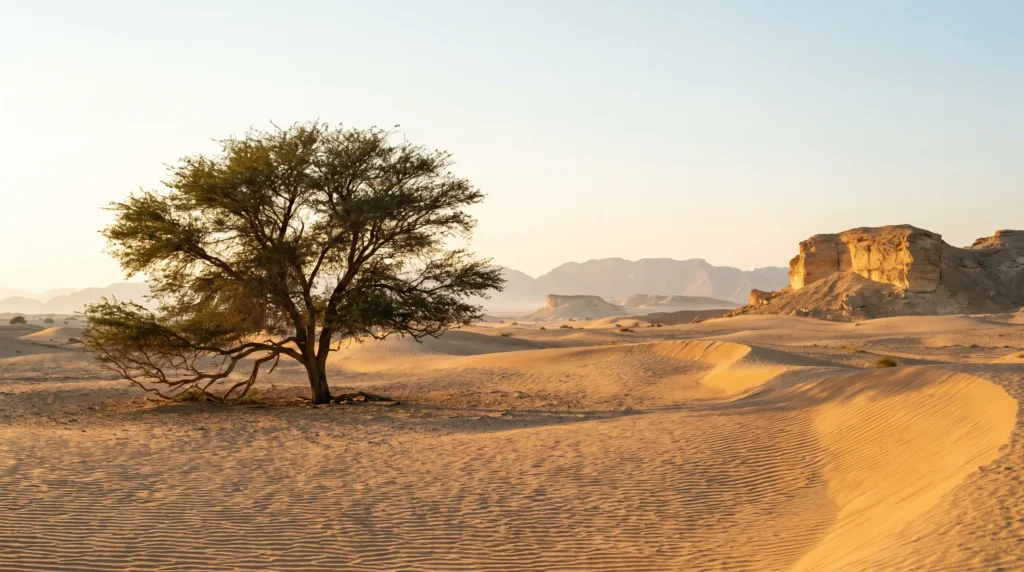
Home to the Bahrain International Circuit, the Royal Camel Farm, and the Tree of Life — a roughly 400-year-old mesquite tree standing alone in the desert near Jebel Dukhan with no obvious water source, free to visit and drawing an estimated 50,000 visitors a year.
Riffa & the Southern Towns
Historic Riffa Fort and older residential quarters give a quieter, more local slice of Bahrain than the capital, with some of the country’s best-preserved traditional courtyard houses.
Culture & People — Pearling Heritage, Islam & a More Liberal Gulf
Islam is Bahrain’s state religion, followed by roughly three-quarters of the population, alongside a significant expatriate community that has made the country the most religiously mixed in the Gulf. Arabic is the official language, but English is genuinely widely used in hotels, restaurants, taxis and business, which makes independent travel easier here than in most of the region.
Before oil, Bahrain’s economy and identity revolved around pearl diving, and that history is treated with real civic pride — UNESCO’s Pearling Path designation exists specifically to preserve the oyster beds, diving traditions and merchant architecture of that era. Dress modestly outside resort pools and beach clubs (shoulders and knees covered is the safe default, especially in Manama Souq and around mosques), and expect a socially relaxed but still conservative Muslim-majority country — alcohol is available in licensed hotels and some restaurants but not sold generally in shops the way it is in, say, parts of Europe.
A Food Lover’s Guide to Bahrain
The national dish is machboos — basmati rice cooked with chicken, lamb or fish, black lime, cloves and cinnamon, usually finished with a drizzle of saffron rosewater and served with daqoos, a tangy green chili sauce. It shows up on nearly every traditional menu, from family-run cafeterias to hotel buffets, and is the single dish worth prioritizing if you only try one.
For dessert, seek out halwa showaiter, a dense, gently spiced sweet made from ghee, sugar, cornstarch and rosewater — Muharraq’s Shawiter family has been making it the same way for roughly 150 years, and watching it prepared in a Muharraq sweet shop is worth the detour on its own. Bahraini cuisine overall blends Persian, Arabian and Indian influences, so expect excellent biryanis and curries alongside Gulf staples, plus fresh Gulf seafood — hammour and shrimp especially — along the waterfront restaurants.
Off the Beaten Path
The Pearling Path’s Quieter Clusters
Most visitors see Siyadi House and Bu Maher Fort; fewer walk the full chain of the Pearling Path’s nine architectural clusters through Muharraq’s residential lanes, past oyster-shell-flecked walls and shaded courtyard houses that see almost no tour groups.
Al Areen Wildlife Park & Reserve
A protected desert reserve near Sakhir with Arabian oryx, gazelle and native bird species roaming semi-wild enclosures — a low-key contrast to the Grand Prix circuit a few minutes down the road.
Riffa Fort’s Old Town
Skip straight past the fort’s postcard photo spot and wander the surrounding older residential streets, where traditional wind-tower architecture survives in pockets largely ignored by day-trip itineraries.
Hawar Islands
A remote archipelago off Bahrain’s southeastern coast, best known among birdwatchers for globally significant breeding colonies of Socotra cormorants — a genuine detour, reachable by boat, for travelers with an extra day and an interest in wildlife over ruins.
Practical Information — Read This Before You Book
Safety — please read this section, not just skim it. As of this writing, the US State Department has Bahrain at Travel Advisory Level 3 (“Reconsider Travel”), following hostilities between the US and Iran that began in early 2026, with warnings about drone and missile activity, disruptions to commercial flights, and standard terrorism concerns around tourist sites, transport hubs and religious sites. The UK FCDO’s guidance has moved more than once in 2026 — it advised against all but essential travel to Bahrain in March, eased that position by late June, but continues to describe the regional situation as “unpredictable,” with airspace and the King Fahd Causeway both having faced sudden, short-notice closures earlier in the year. I am not going to tell you this is fine to wave off — check your own government’s current advisory the week before you fly, buy travel insurance that explicitly covers your destination and covers evacuation, and have a plan that doesn’t depend on embassy assistance. If the advisory situation has genuinely calmed by the time you’re reading this, treat the rest of this guide as your planning starting point; if it hasn’t, this is not the trip to push forward on regardless.
Money. The Bahraini dinar is pegged at roughly 0.376 BHD to 1 US dollar (about 2.65 BHD per USD), a rate the Central Bank of Bahrain has held since 1980. Cards are widely accepted in Manama; carry some cash for the souq and smaller eateries.
Visa. Most US, UK, EU, Canadian and Australian passport holders can obtain an e-visa or visa on arrival, generally valid for stays around two weeks to 90 days depending on the visa class chosen, with passports required to be valid at least six months and proof of onward travel sometimes requested. Rules shift with the regional situation, so confirm current requirements on Bahrain’s official e-visa portal before booking flights.
Health. The CDC recommends routine vaccines plus Hepatitis A for most travelers and Hepatitis B for extended stays; yellow fever vaccination isn’t required for direct travel from the US. Tap water is generally treated to acceptable standards in Manama, but bottled water is cheap and widely preferred by visitors.
Connectivity & practicalities. An eSIM or local SIM gives good 4G/5G coverage island-wide. Plugs are UK-style (Type G), 230V. Time zone is UTC+3, no daylight saving.
Budget Breakdown — What Bahrain Actually Costs in 2026
Bahrain sits mid-pack for Gulf pricing — pricier than Egypt or Jordan, generally cheaper than Dubai or Doha for comparable hotels.
Budget (US$50–90/day): Simple hotel or budget business-class room in Manama, cafeteria machboos and shawarma meals, ride-hail rather than car rental, free sights like the Tree of Life and Bab Al Bahrain.
Mid-range (US$130–230/day): Three- or four-star hotel, a mix of casual and sit-down restaurant meals, a rental car or half-day driver for the southern desert sights, museum and fort entry fees.
Luxury (US$400+/day): Waterfront five-star hotels in Manama, private guided history tours pairing Qal’at al-Bahrain with the Pearling Path, fine-dining seafood, and Grand Prix weekend hospitality packages if your dates line up.
Tipping 10% is appreciated but not obligatory in restaurants; check whether a service charge is already included on the bill.
Planning Your First Trip to Bahrain
Three to four nights is enough for a first visit: a day for Manama (National Museum, souq, Bab Al Bahrain), a day pairing Qal’at al-Bahrain with the Muharraq Pearling Path, and a day for the southern desert (Tree of Life, Al Areen, and the circuit at Sakhir if you’re a motorsport fan). Many visitors combine Bahrain with a Gulf multi-stop trip — the causeway makes a side trip into Saudi Arabia’s Eastern Province genuinely easy with the right visa, and short flights connect onward to our Qatar travel guide or United Arab Emirates travel guide for a longer regional itinerary. Whatever you plan, build it around the safety and advisory checks in the practical section above — flexible or refundable bookings are worth the small premium here.
Frequently Asked Questions
Is Bahrain safe to visit right now?
This is genuinely unsettled at the time of writing. The US State Department has Bahrain at Level 3 (“Reconsider Travel”) following 2026 US-Iran hostilities, and the UK FCDO’s guidance has shifted more than once this year and still describes the regional situation as unpredictable. Check your own government’s current advisory in the days before you fly, not months out, and buy insurance that covers evacuation.
Do I need a visa for Bahrain?
Most US, UK, EU, Canadian and Australian citizens can get an e-visa or visa on arrival, typically for stays of two weeks to 90 days depending on the option chosen. Confirm current rules on Bahrain’s official e-visa portal, since entry policy has moved alongside the regional security situation.
Can I drink alcohol in Bahrain?
Yes, within licensed hotels, some restaurants and designated venues — Bahrain is the most permissive Gulf state on this. It is not sold in general grocery stores the way it might be at home, and public intoxication is taken seriously.
Bahrain or Dubai for a first Gulf trip?
Choose Bahrain for compact history, pearling heritage and a lower-key pace within a couple of days; choose Dubai for scale, shopping and a bigger-ticket resort experience. Bahrain rewards travelers who want depth over spectacle — but check the current safety situation for Bahrain specifically before deciding.
Is the King Fahd Causeway open to tourists?
Usually yes, with standard passport control and a valid Saudi entry document required — but it has closed on short notice during 2026’s regional tensions, so treat any causeway day-trip plan as tentative until close to your travel date.
What’s the single best thing to do with one day in Bahrain?
Pair the Bahrain National Museum with a walk through Manama Souq from Bab Al Bahrain — a half-day combination that covers 4,000 years of history and the modern city’s commercial heart without needing a car.
Ready to Explore Bahrain?
A 4,000-year-old fort, a desert tree that shouldn’t be alive, and a Formula 1 circuit that lights up after dark — Bahrain packs an unusual amount of story into a country you can drive across in under an hour. Just do the safety homework first: check the current advisories close to your travel dates, buy real evacuation-inclusive insurance, and go in with eyes open rather than on autopilot.
Explore More
- Qatar Travel Guide — Bahrain’s Gulf neighbor, a short flight or causeway-adjacent hop away
- United Arab Emirates Travel Guide — pair Bahrain with Dubai or Abu Dhabi for a longer Gulf itinerary
- Oman Travel Guide — more desert, mountains and a different side of the Gulf
- Dubai City Guide — the region’s biggest hub for onward connections
How this guide was built
Published . Built from authoritative sources — Wikipedia entity pages for Bahrain’s geography, currency, airport, causeway and Formula 1 history; UNESCO-documented World Heritage listings for Qal’at al-Bahrain and the Bahrain Pearling Trail; the Central Bank of Bahrain’s monetary policy page for the dinar’s dollar peg; the US State Department’s Bahrain country page and current travel advisory; the UK FCDO’s Bahrain travel advice; and the US CDC’s Bahrain traveler health page. Given the fast-moving regional security situation in 2026, treat the safety and visa details here as a starting point and always verify against the official advisory pages linked below before finalizing travel. Numeric and safety claims carry inline citations.
Sources cited on this page
- Wikipedia — Bahrain
- Wikipedia — Qal’at al-Bahrain
- Wikipedia — Bahrain Pearling Trail
- Wikipedia — King Fahd Causeway
- Wikipedia — Bahrain International Airport
- Wikipedia — Bahrain Grand Prix
- Wikipedia — Bahrain International Circuit
- Wikipedia — Visa Policy of Bahrain
- Central Bank of Bahrain — Monetary Policy
- US State Department — Bahrain
- UK FCDO — Bahrain Travel Advice
- US CDC — Bahrain Traveler Page
- Britannica — Bahrain
More country guides you might like
Plan your trip to Bahrain
The booking tools we use ourselves. FFU may earn a commission at no extra cost to you.
Plan & book your trip to Bahrain
Booking through these searches supports our guides at no extra cost to you.