
Languages of Paraguay
All languages of South America →fluent beta classical · classes by phone with Maya at ranas.ai/maya
Paraguay Travel Guide — Jesuit Ruins, the Gran Chaco & South America’s Least-Visited Heart
Every South American country I’ve written up so far has a headline act — Machu Picchu, the Amazon, Patagonia. Paraguay doesn’t, and that’s precisely why I love recommending it. This is a landlocked country a little smaller than California, wedged between Bolivia, Brazil and Argentina, where roughly 6.1 million people still speak Guaraní as a living daily language alongside Spanish — the only country in the Americas where an Indigenous language is co-official and spoken by the majority. You’ll drink bitter iced yerba mate (tereré) out of a shared cup, walk through Jesuit mission ruins with nobody else around, and stand at the base of a dam that generates more power per turbine than almost anywhere on Earth. It is not a polished destination — English is rare outside Asunción’s business hotels, a handful of border departments carry standing safety cautions, and the tourism infrastructure is thinner than in Argentina or Brazil next door. But if you want South America without the queues, this is where it still exists.
In This Guide
- Overview — Why Paraguay Is South America’s Quiet Middle Child
- The Ñandutí Festival — Itauguá’s Lace Weekend
- Best Time to Visit Paraguay (Season by Season)
- Getting There — ASU, the Triple Frontier & River Borders
- Getting Around — Buses, Colectivos & the Chaco Highway
- Top Regions — Asunción, the Missions & the Chaco
- Culture & People — Guaraní, Tereré & Ñandutí
- A Food Lover’s Guide to Paraguay
- Off the Beaten Path
- Practical Information
- Budget Breakdown — What Paraguay Actually Costs in 2026
- Frequently Asked Questions
Overview — Why Paraguay Is South America’s Quiet Middle Child
Paraguay gets skipped constantly, and mostly for geography: it has no coastline, no glacier-fed peaks, no single monument that dominates a postcard rack. What it has instead is a genuinely distinct culture built around the Río Paraguay, which splits the country into two utterly different halves — the fertile, populated Eastern Region and the vast, dry, thinly settled Gran Chaco to the west, which alone makes up most of the country’s 406,752 square kilometres.
The Guaraní people were here for over a thousand years before Spanish conquistadors arrived in 1524, and Asunción, founded in 1537, became the administrative seed of the entire Río de la Plata region — colonial expeditions launched from here to found Buenos Aires, Santa Fe and other major cities, which is why Paraguayans still call their capital “the Mother of Cities.” That deep colonial-era Guaraní fusion never got erased the way it did elsewhere in the region: Guaraní remains an official, majority-spoken language today, not a heritage language confined to remote communities.
Modern Paraguay also carries real scars — the catastrophic Triple Alliance War of 1864–1870 against Argentina, Brazil and Uruguay killed a staggering share of the male population, and the country spent 35 years under Alfredo Stroessner’s military dictatorship before transitioning to democracy in 1989. None of that is why you’d visit, but it explains why Paraguay feels unlike its flashier neighbors: less performed for tourists, more lived-in. What you’re buying here is Jesuit ruins with no ticket queue, a triple-frontier city buzzing with three currencies at once, and one of the world’s biggest dams generating power that quietly keeps the lights on in Rio and Buenos Aires as much as Asunción.
The Ñandutí Festival — Itauguá’s Lace Weekend
If you’re reading this in July, time your trip around the last weekend of the month, when the town of Itauguá — a short hop from Asunción — hosts the Festival Nacional del Ñandutí, celebrating the delicate, spiderweb-patterned lace that’s become one of Paraguay’s clearest visual symbols. The festival has run annually since 1970 and is recognized as part of the country’s cultural and folkloric heritage; master lacemakers set up open-air stalls threading circular ñandutí pieces in every color, alongside ao po’i embroidery, pottery, live polka and guarania music.
Miss July and you’ve still got options: Encarnación’s sprawling Carnaval runs across multiple weekends from mid-January into February and draws well over 100,000 visitors to Paraguay’s “summer capital” on the Argentine border, and the last Saturday of February is National Tereré Day, when the whole country leans even harder into its signature cold mate ritual.
Best Time to Visit Paraguay (Season by Season)
Mid-May – August · Dry, mild winter (recommended)
Paraguay’s most comfortable stretch: daytime temperatures stay mild to pleasantly warm, humidity drops, and the punishing summer storms mostly stay away. This is the window most guides and locals point first-timers toward, and it lines up with the Ñandutí Festival at the tail end of July.
September – November · Spring shoulder
Warming up, still relatively dry, jacaranda blooms turn Asunción purple. A good compromise if winter dates don’t work.
December – March · Hot, wet summer (peak domestic season)
This is when Paraguayans themselves travel — Encarnación’s river beaches and San Bernardino on Lake Ypacaraí fill up, especially over the New Year holidays. Expect sudden violent thunderstorms and heat that pushes past 38°C in the southeast and Chaco. It’s also carnival season in Encarnación (January–February), so book ahead if that’s the draw.
The Gran Chaco, year-round
The western Chaco is Paraguay’s driest region, getting under 1,000mm of rain a year compared to nearly 2,000mm in the lush southeast — but it’s also brutally hot in summer, so most visitors tackle it in the cooler dry months.
Getting There — ASU, the Triple Frontier & River Borders
Silvio Pettirossi International Airport (ASU), just outside Asunción, is Paraguay’s main international gateway, with connections through regional hubs like Panama City, São Paulo, Lima and Buenos Aires rather than many long-haul direct flights. Most travelers from the US or Europe will connect at least once, most commonly through Panama, São Paulo or Buenos Aires.
The other classic entry point is overland or by air into Ciudad del Este, Paraguay’s second city, which sits directly across the Río Paraná from Foz do Iguaçu, Brazil, connected by the Friendship Bridge. This is by far the most popular way visitors actually arrive in Paraguay: they’re already at Iguazu Falls on the Argentine or Brazilian side and add Paraguay as an easy third-country day trip or overnight, since the falls themselves are only a few kilometres away and visible in panorama from the Paraguayan riverbank. Land borders also connect to Argentina at Encarnación/Posadas and into Bolivia through the Chaco, though the latter is a long, remote crossing best done with a guide or overland tour operator.
Getting Around — Buses, Colectivos & the Chaco Highway
Paraguay runs on long-distance buses. Comfortable coach services (look for “ejecutivo” or “diferencial” classes with reclining seats and air-conditioning) connect Asunción, Encarnación, Ciudad del Este and Concepción for a fraction of what a flight would cost, though journeys can run four to six hours between the major cities. Domestic flights are limited — this isn’t Brazil, and the internal air network is thin — so road time is part of the deal.
Inside Asunción, taxis and rideshare apps are the practical choice for visitors; city buses (“colectivos”) are cheap but not designed with tourists in mind, and both the US State Department and UK FCDO flag pickpocketing and bag-snatching on public transport as a real, if low-level, risk. Renting a car opens up the Ruta Transchaco, the paved highway running deep into the Gran Chaco toward the Mennonite colonies — a genuinely epic, empty drive, but plan for long fuel-stop gaps and take it seriously as remote overland travel, not a day trip.
Top Regions — Asunción, the Missions & the Chaco
Asunción
Paraguay’s capital and by far its largest urban area, with a metro population of over 2.4 million — around 40% of the entire country — clustered along the Río Paraguay. The historic center holds the pink Palacio de los López (presidential palace), the National Pantheon of the Heroes, and the riverfront Costanera; the Botanical Garden and Zoo offers a break from the traffic. Give it two or three nights as your base for flights and buses onward.
Encarnación & the Jesuit Missions
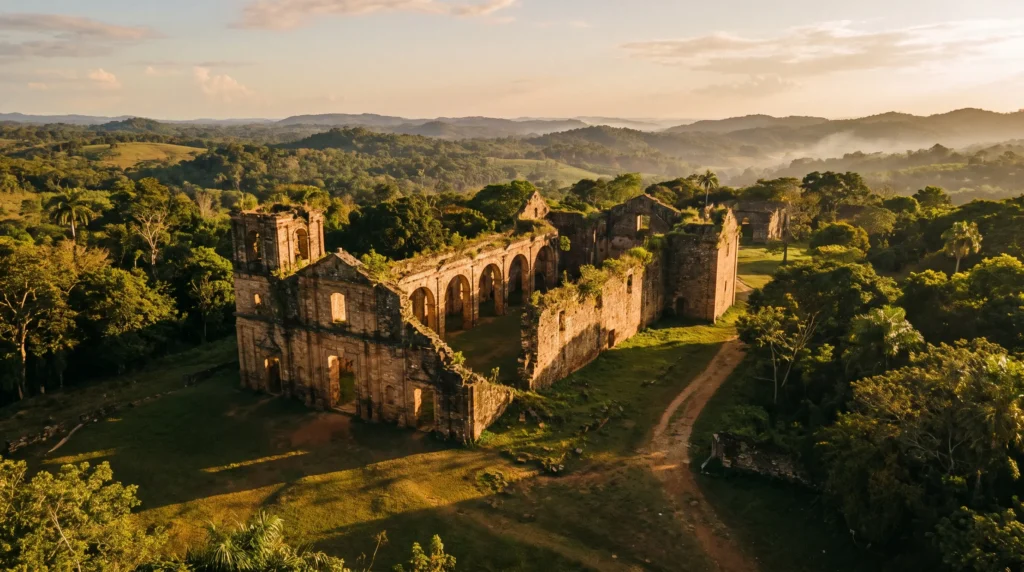
Nicknamed “the Pearl of the South,” Encarnación sits on the Paraná River across from Posadas, Argentina, with public riverside beaches added in 2011 that make it Paraguay’s unofficial summer capital. A short drive away are the ruins of La Santísima Trinidad de Paraná and Jesús de Tavarangue — two 17th–18th century Jesuit mission complexes, inscribed as Paraguay’s only UNESCO World Heritage Site in 1993, part of a wider network of 30 Guaraní missions across Paraguay, Argentina and Brazil. Trinidad is the more complete and visited of the two; Jesús de Tavarangue is famous for a trefoil Mudéjar arch design found nowhere else from the Jesuit era in the region.
Ciudad del Este & the Triple Frontier
Paraguay’s second-largest city and its duty-free shopping engine, sitting at the meeting point of Paraguay, Brazil and Argentina. Most visitors use it as the base for a Paraguay side-trip while touring Iguazu Falls, and to visit the Itaipú Dam — a joint Paraguay–Brazil hydroelectric project with 14,000 megawatts of installed capacity that supplies close to 90% of Paraguay’s own electricity, one of the largest power plants on Earth by output.
The Gran Chaco
The wild, sparsely populated western two-thirds of the country — dry scrubland and thorn forest, home to distinctive Mennonite farming colonies (Filadelfia, Loma Plata) that settled here in the early 20th century, plus some of South America’s least-visited wildlife habitat. It is not a casual add-on: distances are huge, services are sparse, and it rewards travelers who come with time and a guide rather than a checklist.
Ypacaraí & San Bernardino
Lake Ypacaraí, roughly 45 minutes from Asunción, is ringed by weekend towns — San Bernardino is the historic resort favored by Asunción’s own weekenders, with German-influenced architecture and lakeside restaurants; nearby Areguá is known for ceramics and a hilltop church with lake views.
Itauguá & the Central Department
Just outside Asunción, this is ñandutí lace country and the easiest cultural day trip from the capital, especially worthwhile around the late-July festival.
Culture & People — Guaraní, Tereré & Ñandutí
What sets Paraguay apart culturally is bilingualism that actually runs both ways: Spanish and Guaraní are both official, and Guaraní is spoken as a home language by the majority of the population, cutting across class lines in a way that’s rare anywhere colonial languages coexist with Indigenous ones. “Jopará” — a fluid mix of Spanish and Guaraní — is how most casual conversation actually happens.
The clearest cultural symbol you’ll encounter constantly is tereré: yerba mate steeped cold rather than hot, sipped through a metal straw (bombilla) from a shared guampa cup, often mixed with medicinal herbs (pohã ñaná). It’s been declared Paraguay’s national drink and UNESCO recognized it as Intangible Cultural Heritage in December 2020. Being offered a sip from someone’s tereré cup is a genuine social gesture — accept it. Alongside tereré, ñandutí lace-making (centered on Itauguá) and ao po’i embroidery remain living crafts, not museum pieces, and traditional polka and guarania music still soundtrack festivals countrywide.
A Food Lover’s Guide to Paraguay
The dish you’ll meet everywhere is chipa — a chewy, savory bread made from cassava starch and cheese, sold from baskets on street corners and especially central to Easter week celebrations. Its cousin sopa paraguaya is a dense, savory cornbread — confusingly named “soup” despite being solid — that shows up at nearly every family table and asado.
Beef is central here too: Paraguayan asado (grilled beef) rivals its Argentine neighbor, usually with mandioca (boiled cassava) on the side rather than fries. And you cannot separate Paraguayan daily life from yerba mate and tereré — the country grows more organic yerba mate than anywhere else and treats the drink as a cultural cornerstone rather than just a beverage. Wash it all down with a local Pilsen-style beer (Ñu Guasu or Baviera are common brands) and finish with mbeju, a crisp cassava-and-cheese griddle cake that’s Paraguay’s answer to a savory pancake.
Off the Beaten Path
Jesús de Tavarangue
Even relative to its sister ruin Trinidad, Jesús de Tavarangue sees far fewer visitors — a quieter, unfinished Jesuit church with unique Mudéjar arch details and almost no one else wandering the grounds.
Filadelfia & the Mennonite Chaco colonies
German-speaking farming communities deep in the Chaco scrub, running dairy cooperatives in a landscape that feels closer to the Australian outback than tropical South America — a genuinely strange and memorable detour for travelers with extra days.
Areguá
A lakeside pottery town on Ypacaraí with cobblestone streets and hilltop views, easily paired with San Bernardino as an Asunción day trip most tour buses skip.
Concepción & the river north
A faded river port with colonial architecture reachable by riverboat or road, offering a glimpse of northern Paraguay — though it sits in a department the US State Department flags for extra caution, so go informed and ideally with a local guide.
Practical Information
Money. The Paraguayan Guaraní traded around ₲6,068 to the US dollar as of early July 2026, with the Central Bank of Paraguay forecasting roughly ₲6,700 by year-end — rates move, so check current numbers before you go. Cards work in Asunción and Ciudad del Este’s malls; carry cash everywhere else, including buses and most restaurants outside the capital.
Safety. The US State Department rates Paraguay Level 1, “Exercise Normal Precautions,” as of April 2025, but singles out five border departments — Alto Paraná, Amambay, Canindeyú, Concepción and San Pedro — for increased caution due to crime and smuggling activity. The UK FCDO adds that pickpocketing on public transport and occasional protest-related road blockages in Asunción are the more common everyday nuisances tourists actually encounter. Check current guidance before travel and lean on taxis over buses at night.
Health. Routine vaccines should be current; yellow fever vaccination is recommended for most of the country (not required for Asunción-only visits) and mandatory if arriving from Bolivia, Brazil, Peru or Venezuela. Use strong mosquito repellent against dengue, Zika and chikungunya, stick to bottled or treated water, and seek care immediately for any animal bite given local rabies risk.
Connectivity. An eSIM covers Asunción and Ciudad del Este well; rural Chaco coverage is patchy. Plugs: mostly European-style two-round-pin, 220V. Time zone: UTC-4 (UTC-3 during Paraguay’s own daylight-saving periods, when observed).
Budget Breakdown — What Paraguay Actually Costs in 2026
Paraguay is one of the cheapest countries in South America to travel, especially outside the Asunción/Ciudad del Este corridor.
Budget (US$30–55/day): Hostel or basic guesthouse, bus travel between cities, street-stall chipa and set-menu lunches (almuerzo ejecutivo), local beer.
Mid-range (US$70–140/day): Comfortable hotel in Asunción or Encarnación, a rental car or private driver day trip to the Jesuit missions, restaurant asado dinners, guided Itaipú Dam tour.
Luxury (US$250+/day): Boutique riverside stays, private Chaco expeditions with a naturalist guide, chartered transport between regions.
Factor in a modest airport departure tax when flying out and 10% tipping at sit-down restaurants where service isn’t already included.
Planning Your First Trip to Paraguay
The easiest first-timer route is capital + missions + triple frontier: fly into ASU and spend two nights in Asunción, bus or drive four to five hours to Encarnación for the Jesuit ruins at Trinidad and Jesús de Tavarangue, then continue to Ciudad del Este for the Itaipú Dam and an easy side-trip across the Friendship Bridge to Iguazu Falls. Seven to nine days covers this comfortably without rushing. Many travelers actually approach it the other way — arriving via Brazil or Argentina to see Iguazu Falls and adding Paraguay as a low-effort third country. If you have extra time and want the truly remote version of South America, push west into the Gran Chaco toward the Bolivian border, or continue your Southern Cone loop into Uruguay or up through Bolivia.
Frequently Asked Questions
Is Paraguay safe for tourists in 2026?
The US State Department rates it Level 1, “Exercise Normal Precautions” — the same tier as much of Western Europe — but flags five border departments (Alto Paraná, Amambay, Canindeyú, Concepción, San Pedro) for increased caution due to smuggling and crime. Asunción, Encarnación and Ciudad del Este’s tourist areas are generally straightforward; use taxis at night and keep valuables out of sight on buses.
Do I need a visa?
US, UK, EU, Canadian and most South American passport holders can enter visa-free, typically for up to 90 days. Make sure your passport is valid for your full stay and carries at least one blank page for the entry stamp.
Do I need a yellow fever vaccine?
It’s recommended for most of the country if you’re over nine months old, though not required if you’re only visiting Asunción. It becomes mandatory if you’re arriving from Bolivia, Brazil, Peru or Venezuela — check current requirements before booking connecting flights.
Can I visit Iguazu Falls from Paraguay?
Yes — Ciudad del Este sits right across the Río Paraná from Foz do Iguaçu, Brazil, connected by the Friendship Bridge, and the falls (technically on the Argentina–Brazil border) are only a short ride away with panoramic views obtainable from the Paraguayan side. Many visitors do Paraguay as a one-country add-on to an Argentina/Brazil Iguazu trip rather than the other way around.
Paraguay or Bolivia for an off-the-beaten-path South America trip?
Choose Paraguay for river culture, Jesuit history and an easy, cheap loop through three countries at once via the triple frontier; choose Bolivia for high-altitude landscapes, salt flats and more dramatic Andean scenery. They pair well back-to-back if you have the time.
What’s the easiest way to see the Jesuit missions?
Base yourself in Encarnación for a night or two — Trinidad and Jesús de Tavarangue are both short drives away, and a rental car or a single hired driver can cover both plus lunch in a single day.
Ready to Explore Paraguay?
Jesuit ruins with no ticket line, a dam that helps power two other countries, and a lace festival that’s run since 1970 in a town most maps barely label — Paraguay rewards travelers who don’t need a headline landmark to have a great trip. Go now, while it’s still one of South America’s quietest corners.
Explore More
- Argentina Travel Guide — Iguazu Falls and the border crossing to Encarnación
- Brazil Travel Guide — Foz do Iguaçu and the Friendship Bridge into Ciudad del Este
- Bolivia Travel Guide — continue the loop west through the Chaco
- Uruguay Travel Guide — round out a Southern Cone itinerary
How this guide was built
Published . Built from authoritative sources — Paraguay’s national tourism secretariat (SENATUR), UNESCO’s inscription page for the Jesuit Missions of La Santísima Trinidad de Paraná and Jesús de Tavarangue, the US State Department and UK FCDO Paraguay travel advisories, the US CDC traveler page for Paraguay, Trading Economics currency data for the Guaraní, and Wikipedia entity pages for Paraguay, Asunción, Encarnación, the Jesuit Missions, Itaipú Dam, Iguazu Falls, tereré and yerba mate. Numeric and checkable claims carry inline citations.
Sources cited on this page
- SENATUR — Paraguay National Tourism Secretariat
- UNESCO — Jesuit Missions of La Santísima Trinidad de Paraná and Jesús de Tavarangue
- US State Department — Paraguay
- UK FCDO — Paraguay
- US CDC — Paraguay traveler page
- Trading Economics — Paraguayan Guaraní
- Wikipedia — Paraguay
- Wikipedia — Asunción
- Wikipedia — Encarnación
- Wikipedia — Silvio Pettirossi International Airport
- Wikipedia — Itaipú Dam
- Wikipedia — Iguazu Falls
- Wikipedia — Jesuit Missions of Trinidad and Jesús de Tavarangue
- Wikipedia — Tereré
- Wikipedia — Yerba mate
- Travel Food Guide — Paraguay
- Petit Futé — Festival Nacional del Ñandutí, Itauguá
- Hello Paraguay — Ñandutí lace craftsmanship
More country guides you might like
Plan your trip to Paraguay
The booking tools we use ourselves. FFU may earn a commission at no extra cost to you.
Plan & book your trip to Paraguay
Booking through these searches supports our guides at no extra cost to you.