
Languages of South Sudan
All languages of Eastern Africa →fluent beta classical · classes by phone with Maya at ranas.ai/maya
South Sudan Travel Guide — The World’s Newest Country, Read Honestly
I write these guides because I love telling people to go somewhere. This one is different, and I want to be upfront about that before you read another word. South Sudan is a genuinely extraordinary place — the world’s youngest nation, home to the Sudd, one of the planet’s largest wetlands, and to a migration of antelope that recent aerial surveys suggest may be the largest movement of land mammals left on Earth. It is also, right now, a country under active conflict and a formal “do not travel” advisory from multiple governments. This guide exists to inform, not to send you there. If you’re reading it out of curiosity, for research, for work, or because you have family ties here, welcome — I’ve tried to be as useful and as honest as I can be. If you’re reading it looking for a reason to book a leisure trip, I’m going to gently talk you out of it and point you toward some extraordinary neighboring countries instead.
In This Guide
- Safety Notice — Please Read First
- Overview — The World’s Youngest Country
- Independence Day, July 9 — and the World’s Largest Land Migration
- Seasons in South Sudan (For Context, Not Booking)
- Getting There — Juba International Airport & Entry Rules
- Getting Around — Why It’s Genuinely Difficult
- Key Regions & Geography
- Culture & People — Dinka, Nuer & the Cattle Camp
- A Food Lover’s Guide to South Sudan
- Boma, Badingilo & the Sudd — Wild, Not Touristed
- Practical Information
- Cost of Being in South Sudan (Not a Budget-Travel Breakdown)
- If You Genuinely Must Travel
- Frequently Asked Questions
Overview — The World’s Youngest Country
South Sudan became the world’s newest sovereign state on 9 July 2011, seceding from Sudan after decades of civil war — a fact that still shapes almost everything about how the country runs today. It is landlocked, roughly the size of France, bordered by Sudan to the north, Ethiopia to the east, Kenya and Uganda to the south, the Democratic Republic of Congo to the southwest, and the Central African Republic to the west. The capital, Juba, sits on the White Nile in the country’s south and is by far its largest city; Wau and Malakal are the other major urban centers.
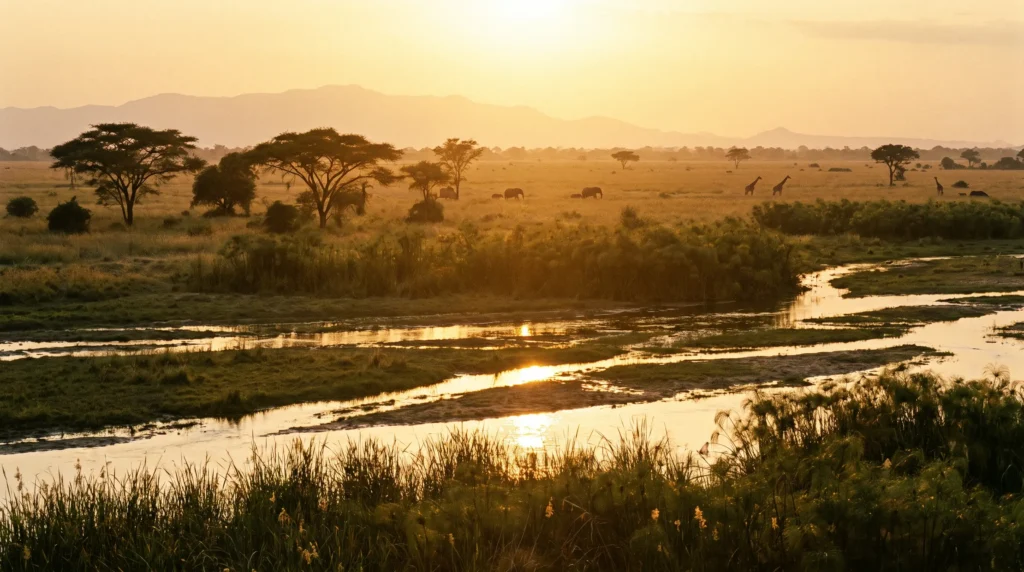
Geographically, this is Nile country in its rawest form. The Sudd — a vast, seasonally flooded swamp and grassland fed by the White Nile — covers tens of thousands of square kilometers and is one of the largest wetlands on the continent, a Ramsar-listed refuge for hippos, Nile crocodiles, and more than 400 bird species. Further south and east, Boma and Bandingilo National Parks hold what conservationists now believe is the largest single migration of land mammals on Earth. None of this has been developed for tourism in any conventional sense — no lodges, no circuits, no guide network — because the country has spent nearly its entire independent existence dealing with internal conflict rather than infrastructure.
That’s the tension at the heart of this guide. South Sudan has more raw natural spectacle, arguably, than most of its East African neighbors that host millions of safari visitors a year. It also has, right now, a security and humanitarian situation that makes visiting for tourism something both foreign ministries and I are telling you not to do. Both things are true at once, and a responsible guide has to hold them together rather than picking the exciting half.
Independence Day, July 9 — and the World’s Largest Land Migration
Every 9 July, South Sudan marks its independence from Sudan, achieved in 2011 after a referendum in which the south voted overwhelmingly to separate. It’s a genuinely emotional date for a population that fought two long civil wars to get there, and it’s worth understanding even from a distance — the day is marked by flag ceremonies in Juba and a renewed round of public reflection on how far the young republic still has to go.
The other date-driven story here isn’t a festival, it’s a migration. Each year, roughly between May and October, an estimated six million white-eared kob, tiang, Mongalla gazelle and reedbuck move in mega-herds between Boma and Badingilo National Parks — a 2024 aerial survey by African Parks confirmed it as likely the largest land-mammal migration left on the planet, larger by headcount than East Africa’s famous Serengeti-Mara wildebeest migration. Conservationists are still working out how to protect it; there is no visitor infrastructure to speak of. Both sites sit on South Sudan’s UNESCO World Heritage Tentative List, alongside the Sudd Wetlands, submitted in 2017 as the country’s first-ever tentative nominations. South Sudan currently has zero inscribed UNESCO World Heritage Sites.
Seasons in South Sudan (For Context, Not Booking)
December – April · Dry season
The most passable time of year weather-wise: dry roads, less flooding, temperatures commonly reaching the mid-30s Celsius. This is also when the Boma-Badingilo migration concentrates in different areas than the wet season, and when Dinka and Nuer cattle camps move herds to riverine dry-season pastures.
May – October · Rainy season
Heavy rains turn much of the country’s unpaved road network to mud or standing water, and the Sudd expands dramatically, cutting off large areas by land entirely. This is also cholera transmission season in a country where it is already widespread; the CDC flags active cholera transmission as an ongoing risk.
None of the above should be read as “so plan your trip for December.” Seasonal passability is one small variable in a security situation that overrides it entirely — a dry road doesn’t make an active conflict zone safe to drive through.
Getting There — Juba International Airport & Entry Rules
Juba International Airport (JUB), about 5 kilometers from the city center on the White Nile’s western bank, is the country’s main gateway, with scheduled service from Egyptair (Cairo), Ethiopian Airlines (Addis Ababa), flydubai (Dubai), and Kenya Airways (Nairobi); other regional routes shift often. The UK FCDO specifically flags that regional instability can cause sudden airport closures or flight cancellations with little notice — a real logistical risk on top of the on-the-ground one.
Most nationalities need an eVisa, applied for online in advance and, per the government’s eVisa portal, typically issued within about 72 hours. Citizens of Egypt, Kenya, Tanzania and Uganda can enter visa-free; Rwandan and Burundian citizens, along with UN ID and diplomatic-passport holders with ministry clearance, can get a visa on arrival. A yellow fever vaccination certificate is mandatory for all arriving travelers aged nine months and up, no exceptions. In practice, the overwhelming majority of people flying into Juba today are humanitarian, diplomatic, UN, or aid-sector personnel rather than leisure travelers, and airlines and insurers price and route accordingly.
Getting Around — Why It’s Genuinely Difficult
South Sudan has one of the least developed road networks of any country its size; large stretches are unpaved and become impassable in the May–October rains, and the Sudd’s seasonal flooding cuts off entire regions from land travel altogether. Between towns, most practical movement for the organizations that do operate here — the UN, African Parks, NGOs — happens by small charter aircraft rather than road, precisely because road travel carries both a security risk (checkpoints, armed groups, carjacking is explicitly cited in the US advisory) and a physical one (washed-out roads, no roadside assistance, minimal medical backup).
The White Nile is a real transport corridor too, particularly around Juba and up toward Malakal, though river travel here is subject to the same security caveats as everything else. There is no tourist rental-car market, no ride-hailing network, and no equivalent of the shared-taxi systems that make budget travel easy elsewhere in East Africa.
Key Regions & Geography
These are described for geographic, historical and cultural context — they are not a suggested itinerary.
Juba & Central Equatoria
The capital and seat of government, on the White Nile in the country’s far south, close to the Ugandan border. It holds most of the country’s limited hotel, embassy and NGO infrastructure, and is also where the US and UK advisories note specific additional security concerns beyond the nationwide Level 4/advise-against rating.
The Sudd (Jonglei & surrounding states)
One of the largest wetlands on Earth, formed where the White Nile spreads and slows across flat terrain, creating a shifting maze of channels, lagoons and floating vegetation mats that can expand or contract by tens of thousands of square kilometers between seasons. It’s a Ramsar Wetland of International Importance and a candidate on South Sudan’s UNESCO tentative list, home to Nile lechwe (found nowhere else on Earth), shoebill storks, hippos and enormous crocodile populations.
Boma & Badingilo National Parks
Adjoining protected areas in the country’s east that host the great white-eared kob migration — millions of animals moving in a corridor between wet- and dry-season range. Conservation NGO African Parks has been working with the government here on wildlife protection and anti-poaching efforts even amid the broader instability.
Nimule National Park
A smaller park near the Ugandan border along the Nile, home to elephants and hippos, notable mainly for being one of the country’s more accessible protected areas given its position near the (relatively) more stable southern border crossing.
Wau & Malakal
The country’s second- and third-largest urban centers, both historically significant river and rail towns that have seen repeated displacement and fighting over the past decade — a reminder that “second city” here doesn’t map to the relative calm it might imply elsewhere.
Culture & People — Dinka, Nuer & the Cattle Camp
South Sudan is one of the most linguistically diverse countries on the continent — English is the sole official language, Juba Arabic serves as the practical lingua franca in the capital and markets, and around 60 indigenous languages are spoken across roughly 60 ethnic groups. The two largest groups, the Dinka and the Nuer, are closely related Nilotic peoples whose cultural and economic life still centers on cattle in a way that shapes nearly everything else about daily life.
The cattle camp is the single most important institution in Dinka social life: cattle provide milk, blood and meat, function as savings and currency, settle disputes, and pay bridewealth, and the values cultivated in the camp — generosity, valor, respect for social norms — are considered the foundation of Dinka identity. Herds move to riverside dry-season pastures from roughly December to April and back to permanent settlements for the rains, when millet and sorghum are planted. The Nuer follow a similar transhumant rhythm — permanent villages in the rains, riverside cattle camps in the dry season — supplementing their herds with millet cultivation and fishing. Both peoples mark the passage from boyhood to manhood with demanding coming-of-age ceremonies, a tradition that predates and has outlasted decades of war.
A Food Lover’s Guide to South Sudan
South Sudanese cuisine is built on grains — sorghum, millet, maize and rice — supplemented by legumes, okra, greens and whatever meat is available, most often goat, chicken or fish, with beef reserved for significant occasions given cattle’s social value. The everyday staple is kisra, a thin, slightly sour fermented sorghum or millet flatbread that doubles as both plate and utensil — you tear off a piece and use it to scoop up stews and sauces, much as injera works across the Ethiopian and Eritrean highlands. Alongside it sits asida, a thick, stiff sorghum or millet porridge cooked until it pulls from the sides of the pot — the caloric backbone of most meals, usually served with a savory stew or leafy greens.
Ful medames — stewed fava beans with cumin and oil, shared across Sudan and South Sudan alike — turns up at breakfast tables and street stalls. Fish from the Nile and its tributaries is common in riverside towns, and milk (fresh, soured or fermented) remains central wherever cattle culture is strong. This is not a cuisine built around restaurants in the way neighboring capitals are; it’s built around what a household or camp produces and shares.
Boma, Badingilo & the Sudd — Wild, Not Touristed
If South Sudan were at peace, the natural case for visiting would be extraordinary: a migration larger than the Serengeti’s, a wetland ecosystem the scale of a small country, wildlife found nowhere else on the planet. None of it has tourist infrastructure — no lodges, no marked trails, no ranger network built for visitors rather than researchers and conservation staff. Access today is essentially limited to conservation organizations like African Parks, which partners with the government on anti-poaching and wildlife-monitoring work in Boma and Badingilo, and to the occasional accredited researcher or journalist working with those organizations directly. This is not a “hidden gem, go now before the crowds” section — it’s an honest acknowledgment that some of the most remarkable wildlife spectacles left on Earth currently exist in a place most of the world, for good reason, cannot safely reach.
Practical Information
Money. The South Sudanese Pound (SSP) is the official currency, with rates set and published on weekdays by the Bank of South Sudan; the currency has a history of significant volatility, so confirm current rates immediately before any transaction rather than relying on any number printed here. Card acceptance and ATM access are minimal outside a handful of Juba locations; this is fundamentally a cash economy, and US dollars are widely sought after.
Safety. This bears repeating in its own right, not just up top: both the US State Department (Level 4, Do Not Travel) and the UK FCDO (advise against all travel) currently rate South Sudan at their most serious advisory tiers, citing armed conflict, violent crime, kidnapping, and landmines, with limited government capacity to assist citizens in an emergency. Check your own government’s advisory immediately before any travel, regardless of what you read here or anywhere else.
Health. Yellow fever vaccination is mandatory for entry. The CDC recommends antimalarial medication for all travelers given widespread, often drug-resistant malaria, plus hepatitis A/B, typhoid, and — for parts of the year — meningococcal vaccination; cholera transmission is currently widespread and a vaccine should be considered. Medical facilities are severely limited nationwide, and the State Department notes adequate treatment is often simply unavailable.
Connectivity. Mobile and internet access exist in Juba but are unreliable and largely absent outside major towns; do not plan around connectivity working when you need it most.
Cost of Being in South Sudan (Not a Budget-Travel Breakdown)
I’m not going to give this the usual “budget/mid-range/luxury per day” treatment, because South Sudan isn’t a tourism economy and doing so would misrepresent it. In practice, almost everyone who spends meaningful time here — aid workers, diplomats, UN staff, journalists — does so through an organization that handles logistics, security, and lodging, and costs reflect that: imported goods, fuel, and secure accommodation in Juba are expensive relative to regional neighbors precisely because so much has to be flown or trucked in through a fragile supply chain, and reputable lodging tends to bundle in compound security. There is no independent backpacker infrastructure — no hostel scene, no budget guesthouse network, no tourist price tier — because there is essentially no independent tourism to build one around right now.
If You Genuinely Must Travel
Some readers arrive here for reasons that aren’t leisure: aid and development work, journalism, research, or family and diaspora ties. If that’s you: travel through an established organization wherever possible, register with your embassy, arrange evacuation and medical evacuation insurance specifically valid for a Level 4 destination (many standard policies exclude these), keep communications and location-sharing arrangements current with someone outside the country, and build in far more schedule slack than you think you need — flight cancellations and checkpoint delays are the norm, not the exception.
If you’re drawn to South Sudan for the wildlife, the Nile, or the culture rather than for essential work, I’d point you instead toward the region around it, where you can experience real adjacent threads of the same story safely. Our Uganda travel guide covers the same White Nile system near its source and shares the Nimule border crossing; our Kenya travel guide covers East Africa’s other great migration story, the Serengeti-Mara system, with a fully built safari infrastructure; our Ethiopia travel guide covers Nilotic and pastoralist cultures related to South Sudan’s own, from the Omo Valley south; and our Egypt travel guide follows the same Nile all the way to the Mediterranean.
Frequently Asked Questions
Is it safe to travel to South Sudan right now?
No government currently advises leisure travel there. The US State Department rates it Level 4, “Do Not Travel,” and the UK FCDO advises against all travel to the country, citing active armed conflict, widespread violent crime and kidnapping risk, landmines, and very limited consular support. Check your own government’s current advisory before making any decision.
Do I need a visa?
Most nationalities need an eVisa arranged in advance through South Sudan’s official eVisa portal, typically processed within about 72 hours. Egypt, Kenya, Tanzania and Uganda passport holders can enter visa-free; Rwandan and Burundian citizens can get a visa on arrival.
What vaccines do I need?
Yellow fever vaccination is mandatory for entry for everyone aged nine months and up. The CDC also recommends hepatitis A and B, typhoid, routine vaccines, antimalarial medication, and, seasonally, meningococcal and cholera vaccination given ongoing cholera transmission.
Can I visit Boma National Park to see the migration?
Not through any conventional tourism channel today. There’s no visitor infrastructure, and access is effectively limited to conservation partners like African Parks working directly with the government.
Is South Sudan the same as Sudan?
No — two separate countries. South Sudan seceded from Sudan in 2011 after a referendum, becoming the world’s newest state; Sudan remains the country to its north, with its own separate (and also serious) conflict and advisory situation.
What currency should I use?
The South Sudanese Pound (SSP) is official, but this is largely a cash economy with a volatile exchange rate set by the Bank of South Sudan — confirm current rates immediately before you need them rather than trusting any figure written in advance.
What I’d Actually Suggest
South Sudan has some of the most remarkable geography and wildlife left on the continent, and I hope this guide gave you a genuine sense of that alongside an honest picture of why it isn’t a place to plan a trip to today. Keep an eye on the official advisories — situations like this do change — and in the meantime, if the pull is the Nile, the migration, or Nilotic pastoral culture, our neighboring guides below cover real, visitable versions of all three.
Explore More
- Uganda Travel Guide — the White Nile’s source region, sharing a border and river system with South Sudan
- Kenya Travel Guide — East Africa’s other great land migration, fully set up for visitors
- Ethiopia Travel Guide — related Nilotic and pastoralist cultures further north and east
- Egypt Travel Guide — the same Nile, followed to the Mediterranean
How this guide was built
Published . Built from authoritative sources: Wikipedia’s South Sudan, Juba International Airport, South Sudanese cuisine, and Visa policy of South Sudan entity pages; UNESCO’s World Heritage Centre pages for South Sudan’s Tentative List (Sudd Wetlands and the Boma-Badingilo Migratory Landscape) and its States Parties record showing zero inscribed sites; the US State Department’s South Sudan travel advisory; the UK FCDO’s South Sudan travel advice; the US CDC’s South Sudan traveler health page; South Sudan’s official eVisa portal; the Bank of South Sudan’s exchange-rate page; African Parks’ reporting on the confirmed Boma-Badingilo migration survey; and Britannica’s Dinka and Nuer entries. Given the seriousness of the subject, every numeric or checkable claim carries an inline citation, and the safety advisory framing was treated as non-negotiable rather than optional editorial color.
Sources cited on this page
- Wikipedia — South Sudan
- Wikipedia — Juba International Airport
- Wikipedia — Visa policy of South Sudan
- Wikipedia — South Sudanese cuisine
- UNESCO — Sudd Wetland (Tentative List)
- UNESCO — Boma-Badingilo Migratory Landscape (Tentative List)
- UNESCO — South Sudan States Parties record
- US State Department — South Sudan Travel Advisory
- UK FCDO — South Sudan Travel Advice
- US CDC — South Sudan Traveler Page
- South Sudan Official eVisa Portal
- Bank of South Sudan — Exchange Rates
- African Parks — World’s Largest Land Mammal Migration Confirmed in South Sudan
- Britannica — Dinka
- Britannica — Nuer
More country guides you might like
Plan your trip to South Sudan
The booking tools we use ourselves. FFU may earn a commission at no extra cost to you.
Plan & book your trip to South Sudan
Booking through these searches supports our guides at no extra cost to you.