
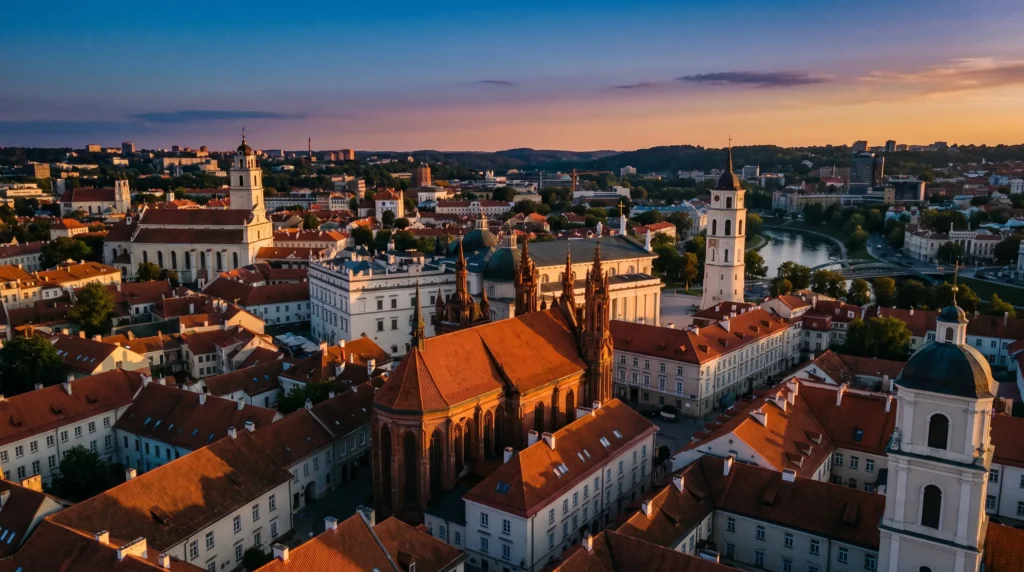
Vilnius Travel Guide — Baroque Spires, a Bohemian Republic & Europe’s Least-Crowded Old Town
Travelers who take a chance on Vilnius keep coming back surprised, which tells you everything about how underrated this city still is. It’s the largest of the Baltic capitals, first mentioned in a 1323 letter written by the Grand Duke who supposedly dreamed the whole city into existence, and it holds one of the biggest, best-preserved Baroque old towns left in Europe — a UNESCO World Heritage site since 1994, sprawling across 3.59 square kilometres of church towers, courtyard cafés and cobbled lanes. You can walk the entire historic core in an afternoon, cross a footbridge into a neighborhood that has declared itself an independent republic with its own constitution, and still make it back for dinner. Vilnius won’t out-shout Prague or Vienna, and it doesn’t try to — what it offers instead is space, quiet, absurdly good coffee culture, and prices that feel like a decade behind Western Europe. The catch, if there is one: winters are long, dark and genuinely cold, and if your only image of the Baltics is “frozen and grey,” you need to see it between May and September to understand the appeal.
In This Guide
- Overview — Why Vilnius Is Europe’s Quietest Capital Secret
- Vilnius as Europe’s Christmas Capital — Festival Calendar
- Best Time to Visit Vilnius (Season by Season)
- Getting There — VNO Airport, Trains & Buses
- Getting Around — Trams, Trolleybuses & Walking
- Neighborhoods — Old Town, Užupis & Beyond
- Culture & People — Baroque, Bohemia & the Jerusalem of the North
- A Food Lover’s Guide to Vilnius
- Off the Beaten Path
- Day Trips — Trakai, Kernavė & the Hill of Crosses
- Practical Information
- Budget Breakdown — What Vilnius Actually Costs in 2026
- Frequently Asked Questions
Overview — Why Vilnius Is Europe’s Quietest Capital Secret
Vilnius sits at the confluence of the Neris and Vilnia rivers in southeastern Lithuania, and it’s the largest city in the Baltic states — bigger than Riga, bigger than Tallinn — yet it remains the one most travelers can’t quite place on a map. That anonymity is doing the city a favor: its UNESCO-listed Old Town, one of the largest surviving medieval-to-Baroque cores in Northern Europe at roughly 1,487 buildings across 70 streets, has none of the queue culture of Prague’s Charles Bridge or Rome’s Trevi Fountain.
The city’s founding legend involves Grand Duke Gediminas dreaming of an iron wolf howling atop a hill, which his pagan priest interpreted as a sign to build a great capital there — a story every Vilnius guide will tell you within the first ten minutes, standing at the base of Gediminas’ Tower where it supposedly happened. What followed was centuries as capital of the Grand Duchy of Lithuania, one of medieval Europe’s largest states, then a long, complicated twentieth century — Polish, then Soviet, then finally independent again in 1990 — that left the city with a striking architectural layering: Gothic churches next to Baroque palaces next to blunt Soviet apartment blocks next to glass-and-steel towers across the river in the modern business district.
What Vilnius doesn’t have is the tourist infrastructure of a marquee capital — and for most visitors that’s the appeal. Menus, museum signage and hotel staff increasingly work in English, but you won’t fight crowds for a café table, and a full sit-down dinner with wine still runs a third of what the same meal costs in Paris or Amsterdam. It’s a city built for wandering rather than checklist-ticking, best explored the way locals actually use it: on foot, through courtyards, into the one neighborhood that decided it should be its own country.
Vilnius as Europe’s Christmas Capital — Festival Calendar
Vilnius held the title of European Christmas Capital for the 2025 season, and the city leaned hard into it: a towering illuminated tree in Cathedral Square, a sprawling Christmas market, and light installations strung through the Old Town’s lanes well past the holiday itself. Even outside an official title year, Vilnius runs a genuinely good December — mulled wine stalls, choir performances in the cathedral, and short, moody daylight that makes the fairy-light displays feel earned rather than gimmicky.
The rest of the calendar is just as active. Vilnius Light Festival takes over the Old Town’s facades and courtyards each January with projection art built around a sustainability theme. Come May, the Pink Soup Fest turns the city pink — literally — celebrating šaltibarščiai, the cold beet soup that’s become an unofficial civic mascot, with thousands turning out in pink to match. And every April 1st, Užupis marks its own independence with Užupis Day, the one date each year the self-declared republic’s border checkpoints and mock passport stamps get taken most seriously.
Best Time to Visit Vilnius (Season by Season)
May – September · The main event
Warm, long-daylight months when Vilnius genuinely comes alive outdoors — courtyard restaurants open their terraces, riverside beaches along the Neris fill up, and the “As Young as Vilnius” festival brings free concerts across the city each July. July and August are peak, with the warmest weather and the busiest (relatively speaking) Old Town; June and September trade a few degrees for noticeably thinner crowds and lower hotel rates.
December · Christmas markets and lights
Short days, real cold, and the best festive atmosphere in the Baltics — Cathedral Square’s tree and market are the centerpiece, with light art threaded through the Old Town into January. Book central hotels early if your trip lands around the holidays.
January – March · Deep winter
The coldest, darkest stretch, with temperatures regularly below freezing and daylight ending mid-afternoon. It’s also when the Light Festival runs, hotel prices bottom out, and museums and thermal-style spas make for a legitimately cozy trip if you don’t mind bundling up. Not the season for open-air sightseeing marathons.
Getting There — VNO Airport, Trains & Buses
Vilnius International Airport (VNO) sits only about 6 kilometres south of the Old Town — one of the closest airport-to-center distances of any European capital — with direct flights from major hubs across Western and Northern Europe on carriers including Ryanair, Wizz Air, LOT, Lufthansa and Finnair, plus Lithuania’s own airBaltic-adjacent connections through the Baltics. A direct rail line runs airport-to-city in about 7 minutes for roughly €0.80–1, making it the fastest and cheapest option by a wide margin; bus route 88 takes a scenic loop through the Old Town in around 20 minutes if you’d rather watch the city go by.
Vilnius also anchors the region’s rail and bus network: direct trains connect to Kaunas and onward toward the Polish border, and long-distance buses (Lux Express, Ecolines) link Vilnius with Riga (around 4 hours) and Warsaw, making a Baltic-capitals loop or a Vilnius–Warsaw combination straightforward without flying at all.
Getting Around — Trams, Trolleybuses & Walking
The Old Town and its immediate surroundings — Užupis, the Cathedral district, the university quarter — are entirely walkable, and most first-time visitors barely need public transport for their first two or three days. Beyond that, Vilnius runs an extensive network of buses and trolleybuses; a single ticket bought via the mobile Trafi/Vilniečio app runs cheaper than paying cash on board, and day passes are worth it if you’re basing yourself outside the center.
Uniquely for the region, Vilnius has also folded small electric riverboats into its public transit system along the Neris, a scenic and slightly novel way to shuttle between the Old Town and the newer business district across the river. Taxis and ride-hailing apps (Bolt is dominant locally) are inexpensive by Western European standards; for anything beyond the city, rental cars open up Trakai and Kernavė at your own pace.
Neighborhoods — Old Town, Užupis & Beyond
Senamiestis (Old Town)
The UNESCO-listed heart of the city: Cathedral Square and Gediminas’ Tower at one end, the university’s five-century-old courtyards in the middle, and Pilies Street’s souvenir-and-amber shops running the length of it. This is where most visitors base themselves, and for good reason — everything else radiates outward from here.
Užupis
Cross the footbridge over the Vilnia and you’re in a self-declared micronation with its own 41-article constitution — the kind that grants a river the right to flow past people and states flatly that “a dog has the right to be a dog.” Declared independent on April Fool’s Day 1997 and now home to roughly 7,000 residents, nearly 1,000 of them artists, Užupis has drawn comparisons to Montmartre for its bohemian density of studios, galleries and courtyard cafés packed into just 60 hectares. It’s touristy in patches now, but it earns the reputation.
Užupio Constitution Wall & Bernardinai Garden
Technically part of Užupis and the Old Town’s edge, this stretch pairs the mirrored, multilingual constitution plaques with one of the city’s best green spaces for an afternoon slowdown between sightseeing pushes.
Naujamiestis (New Town)
The 19th-century grid just south of the Old Town, anchored by Gedimino Avenue — Vilnius’s main boulevard of government buildings, embassies, shops and the sobering KGB Museum (Museum of Occupations and Freedom Fights) in the former secret police headquarters.
Žvėrynas
A leafy, mostly residential riverside district of wooden villas and quiet streets, popular with locals for weekend walks and increasingly with visitors looking for a break from Old Town foot traffic.
Snipiškės & the Business District
Across the Neris from the Old Town, glass towers and the Europa Tower observation deck give Vilnius its skyline-photo contrast — medieval spires on one bank, contemporary high-rises on the other, visible together from the White Bridge.
Paneriai
A sober, essential stop for anyone engaging with the city’s WWII history: the forest site where tens of thousands of Vilnius’s Jewish population were murdered, now a memorial and museum reachable by a short train ride.
Culture & People — Baroque, Bohemia & the Jerusalem of the North
Before the Second World War, Vilnius was one of Europe’s great centers of Jewish scholarship and culture, earning the nickname “Jerusalem of the North” or “Jerusalem of Lithuania” for its density of synagogues, yeshivas and printing houses. That community was almost entirely destroyed in the Holocaust; the Museum of the History of Lithuanian Jews (the Green House) and the Paneriai memorial preserve and confront that history directly, and it’s a strand of the city worth engaging with rather than skipping past for the postcard shots.
The living culture today is a Baroque-and-bohemia mix: the city’s Vilnian Baroque churches — St. Peter and St. Paul’s interior alone has an estimated 2,000 stucco figures — sit blocks from Užupis’s artist studios and a genuinely serious café and third-wave coffee scene. Lithuanian, Polish and Russian all still get spoken on the street, a legacy of the city’s shifting borders and populations, while English has become the default with anyone under about 40 working in hospitality or tourism.
A Food Lover’s Guide to Vilnius
Start with cepelinai — dense potato-dough dumplings, usually stuffed with minced pork, boiled and served under a thick sour-cream-and-bacon-bit sauce. It’s filling in a way that will end your afternoon plans, and it’s the dish locals will insist you order at least once. In summer, order šaltibarščiai, the fluorescent-pink cold beet soup with kefir or buttermilk, cucumber and dill, that’s popular enough to get its own festival every May.
Beyond the classics, Vilnius’s food scene has quietly gone upscale: the city now counts Michelin-recognized restaurants leaning into New Nordic-adjacent, forest-and-foraging Lithuanian cooking — think birch sap, wild mushrooms, lake fish and rye bread reworked into tasting menus. For something in between, the covered Halės Turgus market near the Old Town is the place for cheap, honest lunches and produce shopping, and the courtyard cafés of Užupis are built for slow coffee and people-watching rather than a fast turnaround. Craft beer has taken off too — Lithuania has a strong small-brewery tradition, and taprooms around the New Town pour flights worth an evening’s detour.
Off the Beaten Path
Museum of Occupations and Freedom Fights
Housed in the former KGB headquarters on Gedimino Avenue, with preserved interrogation rooms and an execution chamber in the basement — a heavy, essential counterpoint to the Old Town’s prettiness, covering both Nazi and Soviet occupation eras.
Vilnius TV Tower
Site of the deadly January 1991 confrontation between unarmed Lithuanians and Soviet troops during the push for independence, now an observation deck and small museum with sweeping views over the forested edges of the city.
Money Museum & Europos Parkas
The Bank of Lithuania’s free Money Museum is a surprisingly engaging stop on currency history from the litas to the euro; further out, Europos Parkas open-air sculpture museum sits at Europe’s calculated geographic center, marked by a Napoleonic-era French survey.
Vilnius University’s Hidden Courtyards
One of Europe’s oldest universities, founded in 1579, hides a chain of interconnected Renaissance and Baroque courtyards a block off Pilies Street that most rushed visitors never find — including a chapel painted floor-to-ceiling in astronomical frescoes.
Day Trips — Trakai, Kernavė & the Hill of Crosses
Trakai Island Castle
The single most popular day trip from Vilnius, and deservedly so: a red-brick island castle rebuilt from ruins, floating on Lake Galvė about 28 kilometres west of the city, reachable by train or bus in roughly 35–40 minutes. Grand Duke Vytautas the Great, who expanded the castle to its peak in the early 1400s, died within its walls in 1430; today it houses the Trakai History Museum and draws lakeside crowds for kibinai (a local Karaim meat pastry) as much as the castle itself. Give it a half day, or a full one if you want a lakeside lunch without rushing back for the last train.
Kernavė Archaeological Site
A cluster of five earthen hillforts along the Neris River, considered the medieval capital of Lithuania before Vilnius and inscribed by UNESCO as a site of exceptional testimony to over ten millennia of settlement. Quiet, green, and about 40 minutes from the city — a good pairing with Trakai if you have a car.
Hill of Crosses
A longer haul (roughly 2.5–3 hours each way toward Šiauliai), but genuinely unlike anywhere else: a hillside stacked with an estimated hundreds of thousands of crosses, crucifixes and rosaries left by pilgrims since the 19th century, repeatedly bulldozed by Soviet authorities and just as repeatedly rebuilt by locals overnight. Best done as an organized day tour or on the way toward the Baltic coast rather than a rushed round trip.
Practical Information
Money. Lithuania uses the euro, adopted 1 January 2015 at a fixed conversion from the litas. Cards are accepted almost everywhere, including small cafés and market stalls; carrying some cash is still useful for tips and the odd stall vendor.
Safety. The US State Department rates Lithuania at its lowest advisory tier, “Exercise Normal Precautions,” describing it as generally a safe destination, though it flags pickpocketing in tourist areas and on public transport, and occasional harassment near nightlife areas late at night. UK FCDO guidance carries no specific alert for Lithuania beyond standard precautions. Ordinary city-travel sense — watch bags on trams, use licensed taxi apps at night — covers it.
Health. No special vaccines are required; the CDC recommends routine immunizations plus Hepatitis A/B for most travelers, and flags tick-borne encephalitis risk for anyone doing extensive hiking or forest time in season — repellent and tick checks are worth the habit if you’re headed to Kernavė or rural day trips.
Connectivity. An EU-roaming SIM or eSIM covers Lithuania cleanly if you’re arriving from elsewhere in the bloc; Wi-Fi is fast and near-universal in cafés and hotels. Plugs: European two-pin (Type C/F), 230V. Time zone: EET, UTC+2 (UTC+3 during EU summer time).
Visa note. Lithuania is a full Schengen member; US, UK, Canadian and Australian passport holders currently need only a valid passport for stays up to 90 days in any 180-day period, though the EU’s ETIAS pre-travel authorization is expected to come into force in late 2026 for visa-exempt travelers.
Budget Breakdown — What Vilnius Actually Costs in 2026
Vilnius remains one of the better-value capitals in the EU — noticeably cheaper than Helsinki, Stockholm or Vienna, and still gentler on the wallet than Prague or Warsaw for comparable quality.
Budget (US$50–90/day): Hostel dorm or budget guesthouse in the Old Town or New Town, market lunches and cepelinai at neighborhood cafés, public transport passes, free museum days where offered.
Mid-range (US$110–190/day): Boutique or design hotel, a proper sit-down dinner with wine, museum entries (Museum of Occupations, Trakai Castle), a Trakai day trip by train, occasional taxis.
Luxury (US$300+/day): Old Town design hotels or converted historic properties, tasting menus at the city’s Michelin-recognized tables, private guided tours of the Old Town and Užupis, a driver for the full Trakai–Kernavė day-trip loop.
Tipping 10% is appreciated but not mandatory in most restaurants; a service charge is occasionally already included, so check the bill.
Planning Your First Trip to Vilnius
Three nights covers the essentials well: two days for the Old Town, Užupis and the university, one day for Trakai. Add a fourth night if you want to fold in Kernavė or a slower pace through the museums covering the city’s Jewish and Soviet-era history — both deserve more than a rushed hour. Vilnius pairs naturally into a wider Baltic loop; many travelers combine it with our Tallinn guide and a stop in Latvia for Riga in between, or head south by bus into our Poland guide‘s territory via Warsaw. If you want the fuller country picture beyond the capital, our Lithuania guide covers the coast and the rest of the country.
Frequently Asked Questions
Is Vilnius safe for tourists in 2026?
Yes, broadly — the US State Department rates Lithuania at its lowest advisory tier and calls it generally safe, with standard big-city cautions around pickpocketing in tourist areas and on public transport. Use licensed taxi apps like Bolt at night and keep an eye on bags on trams and buses.
Do I need a visa to visit Vilnius?
US, UK, Canadian and Australian passport holders currently enter visa-free for up to 90 days in any 180-day period under Schengen rules, needing only a valid passport. The EU’s ETIAS pre-authorization system is expected to launch in late 2026 for visa-exempt travelers — check requirements close to your travel date.
How many days do you need in Vilnius?
Three full days comfortably covers the Old Town, Užupis and a Trakai day trip. Four or five lets you add Kernavė, the deeper WWII and Soviet-era history sites, and a slower pace through the café scene.
Is Vilnius expensive?
No — it’s one of the better-value EU capitals, with budget days achievable around US$50–90 and a genuinely good mid-range dinner-and-hotel trip well under what the same standard costs in Vienna, Amsterdam or Stockholm.
What’s Užupis, actually?
A small artist-heavy district across the Vilnia River that self-declared independence on April Fool’s Day 1997, complete with its own 41-article constitution posted on a mirrored wall — equal parts genuine bohemian community and good-natured civic joke.
Vilnius or Tallinn?
Choose Vilnius for a bigger, greener city with Baroque architecture and a more layered, complicated history to explore; choose Tallinn for a tighter, more fairy-tale medieval core that’s easier to see in a single day. Many travelers do both on one Baltic trip — they pair well.
Ready to Explore Vilnius?
A Baroque skyline you can still see without a selfie stick in your face, a bohemian micro-republic across a footbridge, and a castle floating on a lake half an hour away — Vilnius delivers a full capital-city trip at a fraction of the crowd and cost of its Western European peers. Go before the rest of Europe catches on.
Explore More
- Tallinn City Guide — the Baltic’s other medieval old town, a short hop north
- Latvia Travel Guide — Riga and the middle leg of a Baltic capitals loop
- Poland Travel Guide — continue south by bus or train to Warsaw and beyond
- Lithuania Travel Guide — the Baltic coast and countryside beyond the capital
How this guide was built
Published as part of Facts From Upstairs’ city guide series. Built from authoritative sources — Go Vilnius (the official Vilnius tourism board), UNESCO’s Vilnius Historic Centre World Heritage inscription, the Bank of Lithuania and European Central Bank on euro adoption, the US State Department and UK FCDO Lithuania travel advisories, the US CDC traveler page for Lithuania, Canada’s official travel advisory for entry requirements, and Wikipedia entity pages for Vilnius, Vilnius Old Town, Vilnius Airport, Trakai Island Castle and Užupis. Numeric claims carry inline citations.
Sources cited on this page
- Go Vilnius — official tourism board
- UNESCO — Vilnius Historic Centre
- Bank of Lithuania — euro changeover
- European Central Bank — Lithuania and the euro
- US State Department — Lithuania
- UK FCDO — Lithuania
- US CDC — Lithuania traveler page
- Government of Canada — Lithuania travel advisory
- Wikipedia — Vilnius
- Wikipedia — Vilnius Airport
- Vilnius Airport — public transport
- Wikipedia — Trakai Island Castle
- Wikipedia — Užupis
More city guides you might like

Plan your trip to Vilnius
The booking tools we use ourselves. FFU may earn a commission at no extra cost to you.
Plan & book your trip to Vilnius
Booking through these searches supports our guides at no extra cost to you.