
Languages of Cambodia
All languages of Southeast Asia →fluent beta classical · classes by phone with Maya at ranas.ai/maya
Cambodia Travel Guide — Angkor Temples, Khmer Cuisine & Gulf Islands
Cambodia Travel Guide
📋 In This Guide
- Overview — Why Cambodia Belongs on Every Bucket List
- 🎊 Khmer New Year 2026
- Best Time to Visit Cambodia (Season by Season)
- Getting There — Flights & Arrival
- Getting Around
- Top Cities & Regions
- Cambodian Culture & Etiquette
- A Food Lover’s Guide to Cambodia
- Off the Beaten Path
- Practical Information
- Budget Breakdown
- Planning Your First Trip to Cambodia
- Frequently Asked Questions
Overview — Why Cambodia Belongs on Every Bucket List
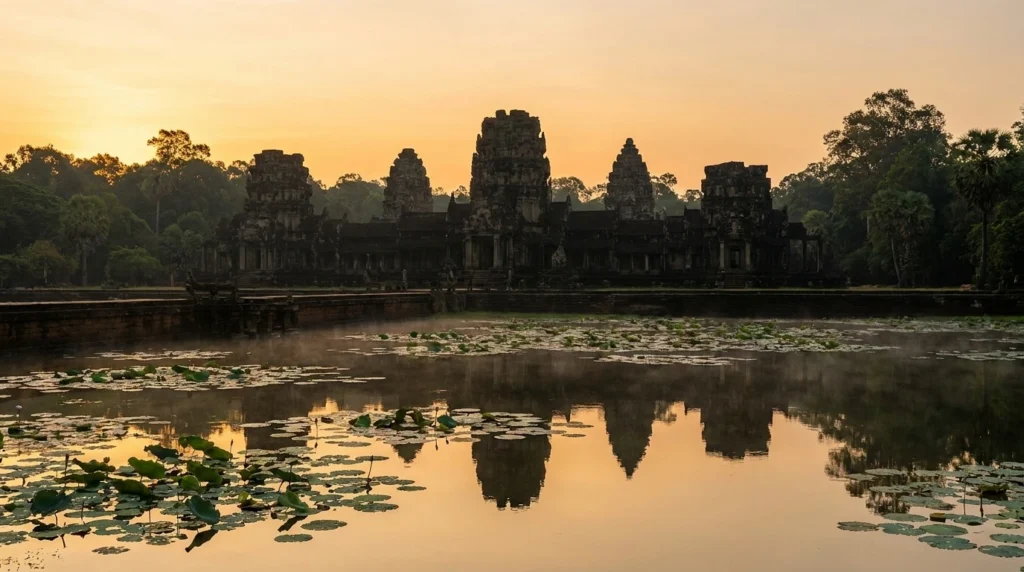
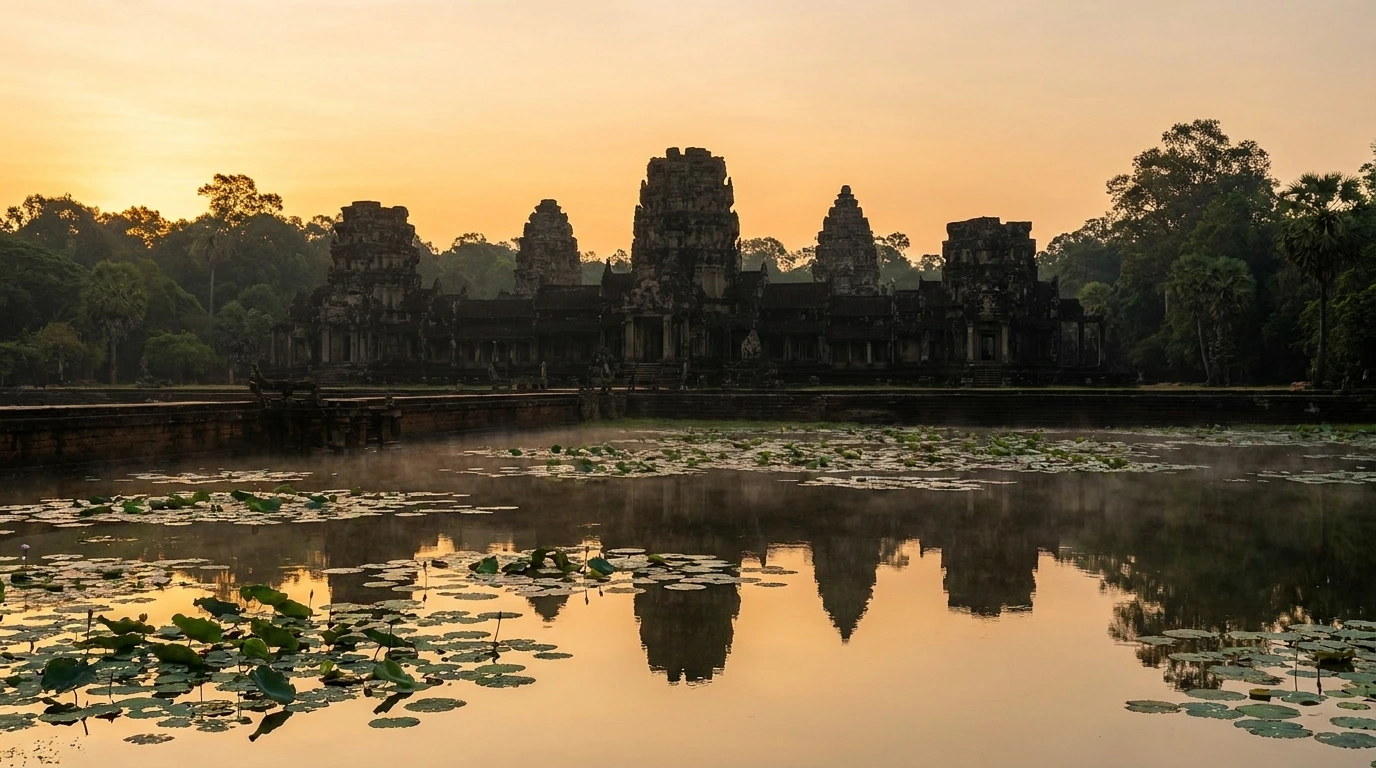
Cambodia is the Southeast Asian country that sits between Thailand and Vietnam on the Indochinese peninsula and does not, despite decades of quiet assumption, exist simply as a stopover on the way to either. It is a country anchored by the single most ambitious religious structure ever built — the 162-hectare Angkor Wat — and by a 20th-century history so shattering that every Cambodian over fifty you will meet carries its direct memory. Treating Cambodia as a three-day temple detour from Bangkok misses the country entirely.
The country covers roughly 181,000 square kilometres of rice plains, the Tonle Sap freshwater lake at its centre, the Cardamom mountain range to the southwest, and a 443-kilometre Gulf of Thailand coastline. A population of about 17 million people concentrates in Phnom Penh, Siem Reap, Battambang, and the Mekong provinces. The Mekong and Tonle Sap rivers meet in Phnom Penh at a confluence that reverses direction twice a year — a hydrological peculiarity that drives fisheries, rice harvests, and the annual Water Festival that packs the capital’s riverfront each November.
Two contrasts define the place. First, the temples: the Angkor Archaeological Park outside Siem Reap contains Angkor Wat (the world’s largest religious monument), the Bayon’s 216 serene stone faces, and hundreds of lesser temples across an area the size of Los Angeles. Second, the history: two hours south, the Tuol Sleng Genocide Museum and the Choeung Ek Killing Fields memorialise the roughly 1.7 to 2 million people killed under the 1975–1979 Khmer Rouge regime. Cambodia is the country that built Angkor, lost its population, and quietly rebuilt. Both facts live in every conversation.
Today’s Cambodia is young, recovering, and under-visited relative to its neighbours. International arrivals reached 6.7 million in 2024 — a genuine recovery trajectory since the 2022 border reopening, but still well below the pre-pandemic 6.6 million peak and far short of Thailand’s 35 million. For a bowl of amok fish curry or a plate of bai sach chrouk at roughly $2 USD, you get a country at ease with visitors who are willing to meet it on its own terms.
🎊 Khmer New Year 2026 — Chaul Chnam Thmey & the Country at Home
Chaul Chnam Thmey, Khmer New Year, is Cambodia’s most important cultural holiday — three days of Buddhist rituals, family reunions, temple visits, and water-and-powder street games. In 2026 it runs from Monday, April 13 through Thursday, April 16, with most families returning to their home provinces and Phnom Penh emptying dramatically. Foreign travellers either avoid the hot-season dates or lean in for an Angkor experience almost unique in its atmosphere: the temples fill with Cambodian pilgrims rather than tour buses.
- Day 1 (Moha Sangkran): April 14, 2026 — household altars prepared, new-year angel welcomed
- Day 2 (Virak Vanabat): April 15, 2026 — charitable giving and sand-stupa building at pagodas
- Day 3 (Virak Loeng Sak): April 16, 2026 — ritual Buddha bathing and elder blessings
- Siem Reap & Angkor: Domestic pilgrims at Angkor Wat and Bayon from dawn; candle offerings fill the corridors
- Phnom Penh (Wat Phnom): City empties; Wat Phnom hosts Buddhist blessings and sand-stupa construction
- Kampot riverside: Family picnics and water games with scented powder on the Praek Tuek Chhu
Bon Om Touk, the three-day Water Festival, lands on November 23–25, 2026 with roughly 400 long boats racing on the Phnom Penh riverfront to mark the Tonle Sap’s annual reversal. Pchum Ben, the 15-day Buddhist ancestors’ festival, closes with public holidays October 9–11, 2026. Angkor Wat’s dry-season sunrise window runs November through April, with the clearest dawn skies between December and February.
Best Time to Visit Cambodia (Season by Season)
Spring (Mar–May)
The hottest stretch of the year and the pre-monsoon build-up. Siem Reap and Phnom Penh climb from 28°C in early March to 38°C by mid-April, with April the single hottest month nationally. Temples are quiet with foreign tourists but domestic traffic surges around Khmer New Year from April 13–16, 2026. Upside: cheapest hotel prices of the year and photogenic Angkor crowds of domestic pilgrims rather than tour groups. Downside: sunrise-to-9 a.m. is the only comfortable window for ruin walking, and the hazy pre-monsoon skies dim the classic Angkor Wat sunrise shot.
Summer (Jun–Aug)
Southwest monsoon arrives through May and June, bringing reliable afternoon downpours that rarely last more than an hour or two. The landscape turns brilliant green, Angkor’s moats refill, and temple photography at Ta Prohm and Beng Mealea genuinely improves. The Gulf coast is wetter and the sea rougher — pick Kep and Kampot over Koh Rong during these months. Budget for mid-afternoon shelter. Downpours end as suddenly as they begin and are no obstacle to a careful traveller.
Autumn (Sep–Nov)
September and October are Cambodia’s wettest months, with regular heavy rain and localised flooding along the Tonle Sap and Mekong plains. Pchum Ben public holidays (October 9–11, 2026) bring domestic travel and closed businesses. November dries up quickly; the Bon Om Touk Water Festival over November 23–25, 2026 draws millions to the Phnom Penh riverfront and marks the effective start of peak tourist season. Book accommodation in advance.
Winter (Dec–Feb)
The dry, cool, cloudless peak window. Siem Reap holds 22–32°C, near-zero rain, low humidity, and the clearest possible Angkor Wat sunrise conditions. Phnom Penh is the most pleasant it gets. This is also the busiest foreign-tourist window: lock in hotels, Angkor Pass timing, and any Tonle Sap floating-village tours four to six weeks ahead, especially over the Christmas–New Year holiday peak. Mornings can feel genuinely chilly; bring a light layer for sunrise temple visits.
Shoulder-season tip: Late November and early December is the sweet spot — post-monsoon greenery still visible, water festivals over, prices still below Christmas-peak rates, and the cool-dry window in full effect.
Getting There — Flights & Arrival
Most travellers arrive at Phnom Penh (PNH) or the new Siem Reap–Angkor International (SAI). There are no current nonstop flights from North America or Europe; every international routing connects through a Southeast Asian hub — typically Bangkok, Singapore, Hong Kong, Seoul, or Taipei.
- Siem Reap–Angkor International (SAI) — new airport opened 2023, 40 km east of central Siem Reap; taxi 45–60 min for $30–40 USD
- Phnom Penh International (PNH) — 10 km to riverfront; taxi 25–35 min for $12–15 USD; tuk-tuk 40 min for $7–9 USD
- Sihanoukville International (KOS) — 18 km to Otres Beach and downtown; taxi 25–35 min for $15–20 USD
Flight times: 22–26 hours with one or two stops from LAX, YVR, or YYZ; 14–16 hours with one stop from London or Frankfurt; 1.5–3 hours from Bangkok, Ho Chi Minh City, Singapore, or Kuala Lumpur.
Flag carriers: Cambodia Angkor Air, Bangkok Airways, AirAsia, and Vietnam Airlines carry most regional traffic.
Visa / entry: Citizens of most nationalities need a tourist visa; the eVisa costs $36 USD total ($30 fee + $6 processing) for a 30-day single-entry stamp via the official Ministry of Foreign Affairs portal. Visa-on-arrival is also available at PNH, SAI, and major land borders.
Getting Around — Tuk-tuks, VIP Buses & the Angkor Pass
Cambodia is compact enough that most travellers skip domestic flights and use roads. The Giant Ibis and Mekong Express VIP bus network connects Phnom Penh, Siem Reap, Battambang, Sihanoukville, and Kampot on comfortable reclining-seat coaches. The 2022 Phnom Penh–Sihanoukville Expressway cut that run to about three hours, and a new National Road 6 expressway to Siem Reap is shortening the capital-temple link toward six hours. PassApp handles urban tuk-tuks in both capitals. The national Royal Railway runs weekend-only passenger trains on two restored lines.
- Angkor Pass: $37 / $62 / $72 USD for 1-day / 3-day / 7-day passes
- Phnom Penh → Siem Reap (VIP bus via NR6): ~6 hours
- Phnom Penh → Sihanoukville (expressway): ~3 hours on the 2022 expressway
- Siem Reap → Battambang (bus): ~3 hours by bus; 6–8 hours by scenic Tonle Sap boat in wet season
Domestic flights: Phnom Penh ↔ Siem Reap runs 45 minutes on Cambodia Angkor Air or Sky Angkor, though most budget travellers now drive it.
Urban transit: PassApp-hailed tuk-tuks ($1–3 USD per ride) dominate in both capitals; Phnom Penh also runs 13 city bus lines at a 1,500-riel (~$0.40 USD) flat fare.
Apps: PassApp (tuk-tuks), Grab (cars and food delivery), Google Maps, and Maps.me for offline navigation.
Top Cities & Regions
📍 Map of Cambodia: Every Place in This Guide
🛕 Siem Reap
The gateway to Angkor and Cambodia’s biggest draw. A compact town on the Siem Reap River transformed by temple traffic — Pub Street, French Quarter guesthouses, the night market, and hundreds of temples across the Angkor Archaeological Park. Three days is the minimum; five lets you add Beng Mealea and a Tonle Sap floating-village morning.
- Angkor Wat — the 162-hectare 12th-century temple, world’s largest religious monument
- Bayon and Angkor Thom — the 216 stone faces of Jayavarman VII’s state temple at the walled city’s centre
- Ta Prohm — the jungle temple left partially to the strangler figs, the “Tomb Raider temple” of 2001
Signature dishes: amok trei (fish curry steamed in banana leaf), nom banh chok (morning rice noodle with green fish curry), and lok lak.
🏛️ Phnom Penh
The riverfront capital at the confluence of the Tonle Sap, Mekong, and Bassac rivers — French colonial villas, the Royal Palace and Silver Pagoda, the Central Market, and the country’s most important sites for understanding the Khmer Rouge era. Budget two full days: one for the palace and markets, one for Tuol Sleng and Choeung Ek.
- Royal Palace and Silver Pagoda — active royal residence with 5,000 silver floor tiles and the Emerald Buddha
- Tuol Sleng Genocide Museum (S-21) and Choeung Ek Killing Fields — essential memorials to the 1975–1979 regime
- Central Market (Phsar Thmei) and the Russian Market (Phsar Toul Tom Poung) for street food and textiles
Signature dishes: bai sach chrouk (pork and broken rice breakfast), kuy teav (rice noodle soup), and num pang.
🎨 Battambang
Northwestern riverside town with the country’s best-preserved French colonial streetscape — wide boulevards, shophouses along the Sangker River, the Phare Ponleu Selpak circus school, and the Killing Caves at Phnom Sampeau. Two nights is a reasonable stop between Siem Reap and Phnom Penh.
- Bamboo Train (Norry) on the rebuilt eastern line — short flatbed rides through paddy fields
- Phare Ponleu Selpak — the circus school and nightly performances that seeded the Siem Reap Phare show
- Phnom Sampeau — hilltop pagoda above the Killing Caves and the nightly bat exodus from the cliff
Signature dishes: prahok ktis (fermented fish dip with pork and coconut), nom banh chok, and fresh Battambang oranges.
🌴 Sihanoukville & Otres
The Gulf of Thailand port city, rebuilt around casino development between 2018 and 2022 and now stabilising. Most independent travellers skip the centre and head to Otres Beach or the Koh Rong islands by ferry.
- Otres 1 and Otres 2 — the surviving quieter stretches of beach south of central Sihanoukville
- Ream National Park — mangrove boat tours and the jungle beach at Koh Sampoch
- Serendipity and Ochheuteal Piers for ferry connections to Koh Rong and Koh Rong Samloem
Signature dishes: fresh grilled squid, ang dtray-meuk (grilled octopus), and seafood amok.
🦀 Kampot & Kep
Twin southern-coast towns beloved for their pace. Kampot sits on the Praek Tuek Chhu River with colonial shophouses and world-famous pepper plantations; Kep is a short drive east — ruined modernist villas, the celebrated crab market, and Rabbit Island offshore.
- Kampot pepper farms — Protected Geographical Indication peppercorns at La Plantation and Sothy’s
- Kep Crab Market — lunchtime stalls serving blue swimmer crab stir-fried with Kampot pepper
- Bokor National Park — the abandoned hill station, 1920s casino ruins, and Popokvil Falls
Signature dishes: Kampot pepper crab, amok, and fresh green peppercorns with pork.
🏝️ Koh Rong Islands
Two sister islands off Sihanoukville — Koh Rong (bigger, Koh Touch backpacker strip and quieter Long Set Beach) and Koh Rong Samloem (smaller, Saracen Bay and Lazy Beach). Bioluminescent plankton on dark nights is the signature experience.
- Long Set (4K) Beach on Koh Rong — white sand, quieter than Koh Touch
- Saracen Bay on Koh Rong Samloem — crescent of bungalows and the island’s calm swimming beach
- Night snorkelling or kayak tours to see bioluminescent plankton in the dark moon phase
Signature dishes: fresh grilled fish, coconut curries, and island-style amok.
Cambodian Culture & Etiquette — What to Know Before You Go
The Essentials
- Remove shoes and hats when entering pagodas, monasteries, and most private homes — watch the shoe pile at the threshold. Angkor Wat’s upper Bakan sanctuary also requires shoes off.
- Dress modestly at temples: shoulders and knees covered. Strictly enforced at Angkor Wat’s Bakan and the Royal Palace; sarongs are sometimes sold at gates but bring your own. No see-through fabrics, tank tops, or short shorts.
- Use both hands when passing or receiving items — money, business cards, gifts — to elders, monks, and shopkeepers. A slight bow with a wai-style palm-press greeting (the sampeah) is the respectful default when meeting older Khmer.
- Never touch a person’s head (it is considered sacred) and never point your feet at a Buddha statue, an altar, or another person. Tuck legs back when sitting on temple floors or low stools.
- Women should never hand objects directly to a monk — place the item on a cloth or on the ground so the monk can pick it up. The rule is doctrinal, not personal, and the monks themselves will quietly indicate the protocol.
Visiting Tuol Sleng, Choeung Ek & the Killing Fields
- These sites memorialise the roughly 1.7 to 2 million Cambodians killed under the 1975–1979 Khmer Rouge. Visit with the gravity the subject deserves — no smiling selfies, no social posing, no loud conversation at the former cells or the memorial stupa.
- Budget two to three hours for Tuol Sleng (former S-21 school-turned-prison in Phnom Penh) and a half-day for Choeung Ek Killing Fields south of the capital. The audio guide at both sites is the best way to engage with the history.
- Sensitive travellers and young children can skip the displayed bone and clothing remains inside Choeung Ek’s memorial stupa; the grounds can be walked respectfully without entering the stupa itself.
- Every Cambodian you meet over 50 has direct memory of the regime. Do not press strangers for personal stories, but be prepared for moments when a guide, driver, or host volunteers one.
A Food Lover’s Guide to Cambodia
Cambodian cuisine is the quiet middle child of Southeast Asian cooking — less globally famous than Thai or Vietnamese but sitting comfortably between them in style. The foundation is kroeung, a pounded paste of lemongrass, galangal, kaffir lime, turmeric, and garlic that anchors amok and most Khmer curries. French colonial influence shows up in Phnom Penh’s num pang (baguette) sandwich culture and in sidewalk café sua, iced condensed-milk coffee sold nationwide. Prahok — fermented fish paste — is the most polarising ingredient and the backbone of village cooking.
Practical advice: eat breakfast on the street. Bai sach chrouk stalls fire up their charcoal grills around 6 a.m. and often sell out by 9. Budget around $1.50–3 USD per street meal, $8–15 USD per sit-down restaurant plate in tourist areas, and $40+ USD per person at fine-dining Khmer rooms. Cash dollars are universally accepted at stalls with change coming back in riel. Siem Reap’s Pub Street is the tourist anchor; Wat Bo Road is better eating. In Phnom Penh the Russian Market food court is the best single-location introduction.
Must-Try Dishes
| Dish | Description |
|---|---|
| Amok trei | Cambodia’s national dish — freshwater fish (snakehead or catfish) steamed in banana-leaf cups with kroeung lemongrass paste, coconut milk, noni leaves, and egg until custardy. Chicken amok (amok moan) is the common alternative for non-fish eaters. A fixture at every Khmer restaurant. |
| Nom banh chok | The national breakfast — cold fermented rice noodles topped with a thin green fish-based curry, raw banana-flower petals, fresh herbs, and cucumber. Sold by morning street vendors from shoulder-pole baskets. Battambang and Siem Reap versions differ subtly in curry sweetness. |
| Lok lak | Stir-fried marinated beef in a soy-oyster-lime-pepper sauce, plated over lettuce and tomato with a fried egg and white rice. The black pepper dipping sauce (tuk meric) uses Kampot pepper and is what distinguishes Cambodian lok lak from the similar Vietnamese bò lúc lắc. |
| Bai sach chrouk | The country’s iconic breakfast — thin-sliced pork grilled over coconut husks, served over broken rice with pickled cucumber, daikon, and a bowl of clear broth. Sold from streetside charcoal grills from 6 a.m. until the pork runs out. |
| Prahok ktis | The tourist-friendly take on prahok (fermented fish paste) — a thick dipping paste with ground pork, coconut milk, chili, and kroeung, eaten with raw vegetables. The backbone of village cooking, the most polarising ingredient, and the best entry point for a first prahok experience. |
| Kuy teav | Morning rice-noodle soup adapted from Teochew Chinese roots — clear pork or beef broth, thin rice noodles, bean sprouts, and a plate of herbs. Found at every market, rivalling Vietnamese phở in breakfast ubiquity but lighter and less assertive in flavour. |
Coffee Culture & Street-Food Institutions
Cambodia is a small arabica and robusta producer, with Ratanakiri and Mondulkiri provinces growing the crops that anchor specialty cafés in Phnom Penh and Siem Reap. Brown Coffee is the dominant domestic chain with over 100 locations; Feel Good Coffee and Tepui represent the third-wave capital scene. Sidewalk café sua dak (iced condensed-milk coffee) remains the daily ritual at around 6,000 riel (~$1.50 USD) a cup.
- Chains: Brown Coffee (nationwide), Feel Good Coffee (Phnom Penh), Amazon Café (ubiquitous)
- Street-food and restaurant institutions: Sister Srey Café (Siem Reap), Malis (Khmer fine dining, Phnom Penh), Cuisine Wat Damnak (Siem Reap), Friends the Restaurant (Phnom Penh training NGO)
Off the Beaten Path — Cambodia Beyond the Guidebook
Preah Vihear
The UNESCO-listed 11th-century mountain-edge Khmer temple perched atop a 525-metre escarpment on the Thai border in northern Cambodia. Reached by 4WD up the access road from Sra Em; the complex is visited by a tiny fraction of Angkor’s crowds, and the view south across the plains at sunrise is unrivalled. Border tensions occasionally close the site — confirm local access before committing the day. An overnight in Sra Em is almost mandatory; the drive from Siem Reap takes four to five hours each way.
Koh Ker
UNESCO-listed in 2023, Koh Ker is the former 10th-century Khmer capital 120 km northeast of Siem Reap, dominated by the 35-metre Prasat Thom step pyramid. Abandoned to jungle for a thousand years; now a day-trip from Siem Reap combined with Beng Mealea (the “jungle temple” of strangler figs) and the Kulen mountain temple Prasat Preah Ang Thom. Hire a car with driver for the circuit — roughly $80–100 USD for the day.
Banteay Chhmar
A massive but remote 12th-century temple complex in Banteay Meanchey province near the Thai border, built by Jayavarman VII with face towers comparable to the Bayon’s. The community-based tourism homestay programme is the best way to visit — a two-day trip from Siem Reap via Sisophon — and revenue flows directly to village families who maintain the site. Expect rougher infrastructure and near-empty temples.
Mondulkiri & Bunong Elephants
Eastern highland province bordering Vietnam — cool, forested, thinly populated, and home to the Bunong ethnic minority. The Elephant Valley Project near Sen Monorom is the most ethical elephant sanctuary in Southeast Asia: no riding, no forced bathing for tourists, just walking alongside retired logging elephants through the forest. Combine with Bou Sra waterfall and a Bunong homestay for a quiet three days far off the temple circuit.
Kratie & Irrawaddy Dolphins
Mekong riverside town 250 km northeast of Phnom Penh. The 15-kilometre stretch of river at Kampi is the last stable habitat for the endangered Mekong Irrawaddy dolphin — roughly 90 individuals remained in Cambodia as of 2024. Late-afternoon boat tours from the Kratie riverfront see them surface between the flooded rosewood trees. Overnight in Kampot-style colonial shophouses in Kratie town; the local durian market is the regional side-dish.
Practical Information
Cambodia is logistically straightforward — USD is universally accepted, English common in tourist zones, PassApp handles urban transport, and the eVisa is quick. A handful of quirks (dual currency, tap water, dress codes) are worth preparing for.
| Currency | Cambodian Riel (KHR, ៛); 1 USD ≈ 4,100 KHR as of April 2026 |
| Cash needs | USD dollars accepted everywhere; riel used for change under $1 USD. Bring clean, untorn small-denomination bills — damaged notes are refused. |
| ATMs | Widely available in Phnom Penh, Siem Reap, Sihanoukville; dispense USD. ABA and Acleda accept most foreign Visa and Mastercard; fees around $4–6 USD per withdrawal. |
| Tipping | Not historically expected; 5–10% in tourist restaurants is increasingly appreciated. Round up tuk-tuk fares. Angkor guides and drivers expect $5–10 USD per day. |
| Language | Khmer is the sole official language. English is common in central Siem Reap, Phnom Penh, and Sihanoukville tourist zones; patchy elsewhere. French speakers still found among older generations. |
| Safety | US State Department Level 2 — exercise increased caution, particularly around Sihanoukville casinos and border zones; unexploded ordnance risk in remote northwest provinces |
| Connectivity | Cellcard and Smart sell tourist SIMs at PNH and SAI arrivals for $5–10 USD for 30-day unlimited data. 4G excellent along tourist routes; patchy in Mondulkiri and on Koh Rong Samloem. |
| Power | Types A, C, and G plugs; 230V, 50 Hz — bring a universal adapter |
| Tap water | Not potable anywhere in Cambodia. Drink only bottled, filtered, or boiled water; use bottled for brushing teeth outside top-end hotels. |
| Healthcare | Royal Phnom Penh Hospital and Raffles Medical are the international-standard options in the capital; Royal Angkor International Hospital in Siem Reap. Carry travel insurance; evacuation to Bangkok for serious cases. |
Budget Breakdown — What Cambodia Actually Costs
Cambodia is one of Southeast Asia’s best-value destinations — prices run below Thailand and comparable to Vietnam, though the Angkor Pass and tuk-tuk-hire cost for a full Angkor day ($37 one-day pass + $20–25 USD tuk-tuk driver) adds a noticeable line item to a Siem Reap stop. A bai sach chrouk breakfast costs around $1.50 USD, a PassApp tuk-tuk across Phnom Penh $1–3 USD, and even mid-range boutique hotels in Siem Reap routinely price below $60 USD a night.
💚 Budget Traveller
Hostel dorm bed $5–10 USD, basic guesthouse $12–20 USD, street-food meals $1.50–3 USD, Giant Ibis VIP buses between cities, shared tuk-tuk days at Angkor. A full day on the ground costs roughly $25–40 USD. A bai sach chrouk breakfast, nom banh chok lunch, and amok dinner all fit comfortably under $10 USD combined.
💙 Mid-Range
Boutique hotel or riverside resort $40–90 USD per night, sit-down Khmer restaurants $8–15 USD per person, private tuk-tuks for the day ($15–25 USD), Giant Ibis VIP bus, and one domestic Phnom Penh–Siem Reap flight. A comfortable day runs $60–120 USD. Covers a Tonle Sap floating-village morning, a full-day Angkor tour with a licensed guide, and a Phare Circus ticket.
💜 Luxury
5-star resorts $250+ USD per night — Raffles Grand Hotel d’Angkor, Amansara, Rosewood Phnom Penh, Six Senses Krabey Island. Fine dining $40+ USD per person at Cuisine Wat Damnak (Siem Reap) or Malis (Phnom Penh). Private driver $80–120 USD per day; helicopter Angkor transfers and hot-air balloon rides top the price list. Budget $300+ USD daily for full private guiding.
| Tier | Daily (USD) | Accommodation | Food | Transport |
|---|---|---|---|---|
| Budget | $25–40 | Hostel dorm | Street food | VIP bus + shared tuk-tuk |
| Mid-Range | $60–120 | Boutique hotel | Sit-down restaurants | Private tuk-tuk + domestic flight |
| Luxury | $300+ | 5-star resort | Fine dining | Private driver + helicopter |
Planning Your First Trip to Cambodia
Cambodia fits comfortably into a 10-day standalone trip or as a 5–7 day leg of a wider Thailand–Vietnam swing. The classic triangle is Siem Reap (Angkor) — Phnom Penh — Kampot and the Gulf coast. Book an open-jaw ticket into SAI and out of PNH to avoid backtracking.
- Decide trip length and direction: 7 days covers Siem Reap + Phnom Penh; 10–14 days adds Battambang, Kampot, and either Koh Rong or Mondulkiri.
- Apply for the 30-day eVisa 3–5 business days before departure at evisa.gov.kh — $36 USD total. Print a copy for airport arrivals.
- Pre-book the Angkor Pass for your first temple day — the 3-day pass ($62 USD, valid across 10 days) is the sweet spot for most travellers.
- Pick up a Cellcard or Smart SIM at PNH/SAI arrivals ($5–10 USD for 30 days unlimited) or preload an Airalo eSIM before flying.
- Install PassApp and Grab before you land; book a Giant Ibis VIP bus ticket online for the Phnom Penh–Siem Reap leg in advance.
Classic 10-Day Itinerary: Siem Reap + Angkor 4 nights · Battambang 1 · Phnom Penh 2 · Kampot + Kep 2 · fly out of PNH.
Frequently Asked Questions
Is Cambodia expensive to visit?
No — Cambodia is among the best-value destinations in Southeast Asia. A bai sach chrouk breakfast runs around $1.50 USD, a PassApp tuk-tuk across Phnom Penh $1–3 USD, and mid-range boutique hotels in Siem Reap routinely price under $60 USD. Budget $25–40 USD daily for backpacker style; $60–120 USD buys comfortable mid-range travel. The Angkor Pass ($37 USD one-day) is the one meaningful line item to plan for.
Do I need to speak Khmer?
No. English is widely spoken in central Siem Reap (around Pub Street and the hotel zone), in Phnom Penh’s tourist districts, and in most Sihanoukville and Koh Rong accommodation. Patchier outside those zones — Google Translate’s Khmer coverage has improved. Learning “suostei” (hello) and “arkun” (thank you) is always appreciated by older vendors and monks.
Do I need an eVisa for Cambodia?
Yes, for most nationalities. The eVisa is $36 USD total ($30 fee + $6 processing) for a 30-day single-entry stamp, issued within 3 business days via the official Ministry of Foreign Affairs portal at evisa.gov.kh. Visa-on-arrival is also available at PNH, SAI, and major land borders. ASEAN neighbours qualify for visa-exempt entry.
Is Cambodia safe for solo travellers?
Broadly yes, with caveats. The US State Department advises Level 2 — exercise increased caution. Violent crime against tourists is rare; the main urban risks are petty theft by scooter in Phnom Penh and Sihanoukville’s casino district. Unexploded ordnance is a concern along remote northwestern borders — stick to marked paths at Preah Vihear and in rural Battambang province.
When is the best time to visit Cambodia?
December to February — dry, cool, cloudless, and the clearest Angkor sunrise conditions. November is the shoulder sweet spot (post-monsoon greenery, fewer crowds, Water Festival atmosphere). Avoid peak-heat April unless you want the Khmer New Year atmosphere, and expect heavy rain September–October. Book December hotels 4–6 weeks ahead.
Can I get by as a vegetarian or vegan?
Yes, with navigation. Cambodian Buddhist culture sustains vegetarian (som chay) options at temples and larger restaurants in Siem Reap and Phnom Penh. Say “te sach” (no meat) and “te prahok, te nam pla” to avoid fish paste and fish sauce, which appear as background seasoning. Dedicated vegetarian places cluster on Wat Bo Road in Siem Reap.
Is the Tuol Sleng Genocide Museum worth visiting?
Yes — Tuol Sleng (S-21) and the Choeung Ek Killing Fields are essential context for understanding Cambodia beyond the temples. The audio guide runs two to three hours at Tuol Sleng and a half-day for Choeung Ek including transfer. Visit with the gravity the subject deserves.
📘 Book Your Cambodia Trip — hotels, Angkor tours, and island transfers through our partners.
Ready to Explore Cambodia?
Start in Siem Reap for three sunrises at Angkor, ride down the expressway to Phnom Penh for the Royal Palace and the sobering S-21, and finish over Kampot pepper crab on the Gulf coast. Cambodia rewards travellers who slow down, respect the temples and the history, and let the tuk-tuk engine do the rest.
Explore More
Cities we cover in Cambodia
More country guides you might like
Plan your trip to Cambodia
The booking tools we use ourselves. FFU may earn a commission at no extra cost to you.
Plan & book your trip to Cambodia
Booking through these searches supports our guides at no extra cost to you.