
Languages of Estonia
All languages of Northern Europe →fluent beta classical · classes by phone with Maya at ranas.ai/maya
Estonia Travel Guide — Medieval Old Towns, Digital Republic & Baltic White Nights
Estonia Travel Guide
📋 In This Guide
- Overview — Why Estonia Belongs on Every Bucket List
- 🔥 Jaanipäev Midsummer 2026 — White Nights on the Baltic
- Best Time to Visit Estonia (Season by Season)
- Getting There — Flights & Arrival
- Getting Around — Elron Trains, Ferries & the Tallinn Card
- Top Cities & Regions
- Estonian Culture & Etiquette
- A Food Lover’s Guide to Estonia
- Off the Beaten Path
- Practical Information
- Budget Breakdown
- Planning Your First Trip to Estonia
- Frequently Asked Questions
Overview — Why Estonia Belongs on Every Bucket List
Estonia is a small, forested, deeply Nordic-leaning republic on the east shore of the Baltic Sea, whose 1.374 million residents have built one of the most digital societies on Earth while preserving a UNESCO-listed medieval Old Town and a Finno-Ugric song tradition older than written Estonian itself. The country covers just 45,339 square kilometres — a bit smaller than Denmark — but half of that land is forest and the Baltic coast breaks up into 2,222 islands, which makes Estonia one of Europe’s least crowded, most coastal countries.
The geography explains most of the rest. Estonia’s north (Harjumaa, around Tallinn) is low Baltic coastline broken by limestone cliffs and the Gulf of Finland; the south (Tartu and Setomaa) is rolling drumlin country reaching the 318-metre Suur Munamägi, the highest point in the Baltic states; the west is an island world of Saaremaa, Hiiumaa and Muhu; and the east ends dramatically at the Narva River, where the 13th-century Hermann Castle stares directly across the water at Russia. Roughly 51% of the land is forest, more than 22% is protected, and the country’s Finno-Ugric heart — its national virtue of stubborn, quiet perseverance — is captured in the word laulupidu, the song celebration that powered the Singing Revolution.
Culturally, Estonia runs on quiet egalitarianism, sauna steam and digital trust. It was part of the Soviet Union from 1940 to 1991, and restored its independence on August 20, 1991 after a four-year nonviolent movement in which 300,000 Estonians sang together at the Tallinn Song Festival Grounds. Since joining the European Union and NATO in 2004, Schengen in 2007 and the euro in 2011, Estonia has leaned hard into the West — but the Russian-speaking minority (around 24%) and the Narva borderland keep the country’s geography front and centre. Estonians are often described as reserved, and on first contact they are; once inside a sauna or across a coffee table, the warmth arrives.
Practically, Estonia is one of Europe’s easiest countries to travel. English is near-universal, cards work everywhere (this is arguably the world’s first truly cashless society), Tallinn Airport sits 4 kilometres from Old Town, and the 2-hour Tallink ferry from Helsinki turns the whole country into a one-day bolt-on from Finland. A walking morning through Old Town, a KUMU afternoon and a sauna-and-black-bread supper will cost under €60.
🔥 Jaanipäev Midsummer 2026 — White Nights on the Baltic
Jaanipäev — Estonia’s Midsummer — is a bigger deal than Christmas for many Estonians, and in 2026 it is one of the best reasons to plan a June trip. Tallinn, Tartu and the industrial cities genuinely empty; families decamp to lake cottages, to the islands and to the Baltic coast; and every shoreline from Pärnu to Käsmu lights a jaanituli bonfire as the 23 June evening slips into the 24 June morning. North of latitude 58° the sun barely dips below the horizon and Tallinn gets roughly 18 hours of genuine daylight with civil twilight covering the rest.
- Jaaniõhtu (Midsummer’s Eve): Tuesday June 23, 2026 — jaanituli bonfires light after 22:00 on coastlines nationwide
- Jaanipäev (Midsummer’s Day): Wednesday June 24, 2026 — public holiday, shops and museums closed
- Peak White Nights window: June 10 through July 5, 2026 — civil twilight never fully ends in Tallinn
- Pärnu & Saaremaa: Estonia’s summer capital holds a beachfront jaanituli on Rannapark; Kuressaare and the Muhu villages run traditional kiiking swings and leelo singing
- Lahemaa National Park: the preserved fishing villages of Altja, Käsmu and Viinistu each light coastal bonfires; Tallinn Song Festival Grounds runs the main urban bonfire
Best Time to Visit Estonia (Season by Season)
Spring (Mar–May)
Estonia’s thaw. Tallinn climbs from roughly -2°C to 16°C through the three months, daylight stretches rapidly (by mid-May it is light past 22:00 in Tallinn), and the Baltic coast slowly unfreezes. The real draw is the shoulder pricing — April and early May see hotel rates 20–30% lower than summer peak, Old Town crowds thinner and the bog-board trails of Lahemaa just opening after winter. Tartu’s student calendar peaks with the late-April Tartu Student Days festival and Tallinn’s Jazzkaar international jazz festival spans late April. Downside: the countryside is muddy, island ferries sail reduced schedules through March, and lake-cottage season has not yet started.
Summer (Jun–Aug)
The main event. Tallinn runs 17–22°C with occasional 28°C spikes; Pärnu’s beach fills from late June; and Jaanipäev on June 23–24, 2026 empties the cities into the forests and islands. July brings Tallinn Medieval Days, Pärnu’s summer-opera season and Saaremaa’s opera days; Seto Kingdom Day lands on the first Saturday of August in Setomaa’s Värska and Obinitsa villages. Warnings: Tallinn Old Town is genuinely crowded in July and August (1.2 million cruise passengers a year disembark at Tallinn’s port), the islands sell out of ferry slots 4–6 weeks ahead, and mosquitoes in Soomaa and Lahemaa bogs are ferocious without DEET.
Autumn (Sep–Nov)
A short, golden season. Temperatures fall from 16°C in early September to near 0°C by late November; Estonian birch and oak forests turn copper through late September, and Lahemaa’s bogs glow orange under the wooden boardwalks — often considered the year’s best two weeks for hiking. Mushroom and berry foraging peaks in September under Estonia’s everyman’s-right tradition. Tallinn’s Black Nights Film Festival (PÖFF) runs through late November and is the largest film festival in Northern Europe. September is also the single best-value month — shoulder rates, stable weather and museums back to normal hours after the tourist rush.
Winter (Dec–Feb)
Dark and festive. Tallinn runs -5°C to 2°C with roughly 6 hours of daylight around the solstice; snow holds from December through March. Tallinn Christmas Market on Town Hall Square (late November through early January) is consistently voted one of Europe’s most atmospheric. The Old Town’s medieval lanes under snow, Kadriorg Park’s frozen pond, and a sauna-verivorst-sült supper are the whole Estonian winter in one evening. Outside Tallinn, Otepää in the south is the country’s small ski and cross-country hub.
Shoulder-season tip: September is Estonia’s best-value window — warm days, long evenings, harvest-markets open and hotel rates 20–30% below midsummer. Early May is the close second, with cheaper flights and Old Town not yet swamped by cruise passengers.
Getting There — Flights & Arrival
Tallinn dominates arrivals. Long-haul flights route through Helsinki, Frankfurt, Riga or Warsaw; the Tallink ferry from Helsinki adds a second front door.
- Lennart Meri Tallinn Airport (TLL) — Estonia’s main gateway and Europe’s closest major airport to a capital city centre, just 4 km from Old Town; 3.6 million passengers in 2024. Tram 4 reaches Viru Square in 15 minutes for €2.
- Tartu Airport (TAY) — Tartu’s regional airport 9 km southwest of the city, with seasonal Finnair service from Helsinki (~45 minutes).
- Kuressaare Airport (URE) — Saaremaa’s small airport, with Transaviabaltika daily flights from Tallinn (~40 minutes) as an alternative to the Virtsu car ferry.
Flight times: London–Tallinn 3 hours direct; Frankfurt–Tallinn 2 hours 30 minutes direct; Helsinki–Tallinn 30 minutes by air or 2 hours by Tallink ferry; New York–Tallinn roughly 9 hours one-stop via Helsinki, Frankfurt or Riga.
Carriers: airBaltic (the dominant Baltic carrier), Nordica (Estonian flag carrier), Finnair on the Helsinki shuttle, plus Ryanair and Wizz Air.
Visa / entry: Schengen rules apply — citizens of the US, UK, Canada, Australia, Japan, South Korea and 60+ other countries enter visa-free for up to 90 days in any 180-day window. Beginning late 2026, visa-exempt travellers will need an ETIAS pre-authorisation (~€7, online, valid 3 years).
Getting Around — Elron Trains, Ferries & the Tallinn Card
Estonia is small and well connected. National rail operator Elron runs electric intercity trains north–south (Tallinn–Tartu, Tallinn–Narva) and east (Tallinn–Pärnu), all reaching 135 km/h top speed; Tallink and Viking Line ferries span the Gulf of Finland to Helsinki in 2 hours; TS Laevad car ferries reach Saaremaa and Hiiumaa in 30–90 minutes from the mainland; and intercity buses (Lux Express, Tpilet) fill the gaps. For Tallinn itself, the free tram-and-bus system (for residents) plus the Tallinn Card covers almost everything.
- Elron electric intercity rail: top speed 135 km/h on the Tallinn–Tartu and Tallinn–Narva lines.
- Tallinn → Tartu: 2 hours by Elron express.
- Tallinn → Pärnu: 2 hours 15 minutes by Elron or Lux Express bus.
- Tallinn → Narva: 2 hours 15 minutes by Elron express; check travel advisories before the eastern border region.
- Tallinn ↔ Helsinki ferry: 2 hours on Tallink or Viking Line, roughly 8 sailings per day, from €25–80 depending on season.
Tallinn Card: the 24h/48h/72h pass runs €32, €47 and €57 respectively and covers all public transit, roughly 40 museums including KUMU, Kadriorg Palace and the Estonian Maritime Museum, plus a free walking tour.
City transit cards: Ühiskaart in Tallinn (€2 single, free for residents), Pilet.ee app in Tartu (€1.50 single), contactless tap works at most urban validators.
Apps: Elron (rail booking), Pilet.ee (regional bus), Bolt (ride-hailing and e-scooters, founded in Tallinn).
Top Cities & Regions
📍 Map of Estonia: Every Place in This Guide
🏰 Tallinn
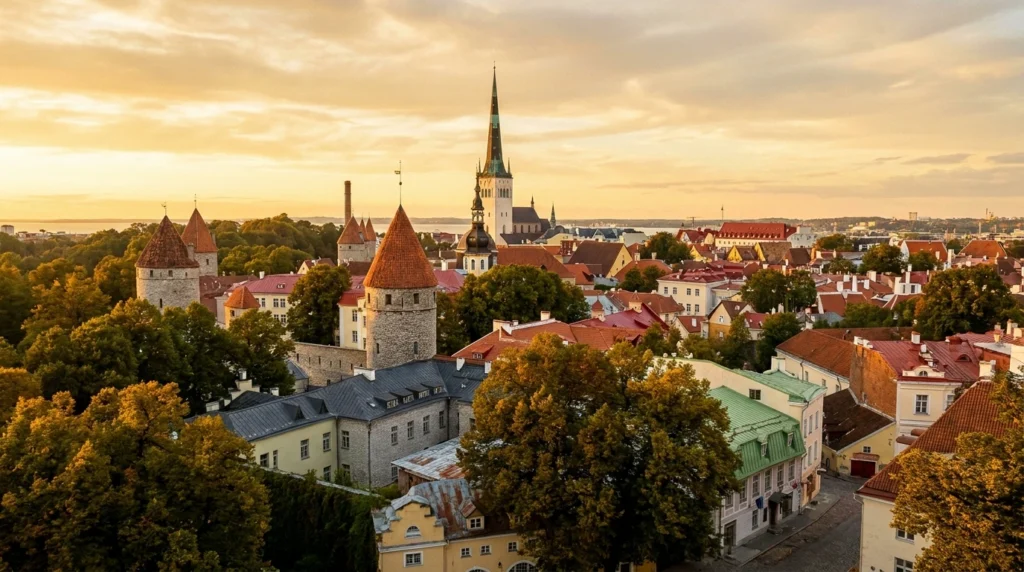
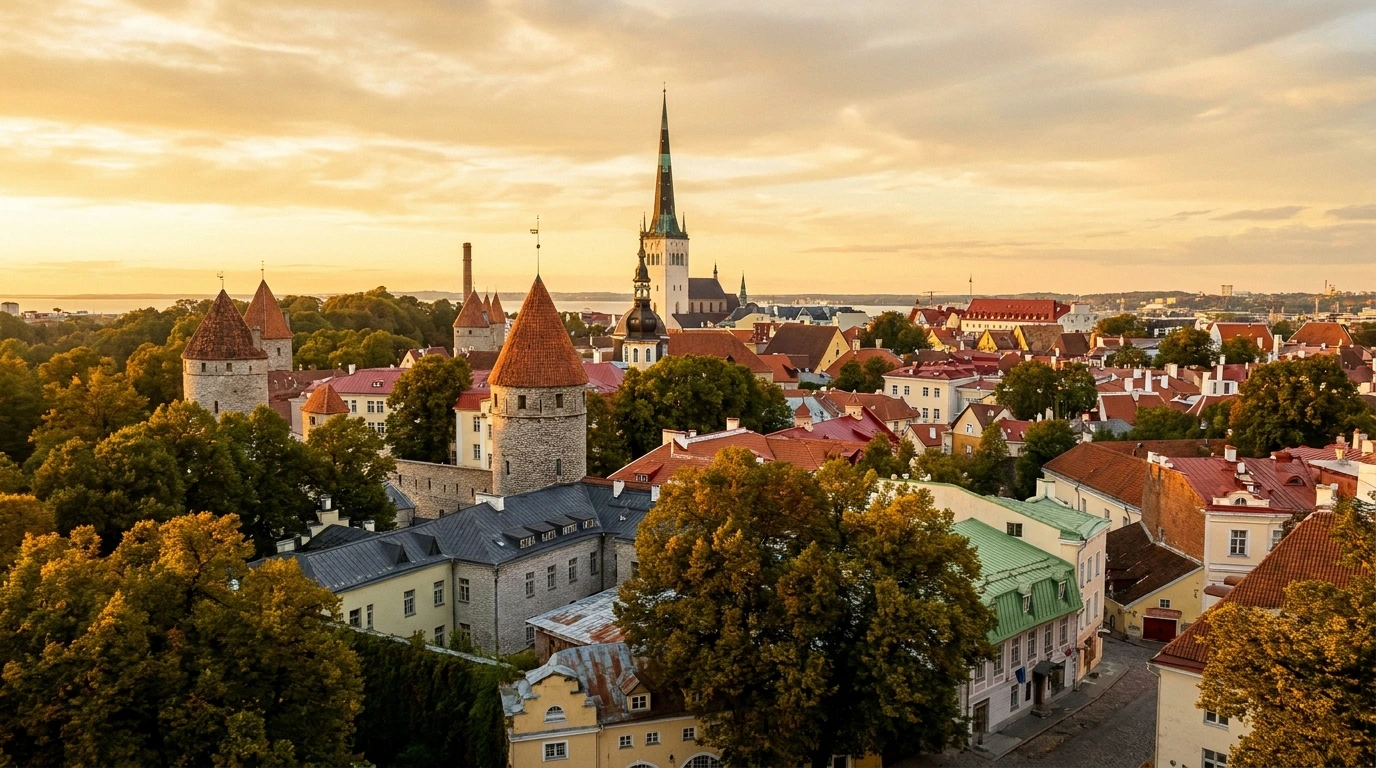
Estonia’s UNESCO-listed medieval capital on the Gulf of Finland — a walled Hanseatic Old Town of pastel merchant houses, Gothic spires and cobbled lanes, fused with the startup-heavy Telliskivi quarter and the modernist seaside KUMU art museum.
- Tallinn Old Town — UNESCO World Heritage since 1997, with Town Hall Square, St. Olaf’s Church and 46 surviving medieval wall towers
- Telliskivi Creative City and Balti Jaam Market — a converted railway workshop full of design studios, vegan cafés and street art behind the central station
- KUMU Art Museum and Kadriorg Palace — Catherine I’s 1718 baroque palace and the Nordic Council-awarded national gallery beside it
Signature eats: black rye bread (must leib); kiluvoileib (sprat sandwich); verivorst with lingonberry; sült at a Christmas Market stall; a Vana Tallinn shot.
📚 Tartu
Estonia’s university city on the Emajõgi River — home to the 1632 University of Tartu, the intellectual capital and the 2024 European Capital of Culture, with a student-heavy Old Town and wooden Supilinn and Karlova neighbourhoods.
- University of Tartu main building (founded 1632) and the Town Hall Square leaning-students statue — the heart of the academic quarter
- Estonian National Museum (ERM, opened 2016) — a 356-metre-long ramp-shaped building on a former Soviet airfield, covering Estonian ethnography and Finno-Ugric cultures
- Supilinn (Soup Town) and Karlova — colourful wooden-house neighbourhoods of cafés, galleries and student bars
Signature eats: mulgipuder (potato-and-barley mash with bacon); kama porridge; smoked lake fish from Lake Peipus; black bread; a glass of Põltsamaa fruit wine.
🏖️ Pärnu
Estonia’s summer capital on the Gulf of Riga — a 19th-century spa town with a 2-kilometre white-sand beach, wooden villas in leafy Rannapark, a lively July festival calendar and the country’s most relaxed pace of life.
- Pärnu Beach and the curved wooden Rannahoone beach pavilion (1939) — Estonia’s most-loved sandy beach, Midsummer bonfire site and open-air concert stage
- Ammende Villa (1905) and the surrounding Rannapark — a preserved Art Nouveau spa villa and the Scandinavian-Baltic spa-town quarter around it
- Pärnu Old Town — Tallinna Gate (1695, the last surviving city gate in Estonia) and the 15th-century Red Tower
Signature eats: smoked Baltic herring; fried Baltic sprats (kilud); black bread; kiluvoileib on every summer terrace; rhubarb desserts at July’s Pärnu Fish Festival.
🏝️ Saaremaa (Baltic Island)
Estonia’s largest island — a windmill-dotted limestone island of fishing villages, juniper moors, a 14th-century bishop’s castle at Kuressaare and a famously strong island-Estonian dialect. Reached by car ferry from Virtsu (~30 minutes) or short Transaviabaltika flight from Tallinn.
- Kuressaare Episcopal Castle (begun 1380s) — the best-preserved medieval castle in the Baltic states, with its complete moat and bastions still intact
- Angla Windmill Park — five 19th-century wooden windmills on the island’s northern inland route, beside the 14th-century Karja Church
- Kaali Meteorite Crater — a 110-metre-wide crater from a roughly 3,500-year-old impact, a sacred site in pre-Christian Estonian folklore
Signature eats: juniper-smoked Saaremaa lamb, island-baked sweet dark bread (kodusai), smoked handi (island herring), and a glass of Saaremaa Vodka or Pihtla Olu island ale.
🌲 Lahemaa National Park (North Coast)
Estonia’s original national park, established in 1971 as the Soviet Union’s very first — 725 square kilometres of Baltic coastline 70 km east of Tallinn, with preserved fishing villages (Altja, Käsmu, Viinistu, Vergi), the restored Palmse and Sagadi Baltic-German manor estates and the 3.5-kilometre Viru Bog boardwalk.
- Palmse and Sagadi manor houses — 18th-century Baltic-German estates now running as museums and guesthouses
- Viru Bog boardwalk and Käsmu fishing village — the country’s most-walked bog trail plus one of its most atmospheric coastal villages
🛡️ Narva & the Eastern Border
Estonia’s Russian-speaking far east on the Narva River — the 13th-century Hermann Castle stares directly across the water at Russia’s Ivangorod Fortress, one of Europe’s most dramatic border confrontations. Visit with awareness that this is a post-2022 frontier region with heightened security; Ida-Virumaa is safe but worth a current travel-advisory check.
- Narva Castle (Hermann Fortress) — the Livonian castle whose 51-metre Tall Hermann tower faces Ivangorod across the river
- Narva-Jõesuu beach and the Sinimäed hills — a quiet Baltic resort strand and World War II memorial hills respectively
Estonian Culture & Etiquette — What to Know Before You Go
Estonian culture sits firmly in the Nordic column — quiet, egalitarian, punctual, and trust-based rather than effusive. There is almost no performed hierarchy on display; the minister and the intern take the same tram and queue in the same order at the same coffee counter. Estonians are often called reserved by outsiders — and they are, on first contact — but the warmth arrives reliably by the second coffee, and still more reliably inside a sauna. Most social mis-steps come from being loud, late, or starting small talk with strangers.
The Essentials
- Remove shoes at the door. Estonian homes and guesthouses universally expect shoes off on arrival; slippers are often offered.
- Silence is comfortable. Estonians are closer to Finns than to Russians in temperament — do not fill pauses with small talk, and let handshakes be short and firm.
- Address people formally at first. Use titles (Härra/Proua, Mr/Mrs) and last names on first meeting; first names follow when the relationship warrants.
- Pay by card — for everything. Estonia is one of Europe’s most card-first economies; even buses, market stalls and public toilets accept contactless.
- Respect language sensitivities. Estonian is the sole official language; greeting in Estonian (tere, aitäh) or English is always welcome. Russian is widely spoken in Ida-Virumaa, but the region’s politics are raw post-2022 — stay factual, avoid opinions on Russia.
Sauna Etiquette
- Estonians share the Finnish sauna (saun) culture: public saunas are gender-separated and nudity is the norm; in mixed family saunas, a towel is fine.
- Shower before entering the hot room — it is not optional, it is hygiene.
- Pour water on the kerises (stove) gently to make leil (the steam); ask permission before the next pour in a shared sauna.
- Swim in the lake, the Baltic, or — in winter — roll in the snow between rounds; the hot-cold contrast is the whole point of the ritual.
- Phones, loud voices and beer cans are not sauna etiquette; quiet conversation is.
A Food Lover’s Guide to Estonia
Estonian food has quietly become one of the Baltic’s most interesting cuisines. The traditional canon — black rye bread, Baltic sprats, blood sausage, head cheese, reindeer from the islands, kama — sits alongside a New Nordic restaurant scene that has produced Tallinn Michelin stars at NOA, 180° by Matthias Diether, Tuljak and Fotografiska. Seasonal Baltic fish, foraged forest mushrooms, Lake Peipus smoked eel and Saaremaa juniper-smoked lamb flow into kitchens that take seasonality seriously; the rye-bread tradition ties everything together.
Must-Try Dishes
| Dish | Description |
|---|---|
| Must leib (Black Rye Bread) | Dense, dark, sweet-sour sourdough rye — the national staple, eaten with butter, cheese, smoked fish or alongside kiluvoileib. Every meal begins with bread, and Estonians traditionally kiss a dropped slice as apology. Supermarket loaves run €2–4; artisanal bakery loaves €5–8. |
| Kiluvoileib (Sprat Sandwich) | Open-faced sandwich of black bread, butter, sliced boiled egg and Baltic sprats (kilud) cured in spiced brine — the classic Estonian pub snack and an essential Midsummer table item. Typically €3–5 at a Tallinn pub; €2–3 at Balti Jaam Market stalls. |
| Sült (Head Cheese / Jellied Meat) | Cold pork-and-trotter terrine set in its own gelatin, served with horseradish or strong mustard and black bread — a Christmas-table essential served throughout winter. Sold at every Christmas Market stall from late November; €4–7 at a sit-down restaurant. |
| Verivorst (Blood Sausage) | Rye-and-barley blood sausage, traditionally the centrepiece of the Estonian Christmas table — served hot with lingonberry jam, sauerkraut and roast potatoes. Tallinn Christmas Market on Town Hall Square is the easiest place to try the classic version. €6–10 at market stalls. |
| Kama | A silky cool drinkable-porridge made from roasted barley, rye, oat and pea flour stirred into buttermilk or kefir, often with sugar and wild berries — Estonia’s uniquely Finno-Ugric answer to a smoothie. Sold as a dry mix in every supermarket for around €3 per 500g; cafés serve kama desserts and kama kokteil cocktails for €4–6. |
| Mulgipuder (Mulgi Porridge) | A South Estonian peasant dish of mashed potato cooked with pearl barley and topped with bacon and caramelised onion — comfort food from the Viljandi region, on most traditional-Estonian restaurant menus for €10–14 a plate. |
| Vana Tallinn | Estonia’s trademark dark rum liqueur, first distilled in 1962 and still produced by Liviko — 40% ABV, with citrus-and-vanilla notes, served neat, stirred into coffee or drizzled over ice cream. A 500ml bottle runs €10–14 at an Alcohol shop; a shot at a Tallinn pub is €3–5. |
Market Halls, Selver & the Estonian Supermarket Run
Estonia does not have Japanese-style convenience stores, but it has a dense network of supermarkets and one of Europe’s most atmospheric market halls. Balti Jaam Market (Tallinn, reopened 2017 behind the central railway station) is the flagship — three storeys of food counters, a dedicated vegan level, a vintage-clothing basement and some of the city’s best street food. Selver, Rimi, Maxima and Coop dominate the supermarket side; R-kiosk runs the transit-station kiosk network. For strong liquor the Alcohol shop is the specialty off-licence, and Viru Keskus mall is the Old Town’s all-weather anchor.
- Chains: Selver, Rimi, Maxima, Coop, R-kiosk (kiosk), Balti Jaam Market (Tallinn flagship).
- Signature items: must leib (black rye bread), kiluvoileib makings, Põltsamaa mustard, Kalev chocolate and marzipan, Vana Tallinn liqueur, Saaremaa Vodka, hapukapsas sauerkraut, pickled pumpkin, kama mix, rhubarb jam and Põltsamaa fruit wines.
Off the Beaten Path — Estonia Beyond the Guidebook
Kihnu Island
A 17-square-kilometre Gulf of Riga island of roughly 700 residents where a UNESCO-inscribed matriarchal cultural space still operates — women in striped red kört skirts, sidecar motorbikes instead of cars, Orthodox-flavoured folk Christianity, and a working fishermen’s song tradition passed between generations. Reached by a 1-hour ferry from Munalaid; best visited mid-June through August, with bicycle the only sensible island transport. Respect for locals is central here — this is a living community, not an open-air museum.
Setomaa & Seto Kingdom Day
Estonia’s Finno-Ugric, Orthodox-Christian cultural minority live in the far southeast corner on the Russian border. The Seto people have their own language (Seto, distinct from Estonian), polyphonic leelo singing (UNESCO-listed), a homemade sõir cheese tradition and — once a year — Seto Kingdom Day (Seto Kuningriigi päev), held on the first Saturday of August when a ceremonial king or queen is crowned in the village of Värska or Obinitsa. The best base is Värska itself.
Lahemaa National Park
Estonia’s original national park, established in 1971 as the Soviet Union’s very first national park — 725 square kilometres of pine-and-bog Baltic coastline 70 km east of Tallinn. Four preserved fishing villages (Altja, Käsmu, Viinistu, Vergi), the Palmse and Sagadi Baltic-German manor estates, and the 3.5-km Viru Bog boardwalk make it the easiest Estonian wilderness day trip. Autumn colours peak in late September; Jaanipäev bonfires light the coastal villages on June 23, 2026.
Hiiumaa Island
Estonia’s second-largest island, quieter and wilder than Saaremaa — a rectangle of forest, pebble beaches, restored farmsteads and the 36-metre Kõpu Lighthouse, first recorded in 1531 and among the oldest continuously operating lighthouses in the world. Reached by 1h 25m car ferry from Rohuküla; Kärdla is the small main town. Hiiumaa is known for its deadpan self-deprecating humour and is a favourite writer’s-retreat island.
Soomaa National Park & Bog Shoes
A 370-square-kilometre raised-bog wilderness in southwest Estonia where the ‘Fifth Season’ — spring flooding — turns meadows into navigable waterways for traditional dugout canoes (haabja). Bog-shoeing (rändsussid) across the peat surface, beaver-spotting night hikes and canoe rentals from Riisa are the signature experiences. Easiest as a day trip from Pärnu or Viljandi; early April is the peak Fifth Season window, though conditions depend on the winter’s snowfall.
Practical Information
| Currency | Euro (€ / EUR); 1 USD ≈ 0.94 EUR (April 19, 2026). Estonia adopted the euro on January 1, 2011. |
| Cash needs | Near-zero. Estonia is one of the world’s most cashless, card-first economies — contactless Visa, Mastercard and Apple Pay work in trams, market stalls, taxis, public toilets and island guesthouses. Carry a backup card rather than cash. |
| ATMs | Swedbank, SEB and LHV ATMs are common in cities and at Tallinn Airport. Rural Saaremaa, Hiiumaa and Setomaa may have only one machine per village — top up in Kuressaare or Kärdla before heading into the countryside. |
| Tipping | Not expected. Service is included. Rounding up at a café or adding 5–10% at a sit-down restaurant is appreciated, never obligatory. |
| Language | Estonian — Finno-Ugric, closely related to Finnish, unrelated to Russian — is the sole official language; Russian is widely spoken in Tallinn and Ida-Virumaa; English is near-universal under 40. Estonia ranked 6th in the 2024 EF English Proficiency Index. |
| Safety | Very safe — Estonia ranked 31st in the 2024 Global Peace Index; violent crime against visitors is rare. Main risks: pickpocketing around Old Town tourist spots and over-drunk port-area stag parties. |
| Connectivity | Nationwide 4G/5G on Telia, Elisa and Tele2; eSIMs (Airalo, Holafly) activate on landing. Free WiFi is essentially ubiquitous. |
| Power | Type C and Type F (Schuko) plugs; 230V / 50 Hz. |
| Tap water | Safe and drinkable everywhere — Tallinn and Tartu tap water meets EU standards and is served free at most restaurants on request. |
| Healthcare | Universal public system. EU visitors use EHIC; others need travel insurance. Emergency number is 112; pharmacies (apteek) are widespread and most pharmacists speak English. |
Budget Breakdown — What Estonia Actually Costs
💚 Budget Traveller
Hostels (Tabinoya in Tallinn Old Town, Terviseks Hostel in Tartu, Lõuna Hostel in Pärnu), Selver and Rimi supermarket runs, Elron off-peak intercity tickets and a Tallinn Card that pays for itself if you hit three museums in a day. Doable at €65–100 per day (~US$70–110), with Tartu and Pärnu running roughly 15–25% cheaper than Tallinn. A supermarket lunch under €6, a market-stall kiluvoileib around €3, and a hostel dorm €20–40 per night.
💙 Mid-Range
A 3-star central hotel (Hotell Palace, Hestia Hotel Europa), one sit-down restaurant meal and one café meal per day, Elron tickets booked in-app and two to three paid sights daily (KUMU around €12, Kadriorg Palace €8, Seaplane Harbour Maritime Museum €18). Plan €140–230 per day (~US$150–250). Tallinn Old Town over Midsummer weekend and Christmas Market peak week (early December) hit the top of that range; Tartu, Pärnu and the islands settle 20–30% lower year-round.
💜 Luxury
5-star hotels (Hotel Telegraaf, Schlössle and the Three Sisters in Tallinn Old Town; Pädaste Manor on Muhu island), Michelin-level tasting menus at NOA and 180° with wine pairings, private island ferries and helicopter transfers. Plan €350+ per day (~US$380+). A 180° by Matthias Diether tasting runs €180–230 per person; a Pädaste Manor island room €350–700; a private Kihnu charter runs €150–300 a half-day.
| Tier | Daily (USD) | Accommodation | Food | Transport |
|---|---|---|---|---|
| Budget | $70–110 | Hostel €20–40 / budget hotel €50–80 | €18–30/day | Tallinn tram/bus €2 ride |
| Mid-Range | $150–250 | 3-star hotel €90–170 | €40–75/day | Elron €5–15 / Tallink €25–45 |
| Luxury | $380+ | 5-star hotel €300–600+ / Pädaste Manor €350–700 | €100–200/day | Private transfers €150–300/day |
Planning Your First Trip to Estonia
- Pick your season deliberately. Late June through August is high summer — beaches, White Nights and Jaanipäev on June 23–24, 2026. Late November through early January brings Tallinn Christmas Market. September is the best-value shoulder, and April–May beats February for cold-weather visits.
- Base in Tallinn, day-trip the rest. Tallinn–Tartu is 2 hours by Elron; Tallinn–Pärnu 2h 15m; Helsinki 2 hours by Tallink ferry; Lahemaa 90 minutes by Lux Express bus. One Old Town base plus day returns beats chasing hotel check-ins.
- Pre-book the islands, Kihnu ferries and Christmas Market weekend. Saaremaa ferry car slots, Kihnu summer crossings and Tallinn hotels for the first December weekend sell out 4–8 weeks ahead.
- Carry a contactless card — nothing else. Estonia is card-first for almost every purchase, including trams, market stalls, museums and public toilets. One Visa or Mastercard on your phone covers the Tallinn Card, Elron, Tallink and Bolt.
- Buy a Tallinn Card if you plan three museums. The 48-hour €47 pass covers transit, roughly 40 museums (KUMU, Kadriorg, Seaplane Harbour) and a free walking tour — almost always cheaper than paying individual admissions.
Classic 8-Day Itinerary: Days 1–3 Tallinn (Old Town, Toompea, KUMU and Kadriorg, Telliskivi, Balti Jaam Market) · Day 4 Lahemaa National Park day trip · Days 5–6 Elron to Tartu (University Square, ERM, Karlova) · Days 7–8 bus to Pärnu for the beach or ferry to Saaremaa for Kuressaare Castle before looping back.
Frequently Asked Questions
Is Estonia expensive to visit?
Not by Northern European standards — Estonia sits roughly on par with Poland or Latvia and about 30–40% below Finland or Sweden. Budget travellers manage €65–100 per day with hostels and supermarket food; mid-range travellers should plan €140–230 per day. Tallinn Old Town is the priciest base; Tartu, Pärnu and the islands run 15–25% lower year-round.
Do I need to speak Estonian?
No. Estonia ranked 6th in the 2024 EF English Proficiency Index and English is near-universal under 40. Estonian itself is Finno-Ugric — closely related to Finnish and genuinely unrelated to Russian — and nobody expects tourists to learn much beyond ‘tere’ (hi), ‘aitäh’ (thanks) and ‘palun’ (please). Russian is widely spoken by older Ida-Virumaa residents but politically sensitive after 2022; English is always the safer default.
Is the Tallinn Card worth it?
Yes, if you hit three or more museums across two days. The 24h/48h/72h passes at €32/€47/€57 cover all Tallinn public transit, roughly 40 museums (including KUMU, Kadriorg Palace and Seaplane Harbour) and a free walking tour. For single-museum days or short stays, stick with the €2 Ühiskaart single ride and walk.
Is Estonia safe for solo travellers?
Yes — Estonia ranked 31st in the 2024 Global Peace Index and violent crime against visitors is rare. Solo women consistently report feeling comfortable on Tallinn trams at night. Main risks are pickpocketing in Old Town tourist spots and stag-party noise around the port. Narva and Ida-Virumaa are safe but worth a fresh travel-advisory check given the post-2022 border situation.
When is the best time to see Tallinn Old Town?
Early May and September are the sweet spots — long days, 20–30% lower rates and far fewer cruise-ship crowds than July–August, when Tallinn’s port handles roughly 1.2 million cruise passengers a year. Mid-December is the most atmospheric for the Christmas Market on Town Hall Square (late November through early January).
Can I get by as a vegetarian or vegan?
Easily in Tallinn and Tartu — Estonia has one of the Baltic’s strongest vegan scenes (Vegan Restoran V, Inspira and the dedicated vegan floor at Balti Jaam Market). Rural Estonia is trickier; expect 1–2 vegetarian options per menu on the islands and in Setomaa, and stock up at Selver or Rimi before ferrying out.
Is Tallinn worth visiting if I only have a day from Helsinki?
Yes. The Tallink and Viking Line ferries cross the Gulf of Finland in about 2 hours and run roughly 8 sailings a day; an 08:00 Helsinki departure reaches Tallinn by 10:30, gives you six hours in the UNESCO Old Town (Town Hall Square, Toompea upper town, Telliskivi) and returns in time for dinner. Return fares run €35–80 by season; no visa needed inside Schengen.
Ready to Explore Estonia?
Estonia rewards travellers who let the trams, the ferries and the long Baltic light do the work — pick a Tallinn Old Town base, book Saaremaa and Kihnu ferries six weeks ahead, learn five Estonian words, and let laulupidu take care of the rest. Start in Tallinn for the medieval walls and the digital republic, head to Tartu for the university and ERM, or ferry west to Saaremaa for Kuressaare Castle and the windmills of Angla.
Explore More
More country guides you might like


Plan your trip to Estonia
The booking tools we use ourselves. FFU may earn a commission at no extra cost to you.
Plan & book your trip to Estonia
Booking through these searches supports our guides at no extra cost to you.