
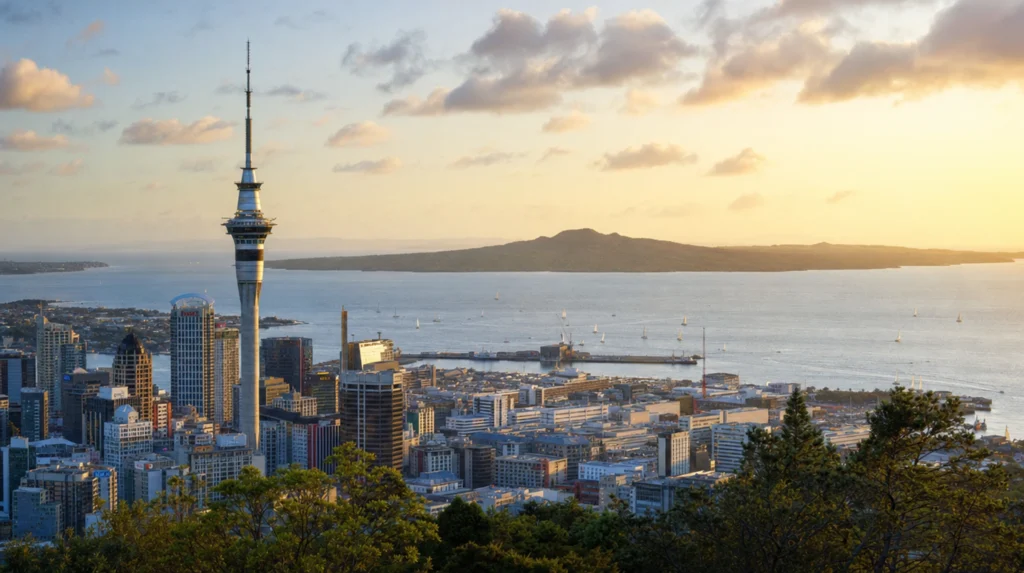
Auckland, New Zealand: City of Sails on Fifty Volcanoes
Part of our New Zealand travel guide.
Auckland City Guide
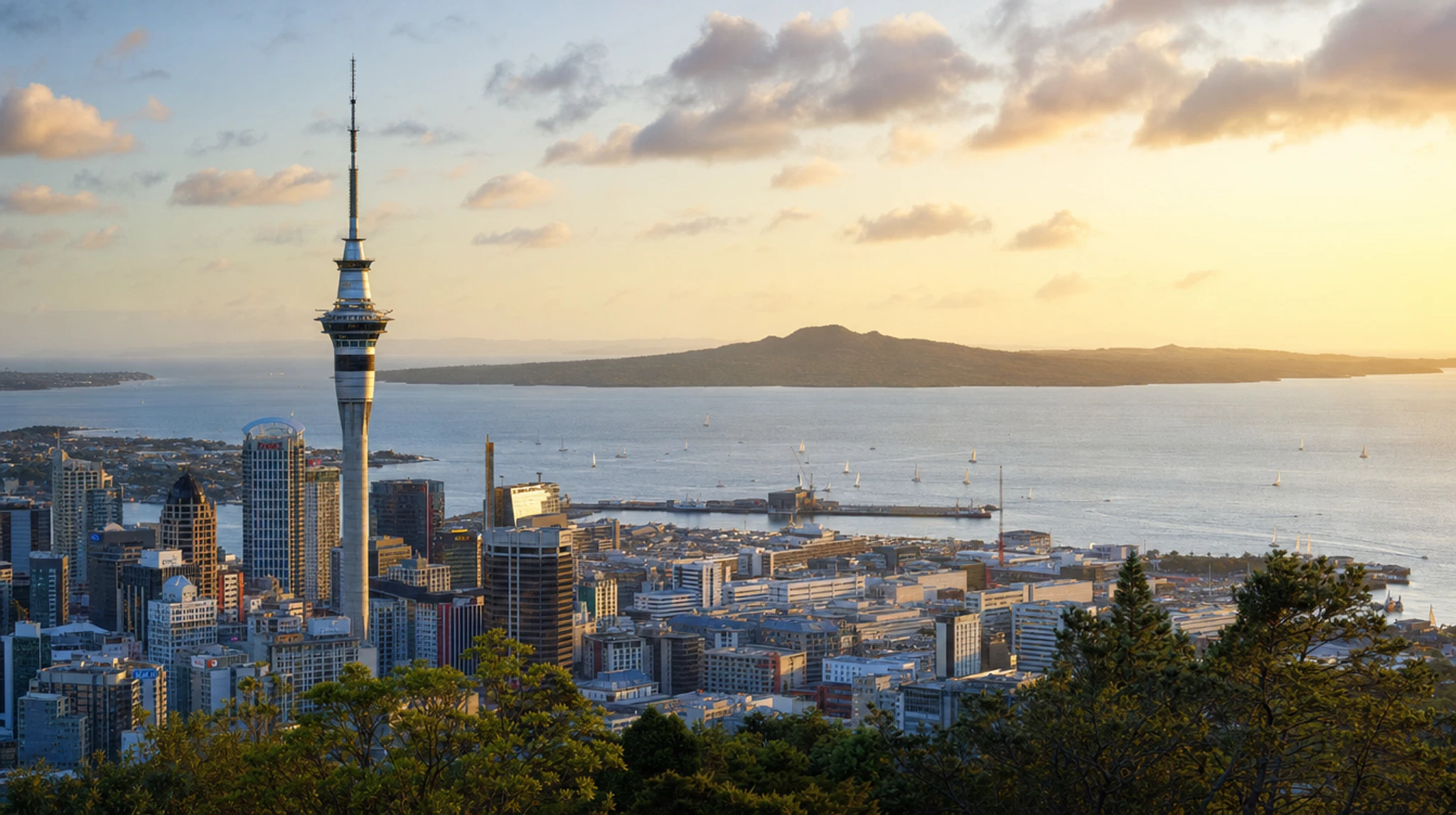
Table of Contents
Why Auckland?
Auckland is the largest city in New Zealand, home to roughly one-third of the country’s population at 1.66 million residents and built across an active volcanic field of approximately 53 cones, craters and maars that punctuate the suburbs with grass-flanked hills and black-sand beaches. In te reo Māori it is Tāmaki Makaurau, “desired by many” — a reference both to the iwi who fought over the isthmus for centuries and to its enduring pull on migrants today.
The city straddles two very different harbours: the deep sheltered Waitematā on the east and the shallow, tidal Manukau on the west. That unusually narrow isthmus explains both the nickname — “City of Sails,” coined when Auckland hosted the America’s Cup and still one of the highest per-capita boat-ownership rates in the world — and the way the city feels. You can leave a glass tower in Commercial Bay at lunchtime, ride a 12-minute ferry to a Victorian village with a volcanic hill behind it, then be back on a rooftop bar at 6 pm without ever touching a motorway.
Auckland sits closer to the tropics than any other major New Zealand city, producing a humid sub-tropical climate where pohutukawa trees bloom crimson along the beaches every December and sea temperatures peak near 20°C in February. It is also the most ethnically diverse city in the country — more than 40% of Aucklanders were born overseas according to Stats NZ’s 2023 census, and its Pasifika population of roughly 243,000 makes it the single largest Polynesian city on Earth. That shows up everywhere: in the 60-plus stalls of Otara Market on a Saturday morning, in the Samoan and Tongan greetings written alongside English and te reo Māori in AT stations, and in the Pasifika Festival every March — billed as the largest Pacific Island cultural festival in the world.
The city also claims one of the busiest regatta calendars on Earth. Anniversary Day on the last Monday of January brings hundreds of yachts onto the Waitematā for a regatta that has run continuously since 1840 — a civic holiday that doubles as a working day for half the CBD’s sailing fleet. Auckland also hosts the final match of the 2026 Women’s Rugby World Cup at Eden Park, making late October a notable pull quite apart from the year-round food-and-harbour draw.
This guide covers the nine neighbourhoods where most visitors actually spend time, the fine-dining rooms that have put Auckland on the international gastronomy map — chef-driven rooms rated under the Cuisine Good Food Guide rather than Michelin — and the five day-trip destinations (Waiheke, Rangitoto, the Waitakere Ranges, Hobbiton and the Bay of Islands) that make the city a superb base for a wider North Island loop. It also flags the practical things you need before you board: the NZeTA plus NZ$100 International Visitor Levy in place since 2024, and the biosecurity declaration you’ll file within 24 hours of landing at AKL.
Neighborhoods: Finding Your Auckland
📍 Auckland Map: Every Place in This Guide
Britomart & CBD
Britomart is the waterfront commercial core and, for almost every visitor, the arrival point. The precinct knits together the 1910 heritage railway building, the glass-and-stone Commercial Bay tower completed in 2020, and the Waitematā Station — the terminus for every Auckland Metro train line and, since the 2026 opening of the City Rail Link, the eastern mouth of the new 3.45-km underground tunnel through the CBD. The laneways between Galway, Gore and Tyler Streets are the densest cluster of independent restaurants and bars in the country, and the whole district is flat, wide and walkable from the ferry terminal two blocks north.
- Britomart Transport Centre (Waitematā Station) — arrival hub for trains and every city-bound bus
- Commercial Bay tower and its two-level laneway food hall
- Queen Street shopping spine running south from the harbour
- Lower Albert Street ferry terminal for Devonport, Waiheke and Rangitoto
Best for: first-timers and business travellers staying within walking distance of the ferries. Access: Waitematā Station (Britomart) on the Eastern, Southern and Onehunga lines; every city bus route terminates here.
Ponsonby
Ponsonby is a heritage villa strip turned boutique shopping and dining street, running 1.8 km along a ridgeline west of the CBD. The road is lined with late-19th-century weatherboard houses now occupied by denim brands, natural-wine bars and café groups that set Auckland’s brunch template in the 2000s. It feels less like a shopping district and more like a long leisurely afternoon — pop into SPQR for a negroni, drift two doors down to an independent bookstore, and you have lost three hours without noticing.
- Ponsonby Road cafés and wine bars between Karangahape Road and Three Lamps
- Ponsonby Central — covered laneway food hall with 14 eateries
- Three Lamps junction at the northern end (original 1880s gas lamp)
- Western Park and the Jacob Scott “Dropped Leaf” sculpture
Best for: design-led shoppers, coffee drinkers and long leisurely dinners. Access: InnerLink bus (every 10 minutes during daytime) or a 15-minute walk from the CBD along Victoria Street West.
Parnell
Parnell is Auckland’s oldest suburb, running up the hill from the Auckland Domain toward the Holy Trinity Cathedral. The Parnell Road high street is narrower and quieter than Ponsonby, weighted toward antique dealers, ceramic studios and heritage restaurants. On Saturdays the La Cigale French Market runs in a converted warehouse behind Parnell Baths — 60-plus stalls, live accordion, and a queue for fresh croissants that snakes out the door before 10 am.
- Auckland Domain and the Wintergardens (two heritage Victorian glasshouses)
- Parnell Rose Gardens (peak bloom late November)
- La Cigale French Market on Saturdays and Sundays
- Holy Trinity Cathedral with its Māori-carved Bishop Selwyn Chapel
Best for: heritage architecture, museum visits and Saturday-morning market browsing. Access: Parnell Station on the Southern and Eastern lines, or a 20-minute walk east from Britomart through the Domain.
Newmarket
Newmarket is the high-street shopping district, anchored by Westfield Newmarket — a NZ$790 million redevelopment opened in 2019 that brought the first Country Road, Mecca and Zara flagships to New Zealand under one roof. The streets around Broadway now hold roughly 500 stores, and the parallel Teed Street laneway has evolved into a dense eating cluster. It is the most convenient base for shoppers who prefer international labels in one walkable strip rather than the indie-heavy flavour of Ponsonby.
- Westfield Newmarket (277 Broadway) with 230-plus tenants
- Teed Street eating laneway — Winona Forever, Gemmayze Street, Saan
- Rialto Cinemas for arthouse film (Newmarket Flower Market on Saturdays)
- Eden Park sports stadium 10 minutes west by foot
Best for: shoppers who want international labels in one walkable strip. Access: Newmarket Station — every Auckland Metro line passes through it, making this the single most connected transit point in the city alongside Britomart.
Grey Lynn
Grey Lynn is the leafy villa neighbourhood next to Ponsonby, running along Richmond Road between Great North Road and Surrey Crescent. Where Ponsonby feels polished, Grey Lynn feels lived-in — organic grocers, second-hand bookshops, a cricket oval in the middle of a 17-hectare park, and the long-running Sunday farmers market inside the Grey Lynn Community Centre. It is the place to come for a slow morning and a flat-white-and-pastry reset rather than a retail marathon.
- Grey Lynn Farmers Market inside Grey Lynn Community Centre (Sundays 9 am – 12:30 pm)
- Richmond Road café row — Little Bird Unbakery, Home Café, Crumb
- Grey Lynn Park (cricket oval, playground, basketball courts)
- Surrey Crescent bus hub for OuterLink services
Best for: slower-paced neighbourhood wandering, Sunday markets and brunch. Access: OuterLink or Route 22 bus from Britomart (15–18 minutes) , or a 25-minute walk from the CBD via Ponsonby Road.
Devonport
Devonport is the Victorian seaside village on the North Shore, reached by a 12-minute ferry that deposits you on a wharf opposite the 1902 Esplanade Hotel. The main street, Victoria Road, has been preserved almost intact: painted weatherboard shops, a single-screen cinema, a heritage bookshop, and two ice-cream windows. Behind the village the volcanic cones of Mount Victoria (Takarunga) and North Head (Maungauika) rise directly from the sea, both crowned with decommissioned WWI-era “disappearing” coastal guns and honeycombed with subterranean tunnels open to visitors for free.
- Devonport Wharf and ferry terminal (passenger only — no vehicles)
- North Head Historic Reserve with WWI gun emplacements and tunnels
- Mount Victoria/Takarunga viewpoint (80-metre cone, 15-minute walk up)
- Cheltenham Beach — the closest swimmable beach to downtown Auckland
Best for: half-day harbour cruising with a village lunch and a short walk up a cone. Access: Devonport ferry from Pier 1, Lower Albert Street — 12 minutes, NZ$8.00 adult one-way with AT HOP.
Mission Bay
Mission Bay is the beachfront promenade along Tamaki Drive, 7 km east of the CBD. A flat cycle and pedestrian path hugs the foreshore from Parnell all the way to St Heliers, passing through Mission Bay’s palm-lined Selwyn Reserve with its 1950s art-deco fountain and uninterrupted views across the Rangitoto Channel to the island’s perfect volcanic cone. On summer evenings the promenade feels like a single 800-metre street party — families on beach towels, swimmers, kayakers, and queues at the gelato windows stretching along Tamaki Drive.
- Mission Bay Beach, Selwyn Reserve and the art-deco fountain
- Bastion Point / Takaparawhā lookout (Ngāti Whātua o Ōrākei marae grounds)
- Kelly Tarlton’s Sea Life Aquarium in an old sewage-pumping station
- Kohimarama and St Heliers beaches continuing east
Best for: a summer afternoon of swim-gelato-sunset in a single kilometre. Access: TāmakiLink bus from Britomart (20 minutes) or a flat 8-km cycle east on the Tamaki Drive path from Quay Street.
Karangahape Road (K Road)
Karangahape Road — universally shortened to K Road — is Auckland’s alt-culture ridge, draped across the southern edge of the CBD between Symonds Street and Ponsonby Road. It is the queer, late-night, creative heart of the city: drag shows at Family Bar, Korean barbecue at midnight, independent galleries in former pawn-shop windows, and three mid-sized live-music rooms (Whammy Bar, Wine Cellar, The Tuning Fork) within 300 metres of each other. The 2026 City Rail Link opened the underground Karanga-a-Hape Station directly beneath the strip, finally giving K Road a rapid-transit connection to the rest of the city and accelerating a wave of new openings.
- Karanga-a-Hape Station (CRL) with entrances on Pitt Street and Mercury Lane
- St Kevins Arcade — heritage arcade with Coco’s Cantina and Hello Beasty
- Whammy Bar and Wine Cellar live-music venues under St Kevins
- Basement Theatre and Q Theatre for fringe and experimental work
Best for: late-night eating, live music and bar-hopping beyond the corporate CBD. Access: Karanga-a-Hape Station on the Western, Southern, Eastern and Onehunga lines once CRL is fully operational.
Mt Eden / Maungawhau
Mt Eden is both a cone and a neighbourhood — a 196-metre volcanic hill surrounded by a ring of leafy residential streets and a bookshop-heavy village on Mt Eden Road. The cone itself is the single most-visited viewpoint in Auckland: a grass-covered 50-metre deep crater (tapu — visitors are asked not to enter it) crowned by a 360-degree panorama that takes in both harbours, the Sky Tower, the Waitakere Ranges and Rangitoto in a single sweep. Below the cone, the village has Time Out Bookstore, Kokako café, and the new Maungawhau Station opened with the 2026 City Rail Link.
- Maungawhau / Mt Eden summit (196 m, walk-up only — vehicles no longer permitted)
- Mt Eden Village shops along Mt Eden Road
- Maungawhau Station (new CRL stop beneath the village)
- Eden Garden — a privately run 2.3-hectare botanic garden five minutes’ walk away
Best for: a free 40-minute sunset walk with the best land-based view of the harbour. Access: Maungawhau Station on the CRL alignment; the summit road is permanently closed to vehicles — walk up from the lower car park on Mt Eden Road.
Britomart laneways — sub-neighbourhood worth naming
Within the CBD, the Britomart “laneways” — Galway, Gore, Tyler and Customs streets between the heritage Britomart Transport Centre and Commercial Bay — function almost as a separate neighbourhood. The 18 heritage buildings in the precinct were restored between 2004 and 2020 in a single coordinated urban design project, and the laneways carry a concentration of independent restaurants, boutique retail (Karen Walker, Workshop) and wine bars dense enough that you don’t need to leave a three-block grid for an entire evening. Most Auckland hotels sit here or within five minutes’ walk; QT Auckland, Hotel Britomart and Naumi Auckland Airport’s CBD sister are the three most-recommended stays.
- Britomart heritage laneway district (Galway, Gore, Tyler Streets)
- Commercial Bay at 7 Queen Street — retail mall plus two-level food hall
- Seafarers Building — rooftop bar and Ostro restaurant overlooking the marina
- Takutai Square — outdoor gathering space with frequent Māori cultural performances
Best for: business travellers and anyone who wants the shortest possible walk to the ferries and the airport bus. Access: Waitematā (Britomart) Station is the ground-level entry.
The Food
Pacific Rim & Modern New Zealand
Auckland’s dining identity sits at the intersection of three food cultures — Asian-Pacific street food brought by the city’s large Chinese, Korean, Vietnamese and Filipino communities; Polynesian root-vegetable and umu cookery from the Pasifika diaspora; and the European settler farm-to-table tradition of pasture-raised lamb, wild venison and Marlborough seafood. Chefs call the result “Modern New Zealand,” though you will also see “Pacific Rim” on older menus. The common thread is hyper-local sourcing: Te Matuku Bay oysters, pāua abalone from the Coromandel, horopito pepperleaf, native kawakawa — ingredients you will not easily find outside the country.
The modern-NZ style tends toward single-plate simplicity with one hero ingredient per dish: charred octopus with horopito aioli; wood-roasted Akaroa salmon with kawakawa oil; Te Mana lamb with salt-baked kūmara. Where a Sydney or Melbourne room might stack seven components on a plate, an Auckland kitchen is more likely to serve three and let the provenance carry the dish. Most of the Modern-NZ rooms sit inside a four-block Britomart-to-Ponsonby radius; the price band runs NZ$55 for a small-plates banquet (MeKong Baby, Amano) up to NZ$145 for a full tasting (Ahi).
- Ahi — modern NZ tasting menu showcasing Aotearoa-sourced produce, Commercial Bay (NZ$145, ~$87 USD)
- Amano — Italian-leaning small plates and hand-rolled pasta in the Britomart precinct (NZ$65, ~$39 USD)
- Cassia — contemporary North Indian tasting by Sid Sahrawat; a 2024 Cuisine Good Food Awards Restaurant of the Year finalist (NZ$110, ~$66 USD)
- MeKong Baby — Southeast-Asian banquet menu on Ponsonby Road (NZ$55, ~$33 USD)
- Gemmayze Street — Lebanese meze and charcoal lamb in the Newmarket eating laneway (NZ$60, ~$36 USD)
Seafood & Green-Lipped Mussels
Because two harbours and a 3,800-km Pasifika supply chain meet on the Auckland waterfront, the city’s seafood is unusually varied. Green-lipped mussels (Perna canaliculus) are endemic to New Zealand and farmed in the Marlborough Sounds — they arrive in Auckland kitchens within 36 hours of harvest , are substantially larger than the blue mussels most visitors know, and show up steamed in white wine, baked under a breadcrumb topping, or in chowder. Clevedon oysters, South Island crayfish (kōura), Cloudy Bay clams and whole snapper round out most seafood menus. For the cheapest route in, go straight to the Auckland Fish Market in Wynyard Quarter — a working auction floor with 12-plus eateries built around it.
Snapper (tāmure) is the most common menu fish — pan-roasted whole for two is the signature preparation at Fish Auckland and Soul Bar. Bluff oysters, which appear from March to August when the season opens in the Foveaux Strait 1,500 km south , command premium prices (NZ$5–7 each) and are worth the splurge. John Dory, tarakihi, kingfish and terakihi all feature seasonally. Vegetarian and vegan options have improved sharply in the last five years — Forest at Britomart, Lucky Taco and Plant Culture in Ponsonby all run fully plant-based menus at casual price points.
- Ostro — freshly shucked Te Matuku Bay rock oysters at Seafarers Building (NZ$42 half-dozen, ~$25 USD)
- Depot Eatery — Clevedon oysters and green-lipped mussel chowder, Federal Street (NZ$36, ~$22 USD)
- Soul Bar & Bistro — harbourfront seafood platter with Cloudy Bay clams, prawns and crayfish (NZ$95, ~$57 USD)
- Fish Auckland (Hilton) — chef Scott Kennedy’s whole-fish of the day at the end of Princes Wharf (NZ$58, ~$35 USD)
- Auckland Fish Market — walk-up counters for fresh oysters from NZ$3 each
Markets & Food Halls
Auckland’s market culture is anchored by four standout venues. The Auckland Fish Market in Wynyard Quarter holds a working auction visible to the public weekday mornings from 7 am, with a wet-market retail floor and a ring of restaurants at casual price points. Commercial Bay houses roughly 40 eateries across two basement levels beneath the PwC tower — everything from hand-pulled noodles to brown-butter pastry shops, genuinely useful for solo travellers. La Cigale French Market in Parnell is the Saturday-Sunday institution for European-style produce, cheeses and croissants. And for a completely different flavour of the city, South Auckland’s Otara Flea Market is the place to eat Tongan ‘ota ika, Samoan palusami and Cook Island ei katu on Saturday mornings — the only Pacific Island market of its kind in the country.
Seasonal events layer on top of the permanent market scene. The Night Noodle Markets take over Victoria Park in March with roughly 40 hawker-style stalls; the Auckland Seafood Festival runs a two-day waterfront event each January; and the Coatesville Market on the North Shore sells rural produce on the first Sunday of every month. The Grey Lynn Farmers Market, inside the Grey Lynn Community Centre on Sundays from 9 am to 12:30 pm, is the best single stop for small-producer fruit, honey and native herbs. For a late-night food-hall option, Ponsonby Central stays open until 10 pm most nights with 14 eateries under one roof — and unlike Commercial Bay, the laneway feel survives after dark.
- Auckland Fish Market — morning auction viewing plus 12+ eateries, Wynyard Quarter
- La Cigale French Market — Saturday and Sunday market with 60+ stalls in Parnell
- Commercial Bay laneways — two-level food hall with 40+ eateries
- Otara Flea Market — Saturday Polynesian market in South Auckland (Tongan ‘ota ika, Samoan palusami, Cook Island ei katu)
- Ponsonby Central — covered laneway with 14 eateries including Bird on a Wire rotisserie (dishes NZ$20–35)
Hāngī and Māori-Influenced Cuisine
A hāngī is the traditional Māori method of cooking food in an earth oven — meat, chicken and root vegetables wrapped in muslin and laid on hot stones in a pit covered with wet sacks and soil for three to four hours. The smoky, steam-softened result is one of New Zealand’s two signature cuisines (alongside lamb roast), though authentic hāngī is harder to find at casual restaurant prices in central Auckland than it is in Rotorua two hours south. What is increasingly available in the CBD and K Road is Māori-influenced contemporary cuisine: rēwena bread (Māori potato-fermented sourdough), boil-up (smoked bone broth with watercress and dumplings), and tasting menus that use native ingredients like kawakawa, horopito and tuatua shellfish. Expect prices to run the full spectrum — NZ$20 for a Kai Eatery lunch, NZ$220 for a Hiakai popup tasting.
Kūmara (Polynesian sweet potato) is the single native ingredient you’ll see most often — roasted whole, mashed under lamb, chipped as fries, and baked in bread. The Māori-owned Poi Room in Newmarket sells pre-cooked hāngī trays (chicken, pork, kūmara and potato, roughly NZ$30 per person) that you can pick up on Saturday mornings. For a more interpretive experience, the Auckland War Memorial Museum’s café runs a rotating rēwena-bread-plus-kawakawa-oil lunch set at NZ$32. Māori cuisine at restaurant price points is a relatively new category in Auckland — expect the space to grow fast in the next five years as a wave of iwi-funded food businesses come online.
- Hiakai popups — Monique Fiso’s indigenous-ingredient tasting menu appears in Auckland on tour dates (NZ$220, ~$132 USD)
- Kai Eatery — boil-up, rēwena bread and Māori fry bread on K Road (NZ$22, ~$13 USD)
- Hāngī Master (South Auckland) — chicken, pork and kūmara cooked on hot stones, pre-order by the tray (NZ$35 per person, ~$21 USD)
- Kēpaki Coffee + Kai — Māori-owned café on Karangahape Road serving rewena toast and horopito-cured salmon (NZ$18, ~$11 USD)
Fine Dining (Cuisine Good Food Guide)
New Zealand does not participate in the Michelin Guide system; the equivalent benchmark is the annual Cuisine Good Food Awards and their Hat rating (one to three hats). Auckland currently holds the highest concentration of three-hat and two-hat restaurants in the country — all in a 15-minute taxi radius of each other. Pasture on Federal Street runs a six-seat counter with live-fire cooking and a single nightly seating. Sid at The French Café, open since 1989 on Symonds Street, is the city’s longest-running three-hat room. Ahi and Onslow are both Cuisine award regulars and run slightly more approachable tasting formats at lower price points.
Expect a long lead time and a set-menu commitment at most of the high-end rooms. Pasture runs a single nightly seating at 7 pm with a set eight-course tasting menu; cancellations are charged in full. The French Café takes bookings 60 days out and typically sells its Friday and Saturday seatings within a week. Clooney and Onslow are the two rooms most likely to have last-minute seats; both accept walk-ins at the bar with a shortened menu. Expect wine pairings to add NZ$110–180 on top of the food price — the Central Otago pinot noirs from Felton Road and Rippon are the most distinctive NZ wine flights you can take home to remember a meal by.
- Sid at The French Café — three-hat tasting (NZ$220, ~$132 USD)
- Ahi — NZ-produce-only tasting (NZ$195, ~$117 USD)
- Pasture — six-seat chef’s counter, live-fire cooking, 2023 Cuisine Restaurant of the Year (NZ$395, ~$237 USD)
- Onslow — seasonal grill menu from chef Khu Scott (NZ$120, ~$72 USD)
- Clooney — modern NZ tasting in a converted Freemans Bay warehouse (NZ$165, ~$99 USD)
Food Experiences You Can’t Miss
Auckland rewards travellers who build the trip around a single food theme as much as those who graze widely. A Waiheke wine-tasting day, a dawn Fish Market auction, a Commercial Bay crawl, a Pasifika dinner at Otara — any one of these can be the headline experience of a visit. Book ahead for the guided and ticketed experiences (Fish Market tour, Hiakai popups, wine-tour coaches); walk-up works for markets and food halls.
- Auckland Fish Market dawn auction tour (Tuesday – Saturday, 7 am — NZ$45 per person)
- Waiheke Island wine-lunch day trip covering three cellar doors (see Day Trips)
- Commercial Bay “eat the building” crawl from basement ramen to rooftop cocktails at The Landing
- Night Noodle Markets in Victoria Park during March — 40+ hawker-style stalls
- Otara Flea Market Saturday breakfast at 7 am — Cook Island doughnuts (poke) at NZ$2 each
- Pasifika Festival food village at Western Springs in mid-March — 50+ Pacific-nation stalls
- Sunday brunch at Little and Friday, Grey Lynn — NZ$12 doughnuts rated among the country’s best
Craft Beer, Wine & Coffee
Auckland’s craft beer scene is smaller than Wellington’s but catching up fast. Brothers Beer, Galbraith’s Alehouse (New Zealand’s longest-running brewpub) and Hallertau all run taprooms in central Auckland; Urbanaut in Kingsland and 16 Tun in Wynyard Quarter are the newer additions. Typical pints run NZ$12–16. For wine, Auckland is one of New Zealand’s two main production regions (along with Marlborough) — West Auckland’s Kumeu and Huapai vineyards sit 30 minutes from the CBD and are open for cellar-door tastings on weekends. Coffee deserves its own mention: Auckland runs on single-origin flat whites at NZ$5.50–7 per cup, and Ozone, Coffee Supreme, Atomic and Kokako are the four roasters most cafés stock.
Cultural Sights
Auckland War Memorial Museum / Tāmaki Paenga Hira
The Auckland War Memorial Museum is both the country’s pre-eminent Māori and Pacific collection and its national war memorial. Founded in 1852 and housed in a Beaux-Arts temple above the Auckland Domain since 1929, it holds over 1.5 million objects including the intact 25-metre war canoe Te Toki ā Tapiri carved in 1836. Admission is free for Auckland residents and NZ$28 for international adults (2025 rate), ~$17 USD . Hours are 10 am – 5 pm daily; closed 25 December. Do not miss the daily Māori cultural performance at 11 am — kapa haka, poi and the haka in the Māori Court, roughly 35 minutes long and the single best Māori cultural introduction in the city. Budget 3 hours total : the Māori and Pacific galleries on Level 1 are the must-sees, the World War I “Scars on the Heart” memorial gallery on Level 2 is the emotional centrepiece, and the natural history and volcano exhibits on Level 3 make good rainy-day filler.
Sky Tower
The Sky Tower is the 328-metre observation spire at the centre of the CBD — the tallest freestanding structure in the Southern Hemisphere and, since its 1997 opening, the signature feature of the Auckland skyline. Standard adult admission to the three observation decks is NZ$35 (~$21 USD), open 9 am – 10 pm daily and extended further in summer. The glass-floor panels on the main observation deck sit 186 metres above street level. If you want to amp the experience: SkyWalk (a guided 192-metre walk on the outside rim) and SkyJump (a 192-metre controlled base jump) both start at NZ$165. The best-value approach is the “Sky Tower entry + Orbit 360° restaurant two-course lunch” package — the revolving restaurant does one full rotation every hour and lunch seatings cost less than dinner while including the NZ$35 admission. For photographers, arrive 45 minutes before sunset and stay through blue hour to catch the city lights come on over the harbour.
Auckland Art Gallery Toi o Tāmaki
The Auckland Art Gallery, founded in 1888 and expanded in a NZ$121 million rebuild in 2011, holds the largest collection of New Zealand art anywhere — over 17,000 works. General admission is free year-round (charges apply to some temporary exhibitions), and the gallery opens 10 am – 5 pm daily. The single must-see room is the Mackelvie Trust collection of Gottfried Lindauer’s late-19th-century portraits of named Māori leaders — 69 paintings that functioned, before photography reached rural New Zealand, as the official portrait record of several iwi. The 2011 extension’s timber-ceilinged atrium is also an architectural landmark in its own right, and the gallery’s café on the ground floor is one of the cheapest lunch stops inside any major museum in the country at NZ$14–22 per plate.
Maungawhau / Mt Eden
Maungawhau is Auckland’s most-climbed volcanic cone — a 196-metre hill with a 50-metre grass-ringed crater (tapu — do not enter) and the single best 360-degree panorama of the city. The cone formed roughly 28,000 years ago and holds the terraced earthworks of a substantial pre-European Māori pā. Entry is free and the walk-up takes 15–20 minutes from the lower Mt Eden Road car park; the summit road is permanently closed to vehicles as of 2016 to protect the fragile cone surface. The gates are open daily 7 am – 8:30 pm — early morning and last-light visits are the quietest. Combine with a coffee stop at Kokako in the village below and you have a 90-minute outing covering both a free-entry volcanic summit and one of the city’s better independent cafés.
One Tree Hill / Maungakiekie
Maungakiekie, more commonly known as One Tree Hill, is the second-most-visited cone after Maungawhau and arguably the more culturally layered site. The 182-metre summit sits at the centre of Cornwall Park, a 172-hectare working farm gifted to the city by Sir John Logan Campbell in 1901, and carries a single stone obelisk commemorating the Māori and Pākehā settlement of Auckland. The original pōhutukawa “one tree” was famously cut down in 2000; a grove of native trees was replanted in 2016. Entry is free, sheep graze on the slopes, and the walk-up takes 20–25 minutes from the Cornwall Park car park. Combine with a visit to Stardome Observatory at the base of the cone for a full afternoon.
Devonport + North Head / Takarunga
Devonport is the Victorian seaside village on the opposite side of the Waitematā, reached by a 12-minute ferry. Behind the wharf, two volcanic cones — Mount Victoria / Takarunga and North Head / Maungauika — carry fortifications from the 1885 Russian Scare, the Boer War and both World Wars. North Head is honeycombed with subterranean tunnels and gun emplacements, all freely walkable between 6 am and 10 pm (torch useful but not essential). Tunnels were gazetted as a military reserve in 1885; the Māori pā on the summit predates that by centuries.
Auckland Domain and Wintergardens
The Auckland Domain, founded in 1840, is the oldest park in the city — a 75-hectare volcanic explosion crater turned English-style parkland, with the Auckland Museum at its summit and the two Victorian Wintergarden glasshouses (built 1915 and 1928) at its western edge. Entry is free. The Wintergardens are open 9 am – 5:30 pm Monday–Saturday and 9 am – 7:30 pm Sunday. In December–January the outdoor pond is framed by flowering pohutukawa; in July–August the tropical glasshouse is the warmest free indoor space in Auckland.
Entertainment
Eden Park (rugby, cricket, All Blacks)
Eden Park is New Zealand’s national stadium — a 50,000-capacity ground in Kingsland that hosts the All Blacks, the Black Caps (cricket) and the Auckland Blues Super Rugby franchise. Tickets run NZ$29 (general admission cricket) to NZ$189 (premium All Blacks tests), ~$17–113 USD. Test-match tickets sell out within minutes of release, so buy 3–5 months ahead via Ticketmaster. The walk from Kingsland Station to the South Stand turnstiles is 400 metres flat — plan an extra 20 minutes on game day because Kingsland Station becomes a crush. A Saturday afternoon Test is the single most distinctive spectator experience in the country. Eden Park also hosts the Black Caps’ traditional Boxing Day Test each summer and, in late October 2026, the final of the Women’s Rugby World Cup — the single biggest women’s sporting event New Zealand has ever hosted. Buy into the pre-game haka and the “four more years” roar and you’ll understand why Aucklanders travel overseas to watch their own team play.
Spark Arena concerts
Spark Arena (formerly Vector Arena) is Auckland’s 12,000-seat indoor concert venue in Quay Park, five minutes’ walk east of Britomart. International tours almost always route through Auckland as a first or last stop after Australia — in the past twelve months alone the venue has hosted Taylor Swift adjacent tours, Billie Eilish, and stadium-level NBL basketball. Typical touring-act tickets run NZ$90–350 (~$54–210 USD). Check the calendar 6–8 weeks before travelling; late-release cheap seats sometimes appear the week of the show. For the best mix of sightlines and cost, aim for Lower Bowl corner seats (sections A–D) over premium floor — the arena is acoustically excellent at all price points. Get to the venue an hour early if you want to eat at Vaughan’s Bar & Bistro or Hawker Lee in the adjacent Quay Park precinct before the show.
Karangahape Road nightlife
K Road is the late-night strip — a three-block cluster of independent bars, live-music rooms and drag venues that stays active until 3 am most weekends. A typical beer runs NZ$14, a cocktail NZ$18 (~$8–11 USD) . Walk-up is fine until about 11 pm on Friday and Saturday; after that expect queues at Whammy Bar, Wine Cellar and Family Bar. The K Road strip has no cover charge at most venues, though live music nights at Whammy run NZ$15–35 door. The new Karanga-a-Hape Station beneath the road means you no longer need an Uber home — trains run until roughly midnight and Night Owl buses cover the post-midnight window. For a crafted cocktail scene, Caretaker inside the Britomart Hotel and Deadshot on Ponsonby Road both sit in the international “best bars” lists; for dive-bar energy, Ding Dong Lounge and The Thirsty Dog are the K Road anchors.
Viaduct Harbour and Wynyard Quarter bars
The Viaduct Basin and Wynyard Quarter waterfront are Auckland’s polished harbour-bar strip — the spot for a NZ$22–32 cocktail (~$13–19 USD) with the yacht scene as backdrop. This is where the America’s Cup teams based themselves in the 2000s, and the superyacht dock remains active year-round. For actual sailing, Explore Group runs match-racing day-charters on former America’s Cup boats (from NZ$150 per person, ~$90 USD, 2-hour session). Sunset sessions between 5 pm and 7 pm are the photogenic pick in summer.
Waiheke Island wineries (evening and day)
Waiheke is covered in the Day Trips section below as a destination, but it also functions as a night-out option. Thirty boutique vineyards cluster across the 92-square-kilometre island — most are cellar doors with restaurants, and several run late-afternoon sittings. Budget NZ$10–25 for tasting flights and NZ$220 for a lunch or dinner menu at Mudbrick (~$6–15 / $132 USD). The 40-minute ferry runs until roughly 11 pm in summer — check the Fullers360 schedule before committing, because missing the last sailing is expensive. Ananda Tours and Fullers360 both sell wine-tour day packages with a driver.
Auckland Theatre Company at ASB Waterfront Theatre
Auckland Theatre Company is the resident company at the ASB Waterfront Theatre in Wynyard Quarter, with a subscription season running March through November. Tickets NZ$35–99 (~$21–59 USD). Pieces from the Kia Mau festival (Aotearoa’s biennial indigenous performing arts festival) frequently tour through. For a distinctly Auckland evening, pair a 6 pm pre-theatre dinner at Saan or Amano with a 7:30 pm curtain and a post-show walk back along the Viaduct waterfront — all within a 600-metre radius. The Civic Theatre on Queen Street, a 1929 “atmospheric” cinema-turned-theatre with a gilded interior and star-field ceiling, is the other heritage venue worth timing your trip around; touring Broadway shows route through the Civic most months, with tickets NZ$75–175.
Day Trips
Waiheke Island (40 minutes by Fullers360 ferry)
Waiheke is Auckland’s wine-country day trip — 40 minutes on the Fullers360 ferry from Pier 2, Lower Albert Street. The island covers 92 km² and carries roughly 30 boutique vineyards, olive groves, two sculpture trails and the family-friendly Palm Beach and Oneroa swimming beaches. Mudbrick, Cable Bay and Stonyridge are the three signature cellar doors — all three run restaurants as well as tasting flights. The Waiheke Ferry + Hop pass (NZ$68 return, ~$41 USD, bus fares included) is the cheapest route in; aim for the 9:00 am sailing to maximise tasting time. The EcoZip three-line zipline with harbour views is the best non-wine activity; don’t miss the Headland Sculpture Trail along the cliff path above Matiatia Bay in odd-numbered Januarys.
Rangitoto Island (25 minutes by Fullers360 ferry)
Rangitoto is the photogenic symmetrical cone you see from every Auckland waterfront — the youngest volcano in the Auckland Volcanic Field, formed roughly 600 years ago in a series of eruptions witnessed by the resident Ngāti Paoa iwi. Fullers360 runs ferries from Pier 2 in 25 minutes; the Summit Track takes about an hour each way up a lava-rock path to the 260-metre peak, with a side loop through lava caves (bring a torch). There are no shops, no shade in the middle of the day, and no accommodation anywhere on the island — bring 2 L of water per person and close-toed shoes for the jagged lava fields. The last return ferry is usually 3:30 pm; do not miss it.
Waitakere Ranges & West Coast Beaches (1 hour by rental car)
The Waitakere Ranges are a 16,000-hectare block of regenerating temperate rainforest 45 minutes west of the CBD , ending in the black iron-sand surf beaches of Piha, Karekare and Bethells. There is no direct bus — this day trip requires a rental car or an organised coach. Piha Beach sits below the 101-metre Lion Rock sea stack; Karekare is where Jane Campion filmed The Piano; and Bethells/Te Henga offers the most dramatic walk-in dunes. The Arataki Visitor Centre near the ranges’ eastern gate runs free displays and a five-minute kauri forest boardwalk. Kauri dieback (Phytophthora agathidicida) has closed many individual tracks — scrub and spray at the boot-cleaning stations before and after every walk, and check the Auckland Council closure map on the morning of.
Hobbiton Movie Set (2 hours by car or coach)
Hobbiton is the permanent 12-acre movie set on the Alexander family farm near Matamata, 2 hours south of Auckland on State Highways 1 and 29. The set carries all 44 Hobbit Holes from the Lord of the Rings and Hobbit films, a full-size Green Dragon Inn with complimentary ale brewed on-site, and — on the second Saturday of each month — an Evening Banquet Tour. Standard day-tour tickets are NZ$120 per adult (~$72 USD); book two weeks ahead in peak summer. Headfirst Travel and Grayline both run day-coach packages from Auckland including transport, the two-hour guided tour and a pub lunch. The 8:00 am slot is the quietest — midday tours can queue for 30 minutes at the gate .
Bay of Islands / Paihia (3 hours 30 minutes by car or coach)
The Bay of Islands is 3 hours 30 minutes north on State Highway 1 — the birthplace of modern New Zealand, where the 1840 Treaty of Waitangi was signed between Māori rangatira and the British Crown. The Waitangi Treaty Grounds hold the original treaty house, a carved meeting house and a 35-metre war canoe. Paihia is the main visitor base; the Hole in the Rock cruise runs from Paihia wharf through Piercy Island (3 hours, NZ$135). Historic Russell / Kororāreka across the harbour is a quieter Victorian-era settlement with one of the oldest pubs in the country. A day trip is possible but tight — the drive is 7 hours return . Overnight in Paihia if time allows, and board the 8:00 am Hole in the Rock cruise before the afternoon wind picks up.
Seasonal Guide
Auckland sits in the Southern Hemisphere — seasons are reversed from North America and Europe. Summer runs December through February; winter runs June through August. The climate is humid sub-tropical with an annual 1,240 mm of rainfall spread across roughly 125–140 rain-days. The “four seasons in one day” cliché is real: carry a rain shell and a light layer at any time of year.
Summer (December – February)
Daily highs 18–25°C (can reach 28°C); sea temperature peaks at 20°C in February. The signature events are the Auckland Anniversary Regatta in late January — one of the largest one-day sailing events on Earth since 1840 — the ASB Classic tennis in early January, and the Laneway Festival in February. This is peak holiday season: accommodation rates climb 40–60% from Boxing Day to mid-January, and Waiheke ferries sell out mid-morning on weekends. Book everything 6–8 weeks ahead for this window. Late February is the quietest slice of summer — schools are back, international visitors have thinned, but the sea is still warm.
Autumn (March – May)
Daily highs 14–21°C; sea temperature 17–19°C. Still warm enough for harbour swimming through most of March. The headline event is the Pasifika Festival in mid-March at Western Springs — billed as the world’s largest Pacific Island cultural festival — followed by the ASB Polyfest (the largest secondary-school cultural festival of its kind) and the Auckland Writers Festival in mid-May. Autumn is the best balance of weather and value: school holidays end mid-April and prices soften noticeably.
Winter (June – August)
Daily highs 8–15°C with frequent rain — sub-tropical rather than alpine, so no snow in the city. The big cultural moment is Matariki, the Māori New Year observed nationally as a public holiday on Friday 10 July 2026. New Zealand Fashion Week runs in late August. Winter is Auckland’s quietest tourist quarter — hotel rates drop 25–35% versus summer — but also the rainiest. Queenstown’s ski season pushes domestic flights higher through June and July, so leave Auckland by train or ferry rather than plane if budget matters.
Spring (September – November)
Daily highs 11–18°C ; westerly winds pick up — the “Auckland four-seasons-in-a-day” reputation peaks in October. The Auckland Diwali Festival in late October is one of the biggest outside the subcontinent, and the Heroic Gardens weekend in November opens private Ponsonby and Grey Lynn gardens to visitors. Spring is shoulder season pricing and the pohutukawa trees (New Zealand’s “Christmas tree”) start to bud in late November, putting the harbour’s iconic crimson bloom on track for Christmas week. Wine Week Waiheke, held in late October, is the single easiest way to sample 20-plus cellar doors in a weekend without committing to back-to-back lunches.
Getting Around
AT HOP Card
The AT HOP card is Auckland’s prepaid transit card — use it on buses, trains and inner-harbour ferries operated by Auckland Transport. A blank card costs NZ$5 (non-refundable) and can be topped up at Britomart, every train station, and most 7-Eleven / BP outlets. Cash fares run roughly 25–35% more per trip than HOP fares; always tag on with HOP. The single most important feature is the NZ$20 all-modes daily fare cap: once you hit NZ$20 in HOP charges across any combination of buses, trains and inner-harbour ferries in a day, all further travel until midnight is free. Top-ups via the AT Mobile app land on the card within 30 seconds and let you skip station ticket machines entirely. Refunds on unused balances over NZ$20 are processed at the AT Customer Service Centre in Britomart with an NZ$5 handling fee.
Buses, Trains and Ferries
Auckland Transport runs four urban rail lines — Southern, Eastern, Western and Onehunga — plus the 2026 City Rail Link (CRL) tunnel, which added three central underground stations (Te Waihorotiu / Aotea, Karanga-a-Hape and Maungawhau) and converted the previously dead-end Britomart into a through-station, roughly doubling peak capacity. Six high-frequency “Link” bus services — City, Inner, Outer, Tāmaki, and the Western — run every 10–15 minutes along the main suburban corridors. Ferries run from Lower Albert Street to Devonport (12 min), Waiheke (40 min), Half Moon Bay, Hobsonville, Bayswater, West Harbour, Birkenhead and Stanley Bay. Off-peak ferry fares are cheaper than peak; check the AT app before boarding. Trains run roughly 5 am to midnight on weekdays and 6 am to 11 pm on Sundays; Night Owl buses cover the CBD-to-suburbs run from midnight to 4 am on Friday and Saturday nights. The airport does not yet have a rail connection — the NZ$2.2 billion airport-to-city light-rail proposal has been paused at the design stage.
Rental Cars
Rental cars run NZ$60–90 per day for a compact in shoulder season and NZ$110+ in December–February (~$36–54 USD base). The big three rental desks (Avis, Hertz, Europcar) are at AKL arrivals plus a downtown Britomart depot; Budget-tier operators like Jucy, Apex and Ezi run out of airport-adjacent lots with a free shuttle. New Zealand drives on the left. Most rentals are manual transmission; automatics cost roughly NZ$10/day more. Do not rent a car just to stay in central Auckland — the CBD is small, parking runs NZ$7–12/hour, and public transit reaches every visitor neighbourhood. Rent only for West Coast beach or Hobbiton day trips.
Airport Access (AKL)
Auckland International Airport (AKL) handles roughly 75% of all international arrivals into New Zealand and sits 21 km south of the CBD. Three transit options cover the journey:
- SkyDrive express bus — 45–60 minutes, NZ$18 one-way (~$11 USD)
- AT Metro Route 38 (standard HOP bus) — 55–75 minutes, NZ$4.70 with AT HOP (~$2.80 USD)
- Taxi or rideshare — 35–45 minutes off-peak, NZ$75–110 (~$45–66 USD)
Taxis and Rideshare
Uber, Didi, Ola and the local Zoomy all operate in Auckland. Uber’s minimum fare is NZ$10 and a typical CBD-to-Ponsonby ride runs NZ$14–18 off-peak. Standard taxis charge a flag-fall of roughly NZ$3.50 plus NZ$2.80/km and are widely available at the Britomart rank. Rideshare pickup at the airport is in the dedicated ground-floor zone at the Park & Ride building — follow the green Rideshare signs, not the main taxi rank.
Navigation Tips
Apps: AT Mobile (real-time transit), Google Maps (surface route planning), Mevo (car-share by the minute). AT Mobile is the key download — top up your AT HOP card directly in the app, see live arrivals for every bus and ferry, and stack the daily fare cap automatically. Google Maps surfaces all three (bus, train, ferry) and understands the new CRL stations from opening day.
Budget Breakdown: Making Your NZ Dollar Count
Auckland is New Zealand’s priciest city for accommodation — expect a 15–25% premium over Wellington or Christchurch — but restaurant and attraction prices are broadly comparable across the three main cities. The figures below assume FX of 1 USD ≈ NZ$1.67 and are per person per day.
| Tier | Daily | Sleep | Eat | Transport | Activities | Extras |
|---|---|---|---|---|---|---|
| Budget | NZ$120–170 ($72–102) | Hostel dorm NZ$45–65 (YHA, Haka Lodge) | Bakery pie + supermarket NZ$28–35 | AT HOP daily cap NZ$20 | Free — Art Gallery, Maungawhau, Wintergardens | NZ$10 HOP card + NZ$15 Museum donation |
| Mid-Range | NZ$320–520 ($192–312) | 3–4★ hotel NZ$210–360 (QT, Naumi) | Café lunch + bistro dinner NZ$90 | HOP cap + Waiheke ferry NZ$58 | Sky Tower NZ$35 + Museum NZ$28 | NZ$45 Waitakere rental car share |
| Luxury | NZ$900+ ($540+) | 5★ hotel NZ$550–1,400 (Park Hyatt, Hotel Britomart) | Pasture or French Café NZ$260–400 | Private transfer NZ$250 | Private Waiheke wine tour NZ$650 | Helicopter to Great Barrier Island NZ$1,400 |
Where Your Money Goes
Accommodation is the single biggest line in an Auckland budget — even a three-star hotel in the CBD rarely drops below NZ$210/night in shoulder season and climbs past NZ$320 over the December-January peak. Restaurant meals run NZ$25–40 for a casual café lunch and NZ$55–95 for a mid-range dinner; the fine-dining tier (NZ$195–395 tasting) is a specific night-out decision rather than an everyday spend. Transport is the cheapest category thanks to the NZ$20 AT HOP daily fare cap, which makes “as much transit as you want” a flat cost across buses, trains and inner-harbour ferries. Activities sit in a wide band: the signature free items (Art Gallery, Maungawhau summit, One Tree Hill, Auckland Domain, the Wintergardens) are free forever; paid highlights cluster around NZ$28–46 (Museum, Sky Tower, Kelly Tarlton’s). The underrated overhead line is coffee — Auckland runs on flat whites, and NZ$5.50–7 per cup adds up fast if you drink three a day. Supermarket self-catering from a Countdown/Woolworths or New World can cut the eating budget in half for travellers who stay in an apartment rental.
Money-Saving Tips
- Use the AT HOP daily fare cap of NZ$20: every ride after that is free across buses, trains and inner-harbour ferries until midnight
- Auckland Art Gallery and the War Memorial Museum both operate donation-based pricing for international visitors — the NZ$28 museum “charge” is a suggested contribution, not a hard gate
- Book off-peak Waiheke returns (before 9 am or after 6:30 pm) for NZ$10 off the standard fare, and bundle the Waiheke Ferry + Hop pass at NZ$68 instead of separate bus and boat tickets
- Eat the NZ$15–22 lunch at K Road or Commercial Bay food halls during the day and save the NZ$55–120 bistro for a single dinner splurge
- Stay in Parnell, Newmarket or Mt Eden rather than Britomart — all three are one train stop from the CBD but run NZ$40–80/night cheaper on hotel rates
- Buy supermarket breakfast and lunch at Countdown or New World and hold the sit-down meals for dinner — Auckland café breakfasts run NZ$22–28 per plate
- Book Sky Tower + Orbit restaurant lunch as a bundle instead of paying separately for the observation-deck entry; the combined ticket runs roughly NZ$90 vs. NZ$35 + NZ$75 à la carte
When Prices Move
Auckland hotel pricing moves sharply with the calendar. Rates spike roughly 40–60% from Boxing Day through to Auckland Anniversary Day (late January), ease back to baseline in February, stay flat March through to late May, drop 25–35% over winter (June–August), and creep back up through September and October. Concert or All Blacks test weekends can push rates higher than Christmas. Ferry and AT train fares are stable year-round; domestic flights out of AKL to Queenstown and Christchurch are the only transport line that varies meaningfully with season.
Practical Tips
Kiwi English and Local Slang
English is universal — no language barrier for visitors from any Anglophone country. Te reo Māori appears on AT station signage, is used in bilingual train announcements and is a full official language alongside English and NZ Sign Language. You will hear daily greetings in te reo (“kia ora” for hello and thanks, “tēnā koe” formal). Kiwi slang worth knowing: a “dairy” is a convenience store, “sweet as” means all good, “jandals” are flip-flops, and “yeah, nah” is a polite no. Samoan and Tongan are the city’s third- and fourth-most-spoken languages at home.
NZeTA and International Visitor Levy
Most Western travellers (UK, EU, US, Canada, Australia and 60+ visa-waiver nationalities) need an NZ Electronic Travel Authority before boarding. NZeTA costs NZ$17 via the official app or NZ$23 online, and is valid for two years / multiple visits of up to 90 days. A separate NZ$100 International Visitor Conservation and Tourism Levy (IVL) was increased from NZ$35 on 1 October 2024 and is collected at the same time as the NZeTA. Apply at least 72 hours before departure. You will also need to file an online New Zealand Traveller Declaration (NZTD) within 24 hours of landing — it replaces the old paper arrival card.
Cash vs. EFTPOS
Auckland is a card-first economy. Visa, Mastercard and EFTPOS are accepted at virtually every café, restaurant, supermarket and transport point. Contactless payWave is the default; some independent cafés apply a 2–3% surcharge. American Express is patchier outside hotels and fine-dining rooms. ATMs are plentiful but charge NZ$5–8 for foreign cards. Carry NZ$50 in cash for Otara Market, honesty boxes at DOC trailheads and small North Shore cafés that still price-preference cash.
Safety
Auckland is a safe city by international standards — New Zealand ranked #4 on the 2024 Global Peace Index and violent crime against tourists is extremely rare. The practical risks are petty theft from rental cars parked at remote trailheads (never leave valuables in sight at Piha, Karekare or the Domain car parks), and the alcohol-heavy K Road nightlife strip late Friday and Saturday nights. Call 111 for police, fire or ambulance — all three share the single emergency number.
What to Wear
Layered and waterproof. Auckland averages 1,240 mm of rainfall annually across 125–140 rain-days, with sudden squalls even in summer. Pack a rain shell, a light jumper and close-toed shoes for bush walks alongside beachwear. The city is semi-formal — restaurants rarely require jackets, but Kiwis dress up for the waterfront-bar scene. UV levels are extreme in summer (the ozone hole is closer here than in the Northern Hemisphere); reef-safe sunscreen and a wide-brim hat are essentials, not optional.
Cultural Etiquette (Māori Tikanga)
On a marae (Māori meeting grounds), observe the tikanga (protocols): wait for the pōwhiri welcome ceremony before entering; remove shoes before stepping into the wharenui (meeting house); never sit on tables, pillows or food-preparation surfaces (heads are tapu, food is noa); photos inside the wharenui require explicit permission; hongi (pressing noses) is the traditional greeting — match your host’s pace. In everyday contexts, tipping is not customary in New Zealand — hospitality wages are set above the minimum wage and service charges do not appear on restaurant bills.
Connectivity / SIM
Three mobile operators — One NZ, Spark and 2degrees — all sell prepaid travel SIMs at the AKL arrivals hall. NZ$49 for 30 days with 15 GB is the most common traveller bundle. eSIMs (Airalo, Holafly) start around USD $6.50 for 1 GB and are useful for shorter stays. 4G covers the entire urban area and most of the Hauraki Gulf islands; 5G is live across the CBD, North Shore, Waiheke village and along the southern motorway corridor. Free public Wi-Fi is available at Britomart, AKL and all Auckland Council libraries.
Biosecurity at AKL
Auckland’s biosecurity check is unusually thorough — MPI (Ministry for Primary Industries) inspects every international arrival. Declare all food, honey, outdoor gear, tents, muddy boots, fishing tackle and plant material on the NZ Traveller Declaration. Undeclared items carry an instant NZ$400 infringement fine; serious breaches can reach NZ$100,000. When in doubt, declare: the penalty for declaring something that turns out to be fine is zero, but the penalty for not declaring is immediate. Camping gear, hiking boots and bicycles will all be inspected and potentially cleaned at the border.
Frequently Asked Questions
How many days do I need in Auckland?
Three full days covers the CBD, one volcanic cone, Devonport, a Waiheke wine day and the Auckland War Memorial Museum without feeling rushed. Add a fourth day for the Waitakere Ranges and a fifth if you want to overnight in the Bay of Islands. Most international itineraries treat Auckland as a 2-to-3-day bookend to a wider New Zealand trip — arriving, sleeping off jet lag, and flying out to Queenstown or ferrying south. A longer stay pays off if you want to use the city as a base for Hobbiton and the Coromandel Peninsula. If you have exactly two days, do Day 1 in the CBD (Museum, Sky Tower, Art Gallery, dinner in Britomart) and Day 2 on Waiheke or in Devonport — those two days cover the “must-see” checklist without layering in a car rental.
Is Auckland good for solo travellers?
Yes. Violent crime is extremely rare, the CBD and Ponsonby stay walkable well into the evening, and solo dining is normal at counter-service spots like Amano, Depot and Commercial Bay’s food hall. The Fullers360 group ferry, an Auckland Museum kapa haka performance or a Fullers wine-tour day package all give you structured social contact without committing to a full tour. Hostels and pod-style hotels (YHA Auckland City, Haka Lodge, Nomads) cluster around the CBD and Queen Street, so solo budget travellers are well served. Walking the Devonport and Mission Bay waterfronts solo is particularly safe and social — both promenades are busy with families, cyclists and swimmers into the late evening.
Do I need a rental car if I’m only staying in Auckland?
No. The CBD, Ponsonby, Parnell, Devonport, Mission Bay and Newmarket are all covered by AT buses, trains and the Link network. You only need a car for the Waitakere Ranges and Hobbiton (there is no direct bus to the West Coast beaches); rent for the day and return it rather than parking it in the CBD, where downtown parking runs NZ$7–12 per hour. If your wider New Zealand itinerary includes self-driving, pick the car up at AKL on your day of departure rather than on arrival.
What about the language barrier?
There isn’t one. English is universal. You will see te reo Māori signage at AT stations and hear bilingual announcements on trains — the government’s stated goal is one million te reo speakers by 2040 — but no spoken te reo is required to navigate. Learning a handful of greetings (kia ora, tēnā koe, ka kite) is appreciated, especially when visiting a marae or reading bilingual government signage. Auckland’s large Chinese, Korean and Pacific Island communities mean you’ll hear Mandarin, Cantonese, Samoan and Tongan daily on the streets of the CBD, Epsom and South Auckland — but all public services, hotels and restaurants operate in English first.
Is Auckland expensive compared to other NZ cities?
Accommodation in central Auckland usually runs 15–25% more than Wellington or Christchurch, but restaurant prices are broadly similar across all three. Transport is actually cheaper in Auckland than in Wellington thanks to the NZ$20 HOP daily cap. Waiheke Island, not Auckland itself, is the priciest dining postcode in the country — expect NZ$90+ per head at Mudbrick or Cable Bay for a sit-down lunch. For the single cheapest Auckland day, stick to free museums, the Maungawhau walk-up, and food-hall lunches at NZ$15–22.
When is the best time for a harbour visit?
Mid-January for the Auckland Anniversary Regatta, and late November for pohutukawa trees in full crimson flower along Tamaki Drive. February delivers the warmest sea temperatures (~20°C) and the calmest sailing conditions. Avoid mid-June to early August if beach weather matters — Auckland winter is mild (8–15°C) but wet. If you want the harbour empty, aim for a Tuesday or Wednesday morning ferry to Devonport at any time of year. Matariki (10 July 2026) is also worth timing: the Auckland Museum runs free dawn observance events and many restaurants run Matariki-themed native-ingredient menus for the entire week surrounding the public holiday.
Can I use credit cards everywhere?
Almost. Visa, Mastercard and EFTPOS are accepted at virtually every café, restaurant, supermarket and transport point. Some independent venues add a 2–3% payWave surcharge; ferry terminals and AT HOP top-up machines prefer debit cards. American Express is patchier outside hotels and fine-dining rooms. Carry NZ$50 in small notes for Otara Market, honesty boxes at DOC trailheads in the Waitakere Ranges, and a handful of older North Shore cafés that still price-preference cash.
Is there anything special about arrival at AKL?
Yes — Auckland’s biosecurity check is unusually thorough. Declare all food, hiking boots, camping gear, honey and plant material on the NZ Traveller Declaration (filed online up to 24 hours before landing). Undeclared items incur an instant NZ$400 infringement fine. The biosecurity dogs are genuinely effective — they will find the apple you forgot in a seat pocket. Budget an extra 20 minutes in the arrivals queue during peak summer.
Ready to Experience Auckland?
Auckland rewards the traveller who comes for a specific slice of it — the wine, the harbour, the volcanoes, the Polynesian food. Time your trip around the Anniversary Regatta in late January or Pasifika in mid-March if you want the city at its most alive. For the full country context, read the New Zealand Travel Guide, or browse the rest of our city guides for the next stop on your itinerary.
Explore More City Guides
Where to Stay
Alex the Travel Guru
Alex the Travel Guru has spent two decades turning far-flung field notes into bite-sized advice for independent travellers. For this Auckland guide Alex leaned on Tourism New Zealand’s latest data, Auckland Council’s neighbourhood and climate records, and Auckland Transport’s 2026 City Rail Link updates to make sure every figure, fare and ferry time is current for the year ahead.
Sibling Cities
Other city guides we recommend for oceania-focused trip planning around Auckland:
- Sydney city guide — Australia
- Amsterdam city guide — Netherlands
- Bali city guide — Indonesia
- Barcelona city guide — Spain
More city guides you might like
Plan your trip to Auckland
The booking tools we use ourselves. FFU may earn a commission at no extra cost to you.
Plan & book your trip to Auckland
Booking through these searches supports our guides at no extra cost to you.