
Bath, United Kingdom: Roman Baths, Georgian Architecture & Jane Austen
Roman spa, Georgian masterpiece, and Jane Austen’s inspirational home, where Roman engineering and 18th-century architecture create Britain’s most harmonious city
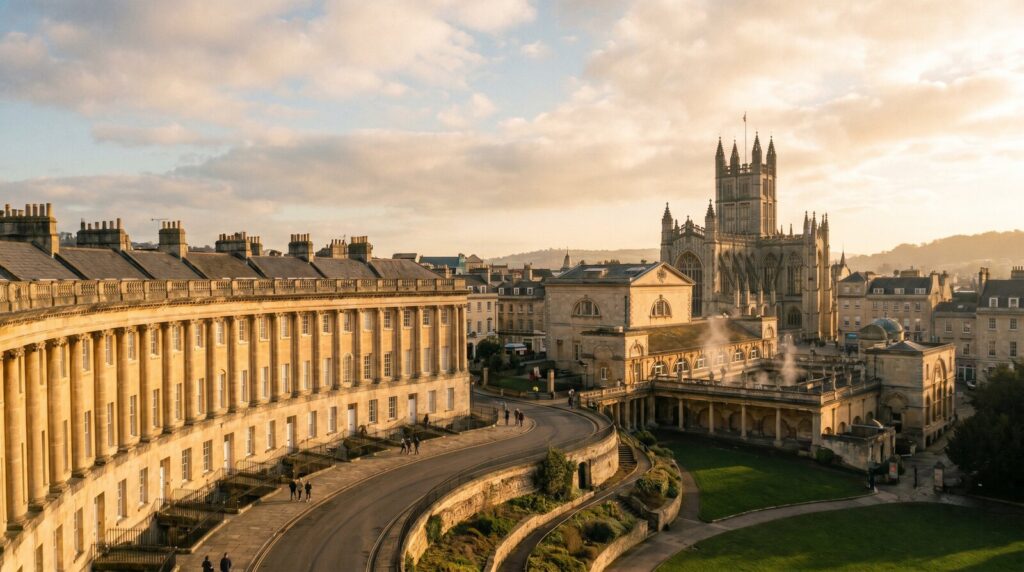
Bath represents Britain’s most architecturally coherent city, with golden Bath stone facades creating harmonious Georgian urban landscape. The Romans discovered hot springs, built sophisticated bathing facilities, and established Aquae Sulis as strategic settlement. Centuries later, Georgian architects John Wood Sr. and Jr. transformed Bath into spa destination for wealthy visitors, creating the Royal Crescent, Circus, and terraces that established English neoclassical architecture standards.

The city functions simultaneously as archaeological museum preserving Roman engineering, testament to Georgian aesthetic principles, and literary landmark—Jane Austen lived in Bath during young adulthood, setting novels within the city’s social hierarchies and architectural contexts. This layering—Roman, Georgian, Austen-esque—creates destination where history appears as physical environment rather than museum exhibits.
Contemporary Bath balances tourism with resident quality of life, with university presence (Bath University and Bath Spa University) creating intellectual energy. The city maintains architectural integrity while supporting contemporary commerce, theater, and cultural institutions. Walking Bath’s streets reveals centuries—Roman engineering beneath Georgian streets, medieval churches adjacent to neoclassical terraces, modern shops within historic facades.
Table of Contents
Roman Engineering & Thermal Waters
The Roman Baths represent extraordinary achievement in Roman engineering, constructing bathing facilities superior to most contemporary facilities. The Romans discovered that the natural hot springs—water emerges at 46 degrees Celsius from deep underground—provided opportunity for ambitious engineering project. They built the Great Bath, tepid baths, and cold plunge pools, creating bathing complex serving military, administrative, and civilian populations.
The thermal waters contain radioactive elements and minerals providing purported health benefits that attracted visitors across centuries. Contemporary Thermae Bath Spa draws mineral water from the springs, offering bathing experiences connecting modern visitors to ancient traditions. Submerging in the same water where Roman soldiers, Celtic priestesses, and medieval pilgrims bathed creates temporal connection.
The Roman Temple dedicated to Sulis Minerva occupied the site where the cathedral now stands. Celtic and Roman religious traditions merged, with Celtic goddess Sulis and Roman Minerva sharing divine responsibilities. The religious syncretism—Celtic and Roman traditions combining—demonstrates how imperial conquest involved cultural adaptation rather than simple domination.
Georgian Architecture & Urban Design
The Georgian era (roughly 1714-1830s) transformed Bath from Roman archaeological site into fashionable spa destination. John Wood Sr., a visionary architect, proposed radical urban design incorporating classical principles into residential neighborhoods. The Royal Crescent—a curved terrace of thirty townhouses forming perfect arc overlooking fields—represents Georgian architecture’s culmination, creating unified aesthetic effect through repetition and proportion.
The Circus, another Wood creation, applies circular geometry to urban residential design. Three curved terraces form a perfect circle, with central open space providing community gathering area. The Circus applies classical proportions (Doric, Ionic, and Corinthian architectural orders stacked in prescribed manner) creating aesthetic sophistication that elevates simple housing into architectural masterpiece.
Hundreds of Georgian townhouses throughout Bath share common characteristics—sash windows, fanlight doors, elegant proportions—creating architectural continuity. Walking through Georgian neighborhoods reveals how individual architects maintained shared aesthetic while creating slight variations—window surrounds, doorway details, wrought iron work. This balance between unity and individuality characterizes Georgian design philosophy.
Terraced Housing
Repeating townhouse units creating unified streetscapes through harmonious proportions and materials.
Classical Orders
Doric, Ionic, and Corinthian columns and capitals applied to residential buildings introducing temple-like dignity.
Sash Windows
Elegant proportioned windows allowing abundant light while maintaining weather protection and visual consistency.
Wrought Iron
Balconies and railings featuring delicate ironwork combining functionality with decorative artistry.
Jane Austen’s Bath & Literary Heritage
Jane Austen lived in Bath from 1801-1806, a period she later described as among the most unhappy of her life. Yet this unhappiness infused her Bath novels—Persuasion and Northanger Abbey—with social satire and architectural awareness. Austen’s Bath characters navigate the city’s social hierarchies, architectural settings, and leisure culture, using Georgian Bath as context for exploring human behavior and social structures.
The Jane Austen Centre, located in a Georgian townhouse in the city center, interprets Austen’s Bath years and her novels’ Bath settings. The museum displays period furnishings, clothing, and manuscripts revealing the material culture of Austen’s era and context for her writing. Experienced Austen readers find additional meaning viewing actual spaces she inhabited.
The Assembly Rooms, where Austen’s characters attended dances and social events, survive as functioning event space and museum. The Ballroom, Tea Room, and Card Room maintain Georgian elegance while hosting contemporary weddings and events. Walking through these spaces where Austen’s characters socialized creates tangible connection to literary world.
Contemporary Bath Culture
Bath functions as cultural center with universities, theaters, festivals, and artistic communities creating intellectual environment. The Bath Festival celebrates music, theater, and literature annually, attracting international performers and scholars. University populations bring contemporary energy and intellectual vibrancy to the historical setting.
The Theatre Royal maintains classical traditions while presenting contemporary work. The Sally Lunn House (historic building serving the traditional Bath bun pastry) represents food heritage continuing through centuries. Contemporary restaurants, bookstores, and galleries integrate with historical architecture, creating dynamic cultural mix.
The city’s Bath stone—quarried locally, creating the distinctive golden color—represents environmental heritage and continued economic importance. Contemporary building maintains Bath stone requirements, preserving architectural character while supporting ongoing stone industry.
Planning Your Bath Visit
Bath is located 190 kilometers west of London, accessible by train (90 minutes) or coach services. The city is walkable, with major attractions within easy walking distance of city center. Bath Spa train station sits centrally, making arrival straightforward.
The best visiting season extends April-October, with summer providing warm weather and full cultural programming. Spring offers pleasant conditions with fewer tourists. Autumn provides excellent weather and active cultural calendar.
Accommodations range from luxury hotels to budget guesthouses. Mid-range options cost 80-130 euros nightly. Dining offers good value, with three-course meals in mid-range establishments costing 20-30 pounds.
Experience Three Centuries of British History
Bath invites exploration of Roman engineering mastery, Georgian architectural perfection, and Austen-era social culture. From thermal waters to elegant crescents to literary landmarks, experience the city where history appears as tangible environment.
Start planning your Bath adventure today with Facts From Upstairs.
🚕 Getting Around Bath
Bath’s compact historic center is a joy to walk — the Roman Baths, Royal Crescent, the Circus, Pulteney Bridge, and Bath Abbey all sit within a 20-minute walking radius. The Georgian streets and crescents were designed for promenading, and the city’s UNESCO World Heritage status means most of the center remains pedestrian-friendly with limited vehicle access.
For reaching the outer neighborhoods and surrounding countryside, First Bus operates local routes including the handy Park & Ride services from the city outskirts. The Bath Bus Company runs a hop-on-hop-off sightseeing tour that covers the major landmarks if your feet need a break. Taxis are available from ranks near the train station and Bath Spa, and Uber operates in the city.
Bath makes an excellent base for day trips. Stonehenge is 40 minutes by car (organized tours depart daily from the city center). Bristol is just 15 minutes by train with frequent Great Western Railway services. The Cotswolds villages (Castle Combe, Lacock, Bradford-on-Avon) are 20–40 minutes by car and feel like stepping into a period drama. For a scenic option, the Kennet and Avon Canal towpath offers beautiful cycling routes into the countryside.
🍽️ Where to Eat & Drink in Bath
Bath punches well above its weight culinarily, with a food scene that balances traditional British comfort with contemporary flair. Sally Lunn’s is the city’s most iconic eatery — housed in one of Bath’s oldest buildings (c. 1482), it serves the famous Sally Lunn Bun, a brioche-like bread best enjoyed with cinnamon butter or as a savory base topped with smoked salmon.
For modern British dining, The Olive Tree (Bath’s only Michelin-starred restaurant) showcases seasonal West Country produce in elegant tasting menus. Menu Gordon Jones offers a surprise multi-course experience — no menu, just trust the chef and enjoy whatever the markets delivered that morning. For a more casual but equally delicious meal, The Circus Restaurant serves superb British-European dishes in a charming Georgian townhouse.
Bath’s pub scene is quintessentially English. The Star Inn (established 1760) is a Grade II listed pub with separate tap rooms and Bass ale served from the jug — it is a living museum of English pub culture. For craft beer, Bath Ales and the Electric Bear Brewing taproom offer local brews. The Bath Gin Distillery on Queen Street serves gin flights in a candlelit Georgian vault. On Saturdays, the Green Park Station Market overflows with artisan producers, local cheeses, and street food.
❓ Frequently Asked Questions About Bath
What is the best time to visit Bath in 2026?
May to September offers the warmest weather and longest days, perfect for strolling the Royal Crescent gardens and canal-side walks. The Bath Festival (May–June) fills the city with music, literature, and art events. December brings the famous Bath Christmas Market — one of England’s best, with over 150 chalets lining the streets around Bath Abbey. Spring and autumn offer pleasant temperatures with fewer crowds than summer.
Can you actually bathe in the Roman Baths?
You cannot swim in the ancient Roman Bath complex itself — it is a museum. However, the Thermae Bath Spa, just steps away, lets you bathe in naturally heated thermal waters in a stunning modern facility. The rooftop pool offers panoramic views over Bath’s skyline and is an unforgettable experience, especially at twilight. Book in advance as sessions fill quickly, particularly on weekends.
How many days do I need in Bath?
Two full days covers the major sights — the Roman Baths, Royal Crescent, Pulteney Bridge, Bath Abbey, and Thermae Bath Spa — with time for a leisurely afternoon tea and evening pub crawl. Three days allows for a Stonehenge or Cotswolds day trip. Bath also works beautifully as a day trip from London (1.5 hours by train), though an overnight stay is highly recommended to experience the evening atmosphere.
How do I get to Bath from London?
Great Western Railway runs direct trains from London Paddington to Bath Spa station in approximately 1 hour 20 minutes. Advance tickets cost as little as £15–30. National Express coaches are cheaper (from £5) but take 2.5–3 hours. If driving, Bath is 115 miles west of London via the M4 — though parking in the city center is limited, so use the Park & Ride services.
Is Bath expensive to visit?
Bath is moderately priced by English standards — more affordable than London but pricier than many regional cities. The Roman Baths admission is around £28 for adults, Thermae Bath Spa sessions start at £40, and a pub lunch runs £12–18. Mid-range hotels cost £100–180 per night. Many of Bath’s greatest pleasures — wandering the crescents, crossing Pulteney Bridge, strolling the canal — are completely free.
🌍 Explore More Destinations
If Bath’s Georgian elegance and thermal waters charmed you, these guides offer more heritage-rich escapes:
- Edinburgh, Scotland: Castles, Whisky & Literary History — Britain’s other great Georgian city with dramatic castle views and legendary pub culture.
- Salzburg, Austria: Mozart’s Birthplace & Baroque Alps — Another elegant European city where music, architecture, and natural beauty converge.
- Ghent, Belgium: Medieval Waterways & Beer Culture — Medieval European charm with world-class art and a thriving food scene.
- Girona, Spain: Catalan Cuisine & Spain’s Best Small City — Another compact historic gem with extraordinary food and centuries of heritage.