
Cape Verde: Atlantic Islands, Morna Music & Volcanic Beaches
Volcanic Atlantic islands where morna music echoes through towns, pristine beaches line volcanic shores, and island culture rewards slow travel
Cape Verde exists in geographical isolation 600 kilometers west of Senegal, a ten-island archipelago rising from the Atlantic Ocean where volcanic geology created landscapes unlike anywhere else in West Africa. The islands appear in the distance as dark rocky outcrops, stark and dramatic against the blue Atlantic. Landing on Sal Island, the primary tourist hub, you encounter beaches of impossibly pure white sand, ocean water that shifts between green and turquoise, and settlements that feel distinctly Portuguese-influenced yet thoroughly African in character.

The islands have maintained cultural identity despite Portuguese colonization and isolation. Morna—a melancholic music tradition born in Cape Verde and inseparable from national identity—fills the air from bars to boats to informal street gatherings. The Portuguese language exists alongside Creole, the actual lingua franca. The culture blends Portuguese, West African, and maritime traditions into something distinctly Cape Verdean. For travelers, this means slow-paced island experiences, excellent seafood, beaches that seem infinite, and cultural encounters that reward curiosity and patient engagement.
Navigate This Guide
The Ten Islands & Geology
The Cape Verde archipelago comprises ten islands and several smaller islets arranged in two groups: the Windward Islands (Barlavento) and the Leeward Islands (Sotavento). Each island has distinct geological and climatic character. The islands are volcanic in origin, with multiple peaks visible from offshore. Pico de Fogo on Fogo Island, Cape Verde’s highest point at 2,829 meters, dominates the landscape and occasionally still shows volcanic activity.
Sal Island, the tourism hub, is low-lying and arid, with white sandy beaches that extend for kilometers. The island developed around salt production historically, hence the name. Contemporary Sal focuses on beach tourism, with the main town of Santa Maria catering entirely to visitors. Santo Antão represents the opposite extreme: mountainous, verdant, and sparsely developed for tourism. The variation between islands allows diverse experiences depending on your priorities.
The islands sit in an arid zone, receiving minimal rainfall. Vegetation is sparse—scrub brush, drought-resistant plants, and few trees characterize the landscape. Yet this aridity creates dramatic visual beauty. Rocky outcrops, volcanic formations, and endless ocean horizons create environments where human presence feels appropriately small. The landscape rewards exploration from those willing to hike and engage with terrain that isn’t conventionally picturesque.
The volcanic geology creates unique ecological relationships. Endemic plant and animal species evolved in isolation. Seabird populations thrive on rocky outcrops. Turtles nest on specific beaches. The islands maintain biodiversity in small areas—a reminder of how speciation occurs when populations are geographically isolated. Conservation efforts aim to protect these unique ecosystems from tourism pressure and development.
Sal Island: Beach Tourism Hub
Sal Island developed specifically for tourism, with the capital Santa Maria containing most hotels, restaurants, and tourist infrastructure. The beaches here are among the world’s finest: nearly white sand, warm year-round water temperatures, and minimal crowds compared to Caribbean destinations. The beaches stretch seemingly endlessly, with sections near town bustling and more distant areas offering relative solitude.
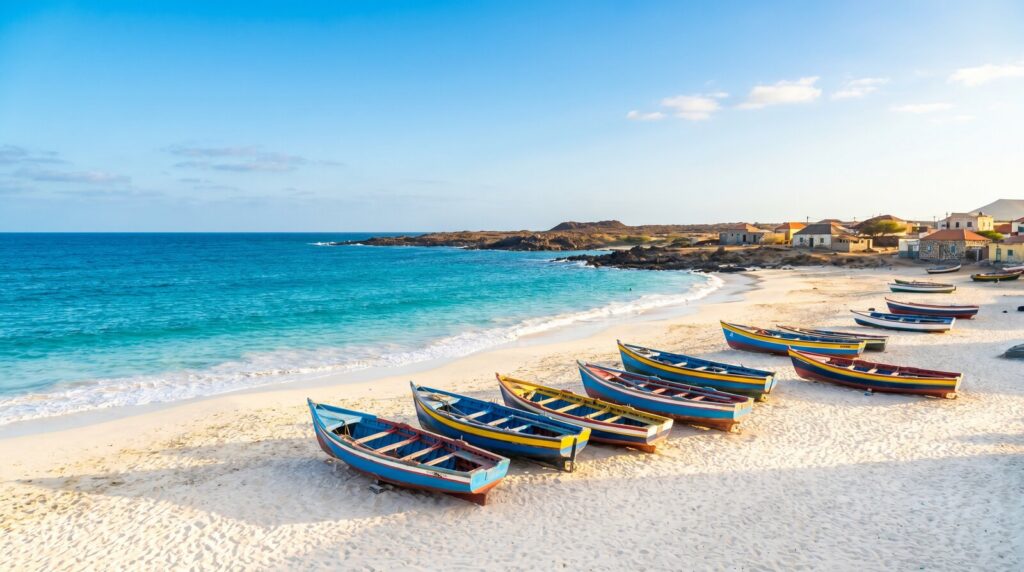
Santa Maria’s waterfront features colorful boats moored in shallow water, a picturesque scene that appears in nearly every Cape Verde travel publication. The town center remains small enough to explore on foot. Restaurants cluster around the harbor, specializing in fresh fish and seafood. The atmosphere is laid-back, with the primary activity being relaxation. For travelers seeking beach time without complex logistics, Sal offers accessibility that other Cape Verde islands don’t provide.
Water sports are popular on Sal. Kiteboarding and windsurfing thrive due to consistent Atlantic winds. Several schools offer instruction for beginners. Diving spotting includes reefs and shipwrecks, attracting underwater enthusiasts. Fishing charters depart regularly for deep-sea or nearshore experiences. The combination of excellent weather, calm water, and infrastructure makes Sal practical for water sports enthusiasm.
Beyond Santa Maria, Sal contains other settlements like Pedra Lume and Buarcos. Pedra Lume offers spectacular hiking terrain with views across the island. Salt ponds, still visible from the island’s salt production history, remain as geographical features creating unusual visual landscapes. Buarcos is smaller and quieter than Santa Maria, attracting travelers seeking alternative beach towns with fewer tourist amenities but more authentic local character.
Morna Music & Cultural Heritage
Morna music epitomizes Cape Verdean cultural identity. The melancholic genre developed from African and Portuguese musical traditions, expressing themes of love, loss, and longing. The music feels emotionally weight-bearing despite relatively simple instrumentation—typically guitar and voice, sometimes supported by light percussion. The most famous morna artist, Cesária Évora, achieved international fame, but morna’s heart remains in the islands where it evolved.
Walking through Cape Verdean towns and villages, you hear morna constantly—from bars, homes, boats, and street gatherings. The music provides soundtrack to daily life rather than existing as tourist artifact. Informal performances occur regularly; bars host musicians nightly. The opportunity to experience morna in its cultural context, performed by people for whom the music holds meaning, differs fundamentally from consuming it as exotic cultural product.
Morna’s lyrics often reference Cape Verde’s isolation and beauty. Songs express the longing of sailors at sea and families separated by migration. Understanding these themes provides context for why morna feels emotionally resonant even for non-Creole speakers. The emotional content transcends language barriers. Many travelers describe experiencing morna for the first time as profoundly moving—the combination of music, setting, and cultural context creates powerful emotional response.
Beyond morna, Cape Verde has other musical traditions. Funaná developed in Santo Antão and differs markedly from morna—faster-paced, more rhythmic, and popular for dancing. Batuque combines vocals with percussion. The diversity of musical traditions reflects how geographically isolated island communities developed distinct cultural forms. Experiencing these different genres provides musical education alongside cultural immersion.
Beaches & Coastal Life
Cape Verde’s beaches rank among the world’s finest, with sand quality and colors varying by island. Sal’s beaches are white and pristine. Santo Antão’s beaches feature black volcanic sand contrasting against turquoise water. Maio offers pink-tinged sand creating unique aesthetic. The variety means that beach-enthusiasts can explore multiple islands seeking different visual experiences and swimming conditions.
The beaches attract fewer visitors than comparable Caribbean destinations, meaning you experience relative solitude even on developed islands. Sunset walks along empty stretches of sand feel appropriately meditative. The combination of pristine beaches and minimal crowds ranks high among travelers’ reasons for visiting. This remains true despite increasing tourism—infrastructure simply hasn’t matched Caribbean development levels.
Coastal fishing villages demonstrate how traditional maritime economies persist despite tourism development. Fishermen depart at dawn, returning with catches sold in markets and to restaurants. The daily rhythm of fishing remains intact, creating authentic economic relationships distinct from tourism. Visiting fishing villages and purchasing fresh fish directly from catches provides both practical food acquisition and cultural immersion simultaneously.
Swimming in Cape Verdean waters requires awareness of ocean conditions. Atlantic currents are stronger than Caribbean waters. Rip currents exist. Lifeguards monitor developed beaches near Santa Maria, but remote beaches lack supervision. Asking locals about current conditions before swimming prevents dangerous situations. The ocean’s power shouldn’t be underestimated despite the beautiful appearance.
Cape Verdean Cuisine
Cape Verdean food reflects island isolation and Portuguese influence. Seafood dominates—fish prepared grilled, in stews, or fried. Tuna appears constantly, prepared numerous ways. Lobster, shrimp, octopus, and crab showcase diverse marine resources. The combination of fresh catch with Portuguese cooking techniques and African ingredients creates distinctive cuisine. Cachupa—a corn-based dish that functions as national comfort food—appears in many variations. The dish represents cultural identity as much as nutritional staple.
Plantains, cassava, sweet potatoes, and rice provide carbohydrate bases. Beans and legumes offer protein alongside fish. Tropical fruits—papayas, mangoes, guavas—are abundant when in season. The food is flavorful without excessive spice, relying on fresh ingredients and careful preparation rather than heat for distinctive taste. Dining experiences range from fine restaurants to informal beach shacks, with both offering quality preparations of similar ingredients.
Grogue—a potent rum distilled from sugar cane—represents local spirit culture. Bars serve it neat or in cocktails. The alcohol is strong enough to require respect; drinking diluted or mixed versions prevents incapacitation. Grogue tastings reveal how quality varies between distilleries. Some versions are dangerously rough; others are surprisingly sophisticated. Local expertise helps distinguish quality from potentially dangerous amateur productions.
Markets throughout Cape Verde overflow with fresh produce. Shopping in markets provides contact with local vendors and access to ingredients for self-catering meals. Many accommodations include kitchen facilities, enabling self-preparation of meals using market ingredients. This approach reduces costs while enabling deeper cultural engagement through food shopping and preparation.
Inter-Island Travel
Ferry service connects the islands irregularly. Schedules change frequently based on weather and demand. Book early and confirm departure times repeatedly. Domestic flights operate between major islands via local carrier. While pricier than ferries, flights offer reliability and speed. Many travelers base themselves on Sal then day-trip to other islands via flights.
Climate & Weather
Cape Verde has consistent year-round temperatures around 24°C. Dry season (November-June) offers the best weather with lower humidity and minimal rain. Wet season (August-October) brings occasional rain and rougher ocean conditions. Harmattan winds (November-March) blow from the Sahara, creating dusty conditions but clear skies.
Accommodation Variety
Sal offers everything from budget guesthouses ($30-50) to all-inclusive resorts ($200+). Other islands offer simpler, more affordable accommodation. Many travelers combine Sal’s convenience with exploration of quieter islands. The diversity allows budget flexibility and experience variety.
Currency & Costs
Cape Verde uses the Escudo Caboverdiano (CVE). Budget travelers can eat and lodge cheaply on local food. Tourism pricing in Sal is considerably higher than local alternatives. ATMs exist in major towns. Credit cards work in established establishments but cash is necessary for informal vendors and smaller islands.
Island Culture & Villages
Cape Verdean culture emphasizes community, family, and slow-paced living. Meals are social events, often extended affairs where eating is secondary to conversation. Greeting rituals are important—taking time for proper hellos demonstrates respect. The concept of “island time” isn’t stereotype but genuine cultural practice where urgency is perceived as wasteful. Visitors who adapt to this rhythm find their experience enriches substantially compared to those attempting to maximize activities through speed.
Village exploration reveals how settlements organize around fishing, agriculture, or administrative functions. Houses cluster tightly, creating communal courtyards and intimate street networks. Walking villages, you’ll encounter people willing to chat, offer guidance, or invite you into homes. These interactions, more than museums or tours, provide genuine cultural understanding. The informality and openness of village life rewards curious travelers who engage respectfully.
Family structures remain important despite increasing urbanization. Older generations maintain authority and respect. Extended family networks support individuals. Community events and celebrations bring people together. As a visitor, observing and respectfully participating in these social structures provides cultural perspective that tourism infrastructure obscures.
Religion (primarily Catholicism reflecting Portuguese colonization, with minority Protestant communities) plays a role in community life. Churches remain important social centers. Religious observances and celebrations mark the calendar. Understanding religious significance enhances cultural comprehension without requiring participation.
Planning Your Island Visit
International flights serve Cape Verde primarily through Praia (Santiago Island). From Praia, connections to Sal and other islands depart regularly. International arrival in Praia requires navigation through customs and the capital before heading to islands, adding travel time. Some international flights connect directly to Sal, eliminating the Praia connection. Flight pricing and schedules vary significantly, so research thoroughly before booking.
Visas for Cape Verde are obtainable on arrival for most nationalities, though pre-arranged visas expedite the process. Yellow fever vaccination isn’t required unless arriving from endemic countries. Malaria is not present in Cape Verde. Tap water is generally safe throughout the islands, though travelers with sensitive stomachs may prefer bottled water.
Portuguese is the official language, with Cape Verdean Creole the actual lingua franca. English proficiency exists in tourist areas but is limited elsewhere. Learning basic Portuguese and Creole phrases enhances interactions. Translation applications assist with communication barriers. The language barrier is noticeable but manageable with preparation and patience.
Allow at least 4-5 days in Cape Verde to appreciate the islands properly. This timeline permits one or two islands’ exploration without feeling rushed. Longer stays enable inter-island exploration and deeper cultural engagement. Many travelers spend a week, using Sal as a base and day-tripping to other islands via flights. This approach balances convenience with experience diversity.
Physical fitness requirements depend on activities. Beach relaxation requires minimal fitness. Hiking volcanic terrain requires moderate fitness. Climbing Fogo’s crater requires significant fitness and acclimatization to altitude. Check specific activities’ requirements and honestly assess your capabilities before booking.
Discover Atlantic Island Paradise
Cape Verde offers isolated beauty where volcanic beaches meet morna music, where fishing communities maintain traditions despite tourism, and where slow-paced island culture rewards patient travelers. The islands remain less-developed than Caribbean alternatives, preserving authenticity that makes them increasingly precious as destination tourism expands globally.