
Crete, Greece: Minoan Palaces, Samaria Gorge & Greece’s Largest Island
Crete isn’t merely another Mediterranean island—it’s a foundational birthplace of European civilization. The Minoan culture that flourished here 4,000 years ago predated classical Greece and influenced classical civilizations across the Mediterranean. Today’s island combines this extraordinary archaeological inheritance with dramatic natural landscapes, exceptional food culture, and communities that maintain genuine Cretan traditions alongside modern tourism infrastructure. Crete rewards travelers seeking substance—whether exploring labyrinthine palace ruins, hiking through dramatic gorges, or dining in family tavernas where recipes pass through generations unchanged.
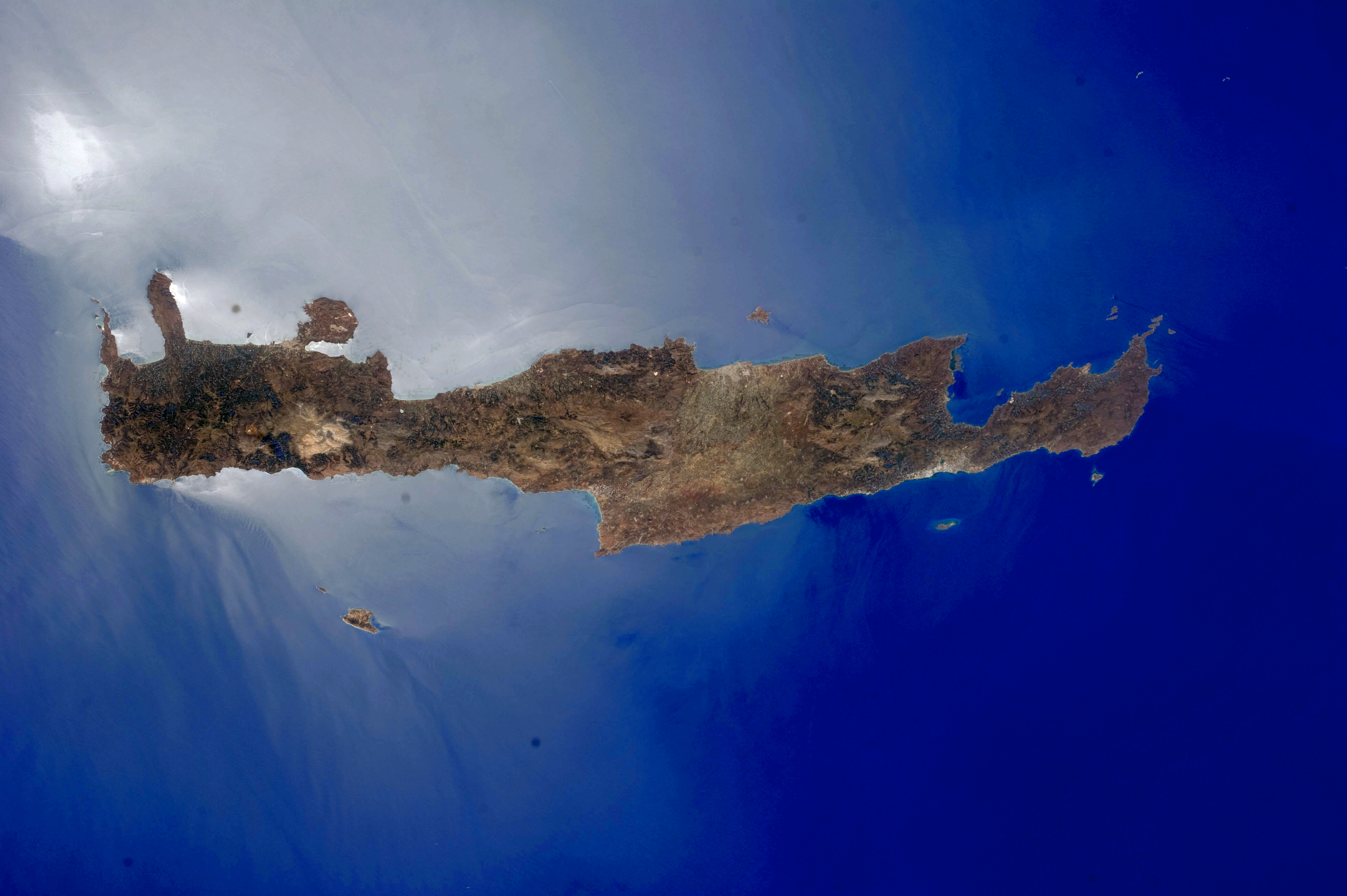
The island’s size—equivalent to Delaware or the region of Wales—means exploration requires planning. Two major cities anchor opposite island ends (Heraklion and Chania), with Minoan palaces spread across the landscape, gorges and hiking opportunities throughout, and beaches ranging from touristy to beautifully remote. Crete offers adventure, history, and culture in proportions matching any Mediterranean destination, yet retains enough authentic character to reward travelers venturing beyond guided tours and established tourist corridors.
In This Guide
- Minoan Palaces: Windows into Bronze Age Civilization
- Knossos: Labyrinth Legend & Archaeological Reality
- Samaria Gorge: Trekking Through Cretan Wilderness
- Cities & Villages: Heraklion, Chania & Authentic Settlements
- Cretan Food Culture: Mediterranean Authenticity
- Beaches: From Sandy Shores to Hidden Coves
Minoan Palaces: Windows into Bronze Age Civilization
The Minoan civilization (2700-1420 BCE) created one of Europe’s first complex societies. Unlike other Bronze Age cultures, Minoans appear to have lacked central authority and organized military power, yet developed sophisticated architecture, trade networks, writing systems, and artistic traditions. Archaeological evidence suggests Minoan civilization valued aesthetics—decorative pottery, fresco paintings, and architectural refinement—as much as functionality. This orientation toward beauty creates surprisingly modern sensibility when examining artifacts.
Minoan palaces scattered across Crete reveal settlement patterns and cultural priorities. Rather than walled fortifications typical of contemporary civilizations, Minoan palaces were architecturally open, featuring numerous entrances and window openings. This openness suggests confidence in peaceful times and suggests social organization different from militaristic Bronze Age kingdoms. The palaces functioned as administrative, religious, and residential centers—merging governance, spirituality, and domestic life in ways that challenge contemporary separation of these spheres.
Minoan society experienced traumatic disruption around 1450 BCE when volcanic eruption on Santorini devastated Cretan civilization. Subsequent Mycenaean invasions from mainland Greece further transformed the island. Yet Minoan cultural influence persisted—Mycenaean Greeks absorbed Minoan artistic traditions, religious practices, and administrative systems. The impact rippled forward, influencing classical Greek culture and establishing Mediterranean civilization patterns persisting today.
Visiting Cretan palaces requires imagination—unlike classical Greek temples with standing columns and intact structures, Minoan palaces are largely foundations and lower wall sections. Yet skilled reconstruction drawings, museum displays, and interpretive signage help visitors envision palace interiors. The archaeological sites’ atmospheric qualities—isolation, surrounding landscape, sense of age—compensate for missing upper structures. Standing in a palace courtyard where Minoans gathered 4,000 years ago creates tangible connection to deep history.
Knossos: Labyrinth Legend & Archaeological Reality
Knossos, near modern Heraklion, was Crete’s largest Minoan palace and its cultural heart. The site inspired the Greek myth of the Labyrinth—a maze constructed to contain the Minotaur (half-man, half-bull creature). While myth and reality diverge dramatically, Knossos’s architectural complexity and scale convinced ancient Greeks that the palace inspired labyrinth stories. The site covers six acres with rooms, corridors, and complexes that genuinely confuse first-time visitors.
Knossos’s notable feature is its multi-story construction. Unlike most palace sites revealing only ground-level ruins, Knossos retained portions of upper stories—revealing spatial organization of residential and administrative zones. The Grand Staircase represents architectural sophistication, with multiple flights serving different levels while creating impressive visual impact. The Throne Room housed a ceremonial throne still visible today, suggesting administrative importance and religious function intertwined.
The palace featured advanced infrastructure—drainage systems, storage magazines for grain and oil, water management systems—indicating sophisticated management of resources and population. The extensive storage facilities suggest centralized control of agricultural surplus, indicating development of hierarchical administration. The residential quarters feature intimate spaces suggesting family life alongside grand ceremonial areas, humanizing ancient inhabitants through architecture revealing daily existence.
The site’s restoration is controversial—early 20th-century archaeologist Arthur Evans reconstructed portions of the palace using his interpretations, creating modern structures mixing original remains with speculative reconstruction. Some scholars criticize these reconstructions as misleading; others argue they enable comprehension impossible with bare ruins alone. Visitors should understand which structures are original versus reconstructed to properly interpret what they observe.
Samaria Gorge: Trekking Through Cretan Wilderness
Samaria Gorge represents one of Europe’s most dramatic hiking experiences—a 16-kilometer descent through a canyon that reaches depths of 600 meters while remaining barely wider than walking width in sections. The trek typically takes 5-7 hours depending on fitness and pace, descending 1,200 meters from the White Mountains to the Libyan Sea. Most hikers arrange transportation to the gorge’s start (Xyloskalo refuge near Omalos village), complete the trek, and arrange return transportation from Agia Roumeli village at the gorge’s foot.
The geological formations are extraordinary—layers of limestone carved by water over millennia, creating sheer walls, natural caves, and unique flora adapted to the harsh environment. The gorge’s narrowest section (Iron Gates) features walls nearly vertical with barely enough space for a stream and single-file hiking path. The contrast between the claustrophobic Iron Gates and wider sections where views expand across surrounding mountains creates dramatic spatial variety.
Hiking Samaria requires preparation despite being relatively accessible. The path is well-marked but rocky and requires stable footwear and reasonable fitness. Early morning departures (tours typically depart 6-7 AM) prevent afternoon heat exhaustion. Water is available at certain points but carrying at least 1.5 liters ensures hydration security. The trek is crowded in summer with hundreds hiking daily, creating some congestion in narrow sections. Early season (May-June) or late season (September-October) hiking provides superior experiences with fewer crowds and more moderate temperatures.
The physical challenge creates psychological reward—completing the trek generates genuine accomplishment and embodied understanding of Crete’s geography. The gorge’s natural beauty combined with physical exertion transforms it from mere tourist activity into transformative experience. Hikers emerge at Agia Roumeli village where local tavernas serve meals to muddy, exhausted trekkers—completing the experience with Cretan hospitality and authentic village life.
Cities & Villages: Heraklion, Chania & Authentic Settlements
Heraklion, Crete’s capital, serves as transportation hub but offers limited charm—it’s a working city rather than tourist destination. The Archaeological Museum, housed in a recently renovated building, contains extraordinary Minoan artifacts including the famous Phaistos Disk (a spiral disc inscribed with undeciphered symbols), frescoes, pottery, and sculptures. The museum contextualizes Minoan civilization and provides essential background for palace visits.
Chania, on Crete’s western end, retains genuine character despite tourism. The Venetian harbor features colorful traditional buildings, waterfront cafes, and working fishing boats creating picturesque scenes. The old town’s narrow streets hide restaurants, galleries, and shops. Unlike completely commercialized Mediterranean ports, Chania maintains authentic community life alongside tourism. Staying in Chania provides better base than Heraklion for exploring western Crete.
Smaller villages throughout Crete offer authentic experiences unavailable in tourist centers. Agricultural villages in the interior produce olive oil, wine, and cheese using traditional methods. Many villages welcome visitors for meals, allowing tourists to sit at family tables eating homemade food and participating in actual communities rather than staged tourist performances. The willingness of villages to accept travelers varies—some aggressively welcome tourism, others remain skeptical—but those receptive create unforgettable memories.
Rethymno
A quieter alternative to Chania with similar Venetian charm. The seaside town features authentic neighborhoods, good beaches, and reduced tourist pressure compared to major centers.
Mountain Villages
Settlements like Anogia maintain traditional Cretan culture—villagers wear traditional dress, speak the Cretan dialect, and maintain customs unchanged for generations. Visiting requires respect for communities not existing for tourism.
Cretan Food Culture: Mediterranean Authenticity
Crete’s food tradition represents Mediterranean cuisine at its finest—built on olive oil, cheese, fresh vegetables, fish, and herbs. The Cretan diet, studied extensively for its health benefits, emphasizes plant-based foods complemented by modest meat consumption. Many locals still grow vegetables, maintain olive trees, and produce cheese at home—food culture deeply connected to land and seasons.
Dakos (barley rusks topped with tomato and cheese) represent simple Cretan staple—peasant food elevated through quality ingredients. Horta (boiled seasonal greens) with olive oil and lemon remain breakfast staple. Graviera cheese, a hard cheese produced from sheep’s milk, represents Cretan dairy tradition. Lamb stewed with vegetables and local wine creates warming winter dishes. Fresh fish grilled simply with lemon and olive oil celebrates the island’s maritime heritage.
Wine production dates to Minoan times—grape seeds found in palace excavations indicate 4,000-year wine culture. Modern Cretan wineries produce exceptional wines increasingly recognized internationally. Local wine bars offer tastings of small-producer wines, providing education in Cretan viticulture and opportunity to support traditional producers. Raki, a potent spirit distilled from grape must, rounds Cretan meals with digestive and social functions.
Beaches: From Sandy Shores to Hidden Coves
Crete’s coastline spans over 1,000 kilometers with beach options ranging from developed resort areas to remote coves accessible only by hiking or boat. The northern coast (facing Greece) features more developed beaches with tourism infrastructure. The southern coast (facing Africa) remains wilder, with dramatic cliffs, fewer crowds, and beaches requiring effort to access. The dramatic topography means that minutes inland from any beach, the island rises steeply toward the central mountains.
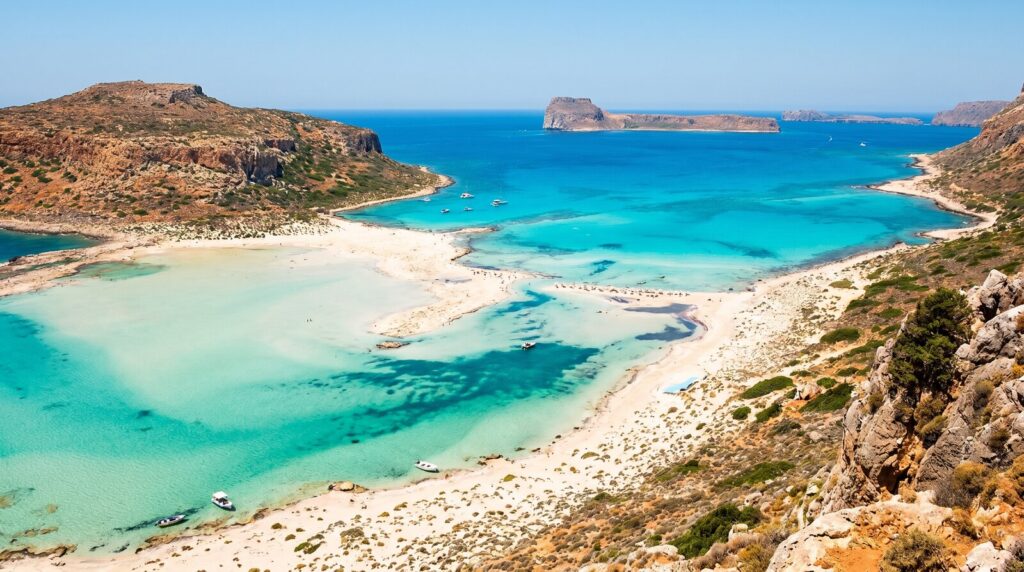
Palm Beach near Vai features one of Europe’s few palm-tree groves creating tropical atmosphere—surprisingly lush for Mediterranean. The beach attracts summer crowds but remains visually stunning. Balos Lagoon in northwestern Crete features turquoise water, sandy islands, and pristine conditions—though accessibility challenges limit crowds. Pink Beach on Crete’s southern coast features sand with pink-hued minerals creating distinctive coloring.
Many travelers hire boats or join boat tours to access remote beaches inaccessible by road. Spending an afternoon in a secluded cove with clear water, sandy beach, and minimal development represents ideal Mediterranean experience. Local boat operators know beaches tourists rarely reach—inquiring at harbors about private boat rentals enables custom itineraries matching interests and preferences.
Journey to Crete’s Past and Present
Crete combines extraordinary archaeology with natural beauty, authentic food culture, and genuine communities resistant to complete commercialization. Whether exploring Minoan palaces, trekking through dramatic gorges, swimming in Mediterranean waters, or sitting in village tavernas sharing meals with locals, Crete rewards travelers seeking substance. The island’s size demands strategic planning, but the rewards justify the effort.
2026 Travel Update for Crete
Crete continues to be one of the Mediterranean’s most beloved island destinations in 2026. Heraklion Airport is undergoing a major expansion project to accommodate growing visitor numbers, and a new airport at Kastelli is expected to open soon, offering improved capacity and connectivity. The island’s agritourism sector has blossomed, with more olive oil estates, wine producers, and organic farms welcoming visitors for tastings and overnight stays. Crete’s long-distance hiking trail, the E4, has received improved waymarking, and new coastal walking routes along the southern shore offer alternatives to the popular Samaria Gorge trek. Sustainable tourism initiatives are increasingly visible across the island.
Frequently Asked Questions About Crete
What is the best time to visit Crete?
The best time to visit Crete is from late April to June and September to October. These shoulder seasons offer warm weather (22–28°C), fewer crowds than peak summer, and lower accommodation prices. The Samaria Gorge opens for hiking in May. July and August bring the hottest temperatures and largest crowds but are ideal for beach holidays. Winters are mild on the coast but the mountains can see snow.
How many days do you need in Crete?
Crete is Greece’s largest island and deserves at least 7–10 days to explore properly. This allows time for the historic cities of Heraklion and Chania, the Palace of Knossos, the Samaria Gorge hike, the stunning beaches of Elafonissi and Balos, and quieter villages in the interior. Many travelers focus on either the western or eastern half of the island for shorter trips of 4–5 days.
Should I rent a car in Crete?
Renting a car is highly recommended in Crete. Public buses connect major towns but service to remote beaches, mountain villages, and southern coast destinations is limited. Car rental rates start from about $25–40 per day in shoulder season. Roads are generally good on the northern coast highway but can be narrow and winding in mountain areas. An international driving permit may be required depending on your home country’s license.
What food should I try in Crete?
Cretan cuisine is considered one of the healthiest in the world. Must-try dishes include dakos (barley rusk topped with tomato and cheese), kalitsounia (cheese or herb pastries), lamb with stamnagathi (wild greens), and fresh seafood at seaside tavernas. The island’s extra virgin olive oil is world-renowned, and local wines from indigenous grape varieties like Vidiano and Kotsifali are excellent. Raki (tsikoudia) is the traditional digestif offered after meals.
Is Crete good for families?
Crete is an excellent family destination. Many beaches have shallow, calm waters suitable for young children, particularly on the northern coast. Family-friendly resorts with kids’ clubs and pools are abundant around Hersonissos, Rethymno, and Chania. The Cretaquarium, Dinosauria Park, and Knossos Palace appeal to children of all ages. Greek tavernas are universally welcoming to families, and children are celebrated in Cretan culture.