
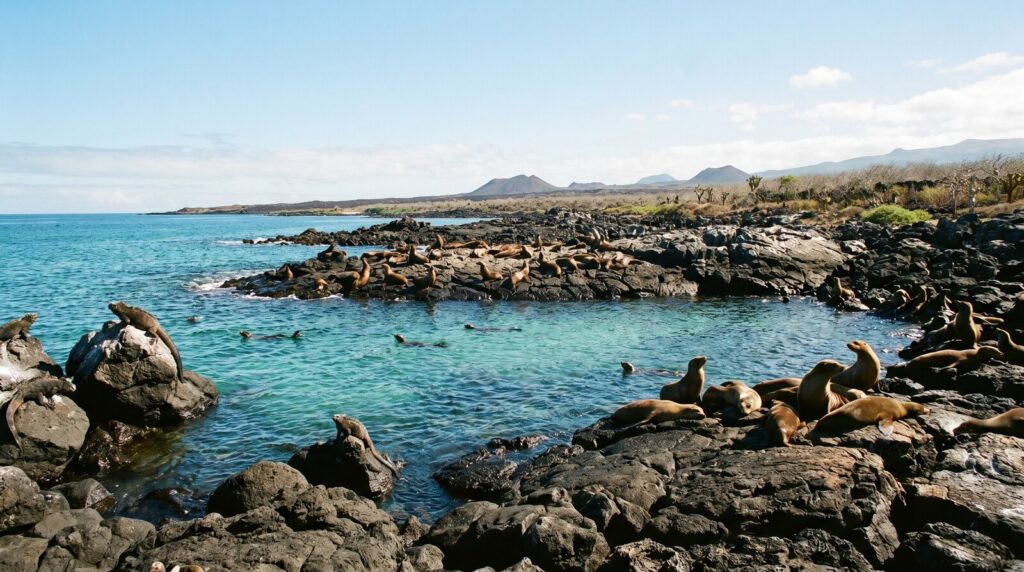
Galápagos, Ecuador: Darwin’s Wildlife, Giant Tortoises & Snorkeling Paradise
Evolution’s laboratory in the Pacific, accessible to curious travelers
Snorkeling & Underwater Encounters
The Galápagos marine ecosystem rivals its terrestrial counterpart in biological significance. Multiple ocean currents converge around the archipelago, creating upwellings rich in nutrients that support extraordinary marine life. The cold Humboldt Current brings temperate-water species into equatorial waters, resulting in unusual biodiversity—penguins swimming alongside tropical fish, hammerhead sharks circling alongside sea turtles, marine iguanas feeding underwater while boobies dive overhead.

Snorkeling opportunities occur across multiple islands, with certified operators managing sustainable access that protects fragile ecosystems. Isabela Island offers consistent encounters with sea lions, starfish in improbable colors, and fields of sea urchins carpeting rock formations. Española Island provides opportunities with Galápagos hawks and marine iguanas in their natural feeding behavior. The Galápagos penguin and flightless cormorant, both found nowhere else on Earth, occasionally appear in snorkeling locations, though encounters require patience and luck.
The cold water—often between 18-22°C—makes quality wetsuits essential. Many snorkelers underestimate temperature; immersion times of 30-45 minutes without proper thermal protection lead to dangerous hypothermia at equatorial latitudes. Responsible snorkeling also means maintaining distance from animals, never touching wildlife, and following guide protocols that have been refined through years of sustainable tourism management.
Island Hopping & Guided Expeditions
Exploring the Galápagos requires navigation via authorized tour operators or cruise vessels. Day trips from port towns offer limited island access, while multi-day cruise experiences enable comprehensive exploration of geographically dispersed islands. Land-based tours from Puerto Ayora provide budget alternatives, with guided hikes to specific ecosystems on accessible islands like Santa Cruz and Isabela.
Genovesa Island provides dramatic volcanic geology with towering red cliffs where frigatebirds soar on thermal currents. Bartolomé Island’s summit walk offers panoramic views of coastal pinnacles and underwater marine reserves, one of the archipelago’s most photographed vistas. Fernandina Island remains largely undeveloped, reserved primarily for scientific research, yet authorized tours occasionally navigate its western shores where recent lava fields create otherworldly landscapes.
The equator passes through the archipelago; several islands straddle the line, offering the novelty of standing simultaneously in Northern and Southern hemispheres. While scientifically meaningless, the photographic opportunity has become a standard itinerary item, revealing how tourism layers contemporary experience over evolutionary and geographical significance.
Blue-Footed Boobies
Famous for brilliant blue feet used in elaborate courtship displays. Watching males perform their high-stepping dance remains one of the archipelago’s most memorable wildlife moments.
Marine Iguanas
The only lizards on Earth adapted to marine environments. They’re awkward on land but graceful swimmers, feeding on algae underwater in daily foraging rituals unchanged for millennia.
Galápagos Sea Lions
Intelligent, playful marine mammals that demonstrate remarkable curiosity toward humans. Watching pups interact with mothers reveals mammalian social structure rarely observed so closely.
Flightless Cormorants
The only cormorant species incapable of flight, having lost flying ability after millions of years in islands with no natural predators. They hunt underwater with remarkable grace.
Endemic Wildlife & Species Adaptations
Galápagos endemism reaches remarkable levels: roughly 97% of the mammalian population exists nowhere else. The reptiles show similarly high endemism, with thirteen finch species descended from a single ancestral population. This concentration of endemic species makes the archipelago irreplaceable for evolutionary biology and conservation—if these species disappear, evolution loses experiments that took millions of years to develop.
The Galápagos hawk, apex predator across the islands, demonstrates how isolation permits unusual predator-prey relationships. With no competition from larger raptors, these medium-sized hawks occupy ecological niches typically filled by eagles and other large raptors on continents. Their fearlessness toward humans reflects evolutionary history without aerial predation, resulting in wildlife behavior impossible to observe in continental settings.
Perhaps most striking is the complete absence of large terrestrial predators. In this predator vacuum, species evolved reduced predator avoidance behaviors—boobies don’t flee approaching humans, iguanas tolerate close observation, and sea lions approach snorkelers with neutral curiosity. This naiveté, which once made species vulnerable to human exploitation, now enables tourism experiences of unparalleled intimacy.
Conservation Travel & Protected Status
The Galápagos National Park, established in 1959, protects 97% of the archipelago’s terrestrial area. Marine protections extend further, with the Galápagos Marine Reserve encompassing 130,500 square kilometers of ocean. These designations represent rare examples of ecosystem-scale conservation where regulations meaningfully constrain human activity for environmental protection.
Tourism itself poses threats despite conservation designation. Increased visitation introduces invasive species via ship ballast water and cargo, overexploits fish stocks, and pressures fragile nesting sites. Ecuador implements strict controls: transit visas cost $20 and are limited to 30 days; most islands remain accessible only via authorized operators; and daily visitor caps limit ecosystem impact. These regulations, while occasionally inconvenient, directly enable continued conservation success.
Responsible Galápagos travel means accepting restrictions as conservation necessary rather than inconvenience. Supporting operators with strong environmental records, maintaining distance from wildlife, avoiding single-use plastics, and choosing sustainable accommodation options transform tourism into a conservation tool rather than threat.
The Galápagos experience demands patient observation. The endemic wildlife, while relatively fearless, remains genuinely wild—animals pursue natural behaviors regardless of human presence. This indifference requires travelers to respect distance; approaching animals too closely disrupts natural behavior and can trigger defensive responses. The best wildlife photography and observation comes from finding animals engaged in natural activities and quietly observing, rather than pursuing animals seeking interaction. The discipline of sitting still, watching, and waiting rewards visitors with insights into behavior that movement and pursuit would prevent.
The cultural and economic dimensions of Galápagos tourism require thoughtful consideration. The islands’ importance for conservation and scientific research can conflict with tourism expansion. Growing numbers of visitors create pressure on ecosystems, though well-managed tourism remains more sustainable than uncontrolled development. The Ecuadorian government balances conservation with economic development—tourism provides revenue enabling conservation funding while simultaneously threatening the ecosystems that justify the tourism. Choosing operators with strong environmental credentials, maintaining respectful distance from wildlife, and supporting conservation-focused tour companies represent individual contributions to sustainable tourism.
The biological research culture distinguishes Galápagos from purely touristic destinations. The Charles Darwin Research Station operates on Santa Cruz Island, conducting ongoing studies of endemic species and evolution. Visitors can tour research facilities, observe research animals, and gain deeper understanding of contemporary biology. The research station’s work directly informs conservation management, meaning that tourism revenue indirectly supports science that maintains the islands’ ecological integrity. This integration of tourism and research creates destination character distinct from locations separating conservation from visitation.
Visit Evolution’s Classroom
The Galápagos demands reverence and rewards curiosity. This isn’t a destination for casual tourism; it’s a pilgrimage to evolutionary genesis, an encounter with species that modified human understanding of life itself. Plan carefully, respect regulations that enable conservation, and prepare for wildlife encounters that will reshape how you understand adaptation, isolation, and time’s awesome power to transform living things.