
Languages of Ecuador
All languages of South America →fluent beta classical · classes by phone with Maya at ranas.ai/maya
Ecuador Travel Guide — Four Worlds in One Tiny Equator-Straddling Country
Ecuador is arguably the best-value country in the Americas, yet most travelers nod politely and book Costa Rica anyway — which leaves the Quilotoa rim blissfully uncrowded. This is a country where a single ordinary day can run from breakfast in Otavalo, wool blankets being folded into pickup trucks outside, to the true equator line at the Quitsato Sundial — the real one, not the famous monument that misses the line by a couple of hundred metres — with ceviche the size of a fist for lunch in Guayaquil and a cloud-forest lodge in Mindo by nightfall, where a single feeder can draw dozens of hummingbird species. The classic Ecuador argument is whether the Galápagos belong on a first trip — the case here is no, see the mainland first — and the runner-up is whether Cuenca or Quito deserves “main character” status. Treat this as the brief you’d want in hand before boarding the LATAM red-eye from JFK to UIO.

In This Guide
- Overview — Why Ecuador Belongs on Every Bucket List
- Galápagos Cruise Season 2026 — Wet vs. Dry, Iguanas vs. Boobies
- Best Time to Visit Ecuador (Region by Region)
- Getting There — Flights & Arrival at UIO and GYE
- Getting Around — Buses, Tren Crucero & Internal Flights
- Top Cities & Regions — Quito, Cuenca, Galápagos, Guayaquil & More
- Ecuadorian Culture & Indigenous Peoples
- A Food Lover’s Guide to Ecuador
- Off the Beaten Path — Cotopaxi, Quilotoa, Mindo & Yasuní
- Practical Information
- Budget Breakdown — Cheap Mainland, Expensive Islands
- Planning Your First Trip to Ecuador
- Frequently Asked Questions
- Ready to Explore
Overview — Why Ecuador Belongs on Every Bucket List
Ecuador’s pitch to travellers is geographic showing-off: it is the smallest of the Andean nations at roughly 283,561 square kilometres , yet it crams four wildly different ecosystems — high-altitude Andes (the Sierra), the Pacific coast (the Costa), the western Amazon basin (the Oriente) and the Galápagos archipelago a thousand kilometres offshore — into a footprint smaller than the US state of Colorado. The country sits squarely on the equator (which gave the republic its name when it broke from Gran Colombia in 1830) and that line crosses a mainland whose elevations sweep from sea level to the 6,263 m summit of Chimborazo, technically the point on Earth’s surface furthest from the planet’s centre thanks to the equatorial bulge. The national tourism board sells the country as “four worlds,” and after a fortnight zig-zagging from Quito’s altiplano to Manta’s Pacific surf, you start to think the marketing slogan is doing the country a disservice rather than overselling it.
Ecuador is one of the planet’s 17 megadiverse countries — a UN-EP designation reserved for nations holding the lion’s share of Earth’s species — and it punches absurdly above its size on biodiversity rankings. With just 0.2 % of the world’s total land mass, Ecuador is home to an estimated 8 % of amphibian species, 5 % of reptiles, 8 % of mammals and 16 % of the world’s birds. Conservation International officially classed Ecuador as ‘mega-diverse’ in 1998, and it covers two of the five South-American biodiversity hotspots — the Tropical Andes and the Tumbes-Chocó-Magdalena corridor. Yasuní National Park alone has set world records for tree, amphibian and bat diversity per hectare, and a single hectare there hosts more than 100,000 insect species. The Galápagos Islands, meanwhile, hold the unique distinction of being the very first natural site UNESCO ever inscribed, declared on 8 September 1978 alongside Yellowstone and the Grand Canyon.
The country’s cultural contrasts are just as vivid. Ecuador’s 2008 constitution made it the first country in the world to enshrine the rights of nature — Pachamama — as a legal entity that can be defended in court, a clause that has been cited in lawsuits halting mining concessions across the Andes. Quito’s 320-hectare colonial core was the first city ever inscribed on UNESCO’s cultural list — co-honoured in 1978 with Kraków — and it remains the largest, least-altered historic centre in the Americas. Cuenca, founded in 1557 on the rigorous town-planning grid Charles V issued for the Indies, joined the list in 1999, and the Qhapaq Ñan Inca road system — shared with five other countries — was added in 2014.
And then there is the practical magic of Ecuador-as-destination. The country has used the US dollar as its official currency since January 2000, when the sucre collapsed; that means no FX surprises for North Americans, no time-zone changes between Miami and Quito, and ATM cash that comes out in dollars. Mainland Ecuador remains one of South America’s cheaper destinations — a $5 set lunch (the famous almuerzo) is everywhere — while the Galápagos behave like a separate, far more expensive nation. The World Bank’s 2025 estimate has Ecuador’s economy rebounding 3.7 % on the back of exports, investment and private consumption after a 2 % contraction in 2024.

Galápagos Cruise Season 2026 — Wet vs. Dry, Iguanas vs. Boobies
The single biggest planning question for Ecuador in 2026 is when — not whether — to add the Galápagos to your itinerary, because the islands run on two utterly different climatic regimes that produce two utterly different wildlife shows. The archipelago has no spring/summer/autumn/winter; instead the Humboldt Current flips on and off, and with it the entire ecosystem. Here is what each window actually looks like on the ground, and how the new $200 national-park fee — doubled from $100 on 1 August 2024, the first increase in 26 years — fits into the calculus.
- Warm/wet season (December–May): air highs around 28–31 °C, sea temperatures 23–26 °C, brief afternoon downpours. Calmest seas of the year — best for snorkellers and queasy cruisers. Marine iguanas turn turquoise and start mating in January, and green sea turtles haul ashore to nest from December through May.
- Cool/dry “garúa” season (June–November): air highs of 20–24 °C, sea temperatures down to 18 °C in August. The Humboldt Current pushes plankton-rich water north, drawing whale sharks and humpbacks; blue-footed boobies stage their famous courtship dance from May through October on Española and North Seymour.
- Cruise vs. land-based: roughly 70 multi-day live-aboard vessels operate in the Marine Reserve, ranging from 16-passenger sailing yachts to 100-berth expedition ships; itineraries are fixed by the National Park Directorate to spread visitor pressure.
- 2024 fee structure: $200 for foreign adults, $100 for foreign children under 12, free under 2; $30 for Ecuadorian nationals (was $7). Plus a $20 INGALA transit control card, payable at UIO/GYE, now mostly digitised since May 2025.
- 2025 update: the INGALA Tarjeta de Control de Tránsito moved fully online from 29 May 2025, eliminating one of the two airport queue points.

Best Time to Visit Ecuador (Region by Region)
Ecuador sits on the equator (the country is named for it) and that means the calendar mostly tracks rainfall rather than temperature, with rhythms that flip wildly between the four geographic worlds. Lump them together and you’ll waste days waiting for weather that never arrives. The answer to “when should I go to Ecuador” is therefore four answers, depending on which world you’re aiming at. One thing that does not vary: daylight is roughly 12 hours from sunrise to sunset every day of the year, give or take 7 minutes either way, because the country straddles the latitude line where the seasonal day-length swing is essentially zero. Plan dawn hikes (Cotopaxi, Quilotoa) for 5:30 a.m. start and you’ll be back at base by lunch in any season.
The Sierra (Quito, Cuenca, Otavalo) — Jun to early Sep is gold
The Andean highlands have a “rainy” October–May and a “dry” June–September; in practice the dry months bring crisp blue skies, cold nights and the best mountain visibility, while the wet months still produce plenty of clear mornings followed by 3 p.m. downpours. Quito sits at 2,850 m and Cuenca at 2,538 m, so daytime highs hover at 18–22 °C year-round but nights can drop to 8 °C. Pack layers; the saying is cuatro estaciones en un día (four seasons in a day) and it’s literal.
The Coast (Manta, Salinas, Montañita, Puerto López) — Dec to Apr is bizarrely the dry sunny window
The Pacific coast inverts North American intuition: December through April is the warm/sunny/swimmable season (highs 28–32 °C, ocean 24 °C), while May through November is grey, drizzly and noticeably cooler thanks to the Humboldt upwelling. The trade-off: humpback whales calve off Puerto López and the Machalilla NP coast from June to October, so the cooler grey months are when the cetaceans show up. Surfers head to Montañita year-round but with a strong preference for December–April groundswells.
The Amazon (Tena, Misahuallí, Coca, Yasuní) — Aug to Dec is driest
Yasuní’s lowland rainforest is wet year-round (this is the western Amazon basin, with annual rainfall regularly exceeding 3,000 mm), but rivers run lowest and trails are most passable from August through December. January–April brings the heaviest rains, which means flooded varzea forests and easier canoe access to inner lagoons — fantastic for serious birders willing to put up with mud. River-cruise lodges along the Napo run year-round; the smaller community-run lodges around Misahuallí close briefly in extreme high-water weeks.
Galápagos — there is no bad month, only different shows
See the seasonal-hook section above: warm/wet (Dec–May) for calm seas and surface activity, cool/dry “garúa” (Jun–Nov) for the productive Humboldt and the famous boobie courtship. Avoid two narrow windows if you can: the second half of December (Christmas/New Year — Galápagos cruise rates spike 30 %) and Easter Week.
Shoulder-season tip: If you’re combining mainland and islands and refuse to pick between weather windows, October and early November are the sneaky-good compromise — Sierra weather has dried out, the coast hasn’t yet warmed, and Galápagos still has cool-season blue-footed boobie courtship in full swing.
Getting There — Flights & Arrival at UIO and GYE
Ecuador has two international gateways, neither of them especially expensive thanks to a competitive carrier mix that survived the 2020 collapse of TAME (the former state airline). North Americans typically arrive via Miami, Houston, Atlanta, JFK or Fort Lauderdale; Europeans via Madrid (Iberia) or Amsterdam (KLM); intra-South-American travellers route through Bogotá (Avianca), Lima (LATAM) or Panama (COPA). Once you’ve cleared immigration you’re on US dollars from minute one — no FX kiosk required.
- Mariscal Sucre International (UIO) — Quito — Ecuador’s busiest airport, opened on 20 February 2013 to replace a 53-year-old runway hemmed inside the city. Sits at 2,400 m altitude, 18 km east of central Quito in Tababela, with a 4,100 m runway. Skytrax made it the first 5-star airport in the Western Hemisphere. Handled 4.3 million passengers in 2022.
- José Joaquín de Olmedo International (GYE) — Guayaquil — the coastal hub, often $50–150 cheaper from the US, only 5 km from the city centre and at sea level (much easier on first-day acclimatisation than UIO). Recommended if your itinerary starts on the coast or if you plan to fly directly to the Galápagos.
- Galápagos onward — Baltra (GPS) and San Cristóbal (SCY) — both reachable only via UIO or GYE on Avianca, LATAM or Equair; no international arrivals. The TCT control card moved fully online from 29 May 2025.
Flight times: Miami–UIO is roughly 4 h non-stop on AA or LATAM; Houston–UIO 5 h on United; JFK–UIO 6.5 h on JetBlue or LATAM; Madrid–UIO 11 h direct on Iberia; Amsterdam–GYE/UIO 11.5 h on KLM. Bogotá–UIO is just 90 minutes on Avianca, which makes Colombia an easy stop-over if you’re already in the region.
Carriers: Avianca, LATAM Ecuador, Equair (post-TAME successor), American, JetBlue, United, COPA, KLM, Iberia, Air Europa. The flag carrier TAME ceased operations in May 2020; LATAM and Avianca dominate the domestic market today.
Visa & entry: Most passports — including all EU member states, the UK, US, Canada, Australia, New Zealand and most of Latin America — receive 90 days visa-free as a “T-3” tourist stamp on arrival, with up to 90 days extra extension available at migración offices. From 12 May 2025, travellers arriving from Peru, Colombia, Bolivia or Brazil (or who spent more than 10 days in those countries) must present a yellow-fever vaccination certificate at immigration. Passport must be valid 6 months past arrival.
Getting Around — Buses, Tren Crucero & Internal Flights
Mainland Ecuador is a country you can sensibly cross by bus in 12 hours, but anyone in a hurry should fly the long legs and rent a car or hire a driver for the short ones. There is no nationwide rail commuter network — the celebrated Tren Crucero heritage line has been on and off since 2020 — and inter-city travel runs on a mature, cheap private bus network supplemented by Avianca/LATAM/Equair domestic flights and Uber/Cabify in the larger cities.
- Long-distance buses: still the workhorse. The rule of thumb is roughly $1 per hour of travel; Quito–Cuenca on a cama-class overnight runs about 8 hours for $12; Quito–Guayaquil 8 hours for $10–12; Quito–Otavalo 2 hours for $3. Every major city has a single terminal terrestre (the Quitumbe and Carcelén terminals in Quito are the principal ones) where dozens of operators sell tickets for the same route at the same price.
- Tren Crucero and Tren Ecuador heritage trains: the spectacular Quito–Guayaquil heritage line (4 days, including the Devil’s Nose switchback at Alausí) suspended commercial operations in 2020 and has been intermittently revived; check status with the operator before booking. The shorter Devil’s Nose excursion (Tren del Hielo, Tren de la Libertad) sometimes runs day trips.
- Internal flights: Avianca, LATAM and Equair fly the busy domestic triangle UIO–GYE–CUE several times daily; one-ways start around $60–80 if booked 2 weeks ahead. Galápagos flights (UIO/GYE → GPS or SCY) are pricier — $250–450 round-trip for foreigners — and only sell with TCT card and park-fee receipts.
- City transit: Quito’s BRT trio — Trolebús, Ecovía, Metrobús — costs $0.35 a ride; the long-awaited Quito Metro Line 1 opened end-2023 and runs from Quitumbe to El Labrador. Guayaquil’s Metrovía BRT (since 2006) is the equivalent on the coast.
- Taxis & rideshares: Uber and Cabify both operate in Quito, Guayaquil and Cuenca; both are cheaper and safer than flagged taxis (insist on the meter — “taxímetro encendido, por favor” — if you must use a street cab).
- Self-drive: straightforward on the Pan-American Highway (E35) and the Quito–Guayaquil corridor; not recommended in Esmeraldas or the southern coastal provinces given the FCDO’s 2026 advisory. International driving permit accepted.
Apps you’ll want: Maps.me (offline), Google Translate (Kichwa pack offline), Uber/Cabify, the Tame-replacement Equair app for cheap last-minute domestic seats, and the Ecu911 emergency app which the government rolled out as a unified 911 alternative. Sierra-bound? Pre-load offline relief maps from OpenTopoMap — patches of the Quilotoa Loop and the Cotopaxi access roads have spotty cell coverage even in 2026.
For long days you can string Quito’s BRT lines into a $0.50 round-the-city tour: south end at El Recreo (Trolebús terminus), north end at Carcelén (Metrobús), and the Ecovía running parallel along the Av. 6 de Diciembre spine. Single-fare cards are sold from green-vested attendants at every station; weekly cards aren’t really worth it for short stays.

Top Cities & Regions — Quito, Cuenca, Galápagos, Guayaquil & More
📍 Map of Ecuador: Every Place in This Guide
Six destinations carry the bulk of Ecuador’s tourist arrivals; together they cover three of the four geographic worlds and four of the country’s five UNESCO sites.


Quito — UNESCO 1978, the world’s first World Heritage city
The capital sits in a long Andean valley at 2,850 m, the second-highest of any in the world after La Paz, with metro-area population around 2.89 million as of the 2022 census. The historic centre is the largest, least-altered colonial core in the Americas — 320 hectares of Baroque churches, Mudéjar carpentry and the world-famous “Quito school” of religious sculpture, co-inscribed with Kraków on UNESCO’s first cultural list in 1978. Add the equator-line excursion at Mitad del Mundo and the cable-car (TelefériQo) to 4,100 m for the highest urban viewpoint in South America.
- La Compañía de Jesús — the gold-leafed interior is regularly cited as the most important Baroque church in the Americas.
- Basílica del Voto Nacional — climb the spires for vertiginous Quito skyline views.
- El Panecillo with the 41 m aluminium Virgen de Quito statue (the only winged Virgin in the world).
Cuenca — UNESCO 1999, the “Athens of Ecuador”
Founded as Santa Ana de los Cuatro Ríos de Cuenca on 12 April 1557 along the Tomebamba, Yanuncay, Tarqui and Machángara rivers, Cuenca preserves the original Spanish colonial grid almost intact and earned UNESCO inscription in 1999. At 2,538 m it sits 300 m lower (and noticeably warmer) than Quito and now has roughly 596,000 residents — Ecuador’s third city, with a 4,000–6,000-strong North American expat retirement community giving it an outsized English-speaking footprint.
- Catedral Nueva — the blue-tiled domes are the city’s signature.
- Mercado 10 de Agosto — the freshest fruit, hornado and morocho in the Sierra.
- The original “Panama” hat — toquilla-straw hats actually originated in coastal Ecuador, and Cuenca is the production capital. UNESCO inscribed the weaving tradition on the Intangible Cultural Heritage list in 2012.
Galápagos Islands — UNESCO 1978, the original natural World Heritage Site
The 18 main islands plus three smaller and 107 islets/rocks span 8,010 km² of land across 45,000 km² of ocean, with the Galápagos National Park (97 % of land area) and a 138,000 km² Marine Reserve providing the protective frame around what may be the most observable evolutionary laboratory on Earth. Roughly 33,000 humans live on the four inhabited islands (Santa Cruz, San Cristóbal, Isabela, Floreana), nearly all in tourism-related work. Wildlife stats are absurd: 80 % of land birds, 97 % of reptiles and land mammals, more than 30 % of plants and ~20 % of marine species are endemic; Darwin’s 13 finch species are all unique to the archipelago.
- Charles Darwin Research Station (Santa Cruz) — the on-site face of 60+ years of conservation science.
- Bartolomé Pinnacle Rock — the iconic photo every Galápagos brochure uses.
- Tortuga Bay (Santa Cruz) — free, walkable from town, marine iguanas everywhere.
Guayaquil — Ecuador’s Pacific port and largest city
Founded in 1547, Guayaquil is the country’s biggest city (2.65 million as of 2022) and economic capital — roughly 70 % of private exports and 83 % of imports flow through its container port. It also became the first Ecuadorian city to declare independence from Spain on 9 October 1820. The Malecón 2000 waterfront regeneration (opened 1999) transformed the city centre, and the Las Peñas neighbourhood — a 444-step climb up Cerro Santa Ana — is the most photogenic district. Use Guayaquil as a Galápagos jump-off, not as a long stay; the US State Department’s October 2025 advisory keeps the city south of Portete de Tarqui Avenue at “Do Not Travel” Level 4.
- Malecón 2000 and Las Peñas — the post-1999 regeneration showcase.
- Parque de las Iguanas (Seminario) — wild green iguanas in the city centre.
- Cerro Santa Ana — pastel-coloured houses up the 444 steps.
Otavalo — South America’s largest indigenous market
Two hours north of Quito at 2,532 m, Otavalo’s Saturday market on the Plaza de los Ponchos is the largest indigenous craft market on the continent — by some accounts running continuously since pre-Columbian trading days. The town and surrounding countryside are home to the Otavaleño Kichwa, recognisable by the men’s long single braid (shimba) and women’s white embroidered blouses; their textile-export business now reaches Europe and Japan.
- Saturday is peak (animal market dawn, then crafts market all day) but the Plaza de los Ponchos runs daily.
- Cuicocha crater lake — 30 minutes away, walkable rim circuit.
- Peguche waterfall — sacred to local Kichwa, the bathing ritual at Inti Raymi (June 21–24) is open to respectful visitors.
Baños de Agua Santa & the Tena/Misahuallí Amazon gateway
Baños sits at 1,820 m on the northern slopes of Tungurahua volcano in the upper Pastaza valley — the “gateway to the Amazon” because it is the last Sierra town on the descent to the rainforest. The town’s name means “Baths of Holy Water,” referring to the thermal pools fed by the volcano; outside town the Pailón del Diablo (Devil’s Cauldron) waterfall and the Casa del Árbol “swing at the end of the world” are the marquee photo stops. From Baños the road descends to Puyo and on to Tena/Misahuallí, the Amazonian gateway towns where 1–4-day rainforest lodges depart.
- Pailón del Diablo waterfall — short hike to the suspension bridge.
- Casa del Árbol — the swing photo, with Tungurahua usually photobombing.
- Ruta de las Cascadas — bike or zipline 18 km past 60 waterfalls.
Ecuadorian Culture & Indigenous Peoples
Ecuador’s 2008 constitution describes the country as “intercultural and plurinational,” and that wording is a direct nod to the 14 indigenous nationalities and 18 recognised “peoples” who together accounted for 7.69 % of the population (1.3 million people) at the 2022 census. Spanish is the official language; Kichwa and Shuar are recognised intercultural languages with state protection; another 12 indigenous languages have legal recognition. CONAIE (Confederación de Nacionalidades Indígenas del Ecuador), founded in 1986, is one of the most politically powerful indigenous organisations in Latin America and has staged the 1990, 2019 and 2022 national strikes that toppled multiple governments.

The major indigenous nations you may meet on the road
- Kichwa (Quichua) of the Sierra: by far the largest group at ~527,000 speakers (40.5 % of the indigenous population), split into a dozen pueblos including the Otavaleños (textile traders north of Quito), Saraguros (south, recognisable by black ponchos), Salasacas (Tungurahua), Cañari (around Cuenca), and the Puruhá around Riobamba.
- Kichwa Amazónico: a separate, lowland branch — the Napo and Pastaza Kichwa run many of the community-tourism lodges around Tena and Misahuallí.
- Shuar: the second-largest indigenous nation (~110,000), historically known to anthropologists for shrunken-head tsantsa warfare and now famous for community-tourism networks across Morona-Santiago.
- Achuar: closely related Jivaroan-language nation across the Pastaza border, partner in the Kapawi ecolodge model.
- Cofán, Siona, Siekopai (Secoya): small Amazonian peoples in Sucumbíos who have spent decades suing Chevron-Texaco over oil contamination — the long-running Aguinda v. Chevron case is one of the most-cited environmental lawsuits in history.
- Huaorani (Waorani): roughly 4,000 people in Yasuní; their reserve overlaps the territories of the uncontacted Tagaeri and Taromenane clans, who live in voluntary isolation.
- Tsáchila (Colorado): the lowland-coast nation famous for the men’s red-dyed bowl-cut hair (achiote/annatto pigment).
Etiquette & the basics
- Greetings matter. A handshake on first meeting; a kiss on the right cheek between women, and between mixed company once introduced. “Buenos días” until noon, “buenas tardes” until dusk, “buenas noches” after, even when entering a shop.
- Photographs of indigenous people: always ask, particularly at Otavalo and Saquisilí markets. “¿Puedo tomar una foto?” A small purchase first will almost always change a no into a yes.
- Personal space and time are looser than North American norms; meetings start late and the country runs on what locals jokingly call la hora ecuatoriana.
- Don’t equate Ecuadorian with “Spanish-only.” In Otavalo, Saraguro, Tena and the Amazon, asking your host whether they speak Kichwa or Shuar is a gesture of respect that carries weight.
- Pachamama and rights of nature: the 2008 constitution made Ecuador the first country in the world to recognise nature itself as a legal subject — a clause indigenous lawyers have used in landmark mining-injunction cases.
Festivals worth planning around
- Inti Raymi (June 21–24): the Andean winter-solstice festival, biggest in Otavalo, Cotacachi and Saraguro — Kichwa men dance in spiral processions to “take” the central plaza of each town.
- Mama Negra (Latacunga, late September & early November): the syncretic Latacunga festival fusing Andean, African and Spanish elements; a man dressed as the “Black Mother” rides through town with a doll baby and a bottle of milk-and-aguardiente.
- Pase del Niño (Cuenca, 24 December): the largest Christmas-procession in the country, 12 hours long, with thousands of children in regional costume.
- Carnaval (Feb/Mar): Guaranda and Ambato host the biggest blowouts; expect water-balloon ambushes everywhere.
A Food Lover’s Guide to Ecuador
Ecuadorian food splits cleanly along the same Sierra/Costa/Oriente lines as the country’s geography. Highland kitchens emphasise pork, potatoes, corn and cheese; coastal cooking is dominated by green plantain and seafood; the Amazon brings yuca, river fish and the caffeinated guayusa leaf-tea that powers indigenous wakefulness rituals. A 2023 study identified encebollado, ceviche and hornado as the three most-consumed Ecuadorian dishes, which is exactly the holy trinity any visitor should hunt down.

Must-Try Dishes
| Dish | Description |
|---|---|
| Ceviche de camarón | Coastal staple — cooked shrimp marinated in lime, tomato and red onion, served with chifles (plantain crisps) and toasted corn nuts. Note: unlike Peruvian ceviche, the shrimp is poached, not raw. |
| Encebollado | Tuna, yuca and pickled red onion soup with a slice of lime — Ecuador’s national hangover cure, sold in coastal markets from 6 a.m. |
| Hornado | Sierra Sunday-market headliner — whole pig slow-roasted in a wood oven, carved to order with llapingachos, mote (hominy) and avocado. The Saquisilí, Latacunga and Cuenca markets do the best ones. |
| Locro de papa | Andean potato-cheese soup, often topped with avocado slices and fresh-toasted corn — comfort food that rebuilds you after a day at altitude. |
| Llapingachos | Pan-fried potato-and-cheese patties served with chorizo, fried egg and peanut sauce — the Tungurahua/Pichincha lunch counter staple. |
| Fanesca | Once-a-year Lent/Easter dish — a thick fish-and-12-grains stew (one grain for each apostle) served with hard-boiled egg and fried plantain. Look for hand-painted signs “Hay Fanesca” outside Sierra restaurants in March/April. |
| Cuy | Roast guinea pig, ceremonial in the Andes since pre-Columbian times — most often eaten at family celebrations and at the Cuenca, Otavalo and Riobamba market food stalls. Expect $15–25 for a whole bird with sides. |
| Bolón de verde | Coastal breakfast — a fist-sized green-plantain dough ball stuffed with cheese, chicharrón or both, deep-fried and served with coffee. |
| Seco de chivo | Slow-stewed goat in a chicha-and-naranjilla sauce, served with rice, ripe plantain and avocado — the Manabí/Guayas regional showpiece. |
| Maito | Amazonian — river-fish (often tilapia or cachama) wrapped in a bijao leaf parcel and grilled over coals, with yuca and palm-heart salad. |
Drinks worth ordering
- Ecuadorian chocolate: Ecuador grows the largest share of fine-flavour “Arriba” Nacional cacao in the world — the only cacao with the highest “100 % Fino de Aroma” rating from the International Cocoa Organisation. The country’s exports are roughly 7 % of global cacao volume but a much larger share of the premium-bean market. Pacari (Quito-based) was the first organic cacao producer to win at the International Chocolate Awards.
- Coffee: the under-rated Loja and Zamora-Chinchipe highland coffees rival Colombian beans; Quito’s third-wave shops (Botánica, Kallari, República del Cacao) are excellent.
- Guayusa: the caffeinated holly-tribe leaf brewed by Kichwa Amazónico families before dawn — Runa and Waykana now bottle it. Bring a tin home.
- Pilsener & Club: the two big domestic lagers; both go with ceviche.
- Canelazo: the cinnamon-and-aguardiente Sierra hot punch made with naranjilla — the Quito night-market drink at 2,850 m.
- Aguardiente / Zhumir / Cristal: sugarcane spirits — Zhumir is the easy-drinking entry-level. Aguardiente “Cristal” is the everyday clear option.
The almuerzo culture
The single best deal in Ecuadorian dining is the almuerzo — a fixed-price lunch sold in workers’ restaurants across every town, usually $3–5 in 2026 (more like $2.50 in small Sierra towns, $6 in tourist Quito). It comes with soup, a main with rice and beans, juice and a small dessert. The chalkboard menu changes daily; the only failure mode is showing up after 2:30 p.m. when most kitchens close. Lunch is the meal of the day — Ecuadorians eat dinner light.
Vegetarians and vegans manage fine in Quito and Cuenca — both cities have a respectable third-wave plant-based scene since 2018 — but rural almuerzos can be tricky because most use chicken or beef stock for the soup, and a “vegetarian” dish often arrives with a fried egg on top. The phrase you want is “sin carne ni huevo, por favor” (“without meat or egg”) and a quick scan of the chalkboard for locro de papa, caldo de bola de verde (vegetarian-adjacent), habas con queso (boiled fava beans and cheese) and menestra (lentil or bean stew over rice) will keep you fed without arguments.
The country also has surprising depth in chocolate-and-cacao tourism: Pacari, To’ak, Mashpi Chocolate and República del Cacao all run factory tours and tasting rooms in Quito or Mindo, and “bean-to-bar” itineraries pairing Mindo with the Manabí coast (Camino del Cacao) have become a recognised Ministry of Tourism circuit.
- Chains worth knowing: KFC and McDonald’s exist in Quito and Guayaquil, but a thousand times better is the menestra y carne grill (rice, lentil stew, grilled beef) at any local parrillada.
- Convenience: tiendas on every corner sell water, snacks and SIM credit. Mercado food courts (every town has one) are the cheapest and most interesting eating.
Off the Beaten Path — Cotopaxi, Quilotoa, Mindo & Yasuní

Cotopaxi National Park (Cotopaxi Province)
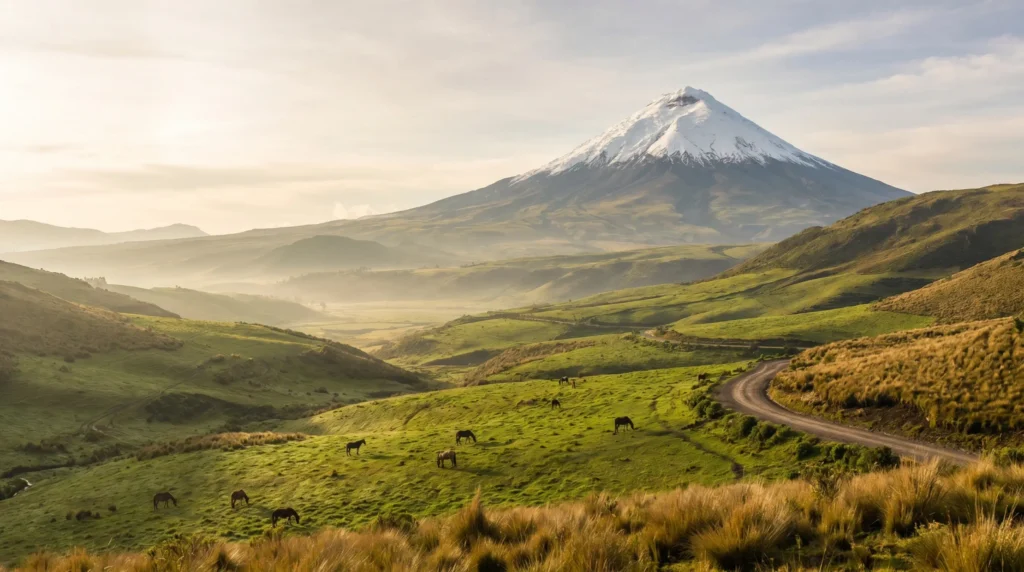
An hour south of Quito, Cotopaxi is one of the world’s highest active volcanoes (5,897 m / 19,347 ft) and one of Ecuador’s most active — 87 documented eruptions, with the most violent in 1742, 1744, 1768 and 1877; the 1877 lahars travelled more than 100 kilometres into the Pacific and destroyed the city of Latacunga. The current eruptive cycle began on 21 October 2022 and the Geophysical Institute of Ecuador had registered roughly 8,000 earthquakes by February 2023; check the IG-EPN bulletin before booking. Most visitors do a day trip from Quito to the José F. Ribas refuge at 4,800 m, with optional walks to the glacier tongue. Summit attempts (December–February ideally) require a certified ASEGUIM guide.
The Quilotoa Loop (Cotopaxi Province)
Quilotoa itself is a 3-km-wide caldera lake at 3,500 m — the most western volcano in the Ecuadorian Andes — formed by a catastrophic VEI-6 eruption around 1280 CE; the lake is 250 m deep and holds 0.35 km³ of mineral-stained water that ranges in colour from yellow-green to deep aquamarine depending on the season. The classic itinerary is the 3- to 4-day “Quilotoa Loop” hike between Sigchos, Isinliví, Chugchilán and Quilotoa village, sleeping in family-run hostels for $20 with breakfast and dinner; the rim circuit alone is a 4–5 hour, 10 km walk. Park entry is $2.
Mindo Cloud Forest (Pichincha Province)
Two hours west of Quito, Mindo sits where the Chocoan lowlands meet the Tropical Andes — a 268 km² watershed from 960 m to 3,440 m altitude that draws roughly 200,000 visitors a year for birdwatching (450+ species recorded), zip-lines, tubing, butterfly farms and chocolate tours. The Ecuadorian tourism ministry has designated Mindo the head of the country’s “Ruta del Cacao.” Bird highlights include cock-of-the-rock leks at the Refugio Paz de las Aves and any feeder-equipped lodge for 20+ hummingbird species in a single sitting.
Vilcabamba (Loja Province)
Vilcabamba sits at 1,500 m about 45 kilometres south of Loja in the southern Andes, in a sheltered valley that became famous in 1973 when Harvard physician Alexander Leaf wrote a National Geographic feature claiming the village had a freakishly high concentration of centenarians — the so-called “Valley of Longevity.” Subsequent research debunked the centenarian claims (the oldest verifiable resident was 96), but the valley’s 22 °C year-round climate, low cost of living and friendly expat community continue to draw a couple of thousand North American retirees. The horseback ride into Podocarpus National Park is the marquee day-out.
Yasuní National Park (Pastaza & Orellana)
Yasuní covers roughly 10,000 km² of the western Amazon basin and holds world records for tree, amphibian and bat diversity per hectare; a single hectare hosts at least 100,000 insect species, and the park accounts for one-third of all bird species in the entire Amazon (596 species). It also holds an estimated 1.7 billion barrels of oil — 40 % of Ecuador’s reserves — and overlaps the territories of the uncontacted Tagaeri and Taromenane Huaorani clans. In an August 2023 referendum, Ecuadorian voters chose by 59 % to ban future oil exploitation in the park’s Block 43-ITT, ordering Petroecuador to dismantle existing operations. Most travellers visit on 4-day lodge stays (Napo Wildlife Center, Sani Lodge, La Selva) reached by a 2-hour flight Quito–Coca then 3-hour motorised canoe down the Napo.
Sangay National Park (Morona-Santiago, Tungurahua & Chimborazo)
Ecuador’s third UNESCO natural site, inscribed in 1983 under all four natural criteria, covers 5,170 km² of central-Sierra wilderness from páramo to lowland rainforest — including the active Sangay (5,230 m) and Tungurahua (5,023 m) volcanoes. The Eastern access is harder than Cotopaxi (no paved road inside the park) but rewards with mountain tapir sightings and the Ozogoche lake circuit. The Inca Trail to Achupallas — part of the Qhapaq Ñan UNESCO road system — passes nearby.

Bonus picks
- Podocarpus National Park (Loja/Zamora): the “Botanical Garden of Latin America,” with more than 4,000 plant species and 600 birds — and one of the wettest, most biodiverse cloud-forest reserves anywhere on the eastern slopes of the Andes.
- Saraguro (Loja): distinct Kichwa nation in the southern Sierra, recognisable by black hand-woven ponchos; the women have one of the most photogenic festival costumes in the country. The Saraguro Inti Raymi (June 21) procession winds for hours through the cobblestoned plaza.
- Tena white-water rafting: the Jondachi and Misahuallí rivers offer Class III–IV rafting in a tropical setting most rafters wrongly skip in favour of Costa Rica. The 2005 World Rafting Championships held heats here, which is exactly the legitimacy stamp the operators wave when they quote you.
- Isabela Island in the Galápagos: the largest island, 4,640 km², with five active shield volcanoes and roughly three-quarters of the archipelago’s land area — but the fewest cruise itineraries call here, so Isabela rewards the land-based traveller. Sierra Negra’s caldera is one of the largest active calderas on Earth (10 km wide).
- Ingapirca (Cañar): Ecuador’s most-significant Inca ruin, built around 1500 by Túpac Yupanqui’s expansionist push north — a 90-minute drive from Cuenca. The Templo del Sol’s elliptical wall is the only one of its kind in the surviving Inca canon.
- The Devil’s Nose train (Alausí): when running, the switchback descent from Alausí to Sibambe drops 500 vertical metres in a series of hairpin reverses — one of the most spectacular short-line train rides anywhere in the world. Service is intermittent post-2020.
Practical Information
| Currency | US Dollar — Ecuador formally dollarised in January 2000, replacing the collapsed Sucre. ATMs dispense USD; small change is the universal struggle (carry $1, $5, $10 bills). |
| Cash needs | Cash is king outside Quito/Cuenca/Galápagos; rural almuerzos, market food and local buses are cash-only. Plan $20–40 a day in cash even on a card-heavy trip. |
| ATMs | Banco Pichincha, Banco Guayaquil and Produbanco have the densest networks; max withdrawal varies $200–500. Use indoor mall ATMs in Guayaquil. Foreign-card fees usually $3–5 per transaction. |
| Tipping | 10 % service is added by law in restaurants (“servicio incluido”); a 5 % top-up for excellent service is appreciated. Taxi drivers don’t expect tips; round up. Galápagos cruise crew expect $10–20 per passenger per day in pooled tips. |
| Languages | Spanish (official), Kichwa and Shuar (intercultural recognised), 12 more indigenous languages legally protected. English fluency is concentrated in Quito, Cuenca expat areas and Galápagos guides. |
| Safety | Active “Internal Armed Conflict” decree since 9 January 2024 (declared by President Noboa after the live-TV takeover and Macías Villamar prison escape). US State Department issued Level 2 (Increased Caution) on 14 October 2025, with Level 4 “Do Not Travel” zones in Esmeraldas city & north, southern Guayaquil, Huaquillas, Arenillas, Quevedo/Quinsaloma/Pueblo Viejo and Durán canton. UK FCDO advises against all but essential travel to seven coastal provinces and within 20 km of the Colombian border. Quito’s tourist core, Cuenca, Otavalo, Baños, Mindo and the Galápagos remain low-risk. Curfews 11 p.m.–5 a.m. cycle on/off in affected provinces. |
| Connectivity | Three networks (Claro, Movistar, CNT) with strong coverage along the Pan-American highway and patchy reach in Yasuní/Galápagos. eSIM works for all three. Prepaid 30-day data SIMs about $15. |
| Power | Type A & B (US flat-blade), 120V / 60Hz — North Americans need no adapter. |
| Tap water | Not safe for visitors anywhere on the mainland or Galápagos; bottled is universal and cheap (~$0.50/litre). Hotels generally provide free filtered jugs. |
| Healthcare | Quito private hospitals (Hospital Metropolitano, Vozandes) are excellent; coastal and Amazonian rural clinics are basic. Dengue endemic on the coast and lowland Amazon. Yellow-fever vaccine recommended (and now required if arriving via Peru/Colombia/Bolivia/Brazil with 10+ days in those countries) for Amazon provinces below 2,300 m. Malaria risk in Sucumbíos, Orellana, Pastaza, Esmeraldas and Morona-Santiago lowlands. Altitude sickness (soroche) is a real factor above 2,500 m — diamox (acetazolamide) is sold over the counter. |
| Galápagos extras | $200 National Park entry fee (foreign adult, 1 Aug 2024+), $20 INGALA transit control card (online from 29 May 2025), $5–20 island-hopping ferry transfers between Santa Cruz/San Cristóbal/Isabela. Children under 12 pay $100 park fee, under-2s free. Ecuadorian nationals pay $30. |
| Time zone | UTC-5 mainland (same as US Eastern Standard, no DST), UTC-6 Galápagos. |
| Mitad del Mundo trivia | The famous yellow-line monument north of Quito is approximately 240 m off the actual equator; the GPS-correct line passes through the Quitsato sundial near Cayambe and the Catequilla pre-Inca observatory in the Pomasqui Valley. The original 1936 French Geodesic Mission’s instruments simply weren’t precise enough. |
Budget Breakdown — Cheap Mainland, Expensive Islands
Ecuador is the great two-budget country of South America: spend a fortnight in the Sierra and Amazon and you’ll struggle to crack $80 a day; spend a single week on a Galápagos cruise and you may pay more than your flights. The reason is simple — the National Park’s tonnage limits and the $200 entry fee make the Galápagos the world’s most regulated wildlife destination, and that regulation prices itself in. Plan two budgets, not one.
💚 Budget Traveller — $40–60/day mainland, $200/day Galápagos land-based
Mainland: $10–18 hostel dorm beds (Quito’s La Floresta and Cuenca’s centro have plenty), $3–5 almuerzos for both lunch and dinner, $1/hour buses, $0.35 transit. The Quilotoa Loop family hostels at $20 with breakfast and dinner are arguably the best value lodging in the Andes. Galápagos: $25–45 hostel beds on Santa Cruz, public-ferry day trips to Isabela ($30 each way), free walks to Tortuga Bay and Las Grietas, plus the unavoidable $200 park fee + $20 TCT card.
💙 Mid-Range — $90–160/day mainland, $400/day Galápagos
Mainland: $50–90 boutique hotels in Quito’s La Mariscal/Mariscal Foch area or Cuenca’s Calle Larga, $15–25 sit-down dinners, an Uber/Cabify budget, and either a 2-day Cotopaxi or 4-day Quilotoa guided tour. Galápagos: $150–250 mid-range hotels with breakfast on Santa Cruz, $100–200 day-trip boats to North Seymour, Floreana or Bartolomé. The Inti Raymi or Mama Negra festival weeks in the Sierra fall into this bracket.
💜 Luxury — $400+/day mainland, $600–1,500/day Galápagos cruise
Mainland: Casa Gangotena or Illa Experience Hotel in Quito, Mansión Alcázar in Cuenca, Hacienda Zuleta or Hacienda Cusín for Sierra haciendas, Napo Wildlife Center or Sani Lodge for an all-inclusive Yasuní stay. Galápagos: 4- to 8-night live-aboard expedition cruises (Ecoventura, Aqua Mare, Quasar Galaxy, M/V National Geographic Endeavour II) starting around $5,000 per person for 7 nights and climbing past $10,000 for the 100 ft sailing yachts. Add $300–500 in pooled crew tipping per passenger.
| Tier | Daily (USD) | Accommodation | Food | Transport |
|---|---|---|---|---|
| Budget mainland | $40–60 | Hostel dorm $10–18 / private $25–35 | Almuerzo $3–5; market food $2–4 | Buses $1/hr; BRT $0.35 |
| Mid mainland | $90–160 | Boutique $60–110 | $15–25 sit-down dinners | Uber $3–8; internal flights $60–100 |
| Luxury mainland | $400+ | Heritage hacienda $250–450 | Tasting menus $50–100 | Private driver $80/half-day |
| Galápagos land-based | $200–600 | $30–250 hotels Santa Cruz | $8–25 menus | Ferries $30 each way; day boats $130–250 |
| Galápagos cruise | $600–1,500 | Berth onboard included | Full board | Pangas, snorkel gear |
Planning Your First Trip to Ecuador
- Decide whether the Galápagos belong on this trip. Adding the islands roughly doubles a 10-day budget and locks 5–8 of your nights into a fixed itinerary. If wildlife is your reason for coming to Ecuador at all, do them early in the trip while you’re fresh; if you’re a culture-and-Andes-first traveller, save them for a return visit. Either way, build the $200 park fee + $20 INGALA card + $250–450 round-trip airfare into your spreadsheet from the start.
- Acclimatise to altitude before you sleep at altitude. Quito at 2,850 m is high enough to give first-time arrivals a thumping headache. The two cleanest plays: fly into Guayaquil, spend 2 nights at sea level, then bus or fly up; or fly into UIO and spend the first 2 nights in Otavalo (2,532 m) rather than central Quito. Drink water, skip alcohol on day one, and ask any pharmacy for diamox (acetazolamide) if you’re prone.
- Book Galápagos cruises early or very late. The shoulder window (3–6 months out) is the worst price point. Either lock in 9+ months ahead with a discount for early payment, or roll the dice in Quito 1–2 weeks before sailing for a last-minute deal.
- Sort the yellow-fever vaccine 10+ days before flying if your itinerary touches Yasuní, Cuyabeno, the Tena/Misahuallí lodges, Coca, or you’ll be transiting through Peru/Colombia/Bolivia/Brazil. The certificate is now demanded at Ecuadorian immigration from those origins as of 12 May 2025, and the vaccine takes 10 days to confer protection.
- Buy travel insurance that covers altitude evacuation, the Galápagos and the FCDO/State Dept caveats. Standard policies often exclude both elevations above 4,500 m (where Cotopaxi day-tour climbers easily go) and “Do Not Travel” advisories — read the small print. World Nomads, SafetyWing, and Ecuador-specific operator policies (Happy Gringo’s HG Care) all sell straight covers.
Classic 14-Day Itinerary: 2 nights Otavalo (acclimatise + Saturday market) → 2 nights Quito (UNESCO centre + Mitad del Mundo) → day trip Cotopaxi → 2 nights Baños → 1 night Tena lodge → 2 nights Cuenca + Ingapirca → fly to Galápagos → 4 nights island-hopping or cruise. Add 2 buffer days for delays.
Frequently Asked Questions
Is Ecuador safe to visit right now?
Most tourist destinations remain safe; the security crisis is geographically concentrated. President Daniel Noboa declared an “internal armed conflict” against 22 criminal groups on 9 January 2024, after the live-TV takeover of TC Television and the prison escape of Los Choneros leader José Adolfo “Fito” Macías Villamar. The US State Department’s October 2025 advisory keeps Ecuador at Level 2 (“Exercise Increased Caution”) country-wide, with Level 4 “Do Not Travel” zones limited to Esmeraldas city & province north, southern Guayaquil, Huaquillas, Arenillas, Quevedo, Quinsaloma, Pueblo Viejo and Durán canton. The UK FCDO advises against all but essential travel to seven coastal provinces and within 20 km of the Colombian border. Quito’s tourist core, Cuenca, Otavalo, Baños, Mindo, Cotopaxi NP and the Galápagos remain low-risk for tourist visits as of May 2026.
Do I need a yellow fever vaccine for Ecuador?
Recommended for any traveller heading east of the Andes below 2,300 m — that’s Morona-Santiago, Napo, Orellana, Pastaza, Sucumbíos, Tungurahua and Zamora-Chinchipe provinces, which together cover the Amazon, Yasuní and the lower slopes of the Sierra. It is required as of 12 May 2025 for travellers arriving from Peru, Colombia, Bolivia or Brazil, or who spent 10+ days in those countries — show the WHO yellow card at immigration. The vaccine must be administered at least 10 days before arrival. Not required for Quito, Guayaquil or the Galápagos.
Is the $200 Galápagos park fee really worth it?
Yes, in the sense that the new fee — doubled from $100 on 1 August 2024, the first increase in 26 years — is what funds the Galápagos National Park Directorate’s tonnage-based vessel quotas, the Charles Darwin Research Station and tortoise breeding programmes that keep the wildlife show running. Spread over a typical 6-night cruise, the fee adds about $33 a day, which is a rounding error inside a $5,000 cruise budget. The harder question is whether the trip itself is worth $5,000-plus; if you only ever do one Galápagos visit in your life, doing it now while the conservation regime is intact is the right call.
How long does it take to acclimatise to Quito’s altitude?
Most healthy travellers shake off symptoms in 24–48 hours; about 25 % feel mild altitude sickness on day one. Quito sits at 2,850 m and the metro climbs as high as 3,000 m on the slopes; UIO airport is at 2,400 m so even the immigration queue may register on a pulse oximeter. Drink twice your normal water intake, skip alcohol for 24 hours, eat lighter than usual and ask a pharmacy (a botica) for acetazolamida/Diamox if you’re prone — it costs roughly $0.50 per pill and is sold over the counter.
Can I drink the tap water in Ecuador?
Not safely. Bottled water is universal and cheap (roughly $0.50–1 per litre); hotels and restaurants supply filtered jugs free. Galápagos tap water is desalinated but still not recommended for visitors. Ice in tourist-area restaurants is generally made from filtered water; ice in remote market stalls is not.
Should I base myself in Quito or Cuenca?
Quito for Galápagos connections, the equator, the Amazon (Coca/Tena are an easy hop), Cotopaxi day trips, and the country’s biggest city-life amenities. Cuenca for southern Ecuador (Ingapirca, Vilcabamba, Loja’s Podocarpus NP), a smaller and gentler altitude (2,538 m vs. 2,850 m), warmer year-round weather, and the country’s largest North American expat community for English-language amenities. If you can swing both, do 3 nights in each.
How much Spanish do I need to speak?
Enough to order food, ask for the bill and read a bus schedule. Outside Quito’s Mariscal, Cuenca’s tourist core and the Galápagos guides (most of whom are bilingual), English is patchy. Ecuadorian Spanish is famously slow and clear — many language schools say it’s the easiest accent in the Americas to learn — so it is also the cheapest country in South America to take a 2-week immersion course (Quito and Cuenca schools quote $200–300/week including a homestay). Learn the survival 50 verbs and you’ll be fine.
Is the Mitad del Mundo monument actually on the equator?
No. The 30-metre monument north of Quito sits roughly 240 m south of the GPS-precise equator. The original 1936 French Geodesic Mission’s instruments were not accurate enough by modern GPS standards. The actual equator passes through the Quitsato Sundial near Cayambe and the pre-Columbian Catequilla observatory in the Pomasqui Valley, which the indigenous Caranqui culture had identified more than 1,500 years before the French got there. Visit both for the comedy of it.
Can I visit Ecuador on a budget?
Mainland Ecuador is one of the cheapest South American destinations — $40–60/day comfortably covers a hostel, three meals and inter-city buses. The exception is the Galápagos, where the $200 park fee, the $20 INGALA card and the $250–450 round-trip air ticket impose a cost floor of around $200/day even before accommodation. If your budget is sub-$60/day, plan a mainland-only itinerary and save the islands for a return visit when you can do them right.
Ready to Explore Ecuador?
Ecuador is, hour for dollar, the best-value travel country in the Americas — and it stays that way exactly as long as the quirky, four-worlds itinerary stays a slightly under-the-radar choice. Pick your two regions, lock the yellow-fever shot ten days early, and you’ll be drinking canelazo in a Quito night-market within 36 hours of leaving home.
Pair this guide with our city deep-dives below for street-level itineraries, neighbourhood maps and our restaurant short-lists.
Explore More
- Quito City Guide — UNESCO historic centre, La Compañía, Mitad del Mundo (Ecuador’s flagship city)
- Lima City Guide — Peru’s coastal capital, ceviche heartland and the classic overland next stop south
- Cusco City Guide — the Inca capital and gateway to Machu Picchu, a natural pairing with the Ecuadorian Andes
- Bogotá City Guide — Colombia’s Andean capital, a 90-minute hop north from Quito
- Cartagena City Guide — Colombia’s walled Caribbean colonial jewel
- Santiago City Guide — Chile’s Andes-backed capital for the wider South American loop
- Peru Travel Guide — the natural overland next-step south
- Colombia Travel Guide — the natural overland next-step north
- All Country Guides
More country guides you might like
Plan your trip to Ecuador
The booking tools we use ourselves. FFU may earn a commission at no extra cost to you.
Plan & book your trip to Ecuador
Booking through these searches supports our guides at no extra cost to you.