
Montpellier Travel Guide — France’s Sunniest University City, Minus the Paris Prices
Montpellier is the France nobody plans a trip around, which is exactly why I keep going back. It’s the seventh-largest city in the country, sitting ten kilometres inland from the Mediterranean in the Occitanie region, and it has spent nearly 800 years as a university town — the medical school here traces back to 1220 and is the oldest continuously operating one in the world. That academic backbone means roughly a quarter of the population is a student, which gives Montpellier a young, loud, café-terrace energy that older, more monumental French cities (looking at you, Avignon) simply don’t have. You get a genuine medieval old town, a wildly ambitious postmodern neighborhood built by Ricardo Bofill, a tram network you’ll actually enjoy riding, free public transit, and a beach twenty minutes away — all at a cost of living well below Paris, Nice, or Aix. The catch: it’s not a bucket-list name, so you have to want it for itself, not for the Instagram grid. I think that’s the whole appeal.
In This Guide
- Overview — Why Montpellier Is France’s Most Livable Secret
- Festival Season — Books, Theatre & Classical Music Back to Back
- Best Time to Visit Montpellier (Season by Season)
- Getting There — MPL Airport, TGV & the Coast Rail Line
- Getting Around — Free Trams, Vélomagg’ & Walkable Streets
- Neighborhoods — Écusson, Antigone & Beyond
- Culture & People — A City Built by Students
- A Food Lover’s Guide to Montpellier
- Off the Beaten Path
- Day Trips — Pont du Gard, Nîmes & Sète
- Practical Information
- Budget Breakdown — What Montpellier Actually Costs in 2026
- Frequently Asked Questions
Overview — Why Montpellier Is France’s Most Livable Secret
Montpellier has been reinventing itself since the year 985, when it first appears in the historical record, but the reinvention that matters most to visitors happened in 1220, when the city’s medical and law schools were formally established — the medical school is now recognized as the oldest continuously operating one in the world, and alumni over the centuries include Nostradamus, François Rabelais, and Petrarch’s circle. Roughly 70,000 students live here today, close to a quarter of the population, which is why Montpellier feels less like a museum piece and more like a city that’s still arguing about ideas over coffee.
Unusually for a city this old, Montpellier also has a genuinely modern face. The Antigone district, a vast neoclassical-meets-brutalist housing project designed by Catalan architect Ricardo Bofill starting in the 1980s, runs in a straight axial line from the medieval Écusson all the way to the River Lez — pink concrete colonnades that look like a film set for ancient Rome, except you can buy groceries there. France’s oldest botanical garden, the Jardin des Plantes, was founded here in 1593, predating the more famous one in Paris.
What Montpellier does not have is the tourist density of Nice or the postcard fame of Aix-en-Provence, and that is the entire pitch: you get a walkable old town, real Occitan culture, easy rail access to some of the best Roman ruins outside Italy, and prices that don’t require a second mortgage. It rains more than the coast further east some winters, and nightlife skews heavily toward the under-25 crowd near the university — know that going in, and plan accordingly.
Festival Season — Books, Theatre & Classical Music Back to Back
Time a spring or early-summer trip and Montpellier hands you three festivals almost back to back. La Comédie du Livre — “10 jours en mai” — takes over the city center with author talks, book stalls and readings for ten days each May; the 2026 edition ran 15–24 May. As that wraps, Le Printemps des Comédiens picks up the baton with a major theatre festival staged in and around the Domaine d’O on the city’s edge, running late May into June (29 May–21 June in 2026).
Then July brings the Festival Radio France Occitanie Montpellier, a serious classical and opera program that fills theatres and outdoor stages across the city for two weeks (5–18 July in 2026). Between these three, late spring is when Montpellier is at its most animated — book accommodation early if your dates overlap, because student housing frees up but festival visitors fill the gap.
Best Time to Visit Montpellier (Season by Season)
May – June · The sweet spot
Warm without being brutal, long daylight, the festival trio above in full swing, and the Mediterranean already swimmable by June. This is when I’d point most first-timers.
July – August · Peak heat, peak beach
Montpellier’s climate is Mediterranean — hot, dry summers and cool, damp winters — and July highs regularly push into the mid-30s Celsius, with a record of 43.5°C recorded in June 2019. Beaches at Palavas-les-Flots and the Étang de Thau coast get crowded with French domestic tourists; book coastal accommodation well ahead.
September – October · Quiet, warm, and underrated
The sea is still warm, the university term hasn’t fully ramped up, and prices soften. This is my personal favorite window and one locals guard jealously.
November – April · Low season
Cool and noticeably damp — annual precipitation averages around 630mm, concentrated in the cooler months — but mild enough for city walking, and this is when hotel rates and flights are cheapest.
Getting There — MPL Airport, TGV & the Coast Rail Line
Montpellier–Méditerranée Airport (MPL) sits about 7km southeast of the city center in Mauguio, with routes from easyJet, Air France, Transavia, Volotea and Royal Air Maroc reaching London, Paris, Amsterdam, Dublin, Casablanca, Algiers and Marrakesh, among others — many seasonal. Shuttle bus route 620 runs between the airport and the Place de l’Europe tram station along Avenue Pierre Mendès-France; it’s the standard budget option if you’re not taking a taxi.
Most travelers, though, arrive by train into Gare Montpellier Saint-Roch, the city’s main station right at the edge of the Écusson. The fastest TGV services from Paris Gare de Lyon cover the roughly 595km in about 3 hours 29 minutes, with around 18–22 trains running the route daily. That makes Montpellier a genuinely easy add-on to a Paris trip, and it plugs straight into the regional network toward Nîmes, Sète, Béziers and Barcelona.
Getting Around — Free Trams, Vélomagg’ & Walkable Streets
Montpellier runs one of France’s more impressive public transit systems for a city its size: a 56-kilometre, five-line tramway network, and as of 21 December 2023 the entire tram and bus system is free to ride. That’s not a small thing for a visitor’s budget — it means the Écusson, Antigone, the train station, the beach shuttle connections and the university district are all a no-cost tram ride apart.
For short hops the city also runs Vélomagg’, a bike-share scheme with around 1,200 bicycles across 50 stations. The medieval Écusson itself is pedestrianized and best covered on foot — cobbled lanes, hidden hôtels particuliers, and no cars to dodge. Renting a car is only worth it if you’re chasing the countryside (Cévennes foothills, wine villages) rather than the coast or nearby cities, which the rail network handles better and cheaper.
Neighborhoods — Écusson, Antigone & Beyond
Écusson (Old Town)
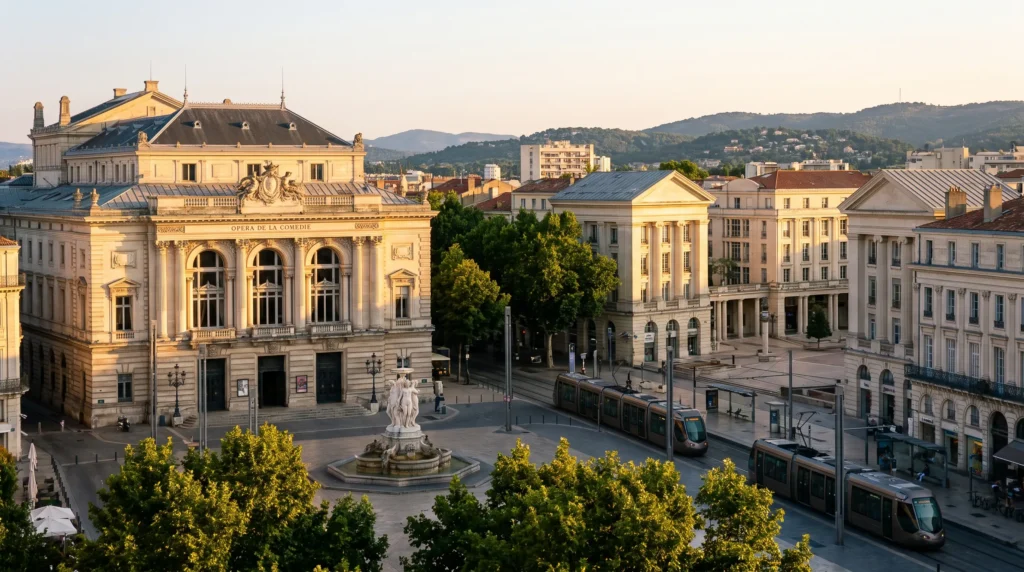
The shield-shaped medieval core, all narrow stone lanes, hidden courtyards and townhouses built on wealth from the city’s historic textile and medical trades. Place de la Comédie — anchored by the 1888 Opéra Comédie — sits at its edge and functions as Montpellier’s living room, ringed by cafés and street performers.
Antigone
Ricardo Bofill’s postmodern neoclassical experiment, built from the 1980s onward in a straight line from the Écusson toward the Lez river — colonnades, pediments and vast plazas in pale concrete that read as ancient Rome reimagined for social housing. Genuinely worth the walk-through even if you’re not staying there.
Port Marianne & Odysseum
The newest face of the city: glassy waterfront apartments along the Lez, the Hôtel de Ville, and the Odysseum retail-and-leisure complex with an aquarium and multiplex. Less charm, more convenience — good for a family day out.
Boutonnet & Les Beaux-Arts
A quieter, leafier residential quarter north of the center, popular with students and young professionals, dotted with independent cafés and a slower pace than the Écusson’s tourist lanes.
Faubourg Figuerolles
A working-class, multicultural neighborhood historically home to Spanish and North African communities, now also gathering a small gallery-and-studio scene. Good, cheap food here.
Prés d’Arènes & the Train Station Quarter
Practical rather than pretty — this is where most arrivals land — but it’s a five-minute tram ride from the Écusson and increasingly has decent budget lodging.
Culture & People — A City Built by Students
Montpellier’s identity is inseparable from its universities. With close to a quarter of the population enrolled as students, the city skews younger and more transient than the French national average, and that shapes everything from bar hours to rent prices near campus. Occitan — the historic language of southern France — still shows up on some bilingual street signs and in regional pride, even though French is universally spoken.
The city’s festival calendar (books in May, theatre in late May–June, classical music in July) is deliberately stacked to keep the cultural momentum going right through the shoulder season, and there’s a strong civic identity around independent bookshops, small theatres and student-run cultural spaces that you won’t find in more touristed French cities. Expect standard French social customs: greet shopkeepers with “bonjour,” dress reasonably smart in the evening, and don’t expect much English outside the center and university areas — though it’s improving fast.
A Food Lover’s Guide to Montpellier
Montpellier sits at the crossroads of Occitan inland cooking and Mediterranean coastal seafood, and the city’s markets are the best way to taste both. Les Halles Castellane and Les Halles Laissac are the classic covered markets in the Écusson — cheese counters, charcuterie, and produce stalls that double as breakfast spots. On weekends, the Marché des Arceaux under the old aqueduct arches is the one locals actually shop at.
From the coast just minutes away, look for Bouzigues oysters and mussels farmed on the Étang de Thau lagoon, often served as a brasucade — mussels flamed over pine needles. From Sète, the tielle sétoise — a spiced octopus-and-tomato hand pie — is a genuine regional specialty worth seeking out rather than a tourist gimmick. Inland, try pélardon, a small AOP goat cheese from the Cévennes foothills, and wash it down with a chilled glass of Muscat de Frontignan or a Picpoul de Pinet white, both produced within a short drive of the city. Aioli — garlic mayonnaise served with poached vegetables, salt cod and snails — is the classic Languedoc Sunday-lunch dish if you want to eat like a local rather than a visitor.
Off the Beaten Path
Jardin des Plantes
France’s oldest botanical garden, founded in 1593, tucked at the edge of the Écusson and largely ignored by day-trippers rushing to Antigone. Quiet, shaded, and free.
Aqueduc Saint-Clément & Marché des Arceaux
An 18th-century aqueduct still striding across the western edge of the city, with a lively weekend market held right under its arches — one of the most photogenic ordinary mornings you’ll spend in France.
Figuerolles at dusk
Skip the Écusson bars one night and eat in Figuerolles instead — cheaper, more mixed, and a better read on how the actual city lives outside the postcard center.
Palavas-les-Flots and the coastal étangs
A short tram-and-bus hop delivers you to a proper Languedoc beach town with none of the Riviera markup — flamingos on the lagoons if you’re lucky, and none of the crowds of Nice.
Day Trips — Pont du Gard, Nîmes & Sète
Pont du Gard
The single best day trip from Montpellier: a UNESCO World Heritage Roman aqueduct bridge, inscribed in 1985, that once carried water roughly 50 kilometres to supply the Roman city of Nîmes. The structure rises across three tiers to a height of close to 50 metres, with its longest level stretching 275 metres — one of the best-preserved pieces of Roman engineering anywhere. It’s about an hour from Montpellier by car; there’s no direct train, so a rental car, organized tour, or taxi combo is the practical route.
Nîmes
A compact, easy rail day trip — around 45km away with direct trains taking roughly 25–30 minutes. The city’s Roman amphitheatre, the Arènes de Nîmes, is one of the best-preserved in the world and still hosts events today, alongside the Maison Carrée temple and the Jardins de la Fontaine.
Sète
A working fishing port built around canals, sometimes called “the Venice of Languedoc” — about 26km from Montpellier with trains as quick as 14–20 minutes. Come for the canalside seafood, the Mont Saint-Clair viewpoint, and August’s spectacular water-jousting tournaments if your dates align.
Camargue & Aigues-Mortes
West of Montpellier, the walled medieval port town of Aigues-Mortes opens onto the Camargue’s salt flats, wild white horses, pink flamingos and rice paddies — a completely different, wilder France within reach of a single day’s driving or organized tour.
Practical Information
Money. France uses the euro, managed by the European Central Bank, subdivided into 100 cents. Cards are accepted almost everywhere, including small cafés; carry some cash for markets and rural day trips.
Safety. The US State Department rates France at Level 2 (Exercise Increased Caution), citing terrorism risk and occasional civil unrest, plus routine pickpocketing in crowded tourist areas — none of which is specific to Montpellier, which is a generally relaxed city. Check current UK FCDO guidance before travel as well.
Health. No special vaccinations are required for most travelers, though the CDC recommends confirming routine and measles (MMR) immunization is current before any international trip. Tap water is safe to drink.
Connectivity & practicalities. An EU-compatible eSIM covers the trip easily; Wi-Fi is standard in cafés and hotels. Plugs: Type C/E, 230V/50Hz — bring an adapter if you’re coming from outside continental Europe. Time zone: Central European Time, UTC+1 in winter and UTC+2 (CEST) in summer.
Budget Breakdown — What Montpellier Actually Costs in 2026
Montpellier runs noticeably cheaper than Paris, Nice or Aix-en-Provence, helped enormously by free public transit.
Budget (US$70–110/day): Hostel or budget hotel in Prés d’Arènes or near the station, market lunches and bakery sandwiches, free trams, walking the Écusson and Antigone.
Mid-range (US$150–250/day): Boutique hotel in the Écusson, sit-down dinners with a carafe of local wine, a Pont du Gard or Nîmes day trip, occasional taxi.
Upscale (US$350+/day): Design hotels near Place de la Comédie or Antigone, tasting menus, a private Camargue or wine-region day tour, first-class TGV tickets.
Tipping isn’t obligatory — service is included by law — but rounding up or leaving a few extra euros for good service is appreciated.
Planning Your Trip to Montpellier
Three to four nights covers Montpellier itself comfortably, with a day spared for Pont du Gard or Nîmes. A natural pairing is the TGV run up to Lyon for more of France’s second-tier food-and-culture cities, or south along the coast toward Marseille and the Calanques. If you’re building a longer Mediterranean loop, the rail line also connects onward toward Spain via Perpignan and the Catalan coast, or you can flip the whole trip around our broader France travel guide for context on visas, rail passes and regional pacing.
Frequently Asked Questions
Is Montpellier worth visiting if I’ve already done Paris and Nice?
Yes — it’s a different register of French city: real university energy, a genuinely walkable medieval core, France’s oldest botanical garden, and prices well below the Riviera. It’s not a monument-heavy bucket-list stop, which is part of why it stays uncrowded.
Do I need a visa to visit Montpellier?
France is in the Schengen Area, so US, UK, Canadian and Australian passport holders can enter visa-free for stays up to 90 days within any 180-day period; check your specific passport’s requirements before travel.
How many days do I need in Montpellier?
Two full days cover the Écusson, Antigone and the markets; three to four lets you add a Pont du Gard or Nîmes day trip and a beach afternoon at Palavas-les-Flots.
Is Montpellier or Nîmes the better base?
Montpellier — it has more accommodation variety, the airport, the TGV connection, and free public transit, and Nîmes is only a 25–30 minute train ride away for a day trip.
Is public transit really free?
Yes — Montpellier’s trams and buses have been free to ride for residents and visitors since 21 December 2023, one of the largest cities in Europe to do this.
What’s the best time to catch the festivals?
Mid-May through mid-July strings together the book festival, the theatre festival, and the classical music festival almost back to back — book accommodation ahead if your trip overlaps any of them.
Ready to Explore Montpellier?
Pink Roman-inspired colonnades, a 700-year-old medical school, free trams gliding past a Roman aqueduct market, and a Mediterranean beach twenty minutes from your hotel — Montpellier delivers the good parts of southern France without the southern France price tag. Go before everyone else figures that out.
Explore More
- Marseille City Guide — France’s Mediterranean powerhouse, an easy rail hop south
- Lyon City Guide — France’s food capital, reachable by direct TGV
- France Travel Guide — the full country picture, visas to regional planning
- Spain Travel Guide — continue the Mediterranean coast south across the border
How this guide was built
Published as part of Facts From Upstairs’ city guide series. Built from authoritative sources — Wikipedia’s Montpellier and Montpellier–Méditerranée Airport entity pages, the official Montpellier tourism site (montpellier-france.com), UNESCO’s Pont du Gard World Heritage inscription, the US State Department and UK FCDO France advisory pages, the US CDC traveler page for France, SNCF Connect’s official rail timetables for the Paris, Nîmes and Sète routes, Wikipedia’s Euro entry, the Printemps des Comédiens festival’s own programming page, the City of Montpellier’s official events agenda, and World Standards’ France electrical reference. Numeric claims carry inline citations.
Sources cited on this page
- Wikipedia — Montpellier
- Wikipedia — Montpellier–Méditerranée Airport
- Montpellier Tourism — Traveller Information
- UNESCO — Pont du Gard (Roman Aqueduct)
- Wikipedia — Pont du Gard
- US State Department — France Travel Advisory
- UK FCDO — France Travel Advice
- UK FCDO — France Entry Requirements
- US CDC — France Traveler Page
- SNCF Connect — Montpellier–Paris Route
- SNCF Connect — Montpellier–Nîmes Timetables
- SNCF Connect — Montpellier–Sète Timetables
- Wikipedia — Euro
- World Standards — France Power Plugs & Voltage
- Printemps des Comédiens — Official Programme
- City of Montpellier — La Comédie du Livre 2026
- City of Montpellier — Official Site
More city guides you might like
Plan your trip to Montpellier
The booking tools we use ourselves. FFU may earn a commission at no extra cost to you.
Plan & book your trip to Montpellier
Booking through these searches supports our guides at no extra cost to you.