
Windhoek Travel Guide — Namibia’s High-Desert Capital Where Germany Meets Africa
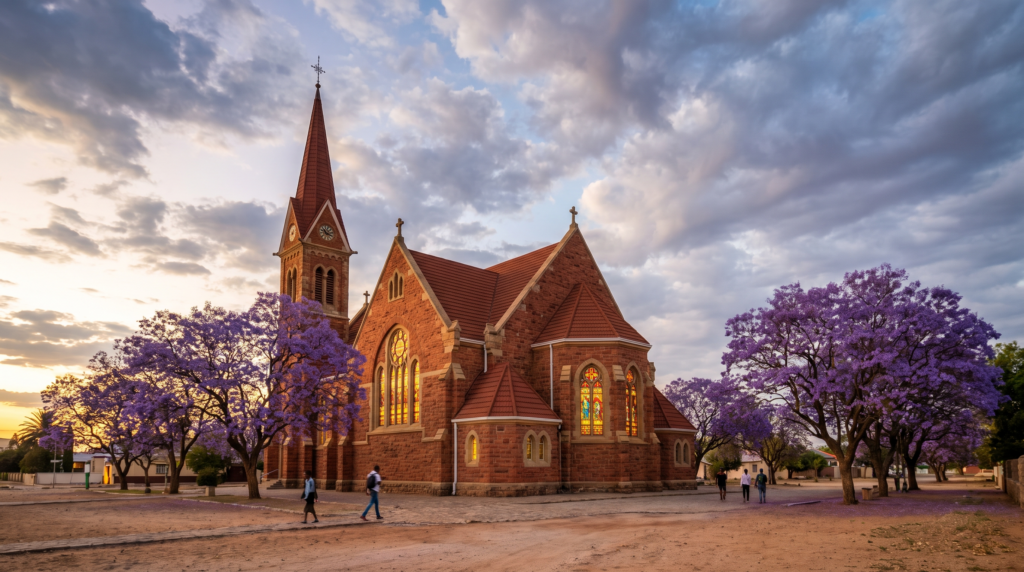
Windhoek is not a city you visit for itself, and Windhoek would probably agree with you — most travelers I meet there are either landing to pick up a rental 4×4 for Etosha and Sossusvlei, or passing back through with red dust still in the treads. That undersells it. This is a capital sitting at 1,655 meters on the Khomas Highland plateau, where a Lutheran church built by German colonists shares a skyline with a legislature nicknamed the “Palace of Ink,” where Oshiwambo, Afrikaans, German and English all get spoken across the counter of the same bakery, and where you can eat a schnitzel that would pass in Munich twenty minutes after buying beadwork from a Himba craftsperson at a market stall. Give it two nights before you drive off into the desert. It rewards the layover.
In This Guide
- Overview — Why Windhoek Is Namibia’s Essential Gateway
- Windhoek Oktoberfest — Southern Africa’s Biggest Beer Festival
- Best Time to Visit Windhoek
- Getting There — Hosea Kutako International
- Getting Around — Taxis, Rentals & Walkability
- Windhoek’s Neighborhoods
- Culture & People
- A Food Lover’s Guide to Windhoek
- Off the Beaten Path
- Day Trips From Windhoek
- Practical Information
- Budget Breakdown — What Windhoek Actually Costs in 2026
- Frequently Asked Questions
Overview — Why Windhoek Is Namibia’s Essential Gateway
Windhoek became a permanent settlement in two stages: Orlam leader Jonker Afrikaner built the first town here in 1840 around a cluster of hot springs, and the modern city dates its founding to 18 October 1890, when German colonial officer Curt von François established a garrison fort on the same site. That double history is still legible on the street: German colonial-era buildings and Lutheran spires sit within walking distance of townships and markets shaped by the apartheid-era South African administration that ruled Namibia until independence in 1990.
Nearly everyone lands here — Hosea Kutako International is Namibia’s only major international airport — and most visitors treat the capital as a one- or two-night hinge between the airport and a self-drive loop through Etosha, the Namib dunes at Sossusvlei, or the Skeleton Coast. That’s a fair strategy for a country the size of Namibia, but it skips a genuinely interesting city: a highland capital with over 300 sunny days a year, a walkable core, and a culinary and cultural mix — German, Afrikaans, Oshiwambo, Herero, Nama — you won’t find compressed this tightly anywhere else in southern Africa.
What Windhoek doesn’t have is a beach, a skyline, or a single must-see landmark that justifies a flight on its own. It earns its place on an itinerary as the connective tissue for the rest of Namibia, and as a two-day acclimatization stop before the long, straight, gravel roads start.
Windhoek Oktoberfest — Southern Africa’s Biggest Beer Festival
Time a late-October trip around Windhoek’s own Oktoberfest, held every year on the last weekend of the month at Sport Klub Windhoek. It’s been running for more than six decades, a direct legacy of German settlement, and it’s grown from a small community gathering for descendants of German colonists into a genuinely national three-day festival — bratwurst, pretzels, oompah bands, and locally brewed beer from Namibia Breweries, which still follows Germany’s centuries-old Reinheitsgebot purity law.
It lands at a genuinely good moment on the calendar too — late October is the tail of the dry season, before the first summer storms build, so you get festival weather and clear pre-rain skies for a Sossusvlei or Etosha add-on either side of the weekend.
Best Time to Visit Windhoek
May – September · Dry season (peak)
Cool, clear highland weather — days in the low-to-mid 20s°C, nights that can drop near freezing, especially June and July. This is also peak wildlife-viewing season for an Etosha add-on, since animals concentrate at waterholes. Book accommodation ahead; this is when the self-drive crowd is thickest.
October · Shoulder, and the Oktoberfest window
Hot and dry, building toward the first rains, with the Oktoberfest weekend as the highlight. Good value before the December–January crush.
December – March · Green/rainy season
Hotter, with afternoon thunderstorms rolling off the escarpment — dramatic rather than washout weather, since Windhoek’s total annual rainfall is modest at roughly 367mm. Landscapes green up dramatically after rain, which photographs beautifully but can mean flash-flooded gravel roads further out in the country — check conditions before a self-drive.
Getting There — Hosea Kutako International
Hosea Kutako International Airport (WDH) sits about 45 kilometers east of the city center — the drive in takes 40–50 minutes. Originally opened in 1965 and renamed in 1990 to honor Namibian independence leader Hosea Kutako, it’s the country’s only major international gateway, with connections via South African Airways, Airlink and FlyNamibia to Johannesburg and Cape Town, Ethiopian Airlines via Addis Ababa, Air Botswana to Gaborone, plus Discover Airlines and Edelweiss Air linking directly to Frankfurt/Munich on seasonal routes — a legacy of Namibia’s large German-speaking travel and diaspora market.
Shuttle buses and airport transfer companies meet every flight for the run into town; taxis and pre-booked transfers are the norm since there’s no train link and ride-hailing coverage is patchy. Almost every visitor also picks up a rental car here — Namibia’s national parks are a self-drive country, and reserving a 4×4 well ahead of a July or August trip is genuinely important, since peak season fleets do sell out.
Getting Around — Taxis, Rentals & Walkability
Central Windhoek — Independence Avenue and the streets immediately around it — is walkable in a couple of hours, flat and compact enough to cover the Christuskirche, Tintenpalast, National Museum and the main craft markets on foot in daylight. Beyond that core, the city sprawls across a highland valley, and public transport is limited to informal shared minibuses that are hard for first-time visitors to navigate.
Metered taxis are scarce; most visitors use ride-hailing apps where coverage exists, hotel-arranged transfers, or a rental car from day one, since nearly everyone is using Windhoek as the staging point for a national-park loop anyway. Self-driving here is genuinely straightforward — wide roads, light traffic, and drivers keep to the left, following the same rules as South Africa.
Windhoek’s Neighborhoods
City Centre (CBD)
Independence Avenue is the spine: government buildings, the Christuskirche’s neo-Romanesque spire (built 1907–1910), the Zoo Park, and the National Museum of Namibia. It’s the base for most first-time visitors, with the widest choice of hotels and restaurants within walking distance of each other.
Klein Windhoek
A leafy, upmarket residential district east of the center, full of guesthouses, boutique lodges and some of the city’s better restaurants. A common choice for a quieter first night before or after a long drive.
Katutura
Established under apartheid-era forced removals — the name itself translates roughly to “the place where people do not want to live” — Katutura today is Windhoek’s largest township and its most vibrant, with the Soweto Market’s braai stalls, informal traders, and a living-history weight that a guided township tour puts into honest context rather than glossing over.
Ludwigsdorf & Eros
Quiet, garden-suburb neighborhoods on the hillier western side of the city, home to some of Windhoek’s larger private lodges and guesthouses with mountain views — a good pick if you want distance from downtown traffic without leaving the city.
Southern Industrial & the Old Location
Site of the original Black township forcibly cleared in 1959 in an incident that helped galvanize Namibia’s independence movement; a memorial marks the ground today. Worth a stop for context before or after Katutura.
Culture & People
Namibia is home to roughly 3 million people spread across one of the world’s most sparsely populated countries, and Windhoek concentrates its ethnic and linguistic range: Oshiwambo speakers form the country’s largest group nationally, alongside Herero, Damara, Nama, Kavango, Caprivian and a substantial German- and Afrikaans-speaking population descended from colonial-era settlement. English became the sole official language at independence in 1990, but Afrikaans and German both remain common lingua francas in daily life and on shop signage.
That layering is Windhoek’s real texture: a Lutheran German church, a Herero women’s procession in Victorian-style dress with distinctive horned headwraps (a garment adapted from 19th-century missionary fashion and now a proud marker of Herero identity), and Oshiwambo spoken at the next market stall — all within a few blocks of each other. Independence Day, 21 March, is the standout national holiday, marking the end of South African administration in 1990.
A Food Lover’s Guide to Windhoek
Windhoek is one of the best cities in Africa to eat German food well outside Germany — a direct legacy of colonial settlement and a still-thriving German-descendant community. Schnitzel, bratwurst and fresh-baked German-style bread and pastries are genuinely good here, not a novelty act, and locally brewed Windhoek Lager (also brewed under the Reinheitsgebot purity law) is the default beer on every menu.
Alongside that sits proudly Namibian game meat — kudu, oryx (gemsbok) and springbok show up as steaks, biltong and potjie stews on most menus, usually sustainably farmed rather than wild-caught. For something less steakhouse and more street, head to Katutura’s braai stalls for grilled meat straight off the coals with pap (maize porridge) and chakalaka, or the informal kapana stands selling flame-grilled beef by the gram. Craft-market stalls also sell dried mopane worms as a snack for the adventurous — a genuine local protein source, not a tourist stunt.
Off the Beaten Path
Katutura Township Tour with a Local Guide
A guided walk or drive through Katutura — its markets, shebeens and community art projects — gives far more honest context on modern Namibia than the colonial-era buildings downtown, and puts money directly into the neighborhood.
Alte Feste & the Old Location Memorial
Windhoek’s oldest surviving building, a former German garrison fort, sits a short walk from the memorial marking the 1959 forced removals — a compact, sobering pair of stops that most day-trippers skip entirely.
Rooikop & Daan Viljoen Nature Reserve
A small game reserve barely 20 minutes from the CBD with hiking trails and giraffe, zebra and antelope sightings — a genuine wildlife fix for travelers who don’t have time for a full national-park run.
Farmers & Craft Markets on a Saturday
Windhoek’s weekend farmers markets (Namibia Village and similar pop-ups) trade the tourist-facing curio stalls of Independence Avenue for a look at how residents actually shop and eat.
Day Trips From Windhoek
Okahandja (about 70km north) hosts one of Namibia’s largest wood-carving and craft markets, plus historically significant Herero and Nama royal grave sites — an easy half-day out.
Gross Barmen Hot Springs (roughly 25km beyond Okahandja) is a mineral hot-spring resort built around thermal pools that Herero communities used long before German missionaries arrived — a relaxed soak-and-lunch day.
Rehoboth (around 90km south) is the historic seat of the Baster community, a distinct Afrikaans-speaking people of mixed Khoikhoi and Dutch descent with their own museum telling that specific history.
For travelers with a full day and an early start, Sossusvlei and the Namib dunes are technically drivable in a very long single day, but realistically deserve an overnight — the drive alone runs several hours each way. The same logic applies to Etosha National Park, roughly 430km/5 hours north via the shorter southern route to Anderson Gate: doable as a there-and-back push, but built for a multi-night safari rather than a day trip. Most visitors treat Windhoek as the start and end point of a longer self-drive loop rather than trying to squeeze the big parks into a single day.
Practical Information
Money. The Namibian dollar is pegged 1:1 to the South African rand, and rand notes and coins are accepted everywhere in Namibia at par. Cards are widely accepted in the city center; carry small cash for markets, taxis and townships. Inspect ATMs for skimming devices, a specifically flagged concern in official guidance.
Visa. As of April 2025, Namibia scrapped visa-free entry for a number of nationalities, including the US and UK, that previously enjoyed it — check current requirements before you fly. Most visitors can still apply online in advance through Namibia’s e-visa portal or get a visa on arrival at Hosea Kutako, but arriving with an approved e-visa avoids queues.
Safety. The US State Department rates Namibia Level 2 (“Exercise Increased Caution”), citing opportunistic crime — pickpocketing, bag-snatching and smash-and-grabs — as the most common risk to tourists, with more serious armed crime rarer but present. Keep valuables out of sight, use registered taxis or hotel transfers after dark, and keep car doors locked in city traffic.
Health. Windhoek itself sits outside Namibia’s malaria zones, which are concentrated in the northern regions (Kavango, Kunene, Zambezi and others) — malaria precautions matter if you’re continuing on to Etosha or the Caprivi Strip, less so in the capital itself. Routine vaccinations plus hepatitis A and typhoid are commonly recommended for the trip.
Connectivity. A local SIM or regional eSIM covers the city easily; coverage thins out fast once you’re driving between parks. Plugs: South African-style round three-pin sockets, 220–240V. Time zone: UTC+2 year-round.
Budget Breakdown — What Windhoek Actually Costs in 2026
Windhoek itself is inexpensive by international standards; the money in a Namibia trip mostly gets spent once you leave the city for parks and lodges.
Budget (US$40–75/day): backpacker hostel or budget guesthouse, self-catering or kapana street food and braai stalls, shared minibus or occasional taxi, free walking through the CBD and Zoo Park.
Mid-range (US$110–190/day): a guesthouse or three-star hotel in Klein Windhoek, restaurant meals mixing German and Namibian game dishes, a rental car for the days you’re in town, a guided Katutura tour.
Luxury (US$300+/day): boutique lodges in Ludwigsdorf or Eros, private guided city tours, fine dining, and the start of a chauffeured or fly-in safari itinerary — where costs jump sharply once you’re paying for lodges inside Etosha or Sossusvlei rather than the capital.
Fixed costs to plan for: the roughly US$88 visa-on-arrival fee for non-African nationals, rental-car insurance excess, and park entry fees once you leave the city. Tipping 10% is standard in restaurants where service isn’t included.
Planning Your Trip to Windhoek
The standard pattern: land at Hosea Kutako, spend one or two nights in Windhoek to pick up your rental car, adjust to the altitude and time zone, and walk the CBD and Katutura before heading out on a self-drive loop — Etosha in the north, Sossusvlei and the Namib dunes in the south, or the Skeleton Coast further west. Book that rental car and any Etosha lodges well ahead for the May–September dry season, when Namibia’s self-drive market is busiest. If you’re pairing Namibia with a wider southern Africa trip, our Cape Town guide and Botswana guide (Okavango Delta, Chobe) sit naturally either side of a Windhoek stopover, and our full Namibia country guide covers Etosha, Sossusvlei and the coast in depth.
Frequently Asked Questions
Is Windhoek safe for tourists in 2026?
The US State Department rates Namibia Level 2, “Exercise Increased Caution,” with opportunistic crime like pickpocketing and smash-and-grabs the main risk in Windhoek itself. Use registered taxis or hotel transfers at night, keep valuables out of sight, and keep car doors locked — standard capital-city precautions rather than a reason to avoid the trip.
Do I need a visa to visit Windhoek?
Most nationalities do, including US and UK passport holders, following Namibia’s April 2025 policy change. Apply online through the e-visa portal in advance, or get a visa on arrival at Hosea Kutako International — but check current rules for your passport before booking.
How many days do you need in Windhoek?
One to two nights is the norm — enough to walk the CBD, see the Christuskirche and Tintenpalast, take a Katutura tour and sort your rental car — before heading out to Etosha or Sossusvlei, which are where most of a Namibia trip’s time should go.
Is Windhoek expensive?
The city itself is affordable by international standards — food, accommodation and local transport all sit well below Western Europe. Namibia trips get expensive once you add lodges inside national parks and long self-drive distances, not from time spent in the capital.
What’s the best month to visit for the Oktoberfest?
Late October, specifically the last weekend of the month, when Sport Klub Windhoek hosts the festival — plan lodging well ahead, since it’s the city’s single busiest tourism weekend outside the dry-season safari peak.
Do I need a 4×4 to explore from Windhoek?
Not for the city itself, but yes for most onward Namibia travel — many park and lodge access roads are gravel, and a 4×4 with good clearance is the standard, strongly recommended rental for a self-drive loop beyond the capital.
Ready to Explore Windhoek?
Windhoek won’t be the headline of your Namibia trip, and it isn’t trying to be. Give it two days to eat well, walk the highland-capital streets, and understand the country’s layered history before the gravel roads and the dunes take over — it makes everything that follows make more sense.
Explore More
- Namibia Travel Guide — Etosha, Sossusvlei and the Skeleton Coast in full
- Cape Town Travel Guide — pair Windhoek with South Africa’s Mother City
- Botswana Travel Guide — Okavango Delta and Chobe next door
- Zambia Travel Guide — continue on to Victoria Falls
How this guide was built
Published as part of Facts From Upstairs’ city guide series. Built from authoritative sources — Wikipedia’s Windhoek, Namibia and Hosea Kutako International Airport entity pages, the Bank of Namibia’s official site for the currency peg, Namibia’s official Visit Namibia visa portal, the US State Department’s Namibia travel advisory, the US CDC traveler page for Namibia, Etosha National Park’s official directions page, and Namibia Economist’s reporting on the Windhoek Oktoberfest. Numeric and checkable claims carry inline citations.
Sources cited on this page
- Wikipedia — Windhoek
- Wikipedia — Namibia
- Wikipedia — Hosea Kutako International Airport
- Bank of Namibia
- Visit Namibia — Visa Information
- US State Department — Namibia
- US CDC — Namibia traveler page
- Etosha National Park — Directions from Windhoek
- Namibia Economist — Windhoek Oktoberfest
- MAT Travel — Namibia Entry Requirements & Visa Fees
More city guides you might like
Plan your trip to Windhoek
The booking tools we use ourselves. FFU may earn a commission at no extra cost to you.
Plan & book your trip to Windhoek
Booking through these searches supports our guides at no extra cost to you.