
Geneva Travel Guide — Free Trams, Alpine Views & the World’s Most Diplomatic City
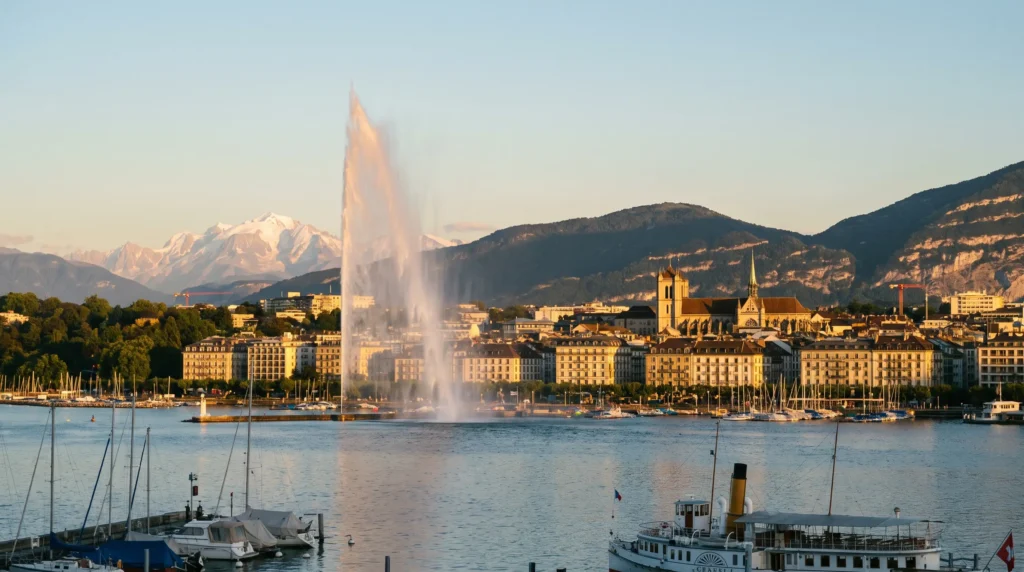
Geneva is a strange kind of famous. Everyone has heard of it — the UN, the Red Cross, CERN, the watches, the private banks — but almost nobody I know has actually been, and that is the gap I want to close. This is a city of barely 205,000 people that somehow hosts more international organizations than almost anywhere on Earth, wedged into the southwestern corner of a lake so clean that locals swim in it on their lunch break. You can stand at the Jet d’Eau watching a 140-metre plume of lake water catch the afternoon light, walk twenty minutes into a medieval Old Town where Calvin once preached reform to all of Protestant Europe, and be eating fondue by dinner — all without paying for a single tram ride, because Geneva hands every overnight guest a free transit pass the moment they check in. It is not a cheap city. I will not pretend otherwise; Switzerland taxes your wallet at every turn. But it rewards you with a compactness, a cleanliness and a sense of order that make it one of the least stressful cities in Europe to actually visit.
In This Guide
- Overview — Why Geneva Punches So Far Above Its Size
- Fête de l’Escalade — Geneva’s Most Genevan Night
- Best Time to Visit Geneva (Season by Season)
- Getting There — GVA, the French Sector & TGV Rail
- Getting Around — Free Trams, Boats & a Walkable Core
- Neighborhoods — Old Town, Left Bank, Right Bank & Beyond
- Culture & People — Calvin, Diplomacy & 190 Nationalities
- A Food Lover’s Guide to Geneva
- Off the Beaten Path
- Day Trips — Alps, Vineyards & Two Neighboring Countries
- Practical Information
- Budget Breakdown — What Geneva Actually Costs in 2026
- Planning Your First Trip to Geneva
- Frequently Asked Questions
Overview — Why Geneva Punches So Far Above Its Size
Geneva is Switzerland’s second most populous city, home to roughly 204,000 people within city limits and just over a million across the wider metropolitan area, sitting at the southwestern tip of Lake Geneva where the Rhône River flows back out toward France. Numbers alone undersell it. This is a city that hosts the European headquarters of the United Nations, the International Committee of the Red Cross, the World Health Organization and dozens more agencies, earning it an outsized reputation as a global “Peace Capital” — a title that shapes everything from its restaurant scene (more diplomatic expense-account dinners than almost anywhere in Europe) to its street life, where you will overhear a dozen languages before you have walked the length of the Old Town.
The city’s founding runs back to a Roman settlement around 121 BC, but the defining chapter is the Reformation: John Calvin arrived in 1541 and turned Geneva into the intellectual engine room of Protestant Europe, a legacy still visible in the severe stone of St. Pierre Cathedral and the long Reformation Wall in the Parc des Bastions. Centuries later, banking secrecy and watchmaking made it wealthy; the 20th century’s League of Nations and then United Nations made it powerful. All of that history sits inside a city small enough to walk across in under an hour.
What Geneva does not have is budget travel. Switzerland is consistently one of the most expensive countries in Western Europe to visit, and Geneva — with its diplomatic per-diems and private-banking clientele — sits at the pricier end of an already pricey country. The trade-off is a place that runs with a precision and a cleanliness that make every other logistics headache of European travel — late trains, closed museums, language barriers — largely disappear. And the free public transit pass every visitor gets on arrival takes a real bite out of the cost of actually getting around.
Fête de l’Escalade — Geneva’s Most Genevan Night
If you can time a trip around one date, make it the weekend closest to 12 December, when Geneva throws Fête de l’Escalade — a commemoration of the night in 1602 when Genevans repelled a surprise attack by the Duke of Savoy’s troops, who tried to scale the city walls under cover of darkness. For 2026 the main weekend runs 11–13 December, with a Sunday procession of roughly 800 Genevans in seventeenth-century costume — some carrying fragments of the original scaling ladders, others on horseback — that draws tens of thousands of spectators through the Old Town. The signature ritual is smashing a chocolate cauldron (“marmite”) filled with marzipan vegetables — traditionally done by the oldest and youngest person present while shouting a very Genevan curse on the enemies of the republic.
Honest catch: if you were hoping for Geneva’s old summer fireworks spectacular, the Fêtes de Genève lake festival that once drew 30,000 rockets over the water each August largely folded after financial losses in 2017–18, and only sporadic fireworks displays have continued since. Don’t build a summer trip around it — build one around the lake itself, which needs no festival to be worth the visit.
Best Time to Visit Geneva (Season by Season)
May – September · Peak season
Warm, long days, lakefront terraces in full swing, average temperatures around 14–21°C, and every rooftop bar and paddleboard rental open for business. This is also when hotel prices climb hardest, driven up further by whichever UN conference or trade show happens to be in town — Geneva’s hotel market moves on a diplomatic calendar as much as a tourist one.
December · L’Escalade & Christmas markets
Cold, often grey, genuinely festive: Escalade weekend, chalet markets around the Old Town, and mulled wine by the lake. Book Escalade-weekend hotels early — this is a local event as much as a tourist one, and the city fills up.
April, October & shoulder months
The value window. Mild enough for walking the Old Town and the lakefront, thinner crowds, and rates well below summer peak. Rain is more likely and the Alps views from the lakeshore are less reliably clear, but this is when locals will tell you the city feels most like itself.
Winter (Jan – Mar)
Cold and quiet in the city itself, but this is exactly when Geneva earns its role as the gateway to the Alps — Chamonix and the Swiss ski resorts are an hour or two away, and the airport fills with ski-bag traffic all season.
Getting There — GVA, the French Sector & TGV Rail
Geneva Airport (GVA) sits just 4 kilometres northwest of the city centre and handled nearly 17.8 million passengers in 2024, making it one of the busiest airports in Switzerland and a hub for Swiss International Air Lines and an operating base for easyJet. An onsite train station connects directly to Genève-Cornavin, the city’s main station, in just a few minutes, and GVA quirkily straddles the French border — its Pier F “French Sector” lets travelers reach the airport from neighboring French territory without formally crossing into Switzerland, a leftover of a 1960s bilateral arrangement, though passport checks between the two disappeared once Switzerland joined Schengen.
Rail is the other serious option: high-speed TGV Lyria trains run direct from Paris Gare de Lyon to Geneva in roughly three hours, and regional and mainline Swiss rail links Geneva to Lausanne, Bern, Zurich and Milan without needing to fly at all. If you’re arriving from elsewhere in Switzerland or eastern France, the train into Cornavin is genuinely often faster door-to-door than flying.
Getting Around — Free Trams, Boats & a Walkable Core
Here is the detail that changes the whole budget calculation of a Geneva trip: every overnight guest at a hotel, hostel or registered short-term rental in the canton gets a free Geneva Transport Card, valid for the entire length of their stay across TPG trams and buses, the SBB suburban trains, the airport train and the yellow Mouettes genevoises water taxis that shuttle across the lake. It’s funded through the city’s hotel tax, so there’s no catch, no app subscription and no per-ride fee — ask at check-in and most properties will have it ready digitally or on paper within minutes.
Beyond that, Geneva is compact enough to walk across in well under an hour: the Old Town, the lakefront, the shopping streets around Rue du Rhône and the international district around the UN are all connected on foot or by a short tram hop. The little yellow Mouettes boats crossing the harbor are cheaper and more scenic than any tram for getting between the Left Bank and Right Bank. Renting a car in Geneva itself is close to pointless — parking is scarce and expensive, and you won’t need one until you’re headed out to the mountains or vineyards.
Neighborhoods — Old Town, Left Bank, Right Bank & Beyond
Vieille Ville (Old Town)
Geneva’s historic core, climbing a hill on the Left Bank: cobbled lanes, St. Pierre Cathedral where Calvin preached, the Maison Tavel (the city’s oldest house), and a Saturday flea market on the Plaine de Plainpalais just below. This is where the Reformation Wall and Parc des Bastions sit too — the wall’s long stretch of statues is free to visit and best seen in late-afternoon light.
Rive Gauche (Left Bank) — Lakefront & Financial District
Home to the Jardin Anglais, the flower clock, and the Jet d’Eau itself, plus the private banks and boutiques along Rue du Rhône. This is Geneva’s postcard side — busy, moneyed, and the obvious base for a first visit.
Rive Droite (Right Bank) — International District & Pâquis
North across the water: the UN’s Palais des Nations, the Red Cross Museum, and the wide green sweep of the Parc de l’Ariana. Down at lake level, Pâquis is Geneva’s scrappier, more nocturnal neighborhood — cheap eats, the public Bains des Pâquis lakeside baths, and a red-light strip that coexists oddly well with diplomats’ apartments a block away.
Carouge
A short tram ride south, Carouge was built by the Kingdom of Sardinia in the 18th century in a deliberately Italian, almost Mediterranean style — ochre facades, inner courtyards, artisan workshops. It feels like a different city grafted onto Geneva’s edge, and it has the best concentration of independent boutiques and quiet café terraces in town.
Plainpalais & Les Eaux-Vives
Plainpalais is studenty and market-heavy, with a huge Wednesday and Saturday flea market on the plaine. Eaux-Vives, further along the lakefront east of the center, has quieter beaches, the Parc La Grange rose gardens, and some of the city’s better mid-range restaurants without the Old Town markup.
CERN & Meyrin
West of the airport, Meyrin is a otherwise unremarkable Geneva suburb whose claim to fame is enormous: it’s home to CERN, the world’s largest particle physics laboratory, established in 1954 and straddling the France-Switzerland border. The Globe of Science and Innovation and the newer CERN Science Gateway are open to the public, and guided tours of working facilities run most days — well worth the tram ride even if particle physics isn’t usually your thing.
Culture & People — Calvin, Diplomacy & 190 Nationalities
Geneva’s character is a genuine collision of Calvinist restraint and international cosmopolitanism. The city that expelled indulgence in the 1500s now counts residents from something close to every country on Earth, drawn by the UN, CERN, the Red Cross, and the private banks and trading houses clustered around the lake. French is the everyday language and the one worth having a few basic phrases in, but English moves you through nearly every hotel, restaurant and museum without friction.
That international layer sits on top of a proudly local civic identity, and nothing expresses it better than Fête de l’Escalade in December — a festival that is emphatically Genevan rather than generically Swiss, rooted in a specific 1602 battle and re-enacted with real seriousness by families whose ancestors fought it. Museums lean the same civic-minded way: the Red Cross Museum and the UN’s Palais des Nations both frame Geneva’s identity as a place built around diplomacy and humanitarian work, not just banking.
A Food Lover’s Guide to Geneva
Fondue is the obvious order, and Geneva does it well — moitié-moitié (half Gruyère, half Vacherin) is the local house style, best had in the Old Town or up in Carouge on a cold night. Look past it, though, and Geneva’s food scene is quietly excellent: the canton’s own vineyards (yes, Geneva has real wine country within its borders) produce Chasselas and Gamay worth seeking out by the glass, and the weekly markets in Plainpalais and Carouge are the best places to try local cheeses, cured meats and the seasonal produce that fills menus across town.
Longeole sausage, a Geneva specialty flavored with fennel seed, turns up on menus alongside filets de perche — small lake fish, fried and served with fries, a dish so tied to the lake that ordering it feels almost mandatory on a first visit. Chocolate is serious business here too, tracing straight back to the marmite-smashing ritual of L’Escalade; Geneva’s chocolatiers rank among Switzerland’s best, and a few still hand-make the Escalade cauldrons from November through December. For a splurge, the canton has a genuine concentration of Michelin-starred dining, much of it out among the vineyards rather than downtown.
Off the Beaten Path
Bains des Pâquis
A public bathing pier on the lake used by Genevans of every income bracket — swimming in summer, a wood-fired sauna and cold plunges in winter, and a no-frills restaurant that serves some of the best-value food in the city. It’s the anti-tourist-trap: cheap, local, and open to anyone.
Parc des Eaux-Vives & the eastern lakefront
Past the tourist center, the lakefront promenade toward Eaux-Vives thins out fast — rose gardens, quiet swimming spots, and views back toward the Jet d’Eau without the crowds standing directly beneath it.
Carouge’s artisan workshops
Small ceramicists, jewelers and furniture makers still work out of Carouge’s courtyard buildings, several open to browsers — a genuinely different texture from the luxury boutiques on the Left Bank.
CERN’s public tours
Free and often overlooked by visitors who assume it’s a closed research facility. It isn’t — the Science Gateway and Globe are open to anyone, and guided tours to working areas run most days, subject to availability.
Day Trips — Alps, Vineyards & Two Neighboring Countries
Geneva’s geography is its superpower for day trips: it sits within striking distance of two countries and some of Europe’s best mountain and vineyard scenery, all reachable without renting a car.
Lavaux Vineyard Terraces (Switzerland)
An hour by train along the lakeshore toward Lausanne, Lavaux’s UNESCO-listed vineyard terraces have been cultivated since the 11th century, when Benedictine and Cistercian monasteries first worked the slopes; the site was inscribed by UNESCO in 2007 and now covers roughly 898 hectares of Chasselas vines climbing the lake’s north shore. Hike the terraces between Lutry and Saint-Saphorin, or just ride the train and drink in the view.
Chamonix & Mont Blanc (France)
About an hour southeast by road, Chamonix puts you at the foot of Mont Blanc, Western Europe’s highest peak, with cable cars up to Aiguille du Midi for glacier and summit views that need no hiking boots at all. A classic full-day trip, and no visa complications since France is also inside Schengen.
Annecy (France)
A little over an hour away, Annecy’s canal-laced old town and turquoise lake make it a favorite half-day escape — busier in summer, genuinely charming in shoulder season.
Lausanne
Thirty-eight minutes up the lakeshore by train, Lausanne offers the Olympic Museum, a steep and photogenic old town, and a completely different lakefront energy from Geneva’s — younger, hillier, less diplomatic.
Practical Information
Money. Switzerland uses the Swiss franc (CHF), not the euro — a genuine point of confusion given the French-speaking, EU-bordering location, so double-check which currency a price is quoted in. Cards are accepted almost everywhere, including small cafés, though carrying some cash is still sensible for markets and smaller shops.
Safety. The U.S. State Department rates Switzerland at its lowest advisory tier, “Exercise Normal Precautions,” with pickpocketing at crowded tourist sites and transit hubs the main practical risk rather than violent crime. If you head into the mountains for skiing or hiking, mountain-rescue-inclusive travel insurance is genuinely worth having — rescue costs can be substantial.
Health. No unusual health risks for typical visitors; the CDC lists Switzerland at its routine-precautions level, recommending travelers be up to date on standard vaccines (MMR, flu, COVID-19) and considering tick-borne encephalitis protection if you’ll be doing extensive hiking. Tap water is safe to drink throughout the city.
Connectivity & visa. An EU/Schengen-compatible eSIM covers Geneva and every day-trip destination in this guide without roaming fees. US, UK, Canadian, Australian and most Schengen-exempt passport holders enter visa-free for stays up to 90 days in any 180-day period; note that ETIAS pre-registration is expected to become mandatory from late 2026. Plugs: Type J (Swiss-specific three-pin), 230V. Time zone: UTC+1 (CET), UTC+2 in summer (CEST).
Budget Breakdown — What Geneva Actually Costs in 2026
Geneva is one of the most expensive cities in Europe, full stop — plan for Zurich- or Oslo-level prices, not Paris- or Rome-level ones.
Budget (US$110–170/day): Hostel dorm or budget hotel in Pâquis or Plainpalais, market lunches and the odd fondue splurge, free transit card doing all the moving, self-guided Old Town and lakefront walking.
Mid-range (US$220–380/day): Three-star hotel or well-located Airbnb, restaurant dinners including one proper fondue night, a CERN or Red Cross Museum visit, a day trip to Lavaux or Chamonix.
Luxury (US$600+/day): Lakefront five-star properties, Michelin-starred vineyard dining, private boat time on the lake, a driver for the Chamonix or Annecy day trip.
Fixed costs to expect: Geneva’s hotel tax (which funds your free transport card, so it isn’t purely a loss), and museum entry fees that add up if you’re museum-hopping — many, though not all, are free on the first Sunday of the month. Tipping is not obligatory in Switzerland since service is included by law, though rounding up is appreciated.
Planning Your First Trip to Geneva
Three nights is enough to cover the essentials: Old Town and the Jet d’Eau on day one, the international district (UN, Red Cross Museum) and CERN on day two, and a day trip to Lavaux or Chamonix on day three. Stretch to five nights and you can add Lausanne and a slower pace through Carouge and the lakefront parks. Geneva pairs naturally with a longer Swiss loop — combine it with our Zurich guide and Bern guide for a full-country rail trip, or push across the border into our France guide territory via Lyon or Annecy. For the bigger Alpine picture and entry logistics, our full Switzerland country guide is the place to start.
Frequently Asked Questions
Is Geneva expensive?
Yes — genuinely one of the pricier cities in Europe, on par with Zurich or Oslo. The free public transport card for overnight guests takes a real bite out of costs, and market lunches and the Bains des Pâquis restaurant help, but budget accordingly.
Do I need a visa?
US, UK, Canadian, Australian and most Schengen-exempt passport holders can enter visa-free for stays up to 90 days within any 180-day period. ETIAS pre-registration is expected to become mandatory from late 2026, so check current requirements before you fly.
Is Geneva in the EU, and does it use the euro?
No to both. Switzerland is not an EU member, and Geneva uses the Swiss franc (CHF), not the euro, despite being French-speaking and surrounded on three sides by France. Some tourist-facing businesses accept euros at a poor exchange rate; it’s better to pay in francs or by card.
How many days do I need in Geneva?
Two full days cover the city center comfortably; three lets you add CERN or a day trip; five gives you room for Lavaux, Chamonix and Lausanne without rushing.
Is Geneva safe?
Very. The U.S. State Department places Switzerland at its lowest advisory tier, with pickpocketing at crowded sites the main practical concern rather than violent crime.
Geneva or Zurich?
Choose Geneva for the lake, international diplomacy, French-speaking culture and easy day trips into France; choose Zurich for a bigger city feel, German-Swiss culture, and better nightlife. Both work well as anchors for a longer Swiss rail trip.
Ready to Explore Geneva?
A city where the Jet d’Eau doubles as a compass point, the tram is free the moment you check into a hotel, and a Michelin-starred vineyard lunch is an hour’s train ride from a UN Security Council briefing. Geneva rewards a slower, walkable visit more than almost anywhere else in Switzerland — go while the free transport card is still funded by someone else’s hotel tax.
Explore More
- Zurich City Guide — Switzerland’s biggest city, an hour away by train
- Bern City Guide — the compact, medieval Swiss capital
- Lyon City Guide — France’s food capital, two hours by rail
- Milan City Guide — across the Alps by direct train
How this guide was built
Published as part of Facts From Upstairs’ city guide series. Built from authoritative sources — Wikipedia entity pages for Geneva, Geneva Airport, CERN, Lavaux, L’Escalade and the Fêtes de Genève; the Swiss National Bank for currency facts; the Swiss Federal Department of Foreign Affairs (EDA) for entry and visa requirements; the official Geneva Tourism site (geneve.com) for the free transport card program; the US State Department Switzerland travel advisory; and the US CDC traveler page for Switzerland. Numeric claims carry inline citations.
Sources cited on this page
- Wikipedia — Geneva
- Wikipedia — Geneva Airport
- Wikipedia — CERN
- Wikipedia — Lavaux
- Wikipedia — L’Escalade
- Wikipedia — Fêtes de Genève
- Swiss National Bank
- Swiss Federal Department of Foreign Affairs — Visa requirements
- Geneva Tourism — Free Geneva Transport Card
- US State Department — Switzerland Travel Advisory
- US CDC — Switzerland traveler page
More city guides you might like
Plan your trip to Geneva
The booking tools we use ourselves. FFU may earn a commission at no extra cost to you.
Plan & book your trip to Geneva
Booking through these searches supports our guides at no extra cost to you.