
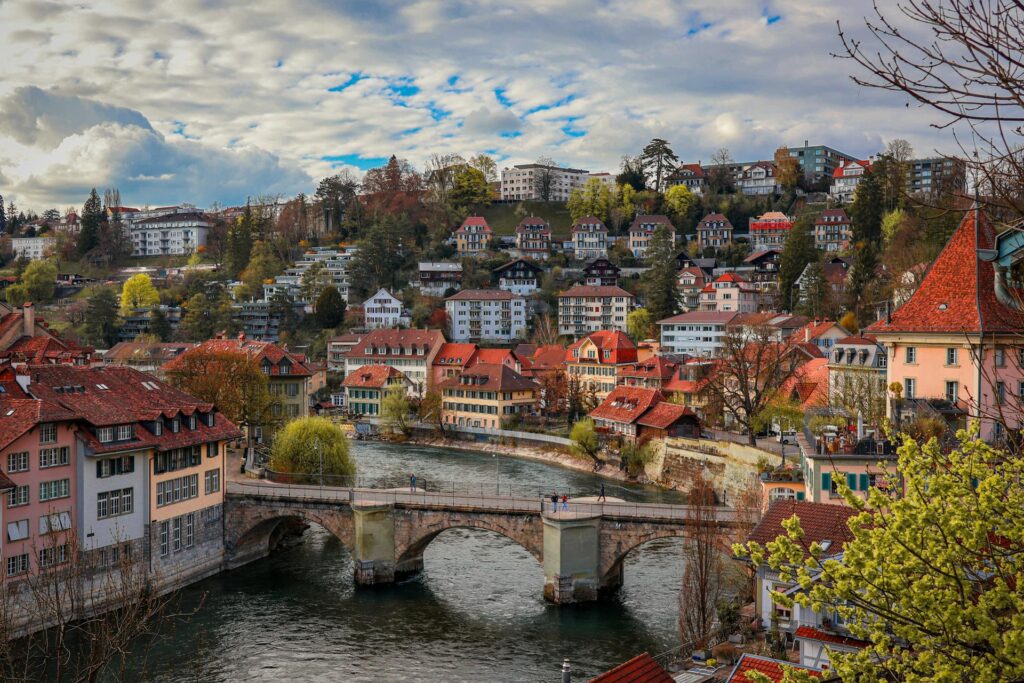
Bern, Switzerland: Sandstone Old Town, Aare River Loop, UNESCO Capital
Part of our Switzerland travel guide.
I have been visiting Bern for more than a decade and the city’s six kilometres of medieval arcades still feel like a secret — most travellers route through Zurich and Geneva and skip the actual federal capital entirely. We tell first-timers Bern is the Swiss capital that walks like a small town and reads like a UNESCO World Heritage site. My favourite ritual is a swim in the Aare River from the Marzili lido on a hot July afternoon, a fondue at Kornhauskeller in the vaulted 18th-century granary cellar, and a sundown walk across the Nydeggbrücke to the Bear Park. Treat this guide as the brief I would hand my own family before they boarded the SBB train from Zürich Hauptbahnhof.

Table of Contents
Why Bern?
Bern is Switzerland’s federal capital and one of Europe’s best-preserved medieval city centres — founded in 1191 by the Zähringen Duke Berthold V on a sandstone peninsula encircled by a near-complete loop of the Aare River, and inscribed on the UNESCO World Heritage list in 1983. The city’s metropolitan area holds about 415,000 people; the Old Town itself only about 145,000 — a population about one-quarter the size of Zurich’s, but the political weight of the country’s capital and the seat of the Swiss Federal Assembly. The result is a federal capital that walks like a small university town, where the Bundeshaus (Federal Palace), the Zytglogge clock tower and the Münster cathedral all sit within a fifteen-minute walking circle.
What makes Bern unmistakeable is the architecture and the Aare. The Old Town’s six kilometres of covered sandstone arcades (Lauben in Berndeutsch) protect the high street from rain and snow — the pavement runs under continuous arches for the entire central peninsula, and the result is one of Europe’s most pleasant rainy-day cities to walk. The Aare River loops the Old Town in an emerald U-bend with current strong enough that locals enter upstream at Marzili lido and let the river carry them downstream a kilometre or more before climbing out at the Eichholz lido. The river is genuinely the city’s summer social spine — on a hot July weekend the lidos and Aare-side gravel beaches hold half the Bernese population.
The city is also genuinely the federal political centre. The Bundeshaus (Federal Palace) on Bundesplatz holds the Swiss Federal Assembly’s National Council and Council of States — both chambers sit publicly four times a year (March, June, September, December) for three-week sessions, and the gallery is open to walk-up visitors with no ticket. Bern itself is the seat of the Federal Council (the seven-member executive), the Federal Supreme Court is in Lausanne and Lucerne, but the political weight of the capital rests here. The 250 Bundesplatz fountains were rebuilt in 2004 and are the city’s most visited free attraction.
The other elevator above its peers is the Albert Einstein and the modern art history. Einstein lived at Kramgasse 49 in the Old Town between 1903 and 1905 — the years he wrote the Annus Mirabilis papers, including special relativity and E=mc², while working as a Swiss patent-office clerk three blocks away. The apartment is now the Einstein Haus museum. The Paul Klee Centre on the eastern edge of the city, designed by Renzo Piano in 2005, holds the world’s largest collection of Klee works (about 4,000 pieces, roughly 40% of his life output). Plan around the BeJazz Festival in late May or the Buskers Bern festival in early August and the cultural payoff doubles for the same train ticket.
Neighborhoods: Finding Your Bern
📍 Bern Map: Every Place in This Guide


The Old Town (Altstadt)
The UNESCO World Heritage core — a sandstone peninsula bounded by the Aare’s U-bend, with three parallel main streets (Marktgasse, Kramgasse, Gerechtigkeitsgasse) running east from Bahnhofplatz to the Nydeggbrücke. The Old Town holds the Zytglogge clock tower, the Münster cathedral, the Einstein Haus, the Bundeshaus, and the eleven 16th-century allegorical fountains scattered along the main streets. The covered arcades make it the only major European Old Town that is fully rain-protected for shopping and walking. Most travellers stay here.
- Zytglogge — the 13th-century clock tower with its mechanical figure show four minutes before each hour
- Münster cathedral — Switzerland’s tallest cathedral spire (100m); the 312-step climb is the city’s best viewpoint
- Kramgasse 49 — Einstein Haus museum (CHF 7 admission)
Best for: first-time visitors, walkable culture, mid-range hotels. Access: Walk from Bern HB station; tram 9 to Zytglogge.
Marzili & the Aare-side Lidos
The neighbourhood directly below the Old Town’s southern cliff edge — reached by the steep Marzili Bahn (Switzerland’s shortest funicular, 105 metres long, free with the bear-park combined ticket). The Marzili lido is the city’s flagship free open-air bath, with the Aare current strong enough that locals enter upstream and float down to the dressing rooms a kilometre downstream. The lido is genuinely free, opens late May through mid-September, and has become the social heart of summer Bern.
- Marzili lido — free entry, sun lawns, the iconic Aare current swim
- Marzili Bahn funicular — 105 metres, opens 06:30, runs until 21:00 in summer
- Sunset views back up at the Bundeshaus from the lido lawn
Best for: summer visitors, river swimming, picnic culture. Access: Marzili Bahn from Bundesterrasse, or walk down the cliff path.
Mattenquartier & Nydegg
The medieval lower town on the Aare’s west bank, accessed via the Nydeggbrücke or the Matte Lift (a free public elevator that drops 30 metres from the Old Town to the riverside). The Mattenquartier is the city’s oldest residential neighbourhood and has the best riverbank evening atmosphere. The Nydegg church and the BärenPark sit at the eastern end. The neighbourhood holds the city’s best informal restaurants — Restaurant Mille Sens, Marzilibrücke for casual riverside lunches, and the Restaurant Schwellenmätteli with its outdoor terrace built directly over the Aare.
- BärenPark (free entry, the modern Aare-side bear enclosure)
- Matte Lift (free, 30-metre cliff elevator)
- Schwellenmätteli — the riverside terrace restaurant
Best for: river walks, casual dining, photography. Access: Walk across Nydeggbrücke; bus 12 to Bärengraben.
Länggasse (University District)
The University of Bern district north-west of the main station — about 17,000 students, a younger café and bar scene, and the cheapest mid-range accommodation in the city. The neighbourhood holds the Botanical Gardens (free, riverside), the Cinematte arthouse cinema, and the second-wave coffee scene at Kafi Kult and Adriano’s Bar & Café. Most of the city’s mid-range guesthouses sit on the Länggasse-Hauptbahnhof axis.
Kirchenfeld & the Museum Quarter
The 19th-century planned district south of the Aare across the Kirchenfeldbrücke — built between 1881 and 1900 as Bern’s “embassy quarter” and now holding the Bernese Historical Museum (which incorporates the Einstein Museum), the Swiss Alpine Museum, the Natural History Museum, the Museum of Communication, and the Kunsthalle Bern. The neighbourhood is twenty minutes’ walk from the Old Town and holds most of the city’s mid-tier hotels (Hotel Bellevue Palace, Hotel Belle Epoque). The bridge crossing itself, with the Old Town view back to the west, is one of the city’s photo-postcard angles.
The Food

Berner Platte & Cantonal Cuisine
The Bernerplatte is the canton of Bern’s signature dish — a single platter holding multiple cured and smoked pork cuts (pork ribs, smoked bacon, beef tongue, smoked sausages), boiled with sauerkraut, dried beans (Dörrbohnen) and potatoes. The dish dates to the canton’s 5 March 1798 victory over French forces at Neuenegg and was originally a celebratory feast for returning militiamen. Modern Bernerplatte is served at Restaurant Harmonie (the city’s institutional address since 1915, CHF 38), Kornhauskeller (refined version in the 18th-century granary cellar, CHF 44), and Restaurant Klötzlikeller (the city’s oldest wine cellar, CHF 36).
Cheese, Fondue & Raclette
The Bern canton sits between the Emmental and Gruyère cheese-producing regions, and Swiss-cheese culture is central to the city’s restaurant scene. The classic moitié-moitié fondue (half Gruyère, half Vacherin Fribourgeois) is the city’s signature winter dish; raclette is its summer cousin (a half-wheel of Raclette cheese melted under a heating element and scraped over potatoes). Headline addresses include Le Mazot in the Old Town arcades (the cheese-fondue institution since 1958, CHF 32 per person), Restaurant Lötschberg (specialising in the canton’s regional cheeses, CHF 28-38), and Käsekeller Bern (cheese tasting flights, CHF 22).
Coffee Culture & the Confiserie Tradition
Bern’s confiserie tradition is one of the city’s defining food experiences — the late-19th-century coffee-house culture survives at Confiserie Tschirren (since 1919, the Truffes du Jour are the city’s most-cited chocolate), Confiserie Beeler (since 1908, the Sachertorte is a Vienna-style holdover), and Confiserie Eichenberger at the train station. The third-wave coffee scene is concentrated in Länggasse and the Mattenquartier — Adrianos Bar & Café, Kafi Kult, and Café Einstein on the Old Town’s main square are the headline addresses. A Schaumkuss (chocolate-covered marshmallow on a wafer base) at Tschirren and an espresso at Café Einstein is the canonical Old Town café-stop pairing.
Markets & Street Food
The Bundesplatz Market runs every Tuesday and Saturday morning year-round (06:30–11:30) — fresh produce, cheeses, sausages, flowers, and the country’s freshest seasonal mushrooms in autumn. The Münstergass-Markt runs Tuesday and Saturday for crafts and antiques. The annual Zibelemärit (Onion Market) on the fourth Monday of November is the city’s biggest and most photographed food event — 50 tonnes of decorative onion plaits sold from 06:00, plus glühwein, onion tart and cheese stalls.
Food Experiences You Can’t Miss
- A Bernerplatte at Restaurant Harmonie — book ahead; the Saturday lunchtime is the Bernese-family time-slot
- A moitié-moitié fondue at Le Mazot or Kornhauskeller — winter only at the traditional venues
- A Saturday Bundesplatz market visit followed by a Tschirren chocolate stop
- The November Zibelemärit if your visit aligns — arrive at 04:00 for the genuine pre-dawn opening atmosphere
Cultural Sights

Bundeshaus (Federal Palace)
The seat of the Swiss Federal Assembly — both chambers (the National Council and the Council of States) sit here for four three-week sessions per year (March, June, September, December). The 1902 Hans Auer-designed neo-Renaissance building is open for free public guided tours when parliament is not in session — book online up to a month ahead. The Bundesplatz fountains (26 jets choreographed in patterns) run from May to October. The terrace behind the building (Bundesterrasse) holds the city’s most photographed Aare-and-Alpine view.
Zytglogge (Clock Tower)
Bern’s medieval centrepiece — built around 1218 as the city’s western gate, converted to a clock tower in 1405 after the gate was rendered redundant by the city’s expansion. The astronomical clock dates to the late 1520s and is one of the oldest functioning examples in Europe. Four minutes before each hour, the mechanical figure show begins (a crowing rooster, parading bears, and a jester). Guided interior tours run mid-March through October — book at the Bern Tourism office. CHF 20 per person.
Berner Münster (Cathedral)
Switzerland’s tallest cathedral — the 100-metre spire was completed only in 1893 (work began in 1421). The west portal’s “Last Judgement” tympanum (1495) is one of the most important late-medieval Swiss sculptures. The 312-step climb to the spire viewing platform is the city’s best 360° viewpoint — Old Town below, Aare U-bend, Bundeshaus, and the Alps on a clear day. Tower admission CHF 5; nave free.
Einstein Haus (Kramgasse 49)
Albert Einstein’s apartment from 1903 to 1905 — the Annus Mirabilis years when he wrote special relativity, the photoelectric effect (Nobel Prize, 1921), Brownian motion, and the mass-energy equivalence (E=mc²) papers while working at the Swiss Federal Patent Office on Speichergasse three blocks away. The two-room first-floor apartment has been restored to its 1903 condition, with original furniture, and the upper floor holds a small biographical museum. Open daily 10:00–17:00 (Feb–Dec), CHF 7. The fuller Einstein Museum is at the Bernese Historical Museum across the river.
Bernese Historical Museum & Einstein Museum
The country’s second-largest historical museum, in a 1894 neo-Gothic Helvetia-temple-style building south of the Kirchenfeldbrücke. The permanent collection covers Bernese history from prehistory to the present; the dedicated Einstein Museum wing (opened 2005) is the country’s most comprehensive exhibition on Einstein’s life and work, with original manuscripts, the famous “tongue” photograph negative, and an introductory film tracking the relativity theory’s development. Combined admission CHF 18; closed Mondays.
Zentrum Paul Klee
The Renzo Piano-designed contemporary art museum on the city’s eastern edge — three undulating steel waves echoing the Aare landscape, opened 2005. The Klee collection holds about 4,000 works (roughly 40% of the artist’s life output), the world’s largest. The museum runs three-to-four major Klee-focused special exhibitions per year. Admission CHF 20. Closed Mondays. Bus 12 from the city centre, fifteen minutes.
Kunstmuseum Bern
The city’s flagship fine-arts museum and one of Switzerland’s oldest (founded 1879) — strong holdings of late-medieval Swiss painting, the Italian Trecento, French and Swiss 19th-century landscape, and a major 20th-century section. The Gurlitt Bequest controversy of 2014 (the museum was named heir to the 1,500-piece Cornelius Gurlitt collection that included Nazi-looted works) added a dedicated provenance-research wing in 2017. Admission CHF 14. Closed Mondays.
BärenPark (Bear Park)
The modern Aare-side enclosure that replaced the 1857 Bärengraben in 2009 — about 6,000 square metres of riverside terrain with a pool fed directly from the Aare current. The current resident bears (Finn, Björk and Ursina) are the latest in a continuous line of city bears since the 16th century. Free entry; the bears are most active in spring and autumn (they hibernate from late November to early March). Cross the Nydeggbrücke from the Old Town and walk down the spiral staircase to the riverside path.
Entertainment

Buskers Bern Festival (early August)
The city’s headline annual cultural event — three nights of free street performance taking over the Old Town arcades, typically the second week of August. About 150 acts from 30 countries perform across 30+ stages built into the arcades and squares. Donations only; the festival has run since 2004. Hotel rates spike during the festival weekend; book six weeks ahead.
Gurten Festival (mid-July)
The four-day Gurten Festival on the Gurten mountain south of the city — the country’s biggest open-air rock and pop festival, drawing about 80,000 visitors over the four days. The Gurtenbahn funicular (free festival shuttle) runs from Wabern. Tickets typically CHF 90–120 per day.
Christmas Markets (late November to 24 December)
Bern’s Christmas markets run from late November through Christmas Eve — the Münstergasse-Markt (the largest, in front of the cathedral), the Waisenhausplatz Sternenmarkt, and the smaller market on Bundesplatz. Glühwein, Lebkuchen, hand-crafted ornaments and seasonal Bernese food. The markets are smaller than Zurich’s and Basel’s but the medieval-arcade setting is the most atmospheric in Switzerland. Free entry; 17:00–22:00 daily.
Concerts & Theatre
The Bern Symphony Orchestra performs at the Casino Bern (CHF 30–95 per concert) — the 1907 Beaux-Arts hall on the Herrengasse holds the city’s classical-music calendar. The Stadttheater Bern (also called Konzert Theater Bern) on Kornhausplatz handles opera and ballet (CHF 25–145). The smaller Theater an der Effingerstrasse, ONO Bühne and Mokka cover indie and experimental theatre. Bierhübeli is the headline mid-size live-music venue (capacity ~1,000) for indie rock and electronic acts.
Bars & Nightlife
Bern’s nightlife is small but quality-driven and concentrated in the Mattenquartier and Lorraine neighbourhoods. The Reitschule (the squatted-1980s alternative cultural centre) is the city’s most-cited late-night venue — concerts, DJ nights, the Sous Le Pont restaurant, and a famously punk political identity. The Old Town holds the more traditional bars: Pyrénées (the city’s oldest pub, since 1837) and Klötzlikeller (the 16th-century wine cellar, the most atmospheric).
Day Trips

Lake Thun & Thun (35 minutes by SBB train)
The closest classic Bernese-Oberland day-trip — Thun’s medieval Old Town with its hilltop Schloss Thun (12th-century, museum CHF 10), then a Lake Thun boat cruise to Spiez, Interlaken or the smaller stops at Oberhofen and Hilterfingen. The full Bern–Thun–Lake Thun cruise–Interlaken–Bern loop is the canonical day. SBB train Bern–Thun CHF 16 each way (45 minutes); Lake Thun boat passes CHF 25–55 depending on length.
Interlaken & the Bernese Oberland (1 hour by SBB)
The classic Swiss Alps base — the town between Lake Thun and Lake Brienz, the gateway to Jungfrau, Eiger and Mönch. Most travellers stay overnight rather than day-trip. The Jungfraujoch (“Top of Europe”) cog railway from Interlaken to the 3,454-metre saddle is the headline alpine experience (CHF 215–250 round-trip; allow a full day). The shorter Schilthorn cable car from Stechelberg (the James Bond film location) is the cheaper alternative (CHF 108).
Lucerne (1 hour by direct SBB)
Switzerland’s most-photographed lakeside town — the wooden Chapel Bridge (Kapellbrücke), the Lake Lucerne paddle-steamer cruises, the Mount Pilatus and Mount Rigi cable cars, and the Old Town wall walk. Direct InterCity train Bern–Lucerne CHF 41 each way (62 minutes). Worth a full day. See our (forthcoming) Lucerne City Guide for the dedicated visit plan.
Gruyères & the Cheese Region (1 hour by SBB + bus)
The hilltop medieval village of Gruyères and the Maison Cailler chocolate factory in Broc — combined visit with cheese-tasting at La Maison du Gruyère (the active Gruyère cheese-making facility) and the Cailler chocolate-tour-and-tasting at Broc. SBB Bern–Bulle CHF 23, then Postauto bus 5 minutes to Gruyères or 15 minutes to Broc. Allow a full day.
Lausanne & the Olympic Museum (1 hour by SBB)
French-speaking Switzerland’s lakeside capital on Lake Geneva, with the IOC Olympic Museum (CHF 20), the Cathedral of Notre-Dame, and the lakeside Ouchy district. Direct SBB Bern–Lausanne CHF 53 each way (66 minutes). The lakeside boat connection to Évian-les-Bains (France) makes a Geneva-Lake-circuit add-on possible.
Emmental & the Cheese Country (45 min by SBB + bus)
The actual Emmental valley east of Bern — wooden barns, the rolling green dairyland of the Emmental cheese region, and the Emmentaler Schaukäserei in Affoltern (the working show-cheese-dairy with daily cheese-making demonstrations, CHF 18 admission). Best as a half-day with Bern as the base. SBB Bern–Burgdorf 20 minutes, then Postauto bus.
Seasonal Guide

Spring (March – May)
Mild and unpredictable — daytime highs 10–18 °C, occasional showers, the Old Town fountains restart in April. Hotel rates climb gradually from late March. The BeJazz Festival in late May and the parliament’s spring session (early March) are the calendar highlights.
Summer (June – August)
The Aare-swimming peak — daytime highs 22–28 °C, the Marzili lido at full social capacity, the Buskers Bern Festival in early August and the Gurten Festival in mid-July. Hotel rates are the year’s highest in late July. Rain showers are common but brief; the covered arcades make rainy afternoons a non-issue.
Autumn (September – November)
The unambiguous best season for sightseeing — daytime highs 12–20 °C, low humidity, mostly clear skies, the Aare in its photogenic emerald colour. October is the rolling-foliage peak in the Bernese Oberland. The Zibelemärit (Onion Market) on the fourth Monday of November is the year’s most photogenic single-day event.
Winter (December – February)
Cold and atmospheric — daytime highs 2–6 °C, occasional snow, the Christmas markets running late November through 24 December. The Bernese Oberland ski resorts (Grindelwald, Wengen, Mürren) are 70–90 minutes by SBB; Bern itself is too low for snow-sports but is the obvious base for Bernese-Oberland day-trips. Hotel rates dip in January through mid-March.
Getting Around
Walking the Old Town
The Old Town is genuinely walkable — the longest east-west traverse from the train station to the Bear Park is about 1.4 km along the covered arcades. The main attractions (Zytglogge, Bundeshaus, Münster, Einstein Haus) all sit within a 600-metre walking circle. The covered arcades make rainy days a non-issue.
Trams & Buses (Bernmobil)
Bernmobil runs the integrated tram and bus network — six tram lines (3, 6, 7, 8, 9, with the 9 going through the Old Town centre to the train station) and a wider bus network. Single ticket CHF 4.60 (60 minutes, all zones in central Bern); Bern Ticket free with any Bern hotel stay (covers tram, bus, the Marzili Bahn funicular and the Gurten funicular). The Bern Ticket alone is worth CHF 30+ for a two-night stay.
SBB Train Hub
Bern HB (the main station) is one of Switzerland’s three biggest railway hubs — direct InterCity trains to Zurich (62 min), Geneva (1h 45m), Basel (55 min), Lucerne (62 min), Lausanne (66 min), and the EuroCity to Milan (3h 45m). The station is integrated with the city tram network at Bahnhofplatz (the western edge of the Old Town).
Airport Access
- Zurich Airport (ZRH): SBB train CHF 51 each way, 1h 25m direct InterCity service every 30 minutes
- Geneva Airport (GVA): SBB train CHF 53 each way, 1h 50m direct InterCity service every 30–60 minutes
- Bern-Belp (BRN): small regional airport, 9 km south, served by SkyWork and Helvetic — bus 334 from Bern HB, 30 minutes, CHF 4.60
Cycling
Bern’s “Bern Rollt” free city-bike scheme — operated by the city, free for the first four hours with a passport deposit at three central kiosks (Bahnhofplatz, Casinoplatz and Münsterplattform). The 30+ km Aare riverside cycling path runs from upstream Wohlen to downstream Hinterkappelen and is one of central Switzerland’s best urban riverside rides.
Driving & Parking
The Old Town is mostly pedestrianised and parking is genuinely difficult and expensive (CHF 4–6 per hour at central garages, CHF 35–45 for 24 hours, with rates published on the city portal) . Most travellers do not need a car for a Bern visit; the SBB train network makes day-trips faster than driving. If you must drive, use the City West (Neufeld), Casino or Metro park-and-ride garages.
Budget Breakdown: Making Your Franc Count
| Tier | Daily | Sleep | Eat | Transport | Activities | Extras |
|---|---|---|---|---|---|---|
| Budget | 80–125 CHF ($90–140) | Hostel dorm 38–55 CHF | Bakery + supermarket 18–28 CHF/day | Walk + Bern Ticket free | Münster tower 5 + Bear Park free | Migros lunch 14 |
| Mid-Range | 180–290 CHF ($200–320) | 3-star 140–230 CHF | Sit-down 38–62 CHF/meal | Tram day 9 | Klee Centre 20 + Historical 18 | Wine 12 + Schaumkuss 5 |
| Luxury | 450+ CHF ($500+) | Bellevue Palace 480+ CHF | Tasting menu 145–225 CHF | Taxi 30 CHF/day | Spa 95 + tour 65 | Cocktail 20 + cigar 18 |
Where Your Money Goes
Bern is genuinely expensive — Switzerland is consistently among the world’s three most expensive countries, and Bern’s prices match Zurich’s almost line-for-line on accommodation and dining. Sleeping is the biggest cost: even a no-frills mid-range city hotel runs CHF 180–230 per night, and the four-star Bellevue Palace tops CHF 480. Food is where the city is most punishing for casual travellers — a sit-down restaurant lunch cannot be done under CHF 25; dinner runs CHF 45–80 per person before drinks. Switzerland’s standard VAT (Mehrwertsteuer) is 8.1% (raised from 7.7% in January 2024) and is included in all marked prices; restaurants do not add a service charge.
The Swiss Travel Pass & Bern Ticket
The Swiss Travel Pass (CHF 244 for 4 consecutive days, second class) is the canonical multi-city Swiss travel pass — covers all SBB trains, most boats, the city tram networks, and most museum admissions across Switzerland. Pays for itself within two day-trips. The Bern Ticket (free with any Bern hotel stay) covers all city tram and bus rides and the two funiculars — a CHF 30+ value for a two-night stay.
Money-Saving Tips
- Stay overnight rather than day-tripping from Zurich — the Bern Ticket alone saves CHF 30+ in city transit
- Eat at Migros, Coop or the Bundesplatz market for breakfast and lunch — sit-down restaurants double your food budget
- Use the Swiss Travel Pass if you’re doing multiple Swiss cities — pays for itself fast
- Drink from the Old Town’s 100+ public fountains — the water is excellent and saves bottled-water costs
- Visit the Kunstmuseum and Klee Centre on a Wednesday evening (free admission 18:00–21:00 at Kunstmuseum, half-price after 17:00 at Klee)
- Skip the bottled wine — supermarket bottles are CHF 8–14 vs CHF 35–55 in restaurants
Currency & Exchange
The Swiss franc (CHF) trades at roughly 0.90 to the US dollar through 2026 (i.e. CHF 1 ≈ $1.11). ATMs are everywhere; most do not charge a foreign-card fee, though your home bank likely will. Cards work everywhere — Visa, Mastercard and increasingly Twint (the Swiss mobile payment) — even at small bakeries and farmers’ markets. Cash is rarely required. The euro is sometimes accepted at tourist-priced venues at a 5–10% unfavourable exchange.
Practical Tips
Language
Bern’s local language is Berndeutsch — a Swiss German dialect that is mutually intelligible with other Swiss German dialects but quite distinct from standard German (Hochdeutsch). All written communication, signs, transport announcements, restaurant menus, museum exhibits and government interactions use standard German. English is functional everywhere — Switzerland has the highest English proficiency in the German-speaking world; mid-range hotels, restaurants, museums and the SBB train network all operate in English. Learn five phrases: Grüezi (hello, the Swiss-German universal greeting), danke (thanks), bitte (please/you’re welcome), Tschüss (goodbye), auf Wiedersehen (formal goodbye). French and Italian are also national languages of Switzerland but rarely used in Bern itself.
Cash vs. Cards
Genuinely card-friendly — Visa, Mastercard, Twint and contactless payment work at every hotel, restaurant, supermarket, bakery, market stall, and even most public toilets. Cash is rarely needed; CHF 100–200 is plenty for a multi-day visit. ATMs almost never charge a foreign-card fee at the machine end (your home bank likely will).
Safety
Bern is statistically among the safest capital cities in the world — violent crime is genuinely rare, the petty-crime rate is far below most European capitals, and the police presence at the train station and Bundesplatz is constant. The U.S. State Department maintains Switzerland at travel advisory Level 1. The only meaningful tourist risk is pickpocketing on summer weekends at Marzili lido — leave valuables at the hotel. Emergency numbers: 112 (general European emergency), 117 (police), 144 (ambulance), 118 (fire). The Bern Tourist Police office is at the train station.
What to Wear
Bern’s dress code is normal-European and relatively informal — no specific cultural expectations beyond Western-equivalent. Light layers in summer (cool evenings), warm coat in winter (snow likely December–February), comfortable shoes for the cobbled Old Town streets. The Federal Palace and the Bundeshaus tour have a smart-casual expectation but no formal dress code; museums and concerts are similarly relaxed.
Cultural Etiquette
Three rules: (1) Punctuality is genuinely important — Swiss trains run to the minute, restaurants expect you within five minutes of your reservation, and being late is a meaningful social misstep. (2) Greet shopkeepers and bakery staff with “Grüezi” when you enter — it is the universal social convention and not greeting is read as rude. (3) Quiet hours run from 22:00 to 07:00 in residential buildings — even moderate hotel-room noise after 22:00 will trigger neighbour complaints. The Swiss are reserved with strangers but warm once introduced; small talk on trains is uncommon.
Connectivity
Swiss SIM cards from Salt, Sunrise or Swisscom run CHF 30–55 for a tourist-tier prepaid pack with 10 GB of data. EU-roaming applies for most European travellers thanks to bilateral agreements. eSIM activations (Airalo, Holafly) work fine. 5G coverage is universal in Bern; hotel and café Wi-Fi is fast and ubiquitous.
Health & Medications
Bern’s hospitals (Inselspital — the Bern University Hospital, one of Europe’s best teaching hospitals) operate to international standards. Tap water is excellent — Bern’s 100+ public fountains are filled by the city’s potable supply, and locals drink directly from them year-round. Travel insurance is strongly recommended; Switzerland’s healthcare costs are among the world’s highest (a single emergency-room visit can run CHF 1,200+ uninsured).
Tipping
Tipping is not strictly expected in Switzerland — service is included in restaurant prices by law, and rounding up to the nearest 5 CHF or 10 CHF is the convention rather than a percentage. Hotel porters: CHF 2–5 per bag. Taxi drivers: round up to the nearest franc. Tour guides on full-day trips: CHF 10–20 per group is the convention. The Swiss tipping floor is much lower than the American 18–22% standard.
Schengen & ETIAS (2026)
Switzerland is in the Schengen Area but not the European Union — passport-free travel from EU/Schengen countries; visa-exempt nationals (US, UK, Canada, Australia, etc.) can stay 90 days in any 180-day rolling window across the whole Schengen zone. The European Travel Information and Authorisation System (ETIAS) launches in late 2026 and will require visa-exempt travellers to apply online for a EUR 7 authorisation valid for three years before travel.
Frequently Asked Questions

How many days do I need in Bern?
One night and one full day is the genuine sweet spot for the city itself. Day 1 arrival + Old Town arcades + Zytglogge + Münster cathedral; Day 2 Einstein Haus + Bundeshaus + Bear Park + Aare swim or Klee Centre depending on weather. Two nights gives you a relaxed pace plus a Lake Thun or Gruyères day-trip; three nights is for repeat visitors or families. Most one-week Switzerland itineraries spend a single night in Bern between Zurich and Geneva.
Is Bern worth the detour from Zurich?
Yes — and most travellers underestimate it. The Old Town is a UNESCO World Heritage site, the arcades are unique in Europe, the Aare-loop geography is striking, and the city offers a genuinely different vibe from Zurich’s commercial sleekness. A one-night detour adds about CHF 250 to a Switzerland budget but adds a strong UNESCO experience that a Zurich-only itinerary misses.
Can I swim in the Aare River?
Yes — and you should. The Aare current is genuinely strong (about 8–10 km/h in central Bern in summer), and the canonical Bernese swim is to enter at Marzili lido or further upstream at Eichholz, float downstream a kilometre or more, and exit at the Marzili steps or the Schwellenmätteli. Marzili is free; opens late May through mid-September; lifeguarded. Read the warning signs about the current and never swim under the influence of alcohol.
Is the Swiss Travel Pass worth it for a Bern trip?
Almost always yes if you are visiting more than one Swiss city. The 4-day pass at CHF 244 covers all SBB train rides, most boats, every city tram network and most museum admissions — the Bern–Zurich return alone is CHF 102, and a single Bern–Lucerne–Bern is another CHF 82. For a Bern-only weekend, the city Bern Ticket (free with any hotel stay) is enough.
What’s the language situation?
Bern is in the German-speaking part of Switzerland — the local dialect is Berndeutsch (a Swiss German variant), but all written material, signs, transport announcements and museum exhibits use standard German. English is universal at hotels, restaurants, museums and the train network. French and Italian are official Swiss languages but rarely used in Bern itself.
When are the busiest weeks?
Late July to mid-August (the Buskers Bern festival, Gurten Festival and the Aare-swimming peak) and late November to 24 December (Christmas markets) are the two peaks; hotel rates climb 30–50% versus the spring baseline. The Zibelemärit Monday (fourth Monday of November) is the city’s single biggest day. Late January and February are the cheapest visit windows.
Can I use credit cards everywhere?
Yes — Switzerland is genuinely card-friendly. Visa, Mastercard, contactless and Twint work at every hotel, restaurant, supermarket, bakery, museum, and even most market stalls. Cash is rarely needed; CHF 100–200 is plenty for a multi-day visit.
Is Bern good for families with kids?
Excellent — the city is genuinely walkable, the Bear Park is free and a guaranteed kids’ hit, the Marzili lido is free and shallow on the upstream side, and the Tierpark Dählhölzli (city zoo on the southern bank, 5 km from the centre) is large and well-curated. The Children’s Museum Creaviva at the Klee Centre is interactive and free. The Old Town’s flat cobbled streets are stroller-friendly with care.
Is Bern good for solo travellers?
Yes — Switzerland is consistently among the world’s safest countries for solo travel including for women travelling alone, and Bern’s small-town atmosphere makes it less intimidating than Zurich’s Bahnhofstrasse-and-banking sleekness. The Old Town hostel network (Bern Backpackers Glocke and the YHA Bern) is small but well-run.
Ready to Experience Bern?
One night, one Old Town arcade walk, one Aare swim and one Bernerplatte dinner — that is the Bern rhythm. For the full country context, read the Switzerland Travel Guide; if you are continuing east, see our Zurich City Guide.
Explore More City Guides
Where to Stay
- Zurich City Guide — Switzerland’s largest city, the financial hub and Lake Zurich gateway
- Geneva City Guide — French-speaking lakeside diplomatic capital
- Lucerne City Guide — Lake Lucerne medieval icon and the Mount Pilatus base
- Switzerland Country Guide
- All City Guides
Alex the Travel Guru
Alex has been writing destination guides for FFU since 2019, with twelve Switzerland trips on the docket and a long-running Bern-as-detour habit on the Zurich-Geneva loop. The city is Alex’s favourite under-rated European capital — the arcades, the Aare swim and a Saturday Bundesplatz-market visit are the unchanging anchors of every visit. For the full country context, read the Switzerland Travel Guide.
More city guides you might like
Plan your trip to Bern
The booking tools we use ourselves. FFU may earn a commission at no extra cost to you.
Plan & book your trip to Bern
Booking through these searches supports our guides at no extra cost to you.