
Languages of Switzerland
All languages of Western Europe →fluent beta classical · classes by phone with Maya at ranas.ai/maya
Switzerland Travel Guide — Matterhorn Peaks, Glacier Trains & Four-Language Alpine Perfection
Switzerland Travel Guide
📋 In This Guide
- Overview — Why Switzerland Belongs on Every Bucket List
- ⛷️ Swiss Ski Season 2026
- Best Time to Visit Switzerland (Season by Season)
- Getting There — Flights & Arrival
- Getting Around — SBB, Swiss Travel Pass & the Densest Rail Network on Earth
- Top Cities & Regions
- Swiss Culture & Etiquette
- A Food Lover’s Guide to Switzerland
- Off the Beaten Path
- Practical Information
- Budget Breakdown
- Planning Your First Trip to Switzerland
- Frequently Asked Questions
Overview — Why Switzerland Belongs on Every Bucket List
Switzerland is a small country that punches above its weight in almost every category a traveller cares about. Compressed into 41,285 square kilometres — roughly the size of the Netherlands — it packs in 48 mountain peaks above 4,000 metres, four national languages, 26 self-governing cantons, and a federal rail timetable that has been engineering Swiss life down to the minute since 1902. With a population of about 9.0 million, it is smaller than London, yet it hosts the UN’s European headquarters, CERN’s Large Hadron Collider, the International Red Cross, FIFA, and a legal framework of armed neutrality that has kept it out of every European war since the Congress of Vienna in 1815.
The geography does most of the tourism brochure’s work. The Alps fill 60% of the country, running diagonally south-west to north-east, with Dufourspitze on the Italian border crowning the chain at 4,634 metres. The Rhône and Rhine both rise here, within a few kilometres of each other on the Gotthard massif, and flow in opposite directions to the Mediterranean and the North Sea. Lake Geneva and Lake Constance bracket the country at its western and north-eastern ends, and 1,500 further lakes fill the valleys in between. You can ride a train from the palm trees of Lugano’s lakeside to the glaciers of Jungfraujoch in a single long day and change climate zones five times on the way.
Culturally, Switzerland is an argument that has been productively unresolved for 700 years. German-speaking Swiss live in Zurich, Bern, Basel and Lucerne; French-speakers in Geneva, Lausanne and the Jura; Italian-speakers in Ticino; and roughly 40,000 Romansh-speakers in the upper valleys of Graubünden. Direct democracy means citizens vote on federal propositions four times a year, and the Bundesrat (federal council) rotates its seven members as a collective presidency. Sundays are quiet by law, trains leave on the second, and the country is not an EU member despite being ringed by EU states on five of its six borders.
Practically, it is one of the easiest and most expensive countries in Europe to travel through. SBB’s 2024 long-distance punctuality rate was 92.5% — among the best in the world. Tap water is free and excellent from public fountains in every square. English is widely spoken. The downside is cost: a cappuccino is CHF 5, a restaurant main CHF 35, and a Swiss Travel Pass 8-day is CHF 419. The pay-off arrives at the top of the Gornergrat cogwheel or in the steam of a shared fondue caquelon — the moment the trip starts earning back its price.
⛷️ Swiss Ski Season 2026 — Peak Weeks Are Right Now
Switzerland essentially invented mountain tourism — St. Moritz hosted the first organised winter sports in 1864, and the country now runs more than 200 ski resorts and mountain railways between December and April, with year-round glacier skiing above Zermatt. The 2025–2026 winter season is peaking right now: lifts are open at every major resort, February’s mid-season “relâche” school holidays have just ended, and the spring-corn snow weeks of mid-March to early April are widely regarded as the connoisseur’s window — long days, stable weather, and noticeably smaller queues.
- Peak window: mid-December 2025 through early April 2026; Zermatt and Saas-Fee operate glacier skiing year-round
- Matterhorn Glacier Paradise: Europe’s highest cable-car station at 3,883 metres — summer skiing daily June through August
- Zermatt: 360 km of connected pistes and a car-free village beneath the 4,478 m Matterhorn; cross-border skiing into Italian Breuil-Cervinia on one lift ticket
- Jungfrau region (Grindelwald, Wengen, Mürren): 211 km of pistes, the Lauberhorn World Cup downhill in mid-January, and direct train access from Interlaken
- St. Moritz / Engadin: 350 km of pistes on five separate mountains; the February Engadin Ski Marathon draws 14,000 cross-country racers
- Verbier & the Four Valleys: 412 km connected, the most off-piste-friendly major resort, and the spring Freeride World Tour finals on the Bec des Rosses
Best Time to Visit Switzerland (Season by Season)
Spring (Mar–May)
Two countries in one season. Valley temperatures climb from 6°C in March to 18°C by late May; cherry blossoms whiten Baselland in early April and Geneva’s parks peak in mid-April. In the Alps, spring is still skiing: pistes above 2,500 m remain open through mid-April. Many cable cars enter their April–May annual maintenance window (Betriebsruhe) — always check operating dates. Sechseläuten in Zurich burns a snowman-effigy called the Böögg to predict the summer.
Summer (Jun–Aug)
Alpine hiking season and the busiest months. Temperatures run 22–28°C in the lowland cities and 10–18°C at 2,000 metres altitude; Ticino frequently hits 32°C. Every mountain lift is running, the 65,000 km of marked hiking trails are fully signed, and Jungfraujoch and Gornergrat see their biggest queues in July–August (60–90 minutes at midday). Montreux Jazz Festival runs in early-to-mid July, 1 August is Swiss National Day with lakeside fireworks, and Alpabzug cattle descents dominate September.
Autumn (Sep–Nov)
Arguably the best-value, best-weather window. September lakeside temperatures are still a comfortable 20°C, Lavaux wine harvests turn the terraces gold through early October, and the Engadin valley’s larch forests burn orange in mid-October. Crowds drop sharply after week one, hotel rates fall 20–30%, and trails remain open into late October. Downside: cable cars close for annual maintenance in late October and early November. Zibelemärit (Bern’s onion market, fourth Monday of November) opens the Christmas season.
Winter (Dec–Feb)
Ski country. Lifts open mid-December, the big season runs through Easter, and snow is guaranteed above 1,500 metres by January. Lowland temperatures sit around −3°C to 5°C; the Alps regularly reach −15°C at altitude. Christmas markets in Basel, Montreux, Zurich and Bern run late November through 23 December; Basel’s is the country’s largest. L’Escalade (Geneva, December 11–13) commemorates the 1602 repulse of a Savoyard assault with a torchlit procession and marzipan cauldrons.
Shoulder-season tip: Late May and the first three weeks of October are the two windows most first-timers miss — Alpine wildflowers, warm hiking days, and noticeably cheaper hotel pricing in both.
Getting There — Flights & Arrival
Switzerland has two intercontinental hubs plus a tri-national airport in the north-west — pick your entry by region: Zurich (ZRH) for the east and central Alps, Geneva (GVA) for the Lake Geneva arc, Basel (BSL) for the Jura and the Rhine.
- Zurich Airport (ZRH) — Switzerland’s largest hub, 31.5 million passengers in 2024. SBB InterCity trains reach Zurich Hauptbahnhof in 10 minutes and continue to Lucerne, Bern and Basel.
- Geneva Airport (GVA) — the Lake Geneva gateway. SBB trains to Geneva Cornavin in 7 minutes; arriving passengers receive a free 80-minute transit ticket at the baggage hall.
- EuroAirport Basel-Mulhouse-Freiburg (BSL/MLH/EAP) — tri-national airport serving Basel, southern Germany and Alsace; Bus 50 to Basel SBB in 25 minutes.
- Bern Airport (BRN) — small capital-city airport with seasonal European links only; 20 minutes by tram/bus to Bern main station.
Flight times: New York–Zurich 8 hours; London–Zurich 1 hour 50 minutes; Tokyo–Zurich 13 hours non-stop on Swiss; Dubai–Zurich 6 hours 45 minutes.
Flag carriers: Swiss International Air Lines (Star Alliance), Edelweiss Air, Helvetic Airways.
Visa / entry: Switzerland is not an EU member but joined Schengen in 2008 — citizens of the US, UK, Canada, Australia, Japan, South Korea and 60+ other countries enter visa-free for up to 90 days in any 180-day window. ETIAS pre-authorisation will be required for visa-exempt travellers after its late-2026 launch.
Getting Around — SBB, Swiss Travel Pass & the Densest Rail Network on Earth
Switzerland runs on rail, boats and cable cars, and all three are timetabled together in the national “integrated” schedule. Swiss Federal Railways (SBB CFF FFS) operates InterCity trains at speeds up to 200 km/h on the Mattstetten–Rothrist and Lötschberg/Gotthard base-tunnel lines, while PostBuses reach the yellow-letterbox villages the trains don’t. Cars are genuinely slower end-to-end — you can leave Zurich HB, eat lunch on board, and walk off in Lugano in under three hours.
- SBB InterCity: max speed 200 km/h on high-speed sections; trains depart at the same minute past the hour on the clock-face timetable
- Zurich → Geneva: 2 hours 43 minutes direct IC
- Zurich → Lucerne: 45 minutes direct IC
- Zurich → Bern: 56 minutes direct IC
- Interlaken Ost → Jungfraujoch: 2 hours 7 minutes via Lauterbrunnen and Kleine Scheidegg on the Jungfrau Railway
Swiss Travel Pass: the country-wide tourist pass — CHF 244 (3-day), CHF 295 (4-day), CHF 419 (8-day), CHF 459 (15-day) in 2026 — covers every SBB train, PostBus, boat and urban tram, plus most mountain cable cars at a 50% discount and entry to 500+ museums. Residents and longer-stay visitors can buy a Half Fare Card for CHF 120 a year, which cuts almost every ticket in half.
Scenic routes: the 8-hour Glacier Express (Zermatt ↔ St. Moritz), GoldenPass Line (Lucerne ↔ Montreux), and Bernina Express (Chur ↔ Tirano, Italy, UNESCO-listed railway). Reservations mandatory for all three.
Apps: SBB Mobile (tickets + live departures), Swiss Travel Guide (official MySwitzerland planner).
Top Cities & Regions
📍 Map of Switzerland: Every Place in This Guide
🏦 Zurich
Switzerland’s largest city and financial capital — medieval Altstadt wrapped around Lake Zurich, blue-and-white trams, and a post-industrial clubbing district (Zürich-West) that runs until sunrise. UBS and the Swiss Stock Exchange are headquartered here, and Dada was born in 1916 at the Cabaret Voltaire on Spiegelgasse 1.
- Old Town (Altstadt) with the twin-towered Grossmünster and 13th-century Fraumünster (Chagall windows)
- Bahnhofstrasse — 1.4 km of flagship retail from the main station to the lake
- Uetliberg mountain (30 minutes by train to the 870 m summit panorama)
Signature eats: Zürcher Geschnetzeltes with rösti at Zeughauskeller, chocolate at Sprüngli on Paradeplatz, raclette at Raclette Factory.
🌊 Geneva
French-speaking headquarters of international diplomacy — home to the UN’s European office, CERN, the International Red Cross and the WHO. The 140-metre Jet d’Eau fountain on Lake Geneva is the signature skyline feature; the Old Town behind it is a compact cobbled knot of watchmaker ateliers and Reformation churches.
- Jet d’Eau (140 m lake fountain, April–October)
- UN Palais des Nations & Broken Chair sculpture; CERN Visitor Centre in Meyrin (free)
- Old Town (Vieille Ville) with Cathédrale Saint-Pierre and the Reformation Wall
Signature eats: Fondue moitié-moitié (half Gruyère, half Vacherin Fribourgeois), longeole sausage, chocolate at Du Rhône.
🐻 Bern
The Swiss federal capital and a UNESCO-listed medieval city since 1983 — 6 km of covered sandstone arcades, the Aare river looping around the old town in a horseshoe, and a bear park on the far bank for the city’s heraldic animal since 1191. Einstein lived at Kramgasse 49 while writing the 1905 relativity papers.
- UNESCO Old Town with covered arcades and sandstone fountains
- Zytglogge astronomical clock tower (built 1218–1220) — figures chime four minutes before every hour
- BärenPark, Einstein House, and the Bundeshaus Federal Palace
Signature eats: Berner Platte, rösti, Toblerone (invented in Bern in 1908).
🌉 Lucerne
The most painted Swiss city — a lakeside medieval old town on the west end of Lake Lucerne with a 14th-century covered wooden bridge and Mount Pilatus rising 2,128 metres directly behind it. Paddle-steamers cross to Alpnachstad for the Pilatus cogwheel (world’s steepest at 48% gradient) and to Vitznau for Mount Rigi.
- Chapel Bridge (Kapellbrücke, 1333) — Europe’s oldest surviving wooden covered bridge
- Lion Monument (1820–1821) — Mark Twain called it “the most mournful piece of stone in the world”
- Mount Pilatus cogwheel (48% gradient) or Mount Rigi (Europe’s first mountain railway, 1871)
Signature eats: Chügelipastete, Älplermagronen, chocolate at Bachmann.
⛰️ Zermatt
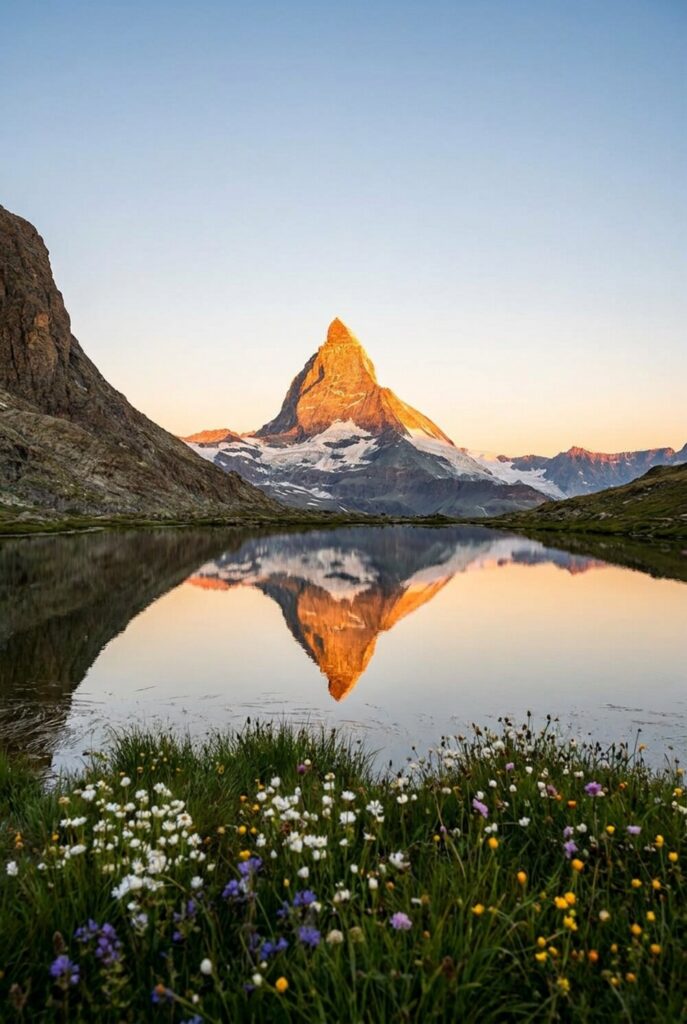
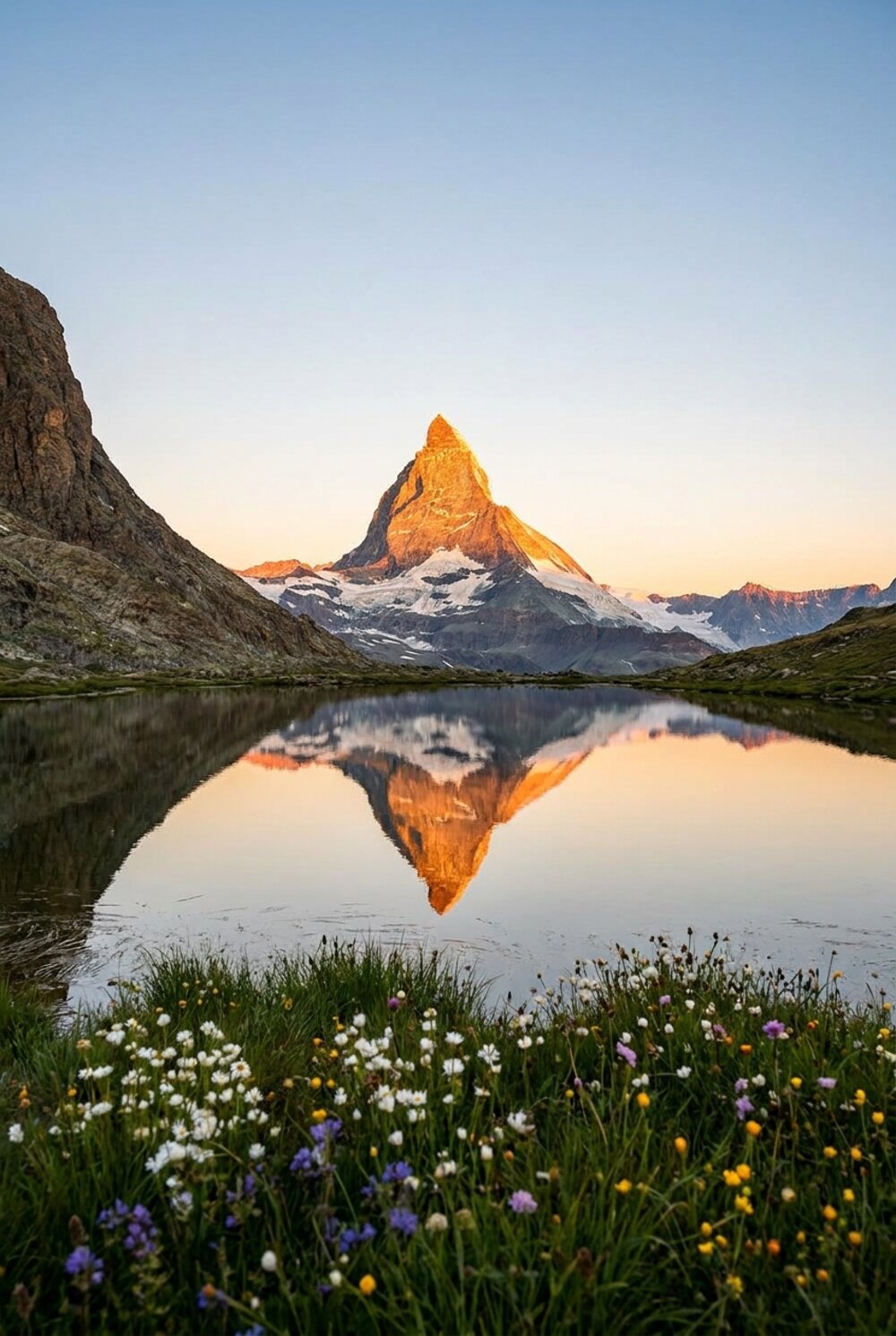
A car-free Alpine village at the foot of the 4,478-metre Matterhorn — Switzerland’s signature peak and the most photographed mountain in the world. Zermatt is reached only by train from Visp; private cars stop in Täsch. The village is walkable end-to-end in 20 minutes.
- Matterhorn Glacier Paradise — Europe’s highest cable-car station at 3,883 m, year-round glacier skiing
- Gornergrat Railway — Europe’s highest open-air cogwheel to 3,089 m; 360° panorama of 29 four-thousanders
- Old-town Hinterdorf with 17th-century timber granaries on stilts
Signature eats: Cheese fondue at Whymper-Stube, raclette at a halved wheel, älplermagronen.
🏔️ Interlaken & the Jungfrau Region
Europe’s adventure-sports capital, set between Lakes Thun and Brienz beneath the Jungfrau, Mönch and Eiger. Paragliders launch over the Höhematte meadow; canyon swings drop from the Stechelberg cliffs; and a mountain railway through tunnels bored into the Eiger delivers you to the “Top of Europe”.
- Jungfraujoch — “Top of Europe” at 3,454 m, reached through Eiger and Mönch tunnels
- Lauterbrunnen valley — 72 waterfalls including the 300 m Staubbach Falls that inspired Tolkien’s Rivendell
- Schilthorn (2,970 m) with the revolving Piz Gloria from the 1969 Bond film
Signature eats: Fondue at a chalet in Wengen or Mürren, Älplermagronen, Berner Haselnusslebkuchen.
Swiss Culture & Etiquette — What to Know Before You Go
Swiss culture is quiet, rule-respecting and linguistically layered. A Ticinese, a Genevois, a Bernese and a Graubündner see themselves as four distinct people, yet all share the same federal baseline: punctuality matters to the second, direct democracy is taken seriously, and small talk is reserved for people who have been introduced. Sundays are quiet by law, and Ruhezeit (quiet hours) between 10pm and 7am is honoured in every canton.
The Essentials
- Punctuality is structural. Trains leave on the second; dinner invitations start at the minute specified. Being more than two minutes late without a message is genuinely rude.
- Greet every shopkeeper on entering. A simple “Grüezi” (German-speaking), “Bonjour” (French-speaking), “Buongiorno” (Ticino) or “Allegra” (Romansh) is expected — not greeting is considered cold.
- Tipping is not required. Service is included by law in every restaurant bill. Rounding up by one or two francs for good service is the polite maximum; leaving 15–20% American-style is awkward.
- Sundays are quiet by law. Supermarkets and most shops close entirely; loud activities (lawn mowing, drilling, shouting) are restricted in residential areas. Exceptions are main-station Coops, bakeries and restaurants.
- Recycling is a civic sport. PET bottles, aluminium, glass (sorted by colour), paper and organic waste each have separate collection points. Shop-supplied plastic bags cost 5–10 centimes.
Fondue & Raclette Etiquette
- Fondue is a shared ritual — never dip bread from someone else’s plate into the shared pot, and never double-dip.
- If you drop your bread in the pot, tradition says you owe the table a round of kirsch or white wine; losing your fork means buying the next bottle.
- Stir in a gentle figure-of-eight to keep the cheese emulsified. Drink warm black tea or dry white wine, never ice water — cold water on melted cheese is said to curdle it in the stomach.
- The crispy browned layer at the bottom of the caquelon is called la religieuse (French) or der Grossmutter (German) — it is the prize and is shared among the table.
A Food Lover’s Guide to Switzerland
Swiss food is regional before it is national. Zurich runs on veal and cream sauces, Bern on slow-cooked meats and rösti, the Valais on raclette, Fribourg on fondue, Ticino on polenta and merlot, and Graubündner on dried meats (Bündnerfleisch) and caramelised-walnut Nusstorte. Cheese and chocolate are the two national obsessions — there are over 450 varieties of Swiss cheese and the Swiss eat about 11 kg of chocolate per person per year, the highest per-capita rate in the world. The Röstigraben (the “rösti ditch”) is the half-serious cultural dividing line between German- and French-speaking Switzerland that runs roughly along the Saane-Sarine river.
Must-Try Dishes
| Dish | Description |
|---|---|
| Fondue | Melted cheese (typically half Gruyère, half Vacherin Fribourgeois in the moitié-moitié style) heated in a caquelon pot with white wine, garlic and a splash of kirsch; eaten by dipping cubes of day-old bread on long forks. Most popular in French-speaking Switzerland and around Gruyères and Fribourg. |
| Raclette | Half-wheel of semi-firm cow’s-milk cheese melted beside a fire or under an electric grill, and scraped onto plates with boiled potatoes in their jackets, cornichons, pickled onions and air-dried meats. A Valais mountain specialty now eaten nationwide, especially on winter weekends. |
| Rösti | Grated potato formed into a pan-fried cake, crisp on both sides — the Swiss national starch. Originally a Bernese farmer’s breakfast; now the standard side dish for veal, sausage or fried eggs, and the cultural dividing line known as the Röstigraben. |
| Zürcher Geschnetzeltes | Strips of veal (sometimes with kidneys) in a white-wine and cream sauce with mushrooms, served with rösti. Zurich’s defining restaurant dish, on every traditional Altstadt menu from Kronenhalle to Zeughauskeller. |
| Älplermagronen | Alpine mac-and-cheese: macaroni, potatoes, onions and mountain cheese layered and baked, served with stewed apple sauce (Apfelmus) on the side. Originally a one-pot peasant dish cooked over a hut fire at the Alpage. |
| Berner Platte | A platter of boiled meats — smoked pork, ham, beef tongue, Bernese sausage — served on a bed of sauerkraut, green beans and boiled potatoes. Commemorates the 1798 Battle of Neuenegg and remains a Bernese Sunday-lunch institution. |
| Swiss Chocolate | Conching was invented by Rodolphe Lindt in Bern in 1879; milk chocolate was invented by Daniel Peter in Vevey in 1875. Lindt, Sprüngli, Läderach, Frey, Cailler and Teuscher are the house names; every supermarket stocks 200+ varieties in one aisle. |
Bakery & Tea-Room Culture
Switzerland does not have konbini, but it has the Bäckerei-Konditorei — an artisan bakery and tea-room combined, usually opening at 6am and serving coffee with warm Gipfeli (Swiss croissants) through the morning commute, then Zopf and Nusstorte through the afternoon. The country has roughly 1,600 licensed artisan bakeries and produces 200-plus named regional breads. Migros and Coop supermarket bakeries anchor the national staples at everyday prices.
- Chains: Sprüngli (Zurich, est. 1836 — Luxemburgerli macarons the size of a 2-franc coin), Läderach (premium chocolate, fresh sheets), Migros and Coop in-store bakeries.
- Signature items: Zopf (plaited Sunday-morning egg bread), Gipfeli (Swiss croissant, firmer and less buttery than French), Nusstorte (Engadin caramelised-walnut tart), Basler Läckerli (honey-spice biscuit from Basel, 14th century), Birchermüesli (raw-oats and fruit invented by Dr Bircher-Benner in Zurich around 1900).
Off the Beaten Path — Switzerland Beyond the Guidebook
Appenzell & the Alpstein
A rural north-eastern canton that still votes by show of hands in an open-air Landsgemeinde assembly every April — one of the last direct-democracy rituals in the world. Cows come down from the Alpine pastures in September in full flower-crown regalia (Alpabfahrt), and the Äscher cliffside guesthouse clings improbably under a 100-metre overhang above the Wildkirchli caves in the Alpstein massif. Try Appenzeller cheese (the recipe is kept genuinely secret under a cantonal trade-secret law) and Biber honey-spice biscuits at a painted wooden farmhouse in Stein or Urnäsch.
Lavaux Vineyard Terraces
A UNESCO-listed 30 km ribbon of dry-stone vineyard terraces between Lausanne and the Château de Chillon on Lake Geneva, first carved by Cistercian monks in the 11th century. Walk village to village on the Corniche path or the Train des Vignes, tasting Chasselas whites at a Lutry, Rivaz or St-Saphorin caveau — most open only on weekends. The three-sun theory of Lavaux — sun above, sun reflected off the lake, and sun radiating from the stone terraces — is the local joke and the literal reason these whites have the minerality they do.
Glacier Express — as a hike, not a ride
Rather than spending 8 hours on the panoramic train from Zermatt to St. Moritz, break the journey into day hikes reachable on normal SBB and RhB services: the Oberalp Pass (2,044 m, the source of the Rhine) between Andermatt and Sedrun; the Landwasser Viaduct near Filisur, a 65-metre-high six-arched 1902 stone curve printed on the Swiss 1,000-franc banknote; and the Val Roseg valley walk from Pontresina to a blue glacier tongue. Each is under three hours on foot, and a Swiss Travel Pass covers the train segments.
Lugano & the Italian Lakes
Italian-speaking Ticino feels like northern Italy with Swiss trains — palm trees and magnolias along Lake Lugano, grotti (stone-walled taverns) serving polenta and merlot in the chestnut-wood valleys around Maggia, and a 15-minute funicular to Monte San Salvatore for the best lake panorama. Pair with a day in Ascona’s frescoed Monte Verità above, a 19th-century vegetarian-reformist colony that once hosted Hermann Hesse, Carl Jung and Isadora Duncan. Lugano is 2 hours from Zurich by IC through the 57 km Gotthard Base Tunnel.
Aletsch Glacier & the Jungfrau-Aletsch UNESCO area
The longest glacier in the Alps — 22.5 km of ice, UNESCO-listed 2001 — viewed from the Bettmerhorn or Eggishorn platforms above Fiesch in the Valais. Take the Bettmeralp cable car up from Mörel for a 30-minute hut-to-hut rim walk. The ice has retreated roughly 1 km since 1980; interpretive signage along the trail is sobering and unmistakable.
Practical Information
| Currency | Swiss Franc (CHF); 1 USD ≈ 0.91 CHF (April 19, 2026). Switzerland does NOT use the euro — tourist-area shops may accept euros at a poor rate. |
| Cash needs | Cards accepted almost everywhere; Twint mobile-payment app is ubiquitous. Keep CHF 100–200 for Alpine huts, mountain toilets and small village bakeries. |
| ATMs | Bancomat machines at every SBB station and at Raiffeisen, UBS and PostFinance branches. Decline dynamic currency conversion — choose CHF. |
| Tipping | Not required — service is included by law. Rounding up by CHF 1–2 is the polite maximum; 15–20% American-style is unnecessary. |
| Language | Four official languages: German (62%, Swiss-German dialect), French (23%, Suisse romande), Italian (8%, Ticino) and Romansh (~0.5%, Graubünden). English is widely spoken in tourist areas. |
| Safety | Among the world’s safest countries — Global Peace Index rank 10 (2024). Main risks are pickpocketing at Zurich Hauptbahnhof, Geneva Cornavin and on crowded cable cars. |
| Connectivity | 4G/5G blanket coverage from Swisscom, Sunrise and Salt. eSIMs (Airalo, Holafly) work nationwide; free WiFi on SBB InterCity trains and in airports. |
| Power | Type J plugs (Swiss-specific 3-pin, 230V / 50 Hz). A universal EU adapter often will not fit — buy a Type J adapter at any station Migros. |
| Tap water | Excellent and safe everywhere — Zurich has more than 1,200 public drinking fountains. Always refill; restaurant bottled water can be CHF 8. |
| Healthcare | World-class private system — carry comprehensive travel insurance. Mountain emergencies call 1414 (Rega air rescue); otherwise 144 for ambulance. |
Budget Breakdown — What Switzerland Actually Costs
💚 Budget Traveller
Youth hostels (Swiss Youth Hostels network, Interlaken Backpackers, Zermatt YH), Coop and Migros grocery stops, a Swiss Travel Pass or Saver Day Pass for transit, and the occasional PostBus in place of a cable car. Doable at CHF 120–165 per day (~US$130–180) — the cheapest developed-world “budget” tier you will find, because Switzerland’s floor is other countries’ ceiling. A Coop take-away lunch is CHF 10–14, a supermarket dinner CHF 15, and a mountain-hut breakfast is free with your hostel stay.
💙 Mid-Range
3-star hotel or a Swiss Lodge, one sit-down meal and one café/bakery meal a day, an 8-day Swiss Travel Pass (CHF 419), and a couple of paid mountain peaks (Jungfraujoch: CHF 224, Gornergrat: CHF 126). Plan CHF 240–365 per day (~US$260–400). Zurich and Geneva in conference weeks push the top of that range; Ticino and Graubünden in shoulder season settle at CHF 220.
💜 Luxury
5-star hotels (Badrutt’s Palace St. Moritz, The Dolder Grand Zurich, Gstaad Palace, Mandarin Oriental Geneva), Swiss Travel Pass 1st class (CHF 669), Glacier Express Excellence Class (CHF 490 one-way), Michelin-starred tasting menus, and private Alpine transfers. Plan CHF 640+ per day (~US$700+). A 3-star Michelin dinner in the Valais (Didier de Courten, Damien Germanier) lands around CHF 350 per person with wine pairings; a suite at Badrutt’s Palace in February holiday weeks is CHF 3,000+ per night. Switzerland rewards luxury spending with genuinely world-class service.
| Tier | Daily (USD) | Accommodation | Food | Transport |
|---|---|---|---|---|
| Budget | $130–180 | Hostel CHF 45–75 / budget pension CHF 90–140 | CHF 25–40/day (Coop/Migros + one meal out) | Swiss Travel Pass 3-day CHF 244 or Saver Day CHF 52–79 |
| Mid-Range | $260–400 | 3-star hotel CHF 180–280 | CHF 60–100/day | Swiss Travel Pass 8-day CHF 419 |
| Luxury | $700+ | 5-star hotel CHF 550–1,500 | CHF 200–400/day | Swiss Travel Pass 1st class CHF 669 / Glacier Express Excellence Class CHF 490 |
Planning Your First Trip to Switzerland
- Pick your axis. East (Zurich, Lucerne, Engadin), West (Geneva, Lavaux, Montreux), or the Bernese Oberland (Bern, Interlaken, Jungfrau, Zermatt). Two axes fit comfortably in 10 days via SBB.
- Book the Swiss Travel Pass before you fly. 3/4/6/8/15-day passes cover every SBB train, PostBus, boat and urban tram, plus most lifts at 50% off and 500+ museums free.
- Decide on your season. Ski season mid-December to early April; Alpine hiking June through September; shoulder October and late May for best value. Avoid mid-July to mid-August at Jungfraujoch and Matterhorn Glacier Paradise.
- Pre-book the big peaks. Jungfraujoch and Matterhorn Glacier Paradise both sell timed tickets through SBB Mobile — book 48 hours ahead to cap prices in peak weeks.
- Pack Swiss-specific extras. Type J plug adapter (universal EU kits often won’t fit), warm layers even in July, a refillable water bottle, and CHF 50–100 in cash for mountain-toilet turnstiles.
Classic 10-Day Itinerary: Days 1–2 Zurich · Day 3 SBB to Lucerne · Day 4 GoldenPass to Interlaken · Days 5–6 Jungfrau region · Day 7 train to Zermatt · Days 8–9 Zermatt · Day 10 train to Geneva and fly home from GVA.
Frequently Asked Questions
Is Switzerland expensive to visit?
Yes — one of the most expensive countries in the world. Budget travellers can get by on CHF 120–165 per day (~US$130–180) with hostels and supermarket meals; mid-range is CHF 240–365 (~US$260–400). A cappuccino is CHF 5 and a Jungfraujoch ticket without a pass is CHF 224. The Swiss Travel Pass and supermarket picnics are the two biggest savers.
Do I need to speak German, French or Italian?
No. English works in every tourist area and among under-45s in all four language regions. A little local courtesy goes far: “Grüezi” (Zurich/Bern), “Bonjour” (Geneva), “Buongiorno” (Lugano) and “Merci vielmal” cover 90% of daily interactions.
Is the Swiss Travel Pass worth it?
For most travellers moving between two or more regions, yes. At CHF 419 for 8 days, it covers all SBB trains, PostBuses, lake boats and city trams, plus 50% off most cable cars and free entry to 500+ museums. Break-even is roughly 4 intercity segments. For a single-region trip, a regional Tell-Pass or Berner Oberland Pass may beat it.
Is Switzerland safe for solo travellers?
Extremely — Switzerland ranks 10th in the 2024 Global Peace Index, and violent crime against visitors is rare. Main risks are pickpocketing at Zurich Hauptbahnhof, Geneva Cornavin and crowded cable cars. Mountain emergencies call 1414 (Rega air rescue) from any Swiss mobile.
When is ski season, and when is hiking season?
Ski season runs mid-December to early April, with year-round glacier skiing at Zermatt and Saas-Fee above 3,000 metres. Alpine hiking runs June through September, when high passes are snow-free. May and October are the shoulder weeks — cheapest prices, but many lifts close 2–4 weeks for maintenance.
Can I get by as a vegetarian or vegan?
Easily in the cities. Zurich, Geneva and Bern all have dedicated vegan restaurants; Hiltl in Zurich opened in 1898 and is the world’s oldest vegetarian restaurant. In rural Alpine villages, plant-based thins out — phone ahead in high season.
Is Switzerland in the European Union? Do they use the euro?
No and no. Switzerland is NOT an EU member — voters rejected EEA membership in 1992 — but it IS part of the Schengen Area (since 2008). The currency is the Swiss Franc (CHF). Many tourist-area shops accept euro notes but give change in francs at an unfavourable rate; always pay in CHF.
Ready to Explore Switzerland?
Switzerland rewards travellers who let the timetable do the planning — buy the Swiss Travel Pass, pick one or two axes, learn how to say “Grüezi” and “Merci vielmal”, and let the trains, boats and cable cars handle the rest. Start in Zurich for the cities and culture, Interlaken for the peaks, or Zermatt for the Matterhorn.
Explore More
Cities we cover in Switzerland
Cities to explore in Switzerland
Deep-dive guides to specific cities, neighbourhoods, and food scenes — written with the same magazine voice.
More country guides you might like
Plan your trip to Switzerland
The booking tools we use ourselves. FFU may earn a commission at no extra cost to you.
Plan & book your trip to Switzerland
Booking through these searches supports our guides at no extra cost to you.