
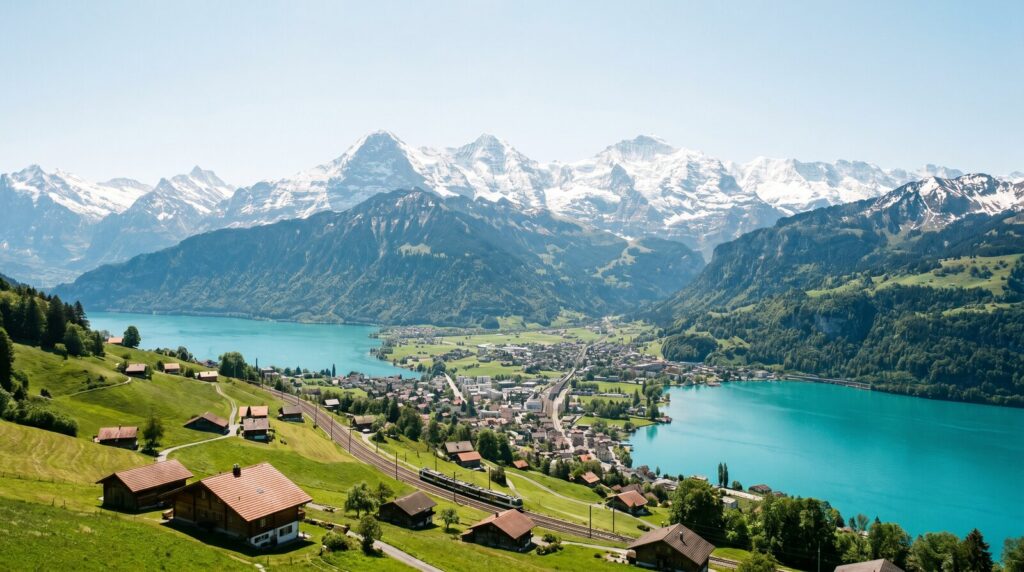
Interlaken, Switzerland: Swiss Alps Gateway, Paragliding & Jungfrau Region
Adventure capital nestled between two lakes where some of the world’s most dramatic mountains loom above charming valleys
Interlaken sits literally between two lakes—Thun and Brienz—in a valley surrounded by some of the Swiss Alps’ most dramatic peaks. The Eiger, Matterhorn, and especially the Jungfrau define the skyline, their summits visible from town on clear days, their shadow and presence coloring every moment of the visitor experience. This is adventure tourism capital, hosting rock climbers, hikers, mountain bikers, paragliders, skydivers, and bungee jumpers seeking adrenaline amid extraordinary scenery. Yet the town also attracts visitors seeking Alpine scenery without extreme sports—the hiking alone justifies extended stays, and the lake environment offers relaxing contrast to mountain intensity.

Interlaken functions primarily as a tourist service center and adventure hub rather than as a historic destination with significant cultural heritage. This candid positioning is part of its appeal—the town embraces tourism infrastructure without pretense, making it exceptionally organized for visitors. Multiple adventure companies, well-marked hiking trails, easy train access to higher elevations, and accommodation options for all budgets create an infrastructure that facilitates independent exploration. The combination of accessibility and spectacular scenery makes Interlaken ideal for visitors of varying fitness levels and adventure tolerance.
What You’ll Find Here
Adventure Activities: Adrenaline in the Mountains
Interlaken has earned a reputation as the adventure capital of the Alps, offering activities from relatively mild to genuinely dangerous. Paragliding from surrounding peaks has become the town’s signature activity—hundreds of visitors annually experience the sensation of flying with professional instructors while soaring above valleys and lakes. Tandem paragliding costs approximately 180-250 CHF and lasts 1-2 hours, including ascent via cable car and scenic descent. The experience is genuinely remarkable—drifting silently above landscape at eye level with peaks, feeling weightless over thousands of meters of air.
Bungee jumping from the Stocki Bridge, rafting down the Aare River, rock climbing on surrounding crags, mountain biking on countless trails, and skydiving appeal to visitors seeking maximum adrenaline. These activities range from 80-300 CHF depending on complexity and duration. Multiple companies operate each activity competitively, suggesting reasonable safety standards and pricing—the adventure sports industry is sufficiently saturated that corners can’t be cut without losing business.
The paradox of adventure tourism is that the actual activity duration often proves brief relative to travel time, briefing, and preparation. A 20-minute paraglide flight might involve 3 hours total from hotel to return. Understanding this temporal reality helps plan realistic daily itineraries. Most adventure companies operate daily, though conditions (particularly weather) determine actual availability. Paragliding and helicopter tours require clear weather; rafting and climbing proceed in wider weather windows.
Jungfrau Region: Mountain Access & High-Altitude Experience
The Jungfrau (4,158m) dominates the region psychologically and geographically. The Jungfrau Railway, one of Europe’s engineering marvels, climbs to the Jungfraujoch (3,454m, “Top of Europe”) through two mountains using tunnels blasted through rock. The journey takes approximately 2.5 hours and costs 200 CHF or more depending on specific routing. The summit station sits at an elevation where weather controls visibility and experience quality dramatically—you might find yourself in clouds unable to see 20 meters, or enjoy extraordinary views encompassing dozens of peaks and the Aletsch Glacier.
The experience includes an ice palace carved within the glacier, a restaurant offering cuisine at high altitude, and various observation points. The infrastructure is remarkably developed—you can experience high Alpine elevation without mountaineering skills, altitude acclimatization challenges, or significant personal risk. Approximately 1 million people annually visit the Jungfraujoch, making it one of Switzerland’s most-visited tourist attractions. Crowds can be substantial in summer peak season; visiting in shoulder seasons (May-June, September-October) improves the experience.
The Schilthorn, an alternative peak accessible via cable car through increasingly dramatic aerial routes, offers similar high-altitude views at 2,970m. The Schilthorn is lower than Jungfraujoch but equally dramatic, and the cable car journey itself creates impressive views as you climb through multiple stations. The Schilthorn famously appears in the James Bond film “On Her Majesty’s Secret Service.” A revolving restaurant at the summit provides 360-degree views while dining.
Hiking Trails: From Valley to Alpine Terrain
The hiking network around Interlaken encompasses approximately 100 kilometers of marked trails ranging from easy valley walks to serious Alpine routes requiring mountaineering experience. The beauty of the system is its accessibility—cable cars, trains, and buses deposit hikers at various elevations, allowing creation of itineraries matching fitness levels and interests. A beginner hiker might ascend by cable car to 2,000m, then hike downward for 3-4 hours to intermediate elevation. An experienced hiker might traverse high Alpine passes connecting multiple valleys over 6-8 hours.
The Eiger Trail descends from Eigergletscher (2,320m) along the base of the Eiger’s north face—the world’s most famous climbing wall. The 10-kilometer trail offers close perspectives on the face where climbers pursue routes of extreme difficulty. While the hiking itself is straightforward, the immensity of the rock architecture and awareness of climbers above create emotional intensity. Completing this hike provides understanding of mountaineering ambitions and the landscape that attracts world’s greatest climbers.
The Lauterbrunnen Valley, accessible by train or the scenic road, contains itself waterfalls, small villages, and innumerable hiking routes. The valley’s western wall features numerous permanent waterfalls—ribbon-like cascades descending cliffs where seasonal snowmelt flows steadily even in summer. The contrast between peaceful valley floor and dramatic cliff sides creates visually stunning environment throughout extended walks.
Easy Hikes (2-4 hours)
Valley walks around lakes, cable car-assisted descents, family-friendly routes. Appropriate for all fitness levels. No climbing skills required.
Intermediate (4-7 hours)
Alpine meadow traverses, mountain passes. Requires moderate fitness and comfort with elevation changes. Some exposed sections, but no technical climbing.
Lakes Thun & Brienz: Water Recreation & Scenery
Lake Thun (Thunersee) extends approximately 17 kilometers westward, narrowing gradually until mountains nearly meet the water. Lake Brienz (Brienzersee) runs eastward with similar dramatic characteristics. Both lakes are product of glacial action and feature water clarity and Alpine beauty. Steamship cruises operate on both lakes, offering leisurely journeys that combine sightseeing with meal service. A full-length cruise takes approximately 2-3 hours and costs 30-50 CHF depending on route. Many visitors combine partial lake cruise with train journey—taking a boat one direction and returning by train through valleys.
Swimming is permitted in both lakes, though water temperatures remain cool (15-18°C in summer). Designated beaches provide facilities; locals swim regularly in summer. The water clarity enables snorkeling—equipment rental is available. Kayaking and small boat rentals allow independent exploration at various pace and depth. Several lakeside villages are accessible only by boat or mountain road, creating sense of exploring remote terrain despite being within Swiss infrastructure.
The Giessbach Falls cascade directly into Lake Brienz—a spectacular waterfall viewable from lake cruises, or accessible via hiking trail from Giessbach Hotel. The combination of waterfall, lake water, and mountain backdrop creates photographic perfection. Many lake excursions arrange itineraries incorporating waterfall viewing with broader lake exploration.
Mountain Villages & Local Life
Interlaken itself functions primarily as a tourist infrastructure hub rather than a historic destination. However, surrounding villages—Grindelwald, Wengen, Murren, Kandersteg, and others—retain genuine mountain village character while offering accommodation and restaurant options. Wengen and Murren are car-free villages accessible only by cable car or train—this isolation has preserved their character and created village atmospheres distinct from motorized settlements.
Grindelwald, perhaps the largest and most developed nearby village, combines infrastructure with Alpine village charm. It serves as an alternative base to Interlaken, offering better views of the Eiger and positioning for different hiking options. Many visitors spend 2-3 days in Interlaken, then transfer to a mountain village for additional nights, experiencing different environments and perspectives.
The local culture reflects mountaineering heritage, agricultural tradition (dairy farming and cheese production), and contemporary tourism economy. Villages maintain weekly markets, traditional restaurants serving local cuisine, and cultural pride around Alpine heritage. Understanding local life requires spending time in villages, eating with locals rather than tourists, and hiking with recognition that these mountains represent locals’ literal and cultural foundation.
Practical Planning & Essentials
Interlaken is accessed via train from Zürich (2 hours), Bern (1 hour), Lucerne (2 hours), and other Swiss cities. Direct flights don’t serve Interlaken; closest major airports are Zurich (2.5-3 hours) or Bern (1.5 hours). Public transportation connects to surrounding villages; train access to higher elevations is excellent. The town itself is walkable; most services cluster along one main street. No car is necessary and parking is challenging and expensive.
Accommodation ranges from budget hostels (30-50 CHF per bed) to five-star resort properties (300+ CHF). Mid-range hotels and guesthouses cost 80-150 CHF per night. Booking accommodations in nearby villages sometimes offers better value and more authentic experiences compared to central Interlaken. Food costs 15-30 CHF (casual meals), 50-100+ CHF (restaurants). The region is expensive relative to surrounding countries but cheaper than Zürich.
Summer (June-September) brings peak crowds, warmest weather, and all facilities operational. Shoulder seasons (May-June, September-October) offer better conditions for hiking and paragliding with smaller crowds. Winter (November-March) brings snow, cooler conditions, and reduced services in some areas, though skiing becomes available and snow-covered landscapes offer different beauty.
Necessary Gear
Good hiking boots, weather-appropriate layering (temperatures drop roughly 6°C per 1,000m elevation), sunscreen (high elevation intensifies UV), and water bottle for extended hikes.
Regional Pass Options
Jungfrau Pass covers cable cars, trains, and mountain access. Swiss Pass covers national rail network plus regional transit. Both offer value for multi-activity days.
Plan Your Interlaken Adventure
Spend minimum 3-4 days to experience town infrastructure, enjoy at least one significant hike or mountain-cable excursion, and take a lake cruise. Longer stays allow multiple adventure activities, hiking various elevations and distances, and overnight stays in surrounding mountain villages. The region rewards extended engagement—the best experiences come from moving slowly through mountains, repeating hikes in different seasons, and developing understanding of Alpine environment’s intensity and fragility.