
Kerala Travel Guide — Backwaters, Tea Hills & India’s Most Relaxed State
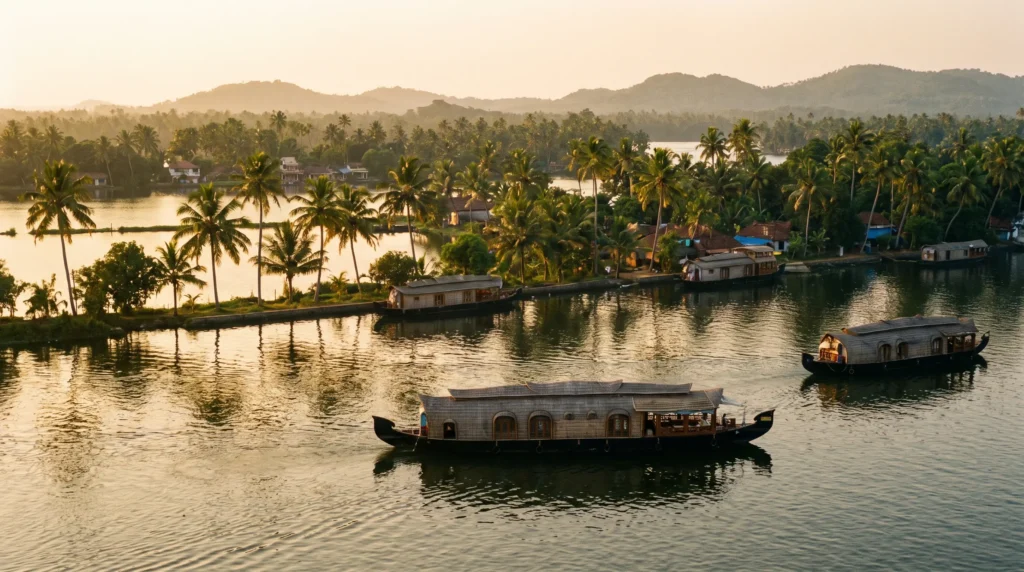
I tell people Kerala is the India you recommend to a friend who says they’re “not sure they can handle India.” That’s not a knock on the rest of the country — it’s just that Kerala runs at a different speed. Coconut palms lean over glassy backwater canals, 95% of the population can read a menu in English if you can’t manage Malayalam, and the state’s own tourism board has spent two decades selling it, accurately, as “God’s Own Country.” I’ve slept on a houseboat rocking gently on Vembanad Lake, hiked into tea plantations green enough to look photoshopped, and eaten a fish curry in a Fort Kochi backstreet that I still think about. Kerala rewards slowness — this is not a place to rush through in three days on a north-India-plus-add-on itinerary, though people try that constantly and always regret it.
In This Guide
- Overview — Why Kerala Is India’s Slow Lane
- Onam Festival — Kerala’s Ten Days of Boat Races & Flower Carpets
- Best Time to Visit Kerala (Season by Season)
- Getting There — Cochin Airport & the Rail Network
- Getting Around — Houseboats, Auto-Rickshaws & Hill Roads
- Key Regions — Backwaters, Hills & Coast
- Culture & People
- A Food Lover’s Guide to Kerala
- Off the Beaten Path
- Day Trips
- Practical Information
- Budget Breakdown — What Kerala Actually Costs in 2026
- Frequently Asked Questions
Overview — Why Kerala Is India’s Slow Lane
Kerala is a narrow strip of India’s southwest coast, wedged between the Arabian Sea and the Western Ghats mountains, formed as a unified Malayalam-speaking state on 1 November 1956. At roughly 38,863 square kilometers with a population near 36 million, it’s dense but never feels chaotic the way Delhi or Mumbai can. That’s partly a numbers story: Kerala’s literacy rate sits at 95.3%, among the highest of any Indian state, and its Human Development Index of 0.804 is the second-highest in the country.
The signature experience is the backwaters — a maze of lagoons, rivers and man-made canals fed by 44 rivers, centered on Vembanad Lake, India’s longest lake. Inland and up, the Western Ghats rise into tea and spice country, with 20 of the range’s 39 UNESCO-inscribed component sites sitting inside Kerala’s borders — more than any other Indian state shares in this single World Heritage listing. The range is one of the world’s eight biodiversity “hottest hotspots,” home to over 325 globally threatened species.
What Kerala isn’t is a place to speed through. There’s no single knockout monument here the way there is at Agra or Jaipur — the appeal is cumulative: a houseboat afternoon, a spice-scented hill town, a beach sunset, a Kathakali performance, repeated over a week or two. Try to do it in three days and you’ll just be tired in a beautiful place.
Onam Festival — Kerala’s Ten Days of Boat Races & Flower Carpets
If you can time a trip around one date, make it Onam. In 2026 the festival runs across ten days, with Thiruvonam, the main celebration day, falling on 26 August. Public holidays typically cluster around 25–28 August. Every household lays a pookalam — a geometric carpet of fresh flower petals — on the doorstep, and the ten-course Onam Sadya feast, served on a banana leaf, is the single best meal you can eat in Kerala all year.
The festival period is also boat race season. Alappuzha’s Nehru Trophy Boat Race, held on Punnamada Lake, traces back to 1952, when Jawaharlal Nehru was so taken by a snake-boat demonstration that he donated the trophy himself. Dozens of 100-foot-plus snake boats, paddled by up to a hundred rowers each, race to drumbeats and crowd roars — book Alappuzha accommodation months ahead if your trip lines up with race day.
Best Time to Visit Kerala (Season by Season)
December – February · Peak season
Cool, dry, and the most comfortable month-set for backwaters, hill stations and beaches alike. Expect the highest hotel rates and the busiest houseboats — book Alappuzha and Munnar stays several weeks out.
March – May · Hot season
Coastal humidity climbs and daytime heat is heavy on the plains, though Munnar’s altitude keeps it noticeably cooler. Good value season if you build the itinerary around the hills and mornings.
June – August · Southwest monsoon
Kerala’s rains are serious business — this is when the southwest monsoon hits, with average annual rainfall around 2,923mm concentrated heavily in these months. It’s also, confusingly, when Ayurvedic wellness resorts insist the humid air makes treatments most effective, and prices are lowest. Go if you want quiet backwaters and don’t mind daily downpours; skip it if you want beach days.
September – November · Northeast monsoon & Onam
The northeast monsoon brings a second, lighter rainy spell from roughly September through December, but this window also contains Onam (late August into early September) and generally clearing skies by November — a genuine shoulder-season sweet spot before winter crowds arrive.
Getting There — Cochin Airport & the Rail Network
Cochin International Airport (COK) in Nedumbassery, about 25km northeast of Kochi city, is Kerala’s main international gateway — and a genuine claim to fame: in 2015 it became the world’s first fully solar-powered airport, running on a 15MW photovoltaic array. It handled more than 11 million passengers in fiscal year 2024–25 across 25-plus airlines serving over 30 international and 25 domestic destinations. Thiruvananthapuram (TRV) in the south and Kozhikode (CCJ) in the north are the state’s other two international airports, useful if your itinerary leans that direction.
Overland, Kerala’s rail spine connects to Chennai, Bangalore, Mumbai and Delhi via Indian Railways, with Ernakulam Junction (Kochi) as the main hub — a slower but scenic and budget-friendly way to arrive if you’re already touring India. All non-e-Visa nationals and most Western passport holders need an e-Visa arranged in advance through the single official government portal before departure; there is no visa-on-arrival for tourists.
Getting Around — Houseboats, Auto-Rickshaws & Hill Roads
Kerala rewards a hired car and driver over self-driving — Indian traffic norms take adjustment, and a driver who knows the hill roads to Munnar is worth every rupee. Typical day rates for a car-with-driver run modestly by Western standards and are the most common way visitors string together Kochi, the backwaters, and the hills.
Within towns, auto-rickshaws (“autos”) are the default short-hop transport — agree the fare or insist on the meter before you get in. In the backwaters, everything moves by water: a rented kettuvallam houseboat (traditional rice barges converted to overnight cruisers) is the classic way to see Vembanad Lake and the connecting canals around Alappuzha and Kumarakom, while day boats and canoes reach narrower canals houseboats can’t fit through. In the hills around Munnar, roads switchback constantly — the drive up from Kochi covers roughly 130km along National Highway 49 and takes about four hours.
Key Regions — Backwaters, Hills & Coast
Fort Kochi & Ernakulam
Kerala’s cultural gateway and most walkable historic quarter. The Chinese fishing nets on the waterfront were introduced by traders in the early 14th century and remain the city’s signature silhouette. Layers of colonial history stack visibly here: the Portuguese arrived in 1498 and built St. Francis Church in 1503 (where Vasco da Gama was briefly buried), the Dutch held the territory for 112 years from 1683, and the British took over in 1795. The Paradesi Synagogue in nearby Mattancherry traces to a Jewish community on the Malabar Coast dating back to around 600 AD.
Alappuzha (Alleppey) & Kumarakom
The “Venice of the East,” where canals crisscross the town as part of National Waterway 3 and houseboat tourism is the whole economy. Kumarakom, on Vembanad’s opposite shore, trades Alappuzha’s working-town bustle for quieter resort backwaters and a bird sanctuary.
Munnar
A hill station at roughly 1,600m elevation, ringed by tea estates whose commercial planting dates to the 1880s. Eravikulam National Park nearby protects the endangered Nilgiri tahr along with grizzled giant squirrels and the Nilgiri wood-pigeon. Mornings here are genuinely cold by Kerala standards — pack a layer.
Thekkady & Periyar
Base for Periyar Tiger Reserve, one of India’s best-known wildlife sanctuaries, where boat safaris on Periyar Lake are the main way to spot elephants, sambar deer and (with luck) a distant tiger.
Kovalam, Varkala & Thiruvananthapuram
The southern coast’s beach belt. Kovalam’s crescent bays put beach and city within a short ride of each other; Varkala’s dramatic red cliffs above the Arabian Sea are the more laid-back, backpacker-leaning option. Thiruvananthapuram, Kerala’s capital, anchors the region with the Padmanabhaswamy Temple and government museums.
Kozhikode & the Malabar Coast (North Kerala)
Historically the epicenter of the spice trade that drew Portuguese ships in the first place — Vasco da Gama landed nearby at Kappad in 1498. Far fewer tourists reach this stretch, which is exactly its appeal: old bazaars, halwa shops, and beaches with none of the south’s crowds.
Wayanad
The Western Ghats’ greener, less-visited highland district — spice plantations, caves with prehistoric rock art, and wildlife sanctuaries that connect into the broader Nilgiri elephant corridor.
Culture & People
Malayalam is the official language, but Kerala’s near-universal literacy means English gets you remarkably far in hotels, restaurants and tourist offices. Hindu, Muslim and Christian communities have coexisted here for centuries — a legacy of the spice trade that brought Arab, Jewish, Chinese and European traders to this coast long before the rest of India saw them.
Kathakali, the elaborate classical dance-drama with its distinctive painted-face makeup and towering headdresses, is the performing art most associated with the state, alongside Kalaripayattu, often called one of the world’s oldest martial arts, still taught in traditional training halls. Theyyam, a ritual dance form from the northern Malabar region, and Padayani are older, more localized traditions worth seeking out if you’re in the north. Ayurveda, the traditional Indian medicine system, is practiced here with a seriousness that predates its current wellness-tourism popularity — a genuine Ayurvedic treatment course runs weeks, not a single spa afternoon.
A Food Lover’s Guide to Kerala
Coconut is the connective tissue of Kerala cooking — in curries, chutneys, and grated over almost everything. Breakfast usually means appam (lacy, fermented rice-and-coconut pancakes) with stew, or puttu (steamed rice-flour cylinders) with black chickpeas or banana. Along the coast, fish and prawn curries built on tamarind, coconut milk and curry leaves are the daily staple — Kerala’s Syrian Christian communities are famous for their meen (fish) curry.
The dish to build a trip around is the Onam Sadya — a vegetarian feast of up to 20-plus dishes served on a banana leaf, traditionally eaten with the right hand, available at proper restaurants year-round but at its best during the festival itself. Toddy shops serve fermented palm wine alongside simple, excellent seafood — an experience worth one evening even if you don’t finish the toddy. Spice country in the north and the hills grows the pepper, cardamom and cinnamon that first put this coast on European maps, and spice-plantation tours around Munnar and Thekkady let you see, smell and taste where it all comes from.
Off the Beaten Path
Vembanad Lake’s Quiet Canals
Skip the crowded main Alappuzha departure point and hire a small canoe from a village further along the backwaters — you’ll pass working paddy fields below sea level and rural life the big houseboats never reach.
Wayanad’s Edakkal Caves
Petroglyphs estimated at several thousand years old, reached by a short but steep climb, in a district most visitors skip entirely in favor of Munnar.
Kozhikode’s Old Town
The historic Malabar spice-trade port where Vasco da Gama first landed in 1498, today a working city with almost no tourist infrastructure — old bazaars, halwa shops, and a beach with none of Kovalam’s crowds.
Silent Valley National Park
One of the last untouched patches of tropical evergreen rainforest in the Western Ghats, saved from a hydroelectric project by a 1970s-80s conservation movement — permits are limited and the visitor experience is deliberately low-key.
Day Trips
From Kochi, Munnar and the backwaters both work as long day trips if you’re pressed for time, though both reward an overnight far more. From Munnar, the Anamudi Peak area (South India’s highest point at 2,695m within Eravikulam National Park) makes for a half-day hike, and the Mattupetty Dam and tea museum circuit fills an easy afternoon. From Thekkady, a spice-plantation walking tour plus an evening Kathakali or Kalaripayattu show in a nearby cultural center makes a full, well-rounded day without a long drive.
Practical Information
Money. The Indian rupee (₹/INR) is the only accepted currency; ATMs are common in cities and tourist towns but scarcer in rural backwater villages, so carry cash when heading out on a houseboat. Digital UPI payment apps are ubiquitous locally but generally require an Indian bank account, so most visitors rely on cash and cards.
Safety. The US State Department rates India Level 2 (“Exercise Increased Caution”) overall, citing crime and isolated terrorism risk concentrated mainly in specific regions far from Kerala, plus a general note that women should avoid traveling alone. Kerala itself carries none of the Level 4 “do not travel” designations that apply to Jammu & Kashmir, Manipur or Naxalite-affected central India — check current government advisories before you go regardless.
Health. The CDC recommends being current on routine vaccines plus Hepatitis A and Typhoid for most travelers to India, with Hepatitis B, rabies and malaria precautions depending on your itinerary and activities. Stick to bottled or filtered water, and consider antimalarial precautions if visiting lower-elevation rural areas.
Connectivity. A local SIM or eSIM is cheap and easy to arrange at the airport; coverage is strong in cities and towns, patchier deep in the hills. Plugs: Type C/D/M, 230V. Time zone: India Standard Time, UTC+5:30, no daylight saving.
Budget Breakdown — What Kerala Actually Costs in 2026
Kerala is inexpensive by Western standards, though a night on a well-appointed houseboat can rival a mid-range hotel elsewhere in Asia.
Budget (US$25–45/day): Guesthouse or hostel room, local thali meals, auto-rickshaws and public buses, shared backwater canoe trips over a private houseboat.
Mid-range (US$70–150/day): Boutique heritage stay in Fort Kochi or a Munnar tea-estate hotel, a shared or budget overnight houseboat, a car-and-driver day for hill excursions, restaurant meals.
Luxury (US$250+/day): Premium private houseboat charter on Vembanad Lake, five-star Ayurvedic wellness resort, private guided wildlife safaris in Periyar, chauffeured multi-day touring.
Fixed costs to expect: national park and wildlife sanctuary entry fees, and the e-Visa application fee paid in advance. Tipping 10% is appreciated but not mandatory at most restaurants.
Planning Your First Trip to Kerala
The classic first-timer route runs hills to water: fly into Cochin (COK), spend a night or two in Fort Kochi for history and food, head up to Munnar for two nights of tea-estate cool, drop down to Thekkady for a Periyar wildlife day, then finish with two nights on the Alappuzha or Kumarakom backwaters before flying home. Seven to ten days covers it comfortably; add Kovalam or Varkala beach time at the end if you have a few days to spare. Kerala pairs naturally with a wider South Asia itinerary — many travelers bookend it with our Sri Lanka guide for beaches and ancient cities a short flight away, or continue on to the Maldives for pure beach time. If you’re touring wider India first, our India travel guide and Mumbai city guide cover the north and west.
Frequently Asked Questions
Is Kerala safe for tourists in 2026?
Generally yes. The US State Department rates India overall as Level 2 (“Exercise Increased Caution”), but the specific high-risk, do-not-travel regions it names are far from Kerala. Use standard precautions — registered operators for houseboats and safaris, agreed fares before rides, and extra caution for women traveling solo, as the advisory specifically flags.
Do I need a visa?
Yes — US, UK, EU and Canadian citizens need an e-Visa arranged in advance through India’s official government portal; there is no visa-on-arrival for tourists. Apply only through the official site to avoid inflated third-party fees.
How many days do I need in Kerala?
Seven days covers Fort Kochi, Munnar, Thekkady and the backwaters without rushing; ten to fourteen lets you add a southern beach stretch or the northern Malabar coast.
Is a houseboat worth the cost?
For one night, yes — it’s the single most distinctive Kerala experience. Shared or budget boats bring the cost down considerably versus a private luxury charter, and the experience (drifting past palm-lined villages, a home-cooked lunch onboard) is similar at both price points.
Kerala or Goa?
Choose Kerala for backwaters, tea hills and a slower, more culturally layered trip; Goa for a more concentrated beach-and-nightlife holiday. Kerala rewards a longer stay — Goa works fine as a long weekend.
What’s the cheapest way to see the backwaters?
Skip the overnight houseboat and take a shared day cruise or a village canoe trip out of Alappuzha or Kumarakom — a fraction of the private charter price for most of the scenery.
Ready to Explore Kerala?
Tea hills cool enough for a sweater, backwater canals lit gold at sunset, and a fish curry that’ll ruin every other fish curry for you afterward. Kerala doesn’t have one headline monument — it has a whole slow, green rhythm, and that’s the point. Give it more days than you think it needs.
Explore More
- India Travel Guide — the wider country beyond Kerala
- Sri Lanka Travel Guide — beaches and ancient cities a short flight away
- Maldives Travel Guide — pure beach time next door
- Mumbai City Guide — India’s west-coast metropolis
How this guide was built
Published as part of Facts From Upstairs’ city guide series. Built from authoritative sources — UNESCO’s Western Ghats World Heritage listing, India’s official e-Visa government portal, the US State Department’s India travel advisory, the US CDC traveler page for India, and Wikipedia entity pages for Kerala’s geography, Cochin International Airport, Munnar, Alappuzha, Fort Kochi, and the Indian rupee. Numeric claims carry inline citations.
Sources cited on this page
- Wikipedia — Kerala
- UNESCO — Western Ghats
- Wikipedia — Cochin International Airport
- Wikipedia — Munnar
- Wikipedia — Alappuzha
- Wikipedia — Fort Kochi
- Wikipedia — Indian rupee
- India e-Visa — Official Government Portal
- US State Department — India Travel Advisory
- US CDC — India Traveler Page
- DrikPanchang — Onam/Thiruvonam 2026 Date
More city guides you might like
Plan your trip to Kerala
The booking tools we use ourselves. FFU may earn a commission at no extra cost to you.
Plan & book your trip to Kerala
Booking through these searches supports our guides at no extra cost to you.