
Udaipur Travel Guide — Lake Palaces, Marble City Walls & Rajasthan’s Most Romantic City
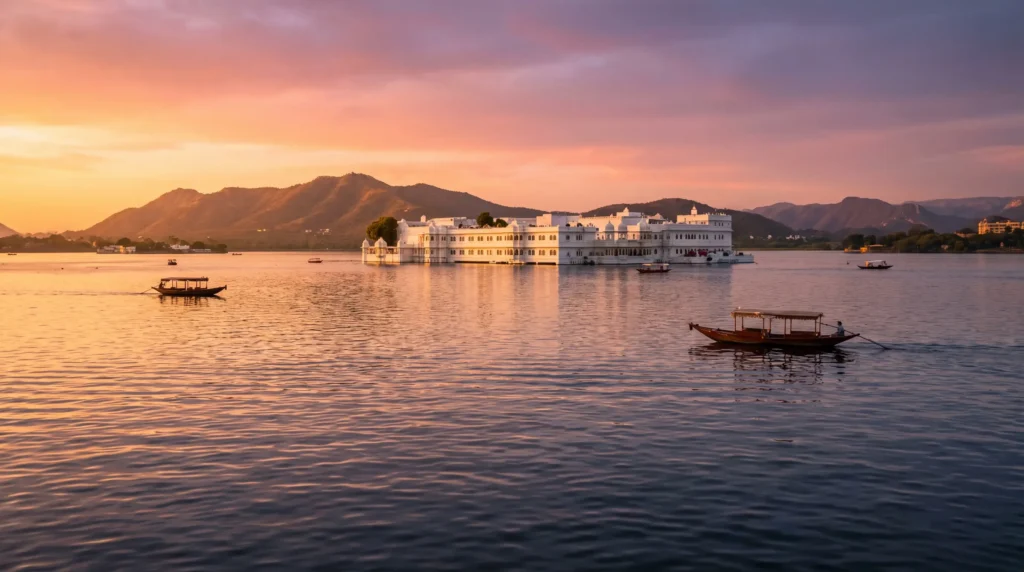
I still remember the first time a rooftop waiter in Udaipur pointed across Lake Pichola and said, without a trace of irony, “that is where they filmed James Bond.” He was right — Octopussy plays on a loop in half the cafés here, and nobody seems tired of it. Udaipur earns the theatrics: a 16th-century capital built around a man-made lake, a City Palace that took four centuries to finish, and a marble palace that appears to float on water because it does. It is also a genuinely workable city — walkable old-town lanes, sunset boat rides you don’t need to book weeks ahead, and a food scene built around simple, very good Rajasthani thalis. The catch is that everyone else has heard the same pitch, so the ghats and palace queues get crowded in peak season, and the city’s charm dims fast if you let a tout plan your day for you. Go in with a little structure and Udaipur delivers on every postcard it’s ever been on.
In This Guide
- Overview — Why Udaipur Is Rajasthan’s Softest Landing
- The Mewar Festival — Udaipur’s Spring Showpiece
- Best Time to Visit Udaipur (Season by Season)
- Getting There — Airport, Rail & Road
- Getting Around — Auto-Rickshaws, Walking & Boats
- Neighborhoods — Old City, Lake & Beyond
- Culture & People — Mewar’s Living Court City
- A Food Lover’s Guide to Udaipur
- Off the Beaten Path
- Day Trips from Udaipur
- Practical Information
- Budget Breakdown — What Udaipur Actually Costs in 2026
- Planning Your First Trip to Udaipur
- Frequently Asked Questions
Overview — Why Udaipur Is Rajasthan’s Softest Landing
Udaipur was founded in 1559 by Maharana Udai Singh II of the Sisodia Rajput dynasty, who moved the Mewar capital here after Chittorgarh fell to the Mughals — a ridge beside an existing lake seemed easier to defend. That lake, Pichola, had actually been built two centuries earlier, in 1362, and it’s still the organizing feature of the whole city: whitewashed havelis climb its eastern ghats, the City Palace complex runs along its shoreline for nearly half a mile, and the Lake Palace — built in 1746 by Maharana Jagat Singh II — sits on its own island in the middle, looking, from most angles, like it’s floating.
The City Palace itself is really eleven palaces stitched together by successive Maharanas over roughly four centuries, entered through the triple-arched Tripolia gate built in 1725. It’s the single best orientation point in the city and worth the first morning of any trip.
What makes Udaipur different from Rajasthan’s bigger, brasher cities — Jaipur’s traffic, Jodhpur’s heat, Jaisalmer’s remoteness — is scale. The old city core is compact enough to walk in a day, the lake views are constant rather than occasional, and the whole place reads as more relaxed than “romantic,” a word every brochure reaches for, tends to suggest. The tradeoff: this is one of Rajasthan’s most visited cities, so October through March brings real crowds to the palace, the ghats and the rooftop restaurants with the best lake views, and touts around the old-city gates can be persistent about “helping” you find a hotel or a shop.
The Mewar Festival — Udaipur’s Spring Showpiece
If you can time a trip around one date, make it the Mewar Festival, held over three days in late March or April (2026 dates are tracking around April 11–14, confirmed closer to the event). It coincides with the final day of Gangaur, when locally dressed women carry idols of the goddess Gauri in procession through the old city before a ceremonial boat procession on Lake Pichola, followed by folk dance, music and a fireworks finale over the water.
It’s one of the most photogenic events anywhere in Rajasthan and — unlike Pushkar or Jaipur’s bigger festivals — still feels manageable in scale, with the whole old city as the stage rather than a fenced-off fairground. Book lake-facing rooms well ahead if your dates line up; everyone wants that view for the boat procession.
Best Time to Visit Udaipur (Season by Season)
Mid-September – March · Cool, dry season (peak)
Warm days, genuinely cool nights, and the clearest lake views of the year — this is when most travelers come, and December–January mornings can dip cool enough for a light jacket. Book palace-view hotels a few months out for the Diwali–New Year–Mewar Festival stretch.
April – June · Pre-monsoon heat
Hot and dry, with daytime temperatures regularly climbing well into the 40s Celsius — manageable if you plan around it (early mornings, air-conditioned midday breaks, rooftop evenings) and rewarded with the lowest hotel rates and thinnest crowds of the year.
July – August · Monsoon
Rains typically arrive in July and build through August, filling Lake Pichola and Fateh Sagar back up after the dry months and turning the surrounding Aravalli hills a green that Rajasthan rarely shows off. Showers tend to be short, dramatic afternoon downpours rather than all-day washouts, but some rooftop restaurants close for repairs and hill-fort day trips get muddier.
Getting There — Airport, Rail & Road
Maharana Pratap Airport (UDR) sits at Dabok, about 22 kilometres east of the city, with domestic connections to Delhi, Mumbai, Jaipur and other major Indian hubs; international arrivals typically connect through Delhi or Mumbai. Pre-paid taxi counters and app-based cabs both operate at arrivals; the ride into the old city takes 30–45 minutes depending on traffic.
Udaipur City railway station has broad-gauge connections to Delhi, Mumbai, Jaipur, Ahmedabad and Chittorgarh, including overnight services that are a genuinely comfortable way to arrive without burning a travel day. Note that a few routes — Jodhpur among them — have no direct train and require a change, so check connections rather than assuming a straight run. By road, Udaipur sits roughly 415 kilometres south of Jaipur and about 250 kilometres northwest of Jodhpur on national highways; both are workable as overnight bus routes or private-car day drives.
Getting Around — Auto-Rickshaws, Walking & Boats
The old city around Lake Pichola — Jagdish Temple, City Palace, Bagore ki Haveli, the ghats — is genuinely walkable, and it’s the best way to see it: narrow lanes, painted havelis, cows setting their own pace. For anything further — Fateh Sagar Lake, Saheliyon ki Bari, the airport, day-trip pickups — auto-rickshaws are the default; agree a fare before getting in, or use an app-based ride service where available, which mostly removes the negotiation.
Boat rides on Lake Pichola (to Jag Mandir island, or a sunset loop past the Lake Palace) run on a fixed schedule from the City Palace jetty and are worth building an evening around. Rental scooters are easy to arrange and reasonable for day trips outside the city, though Udaipur’s older lanes weren’t built with traffic in mind, so expect tight, chaotic corners near the main gates. Cycle-rickshaws are common in the old city for short hops and are a decent way to support a slower pace than a rickshaw’s throttle encourages.
Neighborhoods — Old City, Lake & Beyond
The Old City & Lake Pichola ghats
The historic core, packed inside what were once city walls: City Palace, Jagdish Temple, the ghats where locals still wash clothes and buffalo cool off feet from tourist boats. This is where you’ll spend most walking time, and where the rooftop-restaurant density is highest.
Lal Ghat & Hanuman Ghat
The backpacker-friendly lakeside strip just north and south of the old city proper — guesthouses with lake glimpses, cooking classes, and a slower pace than the main palace gates a few minutes’ walk away.
Fateh Sagar Lake area
A second, larger lake north of the old city, ringed by a promenade and backed by the Aravalli hills, with the Monsoon Palace (Sajjangarh) visible on its hilltop above. Quieter than Pichola, with fewer tourist boats and better sunset-hill access.
City Palace & Ambrai Ghat side
The lake’s eastern shore, dominated by the sprawling City Palace complex itself and Ambrai Ghat opposite the Lake Palace — arguably the single best sunset photo spot in the city, and free.
Shilpgram & the western outskirts
A rural arts-and-crafts village a short drive west of the lakes, with artisan workshops, a crafts fair each December, and a slower, village-paced contrast to the old city’s density.
Delhi Gate & the new town
North and east of the old walls: the modern commercial city, bus stands, most mid-range chain hotels, and the practical stuff — pharmacies, SIM shops, ATMs — that the old city doesn’t have much of.
Culture & People — Mewar’s Living Court City
Udaipur was the capital of the Kingdom of Mewar, one of the longest-ruling Rajput dynasties in India, and the current head of the Mewar royal family still lives partly in the City Palace complex and runs several of its museum wings through a private trust — a rare case of a former royal house staying visibly present in its own capital rather than fading into a plaque.
Mewari and Rajasthani are widely spoken alongside Hindi, and English is common in the tourism economy — hotels, guides, restaurant staff. Folk traditions run deep: puppet shows (kathputli), Rajasthani ghoomar dance, and the miniature-painting workshops clustered near Bagore ki Haveli, where you can watch artists working in the same style the Mewar court once commissioned. Dress modestly at temples (Jagdish Temple in particular), and ask before photographing people at the ghats — locals doing laundry or bathing there are living their day, not performing for cameras.
A Food Lover’s Guide to Udaipur
The signature meal is the Rajasthani thali — a rotating spread of dal, gatte ki sabzi (gram-flour dumplings in yogurt curry), ker sangri (a desert-bean and berry dish unique to the region), rotis and rice, refilled until you tap out. Look for it at no-frills local diners rather than the rooftop restaurants, where quality is often better and prices considerably lower.
Street food worth seeking out includes kachori (deep-fried, spiced lentil pastries) at breakfast, and mirchi bada — battered, stuffed green chilies — from carts near the clock tower market. Lassi shops in the old city are a genuine institution; the one near Jagdish Temple has been serving thick, saffron-topped lassis for decades and lines form accordingly. For a splurge, several heritage havelis run rooftop dinners with a City Palace or Lake Palace view, where the food is fine but you’re really paying for the view — worth it once, at sunset.
Off the Beaten Path
Bagore ki Haveli’s evening puppet show
A restored 18th-century haveli on the lake’s western ghat, its courtyard hosts a nightly folk-dance and puppet performance that’s considerably less touristy than it sounds — mostly Rajasthani families in the audience, not tour buses.
Saheliyon ki Bari
A modest 18th-century garden of fountains and marble elephants, built for the ladies of the royal court and now one of the calmer, cheaper stops in the city — easy to combine with a Fateh Sagar Lake visit.
Ahar Cenotaphs
A quiet field of royal cremation memorials just east of the city, marking centuries of Mewar rulers — far fewer visitors than the palace, and a genuinely moving, low-key contrast to it.
Old-city miniature painting ateliers
Small family workshops near Jagdish Temple still teach and sell Mewar-school miniature painting on paper and silk — ask to watch the process before buying, and expect prices to reflect real hours of work rather than souvenir-stall margins.
Day Trips from Udaipur
Kumbhalgarh Fort is the standout: a 15th-century Mewar fortress on the Aravalli range, part of the six-fort “Hill Forts of Rajasthan” UNESCO World Heritage listing inscribed in 2013, and famous for a perimeter wall long enough to be nicknamed the Great Wall of India. It’s a straightforward half-day round trip by car or organized tour, often paired with the intricately carved Jain temples at Ranakpur on the same road.
Chittorgarh Fort, roughly 110 kilometres north, is also part of that same UNESCO serial listing and was the Mewar capital before Udaipur — the dynasty’s move here in 1559 happened specifically because Chittorgarh had fallen. One of India’s largest forts, with enough temples, towers and history to fill most of a day.
Mount Abu, Rajasthan’s one hill station, sits roughly 90 kilometres southwest and makes a cooler, greener contrast to the desert plains — best known for the marble-carved Dilwara Jain temples. It’s doable as a long day trip but more comfortable as an overnight, especially combined with Kumbhalgarh en route.
Trying to combine all three in a single day isn’t realistic given road conditions through the hills — pick one, or budget an overnight if you want two.
Practical Information
Money. The Indian Rupee floats freely against major currencies; the Reserve Bank of India’s reference rate sat around ₹95 to the US dollar in early July 2026, but check current rates before you travel. ATMs are widely available in the new town and old city; UPI-based payment apps are everywhere but generally require an Indian bank account, so carry cash and cards as backup.
Visas. Most Western travelers need a visa before arrival — an e-Visa covers many nationalities including UK, US, EU and Canadian passport holders — and everyone must also file a separate online e-Arrival Card up to 72 hours before landing; the arrival card is not a substitute for the visa itself. Apply well before your trip and double-check your specific nationality’s rules, since eligibility and validity periods vary.
Safety. The US State Department rates India Level 2 (“Exercise Increased Caution”) overall, citing crime and terrorism risk, with a specific Do Not Travel advisory for most of Jammu & Kashmir (excluding eastern Ladakh and Leh) and Manipur. None of that applies directly to Rajasthan or Udaipur, which are firmly on the standard tourist circuit, but check your own government’s current advisory before you go, use registered guides and licensed taxis, and negotiate fares upfront to sidestep the old city’s more persistent touts.
Health. Routine vaccinations should be current, and hepatitis A and B vaccination is commonly recommended for travelers to India; malaria risk exists in parts of the country, so talk to a travel clinic about whether prophylaxis makes sense for your itinerary. Stick to bottled or filtered water and freshly cooked food from busy stalls.
Connectivity. A local SIM or eSIM is cheap and covers the city well; hotel Wi-Fi ranges from fine to frustrating. Plugs: Type C, D and M sockets, 230V. Time zone: IST, UTC+5:30 year-round, no daylight saving.
Budget Breakdown — What Udaipur Actually Costs in 2026
Udaipur is inexpensive by Western standards and mid-range even by Indian city standards, given how tourism-oriented it is.
Budget (US$20–35/day): Old-city guesthouse with a fan or basic AC, thali meals and street food, auto-rickshaws and walking, free ghat sunsets.
Mid-range (US$50–110/day): Boutique lakeside hotel or haveli, a mix of thali and rooftop-restaurant dinners, a private car for a Kumbhalgarh or Chittorgarh day trip, one boat ride to Jag Mandir.
Luxury (US$200+/day): A room at one of the lake-facing heritage or palace-style properties, private guided tours, a splurge dinner with a City Palace view, a driver for multi-day day trips.
Fixed costs to expect: City Palace entry and camera fees, boat-ride tickets, and separate entry charges at most museums and gardens. Tipping 5–10% is appreciated in restaurants and for drivers where service isn’t already included.
Planning Your First Trip to Udaipur
Three nights covers Udaipur itself comfortably: a day for the City Palace and old-city ghats, an evening boat ride and sunset at Ambrai Ghat, a second day for Fateh Sagar, Saheliyon ki Bari and the Bagore ki Haveli evening show, and a third day for a Kumbhalgarh–Ranakpur loop. Udaipur sits naturally at the end (or start) of a wider Rajasthan circuit through Jodhpur and Jaipur, or pairs well with a broader look at our India travel guide for planning the rest of the country. If you’re continuing on through the wider subcontinent, our Kathmandu city guide and Colombo city guide cover two of the region’s other classic add-ons.
Frequently Asked Questions
Is Udaipur safe for tourists in 2026?
Yes, broadly — Udaipur and Rajasthan sit well outside the specific regions the US State Department flags in its overall Level 2 advisory for India. Normal city-travel precautions apply: agree fares before rides, use registered guides, and be firm but polite with touts around the old-city gates.
Do I need a visa for India?
Almost certainly yes — most nationalities, including UK, US, EU and Canadian passport holders, need either a paper visa or an e-Visa arranged in advance, plus a separate mandatory online e-Arrival Card filed up to 72 hours before arrival. Apply well ahead of travel and confirm your own nationality’s specific requirements, since rules and processing times vary.
How many days do I need in Udaipur?
Two full days cover the essentials; three lets you add a Kumbhalgarh or Chittorgarh day trip without rushing the city itself.
What’s the best time of year to visit?
Mid-September through March, for cool nights and clear lake views — with a bonus if your dates land near the Mewar Festival in late March or April.
Udaipur or Jaipur?
Choose Udaipur for lakes, a compact walkable core and a slower pace; choose Jaipur for bigger forts, bazaars and the full Pink City energy. Most Rajasthan itineraries end up doing both.
Is tap water safe to drink?
No — stick to bottled or properly filtered water throughout your trip, as is standard advice across India.
Ready to Explore Udaipur?
A lake with a floating marble palace on it, a fort city that took four centuries to build, and a sunset from Ambrai Ghat that genuinely earns every rooftop-restaurant Instagram post you’ve scrolled past. Udaipur is one of the rare places where the postcard version and the real thing line up — just build in enough time to see it slowly, and skip the tout with a “special deal” outside the palace gate.
Explore More
- India Travel Guide — plan the rest of your Rajasthan and India itinerary
- Kathmandu City Guide — the Himalayan add-on many Rajasthan trips make
- Colombo City Guide — continue on to Sri Lanka
- Malé (Maldives) City Guide — trade desert forts for atolls
How this guide was built
Published as part of Facts From Upstairs’ city guide series. Built from authoritative sources — the UNESCO World Heritage Centre’s Hill Forts of Rajasthan inscription, the Reserve Bank of India’s reference rate archive, the UK government’s India entry-requirements advisory, the US State Department’s India travel advisory, the US CDC traveler page for India, Britannica’s Udaipur and City Palace entries, India’s official festival portal (utsav.gov.in) for Mewar Festival dates, and Wikipedia entity pages for Udaipur, Lake Pichola, Lake Palace and Maharana Pratap Airport. Numeric claims carry inline citations; where a precise figure couldn’t be verified against an authoritative source, it’s described qualitatively instead.
Sources cited on this page
- Wikipedia — Udaipur
- Wikipedia — Lake Pichola
- Wikipedia — Lake Palace
- Wikipedia — Maharana Pratap Airport
- Britannica — Udaipur
- Britannica — Udaipur City Palace
- UNESCO — Hill Forts of Rajasthan
- Reserve Bank of India — Reference Rate Archive
- UK Government — India entry requirements
- US State Department — India Travel Advisory
- US CDC — India traveler page
- Government of India — Utsav portal, Mewar Festival
More city guides you might like


Plan your trip to Udaipur
The booking tools we use ourselves. FFU may earn a commission at no extra cost to you.
Plan & book your trip to Udaipur
Booking through these searches supports our guides at no extra cost to you.