
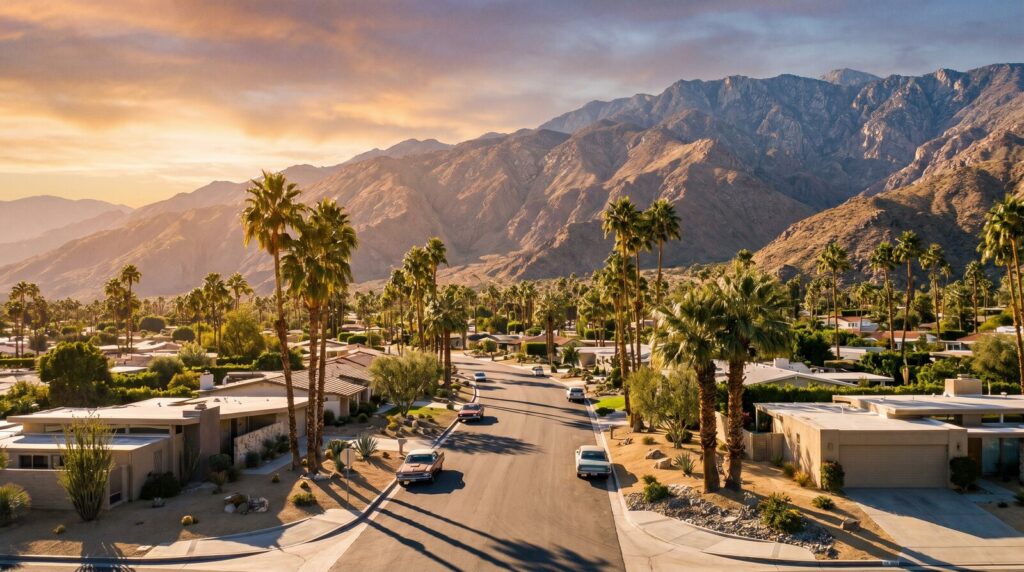
Palm Springs, California: Desert Glamour, Midcentury Masterpieces & Mountain Trams

📍 In This Guide
- ☀️ When to Visit Palm Springs
- 🚡 The Aerial Tramway
- 🏠 Midcentury Modern Architecture
- 🛍️ Palm Canyon Drive & Downtown
- 🌵 Desert Hikes & Indian Canyons
- 🏊 Spa Culture & Pool Life
- 🌄 Day Trip: Joshua Tree National Park
- 🍽️ Food Scene & Nightlife
☀️ When to Visit Palm Springs
Palm Springs operates on a reverse tourism calendar. October through May is prime time — temperatures sit between 18°C and 30°C (65–86°F), evenings cool dramatically, and the desert air carries a clean mineral freshness. January through March sees the snowbirds arrive, the resort pools fill up, and the restaurant scene hit peak form. Spring weekends book out months in advance, especially during the Coachella and Stagecoach festival windows in April.
Summer is a different story. June through September routinely hits 42–47°C (108–117°F), and midday outdoor activity becomes genuinely dangerous. Savvy budget travelers use this window — rates drop by 40–60%, and you get the city largely to yourself. Early morning hikes and late-night pool sessions become your rhythm. Avoid summer unless you know exactly what you’re signing up for.
🚡 The Palm Springs Aerial Tramway
Few single experiences in California compress as much landscape change into 10 minutes as the Palm Springs Aerial Tramway. You board at Valley Station (488m) in the Sonoran Desert heat, step into the world’s largest rotating tram car, and ascend 1,760 vertical meters up the sheer granite faces of Chino Canyon. At the top, Mount San Jacinto State Park sits in full alpine pine forest — often 25°C cooler than the desert below.
The summit station at 2,596m opens onto 56 miles of hiking trails through genuine wilderness. Day hikes range from the gentle 2-mile Round Valley loop to the grueling 11-mile summit push to San Jacinto Peak, the third most prominent peak in the contiguous United States. In winter, there’s often snow at the top while it’s 35°C at the base station.
The tram runs year-round with cars departing every 30 minutes from 10am weekdays and 8am weekends. The Peaks Restaurant at the summit serves surprisingly good food with panoramic views that make the $30 ticket feel entirely justified.
🏠 Midcentury Modern Architecture
No city in the world has preserved Midcentury Modern residential architecture as completely as Palm Springs. Between the 1940s and 1970s, architects including Richard Neutra, Albert Frey, William Cody, Donald Wexler, and E. Stewart Williams built here with the freedom that comes from a client base of wealthy Hollywood figures who wanted experimentation, not convention. The result is an open-air museum you can drive through in a single afternoon.
The Alexander Construction Company built over 2,000 tract homes in the late 1950s and early 1960s — the butterfly and gabled rooflines of the “Alexander homes” are among the most photographed residential architecture in America. The Kaufmann Desert House (1946, Neutra) remains privately occupied but visible from the street.
Modernism Week, held each February, draws architecture enthusiasts worldwide for tours of private homes normally closed to the public. The Palm Springs Art Museum’s Architecture and Design Center hosts excellent rotating exhibitions on desert modernism year-round.
🛍️ Palm Canyon Drive & Downtown
Palm Canyon Drive runs north to south through the heart of Palm Springs and functions as the city’s social spine. The stretch between Alejo and Ramon Roads concentrates galleries, boutiques, cafés, and restaurants in a walkable two-mile corridor that’s genuinely pleasant in the cooler months. The architecture along this strip earns its own attention — several buildings retain their original 1950s commercial modern facades.
The Palm Springs Art Museum anchors the north end of downtown with an impressive permanent collection featuring works by Henry Moore, Alexander Calder, and strong representation of Native American art from the Agua Caliente Band of Cahuilla Indians, whose ancestral land this fundamentally is. Admission is free on Thursday evenings.
The weekly VillageFest (Thursday evenings October–May) closes several blocks of Palm Canyon Drive for a farmers market, crafts vendors, and street performers — the best free evening in Palm Springs.
🌵 Desert Hikes & Indian Canyons
The Agua Caliente Band of Cahuilla Indians has maintained stewardship of the Indian Canyons — Palm Canyon, Andreas Canyon, and Murray Canyon — for thousands of years, today managing them as one of the most accessible desert wilderness areas in Southern California. Entering from South Palm Canyon Drive, you’re 10 minutes from downtown and surrounded by 3,000-year-old California fan palms growing in dense groves along year-round streams.
Palm Canyon Trail winds 15 miles through the world’s largest natural fan palm oasis. Day hikers typically walk the first 3 miles to the palm grove core and back. Andreas Canyon offers a shorter, more dramatic slot canyon experience. Bring 2–3 liters of water per person regardless of season, and start before 9am to avoid midday heat.
Tahquitz Canyon, managed separately by the tribe, requires a permit and features a 60-foot waterfall accessible via a moderate 1.8-mile loop — a rare peaceful hike this close to a resort city.
🏊 Spa Culture & Pool Life
Palm Springs earned its retreat reputation partly through natural geothermal hot springs — the same mineral-rich waters that gave the city its name. The Spa Resort Casino, built on the original hot springs site downtown, offers mineral pool soaks and spa treatments accessible to non-hotel guests. Sitting in geothermally heated mineral water while the San Jacinto Mountains turn pink at sunset is as good as California gets.
Hotels here compete on pool architecture and ambience. The Saguaro’s neon-bright pool, the Ace Hotel’s communal party atmosphere, Two Bunch Palms’ clothing-optional grotto pools in Desert Hot Springs (20 min north) each attract very different clientele. Many resorts offer day passes, making premium pool access possible on any budget.
🌄 Day Trip: Joshua Tree National Park
Joshua Tree sits 45 minutes east of Palm Springs and delivers an entirely different desert experience — rawer, quieter, and astronomically extraordinary at night. The park straddles two ecosystems: the Mojave (above 3,000 ft, where the Joshua trees grow) and the lower Colorado Desert. Most visitors enter via the West Entrance and spend the day among iconic boulder formations and twisted tree silhouettes.
Skull Rock Nature Trail (1.7 miles), Hidden Valley (1-mile loop), and Barker Dam Trail (1.4 miles) cover the best of the boulder landscape without technical hiking. Over 8,000 established rock climbing routes draw climbers year-round.
Dark sky certification makes Joshua Tree one of Southern California’s premier stargazing locations. Stay until after sunset — the Milky Way is clearly visible on moonless nights, and the contrast between skeletal trees and the starfield is genuinely unforgettable.
🍽️ Food Scene & Nightlife
Workshop Kitchen + Bar in a converted 1920s bank building sets a high standard for elevated California cuisine — open kitchen, beautiful materials, serious cocktails. Cheeky’s serves the best breakfast in the desert, with rotating menus built around seasonal local ingredients and a bacon flight that has achieved local legendary status. Come for the 9am opening or queue.
The LGBTQ+ community has shaped Palm Springs culture for decades, making it one of the most welcoming resort cities in the United States. The Arenas Road strip concentrates bars, clubs, and restaurants with a warm, inclusive energy that extends across the whole city. The Saturday morning Certified Farmers Market (October–May) brings locally grown Medjool dates and valley citrus worth buying in bulk.
The Desert Rewards the Patient
Palm Springs works best when you resist the urge to over-schedule. A morning tram ride, an afternoon in a resort pool, a slow dinner on a patio as the mountains cool to purple — that’s the rhythm the city was designed for. The desert will give you exactly what you came for.
❓ Frequently Asked Questions
What is the best time to visit Palm Springs?
The best time to visit Palm Springs is from November through April, when daytime temperatures hover between 70–85°F (21–29°C). Summer temperatures regularly exceed 110°F (43°C), though hotel rates drop significantly and many resorts offer deep discounts.
How far is Palm Springs from Los Angeles?
Palm Springs is about 107 miles (172 km) east of Los Angeles, roughly a two-hour drive via Interstate 10. The closest airport is Palm Springs International (PSP), which receives direct flights from many major U.S. cities.
Is Palm Springs good for families?
Yes, Palm Springs is family-friendly with attractions like the Palm Springs Aerial Tramway, the Living Desert Zoo and Gardens, and numerous hiking trails in Indian Canyons suitable for children. Many resorts also offer kids’ programs and shallow pool areas.
Do you need a car in Palm Springs?
A car is recommended for getting around Palm Springs and visiting nearby attractions like Joshua Tree National Park. However, downtown Palm Canyon Drive is walkable, and the free Buzz trolley runs along the main strip during peak season.