
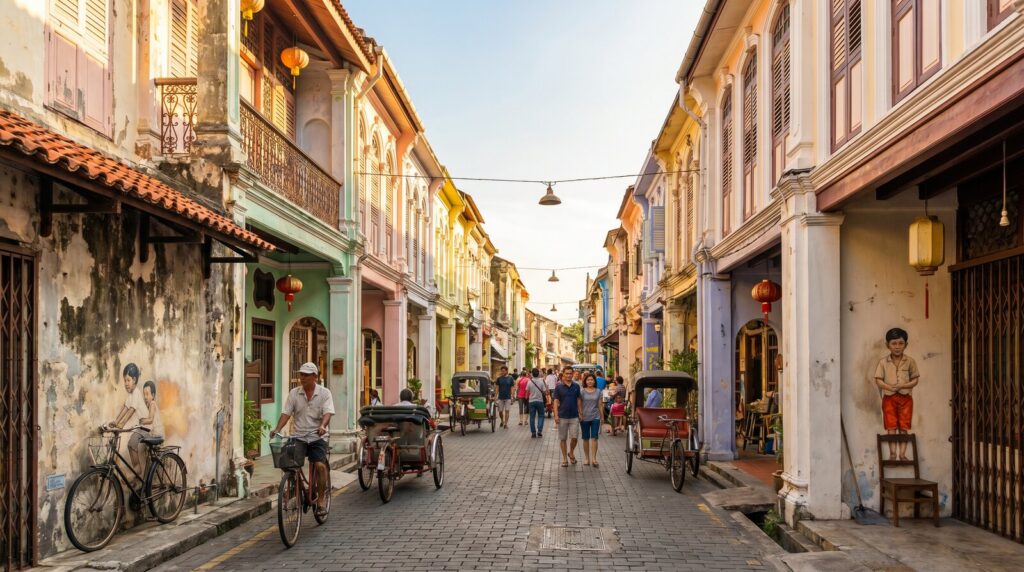
Penang, Malaysia: Georgetown Street Art, Food & Colonial Architecture
Malaysia’s island jewel where colonial architecture meets street art and legendary food traditions
Penang stands as one of Southeast Asia’s most underrated destinations, a Malaysian island where colonial heritage architecture, contemporary street art, multicultural communities, and legendary hawker food traditions combine into distinctive urban experience. The island’s history as a British colonial trading post created urban patterns and institutions that persist today, while contemporary artistic movements and food culture have transformed it into cultural destination drawing travelers seeking authentic experiences beyond resort tourism.

Georgetown, Penang’s capital, represents remarkable preservation of nineteenth and early twentieth-century colonial architecture combined with authentic street-level urban life. Unlike heritage districts in other Asian cities that often feel sanitized or commercialized, Georgetown maintains genuine community function—residents live in heritage buildings, small shops and workshops occupy ground floors, and daily life continues amid architectural splendor. The UNESCO World Heritage designation reflects this authenticity—Georgetown merited recognition not as museum but as living city preserving heritage while functioning as contemporary urban center.
Table of Contents
Colonial Heritage & Georgetown’s Architecture
Georgetown’s colonial quarter preserves architectural heritage spanning centuries, with structures ranging from Fort Cornwallis (the original British military installation) through nineteenth-century shophouses to early twentieth-century government buildings. Walking through Georgetown’s streets reveals layers of historical development, with construction techniques, materials, and design principles showing how architecture adapted to tropical environments while maintaining British aesthetic traditions.
Shophouses—a distinctive Southeast Asian architectural form combining residential spaces above commercial ground floors—dominate Georgetown’s streetscape. These narrow buildings, typically three to four stories tall, represent efficient use of expensive urban land while creating distinctive urban fabric. The ground floors open directly to streets, creating permeable boundaries between commercial activity and public space. Residents literally live above their businesses, maintaining personal investment in neighborhood conditions and commercial success. This integration of living and commerce creates vitality and community connection unavailable when residential and commercial zones separate.
The Clan Houses (Kongsi) represent remarkable architectural and cultural achievements, with Chinese immigrant communities establishing meeting spaces and commercial centers adorned with elaborate decoration reflecting clan history, mythology, and prosperity. The Khoo Kongsi features interior courtyards, hand-carved wooden screens, painted ceiling panels, and intricate architectural details demonstrating extraordinary craftsmanship. These spaces served practical community functions while expressing identity and cultural continuity for diaspora populations.
Fort Cornwallis, the original military fortification establishing British control, preserves much of its original structure though now functioning as park and museum rather than military installation. Walking the perimeter walls, observing cannons positioned to control sea approaches, examining interior structures reveals how colonial powers established control through military infrastructure. The fort’s location, dominating the harbor, made it essential for controlling maritime trade.
St. George’s Church, the oldest Anglican Church in Southeast Asia, combines English ecclesiastical architecture with tropical modifications. The interior design, scale, and decoration reflect British social hierarchy and cultural values expressed through religious architecture. Visiting during services allows observing how heritage buildings function in contemporary community life rather than merely as tourist attractions.
Street Art: Georgetown’s Modern Canvas
Georgetown’s transformation into street art destination began with Ernest Zacharevic’s murals around 2008, which sparked international attention and inspired subsequent artists to create works throughout the city. Rather than covering heritage buildings, most street art appears on simple walls or shophouse sides, creating contemporary visual layer complementing rather than competing with colonial architecture. The street art movement has made Georgetown photographer’s paradise while creating economic stimulus as visitors specifically seek mural locations.
The famous “Children on a Swing” mural combines stencil art with environmental interaction—the painted children appear to swing on actual ropes attached to walls, creating three-dimensional illusion. This approach influenced subsequent artists who developed sophisticated techniques combining painted elements with environmental interaction. The style—whimsical, playful, technically sophisticated—created signature Georgetown street art aesthetic distinct from graffiti art in other cities.
Finding Georgetown’s street art has become part of the tourist experience, with visitors photographing famous murals, creating Instagram locations documented by thousands. While this popularity raises concerns about commodification and commercialization of what began as grassroots artistic expression, it simultaneously provides income opportunities for artists and creates incentive for community acceptance and protection of murals. The balance between artistic authenticity and commercial development remains ongoing tension.
Contemporary street artists continue creating new works throughout Georgetown, with established pieces alongside newer creations forming constantly-evolving gallery. Walking streets without predetermined itinerary, discovering murals organically, provides more authentic engagement than following documented mural maps, though maps assist locating significant works. The creative energy feels genuine—artists remain engaged, communities increasingly recognize street art’s cultural value, and visitor interest provides economic motivation for continued artistic development.
Local artists’ studios scattered throughout Georgetown provide opportunities to observe artistic process and purchase directly from creators. These studios, often hidden in shophouses or upstairs spaces, maintain authentic character while welcoming visitors interested in contemporary Malaysian art. Supporting artists directly provides economic benefit beyond gallery middlemen while creating personal connections with creative communities.
Penang’s street art extends beyond Georgetown to surrounding communities, with secondary towns and villages developing local artistic traditions. These areas, less touristed, maintain grassroots character with art serving genuine community expression rather than tourist entertainment. Traveling beyond Georgetown reveals how artistic movements spread and localize, with regional variations reflecting distinct communities and themes.
Hawker Food & Culinary Excellence
Penang achieved international culinary recognition almost entirely through its hawker food tradition—inexpensive street food created by specialized vendors who perfected singular dishes through decades or lifetimes of practice. Unlike fancy restaurants or elaborate dishes, hawker food emphasizes simplicity, quality ingredients, and technical excellence in preparation. The combination creates meals extraordinary for their flavor intensity and value, attracting serious food travelers to Penang specifically for culinary experiences.
The hawker center—a collective space housing dozens of food stalls where customers order from various vendors and share communal seating—represents the primary hawker experience. Georgetown’s Kimberly Street Market and Air Itam Hawker Center contain legendary stalls operated by individuals perfecting specific dishes. A single hawker might make only one or two items—assam laksa, nasi kuning, cendol—practiced across decades to near-perfection. Customers demonstrate loyalty to individual stalls rather than entire centers, returning repeatedly for the same hawker’s expertise.
Assam Laksa, a soup dish combining spiced broth with rice noodles and fish, represents Penang’s signature hawker creation. The complexity of the broth—layered spice flavors, fish essence, tartness from tamarind—develops through hours of simmering, though preparation appears simple. The noodles, served soft and delicate, absorb broth while maintaining their texture. Top hawkers prepare assam laksa with such expertise that variations in ingredient sourcing or technique become immediately noticeable, creating reputations spanning decades.
Nasi Kandar, a rice dish topped with curried meats or vegetables and accompanied by various side dishes, represents Tamil Indian hawker tradition. The dish’s versatility—customers selecting desired proteins and curry combinations—allows customization while maintaining preparation quality. Quality nasi kandar restaurants maintain fragrant broths and properly spiced meat preparations requiring technical expertise rivaling elaborate restaurant cuisine.
Char Kway Teow, flat rice noodles stir-fried with soy sauce, meat, and vegetables, requires extreme heat and spatial awareness to achieve proper texture—the noodles should remain slightly chewy while acquiring flavorful char marks. The theatrical nature of kway teow preparation—the vigorous wok-tossing, the controlled flame, the rapid transformation—attracts spectators appreciating the technical mastery involved.
Contemporary Penang sees younger chefs opening modern restaurants celebrating hawker traditions while experimenting with innovations. These establishments maintain affordable pricing while offering cleaner environments and contemporary aesthetics than traditional hawker centers. The tension between authenticity and modernization reflects broader questions about how traditions evolve while maintaining essential character.
Food tours led by local guides provide contextualized hawker experiences, with guides explaining preparation methods, cultural significance, and historical development of dishes. The guides often possess personal connections to specific hawkers, allowing access to preparation areas and behind-the-scenes understanding unavailable to independent visitors. These curated experiences cost more than DIY hawker exploration but provide deeper cultural engagement.
Multicultural Heritage & Living Communities
Penang’s distinctive character derives from coexistence of Chinese, Malay, and Indian communities, each maintaining cultural traditions while interacting through daily life, commerce, and cultural exchange. Rather than segregation, the communities integrate through shared commercial spaces, neighborhood proximity, and interethnic friendship and marriage. Understanding Penang requires appreciating how distinct cultural traditions coexist and merge while maintaining individual identity.
Georgetown’s temples, mosques, and churches operate simultaneously within walking distance, reflecting this religious and cultural diversity. The Kuan Yin Temple (Buddhist), the Acheen Street Mosque (Islamic), and St. George’s Church (Christian) serve their respective communities while functioning as heritage sites attracting visitors. The mosque features remarkable architecture including hand-carved wooden doors and calligraphic decoration. The proximity of diverse religious spaces reflects Penang’s multicultural reality—different traditions coexisting peacefully through centuries.
The Chinese clans—Hokkien, Teochew, Cantonese, Hakka communities—established distinct areas throughout Georgetown, each with clan associations, temples, and commercial concentration. Walking these neighborhoods reveals how immigrant communities organized themselves, maintained cultural traditions, and gradually integrated into broader society while preserving distinct identity. The clan houses remain active community centers, hosting celebrations, managing community affairs, and preserving historical memory.
Thaipusam Festival, celebrated by Hindu Tamil communities, features public processions and temple activities that demonstrate religious practice and community identity within multicultural context. Watching devout Hindus carrying decorated wooden frames pierced with metal skewers (kavadi), enduring pain while maintaining spiritual focus, reveals faith intensity and commitment to religious tradition. These public religious expressions remain accepted and respected by non-Hindu communities, reflecting multicultural coexistence.
Chinese New Year celebrations, Hari Raya (Islamic festivals), and Hindu Deepavali festivals all occur within Penang’s calendar, creating regular celebrations reflecting various community traditions. Residents of different backgrounds often participate in each others’ celebrations, attending festivals, sharing special foods, and reinforcing intercommunal bonds. This participatory multiculturalism differs from abstract diversity recognition—it’s lived practice occurring daily.
Penang’s contemporary character reflects these historical multicultural foundations. Young Penangites often possess fluency in multiple languages, comfort navigating different cultural contexts, and friendships spanning ethnic boundaries. This multicultural ease, developed through living alongside diverse communities, distinguishes Penang residents and makes the state distinctive within Malaysia.
Planning Your Penang Visit
Penang’s tourism infrastructure has expanded significantly, with improved accommodations, restaurants, and transportation supporting visitors. Planning involves understanding entry logistics, seasonal considerations, accommodation options, and practical details enabling smooth experiences.
Penang International Airport receives flights from Kuala Lumpur, Bangkok, Singapore, and increasing direct international routes. The airport lies approximately twenty kilometers from Georgetown, with buses, taxis, and ride-sharing apps providing accessible transportation. Alternatively, buses and trains connect Penang to other Malaysian cities through causeways and rail connections.
Georgetown remains the primary tourist destination, with abundant accommodations ranging from luxury hotels to budget hostels. The heritage district offers the best tourism experience, though accommodations there cost more than areas outside heritage zones. Mid-range hotels provide good value and comfortable conditions within heritage district. Budget options exist but may sacrifice location or comfort for expense savings.
The best seasons extend from October through April, when temperatures moderate and rainfall decreases. May through September brings monsoon conditions with occasional heavy rains, though these months see fewer tourists and lower prices. Penang remains tropical year-round, requiring acceptance of heat and humidity regardless of season.
Transportation within Penang includes buses (inexpensive, somewhat unreliable), taxis (negotiate fares or use apps), and ride-sharing services. Walking remains feasible for Georgetown exploration, particularly the heritage district. Renting motorcycles provides flexibility for exploring less touristy areas, though traffic requires comfort and attentiveness.
Currency is the Malaysian Ringgit, with ATMs widely available throughout Georgetown and major areas. Credit card acceptance has improved significantly, though cash remains necessary for many establishments. Exchange rates favor most Western currencies, making Penang relatively inexpensive. Hawker meals often cost under five dollars; mid-range restaurants serve excellent food at reasonable prices.
Communication functions well throughout Penang, with mobile phone coverage excellent and WiFi available in hotels and restaurants. The internet connectivity allows maintaining contact while exploring and serves as resource for discovering lesser-known attractions and restaurants.
Penang’s multicultural population means English proficiency varies—better in tourism areas, more limited in residential neighborhoods. Learning basic Malay phrases facilitates interactions and demonstrates respect. Respecting multicultural contexts requires awareness that Penang’s religious and cultural diversity merits respectful behavior in all contexts.
Discover Penang’s Creative Soul
Penang invites you to walk heritage streets filled with street art, experience legendary hawker food in bustling markets, encounter multicultural communities maintaining traditions while embracing coexistence, and discover why this island captivates travelers seeking authentic Southeast Asian experiences.
Plan your Penang journey today and explore Malaysia’s most culturally rich and artistically vibrant destination.
2026 Travel Update for Penang
Penang continues to shine as Southeast Asia’s food and culture capital in 2026. Georgetown’s UNESCO World Heritage zone has seen careful preservation with new street art installations joining the famous wire sculptures that put the neighborhood on the global art map. The Penang Hill funicular railway has completed its modernization, offering faster rides and panoramic views from the expanded summit complex. New direct flights from several international cities have boosted accessibility, and the island’s hawker food culture—recognized by UNESCO—has inspired a new generation of young chefs blending traditional recipes with modern techniques. The Butterworth-Penang rail link provides seamless connections from mainland Malaysia.
Frequently Asked Questions About Penang
What is the best time to visit Penang?
Penang can be visited year-round, but the driest period is from December to March, making it the most popular tourist season. Temperatures remain consistent throughout the year at 27–33°C. The wettest months are September and October, with afternoon thunderstorms that typically clear quickly. Chinese New Year (January/February) and the George Town Festival (various months) are exciting times to visit but accommodation should be booked well in advance.
What food must I try in Penang?
Penang is consistently ranked among the world’s best food destinations. Must-try dishes include char kway teow (stir-fried flat noodles), assam laksa (tangy fish soup with noodles), nasi kandar (rice with various curries), Hokkien mee (prawn noodle soup), and cendol (shaved ice dessert with palm sugar). The best food is found at hawker centers like Gurney Drive, New Lane, and Kimberley Street. Street food meals typically cost RM 5–15 ($1–3.50).
How many days should I spend in Penang?
Three to four days is ideal for most visitors. This allows time to explore Georgetown’s street art, temples, and clan jetties on day one; visit Penang Hill and Kek Lok Si Temple on day two; enjoy the beaches at Batu Ferringhi or the national park on day three; and dedicate a final day to a food crawl and shopping. Foodies and history buffs could easily fill a full week exploring the island’s diverse offerings.
Is Penang good for digital nomads?
Penang has become one of Asia’s top digital nomad destinations. Fast, reliable internet is widely available, and numerous co-working spaces have opened across Georgetown. The cost of living is very affordable—a comfortable monthly budget of $800–1,200 covers accommodation, food, and entertainment. Malaysia offers a Digital Nomad visa (DE Rantau) for remote workers, making longer stays straightforward. The multicultural environment and English-speaking population add to the appeal.
How do I get around Penang?
Georgetown’s compact center is best explored on foot or by bicycle, with rental bikes available for around RM 15–30 per day. The free CAT bus loops through the heritage zone. For longer distances, Grab is the most convenient and affordable option. Renting a scooter (RM 30–50 per day) gives freedom to explore the whole island, including the quieter southern beaches and durian orchards. The Penang ferry connects Georgetown to Butterworth on the mainland.