
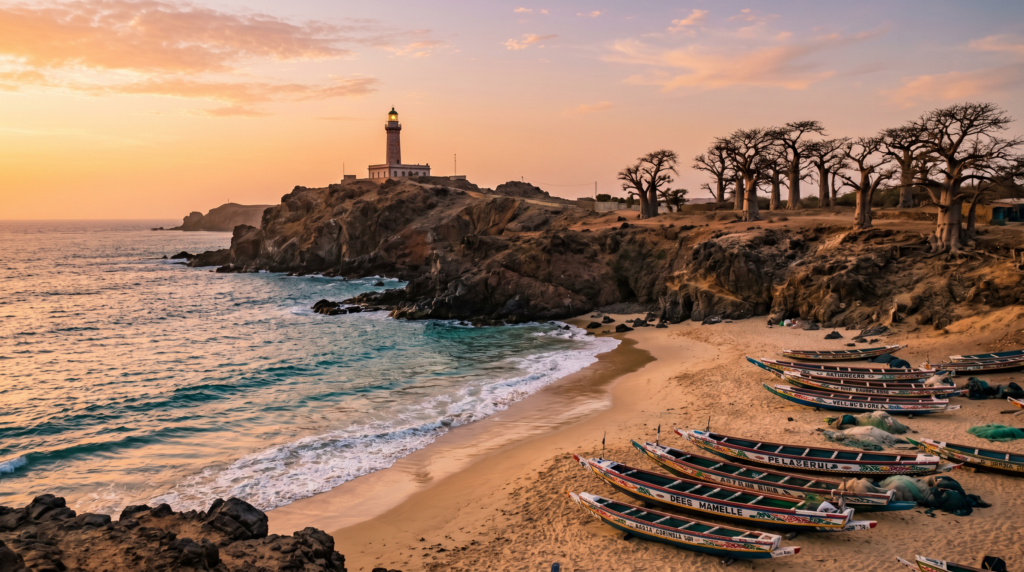
Senegal Travel Guide — Dakar’s Rhythms, Gorée Island & the Spirit of Teranga
Senegal is West Africa’s most accessible and welcoming introduction to the region: a stable, vibrant democracy where the music never stops, the food is among the continent’s best, and the famous Senegalese teranga (hospitality) greets every visitor. From the energy of Dakar and the heartbreak and history of Gorée Island to faded colonial Saint-Louis, the bird-filled Sine-Saloum delta and the lush beaches of Casamance, it rewards curious travellers with culture, nature and a genuinely warm welcome.
📋 In This Guide
- Overview — West Africa, made welcoming
- Dakar, Gorée & the spirit of teranga
- Best time to visit (season by season)
- Getting there & entry
- Getting around
- Where to go — Dakar, Saint-Louis, Sine-Saloum & Casamance
- Culture & people — music, faith & teranga
- A food lover’s guide to Senegal
- Off the beaten path
- Practical information
- Budget breakdown — what Senegal costs in 2026
- Planning your first trip
- Frequently asked questions
Overview — West Africa, Made Welcoming
Jutting into the Atlantic at the westernmost point of mainland Africa, Senegal is the region’s easiest first step: politically stable, peaceful and used to visitors, with a creative capital and a coastline of beaches, deltas and historic towns. Dakar is a fast, music-filled metropolis; just offshore, tiny Gorée Island holds one of the most moving memorials of the transatlantic slave trade.
Beyond the capital, the country opens into the crumbling colonial elegance of Saint-Louis, the mangroves and birdlife of the Sine-Saloum Delta, the wildlife of the reserves, and the lush, distinctive south of the Casamance. Through it all runs teranga — the deep Senegalese ethic of hospitality — which more than anything is what travellers remember.
Dakar, Gorée & the Spirit of Teranga
Two experiences define a Senegal trip. The first is Dakar itself: a city that pulses with mbalax music (this is Youssou N’Dour’s home), bustling markets, the giant African Renaissance Monument and a creative energy unmatched in the region. The second is the short ferry to Gorée Island, a car-free, pastel-coloured UNESCO site whose House of Slaves and “Door of No Return” make it a place of pilgrimage and reflection. Bracketing both is teranga: expect to be invited to share tea, food and conversation, and to leave with a sense of welcome few destinations match.
Best Time to Visit Senegal (Season by Season)
November–February — Cool dry season (best)
The most comfortable months: warm, dry days and cooler nights, ideal for Dakar, the historic towns and birdwatching in the deltas. November also brings the Great Carnival of Dakar.
March–May — Hot dry season
Still dry but increasingly hot, especially inland; fine for the coast and culture if you don’t mind the heat, with thinner crowds.
July–October — Rainy season
Hot and humid with heavy downpours, greenest in the south; some roads and the Casamance can be harder going, but prices are lower and birdlife abundant.
Getting There & Entry
Blaise Diagne International Airport (DSS), about an hour from Dakar, is the main gateway, with nonstop flights from the US (New York), Europe (Paris, Brussels, Madrid, Istanbul) and across Africa — one of West Africa’s best-connected hubs.
- Visa: US citizens don’t need a visa for stays of up to 90 days; bring a passport valid six months and proof of accommodation and funds.
- Yellow fever: a yellow fever vaccination certificate is required — get vaccinated at least 10 days before arrival.
- From the airport: arrange a hotel transfer or official taxi for the roughly one-hour drive into Dakar.
Getting Around
- Taxis: plentiful in Dakar — agree the fare before you set off, as meters are rare; ride apps also operate.
- Sept-places: shared seven-seat Peugeot taxis are the classic way to travel between towns cheaply.
- Ferries & flights: the Gorée ferry runs frequently from Dakar; domestic flights and good roads link Saint-Louis and the south.
- Hired driver: the most comfortable option for the Sine-Saloum, Saint-Louis or Casamance, especially for first-timers.
Where to Go — Dakar, Saint-Louis, Sine-Saloum & Casamance
Dakar & Gorée Island
The energetic capital — markets, music, the African Renaissance Monument and the Museum of Black Civilisations — plus the short, essential ferry to historic Gorée Island.
Saint-Louis
The UNESCO-listed former colonial capital on an island in the Senegal River, with faded pastel architecture, a famous jazz festival and the bird-rich Langue de Barbarie nearby.
The Sine-Saloum Delta
A UNESCO maze of mangroves, lagoons and shell islands — superb for pirogue trips, birdwatching and quiet eco-lodges, plus the nearby Bandia wildlife reserve.
The Casamance
The lush, green south beyond The Gambia, with palm-fringed beaches, distinct Diola culture and a slower pace — long Senegal’s loveliest, least-visited corner.
Culture & People — Music, Faith & Teranga
Senegal is a cultural powerhouse: the birthplace of mbalax, a global force in music and fashion, and home to a proud literary tradition (its first president, Léopold Sédar Senghor, was a renowned poet). Society is overwhelmingly Muslim, shaped by Sufi brotherhoods centred on holy cities like Touba, yet famously tolerant and easy-going, with Christian and traditional communities woven in.
The national sport is laamb (traditional wrestling), drawing huge, festive crowds. French is the official language and Wolof the lingua franca, and daily life is sociable, generous and unhurried — the embodiment of teranga. A respectful, curious traveller, ready to share a glass of strong mint tea, is met with real warmth.
A Food Lover’s Guide to Senegal
- Thieboudienne — the national dish: fish, broken rice and vegetables in a rich tomato sauce, considered one of West Africa’s great meals.
- Yassa — chicken or fish marinated in a tangy onion-and-lime sauce, a national favourite.
- Mafé — a hearty groundnut (peanut) stew with meat and vegetables over rice.
- Attéké, fresh fish & ataya — grilled seafood off the Atlantic, and the social ritual of ataya, sweet mint tea poured in three rounds.
Off the Beaten Path
- Djoudj National Bird Sanctuary — near Saint-Louis, one of the world’s great bird reserves, alive with flamingos and pelicans (best Nov–Apr).
- Lac Rose (Lake Retba) — the salt lake near Dakar, historically pink and dotted with salt-harvesters and their pirogues.
- The Casamance villages — Cap Skirring’s beaches and the traditional Diola country of the deep south.
- Touba — the vast holy city and Great Mosque at the heart of the Mouride brotherhood (dress and behave respectfully).
- Sine-Saloum eco-lodges — sunrise pirogue trips through the mangroves to shell islands and bird colonies.
Practical Information
- Money: the West African CFA franc (XOF) is fixed to the euro (~600 to the US dollar). It’s largely cash-based — ATMs work in Dakar but are scarcer elsewhere, so carry cash for the regions.
- Health: a yellow fever certificate is required; take malaria precautions and use repellent; drink bottled or filtered water.
- Safety: the U.S. advisory is Level 1 (exercise normal precautions); the main risk is petty theft in busy areas — keep valuables discreet and use registered taxis at night.
- Power: 230V, European two-pin plugs — US travellers need an adapter.
- Language: French goes a long way; a few words of Wolof (“nanga def”) earn big smiles.
- Etiquette: dress modestly at religious sites, and always greet people — greetings matter here.
Budget Breakdown — What Senegal Costs in 2026
Senegal is affordable, especially outside the smartest Dakar hotels. Rough per-person, per-day estimates in USD:
| Style | Accommodation | Food | Total / day |
|---|---|---|---|
| Budget | $15–35 guesthouse | $8–15 (local) | $30–50 |
| Mid-range | $45–90 hotel | $20–35 | $70–120 |
| Comfort | $120–250+ | $40–70 | $180–300+ |
The Gorée ferry costs about $8–11 round trip, street and market food is cheap and delicious, and shared sept-places keep regional travel inexpensive. Dakar’s top hotels are where costs climb.
Planning Your First Trip
A great first week pairs Dakar and Gorée Island (two or three days of music, markets and history) with Saint-Louis and the Sine-Saloum Delta for colonial charm, birdlife and mangroves — or head to the Casamance for beaches and a slower pace with more time. Travel in the cool dry season (November–February), sort your yellow fever certificate early, carry CFA cash for the regions, and lean into the teranga — the invitations are the highlight.
Frequently Asked Questions
Do US citizens need a visa for Senegal?
No visa is required for stays of up to 90 days. You need a passport valid for at least six months, a yellow fever vaccination certificate, and proof of accommodation and funds.
Is Senegal safe to visit?
Yes — it’s a stable, peaceful country rated Level 1 (exercise normal precautions) by the U.S. The main concern is petty theft in busy areas; keep valuables discreet and use registered taxis at night.
When is the best time to visit?
November to February for the coolest, driest weather and the best birdwatching; the July–October rains are hot and humid, greenest in the south.
Is Gorée Island worth visiting?
Yes — the short ferry from Dakar reaches a car-free, beautiful and deeply moving UNESCO site at the heart of slave-trade history; allow at least half a day.
What language do they speak?
French is official and Wolof is the everyday lingua franca; English is limited, so basic French (and a few Wolof greetings) helps enormously.
Ready to Explore Senegal?
Dakar’s rhythms, Gorée’s history and the warmest welcome in West Africa — Senegal is the region’s most rewarding first trip. Tell us your dates and travel style and we’ll help you plan it. Plan your trip →
Explore More
How This Guide Was Built
Researched and written by the Facts From Upstairs team, last updated . Prices, visa rules and health requirements change — always confirm current details with official sources before you travel.
More country guides you might like
Plan your trip to Senegal
The booking tools we use ourselves. FFU may earn a commission at no extra cost to you.
Plan & book your trip to Senegal
Booking through these searches supports our guides at no extra cost to you.