
Languages of Armenia
All languages of Western Asia →fluent beta classical · classes by phone with Maya at ranas.ai/maya
Armenia Travel Guide — Ancient Monasteries, Mountain Villages & the World’s Oldest Wine Country
Armenia is the country that keeps rewriting your assumptions about the Caucasus. It was the first nation on Earth to adopt Christianity as a state religion, in 301 AD, decades before Rome got there. Its capital, Yerevan, was founded in 782 BC, which makes it older than Rome itself. And in a cave above a wine village called Areni, archaeologists found a working winery dated to roughly 4100–4000 BC — the oldest ever discovered. I keep coming back because this is a small, landlocked country that somehow contains an entire continent’s worth of history: pagan temples, rock-cut monasteries, a genocide memorial that will stop you cold, and villagers who will pour you a glass of homemade mulberry vodka before you’ve even said hello. It is also, still, a country shaped by an unresolved conflict with its neighbor Azerbaijan — that’s the honest part of this guide, and I won’t bury it.
In This Guide
- Overview — Why Armenia Rewards a Longer Look
- Vardavar — Armenia’s Nationwide Water Fight
- Best Time to Visit Armenia (Season by Season)
- Getting There — Zvartnots, Closed Borders & Overland Routes
- Getting Around — Marshrutkas, Ride-Hailing & Mountain Roads
- Top Regions — Yerevan, Sevan, Syunik & the Wine Country
- Culture & People — Faith, Alphabet & Memory
- A Food Lover’s Guide to Armenia
- Off the Beaten Path
- Practical Information
- Budget Breakdown — What Armenia Actually Costs in 2026
- Frequently Asked Questions
Overview — Why Armenia Rewards a Longer Look
Armenia is a landlocked republic tucked into the South Caucasus, bordered by Georgia to the north, Azerbaijan to the east, Iran to the south, and Turkey to the west. Two of those four borders — Turkey and Azerbaijan — have been closed for decades, a legacy of the Armenian Genocide of 1915 and the ongoing conflict with Azerbaijan over Nagorno-Karabakh. That history isn’t background trivia here; it shapes where you can drive, which roads show up empty on maps, and why every Armenian you meet seems to carry the national story close to the surface.
None of that should scare you off. What it means practically is that Armenia is compact, uncrowded, and startlingly cheap for what you get: rock-cut monasteries older than most European cathedrals, a national alphabet invented specifically to translate the Bible in 405 AD, and a landscape that swings from the volcanic Ararat plain to the alpine shores of Lake Sevan, the largest lake in the Caucasus at roughly 1,242 square kilometers, sitting at nearly 1,900 meters above sea level.
Armenia holds three UNESCO World Heritage Sites — the monasteries of Haghpat and Sanahin, the Cathedral and Churches of Echmiatsin with the archaeological site of Zvartnots, and the Monastery of Geghard with the Upper Azat Valley — and dozens more monastery complexes that never made the list simply because there are too many to inscribe. This is a country built for slow road trips: two, maybe three hours between any two major sites, monastery bells instead of tour buses, and a wine region that was making vintages while Stonehenge was still being planned.
Vardavar — Armenia’s Nationwide Water Fight
If you’re reading this in early-to-mid July, time it around Vardavar, which lands on 12 July 2026. It’s a pre-Christian festival honoring Astghik, the goddess of water, love and fertility, that survived the country’s conversion by quietly attaching itself to a summer feast day — and today it plays out as a nationwide, all-ages water fight. Buckets get poured from balconies onto unsuspecting pedestrians, kids ambush strangers with water guns, and nobody is exempt, tourists included.
The unwritten rule: if you get soaked, you’re being welcomed, not targeted, so wear clothes you don’t mind ruining and keep your phone in a dry bag. Yerevan’s Republic Square and the pedestrian streets around the Cascade get the rowdiest crowds; Dilijan and Lake Sevan towns run a gentler, more family-oriented version. It is, hands down, the most fun way to experience Armenian hospitality with zero language required.
Best Time to Visit Armenia (Season by Season)
Late April – June · Spring
Wildflowers across the Ararat plain, comfortable daytime temperatures, and Vardavar closing out the season in July. This is when Armenia looks its most photogenic and hasn’t yet hit peak summer heat.
July – August · Summer
Yerevan’s continental climate means genuinely hot, dry days — often into the low-to-mid 30s°C — while Lake Sevan, Dilijan and the Syunik highlands stay noticeably cooler and are where locals escape to. It’s the best window for swimming at Sevan and hiking in the mountains, just plan around midday heat in the capital.
September – October · Autumn (the sweet spot)
Most people who love Armenia will tell you this is when to come: mild temperatures, the grape harvest in full swing around Areni, wine festivals, and golden light on the monasteries. Book Vayots Dzor guesthouses ahead if you’re timing a harvest visit.
November – March · Winter
Cold and often snowy, with Yerevan regularly dropping below freezing and the mountains getting serious snowfall. Not a washout, though — Tsaghkadzor, less than an hour from Yerevan, runs a proper ski resort, and monasteries dusted in snow are arguably more atmospheric than in summer.
Getting There — Zvartnots, Closed Borders & Overland Routes
Zvartnots International Airport (EVN), about 15 kilometres west of Yerevan, is the country’s only major international gateway. There are no direct flights from North America; travelers from the US, Canada or the UK typically connect through hubs like Paris, Vienna, Frankfurt, Doha or Dubai, all of which run direct services into Yerevan.
Overland is where Armenia’s geography gets complicated: the borders with Turkey and Azerbaijan are both closed and have been for years, so the only functioning land routes in are through Georgia (the Sadakhlo/Bagratashen crossing, a common pairing with a Tbilisi trip) and Iran in the south, though the US State Department advises against travel through Iran and both the US and UK advise staying well clear of the entire Armenia–Azerbaijan frontier. For most visitors, that means: fly into Yerevan, or cross overland from Georgia — don’t attempt the eastern border regions at all.
Getting Around — Marshrutkas, Ride-Hailing & Mountain Roads
Armenia has no meaningful passenger rail network beyond a couple of scenic legacy lines, so road transport does almost everything. In Yerevan, ride-hailing apps (Yandex Go and GG are the two locals use) are cheap, reliable and the easiest way to avoid haggling with street taxis. Between towns, shared minibuses called marshrutkas run fixed routes for a few hundred dram and leave when full rather than on a timetable — patience required, but it’s how most of the country actually travels.
For reaching the monasteries, Lake Sevan, and the Vayots Dzor wine region on your own schedule, renting a car (roughly US$35–55/day) is the better call — roads are decent on main routes, rougher in the mountains, and a GPS with offline maps is worth downloading before you leave Yerevan. Guided day tours from Yerevan are the low-effort option and are inexpensive enough that many independent travelers still use them for the harder-to-reach sites like Tatev.
Top Regions — Yerevan, Sevan, Syunik & the Wine Country
Yerevan
The capital and obvious base: the pink-tuff Cascade complex, Republic Square’s singing fountains, the sobering Armenian Genocide Museum-Institute at Tsitsernakaberd, and a café scene that punches well above the city’s size. On a clear day, Mount Ararat — just across the closed Turkish border, and no longer part of Armenian territory but still the country’s defining symbol — dominates the skyline.
Lake Sevan & Dilijan
Armenia’s “sea,” ringed by beach towns, monastery peninsulas and the famous ishkhan trout. Push on to Dilijan, a forested resort town often nicknamed “Armenian Switzerland,” for hiking and the handsome Old Yerevan-style restored quarter.
Vayots Dzor Wine Country
Home to Areni, where the Areni-1 cave complex yielded the world’s oldest known winery, dated to roughly 4100–4000 BC. Modern boutique wineries now cluster around the same valley, alongside the cliffside Noravank Monastery, one of the most photographed sites in the country.
Syunik & Tatev
The dramatic south, reached via the Wings of Tatev cable car — at 5.7 kilometres, the Guinness World Record holder for longest non-stop reversible aerial tramway, crossing a gorge up to 320 metres deep to reach Tatev Monastery. Note that the state department’s most cautious guidance covers areas east of Goris and south of Kapan in this region — plan routes with that in mind.
Kotayk — Garni & Geghard
A single, easy day trip from Yerevan: the Hellenistic-style pagan temple at Garni, Armenia’s only standing Greco-Roman colonnaded structure, paired with the rock-hewn Geghard Monastery, part-carved directly into the cliff face and one of the country’s three UNESCO listings.
Lori & the Debed Canyon
The wooded north, where the Debed Canyon holds the UNESCO-listed monasteries of Haghpat and Sanahin, both masterpieces of the 10th–11th century Armenian architectural revival.
Gyumri
Armenia’s second city, rebuilt after a devastating 1988 earthquake, with a distinctive black-and-red volcanic-stone Italian-Armenian architectural core and a scrappier, artsier feel than Yerevan.
Culture & People — Faith, Alphabet & Memory
Armenia became the first state in history to adopt Christianity as its official religion, around 300–301 AD under King Tiridates III, and the Armenian Apostolic Church has functioned ever since as much more than a religion — it preserved national identity through centuries of Persian and Ottoman rule. A century later, in 405 AD, the monk Mesrop Mashtots invented the 36-letter Armenian alphabet specifically to translate scripture — you’ll see it on every street sign, and it’s worth learning to sound out even a few letters.
The single most important site for understanding modern Armenian identity is Tsitsernakaberd, the genocide memorial complex overlooking Yerevan, commemorating the roughly 1.5 million Armenians killed by the Ottoman Empire starting in 1915 — an event that touches nearly every Armenian family, including the global diaspora, directly or through inherited memory. Go respectfully; it’s not a quick photo stop. On a lighter note, Armenian hospitality runs deep and genuine — accepting an offered coffee, fruit, or homemade vodka isn’t optional small talk, it’s how relationships here start.
A Food Lover’s Guide to Armenia
Start with khorovats, Armenian barbecue — pork, lamb or beef marinated simply and grilled over wood coals, always served with fresh herbs and grilled vegetables. It’s wrapped in lavash, the paper-thin traditional flatbread whose preparation, baked in a clay tonir oven, is recognized on UNESCO’s Intangible Cultural Heritage list. Breakfast or brunch often means khash (a hearty simmered beef-trotter soup, traditionally a winter dish) or simply cheese, greens and fresh bread.
Don’t skip dolma (grape leaves stuffed with meat and rice), or the fruit-forward preserves and dried fruit that show up at every table. Armenia’s brandy — often labeled “cognac” locally and internationally famous under the Ararat brand distilled in Yerevan — has been produced since the late 19th century and is worth a distillery tour. And circle back to Areni: the same valley that produced the world’s oldest known winery now makes genuinely good modern wine, particularly from the indigenous Areni noir grape.
Off the Beaten Path
Khor Virap
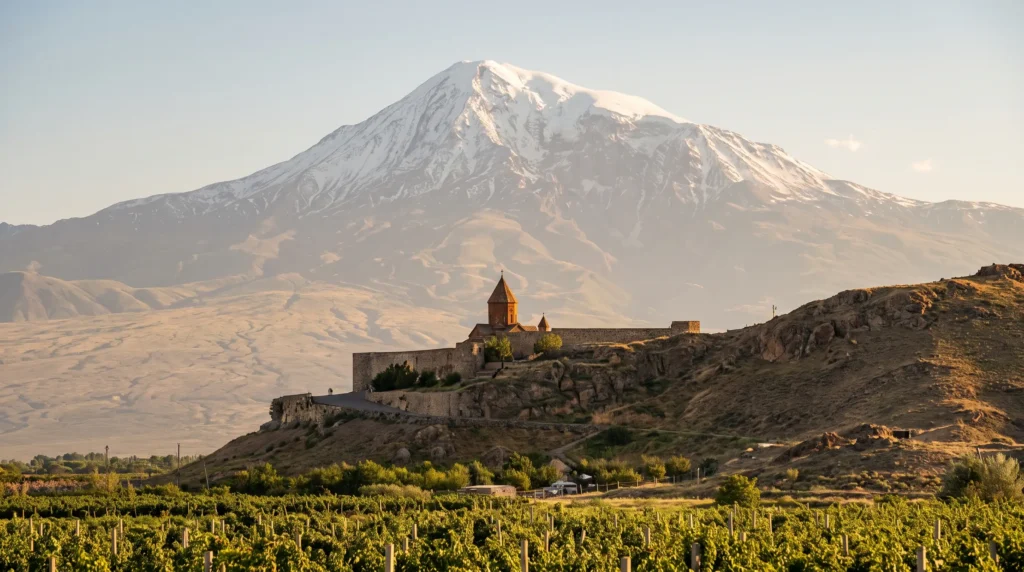
A hilltop monastery on the Ararat plain, famous for the closest available view of Mount Ararat from Armenian soil and for the pit where Gregory the Illuminator was reportedly imprisoned before converting the king. Sunrise visits are worth the early alarm.
Karahunj (Zorats Karer)
Often billed as “Armenia’s Stonehenge” — a field of ancient standing stones in Syunik whose exact age and purpose remain debated, with far fewer visitors than its British counterpart.
Jermuk
A Soviet-era spa town built around mineral springs and a dramatic waterfall, quietly popular with Armenians and almost entirely off the international radar.
Dilijan National Park
Dense forest, monastery hikes to Haghartsin and Goshavank, and some of the best homestay-style guesthouses in the country.
Practical Information
Money. The Armenian dram (AMD) floats freely against the dollar and has generally traded somewhere in the range of the mid-300s to mid-400s per US dollar in recent years — check a live converter before you go, since it moves. Cards are widely accepted in Yerevan; carry cash for marshrutkas, village guesthouses and market stalls.
Safety. Yerevan and the main tourist circuit are calm and low-crime day to day. The real caution zone is the entire Armenia–Azerbaijan border region: both the US State Department and UK FCDO advise against travel there, and the FCDO specifically recommends staying at least 5km back from that frontier. Check current advisories before finalizing any Syunik or Gegharkunik itinerary.
Health. The CDC recommends being current on routine vaccines plus Hepatitis A for most travelers, with Hepatitis B and rabies pre-exposure vaccination worth discussing with a travel clinic given documented rabies in local dog populations. Stick to bottled or treated water outside major hotels.
Connectivity. A regional eSIM works well; Yerevan Wi-Fi is generally solid, mountain guesthouses more variable. Plugs: European-style Type C/F, 230V. Time zone: UTC+4, no daylight saving.
Budget Breakdown — What Armenia Actually Costs in 2026
Armenia remains one of the better travel values in the wider region — noticeably cheaper than Western Europe, and competitive with its Caucasus neighbors.
Budget (US$35–70/day): Hostel or guesthouse room, marshrutkas between towns, khorovats and lavash from neighborhood spots, self-guided monastery visits.
Mid-range (US$90–160/day): Boutique Yerevan hotel or a Dilijan guesthouse, a rental car or private day tour (Tatev, Sevan, Garni-Geghard loops run roughly US$60–100 for a driver-guide), restaurant meals with local wine.
Luxury (US$250+/day): Design hotels in central Yerevan, private multi-day driver itineraries, wine-country tastings paired with harvest-season dinners, Ararat brandy distillery private tours.
Tipping 10% is appreciated but not obligatory in most restaurants; round up for taxis and drivers.
Planning Your First Trip to Armenia
A comfortable first-timer route: land in Yerevan and spend two nights exploring the city and Tsitsernakaberd, day-trip to Garni and Geghard, then head south for two nights around Vayots Dzor and Tatev before looping back via Lake Sevan and Dilijan on the way to the airport. Seven to nine days covers the country without rushing. Because the Turkey and Azerbaijan borders are closed, most multi-country trips pair Armenia with a land crossing into Georgia through Tbilisi, or a separate flight leg to explore Azerbaijan or Turkey on their own itineraries.
Frequently Asked Questions
Is Armenia safe to visit in 2026?
Yerevan and the main tourist circuit — Sevan, Dilijan, Vayots Dzor, the Garni-Geghard loop — are calm and welcoming day to day. The specific risk area is the Armenia–Azerbaijan border region, which both the US State Department and UK FCDO advise avoiding; check current government guidance before planning any Syunik or Gegharkunik border-adjacent route.
Do I need a visa?
Citizens of the US, UK, EU member states, Canada, Australia and several other countries generally get visa-free entry, typically for stays of up to 180 days per year, based on citizenship alone. Rules do shift, including temporary residence-permit-based waivers, so confirm current requirements on an official source shortly before you travel.
Can I visit Nagorno-Karabakh?
This is not a standard tourist route and conditions have shifted substantially in recent years; treat it as outside the scope of a first-time Armenia trip and check current government advisories rather than older travel blogs if you’re considering it.
What’s the best time to see Mount Ararat?
Clear mornings, especially in autumn, give the best odds — the peak sits across the closed border in Turkey and is often shrouded in haze by midday. Khor Virap monastery offers the classic close-up angle.
Armenia or Georgia — which first?
They pair naturally via an overland Tbilisi–Yerevan crossing. Choose Armenia first for monasteries, ancient wine culture and a slower pace; Georgia for more developed tourism infrastructure and its own mountain and coastal range. Most travelers do both in one trip.
Is English widely spoken?
In central Yerevan’s hotels, cafés and tour operations, yes. Outside the capital, Russian is more commonly a second language than English, so a translation app and a few Armenian pleasantries go a long way.
Ready to Explore Armenia?
Rock-cut monasteries older than most nations, a wine region that got a millennia-long head start on the rest of the world, and a capital that will happily throw a bucket of water on you every July. Armenia isn’t a country you rush through — go with time to sit at one more monastery, accept one more cup of coffee, and let the history settle in.
Explore More
- Georgia Travel Guide — the natural overland pairing, via Tbilisi
- Tbilisi City Guide — Georgia’s capital, a short crossing from Yerevan
- Azerbaijan Travel Guide — the Caucasus’s Caspian side
- Turkey Travel Guide — shared history, best reached by air given the closed border
How this guide was built
Published as part of Facts From Upstairs’ country guide series. Built from authoritative sources — Wikipedia entity pages for Armenia’s geography, UNESCO sites, Zvartnots Airport, Lake Sevan, the Areni-1 winery, the Wings of Tatev cable car and the Armenian Apostolic Church; the official Armenia Travel tourism board for visa rules and the Vardavar festival; the Central Bank of Armenia for currency; and the US State Department, UK FCDO and US CDC traveler pages for safety and health guidance. Numeric and checkable claims carry inline citations.
Sources cited on this page
- Wikipedia — Armenia
- Wikipedia — List of World Heritage Sites in Armenia
- Wikipedia — Zvartnots International Airport
- Wikipedia — Lake Sevan
- Wikipedia — Areni-1 winery
- Wikipedia — Wings of Tatev
- Wikipedia — Armenian Apostolic Church
- Wikipedia — Armenian dram
- Armenia Travel (official tourism board) — Vardavar
- Armenia Travel (official tourism board) — 2026 visa-free travel rules
- Central Bank of Armenia
- US State Department — Armenia
- UK FCDO — Armenia
- US CDC — Armenia traveler page
More country guides you might like
Plan your trip to Armenia
The booking tools we use ourselves. FFU may earn a commission at no extra cost to you.
Plan & book your trip to Armenia
Booking through these searches supports our guides at no extra cost to you.