
Languages of Georgia
All languages of Western Asia →fluent beta classical · classes by phone with Maya at ranas.ai/maya
Georgia (the Country) Travel Guide — Sakartvelo, 8,000 Years of Wine & the Caucasus Skyline
Let me clear up the confusion in the first sentence: this is Georgia the country — Sakartvelo, საქართველო — wedged between the Greater Caucasus and the Black Sea, not the US state with the peaches. I have driven the Georgian Military Highway up to Kazbegi with the windows down and a tamada (toastmaster) in the back seat, and I still think the most underrated hour in travel is the one you spend in a Kakheti cellar watching wine ferment in a clay qvevri buried in the earth. We tell first-timers that Georgia is “Tbilisi and a winery,” and that sells it short — in a country smaller than Ireland you can ski powder at dawn, stand under 5,000-metre peaks by lunch, and eat boat-shaped khachapuri on a Black Sea boulevard by dinner. Treat this as the brief I hand my own friends before they fly into Tbilisi.

In This Guide
- Overview — Why Georgia (Sakartvelo) Belongs on Every Bucket List
- Rtveli 2026 — The Georgian Wine Harvest (September–October)
- Best Time to Visit Georgia (Season by Season)
- Getting There — TBS Tbilisi, KUT Kutaisi & BUS Batumi
- Getting Around — Marshrutkas, Trains & the Military Highway
- Top Cities & Regions
- Georgian Culture & Etiquette
- A Food Lover’s Guide to Georgia
- Off the Beaten Path
- Practical Information
- Budget Breakdown
- Planning Your First Trip to Georgia
- Frequently Asked Questions
Overview — Why Georgia (Sakartvelo) Belongs on Every Bucket List
Georgia — Sakartvelo to the people who live here — is a Caucasus country of roughly 3.7 million people packed into about 69,700 km², a footprint smaller than Ireland and wedged between Russia to the north, Turkey and Armenia to the south, Azerbaijan to the east and the Black Sea to the west. The Greater Caucasus range walls off the northern border; its highest summit, Shkhara, reaches 5,201 m, with Mt Kazbek at 5,047 m the peak most travellers actually stand beneath. The capital, Tbilisi, sits in a river gorge at 380–770 m of elevation and holds around 1.3 million people — better than a third of the entire country in one warm, sulphur-scented city.
The first story Georgia tells is wine. Archaeologists working south of Tbilisi found pottery residue pushing organised winemaking back roughly 8,000 years — the oldest evidence on Earth — and the qvevri method, fermenting grapes in egg-shaped clay vessels buried to the neck in the ground, was inscribed on the UNESCO Intangible Cultural Heritage list in 2013. Around 70% of the country’s grapes grow in the eastern region of Kakheti , and Georgia exported roughly 94 million bottles in 2019 — wine here is not an industry bolted onto tourism, it is the spine of the supra (feast).
The second story is the mountains and the monasteries. Three Georgian sites carry UNESCO World Heritage status: the Historical Monuments of Mtskheta (inscribed 1994), Upper Svaneti with its medieval tower-houses (1996), and Gelati Monastery near Kutaisi (1994, after the adjacent Bagrati Cathedral was de-listed in 2017 following a contested reconstruction). The Colchic Rainforests and Wetlands on the Black Sea coast were added as a natural site in 2021. Orthodox Christianity, adopted in the early fourth century, still shapes 83% of the population , and the gold-domed Sameba (Holy Trinity) Cathedral now dominates the Tbilisi skyline.
Practically, Georgia in 2026 is in the middle of a tourism boom, having logged about 7.8 million international arrivals in 2025, up from 7.4 million the year before. The country was granted EU candidate status on 14 December 2023 , though Brussels effectively froze the accession process in late 2024 amid a domestic dispute over a “foreign-agent” transparency law. For the visitor, the upshot is simple: visa-free entry for up to a year for around 95 nationalities , some of the warmest hospitality in the region, and prices Western Europe abandoned a decade ago.

Rtveli 2026 — The Georgian Wine Harvest (September–October)
If there is one window to build a trip around, it is Rtveli — the grape harvest that turns the whole of Kakheti into one rolling, weeks-long feast from roughly mid-September into October. Families and wineries pick by hand, crush the grapes, and start the fermentation in qvevri buried in the marani (cellar) floor — the UNESCO-listed method that has run essentially unchanged for millennia. The timing tracks the grape and the altitude: lowland white Rkatsiteli and the red Saperavi around Telavi and Sighnaghi tend to come in first, with higher and cooler vineyards finishing into mid-October.
Around 70% of Georgia’s grapes are grown in Kakheti , so this is the region to base yourself — Telavi and the hilltop town of Sighnaghi over the Alazani Valley are the classic hubs. Many family wineries welcome visitors to pick and stomp grapes, and the harvest doubles as the country’s biggest excuse for a supra, the ritual Georgian feast presided over by a tamada (toastmaster) whose toasts can run for hours. Book cellar stays early: Rtveli is the single most-booked window of the Georgian travel year.
- Typical start: mid-September in the Kakheti lowlands (Telavi, Gurjaani, Sighnaghi), tracking the Rkatsiteli and Saperavi harvest.
- Peak window: roughly late September into the first half of October across most of Kakheti.
- Qvevri: the egg-shaped clay vessel buried to the neck in the marani floor; UNESCO ICH inscribed the method in 2013.
- Kakheti share: around 70% of the national grape crop comes from this one eastern region.
- The feast: Rtveli runs straight into the supra — expect churchkhela (grape-must candle sweets) being strung up to dry along every village porch.

Best Time to Visit Georgia (Season by Season)
Spring (Apr–Jun)
The sweet spot for a first trip. Tbilisi warms from the low teens in April to a comfortable 22–26°C by June, the lowland wildflowers and the Alazani Valley vineyards green up, and the marshrutka roads to the high mountains begin to reopen as the snow retreats. May and June are ideal for Kakheti wine country, Mtskheta’s monasteries and the Black Sea coast before the summer crowds, though the very highest passes to Svaneti and Tusheti may not clear until late June. Mild temperatures, long days and shoulder-season prices make this the value-for-money season.
Summer (Jul–Aug)
Hot in the lowlands, perfect in the mountains. Tbilisi and the eastern plains push 30–35°C and the city empties as locals head for the hills, while Svaneti, Kazbegi, Tusheti and the alpine meadows hit their hiking peak with passes fully open and long daylight. The Black Sea resort of Batumi is at its busiest and most humid. This is the only reliable window for the multi-day Mestia-to-Ushguli trek and the rough 4×4 road into Tusheti, which is typically only passable roughly June to early October.
Autumn (Sep–Oct)
Arguably the best season of all, and the reason to time a trip around Rtveli. The grape harvest fills Kakheti from mid-September, the lowland heat breaks back to a perfect 20–25°C, the Caucasus foliage turns, and the high trails stay open into early October. Hotel rates ease off the summer peak everywhere except the Kakheti wine hubs during harvest week. For most travellers chasing food, wine and walkable weather in one trip, late September is the single best fortnight on the Georgian calendar.
Winter (Nov–Mar)
Two trips in one. Tbilisi sits around 0–8°C with the sulphur baths of Abanotubani at their most appealing, while the ski resort of Gudauri on the Georgian Military Highway delivers some of the best-value powder in the wider region — around 76 km of pistes from a base near 2,200 m. Bakuriani and Mestia (Hatsvali/Tetnuldi) round out the ski options. The high mountain villages are largely cut off by snow, so winter is a city-plus-ski season, not a Svaneti-hiking one.
Shoulder-season tip: late May into mid-June and all of September hit the sweet spot — daytime temperatures in the low-to-mid 20s°C in the lowlands, the high trails opening or still open, harvest energy building in September, and hotel rates noticeably below the July–August peak. If you can only travel once, aim for the second half of September: Kakheti is mid-Rtveli and the Kazbegi road is still clear.
Getting There — TBS Tbilisi, KUT Kutaisi & BUS Batumi
Georgia has three international airports, all operated under the United Airports of Georgia umbrella, and which one you fly into shapes your whole itinerary — Tbilisi for the east and the wine country, Kutaisi for the budget carriers and the mountains, Batumi for the Black Sea coast.
- Tbilisi International (TBS) — the main gateway, about 17 km south-east of the capital, served by full-service carriers across Europe, the Gulf and Turkey; a city bus and metro link reach the centre cheaply.
- Kutaisi (Kopitnari, KUT) — the low-cost hub in the west, the base for Wizz Air’s dense European network and the most convenient arrival for Svaneti, Imereti and Racha.
- Batumi (BUS) — the Black Sea coastal airport in Adjara, busiest in summer and handy for the beach-and-boulevard crowd.
Flight times: Istanbul–Tbilisi about 2h, Dubai–Tbilisi about 3h 30min, most of Central and Eastern Europe under 4h, London–Tbilisi around 6h with one stop. Turkish Airlines, FlyDubai and Wizz Air run some of the densest schedules into the country.
Visa / entry: citizens of roughly 95 countries — including the EU, UK, US, Canada, Australia, Japan and the Gulf states — can enter visa-free and stay for up to one full year, one of the most generous policies anywhere. No pre-arrival paperwork is required for those nationalities; just bring a passport valid for the duration of your stay.
Getting Around — Marshrutkas, Trains & the Military Highway
Georgia is small and cheap to cross, but it runs on shared minibuses rather than a dense rail network. The marshrutka — a fixed-route minivan that leaves when full from a city’s central bus station — is the default way Georgians and travellers alike move between towns, supplemented by a modern intercity train spine and, for the mountains, hired 4×4s and the spectacular Georgian Military Highway.
- Marshrutka (shared minibus): the workhorse of Georgian transport — Tbilisi to almost any town for a few lari, departing when full from Didube, Ortachala or Samgori stations in the capital.
- Tbilisi → Kazbegi (Stepantsminda): about 157 km up the Georgian Military Highway, roughly 3 hours by marshrutka past the Jvari Pass and the Russia–Georgia Friendship Monument.
- Tbilisi → Batumi: the modern Stadler-built intercity train covers the ~370 km to the Black Sea in about 5 hours; far more comfortable than the bus.
- Tbilisi → Zugdidi → Mestia: overnight or day train to Zugdidi, then a shared marshrutka or transfer up into Svaneti.
Tbilisi Metro & city transit: the capital’s Soviet-era metro opened in 1966 and runs two lines and 23 stations carrying around half a million riders a day; pay with the rechargeable MetroMoney / Tbilisi Transport Card, which also covers city buses.
Taxis & ride-hailing: Bolt is ubiquitous and cheap across Tbilisi, Batumi and Kutaisi and removes the haggling that comes with flagging a street cab. Yandex Go also operates.
Self-drive: Georgians drive on the right; rental is inexpensive and a car unlocks Kakheti and the lower Military Highway, but the mountain roads to Tusheti, Ushguli and Omalo demand a high-clearance 4×4 and nerve.
Top Cities & Regions
📍 Map of Georgia: Every Place in This Guide


Tbilisi — The Capital
The warm, ramshackle, fast-changing heart of the country, home to around 1.3 million people in a river gorge where Persian, Russian, Art Nouveau and Soviet architecture pile up on top of each other. Start with our full Tbilisi city guide — this is the primary base for almost every Georgia itinerary, and an easy springboard to Kakheti, Mtskheta and the mountains.
- The sulphur bathhouses of Abanotubani — the brick-domed thermal baths that, by legend, gave Tbilisi (“warm place”) its name.
- Narikala Fortress and the Mother of Georgia statue on the Sololaki ridge, reached by the Rike Park cable car.
- The Bridge of Peace, Rustaveli Avenue, the dry bridge flea market, and the gold-domed Sameba Cathedral across the river in Avlabari.
Signature eats: Adjaruli khachapuri, soup khinkali at a Pasanauri-style house, mtsvadi grilled over vine cuttings, and a glass of amber qvevri wine.
Mtskheta — The Ancient Capital
Twenty minutes north of Tbilisi at the confluence of the Mtkvari and Aragvi rivers, Mtskheta was the kingdom’s capital for a millennium and is the spiritual centre of Georgian Orthodoxy — its Historical Monuments were inscribed by UNESCO in 1994. The hilltop Jvari Monastery (6th century) and the cathedral of Svetitskhoveri below it are the country’s most-visited day-trip from the capital.
- Jvari Monastery, perched above the river confluence with a panorama over the old town.
- Svetitskhoveli Cathedral, the 11th-century coronation and burial church of the Georgian kings.
- Easily combined with the Tbilisi-to-Kazbegi run, since both follow the Military Highway north.
Kakheti — Georgia’s Wine Country
The eastern region that grows around 70% of the nation’s grapes and the obvious base for Rtveli. Telavi is the regional capital; the walled hilltop town of Sighnaghi over the Alazani Valley is the prettiest place to stay; and the family marani (cellars) here pour qvevri wine straight from the buried clay.
- Sighnaghi old town inside intact 18th-century walls, with sweeping Alazani Valley views.
- Telavi, the Alaverda Cathedral, and dozens of family wineries open for tastings.
- The cave-cut Davit Gareja monastery complex on the Azerbaijan border (a long day-trip).
Upper Svaneti — Mestia & Ushguli
The high north-west, walled in by 5,000 m peaks and studded with the medieval stone koshki (defensive tower-houses) that earned Upper Svaneti its UNESCO inscription in 1996. Mestia is the trailhead town; Ushguli, a cluster of four villages at around 2,200 m, is among the highest continuously inhabited settlements in Europe.
- The four-day Mestia-to-Ushguli trek, the country’s signature multi-day walk.
- Ushguli’s tower-houses beneath Mt Shkhara (5,201 m), Georgia’s highest peak.
- The Svaneti Museum of History and Ethnography in Mestia, with its medieval icons and manuscripts.
Kutaisi & Imereti
The western lowland hub and the country’s second-largest urban region, gateway to Wizz Air’s airport and to a cluster of cave-and-monastery sights. The Gelati Monastery here retains its UNESCO listing (from the 1994 inscription) after the adjacent Bagrati Cathedral was de-listed in 2017 following its contested reconstruction.
- Gelati Monastery — a 12th-century complex of mosaics and frescoes founded by King David the Builder.
- The Prometheus and Sataplia caves, with stalactites and dinosaur footprints just outside the city.
- A handy launch point for Svaneti, Racha and the Colchic Black Sea wetlands.
Batumi & Adjara — The Black Sea Coast
The subtropical Adjara region and its boom-town capital Batumi (around 235,000 people) — a seaside strip of palm-lined boulevard, casinos, a Ferris wheel and the spinning 145 m Alphabetic Tower whose DNA-helix facade carries the 33 letters of the modern Georgian Mkhedruli script.
- The Batumi Boulevard seafront, the Miracle Park Ferris wheel and the Ali & Nino moving sculpture.
- The Alphabetic Tower celebrating the 33-letter Georgian alphabet.
- Day-trips inland to the Mtirala rainforest and the green tea terraces of the Adjaran hills.
Kazbegi / Stepantsminda & the High Caucasus
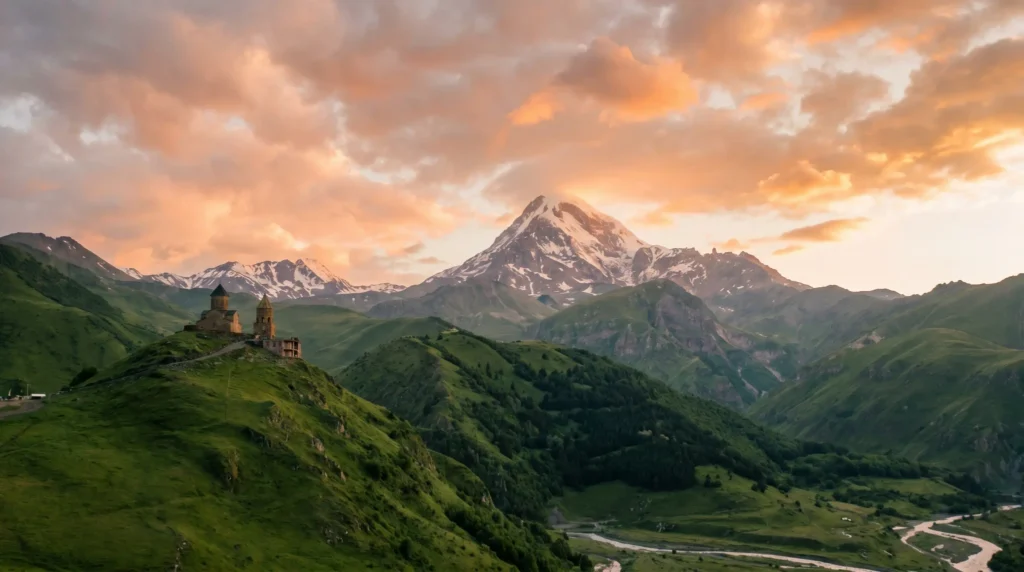
Three hours north of Tbilisi up the Military Highway, the town of Stepantsminda sits beneath Mt Kazbek (5,047 m) with the postcard-perfect Gergeti Trinity Church on its hilltop above — one of the most photographed scenes in the Caucasus and an easy hike or 4×4 ride from town.
- Gergeti Trinity Church (14th century) at 2,170 m beneath Mt Kazbek.
- The Russia–Georgia Friendship Monument and the Jvari Pass on the drive up.
- The Gudauri ski resort (~76 km of pistes) en route, the country’s powder capital.
Georgian Culture & Etiquette — What to Know Before You Go
Georgian public life turns on hospitality. The country is around 87% ethnic Georgian and 83% Orthodox Christian , with its own language, its own three-script alphabet — Mkhedruli, Asomtavruli and Nuskhuri, collectively inscribed by UNESCO in 2016 — and a tradition of polyphonic singing that was among the very first entries on the UNESCO intangible heritage list back in 2001. A guest, the saying goes, is a gift from God, and you will feel it within a day of arriving.

The Essentials
- The supra (feast) is the centre of Georgian social life, presided over by the tamada (toastmaster) whose toasts — to peace, to ancestors, to the guests — structure the meal; wait for the toast before you drink.
- Toasts are made with wine or chacha (grape brandy), never with beer — toasting with beer is reserved, half-jokingly, for your enemies.
- Dress modestly at churches and monasteries: women cover their heads and shoulders (scarves are usually provided at the door), men remove hats and avoid shorts.
- Hospitality can be overwhelming — refusing a second helping or a top-up of wine takes gentle persistence, and a host genuinely will be offended if you leave hungry.
- Learn “gaumarjos” (cheers / to victory) and “madloba” (thank you); a few words of Georgian go a very long way.
Faith, Song & the Three Scripts
- Georgian Orthodox churches are working places of worship — keep voices low, don’t photograph during services, and follow the lead of locals on lighting candles.
- Polyphonic singing — three independent vocal lines woven together — is performed at supras, in churches and at festivals; if you are invited to hear it live, go.
- The modern Mkhedruli alphabet has 33 letters and no upper/lower case; you’ll see all three historic scripts celebrated, including on Batumi’s Alphabetic Tower.
- Russian is still widely understood, especially among older Georgians, but using a few Georgian words rather than Russian is warmly received given the country’s history.
A Food Lover’s Guide to Georgia
Georgian food is having a global moment, and it deserves it. The cuisine is built on a handful of obsessions — cheese-stuffed breads, soup-filled dumplings, walnut sauces, fresh herbs by the fistful, and wine fermented in clay — and it varies sharply by region, from the buttery boat-breads of the Black Sea to the smoke-grilled meats of the eastern plains. The whole edifice rests on the supra, the ritual feast that the wider Georgian table tradition makes the country’s most exportable cultural product after the wine itself. The good news for travellers is that you eat brilliantly here at every price point: a 5-lari khachapuri from a bakery and a tasting menu in a Tbilisi wine bar are working with the same pantry.

Must-Try Dishes
| Dish | Description |
|---|---|
| Khachapuri (ხაჭაპური) | The national cheese bread, in regional forms: the boat-shaped Adjaruli finished with butter and a runny egg yolk; the round, fully enclosed Imeruli; the double-cheese Megruli; and the flaky Penovani. Georgia even has an unofficial Khachapuri Day on 27 February. |
| Khinkali (ხინკალი) | Hand-pleated soup dumplings, traditionally filled with spiced minced meat (the Pasanauri mountain villages are the spiritual home). Hold by the twisted top-knot, bite a small hole, slurp the broth, then eat the rest — and never eat the doughy knot, which you leave on the plate as a tally of how many you managed. |
| Mtsvadi (მწვადი) | Georgian shashlik — chunks of pork, veal or lamb skewered and grilled over embers, classically over dried grapevine cuttings in autumn, served with raw onion, pomegranate and tkemali plum sauce. |
| Pkhali & Badrijani | Cold vegetable starters bound with a walnut-and-garlic paste — spinach, beetroot or bean pkhali rolled into balls, and badrijani nigvzit, fried aubergine rolls stuffed with the same walnut filling and topped with pomegranate seeds. |
| Lobio & Soups | Lobio, a slow-cooked kidney-bean stew with coriander and the spice blend khmeli suneli, served in a clay pot with cornbread (mchadi); plus chakapuli, a spring lamb-and-tarragon stew, and kharcho, a rich beef-and-walnut soup. |
| Churchkhela & Sweets | Churchkhela — strings of walnuts dipped repeatedly in thickened grape must (tatara) until they set into a chewy, candle-shaped sweet, made in bulk at Rtveli; alongside tklapi, sun-dried fruit-leather sheets. |
Wine, Chacha & the Qvevri Cellar
You cannot separate Georgian food from Georgian wine. The country grows hundreds of indigenous grape varieties, dominated by the white Rkatsiteli and the red Saperavi, and the signature qvevri method — fermenting (often skin-on, producing the famous amber or “orange” wines) in clay vessels buried in the marani floor — is what UNESCO recognised in 2013. Around 70% of the grapes come from Kakheti , and Georgia exported roughly 94 million bottles in 2019.
- Order an amber qvevri wine at least once — skin-contact whites with real tannin and structure, unlike anything in the Western supermarket.
- Chacha is the fiery grape-pomace brandy poured for toasts; treat it with the respect 50%+ ABV deserves.
- Borjomi, the naturally carbonated mineral water from the spa town of the same name, is the national soft drink and a hangover staple.
Tbilisi’s natural-wine bars and the family marani of Kakheti are the two ends of the spectrum, and both are worth a dedicated evening. Tip lightly (5–10% is generous and not expected), and accept that the tamada decides the pace.
Off the Beaten Path — Georgia Beyond the Guidebook

Vardzia — The Cave City
In the far south near the Turkish border, Vardzia is a 12th-century cave monastery carved into the cliff face of the Erusheti mountains under Queen Tamar, with hundreds of rooms, chapels and tunnels spread across thirteen levels. Combine it with the nearby Rabati Castle in Akhaltsikhe for a long but rewarding day from the Borjomi-Bakuriani area.
Tusheti — The Roof of the Eastern Caucasus
One of the remotest inhabited regions in Europe, reached over the 2,900 m Abano Pass — often rated among the world’s most dangerous roads — and accessible only by 4×4 for roughly four months a year (June to early October). The stone villages of Omalo and Dartlo, the tower-houses, and the high pastures make this the country’s purest mountain experience for travellers who can handle the road.
Davit Gareja — The Desert Monasteries
A complex of rock-hewn monasteries spread along the semi-desert ridge on the Azerbaijan border south-east of Tbilisi, founded in the 6th century by one of the Thirteen Assyrian Fathers. The Udabno cave cells, with their faded frescoes and a panorama over the steppe into Azerbaijan, sit right on a disputed stretch of border — go with a guide and check the latest access advice.
Borjomi & the Bakuriani Forests
The spa town of Borjomi, famous for its mineral water, sits inside one of Europe’s largest protected forests — the Borjomi-Kharagauli National Park — with marked multi-day trails, a historic central park where you can drink the warm spring water straight from the source, and the narrow-gauge “Kukushka” railway up to the Bakuriani ski slopes.
The Colchic Rainforests & Coast
Georgia’s newest UNESCO site (inscribed 2021) protects the ancient Colchic temperate rainforests and wetlands along the Black Sea — relict subtropical forest, peat bogs and birdlife, including the autumn raptor migration funnelled over Batumi, one of the largest such flyways on Earth. The Kolkheti National Park and the Batumi bird-count stations are the access points, and the wider coast hides green-tea terraces, citrus groves and the warm-spring resort of Kobuleti.
Racha — The Quiet Wine Mountains
Tucked between Imereti and Svaneti, Racha is the green, sparsely visited region Georgians go to when they want their own mountains back. It produces the country’s most famous semi-sweet red, Khvanchkara, from the rare Aleksandrouli and Mujuretuli grapes; the hill villages, the Shaori and Lajanuri reservoirs, and the cliff-side 11th-century Nikortsminda Cathedral with its carved reliefs reward the long, winding drive in. Come in autumn for the foliage and the harvest, when the valleys turn gold and the cellars open their qvevri to the trickle of travellers who make it this far.
Practical Information
| Currency | Georgian lari (₾ / GEL); 1 USD ≈ 2.7 GEL in mid-2026. Cards are widely accepted in Tbilisi and Batumi; carry small lari notes for marshrutkas, rural guesthouses and village markets. |
| Cash needs | Real but shrinking. Cities and chain restaurants take cards and contactless; mountain villages, family marani, marshrutka drivers and small bakeries are cash-only. Keep ₾50–100 in small notes for the day. |
| ATMs | Plentiful in towns (TBC Bank, Bank of Georgia, Liberty) and accept foreign Visa and Mastercard; rural areas have few, so withdraw before heading to Svaneti, Tusheti or Kazbegi. |
| Tipping | Modest — around 5–10% in sit-down restaurants if a service charge isn’t already added; rounding up is fine for taxis and cafés. Not expected at all in marshrutkas or village guesthouses. |
| Language | Georgian is the sole official language, written in the 33-letter Mkhedruli script. Russian is widely understood; English is common among younger people in Tbilisi and Batumi but thin in rural areas. A translation app and a few Georgian words go far. |
| Safety | Georgia is a safe country for visitors with low violent crime; the only no-go areas are the Russian-occupied territories of Abkhazia and South Ossetia, which both the UK FCDO and US State Department advise against all travel to. Watch mountain weather and road conditions rather than crime. |
| Connectivity | 4G is widespread and cheap; Magti, Geocell (Silknet) and Cellfie sell tourist SIMs at the airport and in town. Free WiFi is common in cafés and hotels. |
| Power | Type C and Type F (European 2-pin) plugs, 220V / 50Hz — the same as continental Europe; UK and US travellers need an adaptor. |
| Tap water | Safe to drink in Tbilisi and most towns; the Borjomi region is nationally famous for its mineral springs. In remote villages, ask or stick to bottled. |
| Healthcare | Decent private clinics in Tbilisi and Batumi; carry travel insurance, as mountain rescue and evacuation from Svaneti or Tusheti can be slow and costly. Emergency number is 112. |
Budget Breakdown — What Georgia Actually Costs in 2026

Budget Traveller
Georgia is genuinely cheap. Hostel dorms and family guesthouses run from around ₾30–60 a night (often with a vast home-cooked breakfast included), a bakery khachapuri is ₾4–6, marshrutkas between towns cost a few lari, and a litre of qvevri wine from a village marani can be cheaper than the bottle to put it in. Daily total: USD $30–45.
Mid-Range
Comfortable boutique hotels and well-reviewed guesthouses (₾120–250 a night), sit-down dinners with wine in Tbilisi’s restaurants and wine bars (₾40–70 a head), private transfers or a rental car for the mountains, and guided day-trips to Kakheti or Kazbegi. This tier buys a lot of comfort in Georgia. Daily total: USD $60–110.
Luxury
5-star Tbilisi hotels (Stamba, Rooms, the Biltmore), high-end wine-estate stays in Kakheti, helicopter transfers to Svaneti, private guides and tasting menus at the country’s best tables. Even at the top end, Georgia costs a fraction of Western Europe — a luxury wine-country weekend that would run four figures a night in Tuscany lands far lower here, and the experiences (a private qvevri tasting, a tamada-led supra, a heli-drop onto a Caucasus ridge) are hard to buy anywhere else. Daily total: USD $220+.
| Tier | Daily (USD) | Accommodation | Food | Transport |
|---|---|---|---|---|
| Budget | $30–45 | Hostel / guesthouse ₾30–60 | ₾15–30 (bakery + market) | Marshrutka + metro ₾5–15/day |
| Mid-Range | $60–110 | Boutique hotel ₾120–250 | ₾40–80 (restaurants + wine) | Rental car / private transfers |
| Luxury | $220+ | 5-star hotel / wine estate ₾500+ | ₾150+ (tasting menus) | Private driver + heli to Svaneti |
Planning Your First Trip to Georgia

- Pick your season first. Late September (Rtveli harvest, mild weather, trails still open) is the all-rounder; July–August for serious Svaneti and Tusheti hiking; December–March for Gudauri powder. The high villages are snowed off outside roughly June–early October.
- Choose your airport to match. Fly into Tbilisi (TBS) for an east-and-wine trip; into Kutaisi (KUT) if mountains and Svaneti lead your itinerary and you want the cheapest European fares.
- Don’t overpack the route. Georgia is small but slow — mountain roads eat time. A first trip of 8–10 days does Tbilisi, a Kakheti wine night, the Kazbegi day-run and either Svaneti or the Black Sea, not all of them.
- Book Rtveli and Svaneti beds early. Harvest-week guesthouses in Kakheti and the limited rooms in Mestia and Ushguli fill months ahead; everything else can be booked closer in.
- Pack for two climates. Layers and proper footwear for the mountains even in summer (passes are cold), plus lighter clothing for Tbilisi and the subtropical Black Sea coast — and a modest scarf or layer for visiting churches and monasteries.
Classic 9-Day Itinerary: Days 1–3 Tbilisi (old town, sulphur baths, Mtskheta day-trip) · Day 4 Kakheti wine country overnight (Sighnaghi / Telavi) · Day 5 Kazbegi & Gergeti Trinity up the Military Highway · Days 6–7 fly or transfer west to Svaneti (Mestia + an Ushguli day) · Day 8 Kutaisi (Gelati, Prometheus Cave) · Day 9 return for departure from TBS or KUT.
Frequently Asked Questions
Wait — is this Georgia the country or the US state?
The country. This guide is about Georgia / Sakartvelo (საქართველო), the independent nation in the Caucasus between Russia, Turkey, Armenia and Azerbaijan, with its capital at Tbilisi — not the US state of Georgia with Atlanta and the peaches. The two share an English name by coincidence; Georgians call their own country Sakartvelo, after the core region of Kartli.
Is Georgia expensive to visit?
No — it is one of the best-value destinations in the wider region. Guesthouse beds start around ₾30–60 a night, a filling khachapuri is a few lari, intercity marshrutkas cost a handful of lari, and excellent wine is cheap at the source. Budget travellers manage comfortably on USD $30–45 a day, and even mid-range comfort runs $60–110. Long-haul flights are the main cost; on the ground, Georgia is inexpensive.
Do I need a visa for Georgia?
Almost certainly not. Citizens of around 95 countries — including the EU, UK, US, Canada, Australia, Japan and the Gulf states — can enter visa-free and stay for up to a full year, one of the most generous policies in the world. No pre-arrival paperwork is needed; just carry a passport valid for your stay.
Is Georgia safe for travellers?
Yes. Georgia has low violent crime and is widely considered one of the safest countries in the region for visitors, including solo and female travellers. The one hard rule is to avoid the Russian-occupied regions of Abkhazia and South Ossetia, which both the UK and US advise against all travel to. The real risks elsewhere are mountain weather and rough roads, not crime.
When is the best time to go?
Late September is the single best fortnight: the Rtveli grape harvest fills Kakheti, lowland temperatures ease to a perfect low-20s°C, and the high trails are still open. May–June is the runner-up for mild weather and shoulder prices; July–August is the hiking peak in Svaneti and Tusheti; and December–March is for skiing at Gudauri.
Can I get by as a vegetarian or vegan?
Surprisingly easily. Georgian cuisine has a deep bench of meat-free dishes — the walnut-based pkhali and badrijani nigvzit, lobio bean stew with cornbread, mushroom and cheese khachapuri (skip the egg-and-cheese versions for vegan), grilled vegetables, fresh herb salads and tonnes of fruit. The Orthodox fasting calendar means many restaurants keep a full “lent” (vegan) menu year-round. Cheese-heavy specialities are the main thing vegans skip.
Is the tap water safe to drink?
Yes in Tbilisi and most towns, where the water is good and the country is famous for its mineral springs — Borjomi being the national brand. In remote mountain villages it is sensible to ask locally or stick to bottled water, but on the standard Tbilisi–Kakheti–Kazbegi circuit the tap is fine.
How do I get to the mountains like Svaneti and Kazbegi?
Kazbegi (Stepantsminda) is an easy 3-hour marshrutka or day-trip up the Georgian Military Highway from Tbilisi, about 157 km. Svaneti takes more effort: a train to Zugdidi then a marshrutka up to Mestia, or a short Vanilla Sky flight from Tbilisi or Kutaisi. Tusheti is 4×4-only over the Abano Pass and open just June–early October.
Ready to Explore Georgia?
Georgia rewards travellers who come for the food and stay for the mountains. Time your trip around Rtveli if you can, fly into Tbilisi or Kutaisi depending on your route, and don’t try to see all of it in one go. Start with our Tbilisi city guide, ride the Military Highway up to Kazbegi, pour a glass of amber qvevri wine in a Kakheti cellar, and let Sakartvelo unfold from there.
Explore More
More country guides you might like
Plan your trip to Georgia
The booking tools we use ourselves. FFU may earn a commission at no extra cost to you.
Plan & book your trip to Georgia
Booking through these searches supports our guides at no extra cost to you.