
Languages of Cape Verde
All languages of Western Africa →fluent beta classical · classes by phone with Maya at ranas.ai/maya
Cabo Verde Travel Guide — Ten Volcanic Islands, Morna Music & the Atlantic’s Best-Kept Secret
I get asked constantly whether I mean Cape Verde the island or Cape Verde the country, and the answer is: neither, exactly — it’s ten islands, and they’re nothing alike. Fly into Sal or Boa Vista and you’ll find windswept dunes, kitesurfing schools and all-inclusive resorts that could pass for the Canaries. Take a puddle-jumper an hour west to Santo Antão and you’re suddenly hiking terraced ravines between 1,000-metre cliffs, grateful for a windbreaker. Head south to Fogo and you can sleep inside an active volcano’s caldera, in a village that grows wine in volcanic ash. This is what nobody tells you about Cabo Verde: it isn’t one beach destination, it’s an entire archipelago’s worth of contradictions, tied together by Portuguese Creole warmth (locals call it morabeza) and a music tradition — morna — soulful enough that UNESCO gave it World Heritage status. It is not undiscovered — European charter flights have been landing on Sal for two decades — but it is still wildly underexplored beyond the resort strip, and that’s exactly where the good stuff is.
In This Guide
- Overview — Ten Islands, Ten Different Trips
- Carnival Season & Morna, Cabo Verde’s UNESCO Music
- Best Time to Visit Cabo Verde (Season by Season)
- Getting There — Sal, Praia, São Vicente & the EASE System
- Getting Around — Inter-Island Flights, Ferries & Aluguers
- The Islands — Which One(s) to Pick
- Culture & People — Creole, Diaspora & Morabeza
- A Food Lover’s Guide to Cabo Verde
- Off the Beaten Path
- Practical Information
- Budget Breakdown — What Cabo Verde Actually Costs in 2026
- Frequently Asked Questions
Overview — Ten Islands, Ten Different Trips
Cabo Verde (Cape Verde in English, though the government has asked the world to use the Portuguese form since 2013) is an archipelago of ten volcanic islands roughly 570 kilometres off the coast of Senegal, split into the windward Barlavento group — Santo Antão, São Vicente, Santa Luzia, São Nicolau, Sal and Boa Vista — and the leeward Sotavento group — Maio, Santiago, Fogo and Brava. A former Portuguese colony since 1462 and independent since 5 July 1975 after a joint liberation struggle with Guinea-Bissau led by Amílcar Cabral, the country today is a stable semi-presidential democracy with Praia, on Santiago, as its capital.
What makes it confusing to plan is exactly what makes it worth planning for: the islands don’t feel like the same country. Sal and Boa Vista are flat, sandy, and built almost entirely around European package tourism — think reliable sun, kitesurfing, and resort buffets. Santiago and Fogo are green-to-volcanic, historic and agricultural. Santo Antão is dramatically vertical, a hiker’s island of terraced valleys and cloud-wrapped ridgelines. São Vicente, home to Mindelo, is the cultural and musical capital, birthplace of morna’s biggest star, Cesária Évora. Most first-time visitors land on Sal or Boa Vista and never see the other side of the country — which is a shame, because the interior islands are where Cabo Verde stops looking like a beach resort brochure and starts looking like nowhere else on Earth.
The catch, and I’ll say it up front: inter-island logistics are real. Ferries are irregular and sometimes get cancelled for swell, domestic flights get rescheduled, and island-hopping needs slack built into your itinerary. Cabo Verde rewards travelers who pick two or three islands and commit, not travelers trying to tick off all ten in a week.
Carnival Season & Morna, Cabo Verde’s UNESCO Music
If you can time a trip to February or early March, do it around Carnival — Cabo Verde’s biggest annual party, and Mindelo’s version on São Vicente is the one people fly in for, often compared in spirit (not scale) to Rio’s. The main parade lands on Shrove Tuesday, the last day before Ash Wednesday and Lent, with a week of build-up parties beforehand. Costumes, samba-adjacent rhythms and all-night street dancing take over Mindelo’s waterfront, and Praia and São Nicolau run their own smaller versions the same week.
Whatever month you land, seek out live morna — the melancholic, guitar-and-cavaquinho ballad tradition UNESCO inscribed as Intangible Cultural Heritage of Humanity in 2019, the genre that made the late Cesária Évora, “the Barefoot Diva,” a global star. Mindelo also hosts the Kriol Jazz Festival most years, and small bars across Praia and Mindelo run informal morna nights where a single singer and a guitarist can flatten a noisy room to silence in the first verse.
Best Time to Visit Cabo Verde (Season by Season)
November – June · Dry season (peak)
Consistent sun, low humidity, calm-ish seas on the leeward islands, and the widest range of flights from Europe. December through February also brings intermittent Saharan dust storms (locally the bruma seca), which can occasionally disrupt flights to Boa Vista — a minor annoyance, not a trip-wrecker.
February – March · Carnival
The cultural highlight of the year, concentrated in Mindelo, with good weather on either side of it. Book flights and Mindelo accommodation well ahead.
Mid-August – mid-October · Rainy season
Short, intense downpours rather than all-day rain, concentrated on the mountainous islands (Santiago, Fogo, Santo Antão); Sal and Boa Vista stay drier year-round. This window can bring flooding and landslides on the wetter islands, so it’s the one stretch where flexibility matters most. It’s also the greenest, most photogenic time to hike Santo Antão if you don’t mind checking forecasts daily.
Year-round · Wind & water sports
Sal and Boa Vista’s trade winds are steady enough that kitesurfers plan trips around the season rather than the calendar — roughly June to September for the strongest, most consistent wind.
Getting There — Sal, Praia, São Vicente & the EASE System
Three airports handle nearly all international arrivals: Amílcar Cabral International Airport (SID) on Sal, the country’s busiest gateway with over a million passengers a year and direct charter and scheduled flights from Lisbon, Amsterdam, Milan, Paris and a handful of other European cities; Nelson Mandela International Airport (RAI) serving the capital Praia on Santiago; and Cesária Évora International Airport (VXE) on São Vicente, serving Mindelo. Boa Vista has its own international airport (Aristides Pereira) for direct charter arrivals too — useful if your whole trip is staying put on that island.
Before you fly, every visitor — regardless of nationality — must register through Cabo Verde’s online EASE portal, ideally around five days before arrival, and pay an airport security tax (roughly 3,400 CVE, about €30/US$35); doing this online is meaningfully cheaper than paying on arrival. US, UK, EU, Canadian and many other passport holders don’t need a traditional visa for stays up to 30 days, but skipping the EASE step will cause problems at check-in. As of January 2026, visa-on-arrival was discontinued for nationals of 96 countries not otherwise exempt, so if you’re outside the visa-free list, arrange a visa before you fly rather than assuming you can sort it at the airport.
Getting Around — Inter-Island Flights, Ferries & Aluguers
This is the one part of a Cabo Verde trip that takes real planning. Domestic carrier Cabo Verde Airlines (and smaller operators) fly short hops between the main islands — Sal to São Vicente or Santiago typically 45–60 minutes — but schedules are thin (sometimes a few flights a week to smaller islands) and prone to shuffling, so book island-hopping segments early and build in a buffer day before international connections.
Ferries connect several islands, most usefully São Vicente to Santo Antão (a scenic ~1-hour crossing that can get rough) and Santiago to Fogo or Brava, but sailings are weather-dependent and get cancelled without much notice — pack patience along with seasickness tablets. On land, shared minivans called aluguers are the backbone of budget travel between towns; rental cars (manual transmission, mostly) open up Santiago’s interior and Santo Antão’s valley roads, which are engineering marvels of switchbacks worth driving slowly. Taxis in Sal and Boa Vista’s resort areas are metered or fixed-price — agree the fare before you get in.
The Islands — Which One(s) to Pick
Sal
The resort island: Santa Maria’s long white beach, kitesurfing schools, all-inclusive hotels and the easiest, most direct European flight connections. Good for a first-timer who wants guaranteed sun with zero logistics.
Boa Vista
Sal’s quieter, dunier sibling — vast empty beaches, loggerhead turtle nesting (roughly June to October), and a slower resort scene. The shipwreck Cabo Santa Maria near Praia de Santa Mónica is one of the country’s most photographed sights.
Santiago
The largest island and home to Praia, the capital and biggest city, with roughly 138,000 residents. Its real draw is Cidade Velha, ten kilometres west of Praia — the first European colonial settlement built in the tropics, founded in 1462 and UNESCO-listed since 2009, with a 16th-century fortress, the ruins of one of the oldest colonial cathedrals anywhere, and a marble pillory where enslaved people were once punished, a hard, necessary piece of the archipelago’s Atlantic slave-trade history.
Fogo
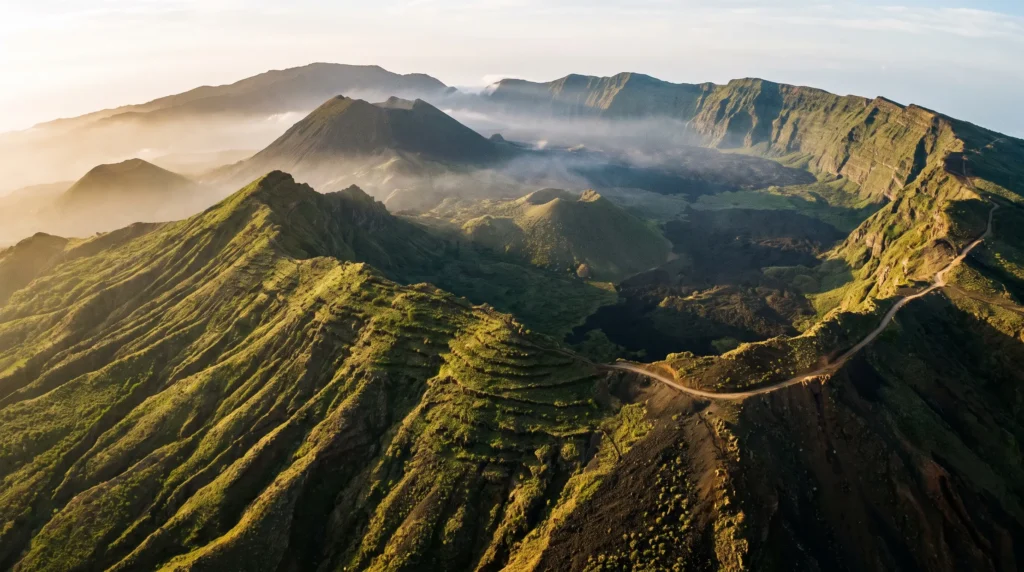
An active volcano you can sleep inside. Pico do Fogo, at 2,829 metres, is Cabo Verde’s highest point, and the Chã das Caldeiras village sits inside its own caldera, growing volcanic-soil wine and coffee between eruptions. The most recent eruption, in November 2014–February 2015, destroyed the village’s houses and forced the evacuation of nearly a thousand residents, who have since rebuilt; guided summit hikes now run again, weather and volcanic activity permitting.
Santo Antão
The hiking island, and for many repeat visitors the best one. Deep green ravines, terraced valley farms, and trails linking villages like Ribeira Grande, Ponta do Sol and Fontainhas along cliff-hugging paths that were, until recently, the only way to get between them. Cool, cloud-wrapped and lush — bring layers, this is not beach weather.
São Vicente & Mindelo
The cultural capital. Mindelo’s colonial waterfront, colorful market, live-music bars and Carnival make it the country’s most atmospheric town, and the birthplace of Cesária Évora, whose airport now bears her name.
Maio, São Nicolau & Brava
The quiet islands, reached less often and rewarding those who make the effort — Maio’s undeveloped beaches, São Nicolau’s dramatic Monte Gordo massif, and Brava’s flower-covered hills, the smallest inhabited island and the most seldom visited.
Culture & People — Creole, Diaspora & Morabeza
Cabo Verde’s culture is Creole in the fullest sense — a genuine blend forged from Portuguese colonizers and enslaved West Africans brought through Cidade Velha from the 15th century onward, with Portuguese as the official language and Cape Verdean Creole (Kriolu) as the language of daily life, home and music.
One number changes how you understand the whole country: an estimated 700,000-plus people of Cape Verdean descent live abroad — chiefly in the United States (especially Massachusetts and Rhode Island), Portugal, France and the Netherlands — meaningfully more than the roughly 530,000 who live on the islands themselves. Remittances from that diaspora are a real pillar of the economy, and it shows in daily life: Cape Verdean-American slang mixed into Kriolu, hyphenated identities everywhere, and a national mood built partly around homecoming, absence and longing — which is precisely the emotional register of morna itself. Ask a local about morabeza (roughly, “warmth toward strangers”) and you’ll usually get a story, not a definition.
A Food Lover’s Guide to Cabo Verde
The national dish is cachupa — a slow-simmered stew of hominy corn, beans, and whatever meat or fish is on hand, eaten for dinner fresh (cachupa fresca) or the next morning pan-fried with a runny egg on top (cachupa refogada, the better version, and the one worth setting an alarm for). Every household and every restaurant has its own version, and arguing about whose is best is a national pastime.
Seafood is excellent and cheap away from the resort strips — grilled tuna, moray eel stew, octopus salad and lobster feature constantly, especially on São Vicente and Santiago. Try pastel com diabo dentro (“pastry with the devil inside”), a fried tuna-and-onion turnover from São Vicente, and grogue, the fiery local sugarcane spirit distilled mostly on Santo Antão and Fogo, often flavored with honey (ponche) as an after-dinner digestif. Fogo also produces genuinely good volcanic-soil wine — a rarity for West Africa, and worth a tasting if you make it to Chã das Caldeiras.
Off the Beaten Path
Fontainhas, Santo Antão
A cliffside village so vertiginously perched it looks photoshopped — reachable only on foot or by the roughest of tracks, and one of the most rewarding short hikes in the archipelago.
Chã das Caldeiras, Fogo
Sleep in a guesthouse inside an active volcano’s crater, hike Pico do Fogo before dawn for the sunrise, and taste wine grown in the ash that nearly destroyed the village a decade ago.
Tarrafal, Santiago
A palm-lined bay at the island’s northern tip, best known for a former Portuguese political prison — now a sobering museum — and some of Santiago’s calmest swimming water.
Brava
Reached only by an unreliable ferry from Fogo, this is Cabo Verde’s least-visited inhabited island: flower-covered volcanic hills, a near-total absence of tourist infrastructure, and the sense of having found something almost nobody else bothers to.
Practical Information
Money. The Cape Verdean escudo is fixed at 110.265 to the euro, backed by a Portuguese credit facility, which keeps it stable and predictable. Euros are widely accepted in resort areas on Sal and Boa Vista; elsewhere, carry escudos in cash — ATMs are common in towns but scarce on smaller islands. Entering or leaving with more than roughly 1,000,000 CVE (about US$10,600) in cash must be declared.
Safety. Cabo Verde is generally considered safe for travelers, but street crime — pickpocketing and bag-snatching — occurs in Praia, Mindelo, and the busier tourist zones of Sal and Boa Vista; keep valuables out of sight in cities and at unsupervised beaches. Ocean currents around the islands are genuinely strong — swim at lifeguarded beaches where possible and take local warnings about riptides seriously.
Health. No yellow fever vaccination is required for direct travel from the US or Europe, though it is required if arriving from a yellow-fever risk country; routine vaccines plus hepatitis A/B and typhoid are commonly recommended, and there’s no meaningful malaria risk on the islands. Medical facilities are basic outside Praia and Mindelo, and UK/EU health cards aren’t accepted, so proper travel insurance is essential rather than optional.
Connectivity. A local SIM or regional eSIM covers the main islands reasonably well; Wi-Fi is common in Sal/Boa Vista resorts, patchier on Santo Antão and Fogo. Plugs: European-style two-pin, 220V. Time zone: UTC-1, no daylight saving.
Budget Breakdown — What Cabo Verde Actually Costs in 2026
Cabo Verde sits mid-pack for West Africa/Atlantic islands — pricier than mainland West Africa, generally cheaper than the Canaries or Cape Town for comparable resort quality, and cheapest of all once you’re away from Sal and Boa Vista’s package-tour infrastructure.
Budget (US$50–90/day): Guesthouse (residencial) on Santo Antão or Santiago, cachupa and aluguer travel, local grogue over imported spirits.
Mid-range (US$120–220/day): Boutique hotel or apart-hotel on São Vicente or Fogo, restaurant dinners, one inter-island flight, a guided Pico do Fogo hike (~US$60–90 with a mandatory local guide) or a Santo Antão trekking day.
Luxury (US$350+/day): All-inclusive beachfront resort on Sal or Boa Vista, private tours, water sports packages, and the odd charter flight to skip a ferry crossing entirely.
Fixed costs to expect: the EASE security fee at entry, a mandatory local guide fee for the Fogo volcano summit, and 220V-outlet adapters if you’re not traveling from continental Europe. Tipping 10% is appreciated in restaurants, not obligatory.
Planning Your First Trip to Cabo Verde
The realistic first-timer split is beach + interior: fly into Sal or Boa Vista for three or four nights of guaranteed sun and kitesurfing, then take a domestic flight to São Vicente for Mindelo’s music and a ferry across to Santo Antão for three nights of hiking Fontainhas and the Ribeira Grande valleys. Ten days covers that comfortably; add Fogo if you can stretch to two weeks, since getting there and back eats a day on either end. Pair the trip with our Senegal travel guide for a mainland West Africa add-on (Dakar is under two hours from Praia by air), our Morocco travel guide for another Atlantic-Africa contrast, or our Portugal travel guide if you’re tracing the colonial and diaspora threads that run through Cabo Verde’s history and its escudo’s peg to the euro.
Frequently Asked Questions
Is Cabo Verde safe for tourists in 2026?
Generally yes — the resort islands and main towns are relaxed, and violent crime against tourists is rare. Petty theft happens in Praia, Mindelo and busy beach areas, so keep bags zipped and don’t leave valuables on the sand; strong ocean currents are a bigger practical risk than crime for most visitors.
Do I need a visa for Cabo Verde?
US, UK, EU, Canadian and many other passport holders don’t need a traditional visa for stays up to 30 days, but everyone must pre-register through the online EASE system and pay a small airport security fee before arrival — don’t skip this step assuming you’ll sort it at check-in.
Which island should I pick if I only have one week?
Sal or Boa Vista if you want pure, low-logistics beach time. São Vicente plus a Santo Antão day trip if you want a taste of both music-and-culture and hiking without full island-hopping stress.
Can I really hike an active volcano?
Yes — Pico do Fogo is climbed regularly with mandatory local guides from Chã das Caldeiras, the village inside its caldera. The 2014–2015 eruption was serious and destructive, so always check current activity status and go with an established local guide rather than freelancing it.
How do I get between the islands, and is it reliable?
Domestic flights and ferries connect the main islands, but schedules are thin and weather-dependent — book early, expect occasional cancellations or reshuffles, and never schedule an inter-island hop for the same day as an international flight home.
What’s the food like if I don’t like seafood?
Cachupa, the national corn-and-bean stew, is usually made with pork or chicken as much as fish, and it’s the dish to try regardless — order it “refogada” (pan-fried, with an egg) for breakfast at least once.
Ready to Explore Cabo Verde?
Ten islands, one currency pegged to the euro, and enough contrast between them to fill three separate trips — resort beaches on Sal, an active volcano you can sleep inside on Fogo, and cliffside villages on Santo Antão that look unreal until you’re standing in one. Cabo Verde rewards travelers who slow down and pick a handful of islands rather than chasing all ten — book the inter-island logistics with slack, and let morna do the rest.
Explore More
- Senegal Travel Guide — the nearest mainland West African neighbor, under two hours from Praia
- Morocco Travel Guide — another Atlantic-facing corner of Africa
- Portugal Travel Guide — the colonial and diaspora thread running through Cabo Verde’s history
- Ghana Travel Guide — more West African coast and history
How this guide was built
Published as part of Facts From Upstairs’ country guide series. Built from authoritative sources — Wikipedia entity pages for Cabo Verde, Cidade Velha, the Cape Verdean escudo, the Cape Verdean diaspora, Pico do Fogo, the 2014–2015 Fogo eruption and Amílcar Cabral International Airport; UNESCO’s Intangible Cultural Heritage listing for morna; the official Cabo Verde EASE entry-registration portal; the official Cabo Verde tourism board (visit-caboverde.com); the US State Department’s Cabo Verde country page; the UK FCDO’s Cape Verde travel advice; and the US CDC’s Cape Verde traveler health page. Numeric claims carry inline citations.
Sources cited on this page
- Wikipedia — Cabo Verde
- Wikipedia — Cidade Velha
- Wikipedia — Cape Verdean escudo
- Wikipedia — Cape Verdean diaspora
- Wikipedia — Pico do Fogo
- Wikipedia — 2014–15 Fogo eruption
- Wikipedia — Amílcar Cabral International Airport
- UNESCO ICH — Morna, musical practice of Cabo Verde
- EASE — Cabo Verde electronic entry authorization
- Visit Cabo Verde — official tourism board
- US State Department — Cabo Verde
- UK FCDO — Cape Verde travel advice
- US CDC — Cape Verde traveler page
More country guides you might like
Plan your trip to Cabo Verde
The booking tools we use ourselves. FFU may earn a commission at no extra cost to you.
Plan & book your trip to Cabo Verde
Booking through these searches supports our guides at no extra cost to you.