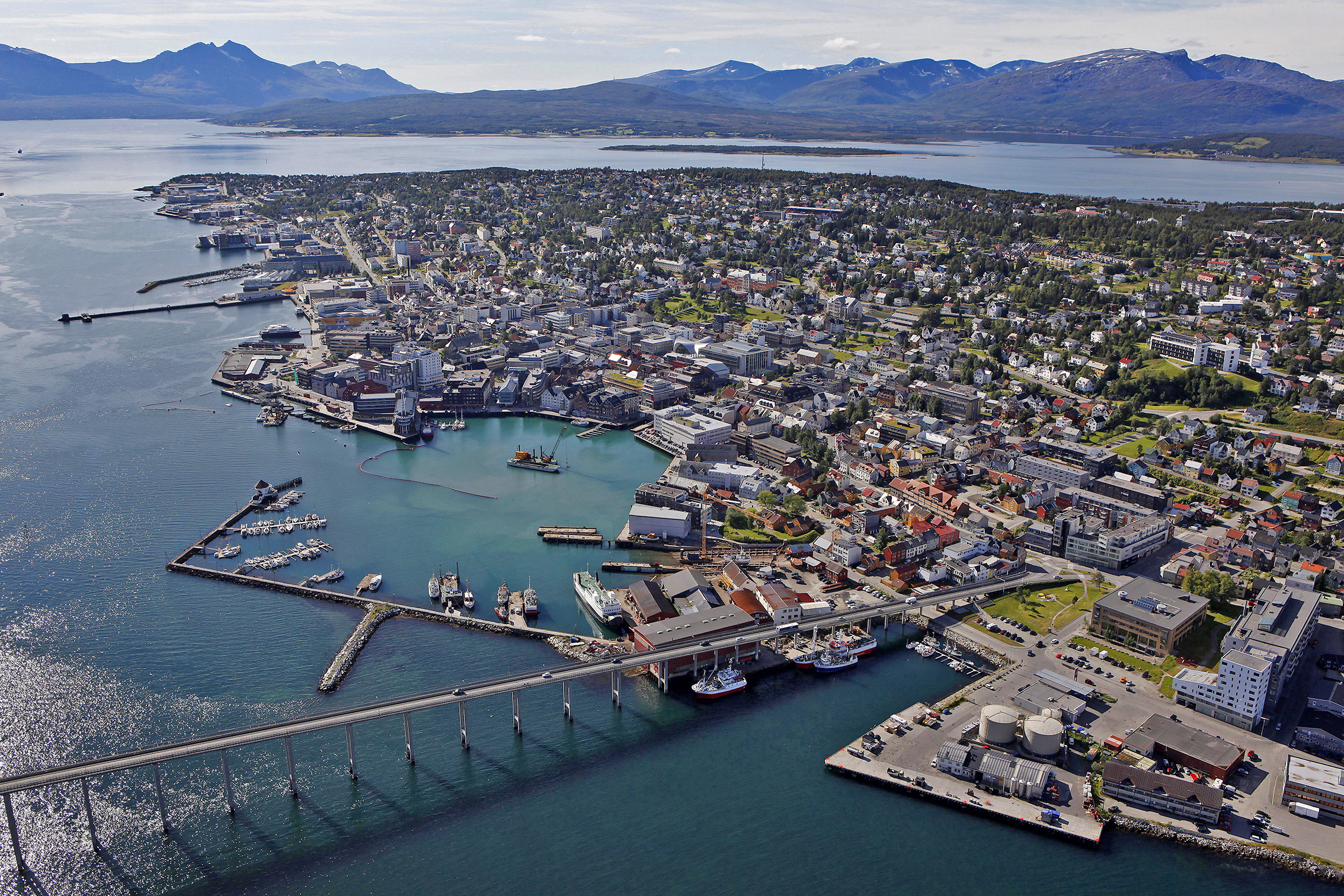
Experience the aurora borealis and meet Arctic whales at Earth’s northern edge
Facts From Upstairs Travel | 8-minute read | Updated March 2026
69°N
Latitude (Inside Arctic Circle)
65-200km
Northern Lights Visible Range
8
Whale Species in Waters
150 days
Polar Night (November-January)
Tromsø sits inside the Arctic Circle at 69 degrees north latitude, closer to the North Pole than to Oslo. The city shouldn’t exist here—the northernmost permanent settlement of its size, perched on islands where Arctic waters flow past mountains capped in snow. Yet it thrives as a genuine Arctic metropolis, home to 77,000 people who embrace rather than merely tolerate their extreme location. Tromsø is where the Northern Lights shimmer across winter skies, where whales break through dark waters, where the midnight sun blazes continuously in summer, and where the polar night stretches through autumn and winter.
The city’s appeal lies in its fundamental difference from southern existence. Up here, your relationship with light transforms. Winter darkness becomes profound yet beautiful. Summer perpetual daylight becomes disorienting then meditative. Arctic wildlife congregates in these waters in surprising abundance. The experience reaches beyond tourism into genuine transcendence—you’re witnessing Earth’s most dramatic atmospheric and celestial phenomena, swimming alongside creatures of mythic proportion, and living for a time in a place where human civilization seems almost incidental to nature’s overwhelming power.
The Northern Lights aren’t guaranteed—they’re a solar phenomenon dependent on coronal mass ejections and geomagnetic storms. A night photographed perfectly on Instagram might leave the next night completely dark. The aurora borealis rewards patience and acceptance of uncertainty.
The Northern Lights exist in scientific understanding as plasma emissions created when solar wind particles collide with Earth’s magnetosphere, ionizing atmospheric gases and producing visible light. But descriptions collapse when confronted with the actual experience. The aurora borealis isn’t static. It dances. It pulses. It expands and contracts across the sky like a living entity. Emerald green is most common, but violet purples, deep blues, and occasional reds appear. The lights flicker silently, generating emotional responses that people often describe in spiritual language regardless of their atheism or religious conviction.
Seeing the Northern Lights requires being outside in Arctic cold during dark months (September through March, with peak activity December-February). Tromsø offers prime viewing because of its latitude and relatively clear skies compared to further north. Guided tours, which constitute the practical approach for most visitors, drive into wilderness away from light pollution. You stand in cold that becomes physically intense—typically minus 10 to 20 Celsius—waiting for the sky to activate. Some nights nothing appears. Other nights, the entire sky erupts. The unpredictability is part of the experience.
The moment the first visible ribbons appear feels like witnessing a miracle. Your guides, who’ve seen the lights thousands of times, share your excitement. Other viewers, international travelers from dozens of countries, react simultaneously with gasps and reverence. Language disappears. The lights dominate awareness absolutely. Time becomes either frozen or meaningless.
✨
Fun Fact: The Northern Lights result from solar wind—particles streaming from the sun at approximately 400 kilometers per second. When these collide with Earth’s magnetosphere, they create cascades of ionization. Aurora activity increases during solar maximums (11-year cycles). We’re currently at the peak of a solar maximum, making 2025–2027 an exceptional window for viewing. In 2026, conditions remain ideal for Northern Lights sightings.
Pro Tip: Book multiple nights of aurora tours. Even at peak season, clear skies don’t guarantee lights. Many operators offer refund policies if lights don’t appear. Use the waiting nights productively—enjoy Tromsø’s restaurants, museums, and culture. The hours between 10 PM and 2 AM offer best viewing probability. Stay outside even when clouds appear—they can part suddenly.
Whale Watching: Arctic Titans
Tromsø’s waters contain eight whale species, of which humpback whales and orca (killer whales) are most commonly observed. Whale watching tours operate from October through January, timing when whales migrate into these waters following herring and other fish. The contrast between Arctic water (near freezing) and these massive warm-blooded creatures creates a visceral sense of nature’s paradoxes. Whales that can dive 500 meters deep and survive crushing pressure choose to surface near boats where tourist cameras await.
Humpback whales, reaching 16 meters in length and weighing 40 tons, breach dramatically—launching their enormous bodies partially or fully from the water before crashing back with explosions of white water. The first breach you witness creates permanent memory. You suddenly understand why ancient peoples created mythologies around these creatures. The pure physical power, the apparent joy in the breaching motion, the intelligence implied in the deliberate behavior—all combine to transcend normal observation into genuine communion with another sentient being.
Orca, the ocean’s apex predators, hunt cooperatively with intelligence approaching primate levels. They coordinate herding tactics. They teach hunting techniques across generations. Watching orca move through Tromsø’s waters creates cognitive dissonance—you’re viewing dolphins (orca are dolphins taxonomically) that hunt with sophistication exceeding most human strategies.
Humpback Whales
Known for breaching and acrobatic behavior. Longest pectoral fins of any whale species. Migrate between Arctic feeding and tropical breeding grounds. Each individual has unique tail fluke patterns allowing researchers to track them across years and seasons.
Orca (Killer Whales)
Apex Arctic predators. Hunt cooperatively with tactics taught across generations. Highly intelligent, with distinct populations having different dialects and hunting strategies. Among the fastest swimmers in ocean ecosystems.
🐋
Fun Fact: Humpback whales migrate further annually than any other mammal—up to 25,000 kilometers roundtrip. Individuals tracked for decades return to exact same feeding and breeding territories, navigating by mechanisms science still doesn’t fully understand. Their songs, complex and evolving, are theorized to serve communication and mating functions.
Pro Tip: Dress in multiple layers and waterproof outerwear. Boats are exposed, and Arctic spray freezes on contact. Motion sickness medication helps—whale watching involves constant movement. Book tours departing in morning; afternoon returns become rough in Arctic seas. Bring high-speed cameras; whales don’t wait for perfect compositions.
Midnight Sun: Summer’s Perpetual Day
From May to July, Tromsø experiences the midnight sun—the sun never sets. The phenomenon results from Earth’s axial tilt; at this latitude during these months, the sun remains above the horizon continuously. The experience is disorienting then liberating. Midnight looks like 6 PM. Your body’s circadian rhythms become confused. Sleep becomes optional rather than necessary; you choose when to rest rather than darkness forcing the issue.
This creates unique opportunities. You can hike to panoramic viewpoints at 11 PM with full daylight. Restaurants operate in perpetual brightness. The psychological effect—constant light combined with cool temperatures—generates unusual energy states. Some find it exhilarating; others find it exhausting. Most find it both simultaneously.
The wildlife responds to perpetual daylight by becoming hyperactive. Birds never need to rest. Seals surface constantly. Fish feed throughout the night. Hikers can summit mountains at any hour. Bicyclists ride at midnight. The entire ecosystem shifts into a different operational mode.
☀️
Fun Fact: The midnight sun creates a phenomenon called the “blue hour”—the period around midnight when the sun reaches its lowest point, creating twilight-like conditions with unique color qualities. Photographers consider this the best light for landscape photography outside traditional golden hour.
Arctic Wildlife Beyond Whales
Tromsø’s ecosystem extends beyond whale waters. The surrounding landscape hosts Arctic foxes, white-tailed eagles, and during winter months, occasionally polar bears though these are rare near the city. The waters contain Arctic cod (used for traditional stockfish), halibut, and salmon. Seabirds include multiple eagle species, sea eagles, and various gull species. The biodiversity seems improbable given the extreme conditions—yet life proliferates.
Birdwatchers discover that migration patterns create temporary abundance. Certain species appear only during specific weeks, making seasonal timing crucial. The combination of ice-free harbor waters and nutrient-rich inflowing currents makes Tromsø an oasis of biodiversity in an otherwise hostile environment.
Dog sledding, a traditional Arctic activity still practiced commercially, offers intimate encounter with another Arctic adaptation. Sled dogs, bred and trained for harsh conditions, embody the intersection of animal and human Arctic cooperation. Modern recreational dog sledding feels anachronistic—you’re participating in transportation methods perfected over centuries—yet it remains profoundly connected to the landscape.
🦊
Fun Fact: Arctic foxes undergo seasonal color changes, transitioning from brown or blue-gray in summer to white in winter. This camouflage serves hunting and predator avoidance. Individuals can transition between color phases within a single season in response to unseasonable weather.
City Attractions: Culture & Warmth
Despite its Arctic location, Tromsø possesses genuine culture and warmth. The Arctic Cathedral, completed in 1965, features dramatic architecture designed to resemble an iceberg. Its interior contains stained glass and modern designs. The Tromsø Museum documents Sami indigenous culture, Viking history, and Arctic natural history. The Polaria aquarium, uniquely focused on Arctic ecosystems, educates visitors about conditions that define this region.
The University of Tromsø-Arctic University of Norway hosts Northern lights research and Arctic ecology studies. The combination of research institutions and tourism infrastructure creates intellectual energy alongside tourist amenities. Cafes and restaurants serve remarkably sophisticated cuisine given the remote location. Nightclubs and bars operate nightly. The city doesn’t apologize for its Arctic location—it celebrates it.
The population, though small by southern standards, includes people from across Scandinavia and beyond. This creates surprising cosmopolitanism. International researchers, tourists, and transplants blend with locals, generating cultural diversity unusual for high-latitude locations.
Pro Tip: Visit the Sami Parliament and learn about indigenous Arctic peoples whose culture predates Norwegian occupation by centuries. Sami traditions remain living culture, not historical artifact. Respectful engagement with Sami heritage deepens Arctic understanding. Many guides and tour operators are Sami; their perspectives enrich experience considerably.
Surrounding Landscape: Mountains & Fjords
Tromsø sits on islands surrounded by dramatic fjords and mountain ranges. The Grøtfjorden and Malangen fjords extend inland for kilometers, surrounded by steep mountains reaching 1,000 meters. These fjords remain navigable and less touristy than their southern counterparts. Hiking trails climb to ridge lines where visibility extends across the Arctic archipelago. The landscape’s immensity creates perspective—you become aware of your genuine smallness within such scale.
The surrounding mountains host unique ecosystems. Birch forests transition to sparse vegetation at higher elevations. Alpine tundra, despite harsh conditions, contains surprising biodiversity—mosses, lichens, low-growing plants adapted to extreme exposure. Winter transforms the landscape into monochromatic white broken only by dark rock. Summer reveals surprising color variation. Spring transitions arrive late but dramatically.
Accessibility to pristine wilderness defines the region. You can hike from the city center into arctic terrain within hours. The juxtaposition of urban amenities with immediate wilderness access, unusual in most locations, feels natural here—the city and surrounding landscape exist in functional balance.
◆
🏔️
Fun Fact: Tromsø’s islands and surrounding mountains contain glaciers, rare at sea level in Scandinavia. These glaciers are retreating due to warming Arctic temperatures. Viewing them provides physical evidence of climate change—the landscape transforming in observable ways within human timescales.
🧊
Fun Fact: Arctic sea ice extent varies dramatically seasonally. Winter ice can extend kilometers from shore. Summer melt creates open water allowing whale migration. This ice-water dynamic creates unique photographic opportunities—whales breaking through ice near Aurora Borealis conditions.
📡
Fun Fact: Tromsø’s latitude makes it ideal for radio astronomy. The Tromsø Geophysical Observatory conducts advanced atmospheric and space physics research. The absence of light pollution and unique atmospheric conditions create opportunities for observations impossible elsewhere.
Getting Around Tromsø
Tromsø is compact enough that the city center is walkable, with most attractions reachable on foot within 15–20 minutes. The main bridge connecting Tromsøya island to the mainland (where the Arctic Cathedral stands) is pedestrian-friendly, though the distance can feel longer in winter winds.
Local buses operated by Troms Fylkestrafikk connect the city center to surrounding areas including the cable car station and outlying neighborhoods. A single ticket covers most urban routes. For day trips to fjords or hiking trailheads, renting a car provides flexibility—roads are well-maintained even in winter, though winter tires are mandatory from November through April. Many tour operators provide hotel pickup for aurora chases and whale watching excursions.
Tromsø Airport (TOS) sits just 5 kilometers from the city center, reachable by airport bus in 15 minutes or taxi in 10. Direct flights connect Tromsø to Oslo, Bergen, and several European cities. The Hurtigruten coastal ferry also calls at Tromsø, offering a scenic alternative for those traveling along Norway’s coast.
Where to Eat & Drink in Tromsø
Arctic cuisine in Tromsø revolves around what the sea and surrounding wilderness provide. Stockfish (dried cod), king crab, and reindeer are staples that appear on menus ranging from casual bistros to fine dining establishments. The king crab, harvested from nearby Finnmark waters, is typically served simply—steamed or grilled with butter—letting the sweet, rich meat speak for itself.
For a memorable meal, several restaurants serve tasting menus built around seasonal Arctic ingredients. Whale steak (from minke whale, legally hunted in Norway) remains available at traditional restaurants, though opinions on consuming it vary. Reindeer stew and smoked Arctic char are universally appreciated local specialties worth trying.
Tromsø also boasts the world’s northernmost brewery—Mack Brewery, which has been producing beer since 1877. Their Arctic Beer and Mack Pilsner pair well with local seafood. The city’s cafe culture thrives despite—or perhaps because of—the long dark winters, with cozy establishments serving excellent coffee, cinnamon buns (kanelboller), and warm open-faced sandwiches.
Frequently Asked Questions About Tromsø
When is the best time to see the Northern Lights in Tromsø?
The prime aurora season runs from late September through late March, with peak darkness and activity from November through February. Clear skies are never guaranteed, so booking multiple nights increases your chances significantly.
How cold does it get in Tromsø during winter?
Winter temperatures typically range from minus 4°C to minus 15°C, though wind chill can make it feel considerably colder. Proper layering with thermal base layers, insulated mid-layers, and windproof outer shells is essential. Most tour operators provide or rent Arctic-grade outerwear.
Is Tromsø expensive to visit?
Norway is among Europe’s most expensive countries. Budget around 1,500–2,500 NOK per day for mid-range accommodation, meals, and activities. Aurora tours typically cost 1,000–1,500 NOK per person, and whale watching excursions run 1,200–1,800 NOK. Cooking some meals at your accommodation and using public transport helps control costs.
Can I see the Northern Lights from the city center?
Occasionally, strong aurora displays are visible from Tromsø itself, but city light pollution reduces visibility. Guided tours drive 30–60 minutes outside the city to darker locations where the aurora appears far more vivid and photographable.
What is the Polar Night like in Tromsø?
From late November through mid-January, the sun never rises above the horizon. However, this doesn’t mean total darkness—for several hours around midday, a blue twilight illuminates the landscape, creating ethereal light conditions. Locals embrace the period with candles, warm lighting, and social traditions that make the darkness feel atmospheric rather than oppressive.
Ready for Arctic Adventure?
Pack thermal layers, waterproof outer shells, and genuine Arctic-rated equipment. Book accommodations with views—many have heated glass igloos designed for aurora viewing while staying warm. Time your visit strategically: winter for lights and whales, summer for midnight sun. Prepare mentally for the Arctic’s humbling immensity. Tromsø rewards those willing to embrace extreme conditions with experiences transcending normal travel categories.