
FFU Editorial Note: Neighborhood character profiles are based on current operator listings, transit-time data, and on-the-ground observations from the editorial team. Hotel picks are listed at three price bands; specific properties are illustrative and listed in good faith — book through the partner of your choice. Last verified: 8 May 2026. This neighbourhood guide is part of our full Italy travel guide.
Where you sleep in Italy determines what trip you’ll have. Stay in Rome’s Trastevere and you’ll think Italy is medieval lanes and trattorias; stay in Prati and you’ll think it’s wide boulevards and apartment living. Same city. Same trip. Different memories. Below: neighborhood breakdowns for Rome, Florence, Venice, and the Amalfi Coast — by character, transport, and price band — plus a Tuscan countryside section for the agriturismo half of the trip.
Part of the FFU Italy cluster: Italy overview · 30 things to do · 10-day itinerary · Best time to visit
Rome — pick the neighborhood, not the hotel
Rome is a city where the neighborhood matters more than the property. A 4-star hotel in the wrong area will leave you in cabs all night; a 3-star apartment in the right area gives you the trip people remember. The four below cover most of what first-time travellers want.
Trastevere — the Rome of postcards
Vibe: Cobblestones, ivy-tangled walls, students on Vespas, restaurants spilling onto streets. Tiber-side. Genuinely walkable to the Vatican (25 min over Ponte Sisto) and to the Pantheon (15 min).
Best for: First-timers, romance, food-led travellers, people who want their photos to look like an ad. Lively at night.
Watch out: Friday and Saturday nights get loud — pick a hotel on a side street if you sleep light. Cars cannot reach many properties; expect to walk the last 200m with luggage.
Hotel picks (3 price bands):
- Splurge (€350+): Hotel de Russie’s smaller cousins; boutique 5-stars near Via Garibaldi.
- Mid (€150–€250): Hotel Santa Maria (cloister courtyard, central, family-run feel) — [TODO: Booking.com affiliate].
- Budget (€80–€140): Trastevere apartments via Booking — many family-run B&Bs available.
Monti — the cool-kid Rome
Vibe: Where Romans actually drink. Walk-able from the Colosseum and the Roman Forum. Tighter, hillier streets than Centro Storico; vintage shops and natural-wine bars.
Best for: Second-time visitors, design-leaning travellers, anyone who wants the Colosseum five minutes away without staying on the Colosseum’s tourist trap doorstep.
Watch out: Hilly — pulling a wheeled suitcase up Via dei Serpenti is a workout.
Hotel picks:
- Splurge (€300+): The Inn at the Roman Forum — actual Roman ruins under the lobby; rooftop view to the Forum.
- Mid (€140–€220): Hotel Forum, Hotel Antico Palazzo Rospigliosi.
- Budget (€80–€130): The Beehive (long-running boutique hostel/hotel hybrid; private rooms available).
Centro Storico (around the Pantheon and Piazza Navona) — historical core
Vibe: The postcard centre. Pantheon, Piazza Navona, Campo de’ Fiori. Walk to everything. Most expensive square footage in Rome.
Best for: Short trips (3–4 nights) where walking time matters · first-timers willing to pay a premium for proximity.
Watch out: Restaurants fronting major piazzas are tourist traps — walk one street back. Daytime crowds are dense; some hotels have small rooms.
Hotel picks:
- Splurge (€450+): Hotel de Russie, J.K. Place Roma, Six Senses Rome.
- Mid (€200–€330): Hotel Raphael, Albergo del Senato (Pantheon-facing rooms).
- Budget (€140–€190): Difficult — Centro Storico is structurally expensive. Consider Monti instead.
Prati — the quiet, grown-up choice
Vibe: Wide 19th-century boulevards behind the Vatican. Apartment buildings, family-run cafés, bakeries Romans actually use. The Vatican is 10 minutes’ walk.
Best for: Vatican-focused trips · families · returning travellers who want to live like a local for a week.
Watch out: Less atmosphere if you want medieval-Rome aesthetic. Restaurants are fewer at night than Trastevere.
Hotel picks:
- Splurge (€280+): Gran Meliá Rome (with Roman ruins in the garden).
- Mid (€140–€220): Hotel della Conciliazione, Hotel Bramante.
- Budget (€90–€140): Plenty of family-run B&Bs around Via Cola di Rienzo.
Florence — small enough that everywhere is walkable
Florence’s historic centre is compact — under 30 minutes’ walk corner to corner. The neighborhood you choose still shapes the trip: are you in the Renaissance set-piece or the artisan quarter?
Centro Storico (around the Duomo) — the postcard
Vibe: Renaissance Florence at full volume. Duomo at every glance. Tourist-heavy in daytime, magical at dawn and after 9pm.
Best for: First-timers, short stays, anyone who wants to walk down for an espresso with a Brunelleschi view.
Watch out: Most expensive square footage; trattorias near the Duomo are tourist-pricing; rooms can be small.
Hotel picks:
- Splurge (€450+): The St. Regis Florence, Hotel Savoy (Piazza della Repubblica).
- Mid (€200–€340): Hotel Brunelleschi (with Roman ruins in the basement museum), Hotel Pendini.
- Budget (€130–€180): Hotel Centrale, Hotel California — small but central.
Oltrarno / San Frediano — Florence’s artisan side
Vibe: Across the Arno from the Duomo. Workshops, leather artisans, Pitti Palace, Boboli Gardens, narrow streets, neighbourhood trattorias. Less hotel-heavy than the centre — more apartments and small B&Bs.
Best for: Returning travellers, food-led trips, anyone allergic to crowds. Walking the Ponte Vecchio every morning never gets old.
Watch out: Some streets get sleepy at night; not the place for late-night nightlife.
Hotel picks:
- Splurge (€500+): Hotel Lungarno (Arno-facing terraces), Portrait Firenze.
- Mid (€180–€280): Hotel Palazzo Guadagni (Santo Spirito-facing rooms), Hotel Silla.
- Budget (€110–€160): Soprarno Suites, Florence’s many B&Bs around Piazza Santo Spirito.
Santa Croce — neighbourhood feel, walkable centre
Vibe: The square in front of the Basilica di Santa Croce is one of Florence’s loveliest. Neighbourhood markets (Sant’Ambrogio is the locals’ market), great gelato, slightly less foot traffic than the Duomo.
Best for: Mid-length stays (4+ nights), travellers who want proximity to the centre but a touch more local feel.
Watch out: Some streets near the river get loud on summer weekends.
Hotel picks:
- Splurge (€380+): Hotel Plaza Lucchesi (Arno views).
- Mid (€170–€260): Hotel Monna Lisa (16th-century palazzo).
- Budget (€100–€150): Hotel Casci, Hotel Palazzo Ognissanti.
San Marco / Santissima Annunziata — quiet study-town Florence
Vibe: University quarter. Galleria dell’Accademia (the David) is here. Quieter at night, slightly cheaper, walking distance to everything.
Best for: Budget-conscious centre-stay, art-focused trips, families.
Watch out: Lacks the dense tourist energy of Centro Storico — that’s the point, but worth knowing.
Hotel picks:
- Mid (€140–€220): Hotel Loggiato dei Serviti (16th-century convent on Piazza Santissima Annunziata), Hotel Cellai.
- Budget (€90–€140): Hotel Orto de’ Medici, Hotel Casci, plenty of B&Bs.
Venice — stay in the city, not on the mainland
The single most important Venice rule: stay in the historic city, not in Mestre (the mainland) — unless you’re doing it deliberately for Carnevale-week pricing. Venice empties at night when the day-trippers leave; that’s the experience you came for, and you’ll miss it from the mainland.
San Marco — central, expensive, busy
Vibe: The set-piece. St. Mark’s Basilica, Doge’s Palace, the Campanile. Most expensive sestiere; daytime crowds are the densest in Italy.
Best for: Short trips (1–2 nights), anyone who wants to walk out the door into the Piazza in the morning before the cruise crowds.
Watch out: Acqua alta (autumn high tides) hits San Marco hardest. Many cafés on the square charge €15+ for an espresso.
Hotel picks:
- Splurge (€600+): Hotel Danieli, The Gritti Palace, Hotel Cipriani (across at Giudecca).
- Mid (€220–€380): Hotel Flora (interior garden), Locanda Casa Petrarca.
- Budget (€140–€200): Hotel al Codega, Hotel Bonvecchiati.
Cannaregio — the locals’ Venice
Vibe: Northern sestiere. The historic Jewish ghetto, fondamenta-side aperitivo bars, fewer tourists, easy reach of the train station and St. Mark’s by foot.
Best for: Returning visitors · longer stays · travellers who want to drink Spritz at a fondamenta bar at 7pm without queueing.
Watch out: Some far-northern alleys get sleepy late at night.
Hotel picks:
- Splurge (€450+): Hotel Heureka (canal-facing palazzo).
- Mid (€180–€280): 3749 Ponte Chiodo (genuine local-host B&B), Hotel Antico Doge.
- Budget (€110–€160): Hotel Bernardi, Hotel Antiche Figure (next to the train station for early-morning departures).
Dorsoduro — the bohemian side
Vibe: Across the Grand Canal from San Marco, between the Accademia and the Punta della Dogana. The Peggy Guggenheim Collection, university students, Squero di San Trovaso (working gondola yard).
Best for: Art-led trips, mid-length stays, slightly quieter Venice with everything in walking range.
Watch out: Some streets get tight at peak hours.
Hotel picks:
- Splurge (€500+): Ca’ Maria Adele, Sina Centurion Palace.
- Mid (€200–€330): Hotel American-Dinesen (canal-side, classic), Hotel Galleria.
- Budget (€130–€180): Hotel Tivoli, Pensione Accademia (Villa Maravege — Accademia-bridge-facing).
Castello — quietest sestiere
Vibe: Eastern sestiere. The Arsenale, the Biennale gardens, the Riva degli Schiavoni promenade. Less tourist-dense than San Marco but still 10 minutes’ walk to it.
Best for: Biennale visits, longer stays, neighborhood-feel travellers.
Watch out: Far-eastern Castello is sleepy and far-walked from major sights.
Hotel picks:
- Splurge (€400+): Metropole, Hotel Londra Palace.
- Mid (€180–€280): Hotel Bucintoro (lagoon-facing rooms).
- Budget (€110–€160): Casa Querini, family-run B&Bs near Campo Bandiera e Moro.
Say it like a local. Lost between canals? Scusi, dov’è Rialto? works for any landmark. Practise it out loud with Maya on a free phone class, no app needed: book your free class. All six Italy phrases: watch the series. Maya is an AI language coach; this video is AI-generated.
Amalfi Coast — pick your village, not just the coast
“Amalfi Coast” is shorthand for half a dozen distinct villages strung along a 50-km road. Where you base shapes the entire stay — drive times between villages are 25–60 minutes in summer traffic. Below: the four most useful bases.
Positano — the iconic, the expensive
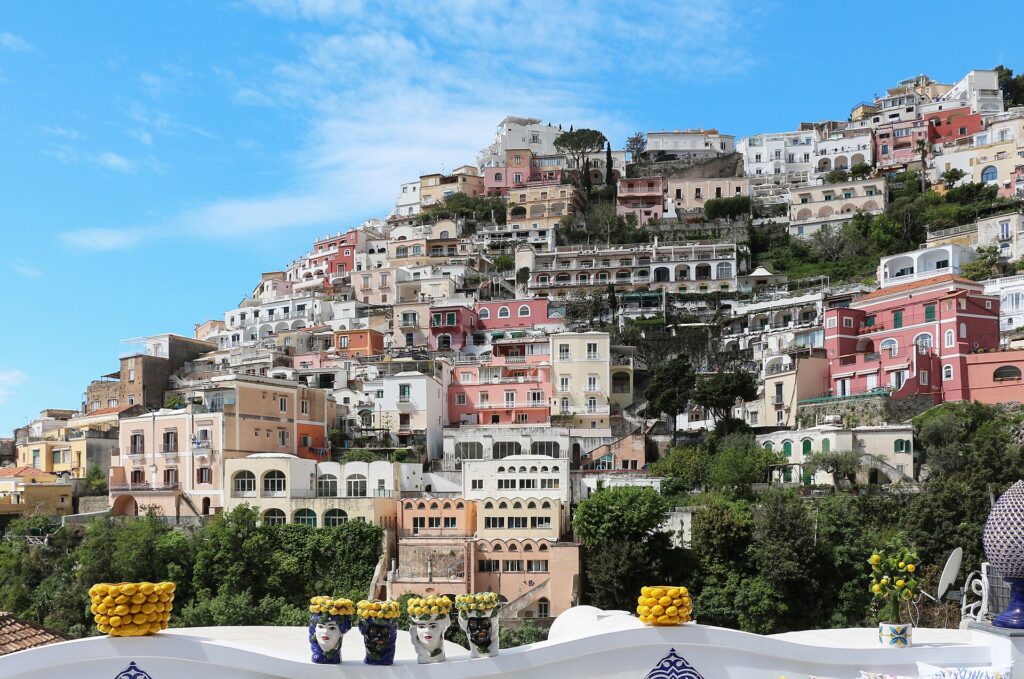
Vibe: The cliff-stacked pastel village every Amalfi photograph is taken in. Stairs everywhere — staying low to the beach means more privacy and a lift ride to dinner; staying high means views and 200 steps to the water.
Best for: First-timers, honeymooners, travellers prioritising visuals.
Watch out: Most expensive village on the coast. Mid-summer crowds are heavy. Cars must park outside town and walk in or pay €40+/day.
Hotel picks:
- Splurge (€800+): Le Sirenuse, Il San Pietro di Positano.
- Mid (€280–€450): Hotel Marincanto, Casa Albertina.
- Budget (€180–€260): Pensione Maria Luisa, Hotel California Positano (limited budget options exist; book early).
Ravello — the quiet, perched, garden-and-music option
Vibe: 365m above the coast. Two famous garden villas (Villa Rufolo, Villa Cimbrone). The Ravello Festival’s outdoor concerts are world-class. Quietest of the major coast bases.
Best for: Returning travellers, music lovers (June–September festival), anyone wanting the coast view without the elbow-density.
Watch out: No beach in town — getting to the water is a 20-minute drive or shuttle.
Hotel picks:
- Splurge (€700+): Belmond Hotel Caruso, Palazzo Avino.
- Mid (€260–€400): Hotel Villa Maria, Hotel Rufolo.
- Budget (€150–€220): Hotel Toro, B&B Casa Mannini.
Amalfi (the town) — central, working, midline-priced
Vibe: The historic centre of the Amalfi Republic. Working harbour with ferries to Capri, Positano, Salerno. Cathedral steps as the social heart. More mid-priced hotels than Positano.
Best for: Mid-budget travellers, people prioritising ferry connections, families.
Watch out: The town’s main beach is small and gets busy.
Hotel picks:
- Splurge (€500+): NH Collection Grand Hotel Convento di Amalfi (cliff-edge, former monastery).
- Mid (€220–€340): Hotel Luna Convento, Hotel Marina Riviera.
- Budget (€130–€200): Hotel Fontana, Hotel La Bussola.
Praiano — Positano’s quieter, cheaper neighbour
Vibe: 6 km west of Positano. Less photogenic than Positano but a 10-minute bus to it; 20% cheaper hotels for similar views; one of the coast’s only flat-ish villages.
Best for: Budget-conscious Amalfi trips, families, returning travellers.
Watch out: Fewer restaurant options than Positano or Amalfi town. Beach is small and reached by stairs.
Hotel picks:
- Splurge (€500+): Casa Angelina (architectural design hotel).
- Mid (€220–€340): Hotel Onda Verde, Hotel Margherita.
- Budget (€140–€220): Hotel Costa Diva, several family-run B&Bs.
Tuscan countryside — agriturismi, villas, and Val d’Orcia
If you have 4+ nights in Tuscany, split your stay: 2 nights in Florence and 2+ nights at an agriturismo (working farm with rooms) in the countryside. The countryside is the version of Tuscany every traveller imagines — not the cities.
Chianti — between Florence and Siena
Vibe: The classic Tuscan landscape — vineyards, cypress-lined drives, hilltop towns (Greve in Chianti, Castellina, Radda). 45 minutes by car to Florence, 30 minutes to Siena.
Best for: Wine-led trips, first-time agriturismo, drivable centre for day trips.
Hotel picks:
- Splurge (€500+): Castello di Ama, Borgo San Felice, Castello Banfi.
- Mid (€220–€360): Villa Le Barone, Castello di Spaltenna.
- Budget (€130–€200): Most working agriturismi (Fattoria Casa Sola, Fattoria di Lamole) — book direct.
Val d’Orcia — south Tuscany’s photo-postcard
Vibe: UNESCO World Heritage landscape. Pienza, Montalcino, San Quirico d’Orcia. The cypress-line image you’ve seen is here. 90 minutes by car from Florence, 75 minutes from Siena.
Best for: Photography-led travellers, Brunello drinkers, returning Tuscany visitors.
Hotel picks:
- Splurge (€600+): Castiglion del Bosco, Rosewood Castiglion del Bosco, Locanda dell’Amorosa.
- Mid (€220–€360): Borgo Lucignanello Bandini, Hotel Adler Spa Resort Thermae.
- Budget (€130–€200): Many family-run agriturismi around Pienza and Montepulciano.
Booking strategy
4–6 months ahead
For Amalfi Coast in May–September, Venice during Carnevale or the Biennale, and Florence in May or October — book at this lead time or earlier. Best-value rooms (with views, balconies, or in family-run favourites) sell out first. Refundable rates from Booking.com or hotel-direct cost ~10% more but worth it.
6–8 weeks ahead
For Rome and Florence in shoulder season (March, late October, November), and Tuscan countryside agriturismi in any season — this lead time still gives you choice. By 6 weeks out, the most-booked properties are gone but mid-band hotels remain available.
2–3 weeks ahead
Possible for Rome, Milan, and Naples in winter (January, February, November) — and you can score real bargains. Avoid this lead time for any coastal destination in summer or any city during a known event week.
Day-of
Possible in winter low-season cities. Don’t try it in Florence in May, Rome at Easter, Venice during Carnevale, or anywhere on the Amalfi Coast in summer — you will end up sleeping in Mestre, Tivoli, or Salerno.
FAQ
What’s a typical mid-range hotel cost in Italy in 2026?
For a standard double in mid-band 3- and 4-star properties: Rome and Florence centre €180–€280 in May/September; €230–€350 in July; €130–€200 in November–February. Venice runs 20–30% higher in any season. Tuscan agriturismi €130–€220 throughout the year. Amalfi Coast properties run double the equivalent Rome property in peak season.
Should I rent a car?
For Tuscany, the Dolomites, Puglia, and Sicily — yes, essential. For Rome, Florence, Venice, Naples — no, never. For the Amalfi Coast — only if you’ve driven serpentine cliff roads before; otherwise use the SITA bus and ferries. Be aware of ZTL zones (Zona a Traffico Limitato) in every Italian city centre — entering one in a non-resident car triggers an automatic €100+ fine, even if you immediately turn around. Hotels in ZTL zones can register your plate for legitimate access; ask before driving in.
Is an agriturismo the same as a B&B?
No. Agriturismo is a legal designation for a working farm that takes overnight guests; the property must derive a majority of its income from agriculture. Most produce their own wine, olive oil, or food. Many include breakfast and offer optional dinner with the family. They’re concentrated in Tuscany, Umbria, and Puglia. A B&B is a smaller-scale guesthouse without farm requirements; common everywhere.
Are short-term rentals legal in Italy?
Yes, with conditions that have tightened in 2024–2026. As of 2024 every short-term rental in Italy needs a CIN (Codice Identificativo Nazionale) registration number that must be displayed on listings and at the property. Rentals without CIN can be fined and legally shut down — check for the CIN on your booking. Florence has paused new rental licences in the historic centre. Venice has its own contributo di soggiorno system. Booking through Airbnb or Booking.com is generally safe; the CIN check is on the host, not you.
What about families with kids?
For Rome, choose Prati or Trastevere over the dense Centro Storico. For Florence, San Marco or Santa Croce over the centre. For Venice, look for hotels with family rooms in Cannaregio or Castello (San Marco hotels are mostly small-room European doubles). For the Amalfi Coast, Praiano or Amalfi town beat Positano (Positano’s stairs are a workout with strollers). For Tuscany, agriturismi with pools are the obvious move — many have onsite kitchens or pizza nights.
What about traveller-couples without kids?
Lean into smaller properties: family-run boutique hotels, small B&Bs, restored palazzi. The 5–15 room properties give the best Italy experience. For honeymoons, Ravello, Florence’s Oltrarno, Venice’s Cannaregio, and Castiglion del Bosco in Val d’Orcia are the picks of pickers.
Continue planning: Italy overview · 30 things to do · 10-day itinerary · Best time to visit
FFU contains affiliate links. We earn a commission when you book through them — at no extra cost to you.
Plan your trip
- Tours & experiences: browse Italy tours and experiences on Klook.
- Airport pickup: pre-book an airport transfer with GetTransfer.
- Car hire: compare rental cars on GetRentacar.
- Bag storage: store your bags with RadicalStorage.
Disclosure: some links above are affiliate links — booking through them supports Facts From Upstairs at no extra cost to you.