
Beirut, Lebanon: The Phoenix City of the Eastern Mediterranean
I have watched the sun drop into the Mediterranean from a rooftop in Mar Mikhael, a cold Almaza in hand, while the call to prayer braided with a thumping bassline two streets over — and I understood, finally, why people who love Beirut talk about it the way they do. We rate it as the most contradictory, most alive city in the Levant: a place rebuilt from rubble more times than anyone can count, where French colonnades, Ottoman stonework and bullet-pocked towers share a single block. I want this guide to feel like a friend handing you their notebook — where to eat the best man’oushe before 9am, which neighbourhoods reward an aimless wander, and how to read a city that has survived war, a financial collapse and the catastrophic 2020 port blast and still throws the best parties in the region. Come hungry, come curious, and let Beirut surprise you.

Table of Contents
Why Beirut?
Beirut rewards the traveller who is comfortable with contradiction. One of the oldest continuously inhabited cities on earth, settled for more than five thousand years, it has been razed and rebuilt so many times that locals nicknamed it the Phoenix. Phoenician, Roman, Ottoman and French layers all surface within a few walkable kilometres along the Mediterranean.
With roughly 2.4 million people in its greater metropolitan area, Beirut is small enough to cross on foot yet dense enough to feel like several cities stacked together. Where Cairo overwhelms with scale and Istanbul with empire, Beirut sells intimacy and intensity: a glass tower beside a shrapnel-scarred facade, a sleek wine bar across from a 1960s falafel counter.
It is also a city defined by resilience. After the devastating 4 August 2020 port explosion — one of the largest non-nuclear blasts ever recorded — and an ongoing economic crisis, Beirut keeps reinventing itself, and its nightlife and food scene remain among the best in the Middle East.

Neighborhoods: Finding Your Beirut
📍 Beirut Map: Every Place in This Guide


Downtown (Beirut Central District)
Reconstructed after the civil war by Solidere, downtown pairs restored Ottoman and French-era buildings with the landmark Mohammad Al-Amin Mosque and the adjacent St George Cathedral — though many blocks were hit hard by the 2020 blast and remain in recovery.
- Mohammad Al-Amin Mosque
- Roman Baths ruins
- Nejmeh Square clock tower
Best for: history and architecture. Access: central and walkable from Martyrs’ Square.
Gemmayzeh & Mar Mikhael
The beating heart of Beirut’s nightlife and design scene, these adjoining districts climb a hill of staircases, galleries, natural-wine bars and restored heritage houses. Both were near the epicentre of the 2020 explosion and have led the city’s grassroots rebuild.
- Rue Gouraud bar strip
- St Nicholas Stairs
- Mar Mikhael wine bars
Best for: nightlife, cafes and indie shopping. Access: walkable from downtown; taxis everywhere.
Hamra
West Beirut’s intellectual core, Hamra grew up around the American University of Beirut, founded in 1866, and still buzzes with bookshops, theatres, students and round-the-clock cafes.
- Hamra Street shops
- AUB seafront campus
- Café Younes (1935)
Best for: students, bookshops and budget eats. Access: west of downtown; cheap taxi ride.
Achrafieh
The traditionally Christian east-side district is leafy and affluent, mixing 19th-century mansions on Sursock Street with the city’s glossiest malls and the restored Sursock Museum of modern art.
- Sursock Museum
- Saifi Village
- ABC Achrafieh mall
Best for: art, upscale dining and quiet streets. Access: east of downtown; walkable in parts.
Raouché & the Corniche
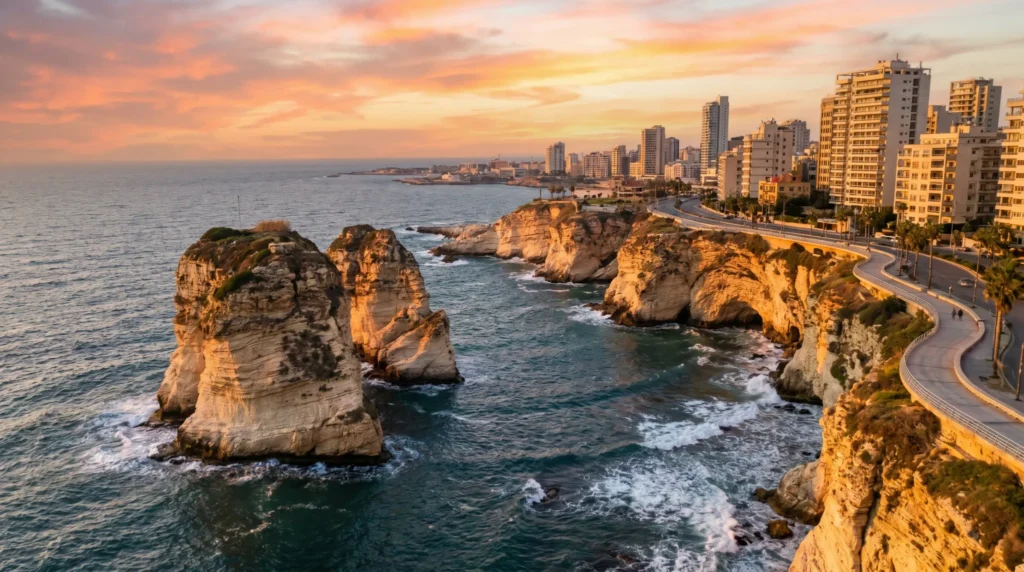
Beirut’s seafront promenade runs for kilometres past joggers, fishermen and argileh smokers to Raouché, where the offshore Pigeon Rocks are the city’s postcard landmark.
- Pigeon Rocks (Raouché)
- Manara Corniche walk
- Sunset cafe terraces
Best for: sunset walks and sea air. Access: follow the coast west from Ain el-Mreisseh.
The Food

Lebanese Mezze
Lebanese cuisine is built on the shared mezze table — hummus, tabbouleh, fattoush, moutabbal and dozens more small plates, ideally washed down with arak. Beirut does it better than anywhere.
- Tawlet — rotating regional home cooking buffet (~US$25)
- Em Sherif Cafe — classic Lebanese mezze (~US$30)
- Le Chef, Gemmayzeh — beloved old-school daily specials (~US$10)
Street Food & Bakeries
The man’oushe — flatbread baked with za’atar, cheese or minced meat — is the national breakfast, sold hot from neighbourhood furn (bakeries) across the city.
- Furn bakeries citywide — man’oushe za’atar (~US$2)
- Barbar, Hamra — falafel and shawarma (~US$4)
- Sahyoun, downtown — landmark falafel since 1933 (~US$4)
Beyond Mezze and Man’oushe
Save room for Lebanon’s legendary sweets and its surprisingly strong wine and arak culture, much of it from the nearby Bekaa Valley.
- Knafeh — cheese-and-semolina breakfast pastry (~US$3)
- Baklava — Abdul Rahman Hallab pistachio trays (~US$5)
- Arak — anise spirit poured over ice (~US$4)
- Sfiha — open-faced lamb mini-pies (~US$2)
Food Experiences You Can’t Miss
- A long mezze lunch at Tawlet, where the cook changes daily by region
- A morning man’oushe from a neighbourhood furn, eaten on the street
- A Bekaa Valley wine tasting paired with a Beirut dinner
Cultural Sights

National Museum of Beirut
Lebanon’s principal museum of archaeology, opened in 1942 and lovingly restored after the civil war, holds Phoenician sarcophagi, Roman mosaics and the famous Byblos gold figurines. Admission is roughly US$5; closed Mondays.
Sursock Museum
A 1912 Italianate villa in Achrafieh turned contemporary-art museum, badly damaged by the 2020 blast and reopened in 2023 after a careful restoration. Entry is free; closed Tuesdays.

Mohammad Al-Amin Mosque & the Roman Baths
The blue-domed Mohammad Al-Amin Mosque, completed in 2008, dominates Martyrs’ Square, while the excavated Roman Baths nearby are a free open-air reminder of Roman Berytus. Mosque entry is free; dress modestly.
Pigeon Rocks at Raouché
Two natural offshore arches off the Raouché cliffs are Beirut’s signature natural landmark, best seen at sunset from the Corniche cafes above. Free to view at any time.
Entertainment & Nightlife

Mar Mikhael & Gemmayzeh Bars
Beirut’s nightlife is legendary across the Middle East; the bars and natural-wine spots of Mar Mikhael and Gemmayzeh spill onto the stairs until dawn. Typical cocktail US$8–12. No booking needed midweek.
Rooftop & Beach Clubs
Summer brings rooftop bars and seaside clubs along the coast north of the city; expect a cover and dress code at the bigger venues. Entry from US$20.
Live Music & Theatre
Hamra’s theatres and small jazz venues such as Metro Al Madina keep an eclectic year-round programme. Tickets from US$10.
Beirut by Night Walks
The Corniche and the lit-up downtown mosque are free, atmospheric evening strolls when the heat finally drops.
Day Trips from Beirut

Byblos (1 hour by car)
One of the world’s oldest continuously inhabited towns and a UNESCO World Heritage site, with a Crusader castle, Phoenician ruins and a pretty fishing harbour.
Jeita Grotto & Jounieh (45 minutes by car)
The vast Jeita limestone caverns sit just above the Jounieh bay, reached by a cable car and a famous teleferique to the Harissa shrine.
Baalbek (2 hours by car)
The colossal Roman temple complex in the Bekaa Valley, including the best-preserved Temple of Bacchus, is among the greatest ruins in the world. Check advisories for the Bekaa first.
Cedars of God, Bsharri (2 hours by car)
A UNESCO-listed grove of ancient Lebanese cedars high in the mountains, near the Kadisha Valley.
Sidon & Tyre (1–1.5 hours by car)
Two ancient Phoenician port cities to the south, with sea castles, souks and Roman hippodromes.
Seasonal Guide
Spring (March – May)
The sweet spot: warm sunny days, wildflowers in the mountains and the sea warming up. My favourite time to visit.
Summer (June – August)
Hot, humid and crowded as the diaspora returns; beach clubs and rooftop parties run at full tilt.
Autumn (September – November)
Warm, dry and quieter after the summer rush — excellent for sightseeing and day trips before the rains.
Winter (December – February)
Mild but wet in the city, with snow in the nearby mountains — you can ski and swim in the same day.
Getting Around
On Foot
Central Beirut is compact and best explored on foot — downtown, Gemmayzeh, Mar Mikhael and the Corniche are all walkable, though pavements are uneven and traffic is assertive.
Shared & Private Taxis
The default way to move. A shared “service” taxi along set routes costs a fixed low fare; flag one and call your destination. Hail a private taxi for direct trips and agree the price first.
Ride-Hailing Apps
Bolt and Careem both operate in Beirut and remove the haggling — the easiest option for visitors, with in-app pricing.
Airport Access
- Taxi or ride-hail from Beirut–Rafic Hariri International (BEY) — ~20–30 minutes, around US$15–25
- Pre-arranged hotel transfer — ~20 minutes, US$20–30
- Flying in against a Do Not Travel advisory carries its own insurance and entry-rule implications — see Can You Fly to Beirut in 2026?
Buses
Aging public and private minibuses cover longer routes cheaply but have no clear timetables or maps; most visitors skip them.
Navigation Tips
Apps: Google Maps and Bolt. Beirut uses landmark-based directions rather than street numbers, so name a nearby building or junction to your driver.
Budget Breakdown: Making Your Dollars Count
| Tier | Daily | Sleep | Eat | Transport | Activities | Extras |
|---|---|---|---|---|---|---|
| Budget | US$40 | US$15 hostel | US$12 | US$5 service taxi | US$5 free sights | US$3 coffee |
| Mid-Range | US$90 | US$45 hotel | US$25 | US$10 ride-hail | US$10 | US$10 |
| Luxury | US$250 | US$150 hotel | US$60 | US$25 private taxi | US$30 | US$25 |
Where Your Money Goes
Dining and accommodation dominate; street food, free sights and shared taxis keep costs low. Prices fluctuate with the currency, so budget in US dollars and confirm rates on the day.
Money-Saving Tips
- Eat man’oushe and falafel from neighbourhood bakeries for US$2–4
- Use shared “service” taxis instead of private hires
- Visit free sights — the Corniche, Sursock Museum and Roman Baths
- For the full 2026 price list — man’oushe to hotel tiers — see What Beirut Costs in 2026
Practical Tips

Language
Arabic is official, but Beirut is famously trilingual — French and English are widely spoken, and locals often mix all three in a single sentence.
Cash vs. Cards
Bring US dollars in cash. Since the 2019 financial crisis, banks and ATMs are unreliable, cards are often refused, and many prices are quoted in dollars.
Safety
See exactly what the current advisories say, area by area. Check your government’s current travel advisory before and during your trip — advice for Lebanon changes with the regional situation, and some areas are flagged for caution. Petty crime is low; political tension is the bigger variable.
What to Wear
Beirut is liberal and fashion-conscious; dress as you would in any Mediterranean city, but cover shoulders and knees when visiting mosques.
Cultural Etiquette
Hospitality is intense — expect to be offered coffee and food. A light tip (around 10%) is appreciated in restaurants.
Connectivity
Buy a local Alfa or touch SIM at the airport for cheap data; power and internet cuts are common, so a power bank is wise.
Health & Water
Drink bottled or filtered water only, and carry any prescription medication with you, as pharmacy supplies can be patchy.
Power Cuts
Mains electricity runs only part of the day; most hotels and venues switch to private generators, but expect occasional brief outages.
Frequently Asked Questions
How many days do I need in Beirut?
Three to four days: two for the city’s neighbourhoods, food and nightlife, and one or two for day trips to Byblos, Jeita or Baalbek.
Is Beirut good for solo travellers?
Yes for confident travellers — locals are welcoming and English is common — but check current advisories, keep cash discreet and stay aware of the political situation.
Do I need cash or can I use cards in Beirut?
Carry US dollars in cash. Since the financial crisis, cards and ATMs are unreliable and many businesses prefer or require cash.
What about the language barrier?
Minimal — French and English are widely spoken alongside Arabic, especially in tourist areas, cafes and hotels.
When is the best time to visit?
Spring (April–June) and autumn (September–October) offer warm, dry weather with fewer crowds than the humid summer peak.
Is it safe to visit Beirut right now?
It varies — always read your government’s current Lebanon travel advisory, as guidance shifts with the regional situation.
Can I do day trips to Byblos and Baalbek?
Byblos and Jeita are easy, popular northbound day trips; Baalbek in the Bekaa Valley is spectacular but check advisories for that region first.
Ready to Experience Beirut?
Check the advisories, pack small dollar bills, and let the Phoenix city surprise you. For the full country context, read the Lebanon Travel Guide.
Explore More City Guides
Where to Stay

About This Guide
Written by the FFU Editorial Team · AI-assisted research, human-verified. Beirut is one of the destinations FFU covers in the greatest depth, precisely because an honest visit here requires the fullest possible context. For the current advisory situation and full country background, read the Lebanon Travel Guide.
More city guides you might like
Plan your trip to Beirut
The booking tools we use ourselves. FFU may earn a commission at no extra cost to you.
Plan & book your trip to Beirut
Booking through these searches supports our guides at no extra cost to you.