
City Guide · Central Valley, Costa Rica
San José, Costa Rica: The Central Valley Capital of Pura Vida, Coffee Money Architecture, and Gold-and-Jade Museums
I will be honest with you the way I would be with my own family: most travellers treat San José as the place you land and leave, a one-night stopover between the airport and the rainforest. We think that is a mistake. The Costa Rican capital sits in a mile-high mountain bowl — about 1,170 metres up in the Central Valley — with a year-round spring climate that locals quietly consider the best weather in the country . The canton holds roughly 352,000 people, but the Greater Metropolitan Area that sprawls across the valley is home to over two million, more than half the nation . My favourite San José ritual is a 7am cortado in Barrio Escalante before the gold-and-jade museums open, then a slow afternoon walk through the coffee-money mansions of Barrio Amón. Treat this guide as the brief I would hand someone the night before they flew into Juan Santamaría — the National Theatre, the Pre-Columbian gold, the soda lunches, the day trips to volcanoes and cloud forest, and the honest practical realities of safety and transit .

Table of Contents
Why San José?
San José is the capital travellers love to skip, and the one that rewards anyone who slows down. It sits in the Central Valley — a fertile, mile-high mountain bowl at about 1,170 metres — which gives it a famously even, spring-like climate the rest of the country envies, with daytime temperatures hovering between roughly 21 and 24°C year-round . The city proper, the canton of San José, holds around 352,000 people, but it anchors the Greater Metropolitan Area (GAM) that spreads across the valley through Alajuela, Heredia and Cartago and is home to more than two million residents — well over half of Costa Rica’s population .
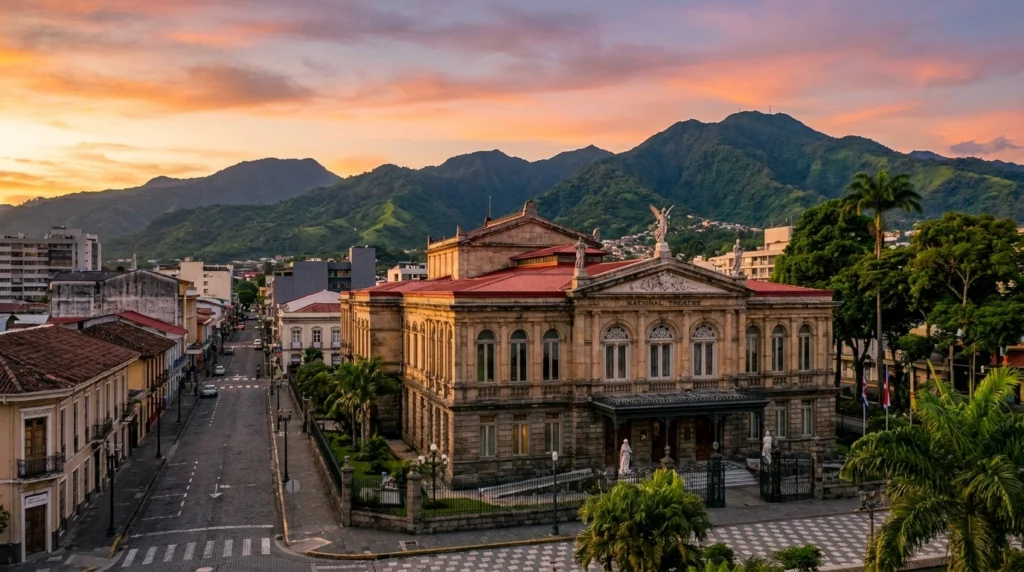
The city reads as a study in understatement. Costa Rica abolished its army in 1948 and poured the savings into education, healthcare and conservation, and San José wears that history quietly — this is a working Latin American capital of government ministries, universities and banks rather than a postcard old town . Its grandeur is concentrated and earned: the 1897 National Theatre, built with a tax the coffee barons levied on themselves, is one of the most beautiful buildings in Central America, and the museums beneath the Plaza de la Cultura hold the country’s pre-Columbian gold and the largest collection of American jade in the world .
What makes San José worth more than a stopover is the texture between the landmarks. The coffee-boom mansions of Barrio Amón, the gastronomic energy of Barrio Escalante, the noisy abundance of the Mercado Central, and the green expanse of La Sabana Metropolitan Park give the city a daily life that the tour buses rushing to the coast never see. Costa Rica’s national ethos — pura vida, the all-purpose phrase for taking life easy — is most visible not on a beach but here, in the unhurried way a soda owner serves a casado at noon or a family lingers in the park on a Sunday .
This guide covers the neighbourhoods you will actually walk, the sodas and Escalante restaurants worth seeking out, the museum-and-theatre core, the volcano and cloud-forest day trips that make San José the best launch pad in the country, and the honest practical realities: a Level 2 US travel advisory, real pickpocketing risk downtown, a chaotic bus system, and the cheap, easy fixes for all of it . Costa Rica’s dry season runs roughly December to April, when San José sees clear mornings and warm afternoons; the green season from May to November brings reliable afternoon downpours that rarely ruin a day if you plan around them.
One orientation point that changes everything: San José is laid out on a grid of avenidas (running east–west) and calles (north–south), but Costa Ricans navigate by landmarks and metres, not street numbers, so an address might read “north and east of the National Theatre.” Embrace it. Base yourself in the walkable Amón–Escalante–downtown corridor, give the city two unhurried days before you bolt for the rainforest, and you will discover the capital that most travellers never bother to meet. For the wider national picture, this guide pairs with our Costa Rica Travel Guide.
Getting There

Almost every visitor arrives through Juan Santamaría International Airport (SJO), about 20 kilometres northwest of downtown San José in the city of Alajuela. It is the busiest airport in Costa Rica and one of the busiest in Central America, handling roughly 6.2 million passengers in 2024, up about 7.7% on the previous year . It has long-haul links to the US, Canada and Europe plus regional Central American service. An official airport taxi (orange) to the centre runs about 30–45 minutes and roughly $25–35 depending on traffic; pre-booked private shuttles cost similar.
A second airport, Tobías Bolaños (SYQ) on the western edge of the city, handles domestic flights on Sansa to coastal destinations such as Quepos, Tamarindo and Tortuguero — useful if you are island-hopping the country by small plane rather than driving.
By road, San José is the hub of the national highway network and the terminus for nearly every long-distance bus line in the country. Companies such as Tracopa and the various regional operators run frequent, cheap coaches to the Pacific and Caribbean coasts, the volcanoes and the Nicaraguan and Panamanian borders from a scatter of terminals around the city centre . There is no inter-city passenger rail network of note, so buses and rental cars dominate onward travel.
Getting Around
San José’s compact historic core — the museums, the National Theatre, the Mercado Central and the main pedestrian avenue — is genuinely walkable, and most first-time visitors cover it on foot. Beyond the centre, the city relies on an extensive but confusing private bus network, abundant red taxis, ride-hailing apps and a limited commuter train. The single most useful habit is to navigate by landmarks rather than street numbers, because Costa Ricans give directions in metres from a known point, not by address .
Walking the Centre
The Avenida Central is partly pedestrianised through downtown, linking the Plaza de la Cultura (above the gold museum), the Mercado Central and the main shopping strip. The walkable core stretches east from there to Barrio Escalante and the National Museum, and north into the historic mansions of Barrio Amón — a circuit you can cover in a long morning. Streets are flat to gently sloping, but watch the pavements, which are uneven and broken in places, and keep valuables out of sight in crowds.
Buses
San José’s public buses are cheap (most central fares are well under a dollar) and frequent, but the network is run by many private operators with no unified map, and routes radiate from a confusing cluster of small terminals rather than one central station. They are best for set runs you can confirm in advance — to the airport, La Sabana or the suburbs — rather than for improvising. Pay the driver in small colón notes and keep your bag on your lap, as buses and the terminals around them are the city’s main pickpocketing hotspots .
Commuter Train (Tren Urbano)

INCOFER runs a modest commuter rail service across the Greater Metropolitan Area, connecting central San José with Heredia, Cartago, Alajuela and the western suburb of Pavas. It is cheap and useful at peak hours for valley commutes, but it runs limited frequencies and is not a tourist metro — treat it as a handy way to reach Heredia or Cartago rather than a way to get around the centre.
Taxis and Rideshare
Official taxis are red (airport taxis are orange) and legally required to run a meter, the maría; insist they use it or agree a fare first. A short cross-centre ride runs a few dollars. Uber and the local app DiDi both operate widely in San José and are popular with visitors for transparent pricing, though their legal status has been contested over the years — pickups still happen routinely. For the airport, the fixed-fare orange taxis or a pre-booked shuttle are the simplest.
Driving
A rental car is the standard way to explore the rest of Costa Rica, but it is more burden than help inside San José, where one-way grids, heavy congestion and scarce, pricey parking frustrate visitors. The sensible pattern is to see the city without a car, then pick up a rental on your way out to the volcanoes or coast — many agencies will deliver to your hotel or the airport.
Neighbourhoods: Where to Base Yourself
📍 San José Map: Every Place in This Guide
San José’s character shifts sharply from barrio to barrio, and choosing the right one shapes your whole stay. The downtown core is busy and businesslike by day and largely empties at night; the surrounding residential barrios are calmer, leafier and far more pleasant to sleep and eat in. Below are the five areas most first-time visitors actually consider, with an honest read on who each suits.


Barrio Amón
The capital’s most atmospheric district: a hillside of coffee-boom mansions from the late 1800s, many now boutique hotels, cafes and galleries. It is central, walkable to the museums, and full of character, with leafy streets and Belle Époque architecture. Best for a first visit who wants charm within walking distance of the sights; quiet at night, so look elsewhere for nightlife.
Barrio Escalante
The city’s gastronomic heart, a few blocks east of downtown around Calle 33 and the “Paseo Gastronómico”. It packs the best concentration of restaurants, craft-beer bars, third-wave coffee and a young, well-heeled crowd into a compact, safe, walkable grid. Best for food-focused travellers and anyone who wants a lively but relaxed evening; book ahead at the popular places on weekends.
Downtown (El Centro)
The historic and commercial core around the Plaza de la Cultura, National Theatre and Mercado Central. Unbeatable for daytime sightseeing on foot, but busy, noisy and largely deserted after dark, with the highest pickpocketing risk in the city. Stay here only if you prioritise being steps from the museums, and take normal big-city precautions, especially around the markets and bus terminals.
Los Yoses and San Pedro
East of Escalante, Los Yoses is a calm, upmarket residential barrio that blends into San Pedro, the university district around the University of Costa Rica. Together they offer leafy streets, good cafes, bookshops and a student nightlife, with quick access to the centre. Best for longer stays and travellers who want a local, lived-in neighbourhood feel.
Escazú and Santa Ana
The affluent western suburbs, about 20–30 minutes from the centre, are where much of San José’s expat and business community lives. Expect modern hotels, malls, international dining and a polished, suburban feel rather than old-city character. Best for business travellers, families wanting comfort and space, or anyone with a car — less ideal if you want to walk to the historic sights.
Food and Drink: Sodas, Casados and Costa Rican Coffee
Costa Rican food is honest, fresh and unfussy, built on rice, beans, plantain and whatever is in season, and San José is the best place in the country to eat across the whole spectrum — from a two-dollar soda lunch to a tasting menu in Barrio Escalante. The national grammar is the casado (“married man’s lunch”): rice, black beans, salad, fried plantain and a protein, served at the small family diners called sodas.

What to Order
- Casado — the national plate of rice, black beans, salad, plantain and a protein, the soda staple.
- Gallo pinto — rice and beans fried with onion, pepper and Salsa Lizano, the classic Costa Rican breakfast.
- Olla de carne — a hearty beef-and-root-vegetable stew, the comfort dish of the Central Valley.
- Chifrijo — a bar snack of rice, beans, fried pork and pico de gallo, invented in the San José area.
- Costa Rican coffee — the Central Valley grows some of the world’s finest; order a cortado or a chorreado pour-over.
Where to Eat
The Mercado Central is the classic introduction — a covered warren of soda counters where you eat casados and fresh fruta shoulder-to-shoulder with josefinos. For the modern side, Barrio Escalante’s Paseo Gastronómico holds the city’s best restaurants, third-wave coffee roasters and craft-beer bars in a few walkable blocks. The Mercado Borbón nearby is the rawer, produce-focused market for grazing.
Coffee Culture
Coffee built San José — the National Theatre was literally financed by a coffee-export tax — and the city takes it seriously. Beyond the sodas’ simple café chorreado, Escalante and Los Yoses now host a wave of specialty roasters sourcing single-estate beans from the surrounding valley and the Tarrazú highlands. A cortado and a slice of tres leches is the local afternoon ritual.
Cultural Sights: Gold, Jade and a Coffee-Money Theatre
San José’s cultural heart is unusually concentrated: the National Theatre, the pre-Columbian gold museum and the jade museum sit within a few blocks of one another around the Plaza de la Cultura, and the National Museum is a short walk east. You can see the city’s headline sights comfortably in a day, with time left for coffee in between.

National Theatre of Costa Rica
The 1897 Teatro Nacional is the city’s architectural jewel — a neoclassical opera house of Italian marble, gold leaf and ceiling frescoes, paid for by a self-imposed coffee-export tax during the boom years. Take the guided tour or, better, catch a concert; the cafe inside is a destination in itself. It anchors the Plaza de la Cultura in the heart of downtown .
Pre-Columbian Gold Museum

Beneath the Plaza de la Cultura, the Museos del Banco Central hold the Museo del Oro Precolombino, a dazzling collection of some 1,600 pre-Columbian gold artefacts — frogs, eagles, shamans and ornaments worked by the region’s indigenous goldsmiths before European contact. The same complex houses a numismatic museum and rotating exhibitions .
Jade Museum
The Museo del Jade Marco Fidel Tristán holds the largest collection of American jade in the world — more than 7,000 pieces — displayed across a modern five-floor building near the Plaza de la Democracia. The carved jade pendants, metates and ceramics trace the daily life and cosmology of Costa Rica’s pre-Columbian peoples, and the museum is one of the best-curated in Central America .
National Museum and Plaza de la Democracia

The Museo Nacional occupies the old Bellavista barracks, whose walls still carry bullet scars from the 1948 civil war that led Costa Rica to abolish its army. Inside, a butterfly garden, pre-Columbian stone spheres, colonial history and natural-history galleries tell the national story. It overlooks the Plaza de la Democracia, built in 1989 to mark a century of democracy .
Nightlife, Murals and Live Music
San José’s after-dark energy concentrates in a few well-defined zones rather than spreading across a single old town, and it skews local — this is where josefinos go out, not a tourist strip. The student district of San Pedro, the polished bars of Barrio Escalante and the grittier downtown clubs each offer a different night, and the city’s street-art scene gives the daytime its own creative edge.
Barrio Escalante and Craft Beer
Escalante is the city’s grown-up nightlife: craft-beer taprooms, wine bars, cocktail spots and late-opening restaurants packed into a walkable, safe grid. Costa Rica’s craft-beer scene has boomed in the past decade, and several of its breweries pour here. It is the easiest, most relaxed place for a visitor to spend an evening out.
San Pedro and the University Nightlife
Around the University of Costa Rica, San Pedro is the budget, high-energy counterpart — “La Calle de la Amargura” is a strip of cheap bars and clubs heaving with students on weekend nights. It is cheerful and lively, but keep your wits and your valuables close in the crowds.
Live Music and Theatre
Beyond the National Theatre’s classical programme, the smaller Teatro Melico Salazar and a circuit of bars and cultural centres host everything from jazz and salsa to Costa Rican rock. Latin dancing — salsa, merengue, cumbia — is woven into the city’s nightlife; several venues run beginner-friendly nights where you can learn the basics.
Street Art and Murals

San José has quietly become a Central American street-art capital, with large-scale murals splashed across downtown facades, the Barrio Amón fringes and the Chinatown gate on Calle 9. Free self-guided mural walks are an easy, daytime way to read the city’s creative pulse.
Day Trips From San José
San José’s greatest asset is its position: it sits in the centre of the country, within easy reach of volcanoes, cloud forest, waterfalls and colonial towns. If you have an extra day before the coast, a day trip from the capital is the best introduction to what makes Costa Rica extraordinary.
Poás Volcano
About 90 minutes north, Poás is one of the most accessible active volcanoes on earth — a short paved walk from the car park brings you to the rim of a vast, steaming, sulphur-blue crater lake. The surrounding national park, coffee farms and La Paz waterfall gardens make a full, scenic day; go early before the clouds roll in .
Irazú Volcano and Cartago
Irazú, Costa Rica’s highest volcano at 3,432 metres, sits about 90 minutes east and on a clear day offers a view of both the Pacific and Caribbean. Pair it with the old colonial capital of Cartago and its Basílica de Nuestra Señora de los Ángeles, the country’s most important pilgrimage church .
Cartago and the Basilica

The former colonial capital, about 45 minutes east in the valley, centres on its grand Byzantine-style basilica, the focus of an enormous national pilgrimage each August . The nearby Orosi Valley adds colonial churches, coffee and hot springs.
Cloud Forest and the Central Valley
For a taste of Costa Rica’s famous cloud forest without the long haul to Monteverde, the reserves and coffee estates of the Central Valley — around Heredia and the slopes of Barva volcano — are within an hour and make a green, misty contrast to the city.
When to Visit: A Season-by-Season Guide
San José’s Central Valley altitude gives it one of the most stable, pleasant climates of any capital in the Americas — “eternal spring”, as locals call it — so the real question is not temperature but rain. The country runs on two seasons: the dry “summer” and the green “winter”.
Dry Season (December–April)
The peak travel window and the easiest weather: clear, warm, sunny days with daytime highs in the low-to-mid 20s°C and little rain. December and the Easter week are the busiest and priciest; January to early March is the sweet spot. Book hotels and tours ahead for the holiday peaks.
Green Season Start (May–August)
The “green season” brings near-daily afternoon downpours that rarely last long — mornings are typically bright and clear, with rain arriving after lunch. The valley turns lush, crowds thin, prices ease, and a flexible traveller who sightsees in the morning barely notices the rain. July often sees a brief dry spell, the veranillo.
Peak Green Season (September–October)
The wettest months in the Central Valley, with heavier and more frequent rain, though the Caribbean coast is paradoxically at its driest. Prices are lowest and the city is greenest and least crowded; pack a good rain jacket and keep plans loose, and you will have the museums and parks largely to yourself.
Transition (November)
The rains taper through November into the dry season, making it an underrated month: green landscapes, easing crowds, lower prices and increasingly reliable weather. By late November the dry season is settling in, and San José is at its fresh, washed-clean best.
Budget Breakdown: What San José Actually Costs
San José is mid-priced by Latin American standards — cheaper than North America or Europe, but noticeably more expensive than its Central American neighbours, a reflection of Costa Rica’s higher development. The figures below are per-person daily estimates excluding international flights, in US dollars, which are widely accepted alongside the colón .
Backpacker ($35–55/day)
A hostel dorm bed runs $12–20; soda casados and market food keep meals to $8–15; city walking and a couple of museum tickets are cheap. Use buses and you stay comfortably under $55.
Mid-Range ($80–140/day)
A boutique hotel in Barrio Amón or a comfortable mid-range room is $50–90 for a double; add $30–45 for Escalante restaurant meals, $10–20 for museums, and Uber rides. This is the typical comfortable-tourist band.
Comfort ($250+/day)
An upscale hotel in Escazú or a top boutique runs $150–300+, fine dining adds $60–120, and private guides and a driver for volcano day trips push the day past $250.
Key Fixed Costs
- Pre-Columbian Gold Museum — about $17 for foreign adults
- Jade Museum — about $16 for foreign adults
- National Theatre guided tour — about $12
- Airport taxi to the centre — about $25–35
- Soda casado lunch — about $5–8
Practical Tips and Safety
San José is a safe city for visitors who take ordinary big-city precautions, but it has a real petty-crime problem downtown that is worth understanding plainly. The US State Department keeps Costa Rica at a Level 2 advisory (“exercise increased caution”) — the same tier as France or the UK — with the warnings concentrated on pickpocketing and opportunistic theft rather than the tourist-facing violence seen elsewhere in the region .
Money and Payments
The currency is the Costa Rican colón (₡), but US dollars are widely accepted for larger purchases and tours, with change given in colones. Cards work in hotels, restaurants and shops; carry small colón notes for sodas, buses and markets. Use ATMs inside banks or malls .
Safety and Scams
The realistic risk is pickpocketing and bag-snatching in crowds — the Mercado Central, the bus terminals, and downtown after dark are the hotspots. Keep your phone and wallet out of sight, wear a bag to the front, leave your passport in the hotel safe, and use Uber or DiDi rather than walking through the centre at night. Violent crime against tourists is uncommon but, as everywhere, do not resist a robbery .
Health and Water
Tap water in San José and the Central Valley is generally safe to drink. No special vaccinations are required for the capital, though routine travel-health precautions apply; pharmacies (farmacias) are widespread and competent. Private hospitals in the metro area are excellent — carry insurance .
Practical Essentials
- Language: Spanish; English common in tourism, less so in sodas and markets.
- Plugs: Type A/B, 120V — same as the US, no adapter for US devices.
- Tipping: a 10% service charge is usually included; rounding up is plenty.
- Addresses: given in metres from landmarks, not street numbers.
- Pura vida: the all-purpose greeting, thanks and “no worries”.
Frequently Asked Questions
How many days do you need in San José?
Two days is the sweet spot: one for the National Theatre and the gold, jade and national museums downtown, and one for a volcano or cloud-forest day trip. Many travellers do one night on arrival and one at the end of a Costa Rica trip, using the capital as a launch pad. A single rushed stopover sells the city short.
Is San José, Costa Rica worth visiting, or just a stopover?
It is worth at least a full day. The pre-Columbian gold and the world’s largest American jade collection, the coffee-money National Theatre, the soda food and the Barrio Escalante dining scene are genuinely rewarding, and the city is the best base for day trips to volcanoes and cloud forest. Skip it entirely and you miss the country’s cultural core.
Is San José, Costa Rica safe for tourists?
Yes, with normal big-city precautions. Costa Rica sits at a US State Department Level 2 advisory, on par with France or the UK, and the main risk is pickpocketing in downtown crowds, markets and bus terminals rather than violence. Keep valuables hidden, use Uber or DiDi at night, and leave your passport in the hotel safe.
How do I get from Juan Santamaría airport to San José?
The airport (SJO) is about 20 km northwest of downtown in Alajuela. An official orange airport taxi or a pre-booked shuttle takes 30–45 minutes and costs roughly $25–35; Uber and DiDi also operate. Juan Santamaría is the country’s busiest airport, handling around 6.2 million passengers in 2024 .
What is the best time of year to visit San José?
The dry season, December to April, brings the clearest, sunniest weather, with January to early March the ideal window. The green season (May–November) sees near-daily afternoon rain but greener landscapes, thinner crowds and lower prices — perfectly manageable if you sightsee in the mornings. The Central Valley stays mild, 21–24°C, all year.
Do I need to book the San José museums in advance?
Generally no — the gold, jade and national museums sell tickets at the door and rarely have long queues. Do check opening days, though: several central museums close on Mondays or keep reduced hours, and the National Theatre’s tour and performance schedule varies, so confirm before building a day around them.
Is San José walkable, or do I need transport?
The historic core — the museums, National Theatre, Mercado Central and Barrio Amón — is walkable in a long morning, and Barrio Escalante is a short stroll east. For anything further, or after dark, use Uber, DiDi or a metered red taxi; the bus network is cheap but confusing, and best saved for confirmed point-to-point runs.
Can I drink the tap water in San José?
Yes. Tap water in San José and the Central Valley is generally safe and of good quality, so you can refill a bottle rather than buying plastic. Standards can vary in remote rural areas of the country, but in the capital and its metro region it is reliably potable .
Was This Guide Helpful?
We update our San José guide as prices, transit and opening hours change. Let us know if it helped — your feedback shapes the next revision.
Ready to Experience San José? Give It Two Days
San José rewards the traveller who resists the rush to the coast. Its museums hold the country’s pre-Columbian soul, its coffee-money theatre is the finest building in Central America, its sodas serve the most honest lunch in the region, and its position in the Central Valley puts volcanoes and cloud forest within a morning’s drive. Plan the museums and a day trip, eat your way through Barrio Escalante, and let the capital surprise you. For the wider picture, see our Costa Rica travel guide, and pair San José with Bogotá and Cartagena for a complete Latin American trip.
Explore More City Guides
San José is one stop in our growing library of Latin American city guides. Keep planning with these companion pages:
More city guides you might like
Plan your trip to San José
The booking tools we use ourselves. FFU may earn a commission at no extra cost to you.
Plan & book your trip to San José
Booking through these searches supports our guides at no extra cost to you.