
City Guide · Northern Portugal
Porto, Portugal: Granite Hills, the River Douro, and the City That Gave the Country Its Name
I have walked down to the Ribeira at dusk more times than I can count, and the view still stops me — the floodlit double deck of the Dom Luís I Bridge, the rabelo boats moored on the Douro, the port-wine lodges glowing on the Gaia bank opposite. We tell first-time travellers that Porto is smaller and steeper than they expect: only about 253,000 people live inside the municipality, though roughly 1.8 million fill the wider metropolitan area . My standard Porto morning is a bica espresso and a custard tart at a marble-counter cafe before the granite lanes fill, then the climb to the Clérigos tower for the rooftops. Treat this guide as the brief I would hand my own family the day before they flew in — the São Bento azulejos, a Gaia cellar tasting, the tram to Foz, and everything in between .

What’s Happening in Porto Right Now · Updated June 22, 2026
São João: Porto’s Biggest Street Party Is This Week
On the night of June 23 into the early hours of June 24 — a Porto municipal holiday — the whole city pours outdoors for Festa de São João, one of Europe’s great street parties. Sardines grill on every corner, communal dinners fill the Ribeira and Fontainhas, a roughly 16-minute fireworks show lights the Douro between the Luís I and Arrábida bridges, and revellers bop each other with squeaky plastic hammers. More than a million people pack the riverbanks and every main event is free. Below: when to arrive, where to stand for the fireworks, and how to eat your way through the night.
Source: Portugal Confidential — Festas de São João
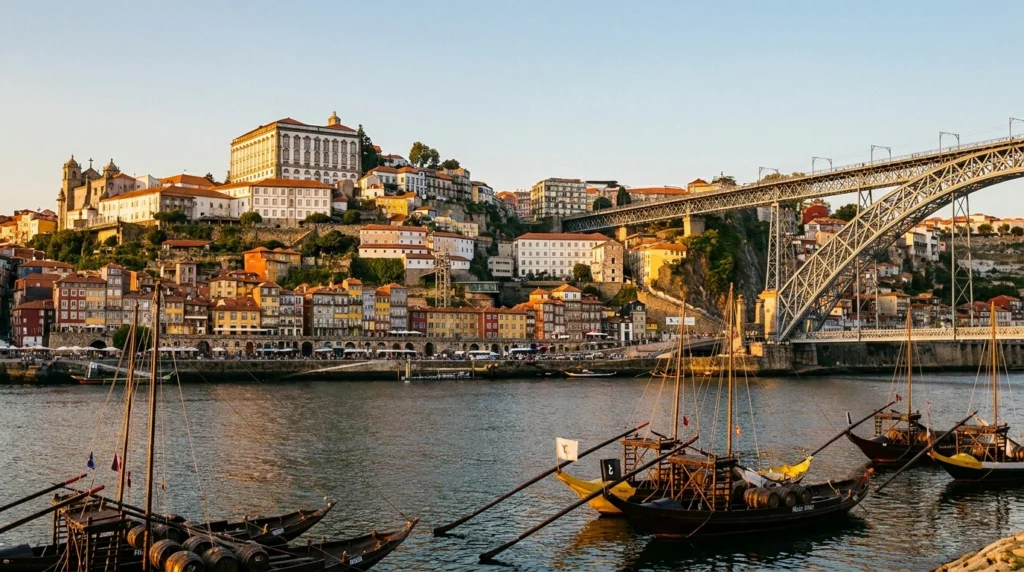
Cinematic aerial of Porto (8s).
Table of Contents
Why Porto?
Porto is the city that literally named the country. The Roman-era settlement of Portus Cale, on the north bank of the Douro estuary, gave its name first to the surrounding county and then to the kingdom of Portugal that grew out of it . Today it is the country’s second city after Lisbon, with about 253,000 residents inside the compact municipality and roughly 1.8 million across the wider metropolitan area — the second-largest urban region in Portugal and one of the larger ones in the European Union . It sits about 280 kilometres north of Lisbon, where the Douro finally meets the Atlantic after its long run down from the Spanish border.
The city reads as a stack of productive contradictions. It is monumental in places — the granite cathedral on its hilltop, the baroque Clérigos tower, the iron arch of the Dom Luís I Bridge — yet daily life happens at the scale of the tiled cafe, the steep cobbled lane, and the riverside terrace. The Historic Centre of Porto, together with the Dom Luís I Bridge and the Monastery of Serra do Pilar across the river, was inscribed as a UNESCO World Heritage site in 1996 . The whole old town tumbles down to the Douro in a tangle of terracotta roofs and azulejo-tiled facades, and the river itself — with the port-wine lodges of Vila Nova de Gaia lined up on the opposite bank — is the spine the city is organised around.
Porto’s defining export is, of course, port wine. The fortified wine takes its name from the city, even though the grapes grow up the Douro valley and the wine is aged across the river in the cellars of Gaia, reached by the upper deck of the Dom Luís I Bridge . But the city is more than its drink: it shared the title of European Capital of Culture in 2001, it has a serious contemporary-art and music scene, and in 2024 it was named the World’s Leading Seaside Metropolitan Destination at the World Travel Awards. More than three million tourists passed through in 2025, drawn by exactly the mix of heritage, food, river and value that makes Porto so easy to recommend.
This guide covers the neighbourhoods you will actually walk, the tripe stews and francesinha sandwiches and Gaia cellar tastings worth seeking out, the cathedral-and-tower tier of sights (Sé, Clérigos, São Bento, Livraria Lello, Bolsa Palace), the day trips Portuenses themselves take on weekends, and the practical realities of Schengen rules, the steep hills and the wet Atlantic winters. Porto’s calendar peaks hard around the Festa de São João on the night of 23–24 June, when the entire city spills into the streets for one of Europe’s great urban street parties.
One orientation point worth fixing early: Porto is a city of hills and the river. Almost everything a first-timer wants to see sits within the old town that drops from the cathedral down to the Ribeira waterfront, with Gaia just across the bridge. The climbs are real — the lanes are steep and the granite cobbles are slippery in the rain — but the rewards are constant, because nearly every corner opens onto a view of the Douro. Front-load the steep sights in the cool of the morning, break for a long riverside lunch, and save the gentler waterfront strolls for the golden evening light. For the wider Portuguese context, this guide pairs with our Portugal Travel Guide and the sibling Lisbon and Seville city guides.
Getting There

Francisco Sá Carneiro Airport (OPO), about 11 kilometres northwest of the centre at Maia, is the main gateway to northern Portugal and one of the country’s busiest hubs . It runs domestic links to Lisbon and the islands plus broad European service on TAP, Ryanair, easyJet and others. The simplest transfer is Metro Line E (the purple line), which runs straight from the airport into the centre in about 35 minutes for the price of a zoned Andante ticket; a taxi to the historic core runs roughly €20–€30 by day.
Rail is the smarter inbound from elsewhere in Portugal and from Spain. Comboios de Portugal (CP) runs frequent Alfa Pendular and Intercidades trains between Lisbon and Porto’s Campanhã station, covering the roughly 300 kilometres in about 2 hours 50 minutes . From Campanhã, a short local train or a metro ride brings you to the central São Bento station. Advance Lisbon–Porto fares start around €25; expect €40–€65 closer to departure. Regional lines also reach Braga, Guimarães and up the Douro valley toward Pinhão.
By road, intercity coaches run by Rede Expressos and FlixBus connect Porto with Lisbon, Braga, Coimbra and across the border into Spain, arriving at the Campo 24 de Agosto and Casa da Música area terminals . Coaches are the cheapest option and useful for smaller towns the train does not reach.
Getting Around
Porto’s historic centre is built for walking, but the hills are no joke and the river splits the city, so you will lean on public transport more than in flatter Lisbon. The network is modern and easy to read: a six-line metro, an extensive STCP bus system, three historic tram lines, two funiculars, and the unifying Andante ticketing card that works across all of them . The flat riverside is a pleasure on foot; the climbs from the Ribeira up to the cathedral or the Clérigos are where most first-timers reach for a funicular or a bus.
Metro and Suburban Rail
The Porto Metro opened on 7 December 2002 and now runs six lines across 85 stations over roughly 70 kilometres of track, carrying about 94.5 million passengers a year — a system whose urban design earned Harvard’s Veronica Rudge Green Prize in 2013 . Much of it runs on the surface as light rail rather than deep underground, and Line E links the airport directly to the centre. A single zoned trip on the Andante card runs roughly €1.40–€2.00 depending on zones, cheaper bought as a multi-trip top-up. The metro is the workhorse for the airport, Campanhã station and crossing the river to Gaia.
Buses, Trams and Funiculars
STCP runs the dense city bus network that fills the gaps the metro misses, especially up the steeper hills and out to the coast. More charming are the three surviving historic tram lines: Line 1 runs along the river from the Ribeira out to Foz do Douro at the Atlantic mouth, Line 18 and Line 22 loop through the old town past the Carmo church . The Funicular dos Guindais climbs the steep bank from the Ribeira up to the bridge approach in a couple of minutes, saving a punishing set of steps. All of these accept the Andante card.
The Andante Card and Passes
The rechargeable Andante card is the single best move for any stay longer than a day. A reusable Blue Andante card costs a small one-off fee and is then topped up with zoned single trips or day passes, valid across metro, bus, tram and the suburban trains. Note that ticket inspection is strict: as of October 2024 the penalty for travelling without a validated Andante ticket is €95, so always validate at the platform reader before you board .
Airport Access
- Metro Line E (purple) to the centre — about 35 minutes, a zoned Andante fare
- Taxi OPO to the historic centre — about 25 minutes, roughly €20–€30 by day
Taxis and Rideshare
Licensed Porto taxis are cream-coloured; flag-fall and per-kilometre rates are metered and regulated, with a surcharge for airport runs and luggage. A typical cross-centre ride runs €6–€10. Bolt and Uber both operate widely in Porto and are usually cheaper than a street taxi, with reliable app pricing. Card payment is increasingly standard, but carry small notes for shorter taxi trips.
Navigation Tips
Porto’s medieval street plan and its hills defeat a sense of direction quickly — lanes bend, climb and dead-end within a block. Google Maps and Citymapper both handle the city’s transit, but the most useful trick is to navigate by the river and the Clérigos tower, both visible from much of the old town. Wear proper shoes: the granite cobbles are genuinely slippery when wet, and Porto is one of the wettest big cities in Europe.
Neighbourhoods: Where to Base Yourself
Torn between Porto and Lisbon as a base? Our guide to where to stay in Portugal compares both, plus the Algarve.
📍 Porto Map: Every Place in This Guide
Porto’s character changes street by street, and choosing the right area shapes the whole trip. The historic core is compact — you can walk it end to end in under half an hour, hills permitting — but each quarter has its own rhythm, price point and gradient. Below are the five neighbourhoods most first-time visitors actually consider, with an honest read on who each suits.


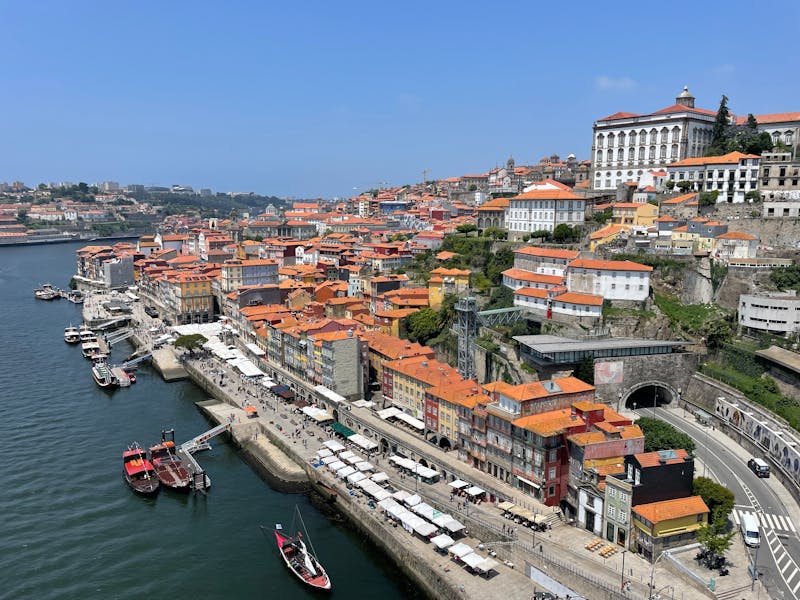

Ribeira and the Historic Centre
The riverside Ribeira is the postcard Porto — colourful facades, narrow medieval lanes, the cathedral two minutes uphill, and the bridge at the end of the quay. It is also the most touristed and the priciest, and the lanes can be noisy and damp. Stay here on a first visit if you want everything on your doorstep; avoid it if you want quiet nights or struggle with stairs, because the area is steep and the riverside bars run late.
Vila Nova de Gaia
Across the Douro, Gaia is technically a separate municipality, but its riverfront is part of the Porto experience: the port-wine lodges, the cable car, and the best head-on views of the old town. It is a five-minute walk over the lower bridge deck to the Ribeira, prices run a little lower, and the sunset light on the Porto bank is the city’s finest. A good-value base if you want the views and the cellars on your doorstep.
Cedofeita and the Arts Quarter
North-west of the centre around Rua de Miguel Bombarda, Cedofeita is Porto’s most creative district — galleries, independent shops, design studios and a younger, local crowd. It is a flatter, more residential alternative to the tourist core, with good cafes and a short walk or tram ride to the Clérigos and the centre. Good value and a genuine sense of everyday Porto.
Bonfim and Campanhã
East of the centre, Bonfim is the up-and-coming neighbourhood: working-class roots, cheaper rents, a wave of new restaurants and bars, and easy access to the Campanhã rail and metro hub. It is a 15-minute walk or a short metro hop to the old town, noticeably better value than the Ribeira, and the best bet for travellers who want a residential base with room to breathe.
Food and Drink: Tripe, Toasties and Port
Porto’s food is hearty, unfussy and proudly its own. The locals are nicknamed tripeiros — “tripe eaters” — after the medieval legend that the city gave away its best meat to provision the fleet and kept the offal for itself. The result is a cuisine built on slow stews, grilled fish, and one gloriously excessive sandwich, all washed down with crisp Vinho Verde or, of course, port.

What to Order
- Francesinha — Porto’s signature sandwich: layered meats under melted cheese, drowned in a spiced beer-and-tomato sauce.
- Tripas à moda do Porto — the city’s namesake tripe-and-bean stew, the original tripeiro dish.
- Bacalhau — salt cod, prepared a hundred ways; the à Gomes de Sá version is a Porto classic.
- Bifana — a thin marinated pork sandwich, the perfect cheap standing snack.
- Pastel de nata — the custard tart, best warm with a dusting of cinnamon and a bica espresso.
Where to Eat
The lanes around the Bolhão market and the Cedofeita and Bonfim districts hold the best mix of traditional tascas and new-wave kitchens. For port and a riverside view, the Gaia cellars and the Ribeira terraces are unbeatable at sunset, if touristy. The restored Mercado do Bolhão and the Time Out-style food halls are good for grazing across several vendors in one stop, and any bakery with a queue of locals is a safe bet for a nata.
Timing and Etiquette
Lunch peaks around 1–3pm and dinner rarely starts before 8pm; bars serving full meals at 6pm are usually catering to tourists. The couvert — bread, olives and small starters brought unbidden — is charged for, so wave it away if you do not want it. A fino or imperial is a small draught beer; Vinho Verde is the local lightly sparkling white. Tipping is light — rounding up or leaving small change is plenty.
Cultural Sights: The Unmissable Few (and More)
Porto’s UNESCO World Heritage listing — inscribed in 1996 — covers the historic centre, the Dom Luís I Bridge and the Monastery of Serra do Pilar as a single ensemble, and most of the headline sights sit within a 15-minute walk of one another up and down the hill . Add the bookshop, the stock-exchange palace and a Gaia cellar and you have two full days of sightseeing without ever needing the metro.

São Bento Station and the Sé Cathedral
Start at São Bento railway station, built between 1900 and 1916, whose entrance hall is lined with around 20,000 blue-and-white azulejo tiles by Jorge Colaço depicting scenes from Portuguese history — often called the most beautiful station in the world . A short steep climb up brings you to the Sé do Porto, the fortress-like Romanesque cathedral begun in the 12th century, with a Gothic cloister and a terrace that gives one of the best free views over the old town and the river .
The Clérigos Tower
The baroque Clérigos church and its soaring bell tower were designed by the Italian architect Nicolau Nasoni and built between 1732 and 1763 . Climbing its roughly 240 steps delivers the definitive 360-degree panorama over the red rooftops, the river and the bridges. It is the navigational landmark of the whole city — visible from much of the old town — and best climbed early before the queues build.
The Bolsa Palace and São Francisco
Down toward the river, the 19th-century Palácio da Bolsa — the former stock exchange — hides the dazzling Arabian Room, a Moorish-revival ballroom that took decades to gild. Next door, the Gothic Igreja de São Francisco conceals an interior smothered in carved gilded woodwork, said to use hundreds of kilograms of gold leaf. Both are ticketed and both reward the entry fee for the sheer over-the-top craftsmanship.
The Dom Luís I Bridge and Gaia
The double-deck iron arch, completed in 1886 to a design by Eiffel’s former partner Théophile Seyrig, is the city’s defining image; its 172-metre span was the longest of its type in the world at the time . Walk the upper deck — shared with the metro — for the panorama, then descend to Vila Nova de Gaia, where the port-wine lodges line the bank and offer cellar tours and tastings that explain why this fortified wine carries the city’s name.
Port, Festivals and Nightlife
Porto’s nightlife is younger and looser than its heritage suggests, and its calendar peaks with one of Europe’s great street parties. Between the Gaia cellars, the riverside bars and the student-fuelled lanes around the Galerias de Paris, the city stays up far later than its sightseeing hours imply.
Port Wine Cellars in Gaia
The defining Porto experience is a cellar tasting across the river in Vila Nova de Gaia, where the great port houses — Sandeman, Graham’s, Taylor’s, Cálem and others — age their wine in the cool riverside lodges . A standard tour-and-tasting runs an hour and explains the difference between ruby, tawny, white and vintage port. Book the bigger houses ahead in summer, and consider a sunset tasting on a lodge terrace for the head-on view back at the old town.
Festa de São João
Porto’s biggest night by far is the Festa de São João on 23–24 June, when the entire city pours into the streets for an all-night party of grilled sardines, bonfires, fireworks over the Douro, and the bizarre tradition of bopping strangers on the head with squeaky plastic hammers . It is chaotic, joyous and utterly local; if you visit in late June, expect packed bars, closed streets and rooms booked months ahead.
Live Music and Bars
The Casa da Música, Rem Koolhaas’s striking 2005 concert hall, anchors the city’s classical and contemporary programme, while the lanes around the Galerias de Paris and Rua Cândido dos Reis are the heart of the bar scene — a dense run of small venues that fills with students and visitors after midnight. For fado, look for an intimate casa de fado rather than a dinner spectacle, and for a quieter night, the Gaia and Foz waterfronts trade volume for sea air and sunset.
Day Trips From Porto
Porto is the natural base for northern Portugal, with fast trains and good buses reaching the region’s other great towns in well under two hours, and the Douro valley running east into one of the world’s oldest demarcated wine regions. If you have more than three days, give one to a day trip — the contrast sharpens your sense of what makes Porto itself distinct.
The Douro Valley
The terraced vineyards of the Douro, the source of the grapes that become port, climb the steep river hills upstream of the city. The most scenic approach is the regional train from Porto to Pinhão, about two hours of river-hugging track, or a full-day river cruise . Many visitors call it the single most beautiful day out from Porto.
Guimarães
About 50 minutes by train, Guimarães is the “cradle of Portugal” — the birthplace of the first king and the country’s founding — with a beautifully preserved medieval centre that is itself a UNESCO World Heritage site. Its castle, ducal palace and walled old town make an easy, rewarding half-day.
Braga
An hour north by train, Braga is one of Portugal’s oldest cities and its religious capital, famous for the baroque Bom Jesus do Monte sanctuary with its dramatic zigzag staircase climbing the hillside. Pair it with Guimarães on a longer day if you hire a car or take an early start.
Aveiro and the Coast
About 40 minutes south by train, Aveiro is the “Venice of Portugal”, a lagoon town of canals, colourful moliceiro boats and striped fishermen’s houses at nearby Costa Nova. It is a gentle, flat counterpoint to hilly Porto and an easy half-day by rail.
When to Visit: A Season-by-Season Guide
Porto’s Atlantic climate is the single biggest factor in timing a trip. It is milder and far wetter than southern Portugal, with no real heatwaves but plenty of rain in the cooler months. Here is how the year actually feels on the ground.
Spring (March–May)
A lovely, increasingly reliable season: the rain eases through April and May, temperatures climb into the high teens and low 20s°C, and the crowds have not yet peaked. Late May in particular offers warm, mostly dry days and long light, making it arguably the ideal window to visit before the summer rush and the June festival.
Summer (June–August)
Peak season, and warm rather than scorching — the Atlantic keeps highs mostly in the mid-20s°C, with cooler sea breezes at Foz. June brings the São João festival and the longest days; July and August are the busiest and priciest months, with the riverside terraces full and cellar tours booked out. Comfortable for walking, but reserve accommodation well ahead.
Autumn (September–November)
September is a quiet gem — warm, dry and far less crowded than summer, with the Douro valley harvest in full swing. October stays pleasant, but from late October the rains return in earnest, and November is properly wet. Early autumn is one of the best times to visit; late autumn rewards the rain-tolerant with low prices and empty sights.
Winter (December–February)
Mild but wet — daytime highs of around 14°C, rarely freezing, but with frequent rain and grey skies, as Porto is one of the wettest big cities in Europe . The trade-off is the lowest prices and thinnest crowds of the year, cosy tasca lunches, and cellar tastings with the lodges nearly to yourself. Pack a waterproof and good shoes for the slippery cobbles.
Budget Breakdown: What Porto Actually Costs
Porto is one of the best-value city breaks in Western Europe, noticeably cheaper than Lisbon and far cheaper than Paris or Amsterdam for food, drink and lodging. The figures below are per-person daily estimates excluding flights, in euros, based on 2025–2026 prices.
Backpacker (€45–70/day)
A hostel dorm bed runs €16–28; tasca meals and a prato do dia lunch keep food to €12–20; the old town is free to walk. Budget one or two paid sights and a single cellar tasting and you stay comfortably under €70.
Mid-Range (€110–170/day)
A three-star hotel or central apartment is €65–110 for a double (more in summer); add €30–45 for restaurant meals, €15–25 for tickets and the occasional taxi, and a port tasting. This is the typical comfortable-tourist band.
Luxury (€280+/day)
A four- or five-star room such as The Yeatman in Gaia runs €250–500+, fine dining adds €70–140, and private guides, Douro cruises and premium experiences push the day well past €280. São João week and peak summer can lift these figures sharply.
Key Fixed Costs
- Livraria Lello entry — about €8, redeemable against a book purchase
- Clérigos tower climb — about €8
- Gaia cellar tour and tasting — about €15–25
- Single zoned metro/bus fare — about €1.40–€2.00
- Metro Line E from the airport — a zoned Andante fare
Practical Tips and Safety
Porto is a safe, easy city for visitors, but a handful of practical habits make the difference between a smooth trip and an avoidable headache. None of this is alarming — it is the ordinary common sense of any popular European destination, plus a healthy respect for the hills and the rain.
Money and Payments
Portugal uses the euro; cards are accepted almost everywhere, but small tascas, markets and older cafes still prefer cash for low-value orders, so carry €20–30 in small notes. ATMs (look for the Multibanco network) are plentiful and fair; avoid the standalone “Euronet” machines, which apply poor exchange rates.
Safety and Scams
Violent crime is rare; the realistic risk is pickpocketing in crowds around São Bento, on busy trams and during festivals. Use a zipped bag worn to the front, and watch your phone on packed metro carriages. Both the UK and US governments rate Portugal a low-risk destination overall .
Health and Water
Tap water is safe to drink throughout the city. EU visitors should carry an EHIC/GHIC card; everyone else should have travel insurance. Pharmacies (farmácias, marked with a green cross) are widespread and competent for minor ailments. Bring a waterproof and shoes with grip — the granite cobbles are genuinely slippery in Porto’s frequent rain.
Practical Essentials
- Language: Portuguese; English is common in tourist areas, less so in neighbourhood tascas.
- Plugs: Type C/F, 230V — bring an EU adapter.
- Tipping: not expected; rounding up is plenty.
- Couvert: bread and starters are charged for — wave them away if unwanted.
- Hills: plan routes downhill where you can; use the funicular for the steepest climbs.
Frequently Asked Questions
How many days do you need in Porto?
Three full days is the sweet spot: one for the old town, São Bento and the Clérigos; one for the Ribeira, the bridge and a Gaia cellar tasting; and one for a Douro valley or Guimarães day trip. Two days covers the essentials at a rush; four or more lets you slow to the city’s actual pace and reach the coast at Foz.
What is the best time of year to visit Porto?
Late May and September offer the best balance of warm, mostly dry weather, manageable crowds and reasonable prices. Summer is warm rather than hot but busiest and priciest, June brings the São João festival, and winter is mild but very wet — the cheapest and quietest season if you do not mind rain.
Is Porto expensive?
No — it is one of the best-value city breaks in Western Europe, cheaper than Lisbon for food, drink and lodging. A mid-range trip runs roughly €110–170 per person per day excluding flights, and backpackers can manage on €45–70. Prices rise in peak summer and spike around São João in late June.
Do I need to book Livraria Lello and the Gaia cellars in advance?
Yes for both. Livraria Lello sells a timed ticket (around €8, redeemable against a book) and the queue is long without one; the larger port houses in Gaia book out their tours in summer. Booking ahead online for both saves an hour or more of queuing in season.
Is Porto walkable, or do I need public transport?
The historic centre is compact and walkable, but it is genuinely hilly, and the river splits the city — so you will use transport more than in flat cities. The metro, buses, historic trams and funiculars all run on the single Andante card. Wear good shoes for the steep, often-wet granite cobbles.
How do I get from Porto airport to the city centre?
The simplest route is Metro Line E (the purple line), which runs straight from the airport into the centre in about 35 minutes for a zoned Andante fare, while a taxi takes around 25 minutes for €20–30 by day . Francisco Sá Carneiro Airport (OPO) is about 11 kilometres northwest of the centre .
Is Porto safe for tourists?
Yes, very. Violent crime is rare and the main risk is pickpocketing in crowds. Both the UK and US governments rate Portugal a low-risk destination. Take the usual precautions with bags and phones on busy trams, around São Bento and during festivals.
What is port wine, and where do I taste it?
Port is a sweet fortified wine named after the city, made from grapes grown up the Douro valley and aged across the river in the lodges of Vila Nova de Gaia. The classic experience is a cellar tour and tasting in Gaia, reached on foot over the lower deck of the Dom Luís I Bridge or by the upper-deck metro.
What food is Porto famous for?
The francesinha — a rich layered sandwich under melted cheese and a spiced sauce — is the city’s signature, alongside tripas à moda do Porto (the namesake tripe stew), salt-cod dishes and the custard pastel de nata. Eat the heavy plates at lunch, wash them down with Vinho Verde, and finish with a glass of port.
Was This Guide Helpful?
We update our Porto guide as prices, transit and opening hours change. Let us know if it helped — your feedback shapes the next revision.
Ready to Experience Porto? Walk It Slowly
Porto rewards a slow traveller. Its sights are world-class — the bridge, the bookshop, the azulejo station, the granite cathedral — but the city’s real magic is in the in-between: a custard tart at a marble counter, a glass of tawny on a Gaia terrace, the river at dusk from the Ribeira, the tram rattling out to the Atlantic at Foz. Plan the headline sights, then leave room to get lost in the hills. For the wider picture, see our Portugal travel guide, and pair Porto with Lisbon and nearby Seville for a complete Iberian trip.
Explore More City Guides
Porto is one stop in our growing library of Iberian and European city guides. Keep planning with these companion pages:
More city guides you might like
Plan your trip to Porto
The booking tools we use ourselves. FFU may earn a commission at no extra cost to you.
Plan & book your trip to Porto
Booking through these searches supports our guides at no extra cost to you.