
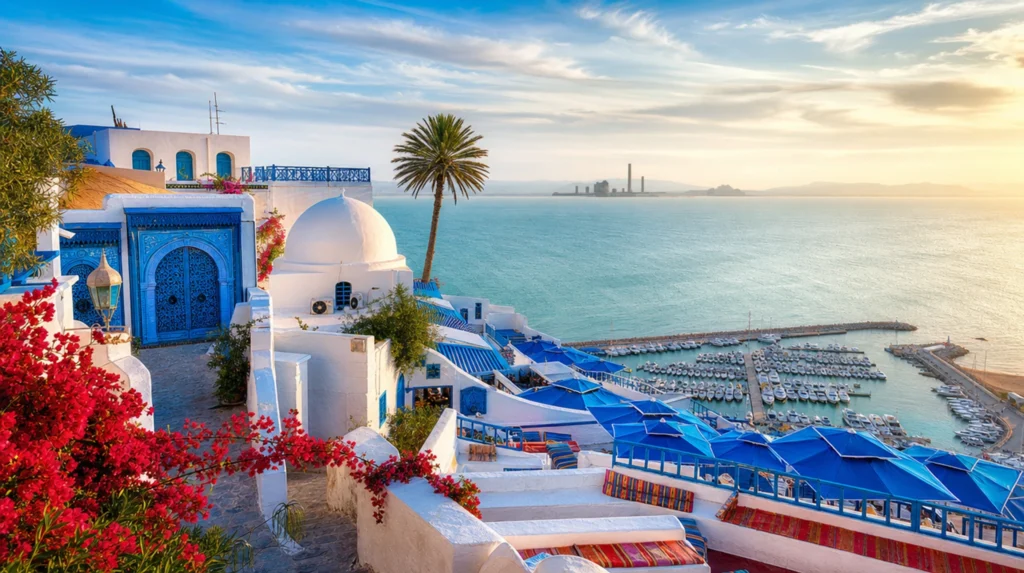
Tunis, Tunisia: A Medina, a Buried Empire and the Bluest Village on the Mediterranean
I came to Tunis expecting a quick stopover and stayed a week. What hooked me was how much the city refuses to choose a single identity: in one morning I drank an espresso under French colonial arcades on Avenue Habib Bourguiba, got happily lost among the perfume sellers of a thousand-year-old medina, then stood on a hill where Hannibal’s Carthage once ruled the sea. By afternoon I was eating a runny-yolk brik in a tiled cafe in Sidi Bou Said, the whole village painted blue and white above the water. Tunis is North Africa for travellers who want the layers without the hard sell — cheaper than Marrakech, calmer than Cairo, and genuinely under-visited. This is the guide I wish I’d had: where to base yourself, what things cost, how the little TGM train ties it all together, and why two days here is never quite enough.

Table of Contents
Why Tunis?
Tunis is the kind of capital that travellers fly over on their way to the beach resorts of Hammamet or Djerba — and that is precisely why you should stop. In one compact, walkable city you get a living medieval medina, a French-built belle-époque downtown, and the ruins of Carthage, the empire that once challenged Rome for the whole Mediterranean. Greater Tunis is home to roughly 2.5 million people, making it Tunisia’s political, cultural and economic heart, yet it never feels overwhelming the way Cairo or Casablanca can.
The scale of the history here is hard to overstate. The medina was founded not long after the Arab conquest in the late 7th century and grew into one of the great cities of the Islamic world; UNESCO inscribed it as a World Heritage Site in 1979, citing some 700 monuments — palaces, mosques, mausoleums, madrasas and fountains — spread across roughly 270 hectares. A short train ride away, the Bardo National Museum holds one of the finest collections of Roman mosaics on Earth, the second-largest museum on the African continent after Cairo’s.
And then there is the superlative that ties the whole region together: Carthage. Founded by Phoenician traders, it became the seat of a maritime empire whose general Hannibal famously marched elephants over the Alps to threaten Rome itself. Rome destroyed it, rebuilt it as a glittering provincial capital, and today its scattered ruins — the Antonine Baths, the Punic ports, the hilltop of Byrsa — sit on the suburban coast a 30-minute light-rail hop from downtown, inscribed by UNESCO in 1979 alongside the medina.
What separates Tunis from Morocco’s better-known imperial cities is the texture of daily life. The hard sell is gentler, French smooths almost every interaction, and the city wears its layers casually rather than performing them. There is no Jemaa el-Fnaa staging a nightly show for cameras; instead the drama is dispersed across covered souks, pavement cafes and clifftop terraces, and the deeper you wander the more the city gives back. You can spend a morning haggling for a red felt chechia cap in a thousand-year-old market, an afternoon among Roman mosaics, and an evening watching the sun drop into the Gulf of Tunis from a blue-and-white village — all for the price of a single museum ticket back home.
Tunis also rewards the traveller who likes a city they can actually read. It is compact and legible in a way the great sprawling capitals of the region are not: a walkable downtown beside a walkable medina, with one little train line stitching the coast to the centre. Come for Carthage and the medina; stay because a milky coffee in Sidi Bou Said, watching the ferries cross the Gulf of Tunis, is one of the Mediterranean’s great quiet pleasures — and because almost nobody else has discovered it yet.

Neighborhoods: Finding Your Tunis
📍 Tunis Map: Every Place in This Guide
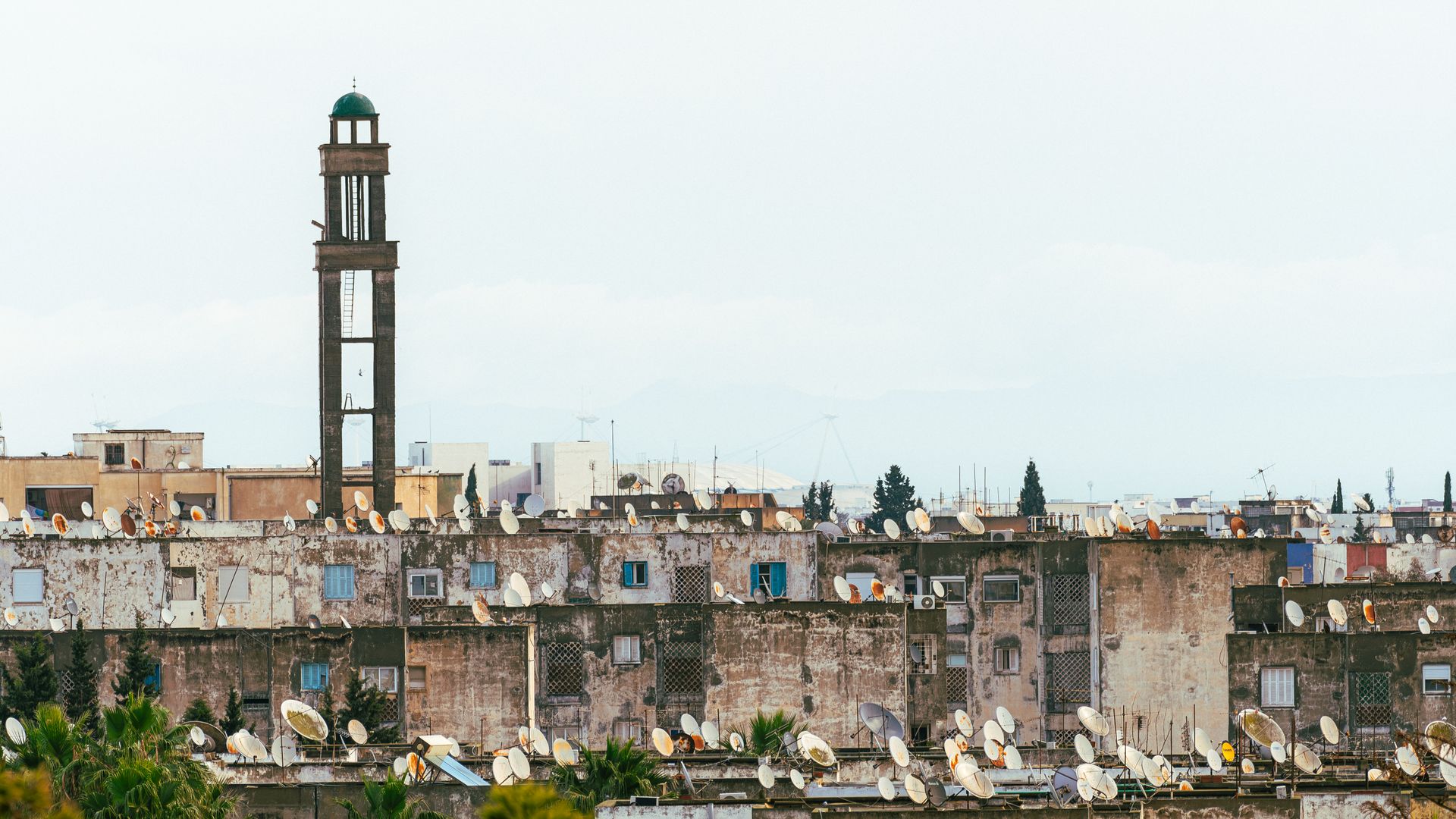
Tunis is really three cities layered on top of one another, strung along a single train line. There is the medina, the medieval Arab core; the Ville Nouvelle, the wide French-built downtown that grew up beside it; and the string of seaside suburbs — Carthage, Sidi Bou Said and La Marsa — that the little TGM railway connects to the centre in half an hour. Knowing which is which, and where to base yourself, turns a confusing capital into a very easy one.
A quick mental map helps enormously. Picture Avenue Habib Bourguiba, the grand central boulevard, as the spine of the modern city: at its western end the Bab Bhar (Porte de France) gateway opens into the medina, while at its eastern end Tunis Marine station is where you catch the TGM out to the coast. Get those two anchors straight and the whole city falls into place. Almost everything a visitor wants is either in that walkable core — medina plus downtown — or strung along the coast on the train line. Below is how I’d carve up the city for a first visit, base by base, so you can decide where to sleep and how to spend each day before you ever arrive.
The Medina
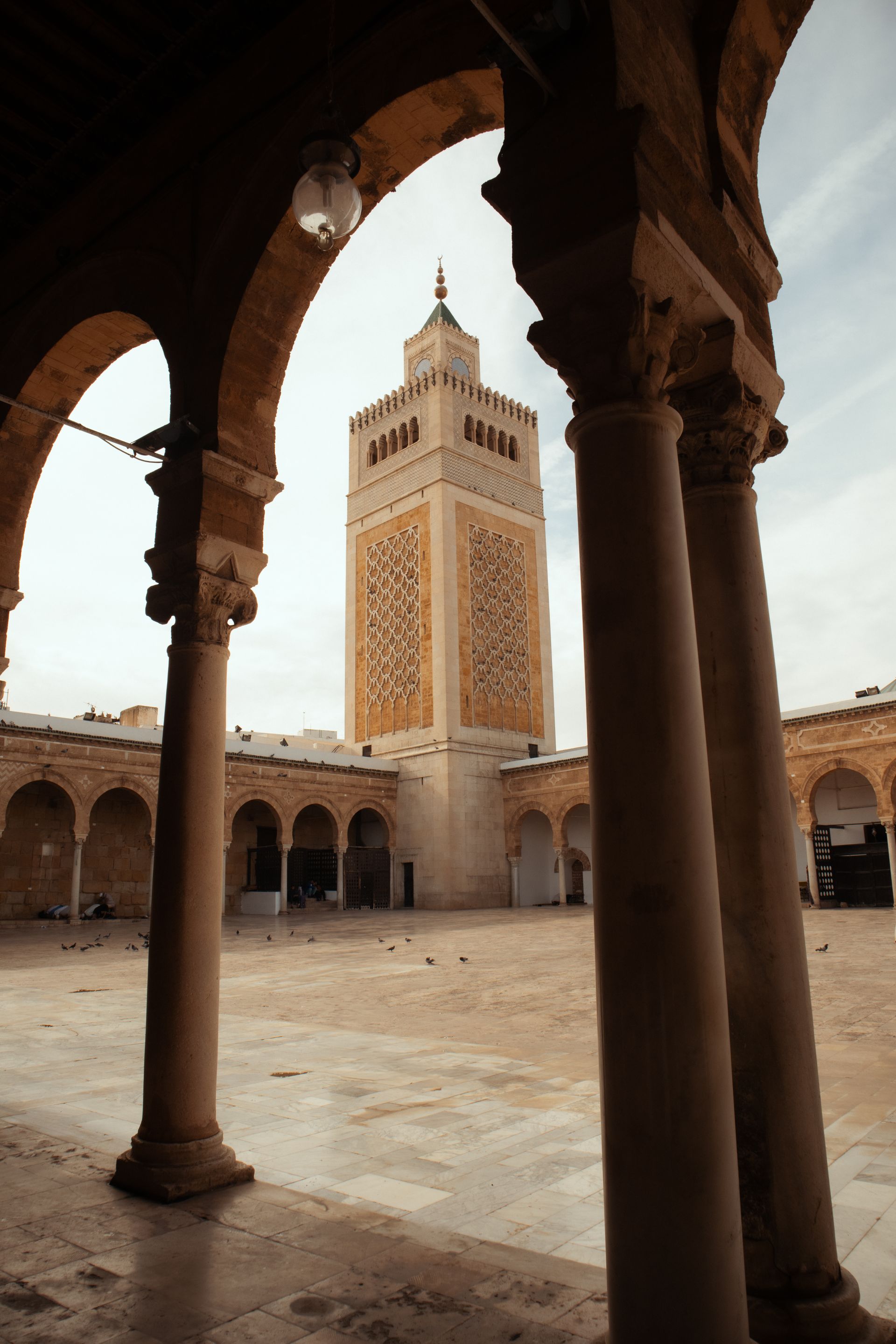
This is the reason you came — a UNESCO-listed labyrinth of covered souks, mosques and hidden palaces radiating out from the great Zaytuna Mosque. It is organised, loosely, by trade: the Souk el Attarine for perfume, the Souk des Chechias for the red felt caps, the gold and fabric souks deeper in. Unlike Marrakech, the medina here is residential and working rather than a tourist stage set, so wandering it feels like genuine discovery. Enter from the Porte de France and let yourself get lost; the lanes always eventually lead back to a recognisable gate.
- Zaytuna (Ez-Zitouna) Mosque
- The covered perfume and chechia souks
- Dar Othman and the medina palaces
Best for: first-time visitors, history lovers, atmospheric guesthouse stays. Access: on foot from the Porte de France at the top of Avenue Bourguiba.
Ville Nouvelle (Downtown)
The French-built new town, laid out from the late 19th century, is where modern Tunis lives, shops and drinks its coffee. Avenue Habib Bourguiba — often called “the Tunisian Champs-Élysées” — runs dead straight from the medina gate to the lake, lined with pavement cafes, the grand Théâtre Municipal, the cathedral and the clock tower. It is the most practical base, with reliable ATMs, hotels and restaurants, and it is walkable to both the medina and the TGM station.
- Avenue Habib Bourguiba cafes
- Cathedral of St Vincent de Paul
- Théâtre Municipal de Tunis
Best for: convenience, nightlife, easy transit. Access: central; walk to the medina or hop the TGM at Tunis Marine.
Carthage
Strung along the coast northeast of the centre, Carthage is today a leafy, affluent suburb whose gardens hide the scattered ruins of one of antiquity’s greatest cities. The Antonine Baths, the Punic ports, the Byrsa hill and the Roman theatre are spread across several TGM stops, so you walk between them through quiet residential lanes with sea views. It is a green, hushed contrast to the medina — history without crowds.
- Antonine Baths by the sea
- Byrsa Hill & the Carthage museum
- The Punic ports
Best for: ancient history, quiet walks, sea views. Access: TGM line, multiple Carthage stops, ~25 minutes from Tunis Marine.
Sidi Bou Said
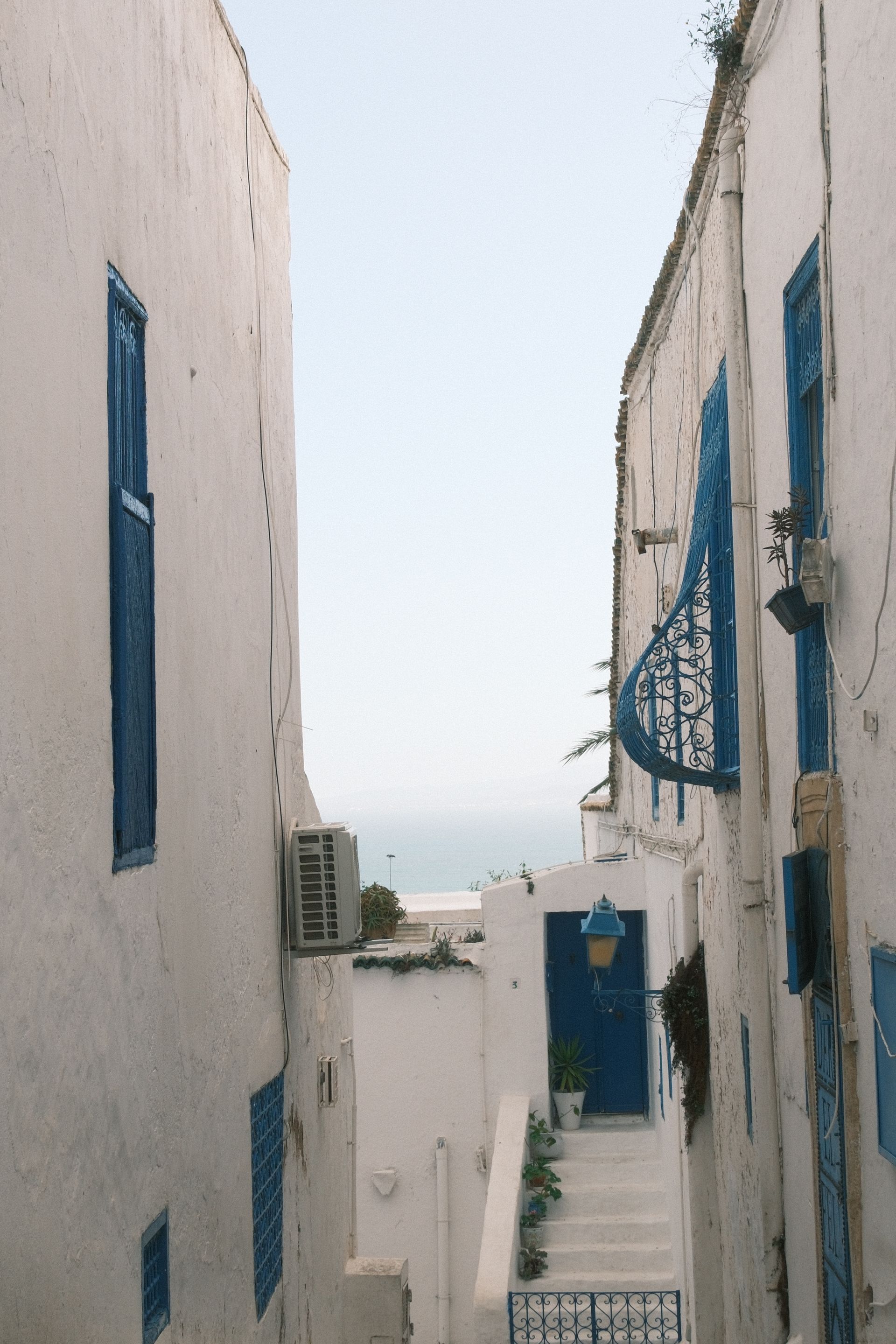
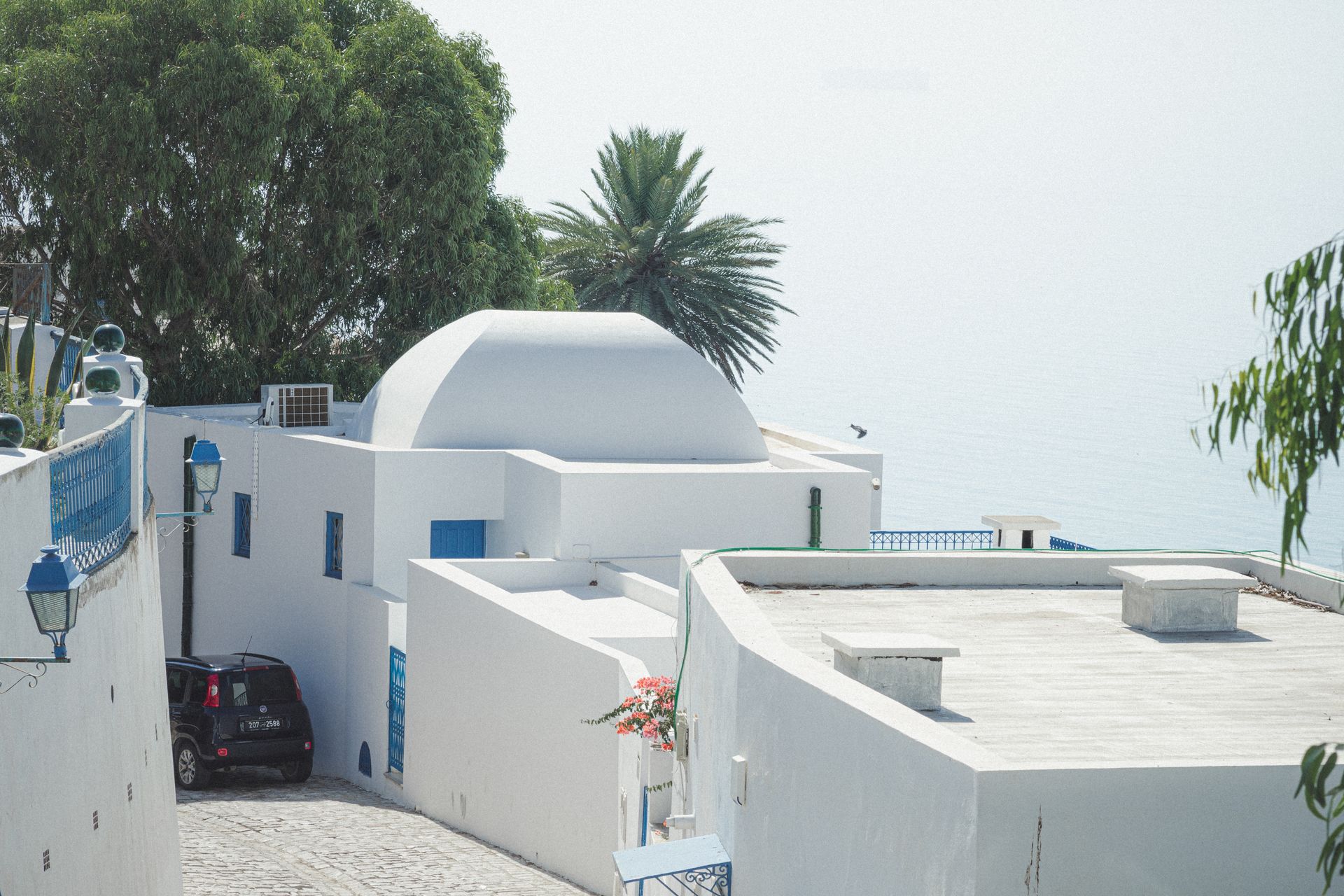
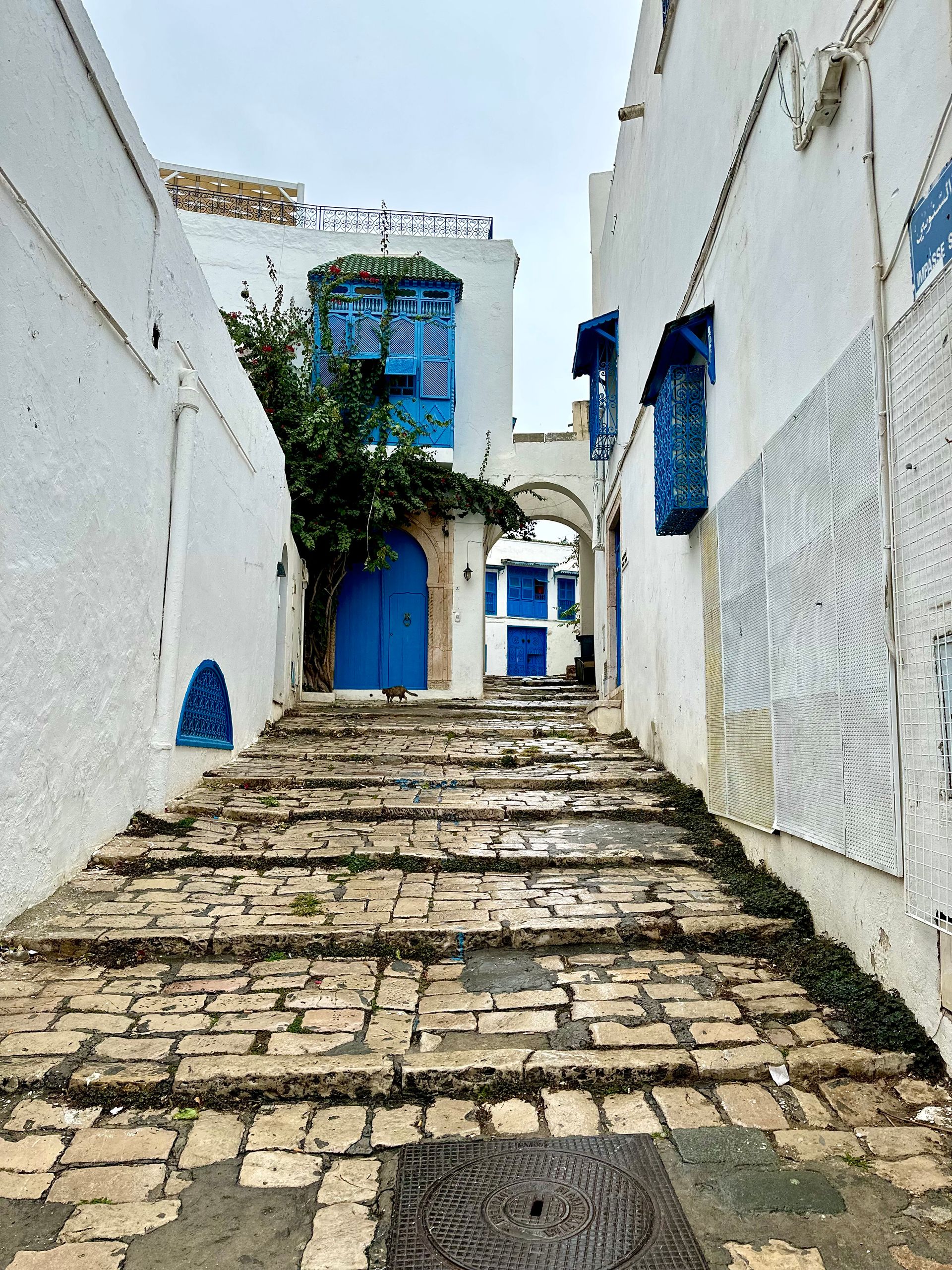
The single most photographed spot in Tunisia, and deservedly so: a clifftop village of cobbled lanes where every building is whitewashed and every door, window and shutter is painted the same cobalt blue, tumbling down toward a little marina and the Gulf of Tunis. It gets busy with day-trippers by midday, so come early or stay for sunset, when the crowds thin and the light turns the white walls gold. Pause for a mint tea with pine nuts at the famous Café des Nattes or the clifftop Café Sidi Chabaane.
- Café des Nattes
- The clifftop viewpoint over the marina
- Dar el-Annabi traditional house museum
Best for: photography, romance, coffee with a view. Access: TGM to Sidi Bou Said, ~30 minutes from Tunis Marine, then a short uphill walk.
La Marsa
The last stop on the TGM line is the easygoing seaside town where well-heeled Tunisois come to swim, stroll the corniche and eat. La Marsa is less about sights and more about atmosphere: a long beach, a palm-lined promenade, and some of the best restaurants and patisseries in the capital. It pairs naturally with Sidi Bou Said and Carthage for a full day on the coast, and makes a relaxed base if you want sea air rather than city bustle.
- La Marsa beach & corniche
- Café Saf-Saf around an old well
- Seafront seafood restaurants
Best for: beach time, dining, a calmer base. Access: TGM terminus, ~35 minutes from Tunis Marine.
Lac de Tunis & Les Berges du Lac
Between the old city and the airport, the reclaimed lakeside district of Les Berges du Lac is modern Tunis at its most international: glassy office towers, embassies, malls, chain hotels and the city’s flashiest nightlife. It is short on charm but useful to know about — it is where many business travellers stay, where the big shopping centres are, and where you will find late-opening bars and clubs that the conservative medina simply does not have.
- Lakeside business hotels
- Shopping malls
- The city’s main nightlife strip
Best for: business stays, nightlife, modern comforts. Access: taxi from downtown; on the road to the airport.
The Bardo & Western Suburbs
West of the centre, the suburb of Le Bardo is dominated by two landmarks: the Bardo National Museum, with its world-class Roman mosaics, and the adjoining parliament building in a former beylical palace. It is an easy light-rail or taxi ride from downtown and well worth a half-day, especially paired with the museum. The surrounding district is ordinary working Tunis, which is part of its appeal — you see the city as locals live it.
- Bardo National Museum
- The former beylical palace
- Local markets and cafes
Best for: mosaics, museum lovers. Access: Metro Léger line 4 to Le Bardo, or a short taxi.
A practical word on where to sleep. Most first-time visitors do best basing themselves in the Ville Nouvelle, within walking distance of both the medina and the TGM station — it is central, well-served and the easiest jumping-off point for everything. Romantics and photographers sometimes prefer to stay out in Sidi Bou Said or La Marsa for the sea air and the sunsets, day-tripping into the centre, while business travellers gravitate to the lakeside towers of Les Berges du Lac. Whichever you choose, the cheap, frequent TGM train means you are never far from any other part of the city, so you can mix a couple of nights downtown with a night by the water.
Belvédère & the Northern Avenues
North of the centre, beyond the Place Pasteur, the city climbs into leafier, well-to-do residential avenues built around Parc du Belvédère, the green lung of Tunis. The park itself — the oldest in the country, laid out in the 1890s — rolls over a low hill with eucalyptus groves, a small lake and the city zoo, and its summit gives one of the best free panoramas over the whole capital to the sea. The surrounding streets shade into the embassy quarters of Mutuelleville and Notre-Dame, full of quiet cafes, bakeries and a more local, unhurried pace. It is not a sightseeing district so much as a pleasant place to walk off a heavy lunch, and a reminder that residential Tunis is greener and calmer than the souk-and-boulevard core suggests. A taxi from downtown is a few minutes and a couple of dinars; the Metro Léger also skirts the area, making it an easy half-hour detour from the central sights.
Where to Base Yourself
The single most useful decision you’ll make is where to sleep, and it shapes the rhythm of the whole trip. Staying inside or beside the medina puts you in the thick of the atmosphere — waking to the call to prayer, stepping straight into the souks — but it can be intense, and the lanes are walked rather than driven. The Ville Nouvelle is the practical middle ground: central, full of hotels and cafes, and walkable to both the medina and the train. The coastal towns of Sidi Bou Said and La Marsa trade convenience for sea air, sunsets and calm, at the cost of a half-hour commute into the centre. And the lakeside towers of Les Berges du Lac suit business travellers who want modern comforts and nightlife over charm. Many visitors split the difference — a couple of nights downtown for the medina and museums, then a night by the water to decompress.
Getting Your Bearings
The mental trick that makes Tunis click is the TGM line. This little electric railway — the Tunis-Goulette-Marsa, running since the 19th century — starts at Tunis Marine, right at the lake end of Avenue Bourguiba, and beads its way out along the causeway and the coast through Carthage, Sidi Bou Said and on to La Marsa. Almost everything a visitor wants to see lies either in the walkable downtown-and-medina core or strung along this single train line. Buy a cheap ticket, ride to the end, and you will have a working map of the whole city in your head within a day. Inside the medina, save an offline map before you plunge in, because the twisting lanes confuse GPS and a paper map is little better — but don’t be a slave to the blue dot, because getting briefly, happily lost in the souks and then finding your own way back out to a recognisable gate is one of the best things you can do here. Elsewhere, Tunis is one of the easier capitals to navigate in the region: the grid of the new town and the straight line of the coast railway keep you oriented with almost no effort, leaving you free to wander.
The Food

Tunisian food is the spiciest in North Africa and, to my mind, the most exciting. The common thread is harissa — the fiery red chilli-and-garlic paste that turns up beside almost every meal — layered over a cuisine that blends Berber, Arab, Ottoman, Andalusian, Jewish and French influences. In Tunis you can eat a refined French-style lunch, a bowl of medieval chickpea stew and a paper cone of fried-dough sweets all in the same afternoon. Here is how I’d structure a few days of eating.
A little context explains the range. As a major Mediterranean port and capital, Tunis absorbed cooking traditions from every power that passed through: olive oil and grains from the Berbers, spices and pastries from the Arab and Ottoman worlds, sweet-savoury combinations and citrus from Andalusian refugees, and bread, coffee culture and patisserie from the French. The result is a cuisine that is at once rustic and sophisticated — and almost always cheap.
Tunisian Classics
Start with the dishes that define the country. Couscous is the national dish, but the Tunisian version is distinctively spicy, often built around fish on the coast and lamb or merguez inland. Brik — a paper-thin pastry parcel folded around a whole egg, tuna, capers and parsley and deep-fried so the yolk stays runny — is the snack you will eat most, and the test of any good cook.
- Dar El Jeld — grand sit-down Tunisian fine dining in a restored medina mansion; couscous and slow-cooked tagines (mains ~30–55 DT, ~$10–18)
- El Ali — a cultural cafe-restaurant in the medina serving classic couscous and brik with a rooftop view (~20–35 DT, ~$7–12)
- Fondouk El Attarine — atmospheric medina dining on traditional Tunisois plates (~25–45 DT, ~$8–15)
For the full ceremonial experience, book a medina restaurant a day ahead and go hungry — meals run to several courses of salads, brik, a main and pastries, usually with mint tea to close. A classic Tunisian table opens with a spread of small salads — the chopped, harissa-spiked salade tunisienne, the smoky grilled-pepper-and-tomato slata mechouia, perhaps a tuna-and-egg plate — before the brik and the main event arrive, so pace yourself. Many of the grandest dining rooms are restored merchant houses or palaces hidden behind anonymous medina doors, and half the pleasure is being led through a plain lane into a soaring tiled courtyard you’d never have guessed was there.
Street & Market Bites
The cheapest, most memorable eating in Tunis happens standing up. Lablabi — a steaming chickpea soup ladled over torn stale bread, dressed with harissa, cumin, olive oil, a soft egg and capers, mixed with two spoons — is the ultimate cheap Tunisois breakfast or hangover cure, and a bowl costs next to nothing. Follow office workers at lunchtime and you will eat brilliantly for the price of a coffee back home.
- Lablabi counters — chickpea soup over bread, the iconic cheap Tunisois meal (3–6 DT)
- Brik stalls — the runny-egg-and-tuna fried pastry, eaten on the move (2–4 DT)
- Casse-croûte — the Tunisian baguette sandwich stuffed with tuna, harissa, egg, olives and salad (4–7 DT)
- Fricassé — a small fried savoury doughnut filled like a casse-croûte (1–3 DT)
Beyond Couscous and Brik
The headline dishes are only the start. Tunis has its own specialities and sweets, some genuinely unusual, that reward the curious eater. A few are tied to season or ritual, so what’s available shifts through the year.
- Ojja — a spicy tomato-and-pepper shakshuka-style stew with eggs, often with merguez or prawns (8–15 DT)
- Kafteji — chopped fried vegetables and egg, a hearty vegetarian street plate (5–9 DT)
- Makroudh — semolina pastry stuffed with dates and soaked in honey, a Kairouan classic sold everywhere (per piece 1–2 DT)
- Bambalouni — a fluffy ring doughnut fried to order and dusted with sugar, the signature treat of Sidi Bou Said (1–3 DT)
Don’t overlook the everyday staples either. Tunisian bread is everywhere and excellent — the crusty baguette is a colonial legacy the country has thoroughly made its own — and olives, olive oil and harissa anchor almost every table. Tunisia is one of the world’s great olive-oil producers, and you will taste it in everything.
The Marché Central & Eating Like a Local
To understand how Tunis actually eats, spend a morning at the Marché Central, the grand covered market just off Avenue de la Liberté in the Ville Nouvelle. Built by the French in the early 20th century, it is a riot of pyramided spices, glistening fish on ice, mountains of olives in a dozen cures, wheels of fresh harissa, dates, citrus and herbs — and the surrounding lanes are lined with tiny lunch counters where stallholders and shoppers eat shoulder to shoulder. Go hungry, buy a bag of dates and a tub of olives for later, and grab a grilled-fish or lablabi lunch at one of the market kitchens. It is cheaper, fresher and far more atmospheric than any restaurant, and it is the single best place to taste the raw ingredients — the oils, the chillies, the brined vegetables — that underpin every dish on this page. The market hums hardest from mid-morning; come before noon while the produce is at its peak and the lunch counters are firing.
Vegetarians, Vegans & Dietary Needs
Tunis is easier for vegetarians than it first looks. Lablabi, kafteji, vegetable couscous, brik (ask for cheese or potato rather than tuna), salads like the chopped salade tunisienne and the grilled-vegetable slata mechouia, plus endless bread, olives and harissa, make for satisfying meat-free eating. The main traps are hidden tuna and fish stock, so ask. Vegans should specify no egg or butter. As ever, the better restaurants and the cafe-culture spots cater knowingly to dietary needs — just flag it when you order.
Where to Eat: Medina Mansions vs. Hole-in-the-Wall
Tunis dining splits cleanly into two worlds. On one side sit the restored-mansion restaurants of the medina — candlelit, tiled courtyards serving the full ceremonial Tunisois feast, where you spend an evening and a fair bit of money. On the other are the tiny, often unnamed lablabi counters, brik stalls and casse-croûte kiosks where a delicious meal costs a dollar or two. Do both deliberately: one grand medina dinner to understand what the cuisine aspires to, and the rest of your meals grazing the souks and the downtown sandwich shops where the city actually eats. Out on the coast, La Marsa and Sidi Bou Said add a third option — fresh seafood and French-influenced bistros with a sea view.
A rhythm that works well: a fricassé or coffee and pastry breakfast, a cheap standing lunch of lablabi or a casse-croûte when hunger hits, an afternoon mint tea with bambalouni in Sidi Bou Said, then either a grand medina dinner or a string of street snacks in the evening. Lunch, not dinner, is the big meal here and is taken late, from around 1pm; dinner runs later still, especially in the warm months when half the city eats outdoors. Don’t over-schedule your eating — meals are unhurried and social, and lingering is the point.
A word on hygiene, since everyone asks: eat where it’s busy. A lablabi counter with a constant queue of locals turns its pot over fast and fresh, which is the best guarantee of a safe, delicious meal. Watch food cooked to order, peel your own fruit, stick to bottled or filtered water, and you can eat adventurously with confidence. Carrying a few rehydration sachets is sensible insurance, but Tunis street food is one of the trip’s genuine highlights rather than a hazard.
Food Experiences You Can’t Miss
Beyond simply eating, a few food experiences double as the best window onto how Tunis works. These are the things I’d build a day around.
- A morning bowl of lablabi at a packed downtown counter, mixed at your table with harissa and a soft egg
- A bambalouni eaten warm from the paper, sugar on your fingers, at the famous stand in Sidi Bou Said
- A long ceremonial dinner in a restored medina mansion, with brik, couscous and Tunisian sweets
- A coffee-and-pastry stop on Avenue Bourguiba, watching the city’s promenade go by — the most Tunisois pastime of all
Drinks, Sweets and the Coffee Ritual
Tunis runs on coffee. The cafe is the central institution of public life, and a strong espresso or a milky café direct on a pavement terrace is how locals punctuate the day. Mint tea, often served with toasted pine nuts floating on top, is the other ritual, sipped slowly on rooftops and clifftops. Freshly squeezed citrus juice is everywhere and cheap. Unlike its Moroccan neighbours, Tunisia produces and sells alcohol fairly openly — local Celtia beer and Tunisian wines and the fig spirit boukha turn up in downtown bars, the lakeside district and the coastal towns, though the conservative medina has little of it.
The sweet tooth here is serious. Beyond makroudh and bambalouni, look for baklava-style layered pastries, zrir (a nutty sesame-and-honey paste), and the orange-blossom-scented sweets that betray the Andalusian influence. The patisseries of the Ville Nouvelle blend French technique with Tunisian flavours to delicious effect.

Finally, a note on timing. Lunch is the big meal, taken late (1–3pm); dinner runs later still, especially in summer. Fridays are slower as families gather. And during Ramadan the whole rhythm shifts to the evening, when the city comes alive after sunset with special dishes and late-night sweets — a magical, if logistically tricky, time to visit, since many daytime eateries close until dusk and then the whole city feasts late into the night. Whatever the season, the golden rule holds: go hungry, go curious, follow the locals to wherever the queue is longest, and let the souks, the market counters and the pavement cafes feed you at their own unhurried pace.
Cultural Sights

Tunis packs an astonishing density of world-class sights into a small area, and the great pleasure is the variety: a medieval Islamic mosque, the ruins of an ancient empire and one of the finest mosaic collections on the planet, all within a short train ride of each other. A note on access before you start: as in much of the Muslim world, working mosques are generally closed to non-Muslims, though several here let you into the courtyard outside prayer times, and the great archaeological and museum sights are wide open. You can comfortably cover the headline acts in two days — the medina and Bardo on one, Carthage and Sidi Bou Said on another. Here are the ones worth your time.
The Medina & Zaytuna Mosque
The UNESCO-listed old city is itself the headline sight — a living warren of souks, palaces and some 700 monuments founded in the late 7th century. At its heart stands the Zaytuna (Ez-Zitouna) Mosque, the oldest and most important in the capital, whose great prayer hall and library made it a centre of learning for a thousand years. Non-Muslims can usually visit the courtyard outside prayer times. Admission to the medina is free; the Zaytuna courtyard costs a few dinars. Go early before the souks fill.
Bardo National Museum
If you see one museum in North Africa, make it the Bardo. Housed in a former beylical palace whose tiled and carved interiors are a spectacle in themselves, it holds one of the world’s greatest collections of Roman mosaics — floor after floor of astonishing scenes of gods, gladiators, hunts and seafaring lifted from villas across ancient Tunisia — alongside Punic, early-Christian and Islamic collections, with more than 8,000 objects in all. It is the second-largest museum on the continent after Cairo’s, and the mosaics are unmatched anywhere. Allow at least half a day, go when it opens to beat the tour groups, and reach it on Metro Léger line 4 or by a short taxi. Admission around 13 DT (~$4).
Archaeological Site of Carthage
The scattered ruins of Carthage — Phoenician superpower, then Roman provincial capital — spread across the coastal suburb over several sites: the seaside Antonine Baths, the Punic ports, the Byrsa hill with its museum, the Roman theatre and the Tophet. A single combined ticket (around 13–20 DT) covers the lot, and a half to full day lets you walk between them. UNESCO-listed since 1979.
Sidi Bou Said
The blue-and-white clifftop village is as much a cultural sight as a neighbourhood: it is held up as one of the earliest examples of architectural heritage protection anywhere, its signature white-and-cobalt colour scheme protected by decree since the early 20th century, when the painter Baron Rodolphe d’Erlanger championed its preservation. Visit the Dar el-Annabi house museum, a traditional family home open to the public, and d’Erlanger’s own clifftop palace, Ennejma Ezzahra, now a museum of Arab and Mediterranean music with concerts in its gardens. The village is free to wander, with small admissions for the house museums; go early or stay for sunset to dodge the midday day-trippers.
Cathedral of St Vincent de Paul
The hulking French cathedral facing the clock tower on Avenue Bourguiba is the most visible relic of the colonial Ville Nouvelle, a Romanesque-Byzantine pile built in 1897. It still serves Tunis’s small Christian community and is free to step into — a striking counterpoint to the minarets a few hundred metres away in the medina, and a reminder of the layered, plural history that makes the modern city tick.
The Souks & Traditional Crafts
The medina’s covered markets are a sight in their own right, and still loosely organised by trade as they have been for centuries. The Souk el Attarine drips with perfume and spice; the Souk des Chechias is dedicated to the red felt caps that are a Tunis speciality, hand-shaped in workshops you can watch; deeper in lie the fabric, gold and leather souks. Beyond shopping, this is living craft — coppersmiths, weavers and cap-makers working in front of you — and watching is as rewarding as buying. The genuine buys are chechias, hand-woven textiles, ceramics and olive-wood; haggle good-naturedly and start well below the asking price.
Belvédère Park & the Northern Suburbs
For green space and a breather, Parc du Belvédère is the largest park in the city, climbing a hill with a small zoo, a koubba (a relocated 18th-century pavilion) and views back over the lake. It is where Tunisois families come at weekends to picnic and stroll, and a pleasant low-key stop between the intensity of the medina and the coast — a reminder that for all its history, Tunis is first of all an ordinary, living capital where people work, raise families and relax.
Entertainment
Tunis is not a wild nightlife city, and it would be misleading to sell it as one — but it has a rich, distinctive seam of evening life if you know where to look. The entertainment here is about atmosphere rather than excess: long hours in cafes, live Tunisian music, traditional bathhouses, and, in summer, world-class festivals staged in genuinely spectacular ancient settings. The geography matters. The action splits between the conservative medina-and-downtown core, where evenings mean pavement cafes, shisha terraces and the occasional bar, and the lakeside district of Les Berges du Lac and the coastal towns, where the actual bars, lounges and clubs are concentrated. Knowing that divide saves you wandering the quiet medina at 10pm looking for a drink that was never going to be there.
Cafe Culture & Shisha
The default Tunisois evening is a long sit in a cafe — an espresso or a mint tea, perhaps a shisha pipe, and hours of unhurried conversation. This is the social engine of the whole city, and joining in is the most authentic thing you can do after dark. The pavement terraces of Avenue Bourguiba, the rooftop cafes of the medina and the famous clifftop terraces of Sidi Bou Said — where the Café des Nattes and Café Sidi Chabaane look out over the gulf — are the classic spots. Typical cost a few dinars for a drink. Nurse one for as long as you like; nobody will ever rush you, and watching the city go by is the point.
Live Music & Malouf
Tunisia’s Andalusian classical tradition, malouf, turns up in cultural venues and some medina restaurants, while contemporary Tunisian and mizoued pop fills the lakeside bars. Typical cost free to ~20 DT with dinner. Ask your guesthouse what’s on; the scene is informal and word-of-mouth.
Summer Festivals
The big draw is the summer festival season. The International Festival of Carthage stages concerts and theatre in the restored Roman amphitheatre, and the Sidi Bou Said and Hammamet festivals run alongside it — seeing live music in a 2,000-year-old theatre above the sea is unforgettable. Typical ticket cost 20–80 DT. Book ahead for headline nights in July and August.
Bars & Nightclubs
For an actual night out, head to Les Berges du Lac and the coastal towns of Gammarth and La Marsa, where hotel bars, lounges and clubs stay open late. Typical cost drinks 8–15 DT. Dress smart; the better venues are attached to the big lakeside and beach hotels.
Hammams
An evening in a traditional hammam (steam bath) is a quintessential Tunisois ritual and a wonderful way to unwind after a long day on your feet in the medina and the ruins. The old city has atmospheric historic public hammams, gender-segregated by time slot or by day, where for a few dinars you get the full scrub-and-steam treatment among locals; the hotels offer plush, pricier spa versions if you’d rather ease in gently. Typical cost 10–40 DT. Bring flip-flops, a change of clothes and a small tip for the attendant, and don’t be shy — it’s a normal, sociable part of Tunisian life.
Theatre & Cinema
The grand Théâtre Municipal on Avenue Bourguiba — an exuberant art-nouveau confection of 1902 — stages Arabic and French drama, dance, opera and concerts through its season, and is worth a look for the building alone. Downtown cinemas screen a lively mix of Tunisian, Arab, French and international films; Tunisia has a respected film industry and hosts the Carthage Film Festival, one of Africa’s oldest. Typical cost 5–20 DT. Check listings on arrival, as programmes are seasonal and not always advertised in English.
Strolling & People-Watching
Never underestimate the most Tunisois evening activity of all: the promenade. As the heat fades, families and friends spill onto Avenue Bourguiba and the coastal corniches to walk, talk, eat ice cream and simply be out together. Pull up a cafe chair, order a coffee or a fresh juice, and watch the whole city pass — it is free, it is endlessly entertaining, and it tells you more about everyday Tunisia than any ticketed attraction. The marina at Sidi Bou Said and the seafront at La Marsa are especially lovely for an evening stroll as the lights come on over the water.
Day Trips

Tunis is one of the best-placed cities in the region for day trips: the coast is right there on the TGM line, and a handful of Tunisia’s greatest historic sites lie within a couple of hours’ drive inland. The coast you can do entirely under your own steam for a dinar or two; the inland sites are better with a hired driver or a small-group tour, both of which are inexpensive and easily arranged through any hotel. Here are the ones I’d prioritise, roughly in order of ease, so you can match them to how many days you have and how far you’re willing to roam.
Carthage & Sidi Bou Said (30 min by TGM train)
The essential half-to-full day, and the single best thing to do from the city. Ride the little TGM railway from Tunis Marine out along the causeway and coast, hop off at the Carthage stops to walk the Roman and Punic ruins — the Antonine Baths by the water, the Byrsa hill, the Punic ports — then continue two stops to Sidi Bou Said for a mint tea and a sunset among the blue-and-white lanes. It is cheap, completely independent (no tour needed), and lets you set your own pace. Tack on La Marsa at the end of the line for dinner by the sea. For the full station-by-station route and the combined Carthage ticket, see our self-guided TGM day-trip guide.
Dougga (2–2.5 hrs by car)
The best-preserved Roman town in North Africa, a UNESCO World Heritage site set in rolling golden countryside southwest of Tunis. Where Carthage is fragmentary, Dougga is gloriously intact: a near-complete theatre that still hosts performances, a soaring capitol, temples, baths, latrines and paved streets, all but deserted on most days. It is easiest by hired driver or organised tour, and an unforgettable full day for anyone who was moved by Carthage.
Kairouan (2.5–3 hrs by car or louage)
Islam’s fourth-holiest city and another UNESCO site, home to the magnificent Great Mosque of Kairouan — one of the oldest and most important in the Muslim world — plus a warren of holy sites, mausoleums and the carpet workshops the city is famous for. It is a long day from Tunis, better as an overnight if you can spare it, but a profound window into Tunisia’s spiritual heartland and a complete change of pace from the cosmopolitan capital.
Hammamet (1–1.5 hrs by car or train)
Tunisia’s original beach resort, on the Cap Bon peninsula, with a pretty little walled medina, a 15th-century kasbah you can climb for sea views, and long sandy beaches lined with cafes. It is the easiest escape if you want a dose of sun, sand and swimming to balance the city’s history, and it is reachable by train as well as car, which makes it a genuinely doable day trip rather than an expedition. The compact old town wraps around the kasbah and is genuinely charming and far quieter than the modern resort strip a little to the south — wander its whitewashed lanes, then settle on the beach for the afternoon before heading back to the capital.
Zaghouan & the Roman Aqueduct (1 hr by car)
A pretty mountain town that supplied ancient Carthage’s water via a vast Roman aqueduct, long sections of which still march dramatically across the plain on their tall stone arches. Combine the beautifully sited, restored Temple of the Waters at the spring’s source with a drive past the surviving aqueduct arches — a lower-key but rewarding half-day that brings home the engineering ambition behind Carthage and Roman Tunisia. It pairs naturally with a lunch in the hill town and makes an unhurried alternative for travellers who have already seen the bigger Roman sites and want somewhere quieter and greener within easy reach of the capital.
Seasonal Guide
Tunis has a classic Mediterranean climate — hot, dry summers and mild, wetter winters — so the city is genuinely visitable year-round, and your choice really comes down to a trade-off between weather, crowds and price. The two shoulder seasons are the clear sweet spots for the walking-heavy mix of medina and ruins that defines a Tunis trip, but each season has its own distinct character worth understanding before you book, and there is genuinely no truly bad time to come if you pack and plan for it.
Spring (March – May)
The best time to visit. Warm, dry days around 18–25°C, wildflowers across the Carthage ruins, and comfortable temperatures for the hours of walking the medina and the archaeological sites demand. Crowds are light, hotel prices are reasonable, and the light is soft and golden for photographing Sidi Bou Said. Evenings can still be cool, so pack a light layer, and an early Easter can bring a brief spike in European visitors.
Summer (June – August)
Hot and busy, often 30–35°C and humid, with the heaviest crowds along the coast and at the beach resorts beyond the city. Midday in the airless medina lanes can be punishing, so the smart rhythm is to sightsee early, retreat for a long lunch and siesta through the worst of the heat, and come out again in the cooler evening. The big upside is the festival season — the International Festival of Carthage and the Sidi Bou Said and Hammamet festivals stage concerts in spectacular ancient settings — plus long, balmy beach evenings at La Marsa. Book accommodation well ahead for July and August.
Autumn (September – November)
The other ideal window, and arguably the very best. The sea stays warm enough to swim well into October, the summer crowds melt away, and temperatures ease back to the pleasant low-to-mid 20s°C. September still feels like summer on the coast without the peak prices, while October and November bring crisp, clear days perfect for the ruins and the medina. The autumn light over the Gulf of Tunis is the photographer’s favourite.
Winter (December – February)
Mild but wet and grey by Mediterranean standards, around 10–16°C with periodic rain showers and the occasional cold snap. It is the cheapest and quietest season by far — ideal for the indoor sights like the Bardo Museum and the cosy medina cafes, and for having Carthage almost to yourself, if less so for the beach. Pack a waterproof and a warm layer, and you’ll find a different, more local Tunis with the tourists gone.
Getting Around
Getting around Tunis is refreshingly simple and cheap, which is one of the great pleasures of visiting. The walkable downtown-and-medina core sits at one end of the single TGM coastal railway, the airport is a short taxi ride away, and a light-rail tram network plus dirt-cheap metered taxis fill in the gaps. There is no need for a rental car — in fact a car is a liability in the dense, walked medina and the busy downtown — and the whole system is so inexpensive that transport will barely register on your budget. Once you grasp that the TGM ties the centre to the coast, the whole city opens up, and you can comfortably reach everything a visitor wants on public transport, your own two feet, and the occasional cheap cab.
The TGM Coastal Railway
The TGM (Tunis-Goulette-Marsa) is the visitor’s best friend — a 19th-century electric line running from Tunis Marine at the lake end of Avenue Bourguiba out along the causeway and coast through Carthage, Sidi Bou Said and on to La Marsa. Trains run every 15–20 minutes, the trip to the coast takes around 30 minutes, and a ticket costs about 1 DT.
Metro Léger (Light Rail)
Tunis has a tram-style light-metro network of several lines covering the central city and inner suburbs, including a line out to Le Bardo for the museum. It is cheap (a dinar or so per ride) and useful, though it can be crowded at rush hour and signage is in Arabic and French. For most short central hops, walking or a taxi is simpler.
IC Cards / Prepaid Transit
There is no single tourist smartcard for visitors; you simply buy cheap paper tickets at TGM and metro station windows or kiosks for each journey. Fares are so low that this is no hardship — keep a few small coins and notes handy and a stash of one-dinar tickets for the day.
Airport Access
- Yellow taxi from Tunis-Carthage Airport to downtown — about 15 minutes, roughly 15–20 DT (insist on the meter)
- City bus (lines 35/635) from the airport to Tunis Marine — about 25–30 minutes, around 1 DT
Taxis
Yellow metered taxis are abundant and cheap, with flag-fall around 0.5 DT and a low per-kilometre rate (a higher night tariff applies after 9pm). Always insist the meter is running or agree a fare first — tourist over-charging at the airport and outside hotels is the most common minor hassle, and the simplest fix is the Bolt ride-hailing app, which shows the price up front and removes the argument entirely. For longer or shared intercity runs, louages (shared minibuses or taxis) leave from dedicated stations when full and are the cheap, local way to reach towns the train doesn’t, like Kairouan or Hammamet — you simply turn up, name your destination and pay a fixed per-seat fare.
Navigation Tips
Apps: Google Maps and Bolt both work well in Tunis, and Bolt in particular takes the haggling out of taxis with up-front pricing. Download an offline map for the medina, where the twisting lanes confuse GPS, but elsewhere the city is easy to read. Note your hotel’s nearest landmark — a gate, the clock tower, a TGM stop — and use it as your anchor. A few words of French go a long way with taxi drivers and stallholders, since French is widely spoken alongside Arabic, and a written address in French helps when a driver doesn’t recognise an English place name. Finally, allow more time than the map suggests in the medina: distances are short but the lanes are slow, crowded and full of tempting detours, so build in wandering room rather than racing between sights.
Budget Breakdown: Making Your Dinars Count
Tunis is one of the best-value city breaks anywhere on the Mediterranean — food, transport and entry fees are all cheap, and the main lever on your daily spend is how grandly you choose to sleep. The table below is a realistic per-person daily estimate in three tiers; prices are in US dollars at roughly 3 Tunisian dinars to the dollar. Carry cash, because much of the city — souks, taxis, street food — is dinar-only, and the dinar is a closed currency you can’t get before you arrive or take home. The headline news is how far your money goes: even the mid-range tier here buys what would be a budget trip in much of Europe, and the budget tier is genuinely rock-bottom for a Mediterranean capital.
| Tier | Daily | Sleep | Eat | Transport | Activities | Extras |
|---|---|---|---|---|---|---|
| Budget | ~$30 | $10 hostel/guesthouse | $7 street food | $2 TGM + tram | $6 museum/site entries | $5 coffee/tips |
| Mid-Range | ~$75 | $38 hotel/boutique | $18 restaurant meals | $5 taxis | $9 guided sites | $5 hammam |
| Luxury | $200+ | $120 lakeside/coastal hotel | $50 fine dining | $20 private driver | $5 spa | $5 extras |
Where Your Money Goes
Accommodation is the swing factor in Tunis. A hostel bed or simple guesthouse versus a coastal boutique hotel or a lakeside tower can be a tenfold difference in nightly cost, while food, museum entries and transport stay genuinely cheap at every tier — you can eat superbly for a couple of dollars and see the Bardo or Carthage for the price of a coffee back home. So your budget decision is really just one question: how comfortably do you want to sleep? After that, the daily spend barely moves.
Tipping & Hidden Costs
Tipping is modest but customary: round up at cafes and restaurants, leave a dinar or two for good service, and tip taxi drivers a little. Keep a pocket of small coins for hammam attendants, washroom keepers and the men who’ll “watch” your parked car. The other cost to watch is the airport-and-hotel taxi over-charge, easily avoided with the Bolt app or by insisting on the meter.
Money-Saving Tips
- Eat lablabi, brik and casse-croûte where the office workers do — a filling meal costs a dollar or two
- Use the TGM train (about 1 DT) rather than taxis for the entire coast — Carthage, Sidi Bou Said and La Marsa
- Buy combined site tickets for Carthage, which cover all the scattered ruins on one cheap pass
- Visit Sidi Bou Said and the medina early to beat both the crowds and the midday heat
- Withdraw dinars from a bank ATM rather than changing cash, and keep small notes for taxis and souks
- Travel in spring or autumn, when hotel rates are well below the summer peak
Practical Tips
Tunis is an easy, rewarding city once you know its rhythms, but a few practicalities — cash, the closed currency, modest dress and taxi haggling — trip up unprepared first-timers. Here’s the on-the-ground detail I wish someone had spelled out for me.
Language
Tunisian Arabic (Derja) is the everyday language and Modern Standard Arabic is official, but French is the second language of business, education and signage, and by far the most useful one for travellers to know a little of. English is growing in tourist-facing hotels and restaurants but is far from universal, so a handful of French greetings, numbers and pleasantries — or a translation app — will smooth almost every interaction and earn you warmer treatment.
Cash vs. Cards
Tunis runs largely on cash. Cards work in upmarket hotels, the better restaurants and malls, but the medina’s stalls, taxis, street food and small shops are dinar-only. Critically, the dinar is a closed currency you cannot obtain or legally export — so plan to withdraw from a bank ATM on arrival, carry plenty of small notes, and spend or re-change any leftover dinars before you fly home.
Safety
Tunis is generally safe for visitors, with the usual big-city caveats: petty theft and pickpocketing in crowded souks and on transport are the main risks, not violent crime. Government travel advisories urge increased caution and advise against travel to remote border and southern desert regions far from the capital, but the city itself and the coastal sights are routinely visited without trouble. Keep valuables zipped and close in crowded souks and on the train, avoid quiet, unlit areas late at night, be a little firm with persistent vendors or self-appointed “guides”, and you will almost certainly have no problems at all. Women travelling solo report Tunis as one of the easier capitals in the region, with attention that is more of a nuisance than a threat. Check your government’s current advice before you travel.
What to Wear
Tunis is more relaxed than its neighbours, and in the cosmopolitan downtown and coastal towns you’ll see a full range of dress. Still, dress modestly out of respect, especially in the medina and near mosques — shoulders and knees covered for both men and women. Women needn’t cover their hair, but a scarf is handy for mosque courtyards. Above all, wear comfortable shoes for hours on uneven medina paving and the Carthage ruins.
Cultural Etiquette
Greet shopkeepers before launching into a question, accept the coffee or tea you’re offered, and use your right hand for eating and giving. Haggling is expected in the souks — keep it light and good-natured, start well below the asking price, and be ready to walk away. Always ask before photographing people. Tunisians are warm and hospitable; a little courtesy goes a long way.
Connectivity
Buy a local SIM — Ooredoo, Orange or Tunisie Telecom — with a cheap data bundle on arrival, using your passport; it’s far more reliable than chasing patchy cafe Wi-Fi. Coverage is good across the city and the coastal suburbs, and an eSIM bought before you fly is an easy alternative if your phone supports it, sparing you the queue at an arrivals counter.
Health & Medications
Stick to bottled or filtered water (locals often do too) and ease gradually into the street food rather than diving in on day one. Pharmacies are plentiful and well-stocked, with a duty pharmacy open at night. Bring any prescription medication in its original labelled packaging, plus a small kit for upset stomachs.
Luggage & Storage
The medina’s narrow lanes are walked rather than driven, so pack as light as you reasonably can if you’re staying inside it — your guesthouse can usually arrange a porter or meet you at a gate. Most hotels store luggage for free on arrival and departure days, handy for squeezing in a final coastal day trip before an evening flight.
Frequently Asked Questions
How many days do I need in Tunis?
Three full days is the sweet spot. Spend one in the medina and downtown, getting lost in the souks and drinking coffee on Avenue Bourguiba; one on the coast, riding the TGM out to walk the Carthage ruins and watch sunset in Sidi Bou Said; and one at the Bardo Museum with a half-day day trip or beach time at La Marsa. Two days is the realistic minimum; a fourth lets you reach an inland site like Dougga or Kairouan.
Is Tunis good for solo travellers?
Yes, it’s a safe and manageable city for solo travel, including for women, who will field some attention but rarely anything threatening. The cheap, easy TGM and tram make getting around alone simple, the cafe culture is welcoming, and a well-reviewed guesthouse whose staff can orient you makes a big difference. Dress modestly in the medina, keep valuables secure in crowds, and a polite firm manner handles the occasional persistent vendor.
Is the TGM train the best way to see the coast?
Absolutely. The TGM (Tunis-Goulette-Marsa) is the cheapest and easiest way to reach Carthage, Sidi Bou Said and La Marsa, running every 15–20 minutes from Tunis Marine for about a dinar a ride. No tour or taxi is needed for the coastal sights — just buy a ticket, ride out, and hop off at each stop. Save a hired driver for the inland ruins instead. Our Carthage and Sidi Bou Saïd day-trip guide covers the stations, fares and the multi-site pass in full.
What about the language barrier?
French and Arabic dominate daily life, with English growing but still patchy outside tourist-facing hotels and restaurants. In practice the barrier is low: a handful of French phrases or numbers, or a translation app, smooths almost every interaction, and Tunisians are well used to bridging the gap with gestures and goodwill. A few words of Tunisian Arabic — aslama (hello), barcha (a lot/very) and shukran (thank you) — earn genuine warmth, and any effort in French is warmly received given the country’s deep ties to it. Younger Tunisians increasingly study English, so in cafes and hotels you will often find someone happy to help. Carry a card with your hotel’s name and address written down to show taxi drivers, and you’ll rarely be stuck.
When is the best time to visit Tunis?
Spring (March to May) and autumn (September to November) are ideal — warm, dry and comfortable for the walking the medina and Carthage demand, with lovely light for Sidi Bou Said. Summer is hot, humid and crowded but brings the festival season; winter is mild but wet and grey, though it’s the cheapest and quietest time and fine for the indoor sights.
Can I use credit cards everywhere?
No, and this catches visitors out. Upmarket hotels, better restaurants and malls take cards, but the medina, taxis, street food and small shops run almost entirely on cash. The Tunisian dinar is also a closed currency you can’t get before you arrive or take home, so plan to draw cash from an ATM on landing and re-change leftovers before you fly out.
Is Tunis safe to visit right now?
The city itself and the main coastal sights are routinely visited without trouble, with petty theft in crowds the main risk rather than violent crime. Government advisories urge increased caution and warn against remote border and southern desert regions far from Tunis, but those don’t affect a normal city-and-coast trip. As always, check your own government’s current travel advice before booking, keep valuables secure, and use registered taxis or the Bolt app. For the exact government advisory zones and where the tourist circuit sits relative to them, see our Is Tunisia Safe? zone-by-zone breakdown.
Do I need a guide for the medina?
Not for simply wandering — the Tunis medina is residential and far less hustly than Marrakech’s, so getting pleasantly lost on your own is safe and half the fun. That said, a licensed local guide for a half-day is excellent value: they unlock the history of the souks, the hidden palaces and mosques you’d walk straight past, and the cap-makers’ and coppersmiths’ workshops, and their presence deters the occasional pushy “helper”. Book through your hotel to be sure the guide is licensed, and agree the fee and route up front.
How do I get from the airport into the city?
Tunis-Carthage Airport sits just a few kilometres from downtown, so a yellow metered taxi is the simplest option — insist on the meter or use the Bolt app to avoid the standard arrivals-hall over-charge, and budget roughly 15–20 dinars for the short run into the centre. There’s no rail link from the airport itself, but cheap city buses run to Tunis Marine if you’re travelling very light and on a budget. Withdraw a little cash from an airport ATM first, since the dinar is a closed currency you can’t bring with you.
Ready to Experience Tunis?
Base yourself downtown, give yourself three days for the medina, Carthage and Sidi Bou Said, and let the little TGM train do the rest. For the full country context, read the Tunisia Travel Guide.
Explore More City Guides
Alex the Travel Guru
Alex has spent two decades getting lost in the world’s great old cities, from the souks of Tunis to the backstreets of Hanoi, and writes the guides he wishes he’d had on the first trip — practical, honest and obsessed with the small details that make a place click.
More city guides you might like
Plan your trip to Tunis
The booking tools we use ourselves. FFU may earn a commission at no extra cost to you.
Plan & book your trip to Tunis
Booking through these searches supports our guides at no extra cost to you.