
City Guide · South Aegean · Cyclades, Greece
Mykonos, Greece: Whitewashed Chora, the Windmills & Little Venice, the Beach-Club Glamour & the Sacred Island of Delos
I came to Mykonos expecting a one-note party island and left convinced it is two places sharing a name. By day the old town — Chora — is a whitewashed Cycladic maze of bougainvillea, sleeping cats and the famous row of windmills above Little Venice; by night the south-coast beach clubs at Paradise and Super Paradise turn into one of the most expensive, most theatrical nightlife scenes in the Mediterranean. The island is tiny, just about 85 square kilometres with a permanent population of roughly 10,700 , yet it pulls in millions of visitors a season and sits a short boat ride from Delos, the sacred birthplace of Apollo and one of the most important archaeological sites in Greece, inscribed by UNESCO in 1990. Treat this as the brief I would hand my own family before they flew into Mykonos JMK — the windmills, the honest cost of the beach clubs, the Delos day trip, the ferries and the best season to dodge the August crush. For the wider Greek frame — the euro, the Schengen 90/180 rule, the island-hopping ferry network — read it alongside our Greece country guide.

Table of Contents
- Why Mykonos?
- Best Time to Visit Mykonos
- Chora, the Windmills & Little Venice
- Getting Around — Buses, Cars & the Old Port
- Beaches & Areas of Mykonos
- Cultural Sights
- Nightlife & the Beach-Club Scene
- Delos & Day Trips from Mykonos
- Food in Mykonos
- Practical Information
- Budget & Costs
- Frequently Asked Questions
Why Mykonos?
Mykonos is the island that taught the world what a Cycladic village looks like — the dense whitewashed maze of Chora, the bougainvillea spilling over blue shutters, the row of stone windmills on the hill above the waterfront, and the colour-washed merchant houses of Little Venice standing with their balconies right over the sea. It is one of the smaller Cyclades — about 85 square kilometres with a permanent population of roughly 10,700 — but its name has carried far beyond its size, first as the jet-set bohemian hideaway of the 1960s and 70s and now as the most glamorous, most expensive beach-and-nightlife destination in Greece. The classical Greeks knew it chiefly as the staging point for Delos, the sacred island a few kilometres offshore, and that role still anchors the island’s deeper story.
The island wears three identities at once. It is a Cycladic picture-book — Chora’s lanes were deliberately built as a confusing labyrinth to disorient the pirates who raided the Aegean for centuries, and the result is the most photogenic town in the islands, with the Kato Mili windmills and Little Venice as its set-pieces. It is a beach-and-nightlife phenomenon — the south-coast beaches of Paradise, Super Paradise, Ornos and Psarou host the beach clubs that made the island’s 21st-century reputation, with day-beds and bottle service at prices that genuinely startle first-timers. And it is the doorstep of Delos — the uninhabited sacred island the ancient Greeks held as the birthplace of Apollo and Artemis, a UNESCO World Heritage Site since 1990 and one of the richest archaeological zones in the Mediterranean.
The pull beyond the party reputation is how much else the island holds. Delos — reached by a 30-minute boat from the old port — is the single most important sight and a half-day that puts Mykonos in its ancient context. The beaches split cleanly into two characters: the organised, music-driven south coast (Paradise, Super Paradise, Psarou, Platis Gialos) and the quieter, family-friendly and more exposed north and west (Agios Sostis, Fokos, Ftelia for windsurfers). The Chora itself — the windmills, Little Venice, the Paraportiani church, the Aegean Maritime Museum and the warren of designer boutiques and tavernas — is a full day on its own. No other Cyclades island stacks a postcard old town, a world-famous nightlife scene and a UNESCO sacred island on a single 85-square-kilometre patch of the Aegean.
What guidebooks under-rate is the honesty the island demands about money. Mykonos is the most expensive island in Greece, and the gap between a budget day and a beach-club day is enormous: a pair of front-row sunbeds at a name beach club such as Nammos on Psarou can run into the hundreds of euros before a single drink, and a bottle of spirits at a south-coast club routinely costs several times its shop price. You can absolutely do Mykonos on a normal budget — bus to a public stretch of Paradise or Ornos, eat gyros in Chora, watch the sunset from the windmills for free — but the island’s signature experiences are priced for a different traveller, and knowing which is which before you arrive is the single most useful planning fact on the island.
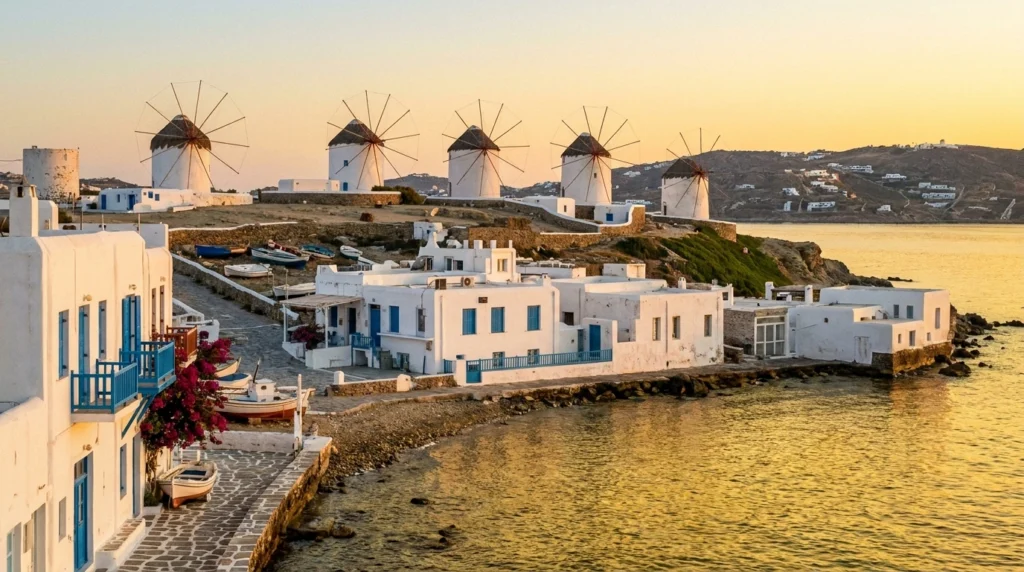
And then the windmills at sunset — the island’s free, democratic set-piece. The Kato Mili row of 16th-century windmills stands on the low hill between Chora and Little Venice, and from the hour before dusk the whole town drifts up to watch the sun drop into the Aegean behind them while the colour-washed houses of Little Venice glow below. Greece sits on US State Department Travel Advisory Level 1 (the lowest tier) and the UK FCDO advisory for Greece is routinely current.
Best Time to Visit Mykonos
Mykonos has a hot-summer Mediterranean climate — long, dry, hot summers and mild, wetter winters, with the island swept hard by the Aegean meltemi wind through July and August. The single most important calendar fact is that Mykonos is an intensely seasonal island: the beach clubs, the nightlife, the Delos boats and the Chora restaurants all run from roughly May to October and peak in July and August, while a large share of the island simply closes from November to April. Plan your trip around which Mykonos you want, and use the four-season breakdown below as the realistic timeline.

Spring (March – May) — the island waking up
The island reopens through April and May, and from mid-May it hits its first sweet spot. Daytime highs run 18–25°C, the sea warms enough to swim by late May, wildflowers cover the bare hills, and Chora is a pleasure to wander before the high-season crowds. Hotel rates and beach-club prices sit well below the July–August peak, and the Delos boats run a building schedule. Orthodox Easter (12 April 2026) is atmospheric, with candlelit midnight processions, and draws Greek domestic visitors. The catch: in March and early April many beach clubs, hotels and restaurants are still shut, the nightlife is dormant, and a wet, windy front can roll through. Mid-to-late May is the safe call for the full island experience minus the peak crowds.
Summer (June – August) — hot, crowded, peak everything
The peak of the heat, the crowds, the prices and the party. July and August highs sit at 27–30°C with strong sun and the meltemi wind whipping the Aegean and the north-coast beaches; the sea is at its warmest (23–25°C) and the south-coast beach clubs at Paradise, Super Paradise and Psarou are in full, expensive swing. This is also when cruise ships anchor off Chora, the old town is shoulder-to-shoulder by late morning, and the beach-club day-bed and bottle prices reach their annual peak. From 2025 Greece levies a per-passenger cruise tax on visitors to popular islands including Mykonos to manage the crush. Town hotels and design resorts peak hard; book three-to-six months ahead. Plan two-shift days: Chora and Delos early, beach or pool through the afternoon heat, and the windmill sunset before dinner.
Autumn (September – October) — the connoisseur’s window
The best-kept secret of the Mykonos year. September holds summer’s warmth (highs 24–27°C, sea still 23–24°C) while the cruise volume tapers, the meltemi eases and the beach clubs stay open with a more relaxed crowd; early October is mild (21–24°C) with the light turning golden and clear. Hotel and beach-club rates fall 30–50% from the August peak through October, Chora thins out markedly after mid-September, and the island is at its most pleasant for walking the old town. The flip side: by late October the season is winding down, sea temperatures begin to drop, the beach clubs start closing, and from the end of the month much of the island shuts for winter. The mid-September-to-early-October window is, for most travellers, the single best time to visit Mykonos — warm, swimmable, photogenic and far less frantic than August.
Winter (November – February) — quiet, mild, mostly closed
The Mykonos almost no visitor sees. November-February daytime highs sit at 14–16°C, overnight lows drop to 9–11°C, rainfall peaks (the wettest months are December and January), and the meltemi gives way to southerly storm systems. The great majority of beach clubs, design hotels, Delos boats and Chora restaurants close from roughly November to April; the old town keeps a core of year-round tavernas, bakeries and shops open for the permanent population. This is the window for travellers who want Chora to themselves — the lanes are empty, the light after a winter storm is extraordinary, and the few open guesthouses cost a fraction of summer — but it requires accepting that the island is in hibernation, that the nightlife and the Delos trip are off, and that ferry schedules thin right out. Greek Orthodox Christmas and the 6 January Epiphany blessing-of-the-waters are quiet local affairs.
Chora, the Windmills & Little Venice

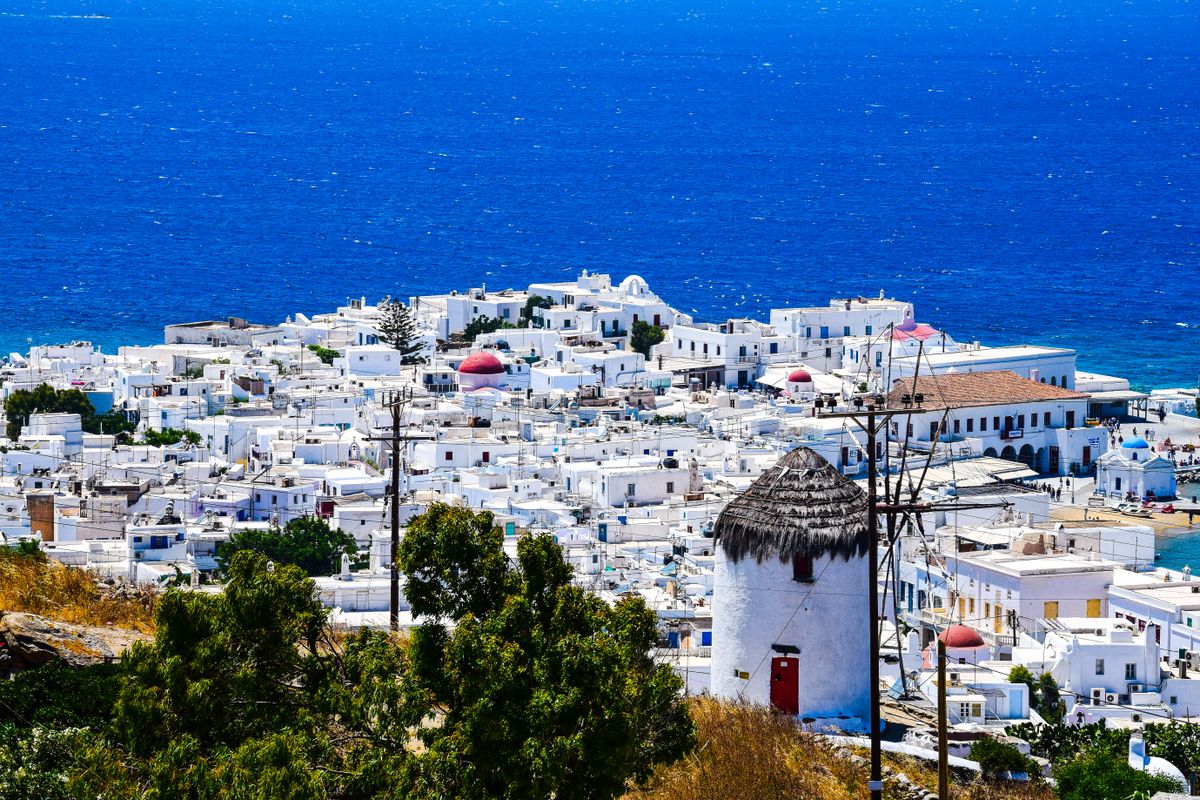
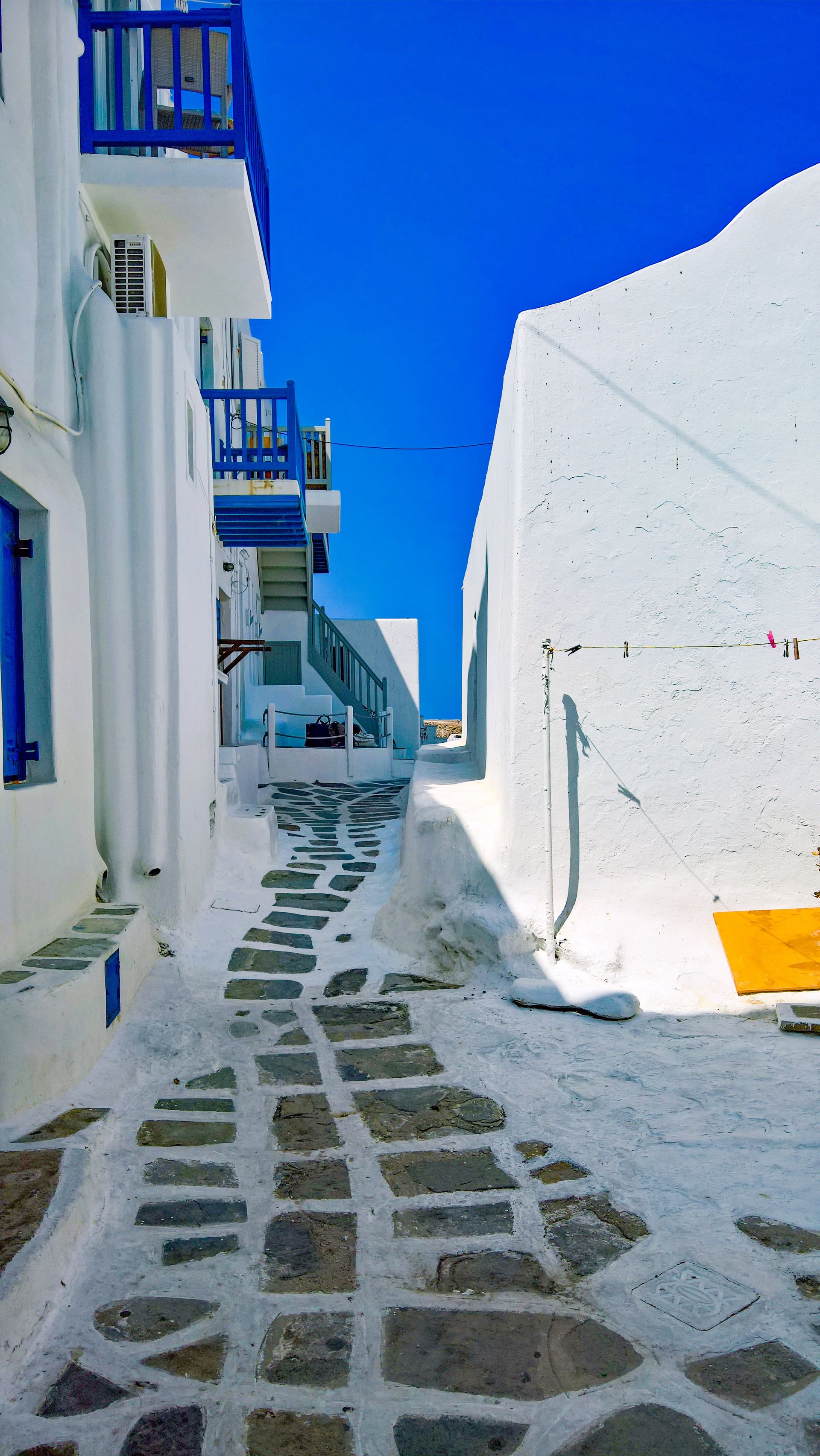
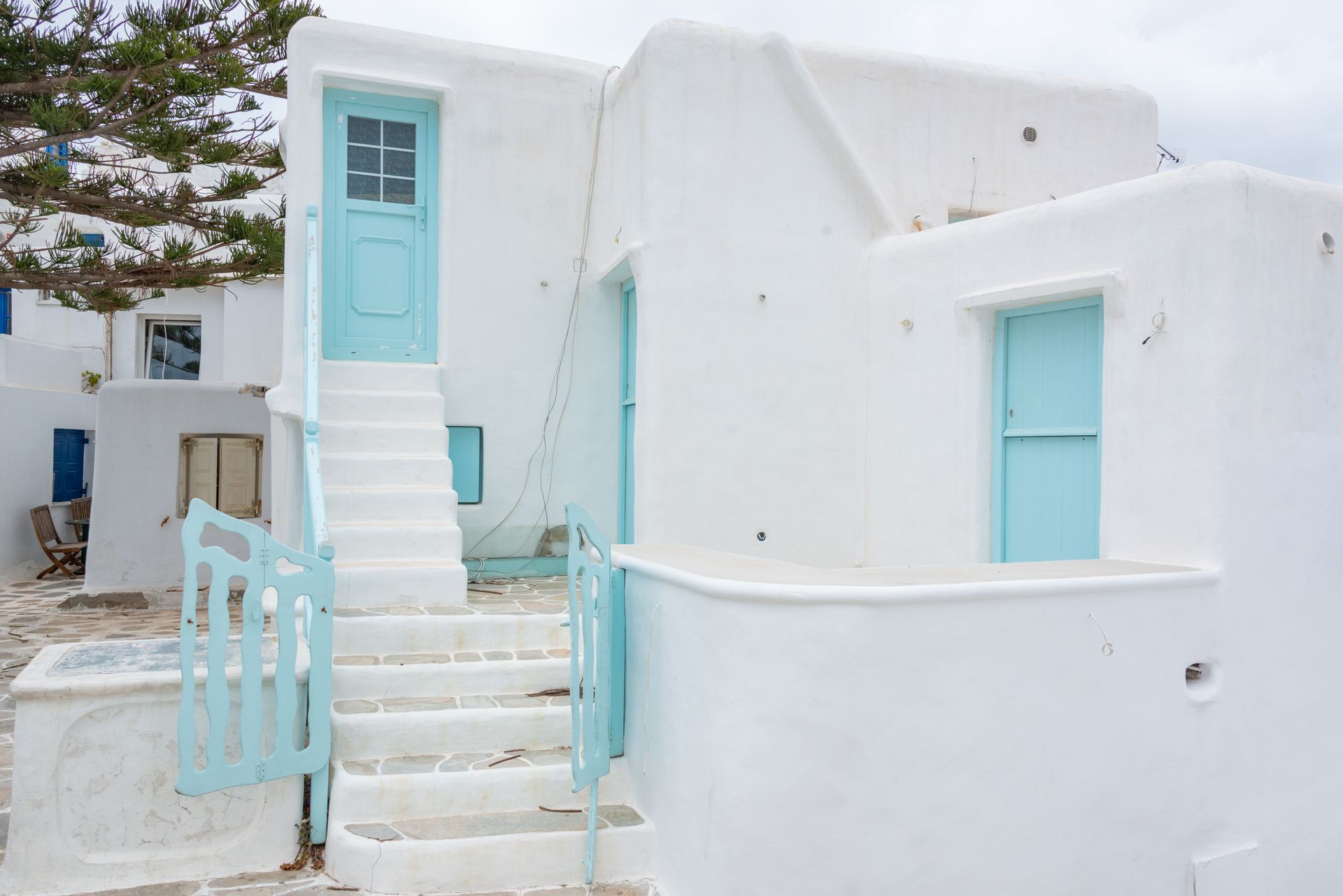
Mykonos Town — Chora — is the reason the world has a mental image of a Cycladic village. The old town is a deliberately confusing maze of narrow, whitewashed lanes, built that way over centuries to disorient the pirates who plagued the Aegean and to break the meltemi wind; the houses are colour-trimmed with blue and ochre, the lanes are paved with stone outlined in fresh white lime, and bougainvillea spills over every corner. Getting lost is the point and the pleasure; the town is small enough that you always emerge at the waterfront, the windmills or the central Matogianni shopping street within a few minutes.
The Kato Mili windmills
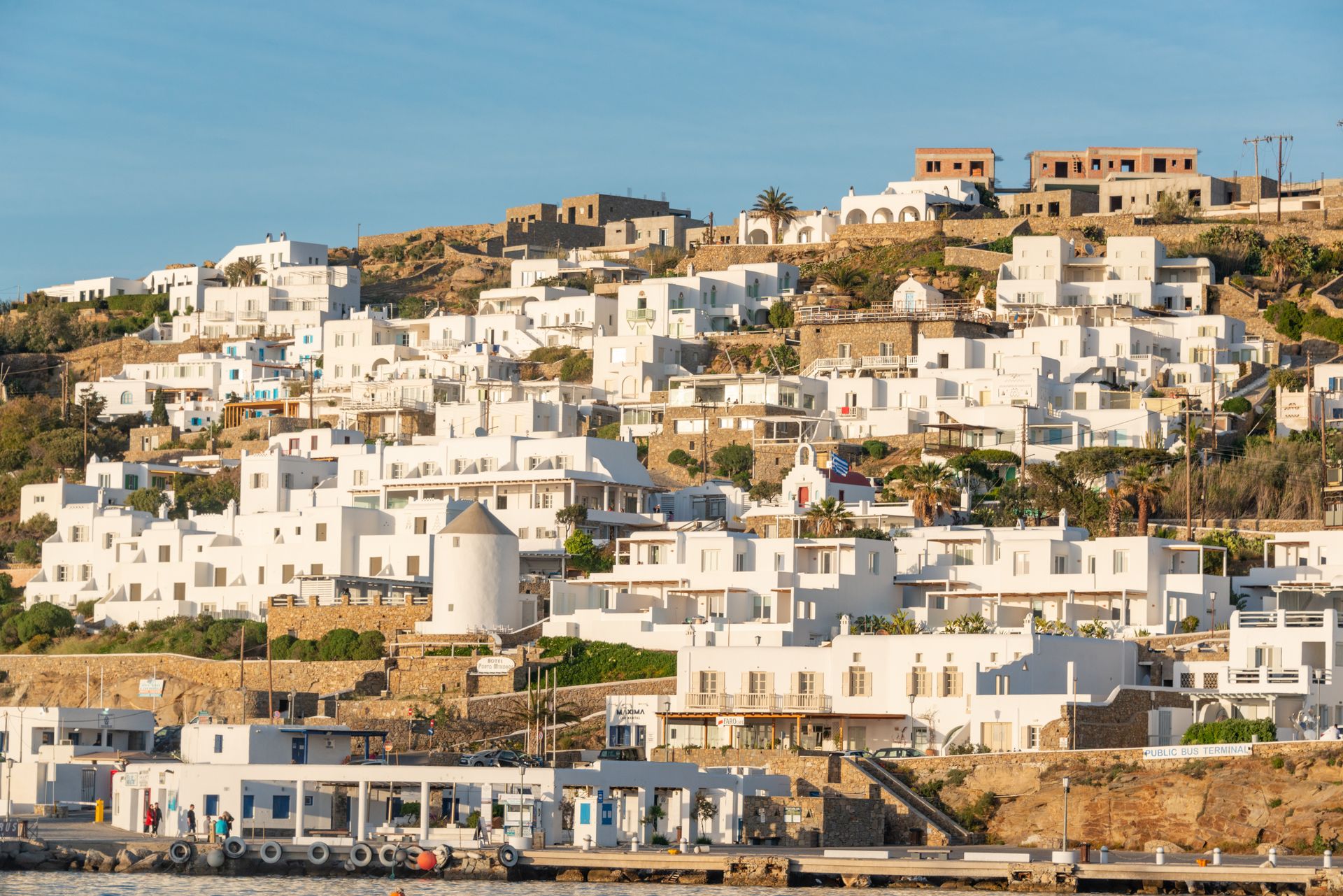
The row of stone windmills on the low hill between Chora and Little Venice is the island’s emblem. Built from the 16th century, the Kato Mili (“lower mills”) once harnessed the relentless Aegean wind to grind the island’s grain, a major part of the Mykonian economy when the island was a stop on the trade routes. Seven of the whitewashed, thatch-capped mills survive in a photogenic line; one, the Boni Mill, is restored and run as an agricultural museum. The hill is the town’s sunset gathering point and a free one — arrive 30–45 minutes before dusk in summer for a spot.
Little Venice (Alefkandra)
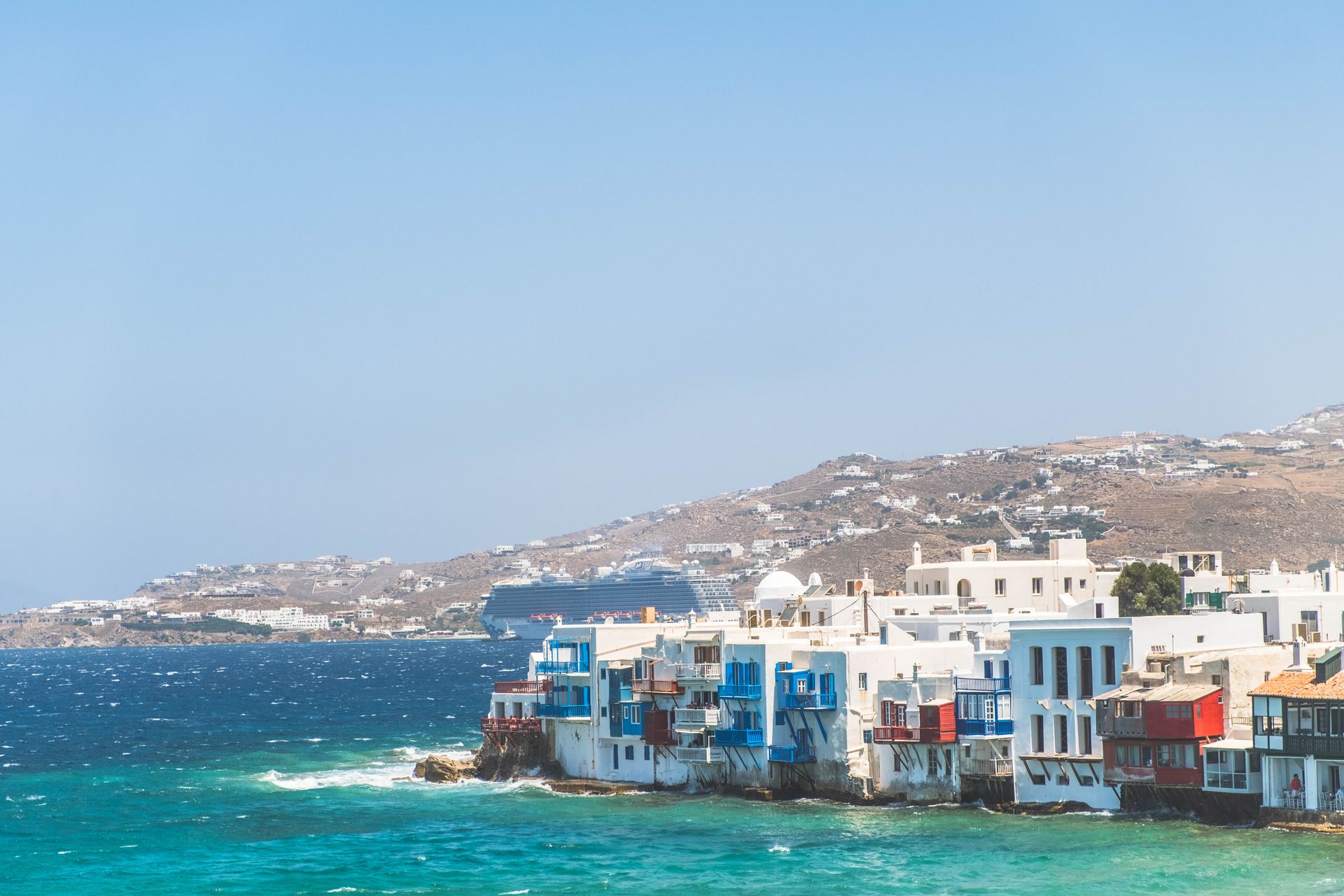
Below the windmills, the quarter of Alefkandra — universally called Little Venice — is a row of 18th-century merchant and sea-captains’ houses built right at the water’s edge, their wooden balconies and colour-washed facades hanging over the sea so the waves break against their foundations. The houses were built this way deliberately by wealthy 18th-century merchants and, the local story goes, by captains who could keep an eye on their ships and quietly land cargo straight beneath their own balconies. The ground floors are now bars and restaurants, and a cocktail on a Little Venice balcony at sunset — expensive, but iconic — is one of the island’s defining experiences. The waterfront here catches the spray on a windy day, which is part of the charm.
The Kastro, Paraportiani & the lanes
The oldest core of Chora is the Kastro, the medieval castle quarter on the headland above Little Venice, and at its edge stands the Panagia Paraportiani — the startling white sculpture of a church formed from five chapels merged over centuries, one of the most photographed buildings in Greece. From here the lanes of Chora fan out: Matogianni Street and its tributaries hold the designer boutiques and the busiest bars, while the quieter back lanes reward simply getting lost — whitewashed steps, blue doors, chapels the size of a room, and the famous resident pelican that has been the town’s unofficial mascot since the 1950s. The town is at its best photographed at first light or in the hour after sunset, when the day-trippers have gone and the white walls catch the soft Aegean colour. Wear flat, grippy shoes: the marble-paved lanes are polished and slick, and the steps are uneven.
Getting Around — Buses, Cars & the Old Port
Mykonos has no rail and no metro — getting around means the KTEL bus network, a rental car or ATV, taxis (there are very few), the south-coast sea-buses, or your own feet. The island is compact (about 15 km across) but the roads are narrow and clogged in peak season, and Chora itself is entirely pedestrian — cars are banned from the old town, so you park or are dropped at the Fabrika or waterfront edge and walk in.
KTEL buses — the budget backbone
The Mykonos KTEL bus network is genuinely useful and cheap, radiating from two stations in Chora (Fabrika in the south and the Old Port in the north) to the main beaches — Ornos, Platis Gialos, Paradise, Paraga, Kalafatis, Elia — and to Ano Mera, the airport and the New Port, with fares typically €1.80–2.30. Buses are frequent in summer (every 15–30 minutes on the busy beach routes, with late-night services to Paradise and the clubs) but pack out at peak times. This is by far the cheapest way to reach the south-coast beaches.
Sea-buses & beach boats
Small sea-buses (caiques) run along the south coast in season, linking Platis Gialos with Paranga, Paradise, Super Paradise, Agrari and Elia — a scenic, traffic-free way to hop between the organised beaches, with short hops typically a few euros. They are weather-dependent and stop when the meltemi is up.
Rental car, ATV and scooter
A rental car is the most flexible way to see the whole island — the north-coast beaches, Ano Mera and the quieter coves are far easier with your own wheels. Expect €40–80 a day in season for a small car, plus fuel; book ahead because cars sell out in July-August. ATV quad bikes and scooters are everywhere and cheap (€25–45 a day) but the accident rate is high on the narrow roads — a full licence, a helmet and caution are essential. Parking near Chora is scarce; use the edge car parks and walk in, as the old town is closed to vehicles.
Taxis & the old port
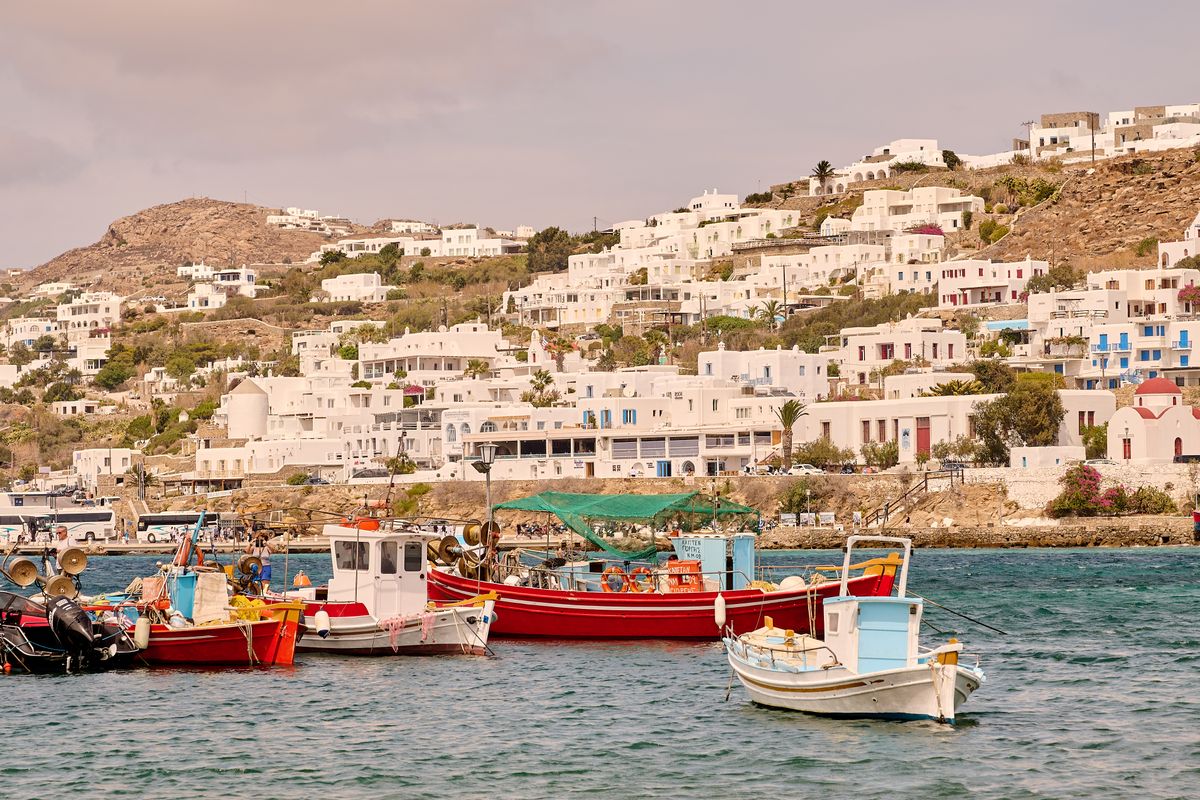
Mykonos has famously few taxis — a small licensed fleet plus app-based options — so they are scarce and pricey at peak times; pre-book or use the bus. The Old Port, just below Chora, is where the Delos boats and some smaller ferries and cruise tenders dock; the New Port at Tourlos, about 2 km north, handles the big inter-island ferries and most cruise ships.
Airport & ferry-port transfers
- Mykonos Island National Airport (JMK) sits about 4 km from Chora; taxis run roughly €15–25 to town and the KTEL bus connects to the Fabrika station.
- The New Port at Tourlos is about 2 km north of Chora; KTEL buses meet the major ferries and taxis charge around €15–20 to town.
Neighborhoods: Beaches & Areas of Mykonos
Comparing Mykonos with Santorini, Athens or Crete? See our guide to where to stay in Greece.
📍 Mykonos Map: Every Place in This Guide
Chora (Mykonos Town) — the white maze
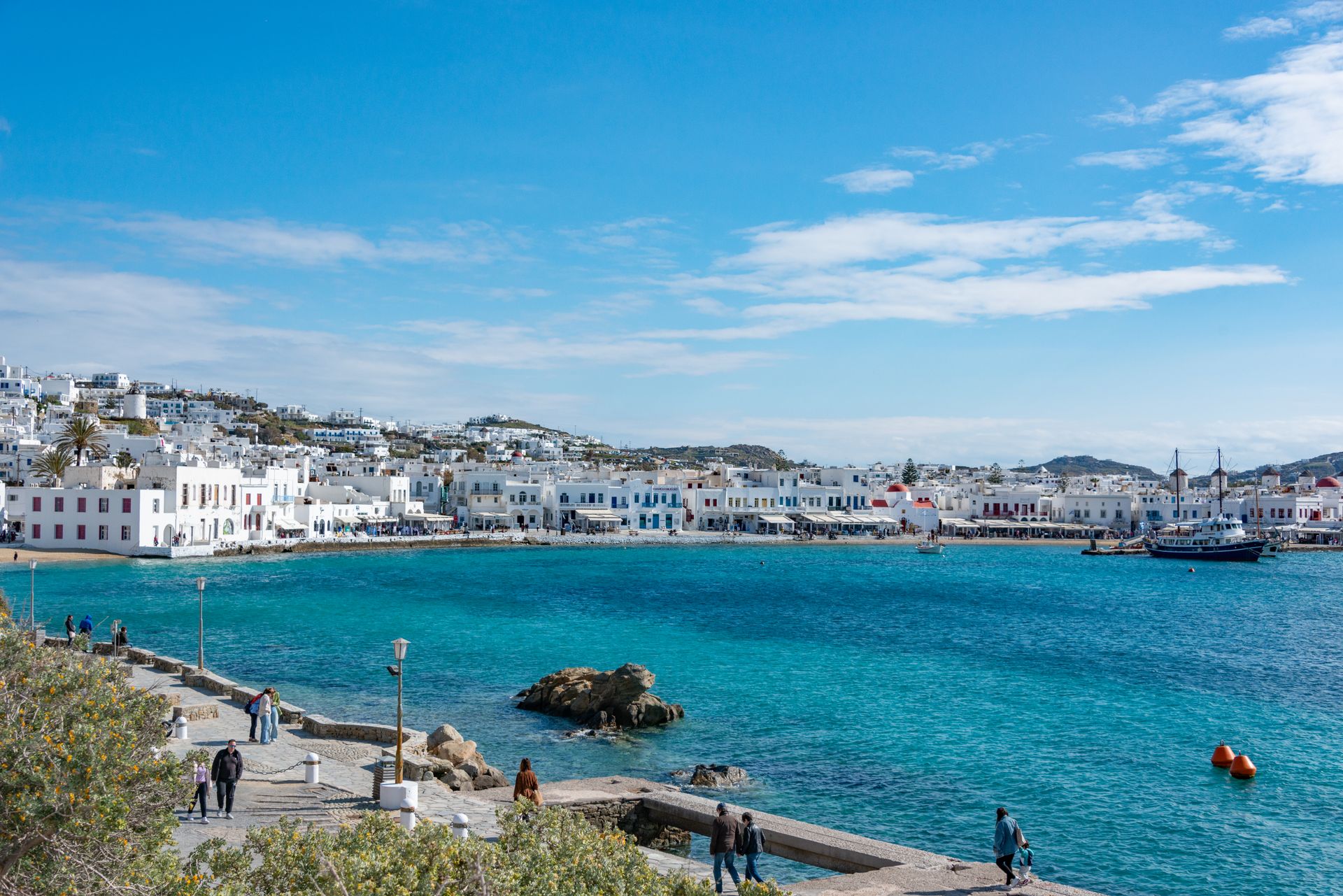
Chora is the island’s capital and beating heart — the whitewashed labyrinth that holds the windmills, Little Venice, the Paraportiani church, the Matogianni boutique street and the densest concentration of bars, restaurants and the famous designer shopping. It is car-free, walkable end to end in fifteen minutes, and the most convenient base for first-timers who want to be at the centre of everything — though also the noisiest at night.
- The Kato Mili windmills and Little Venice
- Paraportiani church and the Aegean Maritime Museum
- Matogianni Street boutiques and the central tavernas
Best for: first-timers, nightlife, shopping, walkability. Access: island bus hub; 4 km from JMK airport, pedestrian-only core.
Ornos & Platis Gialos — the family south coast
Two of the most accessible organised beaches, both a short bus ride from Chora. Ornos is a sheltered sandy bay with a village, family-friendly tavernas and easy swimming; Platis Gialos is a long sweep of sand with sunbed rows, restaurants and the sea-bus jetty for hopping to the party beaches. Both are calmer and better value than the name beach clubs.
- Ornos sheltered family bay
- Platis Gialos sunbeds and the sea-bus jetty
- Plenty of mid-range hotels within walking distance of sand
Best for: families, value, easy beach days. Access: KTEL bus from Fabrika (~10–15 minutes).
Paradise & Super Paradise — the party beaches
The south-coast beaches that built the island’s nightlife reputation. Paradise and Super Paradise run golden sand backed by the famous beach clubs where the daytime party builds into the afternoon with DJs, dancing on the sunbeds and bottle service at top-of-market prices. There are free public stretches at the edges, but the scene — and the spend — is the point here. Super Paradise has long been a centre of the island’s LGBTQ+ friendly reputation.
- Beach-club day-beds and afternoon DJ sets
- Free public sand at the margins
- Late-night bus connections to Chora
Best for: the beach-club scene, young crowds, nightlife. Access: KTEL bus or sea-bus from Platis Gialos.
Psarou & Ornos’s glamour set — the see-and-be-seen coast
Psarou is the most exclusive beach on the island — a small, sheltered cove dominated by the Nammos beach club, where front-row sunbeds and a bottle of champagne reach genuinely eye-watering sums and yachts anchor offshore. This is the Mykonos of the celebrity-and-yacht reputation; come to look, but know the prices before you sit down.
- Nammos and the Psarou yacht set
- Sheltered, calm swimming water
- Top-of-market sunbed and bottle prices
Best for: the glamour scene, people-watching, a splurge. Access: KTEL bus or taxi from Chora.
Ano Mera & the quiet north — the real island
Inland, Ano Mera is the island’s only other real village — a quiet square, the fortified Panagia Tourliani monastery and tavernas serving a local crowd. The exposed north and west coasts — Agios Sostis, Fokos, Ftelia — are wilder, often windswept beaches with few or no facilities, the antidote to the south-coast scene. Ftelia is a windsurfers’ favourite when the meltemi blows.
- Panagia Tourliani monastery at Ano Mera
- Agios Sostis and Fokos — wild, undeveloped sand
- Ftelia for windsurfing in the meltemi
Best for: escaping the crowds, windsurfers, a quieter base. Access: car or KTEL bus to Ano Mera.
Cultural Sights
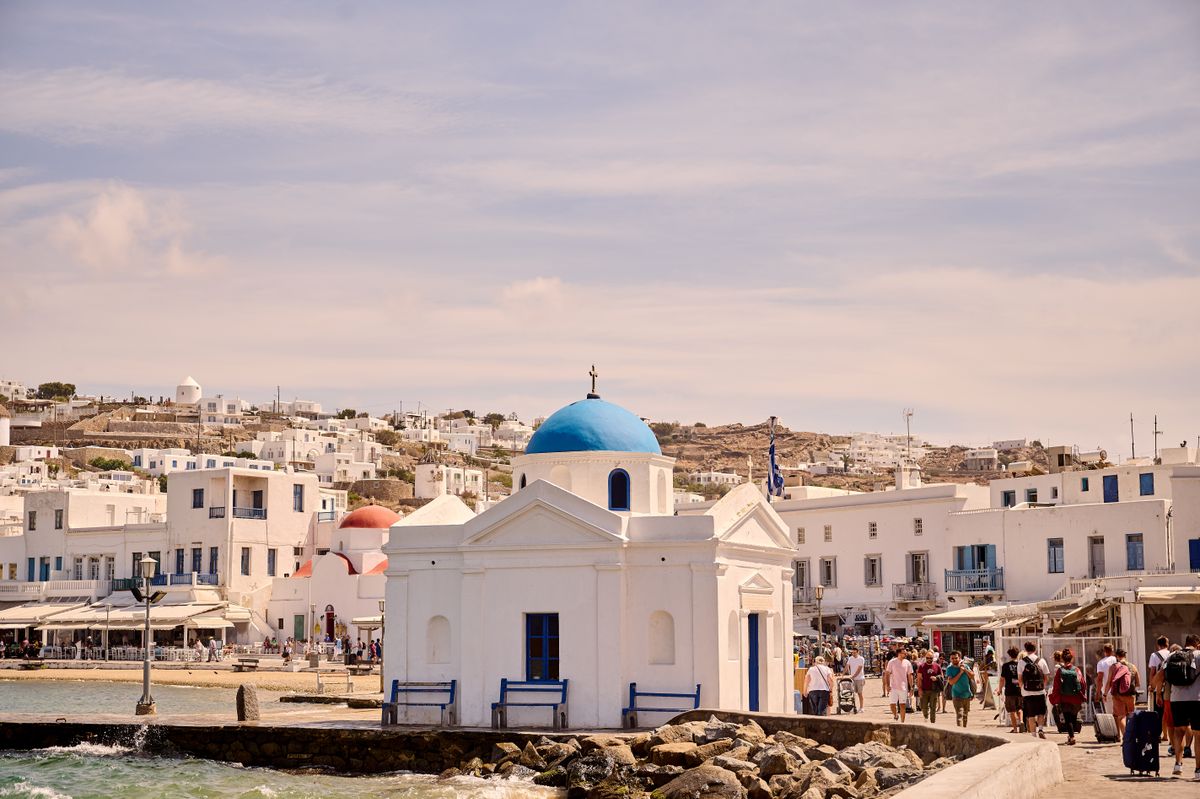
Delos Archaeological Site (UNESCO)
The single most important sight in the region — not on Mykonos itself but a 30-minute boat away. Delos is the uninhabited sacred island the ancient Greeks held to be the birthplace of Apollo and Artemis, a Pan-Hellenic sanctuary and major trading port whose ruins — temples, the Terrace of the Lions, mosaic-floored houses, a theatre and an entire ancient town — cover the small island. It was inscribed by UNESCO as a World Heritage Site in 1990. Admission is around €12 plus the boat fare; the site closes by mid-afternoon and there is no shade, so go on the first boat.
Panagia Paraportiani
The most famous church on Mykonos and one of the most photographed in Greece — a startling whitewashed sculpture of a building near the Kastro at the edge of Chora, formed from five small chapels merged over centuries into a single asymmetric, sea-smoothed whole. It is most striking at sunset when the white walls turn gold. Free to view from outside.
Aegean Maritime Museum & Lena’s House
In Chora, the Aegean Maritime Museum traces the seafaring history that built the island, with ship models, instruments and the story of the Cycladic merchant fleets; the adjacent Lena’s House is a preserved 19th-century Mykonian middle-class home. Modest admission; a quiet, atmospheric counterpoint to the beach scene.
Panagia Tourliani Monastery (Ano Mera)
The island’s principal monastery, founded in the 16th century in the inland village of Ano Mera, with an ornate carved marble bell tower, a Baroque altar screen and a small ecclesiastical museum. A calm, working religious site away from the Chora crowds; dress modestly.
The windmills & the Boni Mill museum
The Kato Mili row is the island’s emblem; the restored Boni Mill above Chora is run as an agricultural museum showing how the 16th-century mills harnessed the meltemi to grind the island’s grain.
Nightlife & the Beach-Club Scene

The beach-club afternoon party
The defining Mykonos experience: the south-coast clubs at Paradise, Super Paradise and Psarou turn the daytime beach into a DJ-driven party that builds from mid-afternoon. Sunbeds at a name club run from €40–50 a pair on a quiet day to several hundred euros front-row in August, and bottle service multiplies bar prices. Set your budget before you arrive.
Little Venice sunset bars
A cocktail on a Little Venice balcony at sunset is the town’s most iconic drink — expensive (cocktails commonly €14–22) and worth doing once. Book a waterfront table an hour ahead in summer.
Chora’s club & bar maze
The old town holds the late-night scene — cocktail bars, drag and cabaret venues around the central lanes, and clubs that run until dawn in July-August. Drinks €10–18; the town has long been one of the most openly LGBTQ+ friendly destinations in the Mediterranean.
Cavo Paradiso & the big clubs
The island’s most famous nightclub, Cavo Paradiso, sits on a clifftop above Paradise beach and books international DJs through the season; entry and drinks are top-of-market, and the night runs to sunrise.
A quieter evening — Ano Mera & the tavernas
For a night away from the scene, the tavernas of Ano Mera and the family restaurants of Ornos serve a local crowd at normal prices — the real island after the beach clubs have emptied.
Delos & Day Trips from Mykonos

Delos (about 30 minutes by boat)
The one day trip nobody should skip — the sacred uninhabited island, birthplace of Apollo, and a UNESCO World Heritage Site whose ruins fill the whole islet. Boats run from the Old Port below Chora several times each morning; allow three to four hours including the crossing, bring water, a hat and sunscreen because there is no shade, and take the first boat to beat the heat.
Tinos (about 30 minutes by ferry)
The neighbouring island north, famous for the pilgrimage church of Panagia Evangelistria, its marble-carving villages and a quietly excellent food scene — a complete contrast to Mykonos’s glamour and an easy day trip or overnight.
Naxos & Paros (about 45–60 minutes by fast ferry)
The larger central Cyclades — Naxos with its mountain villages, long sandy beaches and the marble Portara gateway, Paros with Naoussa’s harbour and the Byzantine Ekatontapyliani church. Doable as long day trips but better as island-hopping stops.
Rhenia (half-day by boat)
The small uninhabited island beside Delos, often combined with the Delos visit on a boat tour — quiet swimming coves and a sense of the Aegean before tourism.
Santorini (about 2–3 hours by fast ferry)
The Cyclades’ other headline island, south of Mykonos — the caldera, Oia’s sunset and Bronze-Age Akrotiri. A long day each way, so far better as a one-way island-hopping leg than a same-day round trip.
Food in Mykonos

Mykonos eats well, with a genuine Cycladic food tradition under the glamour. The island is known for its cheeses — the soft, peppery kopanisti and the fresh tyrovolia — for the cured pork loukaniko and louza sausages, and for the Aegean seafood the tavernas grill simply and beautifully. The volcanic-and-windswept Cycladic terrain gives the produce an outsized flavour, and the meltemi-dried meats and pungent aged cheeses are a direct response to centuries of preserving food on a dry island with little grazing. The catch is the same as everywhere on Mykonos: the waterfront and beach-club tables charge a heavy premium for the setting, and the best value and often the best food are a few streets inland or out in Ano Mera, where the tavernas cook for a local crowd rather than a passing one.
Mykonian specialities to eat
Start with the island’s own products before the seafood.
- Kopanisti — the soft, peppery, aged Mykonian cheese, spread on bread or rusks (€6–9)
- Louza & loukaniko — the cured pork loin and the local sausage, sliced as meze (€7–11)
- Kremmydopita — the Mykonian onion pie, a traditional savoury bake (€6–9)
Where to eat — Chora & Ano Mera
The waterfront tables come with a view premium; the better value is inland and in the village.
- Chora’s back-lane tavernas — family-run spots a few streets off the waterfront with island classics (mains €14–24)
- Ano Mera village tavernas — a local crowd, grilled meat and meze at normal prices (mains €10–18)
- Little Venice & waterfront restaurants — the view tables; expect €25–45 a main at the higher end
Beyond cheese and seafood
Greek staples are everywhere and reliably good.
- Grilled octopus — sun-dried then charred, an Aegean classic (€13–20)
- Souvlaki & gyros — the cheap, excellent street option in Chora (€4–6 a wrap)
- Greek salad (horiatiki) — with local tomatoes and kopanisti or feta (€9–13)
- Amygdalota — the soft Mykonian almond macaroons for dessert (€5–8)
What to drink — wine, ouzo & the local spirit
Mykonos has its own small but growing wine scene — a handful of vineyards around Ano Mera produce crisp Cycladic whites that pair well with the cheeses and seafood — alongside the Greek staples of chilled retsina, the aniseed spirit ouzo sipped with meze, and tsipouro. House wine by the carafe is honest and cheap; a glass of cold assyrtiko or a local Mykonian white runs €6–9 in a taverna and several times that on a Little Venice balcony. The island also turns out excellent bakeries — the soft almond amygdalota and fresh bougatsa are worth seeking out for breakfast.
Food experiences you can’t miss
- Fresh-grilled Aegean fish at a waterfront taverna at sunset
- A kopanisti-and-louza meze board with a cold local white
- An Ano Mera village taverna lunch with a carafe of house wine
- A late-night gyros in the Chora lanes after the bars
Practical Information
Language
Greek is the official language, written in its own alphabet, but English is near-universal in Mykonos’s tourism sector — hotels, restaurants, beach clubs, shops and taxis all operate in English, and menus and signs are bilingual island-wide. Learning kalimera (good morning), efcharisto (thank you) and parakalo (please/you’re welcome) is appreciated.
Cash vs. cards
Cards (Visa/Mastercard) are accepted at hotels, most restaurants, beach clubs and shops; smaller tavernas, beach kiosks, the bus and street stalls prefer cash. ATMs are in Chora, Ornos, Platis Gialos and Ano Mera; carry €50–100 in small notes for the bus, the beach and rural tavernas.
Safety
Greece is on US State Department Travel Advisory Level 1, the lowest tier; Mykonos has very low violent crime. The real hazards are an ATV/scooter accident rate on the narrow roads, the strong sun, and the occasional inflated bar or beach-club bill — always ask the price of sunbeds and bottles before you commit.
What to wear
Light, breathable clothing and a hat for summer; proper shoes for Delos’s rough archaeological ground, not flip-flops. A light layer for the meltemi-breezy evenings. Modest cover for visiting churches and the Ano Mera monastery. Mykonos dresses up at night — the smart restaurants and clubs have a stylish dress code.
Cultural etiquette
The churches and the Panagia Tourliani monastery are working places of worship — dress respectfully and do not climb on roofs for photos. Tipping is modest (round up or 5–10% for good service). Greeks dine late; restaurants fill from 21:00 and the nightlife runs to dawn.
Connectivity
4G/5G coverage is good across the populated parts of the island; EU roaming applies for EU SIMs, and prepaid Greek SIMs (Cosmote, Vodafone) are cheap. Most hotels, cafes and beach clubs offer free Wi-Fi.
Health & medications
Pharmacies are in Chora and the larger beach areas; there is a health centre on the island for minor issues, with serious cases transferred to Athens or Syros. Carry sunscreen, water and any prescription medicines; the EHIC/GHIC covers EU/UK visitors for state care, but travel insurance is strongly advised.
Luggage & the car-free old town
Chora is closed to vehicles, so many town hotels are reached only on foot through the lanes — confirm with your hotel how bags are handled and where to be dropped, and pack light. This catches first-timers out.
Budget Breakdown: Making Your Euros Count
| Tier | Daily | Sleep | Eat | Transport | Activities | Extras |
|---|---|---|---|---|---|---|
| Budget | €90–140 | €55–90 studio (Ano Mera/off-town) | €25–35 tavernas & gyros | €5–10 KTEL bus | €25–40 Delos & a public beach | €5–15 |
| Mid-Range | €220–400 | €140–260 town/Ornos hotel | €50–90 sit-down dinners | €45–70 rental car/day | €60–150 beach-club day & Delos | €25–50 |
| Luxury | €600+ | €400–900+ design hotel | €130+ fine dining | €90+ private transfers | €300+ name-club sunbeds & bottles | €60+ |
Where your money goes
Mykonos is the most expensive island in Greece, and the two biggest variables are accommodation and the beach clubs: a design hotel in Chora in August can cost ten times an off-town studio in Ano Mera, and a front-row day at a name beach club such as Nammos can exceed an entire budget day on its own. The scene is the premium; the bus, the public beaches, the gyros and the Delos boat are all reasonable. Shifting your base off-town or your dates to the shoulder season, and choosing public beaches over name clubs, halves most budgets. Greece uses the euro, and tipping is modest — rounding up or leaving 5–10% at a sit-down taverna is plenty.
A realistic week for a couple landing in the shoulder season, basing off-town and using the bus, comes in around €1,500–2,400 all-in excluding flights — a fraction of what the same week costs in an August Chora design hotel with daily beach-club sunbeds. Delos, the windmill sunset and the old town cost little or nothing, so the experiences are not where Mykonos drains a budget; the beach-club bill and the design-hotel bed are.
Money-saving tips
- Stay in Ano Mera or off-town and bus into Chora rather than paying the town-hotel premium
- Visit in late May, September or early October — rates fall 30–50% from the August peak
- Choose public beaches (free Paradise stretches, Agios Sostis) over name beach clubs, and always ask sunbed and bottle prices first
- Use the KTEL bus (€1.80–2.30 a ride) and the south-coast sea-buses instead of the scarce, pricey taxis
Frequently Asked Questions
How many days do I need in Mykonos?
Three nights covers Chora (the windmills, Little Venice, Paraportiani), the Delos day trip and a beach day; four lets you add the full beach-club scene and a quieter north-coast beach; five fits a slower pace and a day trip to Tinos or Naxos. Many visitors arrive on a cruise for a single rushed day — staying at least three nights is what lets you see the old town at the quiet hours, before the day-tripper crowds land.
Is Mykonos good for solo and family travellers?
Yes to both, with caveats. Greece is on US State Department Travel Advisory Level 1 and crime is very low; the island is easy and welcoming for solo travellers, and famously open and inclusive. Families do well based in Ornos or Platis Gialos near the calm, organised beaches rather than the party coast; the main cautions everywhere are the ATV/scooter traffic on narrow roads and the beach-club costs — keep the family beach days to the public and family stretches.
How do I get around Mykonos without a car?
The KTEL bus network covers Chora, the airport, the New Port and all the main beaches for €1.80–2.30 a ride, with late-night services to the party beaches in summer, and small sea-buses hop between the south-coast beaches. Taxis are famously scarce and should be pre-booked. For the north-coast beaches and Ano Mera a rental car or ATV is far more convenient, but Chora itself is car-free and walked end to end.
What about the language barrier in Mykonos?
Minimal. Greek is the official language and uses its own alphabet, but English is spoken everywhere in tourism — hotels, restaurants, beach clubs, shops, taxis and tour operators all operate in English, and signage and menus are bilingual island-wide. Learning kalimera (good morning) and efcharisto (thank you) earns goodwill but is not necessary to get by.
When is the best time to visit Mykonos?
Late May to June and September to early October are the sweet spots — warm (22–27°C), dry, swimmable sea, the beach clubs open, and far fewer crowds and lower prices than the July-August peak, when the heat, crush and prices all spike. November to April is mild but quiet, with most of the island — beach clubs, design hotels, Delos boats and many restaurants — closed for winter.
Can I use credit cards everywhere in Mykonos?
Hotels, most restaurants, beach clubs and shops take Visa/Mastercard; smaller tavernas, beach kiosks, the KTEL bus and street stalls prefer or require cash. Carry €50–100 in small euro notes for buses, beaches and rural tavernas. ATMs are in Chora, Ornos, Platis Gialos and Ano Mera, but can run dry or queue in peak season — withdraw before a beach or village day.
How expensive are the Mykonos beach clubs really — and how do I avoid the cost?
Genuinely top-of-market. A pair of front-row sunbeds at a name club such as Nammos on Psarou can run into the hundreds of euros in August before any drinks, and bottle service multiplies bar prices, so the beach-club day is the single thing most likely to blow a Mykonos budget. To avoid it, use the free public stretches of Paradise, the calmer organised beaches at Ornos and Platis Gialos, or the wild north-coast beaches; always ask the price of sunbeds and bottles before you sit down; and go on a weekday or early in the day when sunbeds are cheaper. The windmill sunset and the Chora lanes cost nothing.
Is Delos worth visiting and how do I get there?
Delos is the single most important sight in the region and well worth half a day — the sacred uninhabited island, birthplace of Apollo, a UNESCO World Heritage Site whose ruins fill the whole islet. Boats run from the Old Port below Chora several times each morning; the crossing is about 30 minutes, admission is around €12 plus the boat fare, and you should take the first boat because the site closes by mid-afternoon and there is no shade. Bring water, a hat and proper shoes for the rough ground.
How do I get from Athens to Mykonos?
Two ways: fly from Athens to Mykonos (JMK) in about 40 minutes on Aegean, Sky Express or Volotea, or take the ferry — a high-speed catamaran from Rafina (the secondary Athens port, closest to the airport) in about 2 hours 30 minutes, or from Piraeus in around 3 to 5 hours depending on the vessel. Frequent crossings run in high summer; book fast ferries well ahead in July-August, and build a buffer day before an international flight out of Athens because the meltemi wind can cancel sailings.
Ready to Experience Mykonos?
Wander Chora at first light, take the early boat to Delos, watch the sun drop behind the windmills, and decide your beach-club budget before the bill does it for you. For the full country context, read the Greece Travel Guide.
Explore More City Guides
- Athens City Guide
- Santorini City Guide
- Thessaloniki City Guide
- Greece Country Guide
- Greece Travel Guide (full)
- All City Guides
Alex the Travel Guru
Alex has island-hopped the Cyclades end to end, wandered Chora’s lanes at dawn before the cruise crowds, taken the first boat to Delos and watched more than a few beach-club bills land. He writes the kind of brief he’d hand his own family — the real timings, the honest cost warnings and the spots worth the climb.
More city guides you might like
Plan your trip to Mykonos
The booking tools we use ourselves. FFU may earn a commission at no extra cost to you.
Plan & book your trip to Mykonos
Booking through these searches supports our guides at no extra cost to you.