
Languages of Uruguay
All languages of South America →fluent beta classical · classes by phone with Maya at ranas.ai/maya
Uruguay Travel Guide — The World’s Longest Carnival, 98% Renewable Power & Three UNESCO Sites in 176,000 km²
The first thing I tell people about Uruguay is that the cliche about it being a “small Argentina” is wrong on every metric I care about: the beef is at least as good, the coffee is reliably worse, the politics are noticeably saner, and the entire country can be crossed in a leisurely day’s drive without seeing a single skyscraper after you leave the Rambla. My favourite Uruguay argument is whether the chivito on a sidewalk in Pocitos beats the parrilla rib-roll at the Mercado del Puerto — I will defend the chivito until I die — and my second-favourite is whether the right way to do Carnival is the all-night Llamadas drum parade through Barrio Sur or the family-with-kids Tablado in a neighbourhood square. Treat this guide as the brief I would hand a friend who has only been to Buenos Aires before, with a Buquebus ticket already booked and a thermos of mate in their bag.

In This Guide
- Overview — Why Uruguay Punches Way Above Its Weight
- From Charrúa Hunters to Pepe Mujica — A Pocket History
- Best Time to Visit Uruguay (Season by Season)
- Carnival 2026 — The World’s Longest & the Llamadas Drum Parade
- Getting There — Carrasco (MVD) & the Buenos Aires Ferry
- Getting Around — Buses, Self-Drive & the Tres Cruces Hub
- Top Cities & Regions — Montevideo, Punta del Este, Colonia & the Atlantic Coast
- Uruguayan Culture — Río de la Plata Spanish, Mate & the Secular State
- A Food Lover’s Guide to Uruguay
- Off the Beaten Path — Fray Bentos, Quebrada de los Cuervos & the Atlántida Church
- Practical Information
- Budget Breakdown
- Planning Your First Trip to Uruguay
- Frequently Asked Questions
Overview — Why Uruguay Punches Way Above Its Weight
Uruguay is the second-smallest sovereign nation in South America — 176,215 km² (about 68,037 square miles, roughly the size of England-and-Wales or the US state of Washington) wedged between Argentina across the Río de la Plata estuary in the south-west and Brazil along a 985-kilometre land border to the north. The 2023 national census recorded 3,499,451 inhabitants, of whom nearly two million live inside metropolitan Montevideo — meaning more than one in two Uruguayans lives within 50 kilometres of the Plaza Independencia, an extraordinary urban concentration that shapes everything from the country’s politics to its food culture. The terrain is famously gentle: rolling plains called cuchillas, average elevation of 117 metres, with the highest point in the country — Cerro Catedral in the south-eastern Cuchilla Grande — rising to a modest 514 metres. Three big rivers do the heavy lifting: the Río Uruguay forms the western border with Argentina, the Río Negro slices the country diagonally from north-east to south-west, and the Río de la Plata estuary anchors the entire southern coastline.
The first story of Uruguay is geographic luck. Climate is humid subtropical and almost monotonously even-tempered: July averages of 10-12°C in the depths of winter, January averages of 22-26°C at the height of summer, around 1,000 mm of rain spread evenly across the year, and “neither a decidedly dry nor a rainy season” anywhere in the country. The Atlantic coastline runs about 660 kilometres from Punta Carretas in central Montevideo to the Brazilian border at Chuy, and the famous resort and conservation belt — Piriápolis, Punta del Este, La Barra, José Ignacio, La Paloma, La Pedrera, Cabo Polonio and Punta del Diablo — lines up along that arc like beads on a string. Inland, the gentle ridges of the Cuchilla Grande and Cuchilla de Haedo divide the country into thirds: the litoral agricultural west, the interior ranching heartland, and the urban-coastal south where most of the country actually lives.
The second story is colonial inheritance, and it explains why Uruguay still feels Italian-Spanish-Portuguese even by Latin-American standards. Spanish navigator Juan Díaz de Solís reached the Río de la Plata in 1516, the Portuguese founded Colonia del Sacramento across the estuary from Buenos Aires in 1680, the Spanish founded Montevideo in 1726 to push them back, and the Banda Oriental flipped between the two empires for the next century. José Gervasio Artigas led the independence movement and won the Battle of Las Piedras against Spanish forces in 1811; the Thirty-Three Orientals (Treinta y Tres Orientales) launched the final uprising on 19 April 1825 with backing from Argentina; and the 1828 Treaty of Montevideo carved Uruguay out as a buffer state between the two larger republics. Italian and Spanish migration in the 1880-1930 wave was so heavy that the modern Uruguayan accent carries an unmistakable Genoese inflection — if you have ever heard porteño Spanish in Buenos Aires, multiply the Italian shading by about 50%.
The third story is the social-democratic experiment, and it is the one that should change how you think about a Latin-American country. Under the early-twentieth-century reformer José Batlle y Ordóñez, Uruguay introduced state secularism, an eight-hour working day, divorce and women’s suffrage decades ahead of most of the world — The Economist had nicknamed it “the Switzerland of the Americas” by 1920. The military dictatorship of 1973-1985 interrupted that trajectory, but post-democratic Uruguay has resumed it with conviction: the country legalised abortion in 2012, became the third country in the Americas (and the third country in the world after the Netherlands and Belgium) to legalise same-sex marriage in 2013, and made history in December 2013 as the first country in the modern era to fully legalise the production, sale and consumption of cannabis. Pepe Mujica, the former Tupamaro guerrilla and 40th president (2010-2015) who became globally famous for living on a small flower farm and donating 90% of his salary, embodied the country’s stubborn small-state-with-big-ideas character.
The fourth story is energy and economics. Uruguay generated approximately 98% of its electricity from renewable sources in 2025 — a mix of hydroelectric (~29%), wind (~29%), biomass (~14%) and solar (~6%) — flipping in fifteen years from a net electricity importer dependent on Argentine gas to a net exporter shipping over 2,000 GWh into Brazil and Argentina in 2024. The economy is high-middle-income: GDP per capita on PPP terms is around USD $39,030 (2026 projection), more than 60% of the population is middle-class, and Uruguay ranks 14th globally on the Corruption Perceptions Index, one of the best in the developing world. Tourism is a structural pillar: 3.8 million international arrivals in 2023 (more than the country’s own population), with Argentine visitors making up 56% of the total and 70% during the southern-summer months.
The fifth story is culture, and it is what makes Uruguay disproportionately interesting for a traveller. Three UNESCO World Heritage Sites in a country the size of Florida is itself an outlier: the Portuguese-Spanish quarter of Colonia del Sacramento (inscribed 1995, criterion iv), the Fray Bentos Industrial Landscape on the Río Uruguay where the OXO and Fray Bentos beef brands were born (inscribed 2015, criteria ii and iv), and Eladio Dieste’s Atlántida Church — the most beautiful brick-vault structure in twentieth-century engineering — inscribed in 2021. On the intangible-heritage list sits Candombe, the Afro-Uruguayan drum tradition that pulses through Montevideo’s Llamadas parade every February (inscribed 2009). The country also hosted and won the inaugural FIFA World Cup in 1930 (defeating Argentina 4-2 at the Estadio Centenario, built specifically for the tournament), pulled off the legendary Maracanazo against Brazil in 1950 to lift the trophy a second time, and has accumulated 15 Copa América titles — more than any country except Argentina.
Practically, Uruguay in 2026 is the most legible South-American country for a first-time visitor. The currency is the Uruguayan peso (UYU), but the United States dollar is “surprisingly widely accepted” at petrol stations, restaurants and even fast-food counters — you will see prices listed in both currencies along the coast. Tap water is safe in every major city, the bus network covers every corner of the country, the Buquebus catamaran from Buenos Aires takes 1 hour 15 minutes to Colonia del Sacramento, and the violent crime that worries the US State Department is overwhelmingly concentrated in specific Montevideo barrios you will not visit as a tourist. Lonely Planet, Condé Nast Traveler, AFAR, the Financial Times, the New York Times, the Guardian and the Bradt Guides series all maintain dedicated Uruguay coverage with current 2026 itinerary recommendations. Pack a thermos, a thin merino layer for ocean evenings even in January, and a willingness to argue politely about football, asado and which side of the Río de la Plata invented dulce de leche.

From Charrúa Hunters to Pepe Mujica — A Pocket History of Uruguay
Pre-colonial Uruguay belonged to the Charrúa, hunter-gatherer bands related to the Pampean peoples of the lower Río de la Plata, with smaller numbers of Guaraní and Chaná populating the Uruguay-river littoral. Their bola-and-boleadora tradition shaped the gaucho culture that came afterwards, and the Charrúa fought the Spanish, the Portuguese and the new Uruguayan republic in turn. The European story opens with Juan Díaz de Solís, the Spanish navigator who reached the Río de la Plata in 1516, gave the river its name (from plata, silver) and was almost immediately killed in an ambush near what is now Carmelo. The Portuguese arrived from the north and founded Colonia del Sacramento, directly across the river from Buenos Aires, on 28 January 1680 under the command of Manuel Lobo. The Spanish responded by founding Montevideo in 1726 with Bruno Mauricio de Zabala, building the citadel and the colonial grid we still walk today.
The eighteenth century is essentially the slow story of the Banda Oriental flipping between two empires. Colonia del Sacramento changed hands seven times between Portuguese and Spanish forces over 130 years, which is why its UNESCO-inscribed Barrio Histórico fuses an irregular Portuguese street plan with a later Spanish grid — the only urban site in the world where the two colonial geometries collide on the same hillside. Independence came messily. José Gervasio Artigas, a former Spanish-Imperial frontier officer turned caudillo, defeated Spanish forces at the Battle of Las Piedras on 18 May 1811 (still Uruguay’s national army-day holiday) and tried to construct a federal Banda Oriental that would join a loose United Provinces of the Río de la Plata. Portuguese-Brazilian forces invaded in 1816, occupied Montevideo by 1817 and annexed the territory as the “Provincia Cisplatina” of the Brazilian Empire from 1821.
The decisive moment came on 19 April 1825, when Juan Antonio Lavalleja and his thirty-two companions — the legendary Treinta y Tres Orientales — landed at La Agraciada beach with Argentine backing and re-launched the independence war. The Cisplatine War (1825-1828) ended with the Treaty of Montevideo, brokered by British diplomat Lord Ponsonby, which established the Eastern Republic of Uruguay (República Oriental del Uruguay) on 27 August 1828 as a buffer state between Argentina and Brazil. The first constitution was adopted on 18 July 1830, still celebrated as Constitution Day. The new republic immediately split into two political families that defined Uruguayan politics for 150 years: the Colorados (red, liberal-urban-pro-Brazil) and the Blancos / Partido Nacional (white, conservative-rural-pro-Argentina), and the Guerra Grande civil war (1839-1852) between them killed thousands and pulled in regional powers, leaving Montevideo besieged for nearly a decade.
The early twentieth century was Uruguay’s first golden age, and it was driven almost single-handedly by José Batlle y Ordóñez, the Colorado president (1903-1907 and 1911-1915) who built the welfare state that earned the country its “Switzerland of the Americas” nickname by the 1920s. Batlle introduced the eight-hour working day in 1915, divorce by sole female petition in 1907, free secondary education, state secularism (Uruguay removed crucifixes from public hospitals in 1906), women’s suffrage in 1932 and a comprehensive pensions system — reforms that landed a generation ahead of much of Europe. The first FIFA World Cup arrived in 1930 as both a sporting and political triumph: Uruguay built the 90,000-capacity Estadio Centenario in Montevideo specifically for the tournament, won it on home soil by beating Argentina 4-2 in the final, and added a second star at the Maracanã in Rio de Janeiro on 16 July 1950 with the still-mythical 2-1 win over Brazil before 173,850 spectators.
The mid-twentieth-century slide is the painful chapter. Stagnant beef and wool exports, urban decay and political polarisation produced the leftist urban-guerrilla Tupamaros (Movimiento de Liberación Nacional) in the 1960s, then the civic-military dictatorship of 1973-1985 that used torture and disappearance against thousands of citizens (the country had the highest per-capita political-prisoner rate in Latin America at the time). Democracy returned in March 1985 under Julio María Sanguinetti, the country joined Mercosur as a founding member at the Treaty of Asunción in 1991, and the Frente Amplio left-wing coalition won the presidency for the first time in 2004 under Tabaré Vázquez. The 2009-2015 presidency of José “Pepe” Mujica, a former Tupamaro who spent 13 years imprisoned during the dictatorship, made Uruguay globally famous: he passed cannabis legalisation, abortion reform, same-sex marriage, lived on a small flower farm outside Montevideo with a 1987 Volkswagen Beetle, and donated 90% of his presidential salary to social programmes. Mujica died in 2025 and his funeral was a national event of the kind usually reserved for sporting heroes.
The contemporary chapter is steady-state. The November 2024 election returned the Frente Amplio to the presidency under Yamandú Orsi, a former Mujica protégé, and the country sits at the top of regional rankings on press freedom, democratic quality and corruption transparency. For deeper-dive history and economic framing, the World Bank country page, the IMF Article IV reports, the British Museum’s South American collection, JSTOR’s open-access Latin-American Studies portal, the Smithsonian Magazine archive, the Latin American Studies Association (LASA) journals, and the Council on Foreign Relations Latin-America desk all maintain authoritative material that updates faster than printed Bradt or Lonely Planet editions. The Reuters and BBC South America desks track the political and economic news in real time.
Two practical hangovers from this history are worth flagging before you arrive. First, the colonial-architectural inheritance: Colonia del Sacramento’s Barrio Histórico, Montevideo’s Ciudad Vieja and the Wilhelmine-era port towns of Salto and Paysandú are intact in a way Buenos Aires’s denser nineteenth-century city is not, and a quiet morning walk through Calle de los Suspiros in Colonia or the Plaza Matriz in Montevideo gives you a clearer feel for nineteenth-century Río-de-la-Plata urbanism than any Argentine equivalent. Second, the social-democratic legal regime: Uruguay protects LGBTQ travellers explicitly (same-sex marriage since 2013, gender-identity recognition since 2009), respects abortion access, treats marijuana possession indifferently and enforces strict consumer-protection rules — you will find this most useful at restaurants, where every menu must include allergen labelling and the bill cannot legally include hidden service charges. A traveller who reads Galeano’s Las venas abiertas de América Latina on the flight south will recognise the country immediately.
Best Time to Visit Uruguay (Season by Season)
Uruguay sits at southern latitudes 30-35°S — about the same as the US Carolinas, just south — which gives it the kindest climate in South America for a first-time visitor: humid subtropical, four real seasons, no monsoon, no hurricane track, no malaria zone, and roughly 1,000 millimetres of rain spread evenly across all twelve months. The catch is that Uruguay is in the southern hemisphere, so the calendar is mirrored: December-January-February is full summer, June-July-August is full winter, and the school holidays that drive Argentine and Brazilian tourist demand fall between mid-December and the end of February. The country has effectively no mountains to block weather fronts, which means rapid temperature swings of 10-15°C as low-pressure systems blow up from Patagonia.
Spring (September-November) — Best Overall Compromise
The single best window for a first-time visitor. Daytime temperatures climb from 16-20°C in early September to 22-26°C by mid-November, the spring rains soften the rolling-grass cuchillas back to deep green, the Atlantic and Río de la Plata are still too cold for swimming until late November but the surf is good, and lodge prices in Punta del Este, José Ignacio and the Atlantic coast are roughly 35-50% below their January peak. September is the calving season for Hereford and Aberdeen-Angus cattle in the interior, the southern right whales (Eubalaena australis) are still in residence off La Paloma until early November, and Tannat-vine bud-break in the Canelones wineries makes spring the best time for the wine route. The trade-off is that the bigger Atlantic surf towns (Cabo Polonio, Punta del Diablo) are still only half-open until early November, and you may want a fleece for evenings.
Summer (December-February) — Beach & Carnival Peak
The headline season, and the only one that genuinely justifies booking nine months ahead. Daytime highs sit at 28-32°C across most of the country, occasionally climbing to 38°C during the ola de calor heatwaves that arrive from the Argentine Pampa, and the Atlantic warms enough to swim by Christmas. Argentine and Brazilian visitors swarm the coast: Punta del Este’s permanent winter population of 18,193 multiplies by 30 to 40 times in January, La Paloma swells from 5,300 residents to roughly 30,000 holiday-makers, and Punta del Diablo’s 823-person village population spikes to about 25,000 in the first week of January. Carnival overlays the entire window: a 40-plus-day spectacle running from late January through early March, longer than any other carnival on Earth. The trade-off is price (peak January rates triple shoulder-season pricing), traffic on Ruta 10 along the coast and a near-impossibility of finding last-minute lodging east of Punta del Este on weekends.
Autumn (March-May) — Wine Harvest & Quiet Beaches
The second-best window after spring, and arguably the best for food-and-wine travellers. The Tannat-vine harvest peaks in late February and early March around Canelones; Caminos del Vino weekend opens cellar doors at more than 25 boutique wineries; the Atlantic coast empties out after Carnival but the water is still 22-24°C through to mid-April; and the Punta del Este peninsula reverts to a tranquil seaside town with empty beaches and discounted hotels. Daytime highs slide from 26°C in early March to 17°C by mid-May, with cool clear evenings ideal for asado around an open parrilla. The trade-off is that some Atlantic-coast businesses close from Easter Monday until October, so do not assume a last-minute Punta del Diablo booking on a Tuesday in late April will succeed.
Winter (June-August) — City & Hot-Springs Season
The misunderstood season. Yes, the coast is too cold to swim (water temperatures 13-15°C), and yes, July highs in Montevideo sit at a brisk 14°C with overnight lows of 6-7°C. But this is also when Uruguay’s surprisingly good thermal-springs region in the north-west (Termas del Daymán outside Salto, plus Termas del Arapey) hits its sweet spot, the southern right whales return to the La Coronilla and La Paloma coast in their July-October calving season, the Tannat reds are at their drinking peak, the Mercado del Puerto’s wood-fired parrillas have never felt more welcoming, and prices fall to their annual low. Winter is also when European art-house cinema dominates the Punta del Este International Film Festival circuit and the Solis Theatre’s classical-music season runs at its fullest. The trade-off is that the famous beach lodges shut down between June and September.
Shoulder-season tip: if your dates are flexible, the two-week stretch from 5 to 20 November is the magic window — warm enough for daytime swims at Pocitos and José Ignacio, cool enough for nighttime asado, low enough on prices that mid-range Punta del Este hotels run roughly 40% below January rates, and Carnival is far enough off that Montevideo feels like a working capital rather than a fiesta.

Carnival 2026 — The World’s Longest & the Llamadas Drum Parade
If you can pick only one window in 2026, pick the six weeks from late January to early March and aim it squarely at Montevideo. Uruguay’s Carnival is, by simple calendar arithmetic, the longest in the world — the official festival opens with the Desfile Inaugural on the last Thursday of January and runs continuously until Ash Wednesday in late February or early March, which is more than 40 days, longer than Rio, longer than Trinidad, longer than Venice, longer than New Orleans. The festival has two parallel streams: the Afro-Uruguayan drum tradition called Candombe, and the satirical street-theatre tradition called murga, both rooted in Montevideo’s working-class barrios and both incompatible with the bikini-on-a-Sambadrome image of Brazilian carnival next door.
The single must-attend event is the Llamadas, the Afro-Uruguayan drum parade through Barrio Sur and Palermo, held over the first Thursday and Friday of February. UNESCO inscribed Candombe on the Representative List of the Intangible Cultural Heritage of Humanity in 2009, recognising the three-drum cuerda — the high-timbre chico, the medium repique, and the bass piano — as a living tradition descended directly from the African slave-society of nineteenth-century Montevideo. The Llamadas route runs along Calle Isla de Flores from Plaza Colombia, past the historic conventillos (tenement courtyards) of Mediomundo and Ansina where the tradition was preserved through the dictatorship years, and ends at Plaza Cuba near the rambla — roughly 30,000 spectators line the kerb, more than 1,500 drummers and dancers march in 40-plus comparsas (drum troupes), and the crowd-sourced cuerda sound carries half a kilometre on the still summer night air. The Kikongo origin of the word candombe means “pertaining to blacks,” a literal description that survives intact in 2026 Montevideo.
The wider murga tradition runs in parallel through neighbourhood tablados — outdoor stages set up in plazas across Montevideo’s 62 barrios, where 17-piece all-male choirs in painted faces deliver satirical hour-long shows that lampoon the year’s political news. The Concurso Oficial de Carnaval at the Teatro de Verano in Parque Rodó runs for the entire 40-day window, with elimination rounds across five categories (murga, parodistas, humoristas, revistas, negros y lubolos) and a Grand Prix night in the first week of March. A first-time visitor’s two-night plan is straightforward: Llamadas Thursday or Friday plus one Tablado night with subtitles arranged through the Centro Murga office on the Plaza Independencia.
The economics confirm why these dates fill up early. Uruguay’s 2023 figures put international arrivals at 3.8 million — more than the country’s entire population — with 56% of all international visitors arriving from Argentina and a peak of 70% during the southern-summer months. Inside that summer surge, the late-January-to-mid-February stretch — covering both the Llamadas and the back end of school holidays in Argentina and Brazil — sees the highest hotel occupancy of the year. Montevideo’s Ciudad Vieja boutiques and the Pocitos rambla-front hotels routinely sell out 4 to 6 months ahead for Llamadas weekend; flagship Punta del Este beach hotels and Casapueblo close their cheapest rate categories by Christmas.
The practical play for 2026 is to anchor four nights in Montevideo (two before the Llamadas to walk the Ciudad Vieja and watch a Tablado, then Llamadas Thursday-and-Friday in the same room) and extend with a three-night swing along the coast to Punta del Este, José Ignacio and Cabo Polonio for the post-Carnival week, when prices drop, beaches empty and the Atlantic is at its swimmable warmest. Skip Rio’s Carnival the same year — the dates can overlap, the spectacle is bigger, but the experience in Montevideo is more intimate, more politically charged, less commercially packaged and easier to absorb without a tour operator.

Getting There — Carrasco International & the Buenos Aires Ferry
Almost every long-haul visitor enters Uruguay through Carrasco / General Cesaáreo L. Berisso International Airport (IATA: MVD, ICAO: SUMU), 19 km east of central Montevideo on Ruta Interbalnearia in Canelones Department. The current terminal opened on 29 December 2009 to a Rafael Viñoly design (the New York-Uruguayan architect responsible for London’s Walkie-Talkie) and handles a throughput capacity of 3 million passengers a year, with engineering provision to expand to 6 million; in 2025 the airport handled 2,084,836 passengers, comfortably above its pre-pandemic level. Two runways (3,200 m and 2,250 m) and four jetways serve a steady mix of South-American legacy carriers, with daily flights to Buenos Aires Aeroparque (40 minutes), Buenos Aires Ezeiza, São Paulo Guarulhos, Santiago de Chile, Bogota, Lima, Asunción, Madrid, Panama City and seasonal runs to Miami and Punta Cana. American Airlines, Avianca, Copa, LATAM, Aerolíneas Argentinas, Iberia, Air Europa, JetSmart, Sky Airline and FlyBondi all feature in the timetable.
Long-haul access is more triangular than direct. There are no scheduled non-stop flights from London, Paris, Frankfurt, New York, Toronto or Sydney to Montevideo as of 2026 — you connect through one of three obvious hubs. From Europe, the cheapest cash-flight path is Madrid (Iberia operates the only daily nonstop, around 12.5 hours) or via São Paulo or Buenos Aires; the Air Europa Madrid-MVD service is the second European nonstop option. From the United States, the obvious connection is Panama (Copa), Miami (American or LATAM) or São Paulo (LATAM, GOL); from Australia and New Zealand the route is Sydney-Santiago (LATAM) and a 2-hour onward Santiago-MVD hop. Most travellers arriving from Europe reach Carrasco around 09:00-11:00 the day after departure with one stop, which gives you the entire afternoon for the 30-minute taxi or Cabify ride into Pocitos and a slow walk along the Rambla before dinner.
The two secondary international gateways matter only for specific itineraries. Punta del Este — Aeropuerto Internacional de Laguna del Sauce (IATA: PDP), 20 km west of the resort city, runs busy seasonal traffic from Buenos Aires Aeroparque (Aerolíneas Argentinas), São Paulo Guarulhos and Asunción during December, January and February — an open-jaw “into MVD, out of PDP” itinerary saves the long backtrack drive at the end of a beach holiday. Salto Internacional (IATA: STY) on the Río Uruguay handles a single Aerolíneas Argentinas connection from Buenos Aires Aeroparque, useful only if you are heading directly for Termas del Daymán or the upper-Uruguay-river wine route. Rivera, Tacuarembó and Mercedes airports are domestic-only; there is no scheduled passenger rail service in 2026 (TransNamib-style freight only).
For travellers already in Argentina, the dominant entry mode is the Buquebus catamaran ferry from Buenos Aires across the Río de la Plata. Buquebus (founded in 1979 as Los Cipreses S.A.) operates three high-speed catamarans on three routes: Buenos Aires-Colonia del Sacramento (1 hour 15 minutes, 30 nautical miles), Buenos Aires-Montevideo (2 hours 15 minutes direct or a 3-hour Colonia-bus combination), and seasonal Buenos Aires-Punta del Este. Buquebus’s flagship Francisco, commissioned in 2013, holds the Guinness World Record for fastest scheduled passenger ferry at 58 knots; the company is currently building the LNG-and-battery hybrid China Zorrilla, which will be the world’s largest battery-electric passenger ferry. The competing operator Colonia Express runs cheaper if slower 1-hour-50-minute crossings on the same route. About 2.5 million passengers a year cross between Buenos Aires and Uruguay by ferry — if anything compares to the Eurostar in regional importance, this is it.
Land borders are equally relaxed. The busiest is Chuy / Chuí on Ruta 9 to the Brazilian Atlantic coast (24-hour, mixed Brazilian-Uruguayan town with the international border running down the middle of the main street); Rivera / Santana do Livramento north of Tacuarembó is similarly a single street-shared border town; Fray Bentos / Puerto Unzué on the General San Martín bridge connects to Argentina across the Río Uruguay; and Salto / Concordia uses the Salto Grande dam-top road and rail crossing. Buenos Aires to Montevideo by long-distance bus through the Fray Bentos crossing takes about 9 hours and is significantly cheaper than ferry-plus-bus combinations.
Visa policy in 2026 is friendly and stable. Uruguay grants visa-free entry for up to 90 days to citizens of approximately 85 countries, including all European Union member states, the United Kingdom, the United States, Canada, Australia, New Zealand, Japan, South Korea, Israel, Mexico, Argentina, Brazil, Chile, Paraguay and most of Latin America. Tourists need only a passport valid at entry with one blank page; an international airport departure tax is normally bundled into the airline ticket. Children under 18 staying longer than 365 days need a “Permiso de Menor” if they travel with one parent or alone — rarely an issue for short trips. The maximum cash you can carry across the border without declaration is USD $10,000; anything above that must be declared to Aduana (customs).
Getting Around — Buses, Self-Drive & the Tres Cruces Hub
Uruguay is the South-American country most accessible by either intercity bus or self-drive rental, and the choice between the two depends almost entirely on whether you want to set your own pace along the Atlantic coast (drive) or do a Montevideo-and-Colonia-with-a-side-trip-to-Punta-del-Este loop (bus). Driving is on the right (a Spanish colonial inheritance), the international driver’s licence is recognised, and seat belts are compulsory for everyone in the vehicle. Three driving rules surprise foreign visitors: headlights must stay on 24 hours a day on every paved road, right turns on red are forbidden, and the use of any cellphone while driving (including hands-free, in some interpretations) is prohibited.
Map of Uruguay — Montevideo (south coast), Colonia del Sacramento (south-west, Río de la Plata), Punta del Este (south-east coast), Cabo Polonio (Rocha department east coast), Salto (north-west, Río Uruguay), Tacuarembó (interior north), Carmelo & Fray Bentos (west). Loads as Leaflet + OpenStreetMap on mount.
Intercity Buses & the Tres Cruces Hub
The intercity bus network is exceptional — “Uruguay has an extensive internal bus system” with comfortable, frequent service connecting every meaningful town in the country, almost all of it routing through the Tres Cruces terminal in central Montevideo at the intersection of Avenida General Artigas and Bulevar General Artigas. Tres Cruces is genuinely impressive: 30+ platforms, a basement food court, integrated suburban-shopping centre, and 24-hour scheduled departures. The big intercity operators are COT (the dominant Atlantic-coast carrier on the Montevideo-Punta del Este-Cabo Polonio-Punta del Diablo run), CUT-Corporación (the western Río Uruguay carrier to Colonia, Carmelo, Fray Bentos, Salto), Núñez (Salto and Tacuarembó), Turil (Punta del Diablo and Chuí for the Brazilian border), and Bus de la Carrera (Tacuarembó and Rivera). Sample 2026 fares are USD $9-11 Montevideo to Colonia (2.5 hours), $14-18 Montevideo to Punta del Este (2 hours), $30-38 Montevideo to Salto (5.5 hours), $32-42 Montevideo to Punta del Diablo (5 hours).
Self-Drive Rental
The vehicle of choice is a small or medium European car — the major rental brands (Hertz, Avis, Europcar, Budget, Localiza) plus the local Multicar, Punta Car and AutoRentar all operate from the Carrasco airport and from central Montevideo. Daily 2026 rates start around USD $35 for a Volkswagen Gol or Chevrolet Onix, climb to $55-70 for a mid-size sedan and roughly $90-120 for a compact SUV; insurance excess is moderate, and the standard rental contract permits crossing into Argentina at Fray Bentos but explicitly forbids it without prior written consent. The road network is paved, well-signposted and almost entirely free of tolls; the spine is Ruta Interbalnearia (the IB) running from Montevideo east to Brazil, Ruta 1 from Montevideo west to Colonia, Ruta 3 north to Salto, and Ruta 5 north to Tacuarembó. Speed limits are 90 km/h on rural single-carriageway, 110 km/h on the IB and Ruta 1 dual-carriageway, and 45-60 km/h in towns. Fuel (called nafta) costs around USD $1.55-1.70 per litre at ANCAP stations — expensive by Latin-American standards, comparable to European prices.
Ferries & River Crossings
The Buquebus catamaran network is essentially a regional commuter service. The Buenos Aires-Colonia 1 hour 15 minute crossing operates 4-6 times a day on the Atlantic III (38-knot service) and the larger Silvia Ana L (42-knot capacity), and the Buenos Aires-Montevideo direct service uses the record-breaking Francisco at 58 knots, currently the fastest scheduled passenger ferry on the planet. A second operator, Colonia Express, undercuts Buquebus prices but takes 1 hour 50 minutes; a third, Cacciola, operates the small Carmelo-Tigre boat (2 hours 15 minutes) for travellers wanting a quieter, less commercial route into the Tigre delta of Buenos Aires.
Domestic Flights, Taxis & Apps
Uruguay’s small geography makes domestic flying mostly redundant for tourists — the only meaningful regular passenger flight is Aerolíneas Argentinas Buenos Aires-Punta del Este in summer, plus the seasonal MVD-Salto run by Aerolíneas. Inside Montevideo, the official taxi fleet uses metered fares (the meter starts at banderazo approximately UYU $50 and climbs by 10-second increments), Uber operates legally citywide, and the Spanish-Estonian rideshare app Cabify and Bolt also work. Outside the capital, Uber is reliable in Punta del Este but spotty in Colonia and absent in Cabo Polonio. The CTM and STM Montevideo city buses use a contactless card called Tarjeta STM; tourists can buy a temporary 24/72-hour version at the Tres Cruces office for around UYU $80 a day.
Driving Etiquette & Safety
The two genuine driving risks in Uruguay are unrelated to road quality. First, summer-traffic congestion on Ruta Interbalnearia between mid-December and mid-February is severe — expect Montevideo-Punta del Este journeys to lengthen from 1 hour 45 minutes to 3-4 hours on Friday afternoons and Sunday evenings. Second, livestock and gauchos using the verge of Ruta 5, Ruta 26 and other interior roads at dusk represent a real animal-strike risk; never drive faster than 80 km/h on unlit interior routes after sunset, and watch for the cattle that wander across tranqueras (gates) when farmers move stock. The bigger urban-safety story is petty crime against parked cars: do not leave anything visible inside a parked rental car overnight in Montevideo or Punta del Este, and use a guarded estacionamiento for any overnight stop.

Top Cities & Regions — Montevideo, Punta del Este, Colonia & the Atlantic Coast
📍 Map of Uruguay: Every Place in This Guide
Uruguay is geographically small enough that a thorough first-time loop fits inside ten or twelve days without rushing. The standard route flies into Montevideo, drives or buses west along Ruta 1 to Colonia del Sacramento for two nights, doubles back to Montevideo for two nights, then runs east along the IB through Punta del Este, José Ignacio, La Paloma and Cabo Polonio to Punta del Diablo on the Brazilian border — about 600 kilometres of coastal driving covering all three UNESCO sites if you take the optional Fray Bentos detour on the way back through Mercedes. A 14-day extension adds the upper-Uruguay-river thermal-springs town of Salto plus a side-trip into the Tannat-and-Albariño vineyards of Canelones and Carmelo.
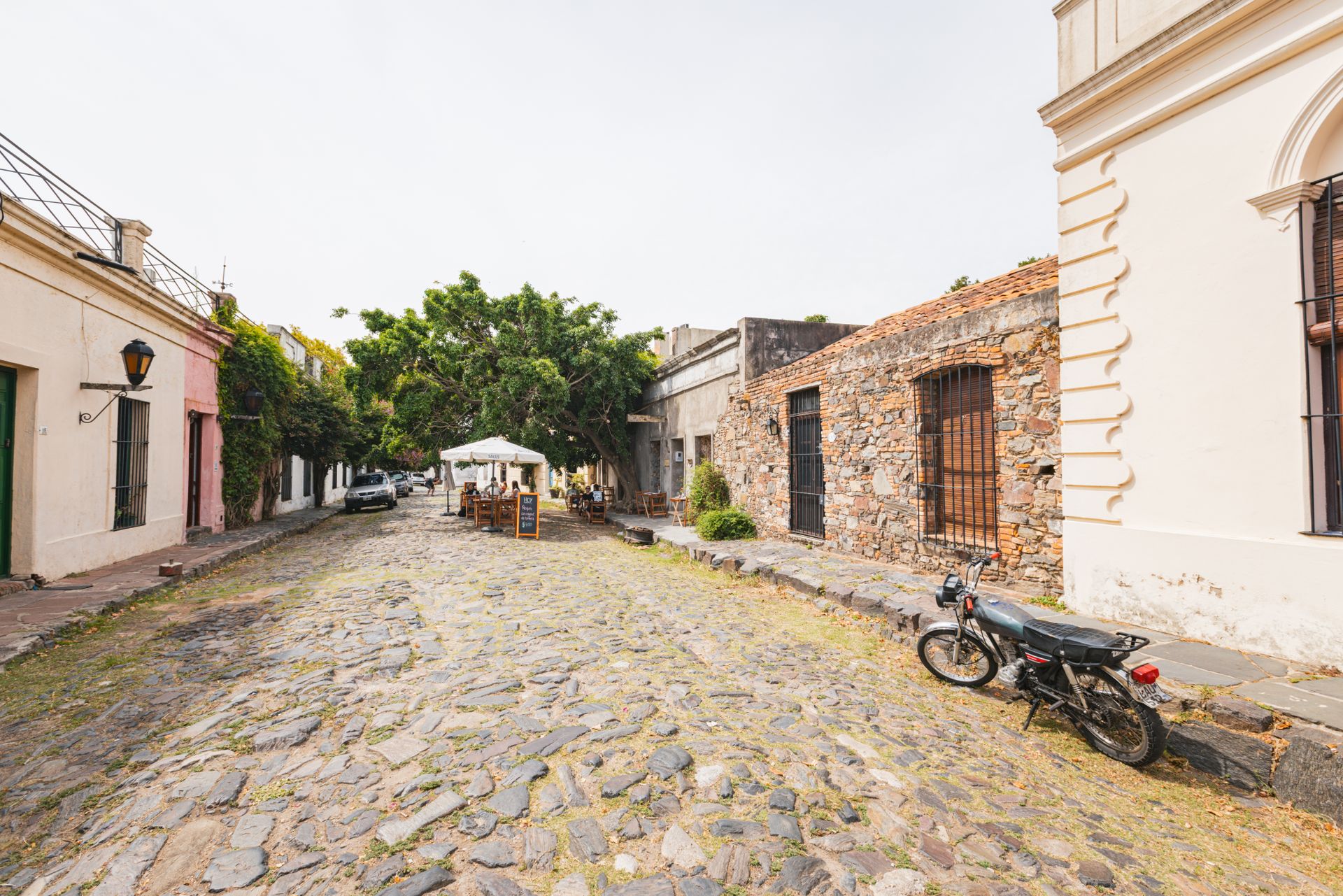
Montevideo & the Río de la Plata
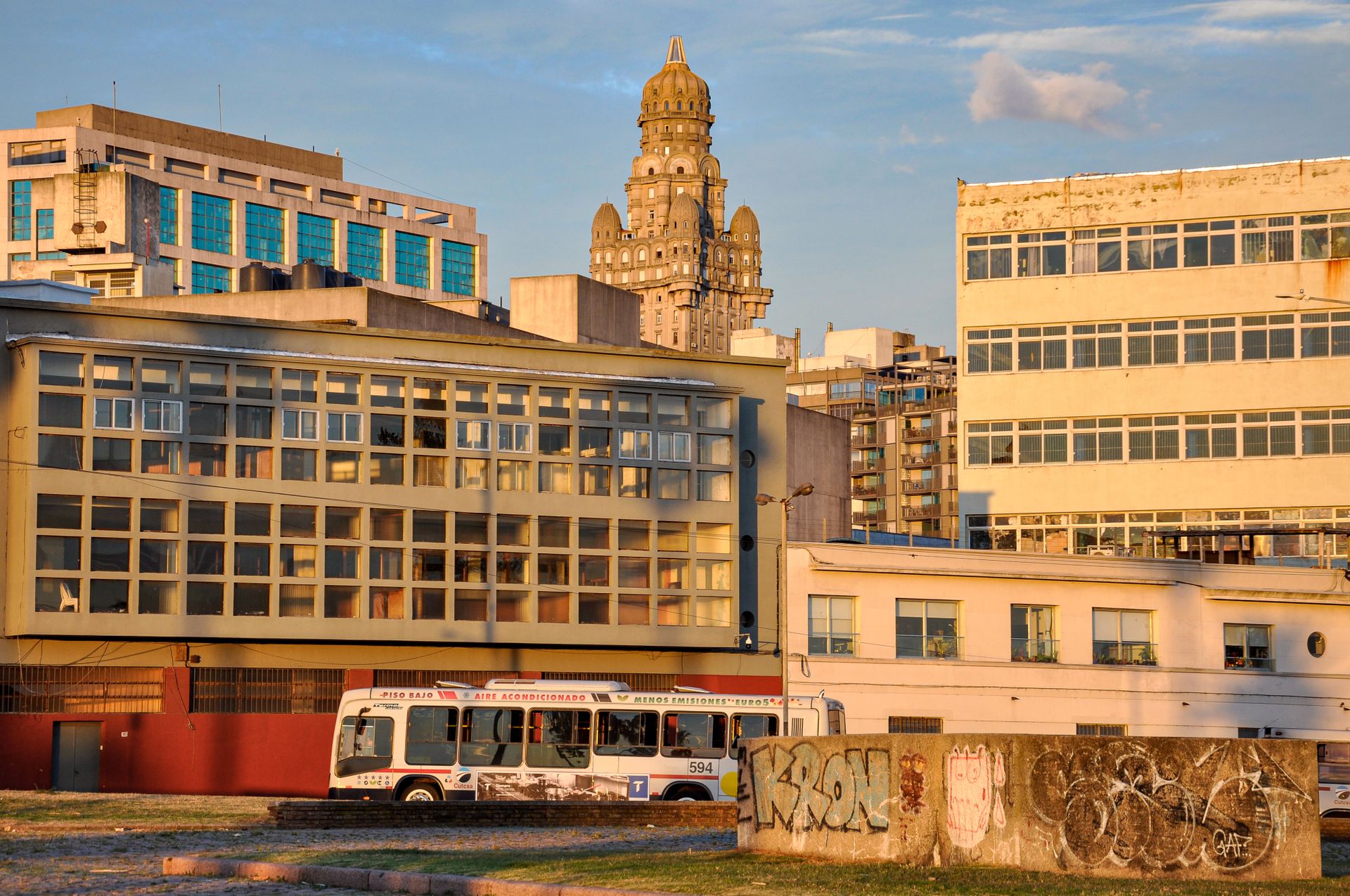
Most travellers underestimate Montevideo and arrive intending to spend less than a day. Resist the instinct: the capital was founded in 1726 by Bruno Mauricio de Zabala, the 2023 census put the city proper at 1,287,452 residents, and the metropolitan area holds about 1.95 million people — roughly 37% of the country’s entire population in a single urban region. The two unmissable cores are the Ciudad Vieja (the old colonial port quarter west of Plaza Independencia, where the Mercado del Puerto, the Solis Theatre, the Plaza Matriz and the surviving Puerta de la Ciudadela all sit within a 15-minute walk) and the Rambla — the 22-kilometre waterfront promenade that runs from Punta Carretas through Pocitos, Buceo, Punta Gorda and Carrasco, claimed locally as the longest continuous urban promenade on Earth. The Solis Theatre, opened in 1856 and renovated 1998-2004, hosts a strong year-round opera and tango programme; the Mercado del Puerto, an 1868 iron-roofed market hall built in Liverpool and shipped in pieces, is now a working parrilla hall with twenty competing wood-fired barbecues. Allow 48 hours in the city, sleep in Pocitos near the rambla or Ciudad Vieja near the port.
Punta del Este & the Maldonado Coast
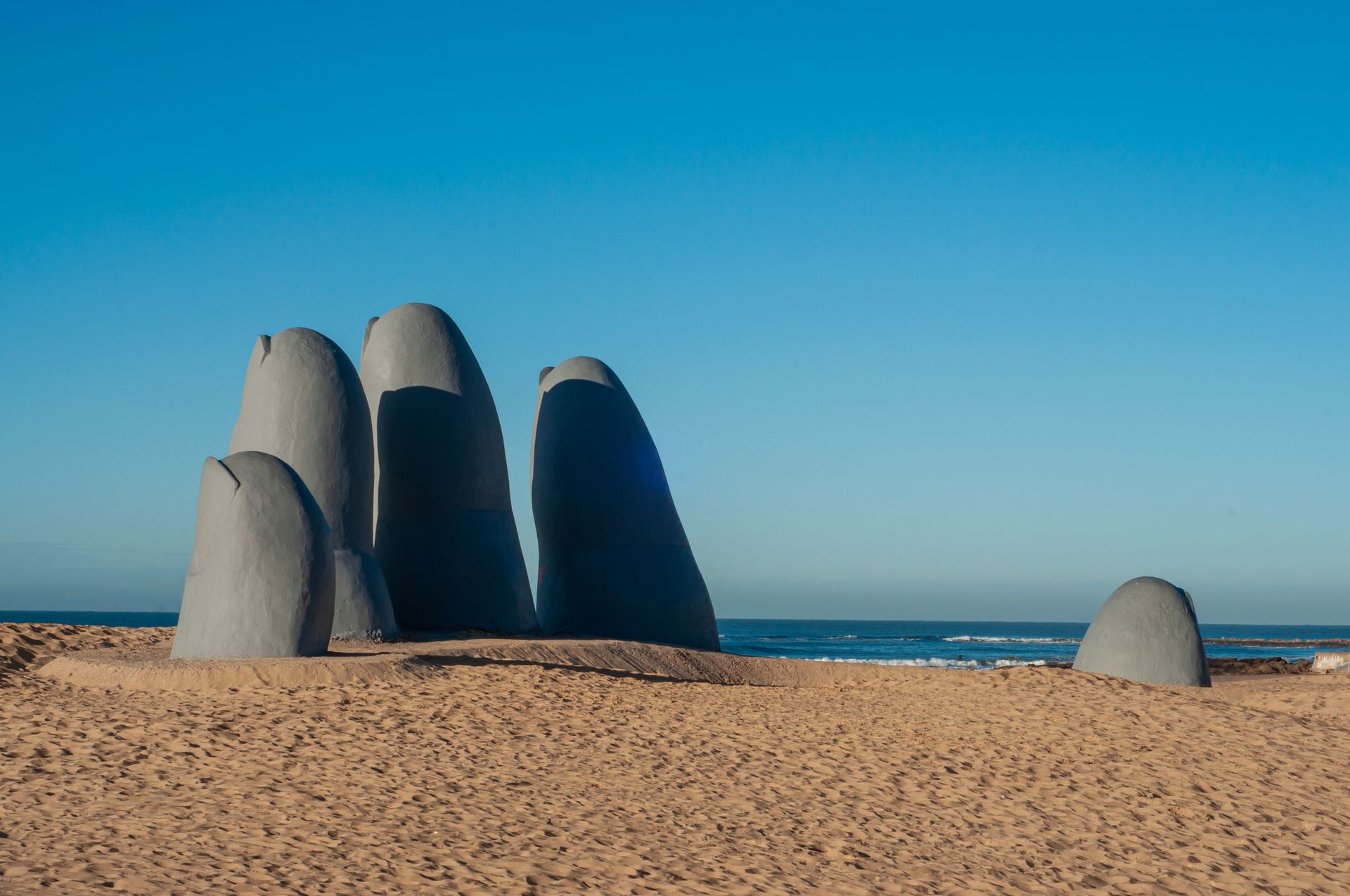
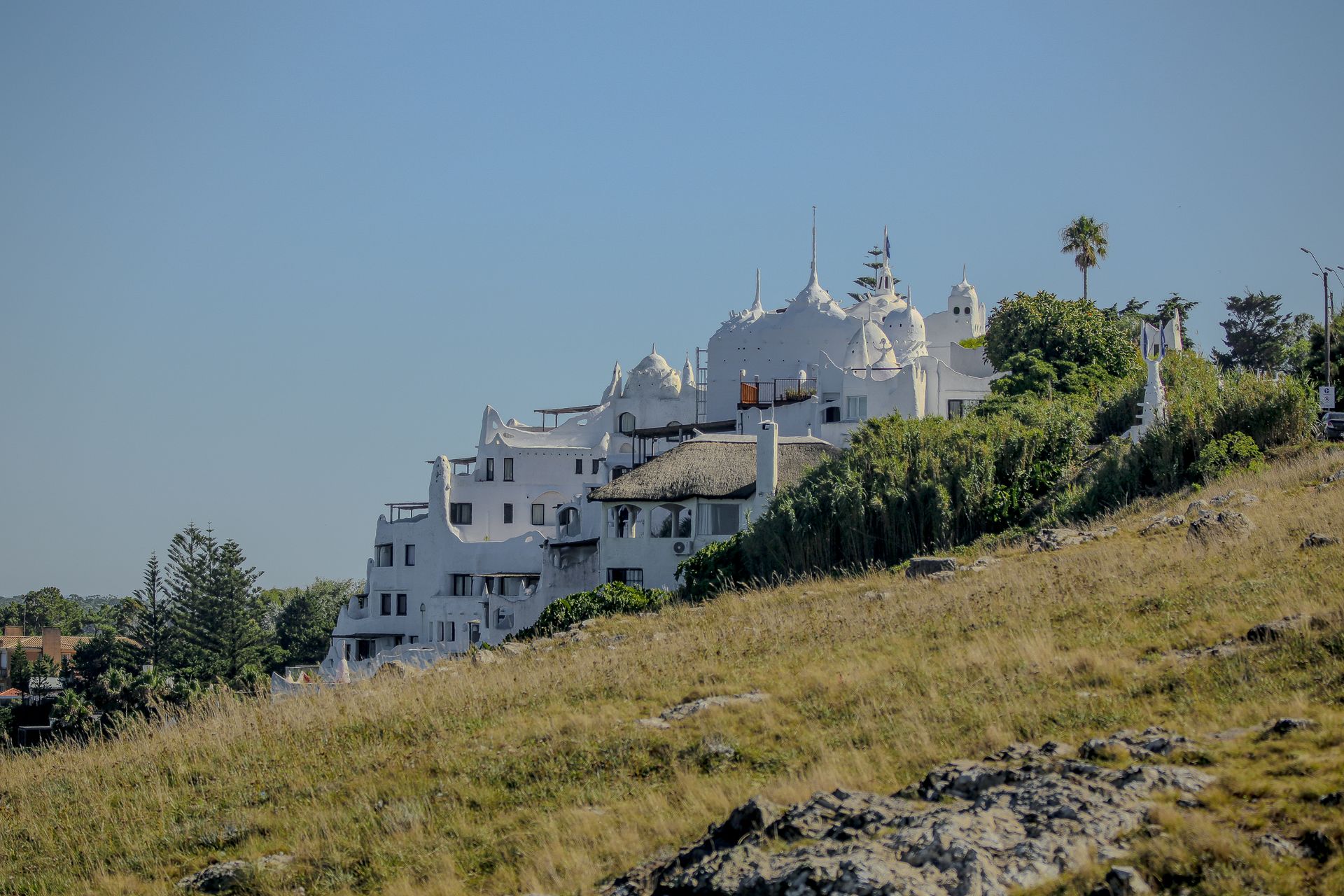
Punta del Este, 140 kilometres east of Montevideo on Ruta IB, is the South-American beach resort par excellence — sometimes called “The Hamptons of South America” or “the Monaco of the South” for its January-February convergence of Argentine and Brazilian wealth. The city was incorporated in 1907 and elevated to city status in 1957; permanent population was 18,193 at the 2023 census, with the summer surge multiplying the headcount by 30 to 40 times. The peninsula divides into two beach systems: Brava (rough Atlantic side, fine white sand, body-board surf) and Mansa (calm river-side, thick golden sand, shallow swim). The 45-metre lighthouse with its original French crystal Fresnel panels has lit the headland since 1860, and Mario Irarrázabal’s La Mano sculpture — the giant five-finger hand emerging from the Brava sand at Parada 1, completed in February 1982 in just six days during the first International Open-Air Sculpture Meeting — is the city’s calling card. The 1958-1994 Casapueblo by Carlos Páez Vilaró sits 13 kilometres west on Punta Ballena: a Mediterranean-meets-Santorini cliffside structure with 13 floors of terraces, a museum dedicated to its creator, and a daily sunset ceremony every evening since 1994.
Colonia del Sacramento
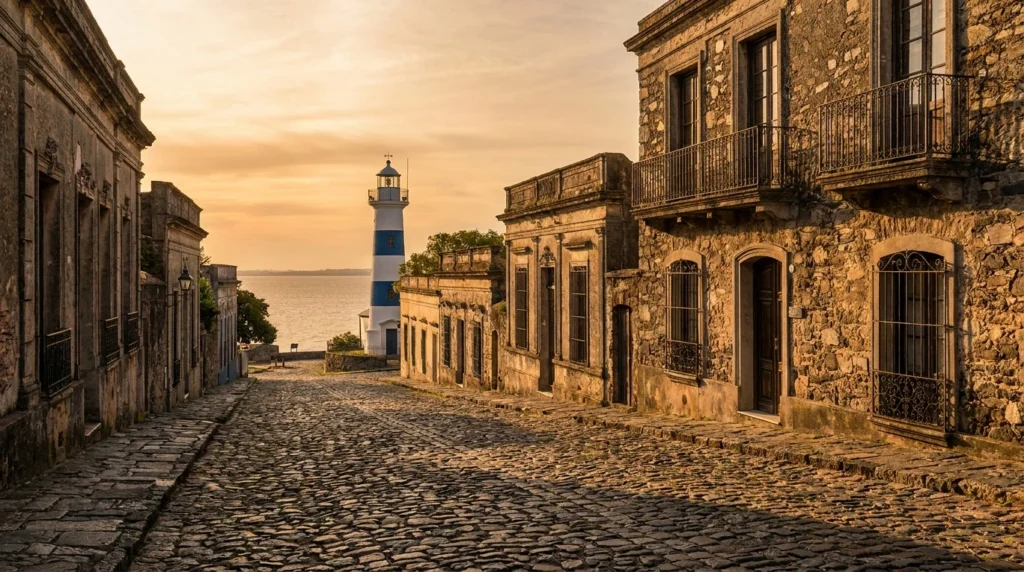
Colonia del Sacramento is the country’s gateway from Buenos Aires — the 1-hour-15-minute Buquebus catamaran lands directly into the colonial harbour — and the Barrio Histórico inscribed by UNESCO in December 1995 is the unmissable urban experience in Uruguay. Manuel Lobo founded the settlement on 28 January 1680 as a Portuguese trading post directly opposite Buenos Aires; the town changed hands seven times between Portuguese and Spanish empires before becoming Uruguayan in 1828, and the result is the only urban area in the world where a tight Portuguese irregular street plan and a later Spanish grid layout are both intact, on the same hillside, separated by a wall whose foundations still survive. Inside the 16-hectare Barrio Histórico the must-walks are Calle de los Suspiros (a 200-metre Portuguese cobble lane), the 1808 Basílica del Santísimo Sacramento, the Portón de Campo gateway with its restored wooden drawbridge, and the 1857 lighthouse that rises from the ruins of the 17th-century Convento de San Francisco. The 2023 census recorded 32,174 residents in the modern town; allow one full overnight to walk the Barrio at dawn before the day-trip ferries arrive.
José Ignacio & the Low-Key Luxury Coast
José Ignacio sits 30 kilometres east of Punta del Este on Ruta 10, on the headland between Playa Mansa and Playa Brava either side of its 1877 lighthouse. The 2011 census recorded only 292 permanent residents, but the village has steadily become the December-January retreat of choice for Argentine-Brazilian-American visitors who find Punta del Este too built-up. The defining experience is dinner at La Huella, the legendary parrilla on Playa Brava (no reservations during Carnival), followed by a walk back across the dunes to a low-rise posada at sunset. The wider east-of-Punta-del-Este coast — La Barra, Manantiales, Punta Piedras — works the same low-rise low-volume formula in 2026, anchored by hotels like Casa Suaya and the original ranch-style Estancia Vik.
Cabo Polonio & the Off-Grid Atlantic
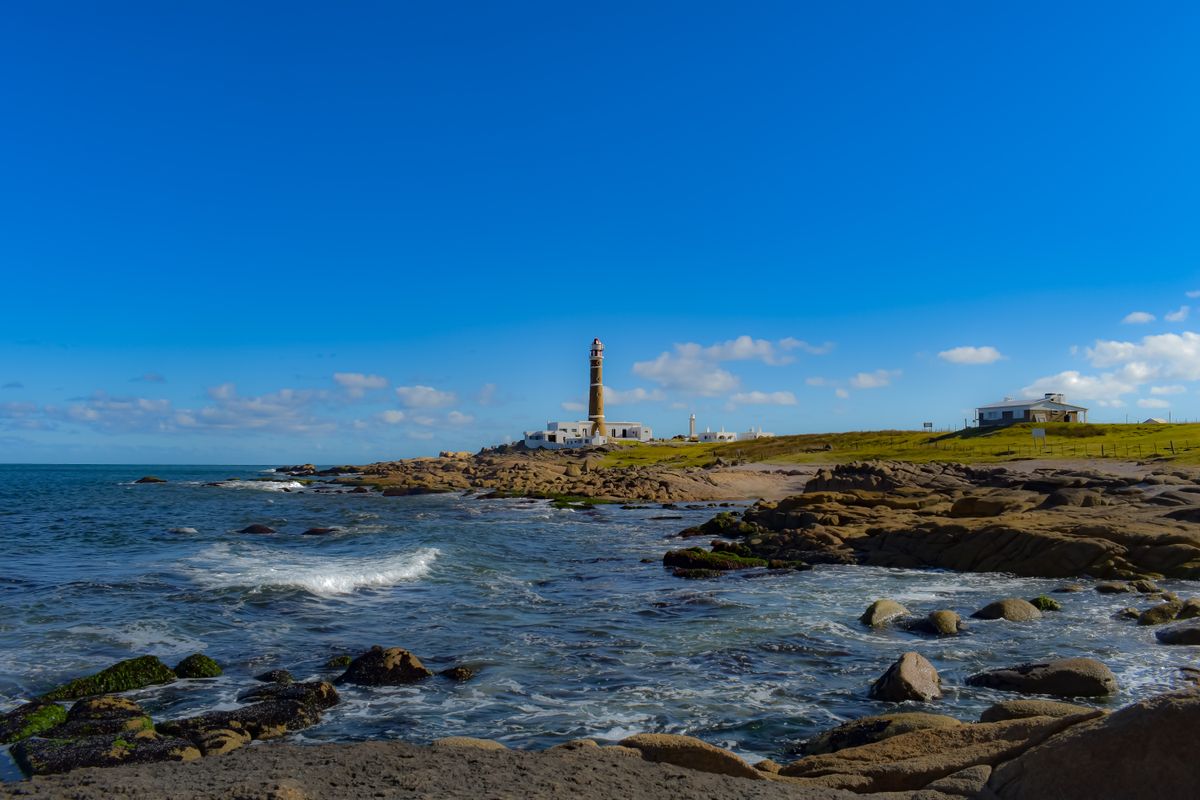
Cabo Polonio is the strangest, smallest and most magnetic of Uruguay’s Atlantic settlements: a 128-resident hamlet on a sand-dune cape in Rocha Department, 264 kilometres from Montevideo, with no road access. Visitors leave their car at the Ruta 10 turn-off and ride 7 kilometres through 30-metre sand dunes in shared four-wheel-drive transport (camiones) operated by the national park. The town has no mains electricity, no piped water and no permanent connection to the national grid — the population runs on solar panels, wind generators and rainwater — the lone exception being the 1881 lighthouse on its rocky promontory, the only structure plugged into the wider system. The Islas de Torres, three rocky islets two kilometres offshore, host one of the largest South-American sea-lion and southern-fur-seal colonies in the western Atlantic, with somewhere close to half of Uruguay’s national pinniped population. Bring cash, a torch, candles, a sleeping bag and patience. The peak season is January, when 30,000+ tourists arrived during a single month in 2015 alone — in shoulder season the cape feels like a working hamlet.
Salto & Termas del Daymán — the Hot-Springs Interior
Salto, 500 kilometres north-west of Montevideo on the Río Uruguay, is the country’s third-largest city (around 104,000 residents) and the gateway to the upper-Uruguay-river thermal-springs corridor. The 1979 Salto Grande dam-and-power-station, jointly operated by Uruguay and Argentina, generates large amounts of clean hydro-electricity and serves as a road and rail crossing into Concordia, Argentina. The springs themselves — Termas del Daymán on Ruta 3 about 8 kilometres south, plus the bigger Termas del Arapey 90 kilometres further north — are open year-round but at their best in winter (June-August), when the 36-46°C water bubbles up against frosty 5°C overnight air for that perfect Roman-bath effect. Smaller mid-budget hotels with private springs (Hotel Horacio Quiroga, Hotel Termas del Daymán) bracket the central public-pool complex.
Rocha Department — Punta del Diablo, La Paloma & Santa Teresa
Rocha is the easternmost department, the wildest stretch of Atlantic coastline in the country and the place backpackers actually fall in love with. Punta del Diablo (823 permanent residents in 2011, 25,000+ summer surge) is a former lobster-fishing village with three black-rock beaches and surf that is the most consistent on the Uruguayan coast. Twenty kilometres north sits the 1928 Parque Nacional Santa Teresa, with 60 kilometres of hiking trails through Atlantic forest and the 18th-century Spanish-Portuguese Fortaleza de Santa Teresa. La Paloma and La Pedrera, west of Punta del Diablo, are the family-friendly beach towns; Cabo Polonio sits between them and Punta del Diablo on the same coastal arc. The region has more conservation territory than any other in Uruguay — the Bañados del Este Ramsar wetland, Laguna de Rocha, Laguna Negra and the Quebrada de los Cuervos all lie inside it.
Carmelo & the Atlantic Wine Route
Carmelo, founded by José Gervasio Artigas himself on 12 February 1816 (the only Uruguayan city personally founded by the national hero), is the western-Uruguay-river wine-and-water town that anchors the Tannat-and-Albariño vineyards in southern Colonia Department. The 18,041-resident town (2011 census) has a small wooden swing-bridge across the Arroyo de las Vacas (opened 1 May 1912), a small port at Puerto Carmelo with a slow Cacciola ferry to the Tigre delta of Buenos Aires, and a cluster of boutique wineries — Bodega Narbona, Cordano, El Legado and Almacen de la Capilla — that anchor the Caminos del Vino weekend in late February. Combine with a half-day drive to Mercedes, Fray Bentos and the UNESCO-inscribed Frigorífico Anglo museum to make the western half of the country a four-day loop.
Uruguayan Culture & Etiquette — Río de la Plata Spanish, Mate & the Secular State

The Essentials
- Spanish, the Río de la Plata variant. Uruguayan Spanish uses vos (not tú) for the second-person familiar, an Italian-influenced melody, and a fusion vocabulary called lunfardo shared with Buenos Aires. Spanish is the sole official spoken language; Uruguayan Sign Language is co-officially recognised.
- Greet with a kiss. Even in business contexts, women greet women and men greet women with a single right-cheek kiss; men greet men with a handshake unless they are family. Foreigners get a polite extra second of decision-time before the kiss commits.
- Mate is shared, not photographed. The traditional gourd is passed clockwise from the cebador (the person preparing it); declining politely requires saying gracias when you finish your turn, which signals “no more for me,” not “thank you.” Uruguay leads the world with about 19 litres of yerba mate per person per year.
- The state is secular and the calendar follows it. What other countries call Christmas is officially “Día de la Familia”; Easter Holy Week is officially “Semana de Turismo”; 6 January (Epiphany) is “Día de los Niños.” This 1919 separation of state and church is one of the strictest in the Western world.
- Punctuality is South-American flexible. Dinner reservations stretch by 15-30 minutes; a 21:00 dinner usually starts at 21:30, especially in summer. Arriving exactly on time at a private house is mildly impolite.
Asado & the Sunday Family Ritual
- Sunday is for asado, not church. Uruguayan beef consumption is among the highest per capita on Earth, neck-and-neck with Argentina, and the Sunday family asado around an open parrilla (grill) is the country’s defining social ritual.
- The asador rules the fire. One person — usually the senior male — runs the fire from start to finish; their decisions about timing and salt are not up for debate.
- Sequence matters. The standard order is chorizo, morcilla, provoleta (grilled cheese), then short-ribs (tira de asado), then vacío (flank), and finally matambre — with a Tannat to drink and a flan with dulce de leche to finish.
- Tipping is gentle. Most restaurants add a 10% cubierto service charge by default; an extra 5-10% in cash for excellent service is welcome but never expected.
A Food Lover’s Guide to Uruguay

Uruguayan food is the simplest and most carnivorous in South America: red meat, more red meat, dulce de leche on everything sweet, mate around the clock, Tannat in the evening. The country produces about 589,000 tonnes of beef a year for a population of 3.5 million people, and Uruguay-and-Argentina between them sit at the top of the global per-capita beef-consumption league. Italian and Spanish migration in the 1880-1930 wave brought pasta, pizza, milanesa, alfajores and the espresso bar; Afro-Uruguayan tradition shaped the way the rhythms inflect dinner-table conversation. The result is a kitchen that is more conservative than Mexico’s and less spicy than Peru’s, but extraordinarily good at the few things it does.
Must-Try Dishes
| Dish | Description |
|---|---|
| Chivito | The national sandwich, invented in 1946 at El Mejillón Bar in Punta del Este when Antonio Carbonaro substituted beef fillet for the goat (chivo) a customer wanted: thin churrasco beef, mozzarella, ham, bacon, fried egg, lettuce, tomato, mayonnaise, olives, all on a toasted bun, served with chips. |
| Asado | Sunday-family meat extravaganza built around a wood-fired parrilla: chorizo, morcilla blood-sausage, provoleta grilled cheese, then short-ribs, flank and skirt cooked slowly over brasas embers. The Mercado del Puerto in Montevideo is the unmissable parrilla destination. |
| Milanesa | Italian-immigrant breaded veal or beef cutlet, often served as milanesa a la napolitana with ham, mozzarella and tomato sauce, or as milanesa al pan in a sandwich for lunch on the run. |
| Dulce de leche | Caramelised milk-and-sugar paste claimed by Uruguay (and disputed with Argentina). Served on toast for breakfast, sandwiched into alfajores, drizzled over flan, baked into the cake called chajá. The dulce-de-leche-flavoured ice cream at Holanda or Las Delicias in Montevideo is a national institution. |
| Pascualina | A Genoese-immigrant double-crust spinach-and-egg pie, eaten cold or warm at any hour. Together with the smaller empanadas saltenas, it dominates the bus-station snack aisle. |
| Medio y medio | The Montevideo aperitif: half dry white wine, half Champagne-style sparkling, served ice-cold from Roldos in the Mercado del Puerto. Pair with a chivito al plato. |
Tannat & the Wine Country
Uruguay is the unsung star of South-American wine. The signature variety is Tannat, brought from the Madiran AOC of south-west France in 1870 by the Basque settler Pascual Harriague, and now considered Uruguay’s national grape — 36% of all vinifera plantings, lighter and lower in tannins than the French original, with blackberry-and-black-cherry fruit. Total 2023 production was 102,964 tonnes from 9,023 hectares of vineyards across 15 of the country’s 19 departments — the fourth-largest wine producer in South America. Canelones (5,046 hectares) is the dominant wine region, immediately north of Montevideo; Maldonado is the up-and-coming Atlantic-influenced cool-climate region (Albariño whites and elegant Tannat); Carmelo and Colonia in the west are the boutique-tourism heart with Bodega Narbona, Bodega Cordano and Almacen de la Capilla. The Caminos del Vino weekend in late February-early March opens cellar doors at more than 25 boutique wineries.
Mate & the Drinking Culture
The everyday drink is mate — not a coffee, not a tea, but a caffeine-rich infusion of yerba mate leaves brewed in a hollow gourd and sipped through a metal straw called a bombilla, with water heated to “70 to 85 °C, never boiling.” Uruguayans drink, on average, around 19 litres of yerba mate per person per year — comfortably the highest per-capita figure on Earth, ahead of Argentina, Paraguay and Brazil. The thermos-and-gourd is the single most visible national object: you will see it at bus stops, on the Rambla, in football stadiums and on the beach. The other regional drinks worth trying are medio y medio (Montevideo aperitif), grappamiel (grappa-and-honey, the winter post-asado tipple) and clerico (white-wine sangria with summer fruit). Coffee, by South-American standards, is mediocre — a flat-white culture has not yet arrived in 2026.
Off the Beaten Path — Fray Bentos, Quebrada de los Cuervos & the Atlántida Church
Fray Bentos Industrial Landscape (UNESCO 2015)
Fray Bentos sits on the Río Uruguay across from the Argentine town of Puerto Unzué, 308 kilometres west of Montevideo, and is best known to most travellers as the canned-pie brand sold in British supermarkets. The brand was real: the Liebig Extract of Meat Company opened a meat-packing plant here in 1865 to extract beef essence for the European market, was rebranded as the Frigorífico Anglo del Uruguay after the British Vestey group bought it in 1924, and became the global heart of corned-beef and bouillon production through both World Wars. At its peak it employed 5,000 workers from 60 nationalities and supported a self-contained company-town called Barrio Anglo with hospital, school, social club and football team. The plant closed in 1979; the entire 268-hectare site — including the slaughter halls, the boiler-house, the harbour, the Barrio Anglo housing and the warehouse complex — was inscribed as a UNESCO World Heritage Site in 2015 under criteria (ii) and (iv), making it the first 20th-century industrial heritage site on the continent. Allow a half-day; combine with a Carmelo wine-route stop the same day.
Cristo Obrero / Atlántida Church (UNESCO 2021)
Eladio Dieste was the Uruguayan civil engineer who effectively reinvented brick architecture in the second half of the twentieth century. His Cristo Obrero church in Atlántida, on Ruta Interbalnearia 45 kilometres east of Montevideo, was completed in 1960 with a thin double-curvature catenary brick vault that rises and falls without internal supports — “resistance through form” rather than mass, in his own phrase. The church is small enough to circle in 15 minutes but has been studied by architectural engineers everywhere; it was inscribed by UNESCO in 2021 as the country’s third World Heritage Site. The interior light, especially on a clear winter morning, is the closest secular spiritual experience Uruguay offers. Easy day-trip out of Montevideo combined with the Atlántida beach and the Antonio Lussich arboretum.
Quebrada de los Cuervos — The Country’s Hidden Canyon
The Quebrada de los Cuervos (“Ravine of the Crows”) is a 100-metre-deep sub-tropical canyon in the interior Treinta y Tres Department, 280 kilometres north-east of Montevideo, with permanent waterfalls, native ombu trees and a population of vultures (the eponymous cuervos). The 4,427-hectare reserve was declared Uruguay’s first protected natural area in 1986 and now sits inside the wider Paisaje Protegido Quebrada de los Cuervos y Sierras del Yerbal. The interpretive trail is 4 kilometres each way; allow 4-5 hours including the canyon-floor swim. The closest accommodation is the small estancia-style hotels around Treinta y Tres town, 60 kilometres south.
Santa Teresa Fortress & National Park
Parque Nacional Santa Teresa sits at the eastern end of the Atlantic coast in Rocha Department, 320 kilometres from Montevideo and 7 kilometres south of the Brazilian border at Chuy. The 18th-century Fortaleza de Santa Teresa was built by Portuguese forces in 1762 and finished by Spanish forces in 1763 after they captured it during the Spanish-Portuguese border wars. The 60-kilometre trail network winds through Atlantic forest with plenty of wild capybara, foxes and an estimated 200+ bird species; the campground is the cheapest accommodation on the entire coast and operates year-round. Combine with Punta del Diablo and the Centro de Recuperación de Tortugas Marinas (sea-turtle rescue centre).
Tacuarembó & Gaucho Country
Inland north-central Tacuarembó is the heart of Uruguayan gaucho culture — the closest the country comes to its own Argentine Pampa. The town hosts the annual Fiesta de la Patria Gaucha in early March: rodeo, traditional asado, mate, dance and gaucho-dress competitions over five days, drawing more than 100,000 visitors. Carlos Gardel — the legendary tango singer claimed by both Uruguay and France — was officially registered as born in Tacuarembó in 1887, though the Argentinian-version says Toulouse and the Uruguayan-version is now backed by recovered church records and a small museum in town. Combine with an estancia-stay at Estancia Panagea or Estancia La Sirena for two nights of riding, asado and stargazing.
Cerro Catedral Hike
The country’s highest point is the modest 514-metre Cerro Catedral, in the Sierra Carapé range of southern Maldonado Department, about 75 kilometres north of Punta del Este. The marked summit trail starts from a small gravel car park on Ruta 12, climbs through native monte serrano woodland of palmeira and ceibo trees, and reaches the summit cairn in about 90 minutes. Views over the rolling green Cuchilla Grande are surprisingly grand for a 514-metre hike; combine with the Salto del Penitente waterfall and an asado at Estancia Las Cumbres on the way back to the coast. Better in autumn (March-May) when the heat is kinder.
Practical Information
| Currency | Uruguayan Peso (UYU); 1 USD ≈ UYU $39 (January 2026); USD widely accepted at petrol stations, restaurants and Punta del Este high-end. |
| Cash needs | Carry small UYU notes for taxis and rural buses; USD bills (clean, post-2009 series) are accepted at most fuel stations and many hotels along the coast. |
| ATMs | Banred and Redbrou networks cover every city town; cash withdrawal in either UYU or USD. Card-skimming has been reported — use ATMs inside bank branches in Montevideo. |
| Tipping | 10% in restaurants where service is not included; round-up taxi fares; UYU $50-100 per bag for hotel porters. Tour guides usually expect USD $5-10 per person per day. |
| Language | Spanish (Río de la Plata variant with vos voseo); English skill is limited outside tourism, far weaker than in Buenos Aires; Brazilian Portuguese is widely understood near the Brazilian border. |
| Safety | US State Department Level 2 (exercise increased caution) due to property crime in central Montevideo, Canelones, Maldonado and Rivera; violent crime rare against tourists outside specific Montevideo barrios. Drink-spiking has been reported in Punta del Este nightlife. |
| Connectivity | Antel (state-owned) and Movistar offer 4G/5G coverage across all populated areas; tourist SIMs from Antel cost roughly USD $12 for 30 days with 10 GB data. Wi-Fi is universal in cafes and free in city plazas. |
| Power | Type C, F, I and L plugs all in use (yes, four standards), 220V / 50Hz — bring a universal adapter and check the wall before charging. |
| Tap water | Safe to drink in all major cities — OSE municipal supply is treated to potable standard; Montevideo, Punta del Este and Colonia tap water is fine. |
| Healthcare | Private and mutualist healthcare is excellent in Montevideo and Punta del Este, comparable to US standards; emergency dial 911 nationwide; CDC recommends routine vaccinations plus Hepatitis A/B and typhoid. |
Budget Breakdown — What Uruguay Actually Costs
Uruguay is more expensive than its Argentine and Paraguayan neighbours but cheaper than Chile or Brazil’s coastal cities — and dramatically cheaper than the United States or Western Europe. The single biggest variable is the season: Punta del Este in January is roughly three times more expensive than Punta del Este in October. Restaurant prices are stable nationally, fuel is moderate (USD $1.55-1.70 a litre), and intercity bus fares are some of the cheapest in South America.
Budget Traveller (USD $60-95 / day)
Hostel dormitory beds in Montevideo’s Ciudad Vieja or Pocitos start around USD $18-25 a night; a private double with a shared bathroom climbs to USD $40-55. Lunch at a Mercado del Puerto parrilla counter costs USD $14-22 for a generous mixed-grill plate; an evening empanada-and-beer at a corner kiosk is USD $7-9. The Tres Cruces intercity buses cover even the longest cross-country runs (Montevideo to Salto, 5.5 hours) for USD $30-38. Camping at Parque Nacional Santa Teresa is USD $4-6 a person per night; campgrounds across Maldonado are similar.
Mid-Range (USD $130-220 / day)
The standard mid-range traveller stays in a 3-star hotel with private bathroom and breakfast (USD $90-140 a night in Montevideo, USD $130-220 in Punta del Este shoulder season), eats one parrilla dinner with a Tannat by the glass at USD $30-45 a head, hires a small rental car at USD $45-60 a day with insurance, and buys museum/excursion tickets at USD $10-25 per attraction. The Buquebus catamaran from Buenos Aires to Colonia in tourist class is around USD $55-75 each way; Buenos Aires to Montevideo is USD $90-130. Wine-route tastings at the Carmelo or Canelones boutique wineries run USD $25-45 per person.
Luxury (USD $380+ / day)
Punta del Este’s flagship hotels — Fasano Punta del Este, The Grand Hotel, Mantra Hotel — price from USD $380-650 a night in shoulder season and USD $1,200+ in peak January; the Casapueblo museum-hotel charges USD $450-700 in January for a sea-facing suite. José Ignacio’s flagship La Susana Beach Club, Casa Suaya and the Estancia Vik fly-in start at USD $750+ a night with breakfast. A degustation dinner at La Huella, Marismo or Garzón with a wine-pairing flight runs USD $180-320 a head. Private wine tours through Bodega Garzón in Maldonado plus a winery lunch are USD $250-400. A high-clearance SUV rental with insurance is USD $130-180 a day.
| Tier | Daily (USD) | Accommodation | Food | Transport |
|---|---|---|---|---|
| Budget | $60-95 | Hostel dorm or simple guesthouse | Mercado parrilla, empanadas, kiosk meals | Intercity COT/CUT buses |
| Mid-Range | $130-220 | 3-star hotel or boutique posada | Parrilla dinner with wine, lunch out | Compact rental car or chauffeur day |
| Luxury | $380+ | Estancia, Casapueblo, La Susana, Vik | Garzón, La Huella, Marismo tasting menus | SUV rental, charter flight, private guide |
Planning Your First Trip to Uruguay
- Pick the season first, dates second. Mid-October to mid-December and mid-March to early-May are the sweet spots for first-timers; late January to early March is Carnival but expect triple prices on the coast and 6-month booking lead times.
- Decide your entry point: MVD or Buenos Aires? If your itinerary already includes Argentina, fly into Buenos Aires Aeroparque and take the 1-hour-15-minute Buquebus to Colonia — cheaper, faster and more atmospheric than direct MVD flights. If Uruguay is the only South-American stop, fly into Montevideo Carrasco (MVD) directly through Madrid, São Paulo or Panama.
- Build a coastal vs. interior split. A solid 10-day first trip is 4 nights along the south-east Atlantic coast (Punta del Este 2 nights + Cabo Polonio 1 night + Punta del Diablo 1 night), 2 nights in Colonia del Sacramento, 3 nights in Montevideo and 1 night in Carmelo or the Canelones wine country. A 14-day extension adds Salto and Termas del Daymán.
- Reserve the headline parrillas and Casapueblo terrace early. Confitería Cabaña Verónica, Garzón by Francis Mallmann, La Huella, Casapueblo’s sunset terrace and the Caminos del Vino weekend cellar tours all sell out 2-4 weeks ahead in summer. Email rather than try to call from abroad.
- Pre-book the inter-city bus and ferry tickets online. Buquebus tickets through buquebus.com, COT and Copsa tickets through cot.com.uy — both accept international cards, and last-minute summer departures often sell out 36 hours ahead.
Classic 10-Day Itinerary: Day 1 fly into MVD, base in Pocitos. Day 2 Ciudad Vieja walking + Mercado del Puerto parrilla lunch + Solis Theatre evening. Day 3 Montevideo to Colonia del Sacramento (3 hours by bus or 2.5 hours self-drive). Day 4 dawn walk in Barrio Histórico, ferry-watch and slow afternoon. Day 5 drive to Carmelo + Canelones wineries; sleep at a boutique bodega. Day 6 east to Punta del Este via Casapueblo for the sunset ceremony. Day 7 Punta del Este peninsula + La Mano + Brava beach. Day 8 east to José Ignacio and dinner at La Huella. Day 9 onward to Cabo Polonio — jeep transfer through the dunes, sunset at the lighthouse. Day 10 return to MVD via Aerolíneas Argentinas or 5-hour bus, fly out.
Frequently Asked Questions
Is Uruguay safe for solo travellers in 2026?
Yes, with the obvious caveats around urban property crime. Uruguay sits at Level 2 (exercise increased caution) on the US State Department travel advisory due to elevated rates of car-jackings, motorcycle-snatch theft and ATM fraud in central Montevideo, parts of Canelones, the busy summer corridor through Maldonado and the border-town of Rivera. Violent crime against foreign tourists is rare; the practical defence is to use Uber or Cabify rather than walk after midnight in Ciudad Vieja, never leave anything visible in a parked car, and to use ATMs inside bank branches in the morning. Solo female travellers consistently rate Uruguay one of the safest destinations in Latin America.
Do I need a visa as a US, UK, EU, Canada or Australia citizen?
No. Uruguay grants 90-day visa-free entry to citizens of approximately 85 countries, including all European Union member states, the United Kingdom, the United States, Canada, Australia, New Zealand and Japan. You need only a passport valid at entry with one blank page; an international airport departure tax is bundled into your airline ticket. The maximum cash you can carry across the border without declaration is USD $10,000.
When is Carnival and how do I plan around it?
Uruguay’s carnival is the world’s longest at 40-plus days, running from the last Thursday of January through Ash Wednesday in late February or early March. The two unmissable events are the Desfile Inaugural on Avenida 18 de Julio (last Thursday of January) and the Llamadas Afro-Uruguayan drum parade through Barrio Sur and Palermo on the first Thursday and Friday of February, which UNESCO inscribed as Intangible Cultural Heritage in 2009. Book Montevideo accommodation by mid-October if you want either weekend.
Can I drink the tap water?
Yes — Wikivoyage notes that “tap water is safe to drink in all major cities” of Uruguay, and the OSE state water utility maintains potable standards across Montevideo, Punta del Este, Colonia and Salto. Locals nonetheless tend to prefer bottled water, partly out of habit and partly because the chlorine taste is noticeable in summer. At remote campsites in Cabo Polonio and on Atlantic-coast estancias, drink filtered or bottled water.
Is Uruguay expensive compared with Argentina or Brazil?
More expensive than Argentina, slightly cheaper than coastal Brazil. A budget-camping self-drive couple lives on USD $60-95 a day; a mid-range hotel-and-restaurant couple lives on USD $130-220; a luxury Punta-del-Este-and-José-Ignacio summer week starts around USD $4,500 per couple all-inclusive. Park entry fees are minimal (most national parks are free), the bus network is cheap, fuel is moderate at USD $1.55-1.70 a litre, but Punta del Este peak-season hotel rates triple normal pricing. Wages and prices are higher than the Latin-American average because the country is in the high-middle-income World Bank tier with GDP per capita PPP of about USD $39,030.
Can I get by as a vegetarian or vegan?
It is not as easy as in neighbouring Argentina or Brazil, but Montevideo, Punta del Este and Colonia all have a growing vegetarian-vegan restaurant cluster — La Vegana, La Otra, Ovo, Vegan Bowl in Pocitos — and most asado restaurants will happily grill provoleta cheese, vegetables, milanesa de soja and pasta. Outside the cities, vegetarian options thin out fast: country parrilla menus are 90% meat. Vegan travellers should plan to self-cater for any interior trip beyond Tacuarembó or Salto.
Is the Buquebus ferry from Buenos Aires worth it?
Yes — for a Buenos-Aires-and-Uruguay combined trip, the Buquebus catamaran is the only sensible entry mode. The Buenos Aires-Colonia 1-hour-15-minute crossing on the Atlantic III or Silvia Ana L lands you directly into the UNESCO old town; the Buenos Aires-Montevideo direct service on the record-breaking Francisco takes 2 hours 15 minutes at 58 knots, currently the fastest scheduled passenger ferry on Earth. Book online at buquebus.com 2-3 weeks ahead in summer.
Is cannabis really legal? Can I buy some?
Yes, recreational cannabis has been fully legal in Uruguay since President Pepe Mujica signed Law 19,172 in December 2013, but the legal supply system is explicitly closed to foreigners. Registered Uruguayan adults (citizens or permanent residents over 18) can grow up to 6 plants at home, join a 15-to-45-member club cannabico, or buy up to 40 grams a month from one of 16 authorised pharmacies; foreigners cannot register and cannot buy legally. Possession of small amounts in public is generally tolerated by police, but transporting any quantity across the border into Argentina or Brazil remains a serious criminal offence in both countries.
What about getting around without speaking Spanish?
Manageable in Montevideo, Punta del Este and Colonia — tourism-front staff usually speak workable English — harder elsewhere. Wikivoyage notes that “although most Uruguayans have studied English at school, they do not actually speak or use it” outside tourist areas. Brazilian Portuguese is widely understood near the Brazilian border (Chuy, Rivera). The five phrases that smooth every interaction: buen día / buenas tardes / buenas noches (greeting), por favor / gracias (please/thanks), ¿cuánto cuesta? (how much), la cuenta, por favor (the bill), and the brilliant Uruguayan filler ta (a quasi-untranslatable yes-OK-fine acknowledgement).
Explore More
- Paris City Guide — plan a European leg of your wider trip
- Rome City Guide — ancient streets and trattorias
- Barcelona City Guide — Gaudí, beaches and tapas
- Tokyo City Guide — neon, temples and the world’s best transit
- London City Guide — museums, markets and royal parks
- Istanbul City Guide — where Europe meets Asia
- Uruguay Trip Cost Guide
- All Country Guides
More country guides you might like
Plan your trip to Uruguay
The booking tools we use ourselves. FFU may earn a commission at no extra cost to you.
Plan & book your trip to Uruguay
Booking through these searches supports our guides at no extra cost to you.