
Languages of Mauritius
All languages of Eastern Africa →fluent beta classical · classes by phone with Maya at ranas.ai/maya
Mauritius Travel Guide — 2,040 km² of Reef-Hemmed Lagoon, UNESCO Heritage & Sega Beats
I have flown into Sir Seewoosagur Ramgoolam four times now, and on every approach the same scene re-orders my brain: the Airbus banks east of Plaine Magnien, the cane fields drop away, and the world’s third-largest coral reef appears beneath the wing as a turquoise ribbon hemming the entire south-east coast. My favourite Mauritius argument with travel friends is whether Le Morne’s basaltic monolith or the seven-coloured earths at Chamarel is the country’s most photographic moment — I always argue Le Morne, because no other UNESCO landscape on Earth carries the maroon-resistance memory at quite the same angle of golden-hour light — and my second-favourite is whether the national snack is dholl puri from a Port Louis street cart or octopus curry at a Tamarin shack. Treat this guide as the brief I would hand my own sister before she boarded her first flight into MRU, with a hire-car booked, a sun-hat in the hand luggage, and zero illusions about how seriously Mauritians take their kapana-style brazier game.

In This Guide
- Overview — Why Mauritius Belongs at the Top of Every Indian-Ocean Bucket List
- From Dodo Island to Multi-Ethnic Republic — A Pocket History
- Best Time to Visit Mauritius (Season by Season)
- Cyclone & Trade-Wind Calendar 2026
- Getting There — SSR International (MRU) & Rodrigues Hops
- Getting Around — Hire Car, Metro Express & Bus Network
- Top Cities & Regions — Port Louis, North & West Coasts, Le Morne, Black River Gorges, Rodrigues
- Cultures & Customs — Hindu, Muslim, Creole, Sino-Mauritian, Franco-Mauritian
- A Food Lover’s Guide to Mauritius
- Off the Beaten Path — Île aux Aigrettes, Chamarel, Trou aux Cerfs, La Vallée de Ferney
- Practical Information
- Budget Breakdown
- Planning Your First Trip to Mauritius
- Frequently Asked Questions
Overview — Why Mauritius Belongs at the Top of Every Indian-Ocean Bucket List
Mauritius is a wildly compact volcanic republic in the south-west Indian Ocean — 2,040 km² of basaltic island, 177 km of mostly reef-hemmed coastline, sitting roughly 800 km east of Madagascar at 20°S latitude. The island sits on the Somali tectonic plate, the main island covers 1,860 km² with the dependency of Rodrigues adding another 109 km² some 560 km to the east, and the highest point is the 828-metre Piton de la Petite Rivière Noire above the south-western Black River Gorges. Roughly 1.23 million people live here as of December 2025, the population is 67% Indo-Mauritian, 28% Creole, 3% Sino-Mauritian and 2% Franco-Mauritian, and Port Louis — the capital, founded in 1638 by the Dutch as the Harbour of Tortoises and named for King Louis XV under French rule — holds 140,403 of them.
The first story of Mauritius is the reef. The island is “almost entirely surrounded by coral reefs,” with more than 150 km of white sandy beaches sitting inside a lagoon protected from the open Indian Ocean by what is widely cited as the world’s third-largest barrier reef. Inside that ring, the lagoon stays at 22–27 °C year-round, the swell flattens, and a beginner snorkeller in two metres of water can see parrotfish, surgeonfish and the occasional reef shark on the same single breath-hold — Île aux Cerfs and the eastern beaches of the Flacq District lean particularly hard on this.
The second story is layered colonial inheritance. The Dutch first settled in 1638, hunted the dodo (Raphus cucullatus) into extinction by 1662 — first described by Dutch sailors in 1598, gone within 64 years — exhausted the ebony forests, and abandoned the colony in 1710. The French claimed it as Isle de France in 1715, governor Bertrand-François Mahé de La Bourdonnais arrived in 1735 and built Port Louis into a naval base for the Cape route, planted the first sugarcane and pepper, and imported tens of thousands of enslaved Africans and Malagasy. Britain captured the island in 1810, formalised the cession at the 1814 Treaty of Paris, abolished slavery on 1 February 1835 freeing 66,343 people, and from 1834 to 1923 imported approximately 500,000 indentured labourers from India through the Aapravasi Ghat depot in Port Louis — a UNESCO inscription since 2006.
The third story is independence and the multicultural republic. Mauritius gained independence from the United Kingdom on 12 March 1968 under Sir Seewoosagur Ramgoolam, became a republic exactly 24 years later on 12 March 1992, and now ranks as the second-highest GNI per capita country in sub-Saharan Africa, an upper-middle-income economy, and the only African country consistently classified “very high human development” by the UNDP. The economy ran 3.2% growth in 2025, the World Bank projects roughly 2.5% in 2026, and unemployment closed Q4 2025 at a two-decade low of 5.4%. Tourism alone supplies a substantial share of foreign exchange — March 2026 alone delivered 114,924 international visitors, marginally up on March 2025’s 113,472, with France, Réunion, the United Kingdom, Germany and South Africa heading the source-market table.
The fourth story is conservation and rewilding, and it is the most surprising part of the country’s profile. Mauritius lost the dodo in 1662, the giant tortoise Cylindraspis triserrata in the 1700s, and most of its primary forest by 1900 — and yet by the late 20th century it became the unlikely poster country for island-bird recovery. The Mauritius kestrel collapsed to four wild individuals in 1974, the rarest bird in the world; a captive breeding programme led by Welsh biologist Carl Jones lifted the population back to roughly 800 by 2005, and the kestrel was declared the national bird in March 2022. The 67.54 km² Black River Gorges National Park, proclaimed in June 1994, now protects most of the country’s remaining native rainforest, the Mauritian flying fox, the pink pigeon and the Mauritius parakeet, and the Mauritian Wildlife Foundation runs a separate offshore island reserve at Île aux Aigrettes — 27 hectares of restored Mauritius Dry Coastal Forest with reintroduced Aldabra giant tortoises filling the ecological niche of the extinct Cylindraspis.
The fifth story is light and rhythm. Mauritius averages a tropical-maritime climate with summer (Nov–Apr) at 24.7 °C and winter (Jun–Sep) at 20.4 °C, the central plateau gets up to 1,500 mm of rain against the coast’s 900 mm, and the south-east trade winds blow consistently across Le Morne from May to October — the reason the area is the global short-list kitesurfing destination it is. Independent reporting from Reuters, the BBC, the Guardian, the New York Times, the Financial Times and Al Jazeera tracks the island’s politics and tourism economy in detail. National Geographic, Condé Nast Traveler, Travel + Leisure, AFAR and Lonely Planet all maintain dedicated Mauritius desks.
Practically, Mauritius in 2026 is the most legible Indian-Ocean destination for first-timers. There is no de jure official language; English handles administration, French dominates business and the press, Mauritian Creole is the everyday tongue at home for 90% of the population, and Bhojpuri lingers in the north among Indo-Mauritian elders at 5.1%. Driving is on the left, plugs are UK Type G dominant at 230V, the currency is the Mauritian rupee (MUR) issued by the Bank of Mauritius, and the road network connects every flagship beach without you ever needing a domestic flight. Pack reef-safe sunscreen, a sun-hat that survives the trade winds, and a single decent dressy shirt for the resort dinner — the Mauritian beachside dress code is informal, the resort dress code is not.

From Dodo Island to Multi-Ethnic Republic — A Pocket History of Mauritius
Mauritius is one of the very few countries on Earth that had no indigenous human population at all before European contact. Arab traders had charted it in the medieval period and named it Dina Arobi, the Portuguese explorer Pedro Mascarenhas sighted it in 1507, and successive Dutch, French and British administrations imported every single member of the population that exists today. That blank-slate fact is the structural reason for the modern multicultural republic: every Mauritian’s lineage points to a 17th-, 18th- or 19th-century arrival from Europe, Africa, India, Madagascar or southern China.
The Dutch were the first to settle. In 1638 a small Dutch East India Company expedition under Cornelius Gooyer established a base at the south-eastern Vieux Grand Port and named the island “Mauritius” after the Stadtholder Maurits van Nassau. Over the next 70 years they introduced sugarcane from Java (still the country’s defining crop), exported ebony heartwood by the boat-load, and — directly through hunting, indirectly through the rats, pigs and macaques the boats brought — drove the dodo to extinction. The last credible dodo sighting was in 1662, less than 64 years after the first description by Dutch sailors in 1598. Cyclones, droughts and rat plagues defeated successive Dutch governors, and the colony was formally abandoned in 1710.
The French period (1715–1810) is the one most visible on a modern map. France claimed the island in 1715, renamed it Isle de France, and in 1735 sent governor Bertrand-François Mahé de La Bourdonnais — the figure whose statue still dominates Place D’Armes in Port Louis — to make it pay. La Bourdonnais founded Port Louis as a naval base, drove the trade routes from the Cape of Good Hope to the Indies through it, planted spices imported by Pierre Poivre at Pamplemousses (the botanical garden was founded in 1770 and is the oldest in the southern hemisphere), and presided over the importation of tens of thousands of enslaved Africans, Malagasy and Indians to work the cane fields. The French built a Wilhelmine-thin lattice of stone churches, sugar mills and the racecourse at Champ de Mars (1812 — older than Royal Ascot’s grass course); the resulting Creole-French-African plantation society is the substrate of every modern Mauritian dish, sega rhythm and Catholic feast.
Britain captured the island in December 1810 — admiral Josias Rowley landing at Cap Malheureux, on the very northern tip — and formalised the cession at the 1814 Treaty of Paris. Crucially, the British kept Code Napoléon civil law, the French language and the Catholic faith intact, which is why Mauritius today still drives on the left but argues in French. The transformative British act was the abolition of slavery on 1 February 1835, which freed 66,343 enslaved Mauritians and triggered the country’s defining demographic event: between 1834 and 1923, approximately 500,000 indentured Indian labourers were brought through the Aapravasi Ghat depot in Port Louis to replace the freed African workforce on the sugar estates. The Aapravasi Ghat — only 15% of which physically survives — was inscribed as a UNESCO World Heritage Site in 2006 because the depot was “one of the greatest migrations in history” and the demographic spine of modern Indo-Mauritian identity. Approximately 68% of the contemporary population traces its line back through that gate.
The 20th century delivered the political republic. Sugar cane, indentured labour grievances and a nascent middle class produced the Indian-Mauritian-led Labour Party under Sir Seewoosagur Ramgoolam, who led negotiations with London and steered the island to independence on 12 March 1968 within the Commonwealth. Ramgoolam served as Prime Minister until 1982; the country diversified out of sugar monoculture into Export Processing Zone textiles, financial services and tourism through the 1980s and 1990s; and on 12 March 1992 — exactly 24 years after independence — Mauritius became a republic with Veerasamy Ringadoo as its first president.
The post-1992 story is one of cautious diversification. Tourism, financial services and ICT have replaced sugar and textiles as the dominant export earners; the 14% of GDP delivered by financial services makes Mauritius the largest international financial centre in sub-Saharan Africa; and the 2024 elections returned Navin Ramgoolam (Sir Seewoosagur’s son) as Prime Minister at the head of an Alliance du Changement coalition. Two ongoing strategic stories shape the next decade: the long-running sovereignty dispute over the Chagos Archipelago (the 2024 UK–Mauritius treaty transferred sovereignty back to Mauritius while leasing the Diego Garcia base for 99 years), and the country’s bid to keep its high-income status — Mauritius briefly attained World Bank high-income classification in 2020 and is working to retain it.
For deeper-dive history, the British Museum’s Africa galleries, the National Archives of Mauritius, the Mauritius Museums Council, the Aapravasi Ghat Trust Fund, the Le Morne Heritage Trust Fund, and the South African History Online project all maintain authoritative material. The two practical hangovers from this history are everywhere on a modern itinerary: French place names (Port Louis, Curepipe, Grand Baie, Trou aux Biches, Pamplemousses) overlay British administrative geography (the nine districts plus Rodrigues), and the population’s Indian-Hindu majority shapes the public-holiday calendar — Maha Shivaratri, Cavadee, Holi, Ganesh Chaturthi and Diwali sit alongside the Catholic Christmas, Easter and All Saints’, the Muslim Eid al-Fitr, and the Sino-Mauritian Spring Festival on the same single national calendar.
Best Time to Visit Mauritius (Season by Season)
Mauritius has the most legible weather pattern in the south-west Indian Ocean: a warm, wet, occasionally cyclone-prone summer from November to April and a cool, dry, trade-wind-driven winter from May to October. Daytime temperatures vary surprisingly little — the summer mean is 24.7 °C and the winter mean 20.4 °C, just 4.3 °C between the two seasons — but altitude matters: Curepipe and the central plateau at 600 m sit two-to-three degrees cooler than the coast, the eastern shore is windier and wetter, and the western leeward coast is consistently the sunniest. Plan around the season, not the calendar — a January afternoon at Belle Mare and a July morning at Le Morne are basically two different countries.
Cool-Dry Winter (May–August) — Hiking, Whale-Watching & Kitesurf Season
This is the cool-comfortable window. Daytime highs sit at 22–25 °C on the coast and 18–22 °C on the central plateau, the lagoon stays at a swimmable 22–24 °C, and rainfall drops sharply (the coast averages well under 100 mm a month). The south-east trade winds pick up to a near-constant 15–25 knots, which is why Le Morne is the global short-list kitesurfing destination from May to October — the One Eye reef break delivers a clean cross-onshore wind for ten or eleven hours a day. Migrating humpback whales arrive off the west coast from late June and stay until early October; the Tamarin Bay charter operators run two-hour trips that will get you within 50 metres of a calf. Black River Gorges hiking is at its best — cool air, bone-dry trails, the Macchabée Trail open in both directions. The trade-off: the eastern beaches (Belle Mare, Trou d’Eau Douce) get genuinely choppy and the Île aux Cerfs ferries occasionally cancel.
Shoulder Spring (September–November) — Best Overall Compromise
The single best window for first-time visitors. Daytime highs climb back to 26–30 °C, the trade winds soften, the lagoons are crystal-flat for snorkelling, and the cyclone risk has not yet started. Mid-October to mid-November is when the local hotel-rate calendar bottoms before the December peak, when European and South African school holidays clear out, and when reef visibility on dive sites like Trou aux Biches and Cathédrale at Flic en Flac peaks at 25–30 metres. Pack a light rain jacket — afternoon convective showers can roll across the central plateau — but otherwise the season demands almost nothing. The Maha Shivaratri pilgrimage to Ganga Talao (the crater-lake at 550 m, attracting roughly half a million Hindu devotees in February or March) is still months away, so the central highland roads stay quiet.
Hot-Wet Summer (December–February) — Beach High Season & Cyclone Risk
The heart of European and South African school holidays, and the country’s peak resort tariff. Daytime highs reach 30–33 °C on the coast, humidity climbs to 80%+, and afternoon thundershowers are routine on the central plateau. The lagoon water is at its warmest (26–28 °C) which is gorgeous for swimming but bleaches the snorkelling colour palette, and the cyclone risk is real — the South-West Indian Ocean basin’s most active months are January through mid-March. Cyclone Carol (1960), Hollanda (1994) and Dina (2002) are the historical reference points; Mauritius averages roughly one direct hit every two-to-three years. Resort prices run 30–60% above winter rates, the Le Morne kitesurfing season is dead (winds drop to 5–10 knots), but Christmas-week Belle Mare and the Maha Shivaratri pilgrimage to Ganga Talao deliver the country at its most extravagant.
Late-Wet Autumn (March–April) — Green & Affordable Tail-End
The most underrated stretch on the calendar. The cyclone-peak danger fades after mid-March, daytime highs drop back to 27–29 °C, the trade winds begin to pick up, and resort prices drop 25–35% below the December–February peak. The Mahebourg seafood market on Mondays is at its most prolific (the rainy-season runoff floods nutrient into the lagoons), Ganga Talao hosts Maha Shivaratri (the most spectacular religious festival in the country), and the Cavadee Tamil Hindu festival in late January or early February draws kavadi-bearing pilgrims to the Tamil temples in Plaine Magnien and elsewhere. The downside is wetter trails (Black River Gorges paths get muddy after a tropical downpour), occasional residual cyclone tail-effects, and the lingering heat — pack a moisture-wicking shirt and good aerated trail shoes.

Cyclone & Trade-Wind Calendar 2026 — Why Late September to Mid-November Wins
If you can pick only one window in 2026, pick the back end of the dry season — roughly 20 September to 15 November — and aim it squarely at the south and west coasts. By late September the south-east trade winds are still consistent for kitesurfing at Le Morne but light enough that east-coast snorkelling has reopened, the lagoon visibility on the western reef has climbed back to 25-plus metres, the cyclone risk is statistically zero, and the December resort tariff peak has not yet kicked in. The reverse window — late April to early June — works almost as well if Northern-Hemisphere school holidays force your hand, with the bonus that the Cavadee and Maha Shivaratri festivals will already have happened and the central plateau roads are quiet again.
The cyclone calendar matters because Mauritius sits squarely inside the South-West Indian Ocean basin, the second most active tropical-cyclone basin in the world after the western Pacific. The official basin season runs from 15 November through 30 April, but the active window is narrower — Mauritius averages a Class III or IV warning roughly twice per season, with January and February the historical peak months. Recent significant events include Cyclone Hollanda (10 February 1994, Class IV, two fatalities and ~USD 135 million damage), Cyclone Dina (22 January 2002, the most expensive in Mauritian history at the time), Cyclone Berguitta (January 2018) and the 2024 Cyclone Belal which closed SSR airport for 36 hours. The Mauritius Meteorological Services issue Class 1 warnings 36–48 hours ahead of impact, Class 2 within 12 hours, Class 3 means winds of 120 km/h are imminent, and Class 4 means they have arrived and you should not leave the building. Modern resorts run cyclone-shutter drills twice a season; even the budget guesthouses on the south-east coast have written protocols.
Trade-wind seasonality is the other half of the calendar and is almost entirely under-discussed in mainstream travel coverage. The south-east trade winds — Mauritian Creole “alizé” — blow consistently from May through October at 15–25 knots, push the world-class kitesurfing wind belt across the One Eye reef break at Le Morne, and make the eastern beaches of Belle Mare, Trou d’Eau Douce and Île aux Cerfs noticeably choppier than their western counterparts. From November to April the winds drop to 5–12 knots and rotate to a more variable east-north-east direction; the eastern beaches calm down, the kitesurf scene at Le Morne packs up, and the western lagoon visibility drops a touch as the convective rain runs sediment off the central plateau into the Black River.
The Mauritius arrival numbers explain why this Sep–Nov window is filling up faster than ever: March 2026 alone delivered 114,924 international visitors, marginally above March 2025’s 113,472, and the resort calendar typically sells out 4–6 months ahead for the prime October–November shoulder. France remains the largest source market (the Réunion 90-minute hop adds another major regional flow), the United Kingdom and Germany are the dominant European Northern-Hemisphere markets, and South Africa tops the African source list. The Mauritius Tourism Promotion Authority operates 13 overseas offices to channel that demand into the right shoulder window.
The practical play for 2026 is to anchor four-to-six nights on the west or south-west coast (Tamarin or Le Morne) for kitesurfing, sunsets and the lagoon, then move three-to-four nights to the north (Trou aux Biches or Grand Baie) for the nightlife and the dolphin charters out of Tamarin Bay, then finish with two nights on the central plateau or the south-east coast (Mahebourg or Belle Mare) for the Pamplemousses Botanical Garden, Île aux Aigrettes, Ferney Forest and the Mahebourg Monday market. The Mauritius Pride passenger ferry to Rodrigues sails monthly and takes 36 hours each way; if you only have 9–11 nights, fly the 90-minute Air Mauritius hop instead of the ferry. Skip the entire week around 1 February if you can — the Abolition of Slavery commemoration at Le Morne combined with the Cavadee festival creates the most compressed visitor demand of the entire calendar.
Deciding which coast to anchor that window on matters just as much as the date — see the full coast-by-coast comparison of east, west and north Mauritius for the trade-wind-adjusted verdict on where to base each trip.

Getting There — Sir Seewoosagur Ramgoolam International (MRU) & Rodrigues Hops
Almost every visitor enters Mauritius through Sir Seewoosagur Ramgoolam International Airport (IATA: MRU; ICAO: FIMP), 48 km south-east of Port Louis at Plaine Magnien on the south-eastern coast. The current passenger terminal opened in 2013, designed in the silhouette of the traveller’s palm (Ravenala madagascariensis), with capacity for 4 million passengers a year, two asphalt runways at 3,040 m and 2,286 m, five airbridge gates with one Airbus A380-compatible stand, and a 2019 throughput of 3,884,056 passengers. The airport is operated by Airports of Mauritius Co. Ltd. (Government of Mauritius majority shareholder) and serves as the primary hub for Air Mauritius (IATA: MK), the national flag carrier founded on 14 June 1967 with a current Airbus-only long-haul fleet of 12 aircraft (Airbus A330-200, A330-900neo, A350-900, plus ATR 72-500 and -600 turboprops for regional Indian Ocean routes).
Long-haul access splits cleanly along three corridors. From Europe, Air Mauritius runs daily Paris-CDG and London-LHR rotations alongside seasonal Geneva, Milan and Frankfurt service; British Airways adds a daily LHR service in northern winter; Air France competes head-to-head with Air Mauritius on Paris-CDG; Lufthansa and Condor add Frankfurt and Munich; KLM connects via Amsterdam through a codeshare. The genuine fare-bargain corridor is Paris-Réunion-Mauritius via Air Austral or French Bee, which cuts the cash cost on a typical Paris-Mauritius adult fare by 25–35% in shoulder season. From Africa, Airlink and Air Mauritius operate daily Johannesburg-MRU and Cape Town-MRU service, South African Airways occasionally codeshares; Kenya Airways flies Nairobi-MRU four-times-weekly; Air Madagascar flies Antananarivo-MRU twice-weekly. From Asia and the Middle East, Emirates fly daily from Dubai (the cheapest cash-flight path from East Asia and Australia/New Zealand), Air Mauritius runs daily Mumbai-MRU service, and a growing China-MRU corridor (Beijing, Shanghai, Hong Kong) is being added piecemeal.
US travellers should treat MRU as a one-stop destination via either Dubai (Emirates), Doha (Qatar) or Paris (Air France/Air Mauritius); the typical fare difference is well under USD 200 between the three, with Doha or Dubai usually winning on cabin product. There is no nonstop service from any North American gateway. Australian travellers route via Perth-Dubai-MRU on Emirates or via Johannesburg from Sydney/Melbourne; Air Mauritius runs a direct Perth-MRU service three-times-weekly in northern winter.
The Plaisance airport setup is genuinely traveller-friendly. Immigration at MRU runs on the “Mauritius All-in-One” platform — every visitor must complete the safemauritius.govmu.org online form (passport details, accommodation address, return flight, declaration of any imported cash) and bring a printed QR-coded confirmation; the platform has a paper backup for travellers who do not complete it ahead of arrival. Visa-free entry covers 60 days for US, UK, EU, Canada, Australia, New Zealand, Japan and most OECD passports — no application, no fee, no pre-clearance required, just a passport-stamp on arrival. A second smaller airport, Sir Gaëtan Duval Airport at Plaine Corail on Rodrigues (IATA: RRG), handles only the 90-minute Air Mauritius ATR-72 hop from MRU and a small charter flow.
Onward Indian-Ocean cruise traffic uses the Port Louis Cruise Terminal at Caudan; MSC Cruises, Costa, Aida, Cunard and the occasional Royal Caribbean ship call at Port Louis November-to-April as part of Indian Ocean island-hopping itineraries. The Mauritius Pride passenger ferry to Rodrigues sails roughly twice a month from Port Louis, takes 36 hours each way, and is genuinely cheaper than the Air Mauritius hop only if you have time to burn. Land-border arrival is impossible — Mauritius is 800 km offshore from Madagascar and 200 km offshore from Réunion — but Réunion-Mauritius is a 90-minute commercial flight that locals treat almost as a domestic trip.
Visa policy is among the world’s friendliest. The UK FCDO confirms 60-day visa-free entry for British citizens; the US State Department confirms the same 60 days for US citizens; the entry rules apply identically to EU/Schengen, Canadian, Australian, New Zealand, Japanese, Singaporean, Malaysian, South African and 100-plus other passports. Stays beyond 60 days require a residence permit through the Passport and Immigration Office (Sterling House, Lislet Geoffroy Street, Port Louis); the standard tourist extension is granted to 90 days for genuine reasons. Required documents at arrival: passport valid for the duration of stay with one blank page, return-or-onward ticket, paid accommodation, and the QR-coded Mauritius All-in-One confirmation.
Getting Around — Hire Car (Drives on the Left), Metro Express & the Bus Network
Mauritius is the rare Indian-Ocean destination where the default tourism mode can be a self-drive hire car, and where the road infrastructure rewards it. The road network is fully tarmacked across the main island, the M1 motorway runs the spine of the country from SSR Airport in the south-east to Port Louis and onwards to the northern resort belt, and the M2 looped extension covers the western coast. Driving is on the left (a holdover of British administration), the urban speed limit is 40 km/h, the rural speed limit is 60–80 km/h, and the motorway limit is 110 km/h. The State Department’s Level 2 advisory specifically flags the road quality: “most roads are narrow and uneven, lack signs and guardrails,” and night driving outside the motorway is genuinely risky.
The vehicle of choice is a small hatchback or compact SUV — the country is 65 km north-to-south, 45 km east-to-west, fits in roughly two-and-a-half hours of driving end-to-end, and delivers no off-road or 4×4 requirement at all. Established hire-car operators include Sixt, Avis, Europcar, Hertz, ABC Car Rental and the local Pingouin and ICar; daily 2026 rates start around USD 30–35 for a Suzuki Swift or equivalent and climb to USD 60–80 for an automatic mid-size SUV. Most international visitors with a normal driving licence and an International Driving Permit can pick up at MRU arrivals; the agencies will deliver to most resorts north of Port Louis at no extra charge. Insurance defaults are usually adequate, but pay the surcharge for full collision-damage waiver and tyre-and-windscreen cover; the rural roads are old and the basalt-gravel verge is brutal on tyres.
The Metro Express light-rail system, opened in October 2019 and running commercial service from January 2020, is the genuine surprise. The 30 km network connects Port Louis with Curepipe via Beau Bassin-Rose Hill, Quatre Bornes, Vacoas and Phoenix, with 21 stations operational, 22 trains running roughly every ten minutes, fares ranging MUR 20–30 (USD 0.55–0.80) depending on distance, and around 55,000 daily passengers using CAF Urbos 100-3 light-rail vehicles. Phase 2A opened to Quatre Bornes in June 2021, Phase 2B to Curepipe in October 2022; a Côte D’Or extension is in advanced planning. Children under 3, seniors over 60 and disabled passengers ride free. The Metro is genuinely useful for Port Louis day-trips out of Quatre Bornes hostels but does not reach the resort coastline.
Public bus is the cheap-and-cheerful option. Four operators (NTC, UBS, MTB and TBS) run a dense scheduled network with one-way fares of MUR 30–50 (USD 0.80–1.30) buying you an hour-and-a-half across most of the country; pay cash on board, single fare, no return ticket. The buses run from roughly 05:30 to 20:00 (slightly later on the M1 corridor), and the system is the daily transport mode for most Mauritians. The downside is speed: a Quatre Bornes to Mahebourg ride takes around 90 minutes by bus versus 35 minutes in a hire car. Bus is the right answer if you are settled in a single resort and only making three or four day-trips.
Taxi is unmetered, frequently inflated, and best negotiated at the start of the ride. The going rate from MRU to a north-coast resort (Trou aux Biches, Grand Baie) is roughly MUR 1,500–2,000 (USD 35–50); to a south-west resort (Le Morne, Tamarin) MUR 1,200–1,500. Hotel-arranged airport transfers tend to be 20–30% above the negotiated street rate; pre-booked transfers via the resort generally split the difference. Yango (the Russian-built Uber alternative) and the local cab apps Heetch Mauritius and Cab.mu now cover Port Louis, the Plaines Wilhems urban corridor and the northern resort belt; rural areas still depend on phoning a taxi from a local stand. The standard etiquette: always agree the fare before you get in, and ask for a written quote on a piece of paper if your French is shaky.
Driving Etiquette & the Mauritian Road
Three rules cover most of the survival quirks. First, the M1 motorway is genuinely fast (110 km/h limit, properly graded surface) but the off-ramps drop you onto pre-1968 single-lane roads with no shoulder, blind bends and lots of pedestrian-and-bicycle traffic — slow your eye to 40 km/h before the off-ramp, not after. Second, the rotary-roundabout convention here is the British one (give way to traffic already on the roundabout), and Mauritian drivers will hold their horn-line aggressively if you hesitate; commit smoothly. Third, never drive after 22:00 outside the M1 corridor — animal-strike (stray dogs and the occasional Mauritian flying fox roosting low), unlit cyclists and roadside parking that materialises out of darkness are the standard hazards.
Domestic flights are minimal — the only routine domestic service is the Air Mauritius MRU-Rodrigues 90-minute hop on an ATR 72-500/600, six rotations a day in dry season. Charter helicopters from MRU to north-coast resorts are available through Mauritius Helicopter Service for USD 600–900 a leg; most travellers do not bother. The Mauritius Pride passenger ferry sails Port Louis-Rodrigues twice a month, 36 hours each way, MUR 4,500–6,500 (USD 100–150) a one-way berth — cheaper than the flight but a serious time-cost.

Top Cities & Regions — Port Louis, North Coast, West Coast, Le Morne, Black River Gorges & Rodrigues
📍 Map of Mauritius: Every Place in This Guide
Mauritius is geographically small enough that a first-time visitor can comfortably do a multi-base loop in two weeks. The standard 12-day route flies into MRU, drops three-to-four nights in the south-west or west (Le Morne or Tamarin), shifts three nights to the north (Trou aux Biches or Grand Baie), spends two nights on the central plateau or south-east coast (Mahebourg) for the museums and Île aux Aigrettes, and reserves two days for Black River Gorges and Chamarel before flying out. A 16-day extension adds two-to-three nights on Rodrigues — the autonomous outer island 560 km east — or, if rest is the goal, an extra three nights at a single Belle Mare resort.
Not sure which coast to anchor the trip on? The East vs West vs North coast comparison breaks the trade-offs down by season and traveler type.
Map of Mauritius — Port Louis (capital, north-west), Grand Baie (north), Flic en Flac (west), Tamarin (west), Le Morne (south-west, UNESCO), Black River Gorges (south interior), Mahebourg & Île aux Aigrettes (south-east), Belle Mare and Île aux Cerfs (east), Rodrigues (560 km east, inset). Loads as Leaflet + OpenStreetMap on mount.
Port Louis & the Capital District
Most travellers underestimate Port Louis and arrive intending to spend less than half a day. Resist that instinct: 24 hours in the capital lets you absorb the colonial-French-meets-Indian-meets-Chinese visual register before you head to the beaches. The city was founded in 1638 by Dutch settlers as Harbour of Tortoises, formally established as the capital under French governor Mahé de La Bourdonnais in 1735–36, and named for King Louis XV. Today it is home to 140,403 people, the country’s financial centre (the Bank of Mauritius and the Mauritius Stock Exchange both sit on the seaward side), and the bay is anchored by the Caudan Waterfront — a 1990s reclaimed dock-front with the Le Suffren stage, the Blue Penny Museum (home to the 1847 “Post Office” stamps which are the most valuable Commonwealth philatelic items in existence), and a clean grid of restaurants. Walk the Aapravasi Ghat UNESCO site at Trou Fanfaron (free entry, closed Mondays — only 15% of the original 1849-1923 immigration depot survives, but the curatorial timeline is the demographic spine of modern Mauritius), the Champ de Mars racecourse (laid out in 1812, the second-oldest active turf racecourse in the world after Royal Ascot), and the Central Market on Farquhar Street for a 30-minute crash-course in dholl puri, gateau piment and alouda.
Grand Baie & the North Coast
Grand Baie sits on the northern shoreline in the Rivière du Rempart District at 20°00′47″S 57°35′04″E, with a 2011 population of 11,910 — small as a settlement, large as a tourism hub. The wider northern resort belt runs from Pereybère in the east through Grand Baie itself and the Trou aux Biches/Mont Choisy stretch to Cap Malheureux in the north (where Admiral Rowley landed the British in December 1810). The northern lagoon is the gentlest swim-water in the country, the seafood (Mauritian clam, octopus, dorado) is at its freshest at Pereybère’s beach shacks, and the Grand Baie Le Croisette mall in the village proper is the third-built shopping centre in Mauritius and the practical retail anchor for any week-long resort visit. Charters from the Grand Baie wharf run snorkelling day-trips to Coin de Mire (Gunner’s Quoin), Île Plate and Île Ronde — three offshore islets between Mauritius and Réunion that hold most of the surviving native dry-coastal forest. Pamplemousses Botanical Garden, founded by Pierre Poivre in 1770 and home to the famous giant water-lily (Victoria amazonica) pond plus 85 palm species, sits 10 km south of Grand Baie and is the country’s oldest single tourist attraction.
Flic en Flac & the West Coast
Flic en Flac sits in the Black River District on the western leeward coast at 20°16′47″S 57°21′59″E and runs roughly 13 km of public white-sand beach — one of the longest in the country. Roughly 500,000 visitors a year use the village’s beach as their main holiday base, the surrounding lagoon is protected by the western reef line, and the snorkel-and-dive ecosystem (Cathédrale, the Couline Bambous reef, Tug II wreck dive at 35 m) is the strongest on the main island. The Casela Bird Park to the immediate east holds 140-plus bird species including the endangered pink pigeon, and the village itself fronts the Le Morne Brabant skyline 16 km to the south — the basaltic peak is visible from every Flic en Flac balcony. The downside everyone underestimates is coastal erosion: a 2018 study tracked the Flic en Flac shoreline retreating roughly 2.7 m per year due to sea-level rise and reef-edge degradation, and several large 1990s resorts sit closer to the water than was originally planned.
Tamarin & the Black River Coast
Tamarin Bay is the surfing-and-dolphin alternative to Flic en Flac, eight kilometres further south on the same west coast. The bay first hit the international surfing radar after the 1974 cult documentary Forgotten Island of Santosha; the two named breaks are Dal and Black Stone, both right-hand point breaks that work best on a south-east trade-wind swell from May to October. Spinner and bottlenose dolphins regularly enter the bay at first light to feed inside the reef line; the Tamarin Bay charter operators (RIB-mounted, 25 minutes’ transit each way) deliver an in-water snorkel encounter to within 50 metres of a free-swimming pod for roughly USD 65–90 per person — the most reliable wild-cetacean experience anywhere in the south-west Indian Ocean. The Tamarin salt pans (about 30 hectares, dating to French colonial production but commercially abandoned in 2012) sit on the inland side of the village. The Black River Estuary Wetland to the immediate north is a Ramsar site and one of the country’s premier birdwatching locations.
Le Morne & the South-West UNESCO Cultural Landscape
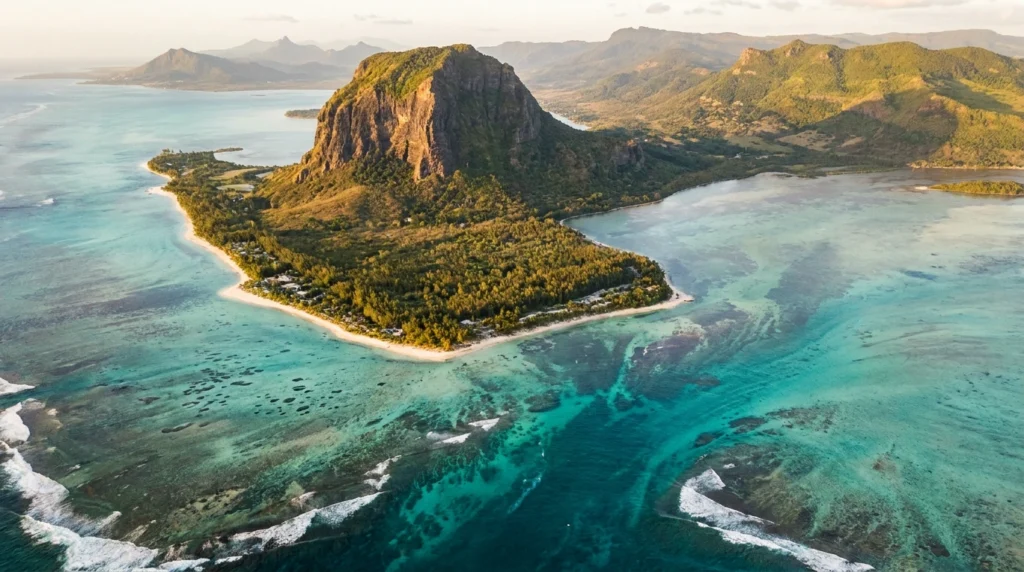
Le Morne Brabant is the basaltic monolith at the country’s south-western tip — a 556-metre peak with a summit covering more than 12 hectares, surrounded almost entirely by lagoon, and inscribed by UNESCO as a Cultural Landscape in 2008 on criteria (iii) and (vi). The inscription’s cultural force is the maroon-slave history: through the late 18th and early 19th centuries the steep slopes and cave-system of the peak became a refuge for enslaved Mauritians who had escaped the plantations, and on 1 February 1835 — the day British police arrived at the peak to announce the abolition of slavery — local tradition holds that the maroons, misreading the police uniforms, leapt to their deaths from the cliff rather than be recaptured. The 1 February anniversary is the country’s Abolition of Slavery commemoration; the Le Morne Heritage Trust Fund runs annual ceremonies on the lower slopes. The peninsula is also the country’s flagship kitesurf destination — the One Eye reef break inside the lagoon is the global short-list spot, the Indian Ocean Kitesurfing World Tour stops here every July, and the four anchor luxury resorts (LUX* Le Morne, Riu Le Morne, Paradis Beachcomber, Dinarobin) have populated the western shoreline since the 1990s. The “underwater waterfall” optical phenomenon — a sand-sediment current viewed aerially that creates the illusion of a submarine cataract — sits in the lagoon directly south of the peak and is the most-photographed natural illusion in the country.
Black River Gorges National Park
Black River Gorges is the country’s only national park, proclaimed on 15 June 1994, covering 67.54 km² of the south-west interior and managed by the National Parks and Conservation Service. The park protects most of Mauritius’s remaining native rainforest — humid upland forest, drier lowland forest and marshy heathland — and is the home range of the Mauritian flying fox, the pink pigeon, the echo parakeet and the Mauritius kestrel (which dropped to four wild birds in 1974, climbed back to roughly 800 by 2005, and was declared the national bird in March 2022). Two visitor centres (Pétrin in the east and Black River in the west), 60 km of marked trails, and the headline Macchabée Trail (10 km, four-to-five hours, hike between Pétrin and Black River) make it the country’s best single hiking day. The park’s highest peak — and the highest point in Mauritius — is the Piton de la Petite Rivière Noire at 828 m, a scramble-grade trail summit reachable in two-to-three hours from the Pétrin entrance.
Île aux Cerfs & the East Coast
Île aux Cerfs (“Deer Island”) is a privately-owned offshore island in the Flacq District at 20°16′20″S 57°48′15″E, reached by a 10-minute speedboat shuttle from Trou d’Eau Douce on the eastern mainland. The island holds a Bernhard Langer-designed 18-hole golf course (the Ile Aux Cerfs Golf Club), several public beaches, an extensive lagoon for water-skiing, parasailing and kayaking, and the busiest tourist day-trip flow on the east coast. The wider Belle Mare resort belt — running roughly 12 km from Trou d’Eau Douce north to Poste Lafayette — is the country’s high-luxury east-coast strip, with the Constance Belle Mare Plage, the Long Beach, the Shangri-La Le Touessrok and the Anantara among the established names. The east coast is the windward side and consequently choppier than the west during the May-to-October trade-wind season, but the lagoon is wide enough that the swimming is consistent. From the Trou d’Eau Douce wharf you can also reach the Grande Rivière Sud-Est waterfalls by speedboat — the country’s second-highest cascade outside Black River Gorges.
Rodrigues — The Outer Island
Rodrigues is the autonomous outer dependency of Mauritius, 560 km east of the main island in the Indian Ocean, covering 109 km², home to roughly 43,650 people in the 2022 census, with Port Mathurin its capital and largest town. Rodrigues has been an autonomous region of the Republic of Mauritius since 12 October 2002 with its own Rodrigues Regional Assembly, 60% Catholic Creole population, and a culture distinct from the multi-ethnic main island. Geographically the island is the eroded tip of an extinct shield volcano with a fringing reef enclosing a lagoon containing 18 small islets — a much higher reef-to-land ratio than the main island. The François Leguat Giant Tortoise Reserve at Anse Quitor holds 5,000-plus reintroduced Aldabra tortoises (filling the niche of the extinct Cylindraspis peltastes that the Dutch ate to extinction in the 1700s) and a series of dramatic limestone caves. Sir Gaëtan Duval Airport (RRG) at Plaine Corail handles the six-times-daily Air Mauritius ATR-72 hop to MRU; the Mauritius Pride passenger ferry sails twice a month. Two-to-three nights is the sensible add-on; five lets you scuba-dive Trou aux Biches Channel and walk Grande Montagne Nature Reserve.


Cultures & Customs — Hindu, Muslim, Creole, Sino-Mauritian, Franco-Mauritian
Mauritius’s 1.23 million people speak more than five widely-used languages between them and divide along a small handful of ethnic and religious lines, and that visible diversity is one of the most rewarding parts of a thoughtful trip. The 2022 census put the Indo-Mauritian population at roughly 67% (the largest group), the Mauritian Creole population at around 28%, the Sino-Mauritian at about 3%, the Franco-Mauritian and other European-descended Mauritians at about 2%. The same census recorded 47.9% Hindu, 32.3% Christian (mostly Roman Catholic), 18.2% Muslim and 1.6% other or unaffiliated, making Mauritius one of the world’s most religiously balanced multicultural societies and the only country in Africa where the Hindu population is the demographic plurality.
Indo-Mauritians — The Hindu and Muslim Majorities
Indo-Mauritians are the descendants of the approximately 500,000 indentured labourers brought from India to work the sugar estates between 1834 and 1923 — primarily Bhojpuri-speaking Bihari farmers from north India, Tamil and Telugu-speaking south Indians, and Punjabi and Gujarati Muslim arrivals. Today the Indo-Mauritian community is split between Hindu (roughly two-thirds, mostly North-Indian and Tamil) and Muslim (roughly one-third, mostly Sunni with a smaller Shia minority). The signature Hindu cultural moment is the Maha Shivaratri pilgrimage to Ganga Talao, the 550-metre crater-lake in the Savanne District: roughly 500,000 Mauritian Hindus walk to the lake each February or March from villages across the island, the route lined with food stalls offering halva and barfi, and the lake itself dominated since 2007 by the 33-metre Mangal Mahadev statue of Lord Shiva — the tallest statue in Mauritius. The Tamil Hindu community celebrates Cavadee in late January or early February, a Thaipusam-style festival in which devotees carry decorated kavadi structures (sometimes weighing up to 30 kg) along pilgrimage routes after 48 days of fasting and purification. The Muslim Indo-Mauritian community celebrates Eid al-Fitr and Eid al-Adha as national public holidays, with the Jummah Masjid mosque (1850s) in central Port Louis the country’s most-photographed Islamic landmark.
Mauritian Creoles — The Afro-Malagasy Inheritance
Mauritian Creoles are the descendants of the enslaved Africans and Malagasy brought to the island under French rule between 1715 and 1810, freed by the British abolition on 1 February 1835, and culturally distinct from the Indo-Mauritian majority by religion (mostly Roman Catholic), language (Mauritian Creole is universal, French is widely used), and the Afro-Malagasy musical inheritance of sega. The community is heaviest along the southern, eastern and western coasts and on Rodrigues; the Creole population of Rodrigues is roughly 95% Catholic and culturally separate from the main island in important respects. The 1 February Abolition of Slavery is a national public holiday and the most significant Creole cultural moment, commemorated annually at the foot of Le Morne Brabant by the Le Morne Heritage Trust Fund.
Sega — The UNESCO-Inscribed Music That Defines Mauritius
Sega is the Afro-Malagasy folk music and dance form that the enslaved Mauritian Creole community developed under French colonial rule, and it is the country’s defining cultural export. UNESCO inscribed traditional Mauritian sega (“sega tipik”) on the Representative List of Intangible Cultural Heritage in 2014. The signature instruments are the ravanne (a one-sided goatskin frame drum, hand-tuned over a fire), the maravanne (a wooden box-rattle filled with seeds), the metal triangle, and the bobre musical bow; the dance form keeps the feet grounded but moves the hips, waist and shoulders in a sliding, low-tempo wave that builds across a typical six-minute song. Modern derivatives include seggae (sega plus reggae, pioneered by Kaya in the early 1990s) and the Rodrigues-specific “sega tambour Rodrigues” — also UNESCO-listed — built around a deeper drum. Live sega tipik happens at the Le Morne 1 February commemoration, at most luxury-resort Saturday-night beach barbecues, and at the Caudan Waterfront’s Le Suffren stage in Port Louis. Treat any chance to see a working sega-tipik group as the cultural equivalent of catching a live samba-school rehearsal in Salvador.
Sino-Mauritians — The Hakka Inheritance
Sino-Mauritians are the descendants of Hakka Chinese migrants who arrived in two main waves: a small first wave in the late 18th and early 19th centuries (mostly Cantonese), and a much larger second wave of Hakka migrants from Meixian (Guangdong Province) in the late 19th and early 20th centuries, principally as small-scale traders and shopkeepers. Today the community numbers about 35,000–40,000, concentrated in Port Louis (the Chinatown around Royal Road, with the L’Hôtel de Ville and the historic Kwan Tee Pagoda) and across the Plaines Wilhems urban corridor. Spring Festival (Chinese New Year, late January or February) is a national public holiday, the L’Hôtel de Ville district hosts a lion-dance and dragon-dance procession, and the Sino-Mauritian fingerprint on national cuisine — mine frite (Chinese stir-fried noodles), bol renversé and dim sum — has been thoroughly absorbed across the country.
Franco-Mauritians — The 2% That Owns the Sugar Estates
Franco-Mauritians are the descendants of the 18th and 19th-century French settler families who developed the sugar plantations and built much of the country’s older economic infrastructure. They number roughly 2% of the population (about 25,000 people), are concentrated in the central plateau (Curepipe, Floréal, Forest Side) and on the Belle Mare and Pereybère coastline, and historically owned a significantly outsized share of the country’s sugar-estate land and offshore-finance interests. French is the lingua franca of business and most newspapers (L’Express, Le Mauricien and Le Défi Quotidien all publish primarily in French), the Roman Catholic Cathedral of Saint Louis on Sir William Newton Street in Port Louis is the centre of religious life, and the Mauritius Turf Club (the country’s racehorse-owning society, founded 1812) remains a Franco-Mauritian-led institution.
Etiquette & Greetings on the Multicultural Island
A quick etiquette note before you start meeting people. English is universally understood in tourism and government, but a serious attempt at French opens far more doors with Indo-Mauritian and Franco-Mauritian shopkeepers, and a single phrase of Mauritian Creole — “ki manyer?” (how are you?), “korek” (fine), “mersi boukou” (thank you very much) — is genuinely appreciated. Always remove shoes when entering a Hindu temple, mosque or Buddhist pagoda; cover shoulders and knees in places of worship; never photograph children without explicit parental permission; never photograph government buildings or military installations. The Mauritian handshake is the standard British one, but the cheek-kiss greeting between two close acquaintances (one cheek, sometimes two) borrowed from French tradition is also common between Mauritian Creole or Franco-Mauritian friends. Photography of religious processions (Maha Shivaratri, Cavadee, Eid prayers, the Spring Festival lion-dance) is generally welcomed, but always ask before photographing kavadi-bearing pilgrims and never publish images on social media that identify a family without consent.

A Food Lover’s Guide to Mauritius — Dholl Puri, Octopus Curry & the Creole-Indian-Chinese-French Fusion
Mauritian cuisine is a four-way conversation between Indian, Creole, Chinese and French traditions, layered over a century-and-a-half of shared lagoon-and-sugar-estate larder, and it is one of the most distinctive food cultures in Africa. The Indian inheritance dominates the everyday cooking — most working Mauritians eat curry-and-rice or curry-and-roti at least once a day — but the seafood-and-tomato Creole vocabulary, the Hakka Chinese stir-fry tradition and the French baking-pastry-wine tradition all sit equally close to the surface.
Dholl Puri & the Street-Food Pantheon
The country’s defining street snack is dholl puri (sometimes “dalpuri”): a thin, hand-rolled flatbread stuffed with cooked yellow split peas (toor dal), griddled on a flat iron pan, served folded around a smear of tomato rougaille, butter beans in onion-garlic sauce, fresh chilli paste and a coriander chutney — bought hot for MUR 20–30 (USD 0.55–0.80) at every street corner from Port Louis to Mahebourg. The accepted national-snack pilgrimage is to a pavement vendor in central Port Louis at lunch time, eaten standing up; the equivalent of New York’s hot-dog cart in cultural weight. Gateau piment (deep-fried split-pea-and-chilli fritters), samoussas (the Mauritian samosa, served with mint chutney), and bhajis (vegetable fritters) round out the trolley vocabulary. Bring small notes, eat what your neighbour eats, and never expect cutlery — the dholl puri is a hand-eaten food.
Octopus Curry, Vindaye & the Creole-Indian Lagoon Larder
Mauritian seafood cuisine is the place where Creole and Indian traditions overlap most fluently. Cari ourite (octopus curry) is the country’s signature lagoon dish — fresh-caught lagoon octopus, slow-cooked in a tomato-onion-thyme-coriander masala with curry leaves, served with white rice and chutney — and the canonical Mahebourg, Tamarin and Belle Mare versions are all worth specific detours. Vindaye is the flag-bearer turmeric-mustard pickle: deep-fried fish (typically tuna or marlin) coated with mustard seeds, turmeric, ginger, garlic and chilli, served cold or at room temperature as a tiffin lunch dish. Rougaille is the all-purpose tomato-onion-garlic-thyme sauce of Creole cuisine, paired with chicken, pork, smoked marlin or sausages. Daube de poulet (slow-cooked Creole-French chicken stew) and bouillon de poulet (chicken broth with green leaves) lean closer to Reunion-Creole tradition. Look for “table d’hôte” guesthouse menus on the south-west coast — these are the kitchens where the cuisine genuinely lives.
Mine Frite, Bol Renversé & the Hakka Inheritance
Travel anywhere in central Curepipe or the Port Louis Chinatown and the food vocabulary tilts sharply Chinese. Mine frite is the Mauritian version of stir-fried noodles — wheat noodles wok-tossed with prawns, chicken, vegetables and soy-and-fish sauce — and the bol renversé (“upside-down bowl”) is the country’s most theatrical dish, a fried rice base topped with stir-fried meat, vegetables and a fried egg, packed into a deep bowl, then inverted onto the plate and lifted off in a single dramatic move. Dim sum brunch is the Sino-Mauritian Sunday tradition; the established names in Port Louis Chinatown are Tien Long, First Restaurant and the Lai Min. The Hakka noodle-soup tradition (boulettes — handmade chayote, fish or chicken dumplings in clear broth) is the cheap, post-9pm, walking-back-to-the-hostel staple of working Port Louis.
The French Inheritance — Baguette, Pâté & Phoenix Lager
French baking, pâtisserie, charcuterie and wine survive on the central plateau more than 200 years after the British capture of 1810. Bread is universally the long French baguette (the Mauritian “pain maison” follows a French country-loaf shape); cassava cakes, croissants and pain au chocolat at the Curepipe Boulangerie de France are the canonical morning pastries; the Mauritius Wine Festival each May at Domaine de Labourdonnais runs French-Mauritian wine tastings; and Phoenix Beverages’ Phoenix Lager (4.6% ABV, brewed at Phoenix since 1963) is the country’s flagship lager, with Blue Marlin (4.7%) and the maltier Black Eagle as the Phoenix-stable variants. The country also produces a small but credible rum tradition — Chamarel, Saint Aubin, La Bourdonnais and Rhumerie de Chamarel run distillery tours — using fresh sugarcane juice rather than molasses, French agricole-style.
Alouda, Sno-Cone & the Drinks Vocabulary
The country’s signature non-alcoholic drink is alouda — a chilled milk drink flavoured with rose syrup, agar-agar jelly cubes, vanilla and basil seeds — sold from market stalls and the Port Louis Central Market. Tea is a serious agricultural product (the Bois Chéri tea estate above Plaine Champagne is open for tours), coffee less so. The country’s iconic cocktail is the Phoenix-and-rum sundowner; the most-famous resort cocktail is the Caudan-style mojito at Le Suffren in Port Louis or the equivalent at Long Beach Belle Mare. The standard rule on alcohol pricing: supermarkets and street bars are reasonable (a 500 ml Phoenix Lager runs MUR 60–80, a 700 ml Mauritian rum bottle MUR 350–500), resort bars are expensive (a single Phoenix runs MUR 250–400, a rum cocktail MUR 450–700).
Signature Dishes & Where to Eat Them
| Dish | What it is | Where to eat the canonical version |
|---|---|---|
| Dholl puri | Yellow split-pea flatbread with rougaille, beans, chutney | Street vendors at Place D’Armes & Central Market, Port Louis |
| Cari ourite | Lagoon octopus curry, tomato-onion-thyme masala | Le Pescatore, Trou aux Biches; or Mahebourg waterfront cafés |
| Gateau piment | Deep-fried split-pea-and-chilli fritters | Anywhere — but Roches Noires market stalls are canonical |
| Vindaye | Cold turmeric-mustard fish pickle | Mauritian table d’hôte guesthouses, Bel Ombre & south-west |
| Mine frite | Hakka-style stir-fried noodles, prawn-chicken-vegetable | Tien Long & First Restaurant, Port Louis Chinatown |
| Bol renversé | Inverted rice-and-stir-fry-bowl with fried egg | Café Mystic, Port Louis; or Happy World Garden, Quatre Bornes |
| Biryani | Indo-Mauritian chicken or mutton biryani, saffron rice | Pereybère and Plaine Magnien Friday-night biryani houses |
| Alouda | Chilled milk-rose-basil seed drink | Pillay Stall, Central Market, Port Louis |
| Phoenix Lager & rum sundowner | Mauritian lager (since 1963) or agricole rum cocktail | Le Suffren, Caudan Waterfront, Port Louis (sunset) |
For broader food-history context, the SBS Food project, the BBC Good Food Africa pages, the OECD’s measuring-the-economic-impact-of-tourism work, the World Travel & Tourism Council and the African Development Bank’s Mauritius country diagnostic each carry useful supplementary material on Mauritian gastronomy and the tourism economy that frames it.
Off the Beaten Path — Rodrigues, Île aux Aigrettes, Chamarel & La Vallée de Ferney
Even Mauritius’s flagship resorts and beaches are uncrowded by Maldives or Seychelles standards, but the country has another tier of places that almost no one on a 10-day standard itinerary ever sees. The five below repay the extra patience and the hire-car miles in full.
Île aux Aigrettes — The Rewilded Offshore Reserve
Île aux Aigrettes is a 27-hectare offshore islet in Grand Port Bay, 850 metres off the south-east coast at Pointe Jérôme near Mahebourg, holding what is widely considered the world’s only remaining piece of intact Mauritius Dry Coastal Forest. Officially established as a nature reserve in 1965 and managed by the Mauritian Wildlife Foundation, the islet is the country’s flagship rewilding project — the foundation has reintroduced the pink pigeon, the Mauritius olive white-eye, the Mauritius fody and a free-roaming population of Aldabra giant tortoises (which, ecologically, fill the niche of the extinct endemic Cylindraspis triserrata that the Dutch ate to extinction in the 1700s). The endemic ebony Diospyros egrettarum, named after the island, grows only here. Two-hour guided tours depart from the Pointe Jérôme jetty on a 10-minute boat transfer, MUR 800–1,200 (USD 18–25) per adult, every 90 minutes between 09:00 and 14:30. Combine with the Mahebourg Monday Market and Blue Bay Marine Park snorkelling for the country’s best non-resort south-east day-out.
Chamarel — Seven-Coloured Earths & the 95-Metre Falls
About 4 km south-west of the small village of Chamarel in the Black River District, set 850 feet above sea level in the western hills, sits the country’s most photographed geological curiosity — the Seven Coloured Earths. The phenomenon is a 7-to-8-acre patch of exposed, vegetation-free volcanic clay that displays seven distinct colours (yellow, brown, red, purple, black, blue and violet) under the right light, the result of differential cooling rates of basaltic lava 3.5 to 7 million years ago and the subsequent oxidation of iron and aluminium oxides in ferruginous clay. The horizontal-banded ridges resemble “melon slices” stacked across the slope. A few hundred metres away, the Chamarel Falls plunge 95 metres along a vertical cliff on the Rivière du Cap, the highest single-drop waterfall in Mauritius, with a small viewing platform on the road. The Rhumerie de Chamarel rum distillery 3 km further down the road runs the country’s best agricole-style cane-juice rum tour for MUR 350–500.
Trou aux Cerfs — The Curepipe Crater
Trou aux Cerfs is a dormant volcano in the heart of Curepipe, sitting at 605 metres on the central plateau, with a crater 300–350 metres in diameter and 80 metres deep, last active roughly 700,000 years ago and classified by the Mauritian Geological Survey as dormant rather than extinct. The rim of the crater offers the best 360-degree view of the central plateau on the island — the Le Morne basalt to the south-west, the Black River Gorges peaks to the south, the Indian Ocean east and west on the same single panorama. A 1.5 km paved walking-and-jogging path circles the rim, the crater floor itself is forested, and the rim makes the country’s best half-an-hour stop on a Curepipe-Mahebourg drive. A small viewpoint at the south-east edge of the crater holds a working seismograph station; the Mauritius Meteorological Services use the location for cyclone-watch radar.
Rodrigues — The Outer Island Deep-Dive
Rodrigues deserves its own Off-the-Beaten-Path slot because it is the deep-end alternative for travellers who want to see Mauritian Creole culture without the resort overlay. A 90-minute Air Mauritius ATR-72 hop from MRU lands at Sir Gaëtan Duval Airport (RRG); rent a small Suzuki at Plaine Corail, drive 8 km north to Port Mathurin (the capital, all 5,000 people), and the rest of the island is yours. The François Leguat Giant Tortoise Reserve at Anse Quitor in the south-west holds 5,000-plus reintroduced Aldabra tortoises and a series of dramatic limestone caves; Grande Montagne Nature Reserve protects the surviving native flora; the Trou d’Argent and Anse Mourouk beaches on the east coast are the country’s most uncrowded sands; the lagoon — fringing reef enclosing 18 small islets — is significantly larger than the islet’s land area, and the kitesurfing scene at Mourouk competes with the main island’s Le Morne. Three nights minimum, five if you want to scuba-dive Trou aux Biches Channel, La Passe and the western reef breaks. The local sega tambour Rodrigues — UNESCO-listed in 2017 — is more deeply rooted on Rodrigues than on the main island.
La Vallée de Ferney & the Bambou Mountains
La Vallée de Ferney is a 200-hectare private nature reserve and forest restoration project in the Bambou Mountains on the south-east coast — the largest single block of native Mauritian forest outside Black River Gorges and home to a wild population of the endemic Mauritius kestrel that has rebuilt from the famous 1974 low of four wild birds. Reach it on the M1 motorway from MRU, exit at Mahebourg, then 10 km north on the B7 — the visitor centre at the entrance offers guided 4×4 forest safaris, two named hiking trails (the Anse Jonchée trail to the eastern viewpoint, and the Ferney Hill trail to the kestrel-feeding-station hide), birdwatching with the resident Mauritian Wildlife Foundation rangers, and a small organic restaurant at the head of the valley serving rougaille daube and a country-style biryani. The reserve sits at the centre of the Mauritian Wildlife Foundation’s broader Bambous and Mondrain conservation programme; the kestrel feeding-station hide sees a near-100% sighting rate at 09:30 and 15:30 daily.


Practical Information
The cheat-sheet below covers the questions your travel-insurance agent, your phone provider and your border-control official are about to ask. Pin it.
| Field | 2026 Detail | Source |
|---|---|---|
| Visa | 60-day visa-free entry for US/UK/EU/Canada/Australia/NZ/Japan/most OECD passports; complete the safemauritius.govmu.org All-in-One form before flight | |
| Currency | Mauritian rupee (MUR); roughly MUR 45 = USD 1 in early 2026 | |
| Phone & data | Mauritius Telecom (My.t) and Emtel SIMs at MRU arrivals; ~MUR 700/month for 10 GB; Airalo eSIM works countrywide | |
| Tap water | Generally potable in Port Louis, the resorts, Curepipe and Mahebourg; bottled recommended for first-time visitors and remote villages | |
| Disease risk | No malaria; dengue and chikungunya present (mosquito-borne); use DEET 20%+ repellent November–April; no yellow-fever requirement unless arriving from a YF country | |
| Vaccinations | Routine + Hepatitis A & B + Typhoid recommended; COVID-19 up to date; chikungunya vaccine generally not required | |
| Plug type | Type C (2-pin Europlug) and Type G (UK 3-pin) dominant; 230V / 50Hz — bring a UK adapter | |
| Time zone | UTC+4 (Mauritius Time, no daylight savings) | |
| Drives on | Left (legacy of British administration); valid international driving permit accepted with home licence | |
| Emergency | 999 (police), 114 (ambulance), 115 (fire); SAMU medical evacuation 114; US Embassy +230-202-4400 |
Cross-checks against the United Nations Statistics Division, the World Health Organization country profile, the US State Department’s Level 2 advisory, the UK Foreign & Commonwealth Office, the Government of Canada travel page and Smartraveller (Australia) confirm Mauritius’s “exercise increased caution” rating throughout 2026 — a level driven by petty crime in central Port Louis after dark rather than any structural security concern. Currency conversion is published daily by the Bank of Mauritius and tracked by XE.com and OANDA.
Budget Breakdown — What Mauritius Actually Costs in 2026
Mauritius is unusual among first-tier Indian-Ocean destinations because the cost gap between guesthouse self-catering and luxury all-inclusive is the widest in the basin. A frugal couple can travel the entire country for two weeks on the price of three nights at a Maldives over-water villa. The numbers below assume a couple sharing accommodation and a hire car; solo travellers add roughly 35% per day, families with two children subtract about 20% per person.
For a full side-by-side against the Indian Ocean’s other headline destination, see Mauritius vs Maldives: the honest comparison, with real costs. Working with a tighter daily number? Mauritius on a Budget: the lagoon island for under $100 a day itemises the guesthouse-and-street-food version of this budget.
Budget — Guesthouse Self-Catering (USD $70–110 / day)
A small hire car (USD 30–35/day Suzuki Swift class), self-catering or chambres-d’hôtes accommodation in Pereybère, Tamarin, Trou aux Biches or Mahebourg (USD 35–60 a night for a clean studio with kitchenette), and the country’s cheap public food. Public buses cover the M1 corridor for MUR 30–50 a ride, the Central Market dholl puri lunch costs MUR 60 (USD 1.30), and a 500 ml Phoenix Lager from the supermarket runs MUR 60–80. Allow MUR 1,200–1,500 (USD 25–32) for a couple’s table d’hôte dinner at a south-west Creole guesthouse including a bottle of Phoenix or local wine. Backpacker hostels exist but are sparse — Pereybère’s PingouinVillas and Tamarin’s “Cabane Bambou” are the established backpacker addresses.
Mid-Range — Half-Board Resort or Boutique Hotel (USD $200–340 / day)
The country’s middle market is its strongest. Three-and-four-star resorts on the north coast (Veranda Pointe aux Biches, Solana Beach, Récif Attitude), the west coast (Tamarin Hotel, Sands Suites Resort) and the south-east (Astroea Beach Hotel) typically charge USD 130–200 per couple per night including breakfast and dinner; LUX*’s mid-tier Tamassa Bel Ombre and Anelia Resort sit in the same band. Add a hire car (USD 35–50 a day in shoulder season), full fuel, daily activities (a Tamarin Bay dolphin charter at USD 75 per person, a Black River Gorges day-hike at USD 0, an Île aux Aigrettes tour at USD 22) and most travellers land in the USD 220–300 daily range.
Luxury — All-Inclusive Le Morne & Belle Mare (USD $700+ / day)
The five-star resort belt — Constance Belle Mare Plage, Constance Prince Maurice, Royal Palm Beachcomber, LUX* Belle Mare, LUX* Le Morne, Paradis Beachcomber, One&Only Le Saint Géran, Shangri-La Le Touessrok, the Anantara Iko, the Heritage Le Telfair, the Constance Le Prince Maurice — runs all-inclusive rates of USD 700–2,400 per couple per night with breakfast, lunch, dinner, beach activities, the kids’ clubs and (at most) the spa included. Le Morne premium suites at LUX* and Paradis routinely top USD 1,800 a night in peak December–January season. The flight time saved versus the Maldives or Seychelles is substantial — a one-stop European city to Mauritius is shorter than two-stop European to Maldives — and the per-couple budget for a 7-night luxury stay lands around USD 6,500–14,000 all-in. The 15% VAT and any local “tourist taxes” are typically included in resort quotes; tipping of USD 8–12 per person per day for service staff is customary.
| Item | Budget | Mid-Range | Luxury |
|---|---|---|---|
| Bed (per couple) | USD $35–60 | USD $130–200 | USD $700–2,400 all-in |
| Hire car (per day) | $30 hatchback | $45–60 mid-size SUV | included or chauffeur |
| Restaurant dinner (per person) | $5 dholl puri street + supermarket | $15–25 Creole table d’hôte | $75+ resort tasting menu |
| Phoenix Lager (500 ml) | $1.50 supermarket | $3.50 hotel bar | included |
| Black River Gorges hike | free | free | guided $90 / person |
| Tamarin dolphin charter | n/a | $75 / person | included on some itineraries |
| Île aux Aigrettes tour | $22 / person | $22 / person | included |
| Le Morne kitesurf lesson (3h) | $80–110 | $110–140 | included on watersport packages |

Planning Your First Trip to Mauritius — Five Steps
-
1. Pick the right window — late September to mid-November
For first-timers in 2026 the single best stretch is roughly 25 September to 12 November — the cyclone risk has passed, the trade winds are still consistent for kitesurfing at Le Morne but light enough that the eastern beaches are usable, the lagoon visibility on the western reef has climbed back to 25-plus metres, and the December resort tariff peak has not yet kicked in. The reverse window — late April to early June — works almost as well if Northern-Hemisphere school holidays force your hand.
-
2. Book the gateway nights early
Le Morne, Belle Mare and Trou aux Biches resort allocations sell out 4–6 months ahead in shoulder season; lock the first-night-after-arrival and the last-night-before-departure with the resort the same week your flight is confirmed. The rest of the itinerary is far more flexible — guesthouses on the south-west and central plateau take refundable bookings up to 14 days before stay.
-
3. Complete the Mauritius All-in-One form 48 hours before flight
Every visitor must complete the safemauritius.govmu.org online form (passport, accommodation address, return flight, declared cash) and bring a printed QR-coded confirmation; without it you fall back to a paper disembarkation card at MRU arrivals. The form is free, takes 8 minutes, and has been a hard requirement since 2022.
-
4. Reserve a small hire car at the airport
Sixt, Avis, Europcar, Hertz, ABC, Pingouin and ICar all run desks at MRU arrivals; pre-book 3–6 months out for shoulder-season pickups for the best automatic-hatchback rates (USD 30–50/day shoulder, USD 60–80 December peak). Decline the cheapest insurance package; pay the surcharge for full collision-damage waiver and tyre-and-windscreen cover. Bring an International Driving Permit alongside your home driving licence.
-
5. Build the route around three coastal anchors
Day 1 Port Louis (acclimatise, Aapravasi Ghat, Caudan Waterfront, Central Market). Days 2–4 west / south-west (Tamarin or Le Morne — sega evenings, kitesurfing, dolphin charter). Days 5–6 north (Trou aux Biches or Grand Baie — reef snorkelling, Pamplemousses Botanical Garden). Days 7–8 central / south-east (Curepipe, Trou aux Cerfs, Mahebourg Monday Market, Île aux Aigrettes). Day 9 Black River Gorges hike + Chamarel falls and seven-coloured earths. Day 10 east coast Île aux Cerfs day-trip + Belle Mare last night, then return to MRU. Pad an extra night on either end if you can; Mauritius distances always look smaller on a map than they drive in school-bus-rich morning traffic.
Frequently Asked Questions
Is Mauritius safe for tourists in 2026?
Yes. The US State Department rates Mauritius at Level 2 (exercise increased caution), the UK Foreign Office and Australian Smartraveller list it among Africa’s safest destinations, and violent crime against tourists is rare. The realistic risks are pickpocketing in central Port Louis and the Caudan Waterfront after dark, occasional purse-snatching at crowded markets, and inflated tourist pricing on unmetered taxis. Use a hotel safe for your passport, decline the drive-all-day taxi pitches at MRU arrivals, and book a metered transfer instead.
Do I need a visa to enter Mauritius?
Probably not for short stays. US, UK, EU, Canada, Australia, New Zealand, Japan and most OECD passport-holders enter visa-free for up to 60 days. You must show proof of onward travel, paid accommodation and complete the online Mauritius All-in-One form (safemauritius.govmu.org) before boarding; print the QR-coded confirmation. Your passport must be valid for the duration of stay with at least one blank page. Stays beyond 60 days require a residence permit through the Passport and Immigration Office in Port Louis.
When is the best month to visit Mauritius?
Late September to mid-November is the sweet spot — the cyclone risk has passed, the south-east trade winds are perfect for kitesurfing at Le Morne, the lagoon is at its clearest for snorkelling, and resort rates have not yet jumped to the December peak. May to August is cooler and drier (ideal for hiking Black River Gorges and Le Morne) but the trade winds make some east-coast beaches choppy. Avoid mid-January to mid-March if you can — that is the cyclone peak and the resort high-season tariff.
Is cyclone season a real risk?
Yes, but it is shorter and less destructive than headlines suggest. The South-West Indian Ocean cyclone season runs November through April, with the genuine peak from January to mid-March. Mauritius averages roughly one direct hit every two to three years; the famous historical events were Cyclone Carol (1960), Hollanda (1994) and Dina (2002), and Belal in 2024 closed MRU airport for 36 hours. Modern resorts and Air Mauritius have well-rehearsed protocols, the Mauritius Meteorological Services issue Class 1-4 warnings 36 hours ahead, and travel insurance with cyclone cover is standard.
Can I drink the tap water?
Tap water is generally considered potable in major towns and resorts (Port Louis, Curepipe, Grand Baie, Flic en Flac, the Le Morne resorts and Belle Mare). The CDC and the UK FCDO both note acceptable municipal supply across the main island. First-time visitors with sensitive stomachs should default to bottled water for the first three or four days, especially in remote villages and on Rodrigues; resort tap water is consistently safe and most resorts offer filtered drinking-water dispensers in the lobby.
Do I need a hire car in Mauritius?
Strongly recommended for anyone planning more than four days outside a single resort. Mauritius drives on the left, the road network is fully tarmacked, the M1/M2 motorway loops south-north and the petrol stations are universal. A hire car (USD 30–50/day in shoulder season) buys you Black River Gorges, Chamarel, Le Morne, the Pamplemousses Botanical Garden and the south-east beaches in a single trip. Sticking to one resort? Use the cheap public bus network (MUR 30–50 per ride) and the Metro Express light rail (Port Louis–Curepipe).
How expensive is Mauritius?
Less than the Maldives, less than the Seychelles, on par with Sri Lanka or Thailand at the mid-range. A guesthouse self-catering couple lives on USD 70–110 a day all-in; a half-board mid-range resort couple lives on USD 200–340; a Le Morne or Belle Mare luxury all-inclusive week lands at USD 5,500–12,000 per couple. Public buses are cheap (MUR 30–50), local food is even cheaper (a dholl puri plate is MUR 20–30), and the cost trap is alcohol at resort bars and unmetered airport taxis.
For the full itemised under-$100-a-day version of this budget, see Mauritius on a Budget: the lagoon island for under $100 a day.
Should I add Rodrigues Island to my itinerary?
Yes if you have nine or more nights, no if you have seven or fewer. Rodrigues is the autonomous outer island 560 km east of Mauritius, reached by a 90-minute Air Mauritius hop or a 36-hour Mauritius Pride passenger ferry. The island has 43,650 people, a fringing reef with 18 lagoon islets, the François Leguat tortoise reserve, and an authentic Creole-Catholic culture distinct from main-island multiethnic life. Two or three nights is the sensible add-on; five lets you scuba-dive Trou aux Biches Channel and walk Grande Montagne Nature Reserve.
What is Sega music and where can I hear it live?
Sega is the Afro-Malagasy folk music and dance form Mauritius developed under slavery — UNESCO inscribed traditional Mauritian sega on the Intangible Cultural Heritage list in 2014. The signature instruments are the goatskin ravanne drum, the maravanne seed-rattle and the metal triangle; the dance keeps the feet grounded while hips and shoulders move. Live sega tipik happens at the Le Morne Cultural Landscape on the 1 February Abolition of Slavery commemoration, at the Trou aux Biches and Belle Mare beach barbecues many resorts run on Saturday nights, and at the Caudan Waterfront’s Le Suffren stage in Port Louis.
Are the beaches really all public?
Yes — and this is one of the best things about Mauritius. Mauritian law guarantees public access to the entire 177-kilometre coastline; resorts cannot legally privatise the beach in front of them, only the loungers and watersports concessions on the sand. You can walk every kilometre of Trou aux Biches, Mont Choisy, Flic en Flac, Belle Mare and Le Morne; you simply cannot use a resort’s loungers without being a guest. The classic public-beach combination is Mont Choisy in the north (vast pine-shaded sand), Flic en Flac in the west (13 km, sunsets), and Le Morne in the south-west (UNESCO landscape, kitesurfing).
For a coast-by-coast breakdown of which beach suits which trip, see Where to Stay in Mauritius: East vs West vs North Coast, Honestly Compared.
Ready to Explore Mauritius?
Two UNESCO sites, the world’s third-largest barrier reef, the deepest multicultural fabric in the Indian Ocean, a 60-day visa-free stamp for almost every English-speaking passport, and a hire-car infrastructure that lets you self-drive every corner of the island in a single fortnight. Lock the September-to-November window the same week your flight is confirmed, drop a refundable hold on a guesthouse in Trou aux Biches or Tamarin, and let the trade-wind silence of the south coast rearrange your week.
Explore More
Mauritius’s own city guides — Port Louis, Grand Baie, Flic en Flac, Le Morne, Mahebourg and Curepipe — are still being written; in the meantime, browse our most popular live city guides for trip-planning inspiration.
More country guides you might like
Plan your trip to Mauritius
The booking tools we use ourselves. FFU may earn a commission at no extra cost to you.
Plan & book your trip to Mauritius
Booking through these searches supports our guides at no extra cost to you.