
Catania Travel Guide — Sicily’s Baroque Port City in the Shadow of Mount Etna
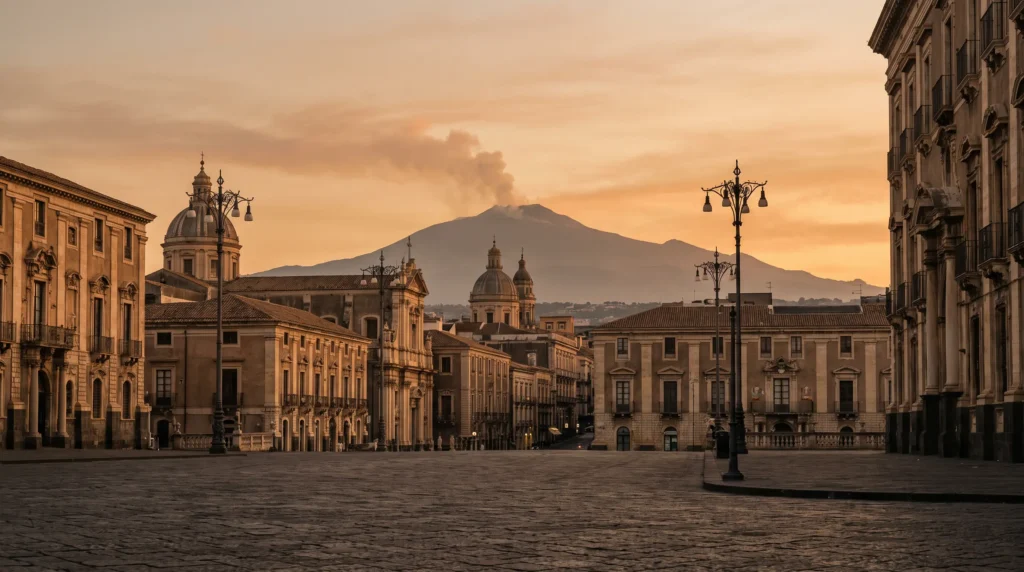
Catania is the city Sicily built twice on top of itself, and you can feel it under your feet — literally, since half the historic center sits on a hardened river of 1669 lava. Everything here is volcanic-black and Baroque-gold at the same time: the cathedral square is paved in dark lava stone and topped with a fountain of white marble elephants, the fish market roars in dialect two blocks from vespers bells, and Mount Etna smokes quietly over the rooftops like it’s simply part of the skyline, which, at 3,403 metres, it very much is. I love Catania because it doesn’t perform for tourists the way Taormina or Florence do — it’s grittier, louder, cheaper, and more alive at 11pm than most European capitals are at all. The catch: it’s also chaotic, sometimes scruffy around the edges, and the traffic makes zero apologies for itself. Come anyway.
In This Guide
- Overview — Why Catania Is Sicily’s Most Underrated City
- Sant’Agata — One of the World’s Largest Religious Festivals
- Best Time to Visit Catania (Season by Season)
- Getting There — CTA Airport & Sicilian Rail
- Getting Around — Metro, Buses & Walking the Lava Streets
- Neighborhoods — Centro Storico, Civita, Ognina & the Playa
- Culture & People — Bellini, Verga & the Etna Shadow
- A Food Lover’s Guide to Catania
- Off the Beaten Path
- Day Trips — Taormina, Siracusa & the Val di Noto
- Practical Information
- Budget Breakdown — What Catania Actually Costs in 2026
- Frequently Asked Questions
Overview — Why Catania Is Sicily’s Most Underrated City
Catania is Sicily’s second-largest city, with roughly 297,000 people in the city proper and over a million across the wider metropolitan area — bigger, denser, and considerably less polished than Palermo’s rival claim to the island’s capital crown. It sits directly on Sicily’s Ionian east coast, wedged between the sea and the lower slopes of Mount Etna, Europe’s largest and most active volcano, whose eruptions have both destroyed and rebuilt the city more than once. The 1669 lava flow buried part of the old town and pushed the coastline outward; the catastrophic 1693 earthquake leveled most of what was left. What rose from that rubble is the Catania you walk through today: a near-total late-Baroque reconstruction in dark volcanic stone, quarried from the very lava that wrecked the place.
That black-and-gold Baroque core is serious enough architecturally that UNESCO inscribed Catania, alongside seven other rebuilt towns of southeastern Sicily, as part of the “Late Baroque Towns of the Val di Noto” World Heritage Site in 2002. Unlike Noto or Ragusa, which were relocated to new sites after the earthquake, Catania was stubbornly rebuilt right on top of itself — a decision you can still read in the street grid and in the lava-black paving of Piazza del Duomo.
What makes Catania worth a trip in its own right, rather than just an airport stopover on the way to Taormina, is the contrast: a working port city with a real university (founded in 1434, the oldest in Sicily), a market that still shouts fish prices in dialect, some of Italy’s best street food, and a volcano close enough to hike in an afternoon. It’s rougher around the edges than the postcard hill towns nearby, and that roughness is largely the point.
Sant’Agata — One of the World’s Largest Religious Festivals
If you can build a trip around one date, make it February 3–5, the Festival of Sant’Agata, honoring Catania’s patron saint and martyr. It’s counted among the largest Catholic festivals on Earth by participation, drawing crowds that regularly outnumber the city’s own population as a silver reliquary bust and a centuries-old processional chariot (“fercolo”) are hauled through the streets by teams of white-robed devotees (“cittadini”) in an overnight procession that runs into the following dawn. A second, smaller celebration falls on 17 August, marking the return of her relics from Constantinople.
Fireworks, fried “minne di Sant’Agata” pastries (yes, they’re shaped exactly like what the name suggests, tied to her martyrdom), and a genuinely overwhelming crowd crush define the February dates — book accommodation months ahead if this is your window, and expect the historic center’s normal traffic rules to simply stop existing for three days.
Best Time to Visit Catania (Season by Season)
April – June · Shoulder season (the sweet spot)
Warm, mostly dry, wildflowers on Etna’s lower slopes, and none of August’s heat or crowds. This is when I’d send most first-timers.
July – August · Peak summer
Hot, often exceeding 40°C in the city, with the coast and beach clubs at Playa jammed with Italian holidaymakers. Fine if you’re built for heat and want beach time; brutal for all-day sightseeing without a siesta break.
September – October · Second shoulder window
Sea still warm, crowds thinning, harvest season on Etna’s volcanic-soil vineyards — arguably the best month for pairing city time with wine tourism.
November – March · Mild, wet, cheap — and Sant’Agata
Winters are mild by European standards with most of the year’s rain concentrated here, but rarely genuinely cold. Early February brings the Sant’Agata festival crush; outside that week, this is the quiet, budget season.
Getting There — CTA Airport & Sicilian Rail
Catania–Fontanarossa Airport (CTA), also known as Vincenzo Bellini Airport, is the busiest airport in Sicily and the largest in Southern Italy, handling roughly 9 million passengers a year with direct connections across Italy and to major European hubs, plus seasonal charters. It sits just a few kilometres southwest of the city center — the Alibus shuttle or a taxi covers it in roughly 15–20 minutes in normal traffic, making Catania one of the most convenient bases in Sicily for a fly-in trip.
By rail, Trenitalia’s Intercity and regional lines connect Catania Centrale to Palermo (roughly 3 hours), Siracusa (about an hour), Messina, and onward via ferry-train to the Italian mainland. The coastal line north toward Taormina and Messina is one of the prettier short rides in Sicily, hugging the Ionian shoreline with Etna looming on the other side.
Getting Around — Metro, Buses & Walking the Lava Streets
The historic center is compact and almost entirely walkable — Piazza del Duomo, Via Etnea, La Pescheria fish market, and the Roman theatre all sit within a 15-minute stroll of each other, though the lava-stone cobbles and Sicilian drivers both demand attention. For anything further, Catania runs Italy’s newest small metro system: the Catania Metro’s single Line A now covers 12 stations across 8.7 kilometres, extended most recently in July 2024 with the Fontana and Monte Po stops reaching the city’s northwest.
AMT city buses fill the gaps the metro doesn’t reach, including routes out to the Playa beach strip in summer. For Etna itself, guided minibus tours or the seasonal Circumetnea narrow-gauge railway that loops around the volcano’s base are the easiest options without a rental car — driving yourself up the mountain’s access road is doable but not for anyone rattled by hairpin turns and sudden fog banks.
Neighborhoods — Centro Storico, Civita, Ognina & the Playa
Piazza del Duomo & Centro Storico
The Baroque heart: the cathedral, the Fontana dell’Elefante — carved from lava rock and topped by an Egyptian obelisk, the unofficial symbol of the city — and the grid of black-and-gold streets radiating out from it. Base yourself here for maximum walkability.
La Pescheria
Catania’s legendary fish market, running most mornings just behind Piazza del Duomo — a genuinely loud, theatrical, elbow-to-elbow scene of swordfish, sea urchins and vendors calling out prices in Sicilian dialect. Come early, come hungry, and expect to be splashed.
Via Etnea & San Berillo
Via Etnea is the city’s grand shopping spine, running dead straight toward Etna’s summit on a clear day. San Berillo, just off it, is Catania’s rougher, more layered quarter — long a red-light district, now slowly gentrifying with galleries and bars moving in alongside the older working-class blocks.
Civita & the Benedictine Monastery
Home to the Monastero dei Benedettini, one of the largest Benedictine monasteries in Europe and now part of the University of Catania — its cloisters and lava-catacomb basements are open for guided tours and worth the detour.
Ognina
A former fishing village folded into the city’s northeastern edge, with a small harbor, seafood trattorias, and a noticeably calmer pace than the centro storico.
Picanello & La Playa
Catania’s beach district — a long stretch of sand and beach clubs (lidos) that fills with locals every summer weekend. Not scenic in the postcard sense, but the closest thing to a proper city beach day without leaving town.
Librino & the Outskirts
Firmly residential and not a sightseeing stop, but worth knowing about if you’re navigating bus routes or arriving by car — this is where the city’s modern sprawl and social housing projects sit, well outside the tourist footprint.
Culture & People — Bellini, Verga & the Etna Shadow
Catania’s two most famous sons anchor its cultural identity: composer Vincenzo Bellini, born here in 1801 and honored with the city’s opera house, main theatre, and airport all bearing his name, and novelist Giovanni Verga, whose Sicilian realism captured the hard edges of 19th-century island life. The University of Catania, founded in 1434 as Sicily’s oldest, keeps the city younger and more studenty than its size suggests, with genuinely good nightlife clustered around Piazza Bellini and San Berillo.
Living beside an active volcano shapes local temperament more than any single monument does — Catanese fatalism about Etna’s rumbles and ashfalls (locals sweep volcanic ash off cars and balconies the way other cities deal with snow) runs through local humor, superstition, and even building materials, since half the city is quite literally built from the mountain that occasionally threatens it.
A Food Lover’s Guide to Catania
Start with pasta alla Norma — tomato, fried eggplant, salted ricotta and basil, named for Bellini’s opera and arguably Sicily’s single most famous pasta dish. Street food here rivals Palermo’s: arancini (fried rice balls, ordered “al burro” for ragù-and-béchamel or “alla Norma” for the eggplant version), cipollina (a puff-pastry pocket of ham and cheese), and scaccia, a folded, pizza-adjacent flatbread from the surrounding province.
For breakfast the way locals actually do it: a granita — almond, pistachio, or coffee are the classics — with a brioche col tuppo for dunking, eaten standing at a bar counter. La Pescheria’s surrounding trattorias serve the day’s catch a few hours after it’s unloaded; look for spaghetti ai ricci (sea urchin) in season and grilled swordfish year-round. Etna’s volcanic soil also produces genuinely excellent wine — Etna Rosso and Etna Bianco DOC labels from vineyards on the mountain’s slopes are a serious, increasingly internationally recognized pour, worth seeking out over the more famous Marsala from the island’s west.
Off the Beaten Path
Aci Trezza & the Cyclops’ Islands
A small fishing village just north of Catania, facing the Faraglioni dei Ciclopi — jagged basalt sea stacks that, per legend, the blinded Cyclops Polyphemus hurled at Odysseus’s fleeing ship. Quiet, unpretentious, and easy as a half-day trip by bus.
The Benedictine Monastery’s Lava Catacombs
Guided tours of the Monastero dei Benedettini descend into basement levels built directly against the solidified 1669 lava flow that the monastery was constructed on top of — one of the most tangible ways to feel the eruption’s scale up close.
Mount Etna’s Lower Trails
You don’t need a summit permit or a guide to explore Etna’s Silvestri Craters and lower forest trails, reachable by car, guided minibus, or the Circumetnea railway — a genuinely different landscape of black volcanic sand and scrub pine within 40 minutes of the coast.
San Berillo’s Street Art
Beyond its reputation, the quarter now hosts a growing scattering of murals and small independent galleries, part of a slow, ongoing effort to reshape the district’s identity.
Day Trips — Taormina, Siracusa & the Val di Noto
Taormina — Sicily’s glossiest hill town, with its cliffside Greek theatre framing Etna in the background, is roughly an hour north by train or car and makes an easy, if crowded, half-day trip.
Siracusa — About an hour south by train, with its own extraordinary Greek theatre, the Ear of Dionysius limestone quarry, and the Baroque island quarter of Ortigia, arguably a rival to Catania’s own historic core.
The Val di Noto towns — Noto, Modica, and Ragusa, Catania’s fellow inscriptions on the same 2002 UNESCO Baroque listing, sit within a 1.5–2 hour drive south and reward a full day or an overnight each. Modica is also the place to try Sicily’s famous cold-processed chocolate.
Mount Etna summit tours — Full-day guided excursions to the higher craters (beyond the lower Silvestri stops) run from Catania and typically include cable car and 4×4 transport partway up, weather and volcanic activity permitting.
Practical Information
Money. Italy uses the Euro; cards are widely accepted in restaurants and shops, but carry cash for the fish market, small bars, and rural Etna stops. Safety. Italy overall sits at the US State Department’s “Exercise Increased Caution” advisory level, largely a general caution about petty crime and crowded-place awareness rather than anything Catania-specific — watch bags and pockets around the market and busy piazzas, standard city-travel sense.
Health. Tap water is safe to drink; no special vaccinations are required for most travelers beyond routine ones — check current guidance for your specific circumstances before departure. Connectivity. An EU-roaming or local eSIM covers the city easily; Wi-Fi is standard in hotels and cafés.
Plugs & power. Italy uses type C, F and L plugs at 230V/50Hz — bring a European adapter. Time zone: Central European Time (UTC+1), shifting to CEST (UTC+2) for daylight saving in summer.
Budget Breakdown — What Catania Actually Costs in 2026
Catania is one of the more affordable major Italian cities, cheaper than Florence, Venice, or Rome across the board.
Budget (US$55–90/day): Hostel or budget guesthouse in the centro storico, arancini and street food, metro and bus passes, walking most sights.
Mid-range (US$110–200/day): Boutique B&B near Piazza Duomo, sit-down trattoria dinners with Etna wine, a guided Etna half-day tour, a train day trip to Taormina or Siracusa.
Luxury (US$350+/day): Design hotel or an Etna wine-estate stay with tasting menus, private volcano guide with 4×4 and cable car access, chauffeured Val di Noto touring.
Tipping is not obligatory the way it is in North America — rounding up or leaving small change for good service is standard; a coperto (cover charge) of a few euros per person is normal and legal on restaurant bills.
Planning Your First Trip to Catania
Three nights in Catania proper covers the centro storico, La Pescheria, and an Etna half-day comfortably; stretch to five or six and add a Taormina or Siracusa day trip, or push south into the Val di Noto towns for a genuinely deep Sicilian Baroque circuit. Pair it with our Italy travel guide for mainland planning, our Naples city guide or Rome city guide if flying in via the mainland, or hop across the water to our Malta travel guide — a short flight or ferry from Catania and an easy add-on for a two-country Mediterranean trip.
Frequently Asked Questions
Is Catania safe for tourists in 2026?
Yes, with the same standard urban precautions as any major Italian city — watch belongings in crowded markets and on public transport, and check your government’s current Italy travel advisory before you go, since it covers the whole country rather than issuing Catania-specific guidance.
Do I need a visa?
US, UK, Canadian, and Australian passport holders can enter visa-free for up to 90 days within any 180-day period under the Schengen rules that apply across Italy.
How many days do I need in Catania?
Two to three full days covers the historic center, the market, and an Etna day trip comfortably; add extra nights if you want to fold in Taormina, Siracusa, or the Val di Noto Baroque towns.
Catania or Palermo?
Choose Catania for easier airport access, a more compact walkable center, and proximity to Etna and the Ionian coast; choose Palermo for a larger, more atmospherically chaotic historic core and closer access to Sicily’s western coast and Monreale.
Can I climb Mount Etna from Catania as a day trip?
Yes — guided day tours run from Catania to the lower Silvestri craters easily, and further to the higher summit zone via cable car and 4×4 when conditions and volcanic activity allow; always book through a licensed guide given the mountain’s active status.
What’s the cheapest way to see the Baroque towns?
Base in Catania, use regional trains to Siracusa, and add a shared day-tour minibus to Noto, Modica, and Ragusa rather than renting a car for a single day — it’s typically the most economical way to cover all three.
Ready to Explore Catania?
A Baroque cathedral square built from the very lava that once buried the city, a fish market that never stops shouting, and an active volcano close enough to touch by lunchtime — Catania doesn’t dress itself up for visitors, and that’s exactly why it’s worth the trip. Go before it does.
Explore More
- Italy Travel Guide — plan the wider mainland trip
- Naples City Guide — Italy’s other volcano-shadowed port city
- Rome City Guide — pair Sicily with the capital
- Malta Travel Guide — a short hop across the Mediterranean
How this guide was built
Published as part of Facts From Upstairs’ city guide series. Built from authoritative sources — UNESCO’s Late Baroque Towns of the Val di Noto and Mount Etna World Heritage listings, the US State Department’s Italy travel advisory page, Wikipedia entity pages for Catania, Mount Etna, Catania–Fontanarossa Airport, the Catania Metro and the Festival of Saint Agatha, and World Standards’ Italy electrical reference. Numeric claims carry inline citations.
Sources cited on this page
- Wikipedia — Catania
- Wikipedia — Mount Etna
- UNESCO — Late Baroque Towns of the Val di Noto (South-Eastern Sicily)
- Wikipedia — Catania–Fontanarossa Airport
- Wikipedia — Festival of Saint Agatha (Catania)
- Wikipedia — Catania Metro
- US State Department — Italy
- World Standards — Italy power plug, socket & voltage
More city guides you might like
Plan your trip to Catania
The booking tools we use ourselves. FFU may earn a commission at no extra cost to you.
Plan & book your trip to Catania
Booking through these searches supports our guides at no extra cost to you.