
Languages of Malta
All languages of Southern Europe →fluent beta classical · classes by phone with Maya at ranas.ai/maya
Malta Travel Guide — 7,000 Years of History on 316 km² of Limestone & Sea
The 6:00 a.m. ferry across the Gozo Channel never loses its charm: a bowl of pastizzi from the Mġarr harbour kiosk, a bus ticket worth less than a coffee, and the certainty of spending the day inside a temple older than the pyramids. The classic Malta argument is whether Valletta or Mdina deserves “main character” status in the trip — the case for Mdina is that nothing on the islands reorders a visitor’s sense of time quite like its Norman walls — and the runner-up is whether Cisk or Kinnie is the more honest souvenir to bring home. Treat this guide as the brief you’d want in hand before boarding the morning Ryanair from Stansted.

In This Guide
- Overview — Why Malta Belongs on Every Bucket List
- Festa Season 2026 — Patron-Saint Feasts & Pyrotechnics
- Best Time to Visit Malta (Season by Season)
- Getting There — Flights & Malta International (MLA)
- Getting Around — Buses, Ferries & the Gozo Channel
- Top Cities & Regions
- Maltese Culture & Etiquette
- A Food Lover’s Guide to Malta
- Off the Beaten Path — Temples, Cliffs & Hidden Coves
- Practical Information
- Budget Breakdown
- Planning Your First Trip to Malta
- Frequently Asked Questions
Overview — Why Malta Belongs on Every Bucket List
Malta is a tight little archipelago of three inhabited islands — Malta, Gozo and Comino — anchored in the central Mediterranean roughly 80 km south of Sicily and 290 km north of Tunisia. The total land area is just 316 km² — the country sits among the world’s ten smallest, and you can drive end-to-end across the main island in under 45 minutes. Roughly 574,250 people live here as of end-2024, making Malta one of the most densely populated countries on Earth at about 1,716 residents per square kilometre. The capital, Valletta, is the European Union’s smallest by area at 0.61 km².
The first story of Malta is age. The Ġgantija temples on Gozo were built between 3600 and 3200 BC, which makes them more than 5,500 years old and predates the Egyptian pyramids by roughly a thousand years. They are widely cited as the second-oldest free-standing manmade religious structures on Earth after Göbekli Tepe in Turkey. Below ground at Paola, the Ħal Saflieni Hypogeum is a three-level subterranean necropolis carved out of soft globigerina limestone around 4000–2500 BC, accidentally discovered in 1902 by workmen cutting cisterns. Heritage Malta caps daily visitors at just 80 to protect the painted ochre chambers from humidity damage.
The second story is the layered, almost cinematic sequence of conquerors. Phoenicians, Carthaginians, Romans, Byzantines, Arabs, Normans, the Knights Hospitaller, the French and the British have all left fingerprints on the islands’ street names, language and skylines. The Knights of St John arrived from Rhodes in 1530 and held the islands for 268 years, founding Valletta in 1566 after the Great Siege and turning the Grand Harbour into one of the most heavily fortified ports in Europe. Britain ruled from 1814 until independence on 21 September 1964, and the country became a republic on 13 December 1974. Malta joined the EU on 1 May 2004, the Schengen Area in December 2007, and adopted the euro on 1 January 2008 — the smallest member state by both area and population in each.
The third story is the Mediterranean light. Malta logs roughly 3,000 hours of sunshine a year — about twice as much as cities in northern Europe — and the average daytime temperature stays around 23 °C across the calendar. Valletta was named the sunniest city in Europe in 2016, and the islands’ coralline limestone glows almost honey-coloured in early morning and late afternoon. Tourism reflects all of this: 2024 was a record year with 3,563,618 inbound visitors, up 19.5% on 2023 and well past the pre-pandemic high. Tourism contributes roughly 6.1% of national GDP.
The economic picture sharpens the appeal. Malta’s GDP reached US $24.32 billion in 2024 with a per-capita figure of roughly USD $67,682 at purchasing-power parity, putting it firmly in the high-income bracket. Tourism alone accounted for €3.3 billion of inbound expenditure in 2024 — up 23.1% on 2023 — and directly employed about 47,827 people, roughly 8.4% of all residents in 2023. The largest source markets in 2024 were the United Kingdom (19.8% of arrivals) and Italy (17.3%), with Poland (+58.3%), Hungary (+35.6%) and the Netherlands (+34.0%) showing the fastest year-on-year growth. The Malta Tourism Authority’s full statistical bulletin confirms 25.4 million guest nights and €3.9 billion of expenditure for 2025, edging the country into a new tier of Mediterranean tourism alongside Croatia and Cyprus.
Practically, Malta in 2026 is one of the most accessible flagship destinations in southern Europe. English is an official language alongside Maltese; almost everyone you encounter under 60 will switch into clear, neutral English the moment they hear yours. Driving is on the left, plugs are British Type G, the currency is the euro, and the entire bus network is run by a single state-licensed operator with a tap-card flat fare. The Lonely Planet entry calls the country a place of “sun-soaked beaches, coastal hikes, medieval fortresses … prehistoric temples, fossil-studded cliffs, hidden coves, thrilling scuba diving and a history of remarkable intensity” — a fair summary you can absorb in a long weekend. Pack swim shoes for the rocky coves, a small torch for the Hypogeum’s dim lower chamber, and a sense of humour about the buses being twenty minutes late in August. The country rewards patience and curiosity in equal measure.

Knights, Bombs & Miracles — A Pocket History of Malta
Malta’s recorded story is unusually dense for a country this size. The earliest human traces date to roughly 5900 BC at Skorba, but the country’s first headline contribution to global history is the Megalithic Temple Period (3600–2500 BC) — a window in which seven free-standing stone temples were raised, vast carved “fat lady” figurines were sculpted, and an underground burial chamber the size of a city block was hand-cut at Ħal Saflieni. Then the temple culture vanishes from the archaeological record around 2500 BC and Malta is, abruptly, an empty island that the Phoenicians repopulate around 800 BC.
From there the conquerors arrive in sequence. Carthaginians from 480 BC, then Romans after the First Punic War in 218 BC, who renamed the central island Melita and built a substantial city on the site that would become Mdina. Christianity, by Maltese tradition, arrived directly with the apostle Paul, shipwrecked at St Paul’s Bay in 60 AD on his way to Rome. The Byzantines held the islands from 535, the Aghlabid Arabs took them in 870 AD, and the Norman Roger I conquered them in 1091 — the moment when the language stopped being classical Arabic and began evolving into Maltese.
The single most consequential 268 years are the Knights’ tenure (1530–1798). The Order of St John, expelled from Rhodes by Suleiman the Magnificent, accepted Malta from Charles V of Spain in 1530 in exchange for one Maltese falcon a year. They built fortifications, fought off the 1565 Ottoman siege under Grand Master Jean Parisot de Valette with 6,100 defenders against an Ottoman force estimated at 25,000–40,000 troops, lost roughly a third of their own number — and a third of the Maltese population — but held the island. The victory turned them into European celebrities, the Maltese Cross became the symbol of the country, and Valletta was founded the following year as their fortified capital.
Napoleon ended the Knights’ tenure with a six-day occupation in June 1798, looted St John’s of its silver, abolished the Order, and sailed onwards to Egypt. The Maltese rose against the French within months and welcomed the British in 1800; formal British rule began with the 1814 Treaty of Paris. The British turned Grand Harbour into the Royal Navy’s central Mediterranean base, and that strategic position made Malta one of the most heavily bombed places of World War II.
Between June 1940 and December 1942 the Axis dropped roughly 15,000 tons of bombs on the islands; King George VI awarded the entire population the George Cross — Britain’s highest civilian gallantry honour — in April 1942, the only time in history a country has been so honoured collectively. The most famous individual incident of the siege was the 9 April 1942 bomb that pierced the dome of the Mosta Rotunda during a 4 p.m. mass with about 300 parishioners present, hit the floor, skidded across the church, and failed to detonate; Royal Engineers later defused the 500 kg German bomb and dumped it at sea. A replica is on display in the church to this day.
Independence on 21 September 1964 followed a 1955 referendum that nearly merged Malta with the UK. The country became a republic on 13 December 1974, joined the EU in 2004 alongside nine other accession states, joined Schengen on 21 December 2007, and adopted the euro on 1 January 2008. A short, busy 7,000 years.
Festa Season 2026 — Patron-Saint Feasts & Pyrotechnics
If you can only visit Malta once, time it to a village festa. From mid-June to the first Sunday of September, every parish on the islands celebrates its patron saint with a long weekend of statue processions, brass bands, family meals on the street, and the noisiest, most lavish fireworks competitions in the Mediterranean. There are 78 parishes on Malta and 15 on Gozo, and almost all of them stage one. The festa tradition is part of the country’s living religious culture — 82.6% of residents identify as Catholic per the 2021 census, and the parish church is still the centre of village life.
- First major festa: Mnarja (St Peter & St Paul) — 28–29 June 2026, Buskett Gardens at Rabat — fenkata feasts, folk music.
- Peak window: 14 June – 8 September 2026 — pyrotechnics nightly in different villages
- Marquee feast: St Mary (Santa Marija) — 15 August 2026, observed across multiple villages including Mosta and Mqabba
- Mosta: Massive parish dome procession 15 Aug; the Mosta Rotunda is one of the largest unsupported domes in Europe at roughly 37 m diameter
- Mqabba & Lija: Famous for fireworks competitions that draw pyrotechnicians from across Europe
- Nadur (Gozo): 28–29 June — St Peter & St Paul, the loudest festa on Gozo
The fireworks deserve their own paragraph. Maltese pyrotechnics are an unlikely national obsession with a serious safety code; many villages run dedicated factories — the Maltese term is kamra tan-nar — that produce coloured aerial shells, ground-based petards, and the trademark logħob tan-nar tal-art (mechanised ground fireworks: spinning wheels, geometric set pieces, sometimes the entire parish church façade illuminated frame by frame). The annual Malta International Fireworks Festival in Valletta, typically held in late April, is the official curtain-raiser to the season. The Times of Malta and Malta Independent run nightly festa-by-festa coverage through August — the cleanest way to plan an itinerary is to check their listings the morning of arrival.
If you cannot make summer, the back-up is Carnival. The island’s Carnival celebrations stretch back to at least the mid-15th century and were formalised under Grand Master Piero de Ponte in 1535. Valletta and Floriana host the official allegorical-float parade and a King Carnival figurehead; on Gozo, the village of Nadur runs a famously anarchic, late-night unofficial Carnival with darker themes — cross-dressing, ghost costumes, satirical clergy outfits — that locals describe as “the dark mirror” of Valletta’s sanctioned version. Carnival in 2026 falls 13–17 February (Friday–Tuesday before Ash Wednesday). Eat prinjolata (a meringue-and-sponge pyramid layered with citrus and almonds) and perlini (sugar-coated almonds) and join the parade.

Best Time to Visit Malta (Season by Season)
Spring (March–May)
Comfortably the best season for a first visit. Daytime highs climb from 17 °C in March to 23 °C in May, the wildflowers on Comino and Gozo are in full bloom by April, and the sea reaches a swimmable 19–20 °C by late May. Easter is a major Maltese festival — figolla almond cakes appear in every bakery, and Good Friday processions run through Valletta, Vittoriosa and Żebbuġ. The Malta International Fireworks Festival usually falls in late April. Hotel rates remain off-peak through April. Pack a light fleece for evenings.
Summer (June–August)
Hot, dry and crowded. August averages 28–34 °C by day with sea temperatures at 26 °C and almost zero rainfall — July rainfall in Malta is statistically near zero, around 0.3 mm. The European Environment Agency tracks Malta’s bathing-water quality and consistently rates more than 90% of designated swim beaches as “excellent.” Festa season is in full swing every weekend; the Blue Lagoon at Comino is genuinely beautiful but operates on a daily cap from May through September following 2024’s overcrowding measures. Hotel rates peak in mid-August, especially over the Santa Marija weekend (15 August), when domestic Maltese tourism doubles. Bring strong sunscreen and resign yourself to swimming as much as possible.
Autumn (September–November)
My personal pick. The sea is its warmest of the year through mid-October at 24 °C, the August crowds dissipate by mid-September, and afternoon highs sit at a perfect 27 °C falling to 22 °C by November. Late festas (Birgu’s Vittoriosa, late October) and the Malta Jazz Festival in late September are draws. The Mediterranean Conference Centre, the former Sacra Infermeria of the Knights, hosts a busy autumn programme of conferences and concerts. November sometimes sees the year’s first heavy rain — Mediterranean autumn storms can be violent — but rarely lasts more than 24 hours. Off-season hotel rates kick in from 1 November.
Winter (December–February)
Mild but wet relative to summer. Daytime highs hold around 12–17 °C, nights drop to 8–10 °C, and December averages around 110 mm of rainfall — the wettest month of the year. Indoor sites — the Hypogeum, St John’s Co-Cathedral, the National Museum of Archaeology — are blissfully empty. Carnival in early-mid February is one of the most underrated travel weeks in the European calendar. The Maltese government’s culture portal lists the official 2026 dates and Floriana parade route. The sea is too cold for most casual swimmers (15 °C). Heating in older limestone houses is poor; ask about it when booking. For the full rundown of what stays open, what’s cheaper and whether it’s worth it, see our Malta in winter guide.
Shoulder-season tip: The single best week is the second week of May — the sea has warmed past 20 °C, the festa season has not yet begun, school holidays haven’t started in continental Europe, hotel rates are still pre-peak, and the wildflowers on Gozo’s Ta’ Ċenċ cliffs are at their peak. Book the Hypogeum at this point and you can sometimes walk in same-week.
Getting There — Flights & Malta International (MLA)
Malta has exactly one commercial airport: Malta International Airport (IATA MLA, ICAO LMML), in Luqa, 5 km southwest of Valletta. It handled 8,957,451 passengers in 2024, a 14.79% increase on 2023 — comfortably the busiest year in its history. The airport has two asphalt runways (3,544 m and 2,377 m) and direct flights to roughly 90 destinations across Europe, North Africa and the Gulf.
- Malta International Airport (MLA) — only commercial airport on the islands; bus terminal at the door, white-cab metered taxis from a fixed-price desk in arrivals.
- Closest mainland gateway: Catania (CTA) — Sicily, 45-min Virtu Ferries crossing from Pozzallo to Valletta in summer (April–October).
- Cruise port: Valletta Cruise Port — Pinto Wharf, 12 berths, hosts roughly 800,000 cruise passengers annually.
Flight times (direct): London ~3 h 15 min · Paris ~2 h 50 min · Frankfurt ~2 h 40 min · Rome ~1 h 25 min · Catania ~30 min · Dubai ~6 h 45 min · New York (no direct, via London/Frankfurt) ~12 h. Ryanair and KM Malta Airlines together carry the bulk of passengers; Ryanair operates a base of multiple aircraft at MLA.
Flag carrier: KM Malta Airlines, which began operations on 31 March 2024 as the successor to the bankrupt Air Malta. The airline operates eight Airbus A320neo aircraft to 17 destinations across 15 European cities and is government-owned.
Visa / entry: Malta is a Schengen Area member since 21 December 2007 (land/sea borders) and 30 March 2008 (air border). Citizens of around 60 visa-exempt nationalities (including UK, US, Canada, Australia, New Zealand, Japan) can stay 90 days in any 180. From late 2026 the EU’s ETIAS pre-travel authorisation will apply to visa-exempt arrivals; budget €7 and complete it online before flying. The UK’s Foreign, Commonwealth & Development Office travel advice for Malta is updated weekly and is the cleanest English-language summary of entry rules.
Getting Around — Buses, Ferries & the Gozo Channel
Malta is small enough that you can use a single transport stack — buses, two passenger ferries, the Gozo Channel car ferry, and the occasional cab — to reach more or less every corner of the country. There are no trains, no metro, no tram, no domestic flights. The bus network is run by Malta Public Transport, a state-licensed monopoly that operates fully across Malta and Gozo.
- Bus single fare: €1.50 (winter, 1 Oct–14 Jun) or €2.00 (summer, 15 Jun–30 Sep); ticket valid for 2 hours of unlimited transfers.
- Tallinja Card (top-up): €15 covers 12 trips at €1.25 each; refundable deposit of €10. Tap on, tap off; chip-card style.
- Free buses for residents: Maltese ID-card holders ride for free under the personalised Tallinja card scheme — the network is genuinely free at point of use for locals.
- Valletta–Sliema Ferry: €2.80 single (€1.50 with TallinjaCard); 7-min crossing every 15 min from 7 a.m. to 11 p.m.
- Valletta–Three Cities (Birgu) Ferry: €2.80 single (€1.50 with TallinjaCard); 8-min crossing.
- Gozo Channel Car Ferry: Ċirkewwa (Malta) → Mġarr (Gozo); 25-min crossing every 45 min in summer, hourly in winter; €4.65 return per foot passenger.
Driving: Malta drives on the left-hand side, a legacy of British rule. Standard EU/UK licences are accepted; speed limits are 50 km/h built-up areas and 80 km/h on rural arterials (no motorways). The country has roughly 414,000 licensed motor vehicles for 574,000 people — among the highest per-capita rates in Europe — and traffic in greater Valletta is genuinely awful between 7:30–9:30 a.m. and 4:30–6:30 p.m. Eurostat figures put Malta’s car-ownership rate among the highest in the EU and rising annually. Parking is paid in Valletta, Sliema, St Julian’s and Mdina; village parking is generally free.
Apps: Tallinja (timetables, real-time bus tracker), Bolt (private cab; the dominant ride-hail app on the islands; cheaper than white-cab taxis), eCabs (Maltese alternative), Gozo Channel app (ferry schedules and live capacity).
Top Cities & Regions
📍 Map of Malta: Every Place in This Guide
Valletta
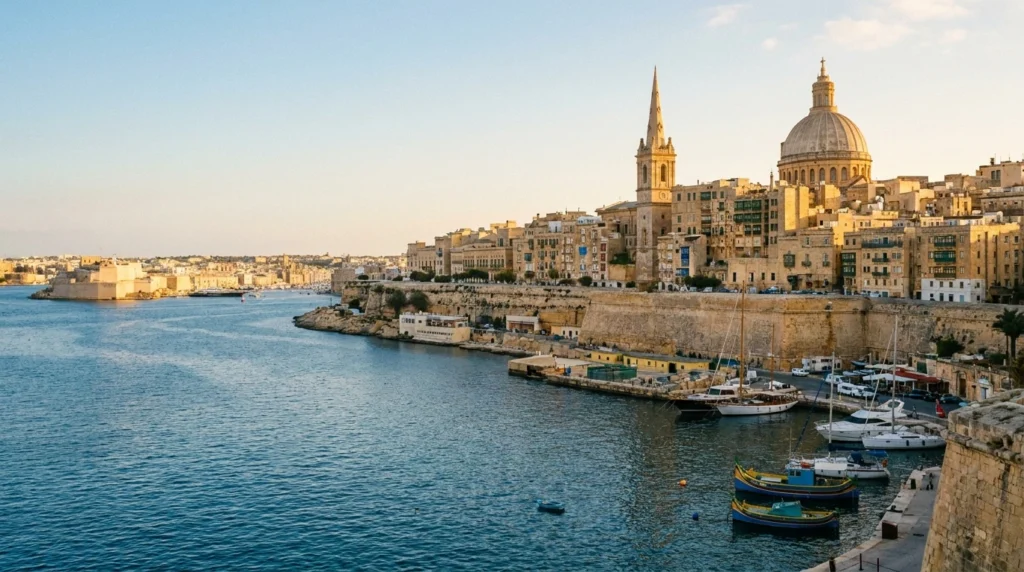
The capital and the EU’s smallest by both area (0.61 km²) and population (about 5,226 residents in 2024). Founded 28 March 1566 by Grand Master Jean Parisot de Valette after the Great Siege, Valletta is a 16th-century planned city — the first in Europe built to a Renaissance grid plan — and was added to the UNESCO list in 1980 with 320 monuments inside its bastions. It served as European Capital of Culture in 2018.
- St John’s Co-Cathedral — Built 1573–78 by Maltese architect Girolamo Cassar; houses Caravaggio’s only signed painting, the 1608 Beheading of St John, and a marble floor of about 400 inlaid Knights’ tomb-stones. The St John’s Co-Cathedral Foundation manages tickets and the Caravaggio gallery.
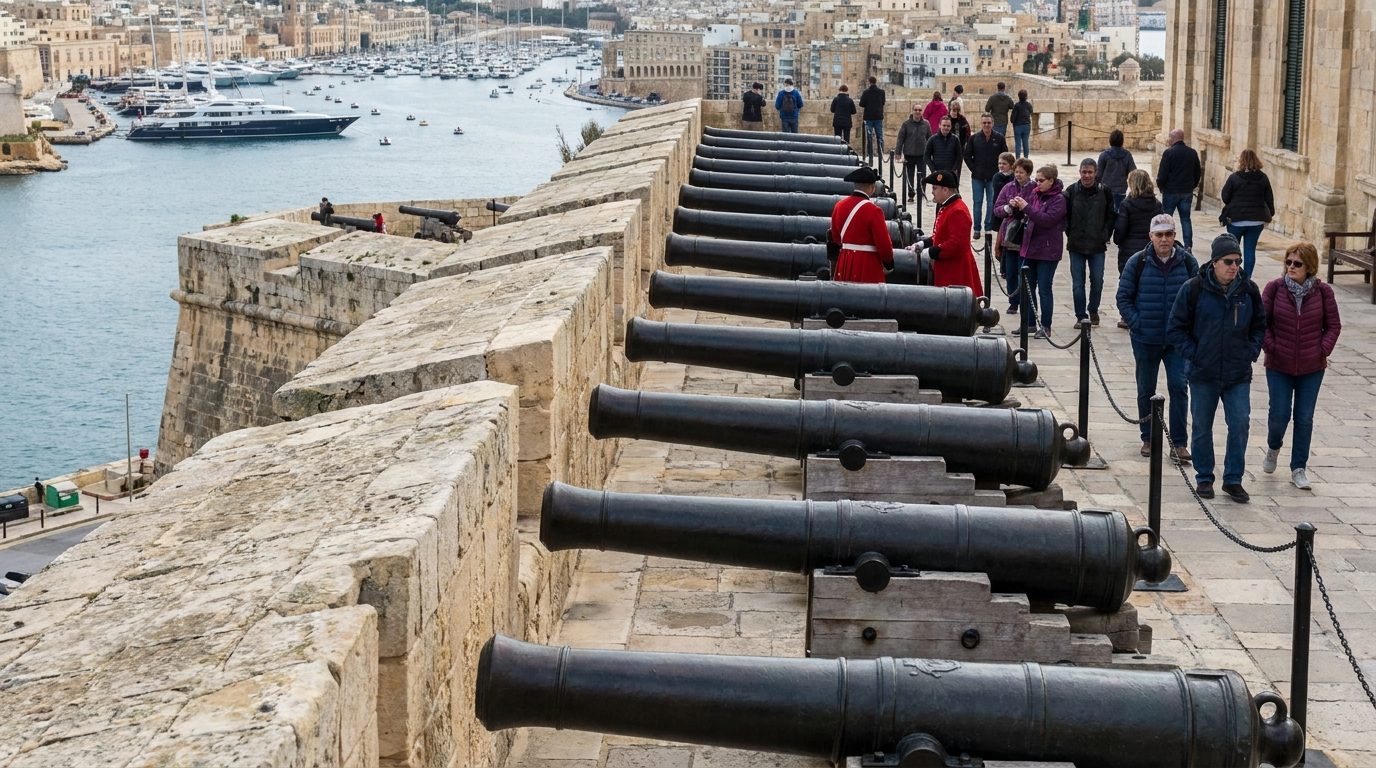
- Upper Barrakka Gardens & Saluting Battery — The best free view in Malta: panoramic across Grand Harbour to the Three Cities. The Saluting Battery still fires its noon and 4 p.m. cannon every day, a tradition with 500-year roots.
- Grandmaster’s Palace — Built 1571–74; now houses the President of Malta’s offices and a public Armoury museum. First-timers with only a single day to spend in the capital should follow our hour-by-hour Valletta in one day itinerary.
Mdina & Rabat
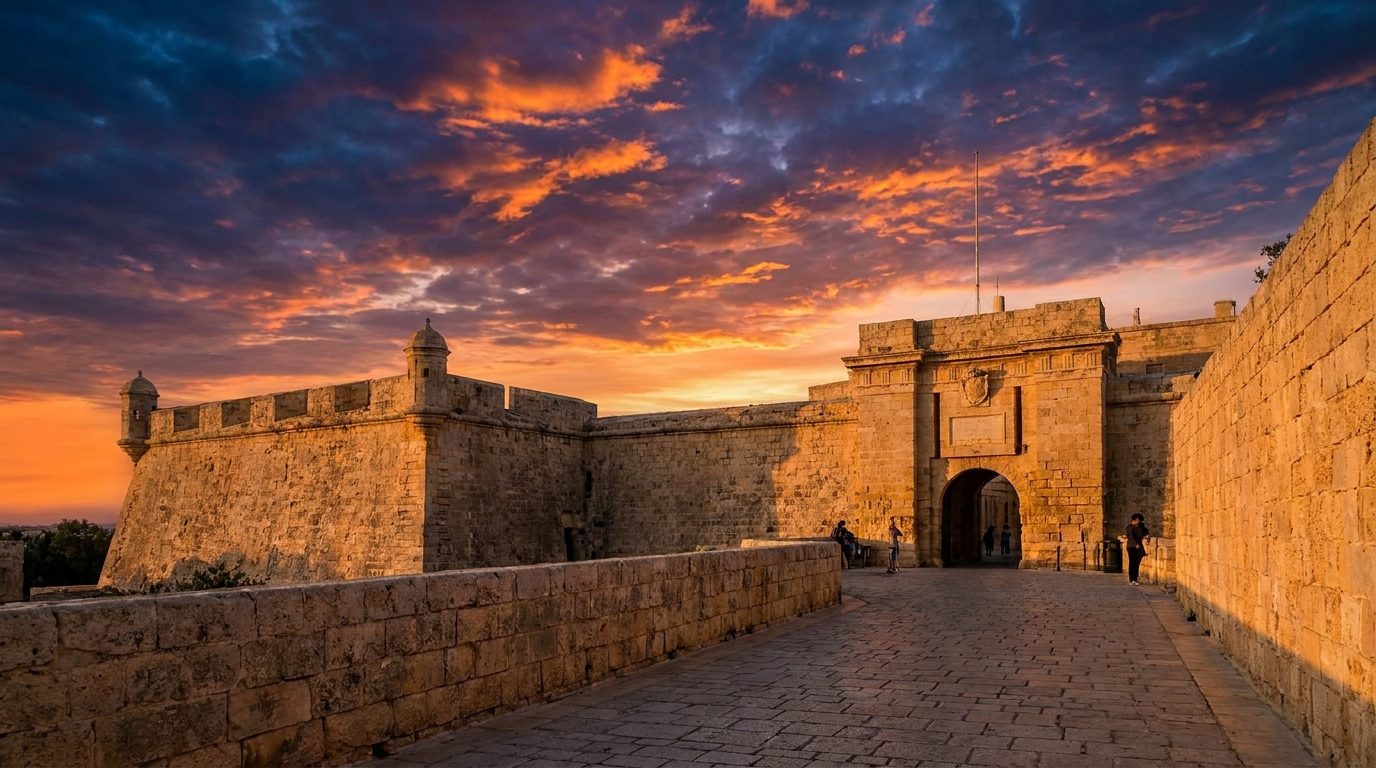
The “Silent City” — Malta’s medieval capital, home today to roughly 250 residents inside walls older than the Knights themselves. Originally a Phoenician colony called Maleth, then the Roman Melita, and refounded after a devastating ninth-century siege as Mdina (from the Arabic word for “town”). Cars are banned except for residents, emergency vehicles, wedding cars and horse-drawn carriages. The walls were restored at length 2008–16. Mdina was the King’s Landing of Game of Thrones Season 1 — Mesquita Square stood in for Littlefinger’s brothel.
- St Paul’s Cathedral & Cathedral Museum — Rebuilt 1697–1703 in Baroque style by Lorenzo Gafà after the 1693 Sicily earthquake destroyed the medieval structure. Houses Mattia Preti’s apse fresco and a Dürer prints collection.
- Bastion Square — Sunset balcony over the entire Maltese plain to the sea.
- St Paul’s Catacombs (Rabat) — A 4th-century AD complex of Punic, Roman and early Christian rock-cut tombs spread across roughly 2,000 m².
Sliema & St Julian’s
The northern resort strip — Malta’s most densely populated town and the centre of modern hospitality. Sliema’s seafront promenade is a 4 km walking and jogging strip from Tigné Point round to St Julian’s; the regular Valletta ferry departs from Sliema’s Strand jetty. St Julian’s, immediately north, is centred on Spinola Bay and the high-rise hotel cluster around Portomaso, including Malta’s tallest building, the Mercury Tower. The hospitality strip is also home to most of the islands’ Michelin-listed restaurants, of which there were five with stars in the 2025 guide.
- Tigné Point — Restored 18th-century Knights’ fort, now a residential and shopping development with a Tigné Mall and seafront cafés.
- Sliema–Valletta Ferry — 7-minute hop with the best harbour views you’ll get for €2.80.
- Paceville — St Julian’s nightclub strip, the loudest district in the country between Friday and Sunday.
Three Cities (Cottonera): Birgu, Senglea, Cospicua
Across Grand Harbour from Valletta, the three fortified peninsulas — Birgu (Vittoriosa), Senglea (L-Isla) and Cospicua (Bormla) — are where the Knights first lived and where the Great Siege was largely won. Birgu earned the title Città Vittoriosa after the 1565 victory; Senglea was named Civitas Invicta for its resistance. Far quieter than Valletta and far closer to how the harbour looked in 1700.
- Fort St Angelo (Birgu) — 16th-century Knights’ headquarters; now under a 99-year lease to the Sovereign Military Order of Malta.
- Malta Maritime Museum (Birgu) — Re-opened 2025 after major restoration; the islands’ main collection of naval and Knights’ Order artefacts.
- Senglea (Isla) Gardjola Garden — The carved sentry-tower with eyes-and-ears reliefs, an Insta-famous viewpoint over Vittoriosa marina.
Marsaxlokk
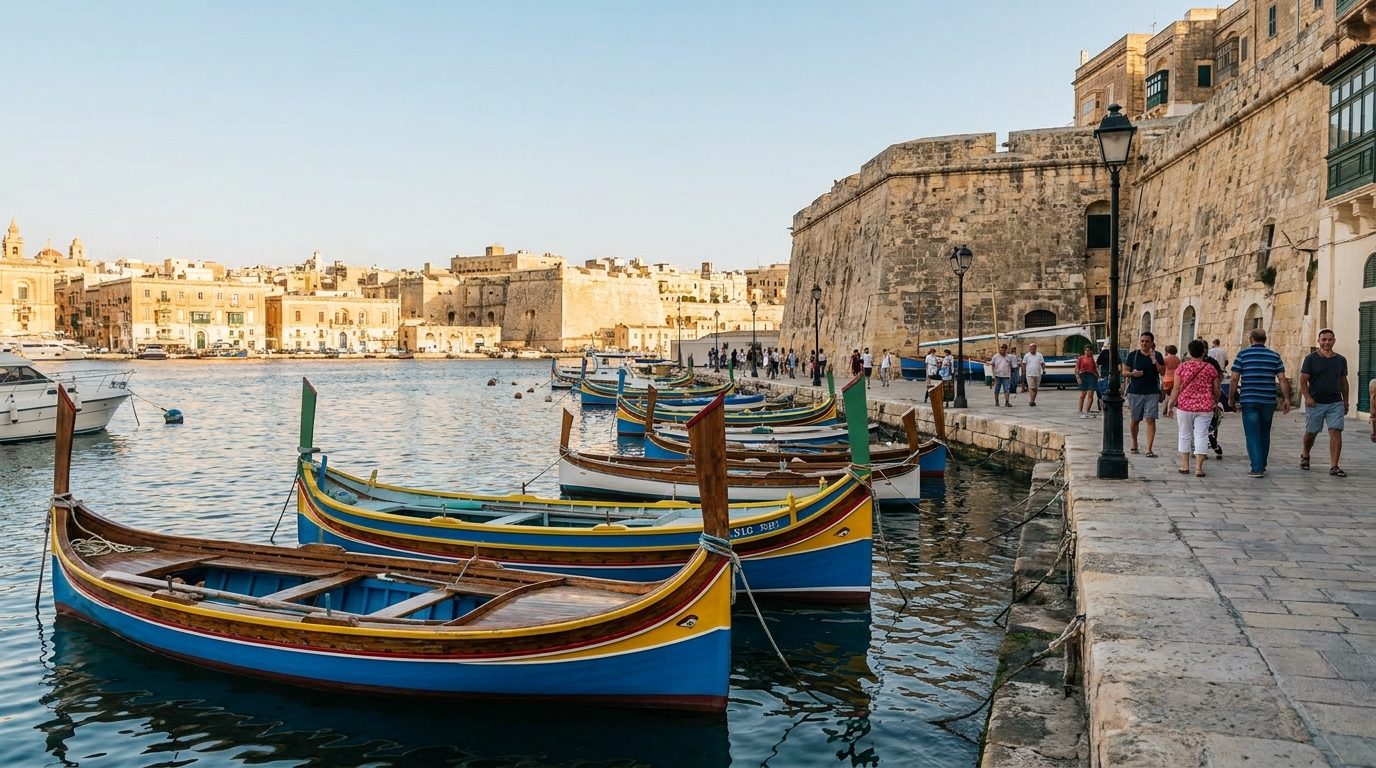
The largest fishing village on the islands and the picture-postcard home of the luzzu — the brightly-painted Maltese fishing boat with the painted protective eye on each side of the prow, a symbol that traces back to Phoenician times. Roughly 70% of the country’s fishing fleet works from this single south-eastern harbour. The Sunday morning fish market is the biggest event of the village week — line-caught swordfish, tuna, and (in season) lampuki dorado. Marsaxlokk also sits next to the prehistoric site of Borġ in-Nadur, a Bronze-Age fortified settlement excavated by Margaret Murray in 1922.
- Sunday fish market — 7 a.m. to 1 p.m., along the entire seafront promenade.
- St Peter’s Pool — A natural rock-cut swimming pool on Delimara peninsula, 25 minutes’ walk from the village.
- Tarxien Temples — A 5–10 min drive away; the most decorated Megalithic Temples site, in continuous excavation since 1915.
Gozo & Comino
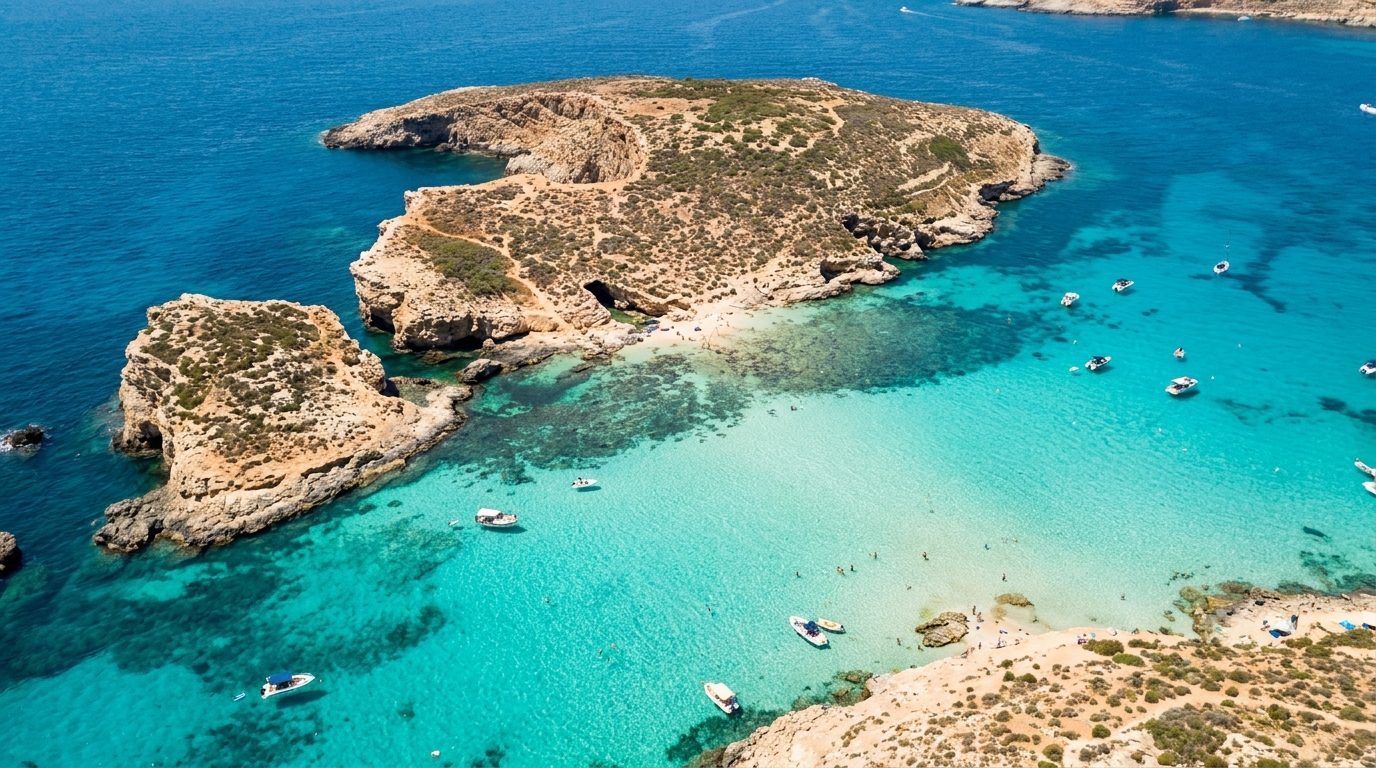
Gozo, the country’s second island, covers 67 km² and houses about 39,287 people, almost a tenth of the national population, plus a separate parish of identity that locals defend fiercely against the main island. The capital, Victoria (Maltese: Rabat), is dominated by the Cittadella, a 17th-century Hospitaller fortress restored 2008–16 at a cost of around €21 million. Comino, the third inhabited island, has a permanent population of 2 (yes, two) and is best known for the Blue Lagoon between Comino and Cominotto islets.
- Ġgantija Temples (Xagħra, Gozo) — Older than the pyramids; UNESCO 1980.
- Dwejra Bay (San Lawrenz) — Site of the collapsed Azure Window (March 2017) and the Inland Sea diving tunnel.
- Ramla Bay — The country’s largest sandy beach, on Gozo’s north coast — Calypso’s mythical cave from the Odyssey is in the cliffs above.
Maltese Culture & Etiquette — What to Know Before You Go

The Essentials
- Greet, then negotiate. Maltese social code is Mediterranean: a “bonġu” (good morning, until noon) or “bonswa” (good evening, after) before you start asking for the bill or the bus information. English in tourist areas is universal; Maltese is appreciated for greetings.
- Dress for churches. Knees and shoulders covered for both men and women in St John’s Co-Cathedral, Mdina Cathedral, the Mosta Rotunda and most parish churches. The Co-Cathedral provides shawls if you turn up under-dressed.
- Tipping is European-light. Round up the bill; an extra 5–10% is appreciated for table service but never expected. Hotel porters: €1–2 per bag.
- Sundays and feast days are family time. Valletta’s main shopping streets close on Sundays, restaurants in villages serve only one mid-day sitting, and the family-meal tradition is taken seriously. The Mediterranean week genuinely starts on Tuesday in summer.
- Smoking is allowed on outdoor terraces. The 2004 EU ban applies indoors only. Maltese smoking rates have fallen sharply but visible smoking outdoors is still common.
Language & Code-Switching
- Maltese (Malti) and English are both official. Most Maltese speakers under 60 will switch to clear English on hearing yours; the code-switch back and forth — sometimes inside a single sentence — is locally called “Maltenglish”.
- Italian is widely understood, particularly among older generations who grew up watching Sicilian RAI television; about a third of vocabulary is Italian-derived.
- Maltese is the only Semitic language in the EU. It became an official EU language on Malta’s 2004 accession; the European Commission interprets all 24 EU official languages, Maltese included.
- The Ġ (with a dot) and Ħ (crossed H) letters — the two distinguishing diacritics of Maltese — are pronounced “j” and a soft “h” respectively. Ġgantija = “Jgantia”. Don’t be afraid to ask.
National Identity, Symbols & Civic Days
Malta has five National Days — more than any other EU country — each marking a different moment in the country’s path to independence. Sette Giugno (7 June) commemorates the 1919 anti-colonial protests; Independence Day (21 September) marks 1964 freedom from Britain; Republic Day (13 December) celebrates the 1974 republic; Freedom Day (31 March) marks the 1979 closure of the British naval base; and Victory Day (8 September) celebrates both the end of the 1565 Ottoman siege and the Italian armistice of 1943. The National Anthem, L-Innu Malti, was composed by Robert Samut to lyrics by Dun Karm Psaila in 1922; first performed at the Manoel Theatre in December that year, officially adopted in 1941, and constitutionally enshrined in 1964.
The eight-pointed Maltese Cross — adopted from the Knights of St John, who took it from the Republic of Amalfi — is everywhere from the country’s two-euro coin to government letterheads. The two largest coins (€1 and €2) carry the cross on the national side; the cents carry the country’s emblem and the smallest the temple altar at Mnajdra. The country’s flag is white and red with a representation of the George Cross — uniquely commemorating the 1942 collective gallantry award.

A Food Lover’s Guide to Malta

Maltese cuisine is the small-print of Mediterranean cooking: Sicilian and southern-Italian foundations, threads of Arabic spice, a layer of British colonial habits, and a stubborn local tradition of slow-cooked stews and oven-baked savoury pastries. The country’s traditional national dish is stuffat tal-fenek — slow-stewed rabbit, often cited as a 19th-century symbolic dish that emerged after the Knights’ restrictions on hunting were lifted in the late 1700s. A full fenkata meal — typically Friday night with friends — opens with a rabbit-broth spaghetti, then the stew itself with potatoes, peas and red wine.
Must-Try Dishes
| Dish | Description |
|---|---|
| Pastizzi | Diamond-shaped flaky savoury pastry, ricotta or curried mushy-pea filling. Sold from a pastizzeria for €0.50–€0.80; eaten standing up. |
| Stuffat tal-fenek | The traditional national dish — rabbit stewed in red wine, garlic, bay and tomato. Best at family-run village restaurants in Mġarr (Malta) or Xagħra (Gozo). |
| Ftira | Ring-shaped Maltese sourdough flatbread, served either as a stuffed sandwich (tuna, capers, olives, tomato, beans) or, on Gozo, open-faced and pizza-like. UNESCO Intangible Cultural Heritage 2020. |
| Lampuki Pie | Seasonal August–December pie of dorado fish (lampuki), cauliflower, spinach and sultanas. Lampuki season formally opens on 15 August. |
| Bragioli | “Beef olives” — thin slices of beef wrapped around a stuffing of breadcrumbs, bacon, hard-boiled egg and parsley, slow-cooked in red wine and tomato. The Sunday-lunch staple of older Maltese households. |
| Aljotta | Garlic-and-tomato fish broth, the Maltese answer to bouillabaisse, often made with rascasse. Best in winter at family-run kenuriji. |
| Ġbejna | Small Gozitan sheep’s-milk cheeselets, sold fresh, peppered or sun-dried. The fresh version on a slice of ħobż biż-żejt bread with tomato pulp is the islands’ great breakfast. |
| Imqaret | Diamond-shaped deep-fried date pastries, sold hot from kiosks during festa season for €1; the unofficial national street food. |
Drinks & Sweet Things
The two flagship Maltese drinks are Kinnie and Cisk, both produced by Simonds Farsons Cisk, a 1928-founded brewery and beverage conglomerate based in Mrieħel. Kinnie launched in 1952 as Malta’s local cola alternative — bitter-orange, wormwood and (so the company hints) a touch of ginseng and rhubarb; it won the French gastronomic-press soft-drink of the year award in 1975 and is genuinely good cold over ice with a slice of lemon. Cisk Lager is the best-known Maltese beer, a clean pale lager that pairs well with pastizzi and ftira; the full Cisk family also includes the heavier Cisk Export and a German-style Cisk Pilsner.
For sweets: kannoli (Sicilian-style ricotta tubes), figolla (Easter almond cakes shaped as fish, lambs and hearts), and qagħaq tal-għasel (treacle-and-pastry rings, traditionally Christmas). The famous chocolate cake at Fontanella Tea Garden on Mdina’s bastion wall is, despite the tourist queues, genuinely worth the slice.
Where to Eat
- Pastizzeriji — for €0.50–€0.80 pastizzi anywhere on the islands; the most-recommended is Crystal Palace in Rabat (open 24 hours). The Maltese tradition of standing-room pastizzi is the country’s everyday answer to a French boulangerie.
- Marsaxlokk waterfront — fresh-fish trattorias along the harbour; book Sunday lunch ahead.
- Ta’ Ċenċ & Xlendi (Gozo) — fenkata dinners at family restaurants like Ta’ Frenċ and Tmun Mġarr.
- Valletta — Strait Street’s revival: chef-driven small-plate restaurants in former 1950s-cabaret-strip premises.
- Mdina — historical fine dining at De Mondion (Michelin-starred) inside the Xara Palace.
Wine, Coffee & Other Liquid Pleasures
Maltese winemaking is small but serious. The two largest producers — Marsovin and Delicata — both bottle indigenous varieties Ġellewża (red) and Girgentina (white) alongside more familiar international cultivars; Maltese wine production runs to roughly 1.7 million litres annually across about 30 commercial labels. Look for the protected DOK Malta designation on the label. Coffee culture is Italian-leaning: every village has at least one bar that serves a stand-up €1 espresso and an emergency pastizz. Tea culture is unexpectedly British — the Mdina Glass Tea Garden at Bastion Square and the Phoenicia Hotel’s afternoon-tea service are both worth the slight detour.
The country’s traditional liqueur is Bajtra, made from the prickly pear cactus that grows along almost every Maltese rural road; sweet, ruby-coloured, served chilled as a digestif. The English-style ales of the Lord Chambray microbrewery on Gozo and the small Mahar Brewing in Mosta are now local fixtures alongside Cisk.
Off the Beaten Path — Malta Beyond the Guidebook

Ħaġar Qim & Mnajdra (Qrendi)
The two southern megalithic temples sit on a clifftop above the Mediterranean, a 15-minute walk apart. Ħaġar Qim was built around 3600–2500 BC; Mnajdra a few centuries later. The lower temple at Mnajdra is precisely solar-aligned: at the spring and autumn equinoxes the rising sun shines straight through the main doorway down the major axis, and at the solstices it lights the edges of two side megaliths. The site is roofed by a fabric tensile shelter installed in 2009 to slow weathering. UNESCO 1992 (extension to the 1980 Megalithic Temples inscription).
The Ħal Saflieni Hypogeum (Paola)
The single most extraordinary thing in the country. Three subterranean levels of rock-cut chambers carved out of solid limestone between roughly 4000 and 2500 BC, used as both a temple and a necropolis. Heritage Malta caps daily visitors at exactly 80, in groups of ten per hour, with humidity-controlled air. Pre-book at least 2–3 months ahead — same-day tickets are almost never available. The painted spiral ochre ceiling of the Oracle Chamber, intact after 5,000 years, is the closest thing to time travel the Mediterranean offers.
Dingli Cliffs & Buskett Gardens
The southern edge of the main island. Dingli village sits on a plateau roughly 230 m above sea level; the Dingli Cliffs themselves drop into the sea from approximately 253 m at Ta’ Dmejrek, the highest point in Malta. On a clear day you see the tiny uninhabited islet of Filfla, 4.5 km offshore — used by the Royal Navy and RAF as a target range until 1971 and a protected bird sanctuary since 1980, with 5,000–8,000 pairs of European storm petrels. Buskett Gardens, the only proper woodland on the islands, was the Knights’ hunting estate; the August Mnarja festa is staged in the meadow.
Ġgantija, Xagħra Stone Circle & Ta’ Kola Windmill (Gozo)
The Ġgantija temples (3600–3200 BC) are the better-known monument, but the trail loops through three contiguous Heritage Malta sites: the Ġgantija temple complex itself, the partly-excavated Xagħra Stone Circle (a hypogeum-style burial site directly linked to Ġgantija) and the working 18th-century Ta’ Kola windmill, restored as a folk museum. A combined ticket covers all three; budget two hours.
The Inland Sea & Blue Hole (Dwejra, San Lawrenz, Gozo)
Until March 2017 this stretch of Gozo’s western coast was best known for the Azure Window, a 28-metre limestone arch that featured in Game of Thrones‘s Dothraki wedding scene. The arch collapsed entirely on 8 March 2017 during a storm. The neighbouring Inland Sea — a small landlocked saltwater lagoon connected to the open Mediterranean by a 60-metre natural tunnel — remains intact, and traditional fishermen run small boats through the tunnel for a small fee. The Blue Hole, immediately adjacent, is one of the country’s premier dive sites.
The Cart Ruts (Misraħ Għar il-Kbir / “Clapham Junction”)
One of Malta’s most enduring archaeological mysteries. A network of parallel grooves cut into the limestone bedrock above Dingli, of unknown date and purpose, sometimes called Clapham Junction for the density of intersecting tracks. They may date to the Bronze Age, may have been wheel-and-runner cart paths, or may have been worn by repeated sledge-traffic; archaeologists do not agree. The site is freely accessible; bring sturdy shoes.
The Manoel Theatre (Valletta)
One of Europe’s three oldest still-working theatres, commissioned in 1731 by Grand Master António Manoel de Vilhena, opened on 9 January 1732 with a production of Maffei’s Merope, and still stages a full programme of opera, ballet and Maltese-language drama in its 623-seat oval auditorium. Daytime backstage tours run on the half-hour for €5; the gold-leaf wooden boxes are some of the most photogenic interiors in the country.
Popeye Village (Mellieħa)
The 1980 Robert Altman musical Popeye starring Robin Williams left behind an entire wooden filmset on Anchor Bay’s clifftop, north of Mellieħa. The set was rebuilt in 1979 from 8 truckloads of timber and 2,000 gallons of paint, and now operates as a small theme park with film exhibits, swimming bays and seasonal animation. The film itself was, famously, a critical disaster but the village survives.
Salt Pans of Marsalforn (Gozo)
The two-kilometre stretch of hand-cut limestone salt-pans along Gozo’s north coast at Xwejni Bay has been worked by the same family — the Cini family — for nine generations. Production peaks each August, when the rectangular pools are scraped of their sun-evaporated sea salt by hand. Drop in at Leli Tal-Melh’s stall, on the coast road, for a kilo bag of unrefined sea salt for €5.


Practical Information
| Currency | Euro (€); Malta adopted the euro on 1 January 2008. 1 USD ≈ €0.93 (May 2026). |
| Cash needs | Cards almost universal in cities; small village cafes and pastizzeriji are still cash-only. Carry €30–50 in coins/€5s for buses, kiosk pastizzi and small entrance fees. |
| ATMs | Plentiful at HSBC, Bank of Valletta and BNF branches; foreign-card fees are typically €2.50–€5. |
| Tipping | Round up; 5–10% appreciated for table service; never expected. Hotel porters: €1–2/bag. |
| Language | Maltese and English are both official; English universal in tourist areas. |
| Safety | Very safe — Malta ranks in the top quartile of the Global Peace Index every year. Petty theft on Sliema seafront and in Paceville nightclubs only. |
| Connectivity | 4G LTE coverage island-wide; 5G in Valletta, Sliema and Mdina. EU roaming applies for European travellers; non-EU should pre-buy a GO or Epic eSIM (€10–15 for 7 days, 20 GB). |
| Power | Type G (UK-style 3-pin) plugs, 230 V / 50 Hz — same as the British Isles. |
| Tap water | Safe to drink everywhere on the islands but heavily mineralised — most locals use a Brita filter or bottled water at home. Restaurants serve filtered water without question. |
| Healthcare | Mater Dei (Msida) is the country’s main public hospital; the EU EHIC card and the UK GHIC are both accepted. Travel insurance recommended for non-EU travellers; ambulance number 112. |
Sustainability & Responsible Travel
Malta in 2026 is grappling, openly, with the costs of its tourism boom. The 2024 Tourism Intensity report from the National Statistics Office put visitor density at roughly 28 tourists per resident over the year — among the highest ratios in Europe. The Blue Lagoon’s daily booking system (May 2025), the deposit-return scheme on plastic bottles (2022), and the seasonal cap on rented Jeeps within the Cittadella walls are concrete responses; recycle wherever the bins are present, refill from the tap rather than buy bottled water, and consider a Gozo-only itinerary in late autumn or early spring to spread your spending into the off-peak. The Malta Tourism Authority’s GreenIQ certification scheme labels hotels and tour operators that meet third-party sustainability criteria. Diving operators on Gozo have, for the past decade, been removing roughly two tonnes of marine plastic a year via volunteer reef-clean dives.
Budget Breakdown — What Malta Actually Costs
💚 Budget Traveller
Malta is the most affordable Western-European island destination at the budget level. A bed in a Valletta or Sliema hostel runs €25–35; a pastizzi-and-coffee breakfast €2.50; a hearty ftira lunch €8–10; an evening Cisk and ftira dinner at a local kenura €20–25. The bus network’s all-day capped tap-card fare is €2 in summer and €1.50 in winter. Major sights: St John’s Co-Cathedral €15, Hypogeum €40 (advance booking essential). USD $75–110 a day comfortably covers everything. Off-season (Nov–Feb) drops the bottom end to USD $60. Stay in Sliema or St Julian’s for cheaper rooms with seafront access.
💙 Mid-Range
A boutique B&B inside the Valletta bastions or in Mdina sits at €150–220 a night, breakfast included. Lunch at the harbour-front restaurants in Marsaxlokk or Mġarr (Gozo) runs €25–35 for a fish-of-the-day plate; dinner at Strait Street’s chef-driven small-plate places in Valletta runs €40–55 with wine. A full-day private guide: €180–250. A Gozo day trip with rented Jeep: €60. USD $160–250 a day delivers the country comfortably with car-hire and chef-driven meals once a day. Book Hypogeum, St John’s Co-Cathedral and the Sunday lunch at Marsaxlokk in advance for July–September.
💜 Luxury
The luxury end is Phoenicia Malta (a 1930s grand hotel directly outside Valletta’s gate, doubles from €450), the Iniala Harbour House (a five-bedroom Valletta heritage hotel from €700), and the Cugó Gran Macina (a converted Knights’ powder magazine on Senglea waterfront from €600). On Gozo, the Kempinski San Lawrenz and Hotel Ta’ Ċenċ are the two luxury anchors. Add a Michelin-starred dinner at Mdina’s De Mondion (€180/head with paired wines), a private skipper for a full day around the Comino archipelago (€800), and chauffeured airport transfers (€80 each way). USD $500+ a day is sustainable; USD $1,000+ unlocks every door on the islands.
Malta’s pricing is meaningfully cheaper than Italy or France for equivalent quality. A 2024 Numbeo cost-of-living comparison places Malta about 12% below Rome and 25% below Paris on consumer prices excluding rent. The euro adoption, the small island scale, and the high tourist throughput keep the mid-range market unusually competitive: a 4★ Sliema seafront hotel sells from about €130 a night out of season.
| Tier | Daily (USD) | Accommodation | Food | Transport |
|---|---|---|---|---|
| Budget | $75–110 | Hostel dorm or budget B&B €30–60 | €20–30 (street food + 1 sit-down) | €2/day bus + ferry |
| Mid-Range | $160–250 | 3★ hotel or boutique B&B €120–220 | €40–80 (3 cafe/trattoria meals) | €35/day rental car or guided |
| Luxury | $500+ | 5★ hotel or heritage suite €450–900 | €120–250 (Michelin or private chef) | €150/day private driver |
Planning Your First Trip to Malta
- Pick the season for your trip type. History-and-walking traveller: late April to mid-June or October. Beach traveller: late June to early September. Festa traveller: any weekend mid-June to early September; Nadur Carnival: mid-February. Avoid mid-August unless you’ve pre-booked: the country fills up over Santa Marija weekend.
- Book the Hypogeum first, everything else second. Tickets release approximately 2–3 months in advance; daily cap is exactly 80. If the Hypogeum is sold out, the (less spectacular but still excellent) overflow option is the Tarxien Temples; same combined-ticket family.
- Allow at least one full day for Gozo. The 25-minute Ċirkewwa–Mġarr ferry runs every 45 minutes in summer; rent a Jeep at Mġarr port (€45–60/day) and circle the island clockwise. Comino’s Blue Lagoon is best done on a half-day separate excursion from Sliema or Buġibba, not bolted onto a Gozo trip.
- Sleep in two locations, not one. Three nights in Valletta or Sliema for the main island, two nights in Xagħra or Marsalforn for Gozo, ideally with the Gozo segment second. Driving distances on Gozo are tiny but parking inside the Cittadella is awkward.
- Pre-book tickets for everything indoor. St John’s Co-Cathedral, the Grandmaster’s Palace State Rooms, and Manoel Theatre tours all run online-only ticketing and the queues at the door in summer can be 90+ minutes. The free Saluting Battery firings (noon and 4 p.m.) need no booking; arrive 20 minutes early for a wall-edge spot.
- Deciding how much time Valletta itself deserves, and whether to add Sicily. See our Valletta in one day itinerary if the capital is a short stop, and Malta vs Sicily if you’re weighing up adding the ferry crossing.
Classic 7-day itinerary: Day 1 — Valletta arrival, Upper Barrakka sunset, Strait Street dinner. Day 2 — St John’s Co-Cathedral, Grandmaster’s Palace, Three Cities ferry & Birgu evening. Day 3 — Mdina & Rabat (catacombs, cathedral, Fontanella tea-garden). Day 4 — Hypogeum (booked), Tarxien Temples, Marsaxlokk Sunday market. Day 5 — Ċirkewwa ferry to Gozo; Cittadella, Ġgantija, Ramla Bay swim. Day 6 — Dwejra Inland Sea & Blue Hole, Ta’ Pinu, Xlendi sunset. Day 7 — Comino Blue Lagoon by boat; return to Malta for departure.
If you only have 3 days: Stay central in Valletta or Sliema. Day 1 — Valletta walking tour with a stop at St John’s Co-Cathedral and the noon Saluting Battery firing. Day 2 — Mdina at sunrise (before tourist coaches arrive at 10 a.m.), Rabat catacombs and Fontanella’s chocolate cake at lunch, then Marsaxlokk for an evening fish dinner. Day 3 — fast Gozo loop: 8 a.m. Ċirkewwa ferry, taxi tour around Ġgantija, the Cittadella, Dwejra and Ramla Bay, return on the 6 p.m. ferry. Skip Comino if you only have three days; the queue at Ċirkewwa eats half a day.
Frequently Asked Questions
Is Malta expensive to visit?
No — by Western European standards, Malta sits in the comfortable middle. A bowl of pastizzi-and-coffee breakfast is €2.50, a bus ride €1.50–€2, a Cisk lager €3, a sit-down ftira lunch €8–12, and a 3★ central hotel €110–160 most of the year. USD $75–110 a day is genuinely workable on the budget tier; USD $160–250 covers everything mid-range. Where Malta gets expensive is mid-August (Santa Marija peak) and the high-end heritage hotels in Valletta — both predictable, both avoidable.
Do I need to speak Maltese?
No. Maltese and English are both official languages and English is universally spoken in tourist areas, restaurants, hotels, museums and on public transport. A handful of greetings — bonġu (good morning), bonswa (good evening), grazzi (thank you), jekk jogħġbok (please) — go a long way. Italian is widely understood among older generations; French and German much less so.
Is the Tallinja Card worth it?
For most short-stay visitors, no. The single-trip fare on Malta Public Transport is €1.50 (winter) or €2.00 (summer), valid for 2 hours of unlimited transfers. You’ll typically take 2–3 bus rides per day, so €4–6 daily on cash fares. The Tallinja Card breaks even after about 12 trips, useful only for stays of a week or more or for daily commutes between, say, Sliema and Valletta. Buy at the airport on arrival if you’re staying 7+ nights.
Is Malta safe for solo travellers?
Yes, very. Malta is among the safest countries in the Mediterranean — the country ranks in the top quartile of the Global Peace Index almost every year, violent crime against tourists is rare, and walking through Valletta or Sliema after midnight is generally fine. Real risks are: heat (June–August midday, drink water and pace sightseeing), occasional petty theft in Paceville’s nightclub strip, and the country’s terrible road traffic — pedestrian crossings on the main island are not always respected. Solo female travellers consistently report Malta as one of their easiest Mediterranean destinations.
When is the best time to swim in Malta?
The Mediterranean reaches a swimmable 20 °C around 20 May, peaks at 26 °C in mid-August, and stays above 22 °C through the end of October. The single best week for swimming is the third week of September: water still warm from the August peak, daytime air at 27 °C, the August crowds gone, and rain almost zero. Mellieħa Bay and Għajn Tuffieħa are Malta’s biggest sandy beaches; Ramla Bay on Gozo is the largest and sandiest of all. Hidden coves like St Peter’s Pool (Marsaxlokk) and Wied il-Mielaħ (Gozo) are rocky but spectacular.
Can I get by as a vegetarian or vegan?
Easier in cities than villages. Sliema, St Julian’s and Valletta have a growing list of dedicated vegan and vegetarian-friendly restaurants — Sustenance, Grassy Hopper, Fix Me a Sandwich and Diar il-Bniet (in Dingli) all run plant-forward menus. Pastizzi tal-piżelli (mushy-pea pastizzi) are accidentally vegan, as are most ftiriet variations without the tuna; ġbejna with ħobż biż-żejt is easy lacto-vegetarian. The classic fenkata rabbit feast is, obviously, not for you. In village restaurants, ask explicitly: “no rabbit, no anchovy” goes a long way.
Do I need a car in Malta?
No, not for a first trip. The bus network reaches every notable site on the main island, ferries cover the harbour and Gozo crossing, and Bolt cabs are widely available at €5–10 for most short hops. A rental car becomes useful only for: (a) a Gozo-only segment (rent at Mġarr port for €45/day), (b) reaching Dingli Cliffs and the temples without a slow bus loop, or (c) families with young children. Driving is on the left, parking in central Valletta is paid and frustrating, and Malta has the highest per-capita car ownership in the EU — traffic is genuinely bad at rush hour.
Is the Blue Lagoon worth visiting?
Yes, but with a plan. The Blue Lagoon between Comino and Cominotto is one of the most-photographed swimming spots in the Mediterranean — sand-bottomed turquoise shallows of 1–4 m depth, framed by white limestone cliffs. From May 2025 it operates on an advance daily booking system to manage overcrowding. The smart approach: take the first morning ferry from Ċirkewwa or Mġarr (8 a.m. departures), swim and snorkel before 11 a.m., then return before the day-tour boats from Sliema arrive. Avoid Saturdays and Sundays in July and August. Visiting outside summer? Boat schedules to the lagoon run reduced and weather-dependent in winter — see our Malta in winter guide for the current picture.
What about tattoos, swimwear and dress codes for churches?
Tattoos are entirely fine in public — Malta is a Mediterranean island, you’ll see plenty of inked locals. Swimwear is fine on the beach and within ~50 m of the shoreline; cover up to walk into a village, and definitely cover for any church. Maltese parish churches enforce a strict knees-and-shoulders rule, especially at Mdina Cathedral and the Mosta Rotunda; St John’s Co-Cathedral provides shawls. Sunglasses come off inside any church.
Ready to Explore Malta?
Three UNESCO sites, two languages, three islands, 7,000 years of layered history — and you can drive across the main island in 45 minutes. Book your Hypogeum slot the week your flight is confirmed, time your visit either side of the August festa peak, and let Malta surprise you for the rest of the trip.
Explore More
Mediterranean & European city guides
- Rome City Guide — the obvious Mediterranean pairing with Malta
- 🏰 Valletta City Guide — the full guide to Malta’s own capital
- Istanbul City Guide — the other great fortified harbour city
- Barcelona City Guide — Mediterranean beach-and-architecture energy
- Paris City Guide — a classic add-on for a longer Europe trip
- London City Guide — Malta’s old Commonwealth connection
- Tokyo City Guide — for the long-haul contrast
- Malta Trip Cost Guide
- All Country Guides
More country guides you might like

Plan your trip to Malta
The booking tools we use ourselves. FFU may earn a commission at no extra cost to you.
Plan & book your trip to Malta
Booking through these searches supports our guides at no extra cost to you.