
Languages of Timor-Leste
All languages of Southeast Asia →fluent beta classical · classes by phone with Maya at ranas.ai/maya
Timor-Leste Travel Guide — The World’s Most Biodiverse Reef, One of Asia’s Youngest Nations
I’ll say the quiet part first: almost nobody I know has been to Timor-Leste, and most couldn’t find it on a map. That’s the whole appeal. This is a half-island nation of roughly 1.34 million people that didn’t fully exist as a sovereign country until 20 May 2002 — the first new nation of this century — after a brutal 24-year Indonesian occupation that followed centuries of Portuguese rule. None of that history is hidden from visitors; it’s part of what makes the place feel so alive. Off the north coast, Atauro Island sits in water that a 2016 Conservation International survey found to hold the highest average reef fish diversity ever recorded anywhere on Earth. Up in the mountains, farmers grow some of the world’s few genuinely organic-by-default coffee, more by necessity than marketing. None of this is polished for tourists yet, and I mean that as a compliment — but I’m not going to pretend the roads are smooth, the ATMs are everywhere, or that safety is a non-issue. Come for the right reasons and go in with eyes open, and Timor-Leste delivers something genuinely rare in Southeast Asia: a frontier that hasn’t been discovered twice. For the honest verdict on whether that frontier is worth the flight, see our companion post, Timor-Leste: Is Asia’s Least-Visited Country Worth the Trip?.
In This Guide
- Overview — Asia’s Youngest Country and Its Wildest Reef
- October’s Double Feature — Calm Seas and Migrating Whales
- Best Time to Visit Timor-Leste (Season by Season)
- Getting There — Dili’s One Airport & the Overland Option
- Getting Around — Mikrolets, 4x4s & Boats to the Islands
- Top Regions — Dili, Atauro, the Far East & the Mountains
- Culture & People — Tetum, Tais and a Hard-Won Independence
- A Food Lover’s Guide to Timor-Leste
- Off the Beaten Path
- Practical Information
- Budget Breakdown — What Timor-Leste Actually Costs in 2026
- Frequently Asked Questions
Overview — Asia’s Youngest Country and Its Wildest Reef
Timor-Leste occupies the eastern half of the island of Timor, plus the separate Oecusse exclave inside Indonesian West Timor and the small islands of Atauro and Jaco. It’s a compact country — about 15,000 square kilometres — but almost none of it is flat: the interior rises to Tatamailau (Mount Ramelau) at 2,963 metres, and the terrain is what keeps the wet-season roads a genuine adventure.
The modern country is young twice over. Portugal colonized the eastern half of Timor for over 400 years; Indonesia invaded in December 1975 and occupied it for 24 years, a period locals discuss openly and without much prompting; and full independence was restored on 20 May 2002, making Timor-Leste the first new sovereign state of the 21st century. It joined ASEAN as a full member in October 2025, the bloc’s newest addition.
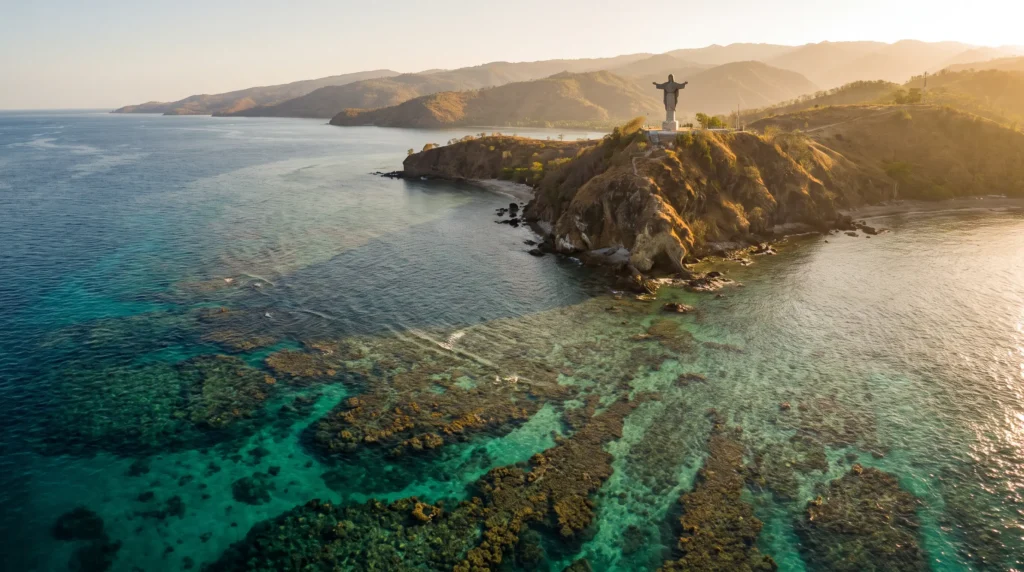
None of that history has diluted the natural side of the ledger. Atauro Island, a 90-minute boat ride from the capital, sits over water that a 2016 Conservation International survey found averaged 253 reef fish species per site — the highest average biodiversity ever recorded on a reef, beating the previous record-holder in West Papua. Out east, Nino Konis Santana National Park protects Jaco Island and a slice of the Coral Triangle that UNESCO designated Timor-Leste’s first Biosphere Reserve in June 2026. Timor-Leste currently has no UNESCO World Heritage Sites inscribed, though its Tais weaving tradition is recognized on UNESCO’s Intangible Cultural Heritage list. Tourism infrastructure is genuinely thin — a handful of dive operators, a slowly growing set of guesthouses, one international airport — which is exactly why the diving, the trekking and the welcome all still feel unclaimed.
October’s Double Feature — Calm Seas and Migrating Whales
If you can only pick one month, make it October. The Ombai Strait, which separates Atauro from the Timor mainland, is one of the world’s great cetacean migration corridors, and pygmy blue whales, sperm whales and other cetaceans pass along Timor-Leste’s north coast twice a year — northbound in June–August through rougher seas, and southbound from mid-October into early December when the water is calmer and boat operators run trips on a regular schedule.
October also sits right at the tail of the dry season, meaning you get the year’s best underwater visibility for diving Atauro’s reefs at the same time whale-watching boats are running their most reliable schedule out of Dili and Atauro. Book dive-boat combo trips ahead — operator capacity is small, and this is the one month locals and dive shops both flag as the one to plan around.
Best Time to Visit Timor-Leste (Season by Season)
May – October · Dry season (recommended)
Warm, sunny and far more predictable for road travel — the driest stretch of the year clusters around July to September on the coast, with daily means around 25–31°C. This is the window for mountain treks (bring a layer for Mount Ramelau’s cold pre-dawn summit), overland trips to the far east, and reliable Atauro dive visibility.
November – April · Wet season
Rain arrives as afternoon storms building to a genuine soaking by December and January, the wettest months on record. Rural roads flood and landslide-block regularly — the FCDO and State Department both flag transport disruption as a real wet-season risk, not a theoretical one. Mornings are often clear and the hills go vivid green, so it’s not a write-off if your dates are fixed — just build slack into any itinerary that leaves Dili.
June–August & mid-October–December · Whale windows
Two separate cetacean migrations bookend the dry season — see the section above. Neither overlaps with peak crowds, because there mostly aren’t any.
Getting There — Dili’s One Airport & the Overland Option
Presidente Nicolau Lobato International Airport (DIL) in Dili is Timor-Leste’s only international gateway, with scheduled flights to a handful of regional hubs — Denpasar/Bali, Kuala Lumpur, Singapore and Darwin among them, operated by a small mix of carriers including Aero Dili, Batik Air and Citilink. There are no direct long-haul flights from Europe or North America — plan on connecting through Bali, Singapore or Darwin. See our companion post for a fuller comparison of the Bali and Darwin routings.
Visa-on-arrival costs US$30 for most nationalities, issued for 30 days, and — as of 2026 — is only available at Dili airport or Dili seaport, not at land borders. EU/Schengen, Indonesian and Cabo Verde passport holders get visa-free entry for up to 90 days. Bring a passport valid six months beyond arrival, a spare blank page, and proof of onward travel — immigration officers do check. Overland crossings from Indonesian West Timor exist (near Batugade/Motaain and into the Oecusse exclave) but are best treated as a route for travelers who already hold a valid visa, not a place to obtain one.
Getting Around — Mikrolets, 4x4s & Boats to the Islands
Dili itself is manageable by taxi or ride-hail. Outside the capital, transport gets rougher fast: mountainous terrain, mostly single-lane roads, and stretches that wash out or land-slide during the wet season. Shared minivans called mikrolets cover Dili’s city routes cheaply; for anywhere else — Baucau, Maubisse, the far-east Lospalos road, Oecusse — most travelers hire a car with driver or a 4×4, since self-driving unfamiliar mountain roads at night is genuinely inadvisable and both the US and UK advisories flag night driving as a specific risk.
Boats are the way to the islands: public ferries and faster chartered boats run from Dili to Atauro (roughly 60–90 minutes depending on the boat), and small fishing boats ferry visitors the short hop out to Jaco Island from Valu Beach near Tutuala. There’s no scheduled domestic air network — this is a country you cross by road and water, slowly, which is part of the point.
Top Regions — Dili, Atauro, the Far East & the Mountains
Dili
The capital and the country’s only real urban hub, home to around 324,000 people. The 27-metre Cristo Rei of Dili statue, unveiled in 1996 atop a globe on Cape Fatucama, is the city’s landmark climb-and-view spot, with a beach on either side of the headland. Add the waterfront Resistance Museum, Timorese coffee shops, and the Tais Market for weaving direct from the districts that make it.
Atauro Island
A 90-minute boat from Dili and the country’s marquee dive-and-snorkel destination — the reef that recorded the highest average fish biodiversity of any site surveyed globally. Wall dives, coral gardens, whale sharks and manta rays on a good day, occasional dugongs, and a handful of small eco-lodges rather than resorts. For the current ferry, speedboat and dive-cost breakdown — including the Sunday transport blackout — see Timor-Leste: Is Asia’s Least-Visited Country Worth the Trip?.
Nino Konis Santana National Park & Jaco Island
Timor-Leste’s first national park, covering 1,236 square kilometres of the far east around Tutuala and Lospalos, and home to Jaco Island — an uninhabited, sacred islet the Fataluku people believe houses ancestral spirits, reachable only by short fishing-boat hop and with no overnight stays permitted. UNESCO recognized the park as Timor-Leste’s first Biosphere Reserve in June 2026.
Baucau & the North Coast
Timor-Leste’s second city, with a faded Portuguese-colonial old town, a market housed in Art Deco arcades, and coastal cliffs and beaches within easy reach along the road east toward Lospalos.
The Central Highlands — Maubisse, Aileu & Mount Ramelau
Cool mountain towns, terraced coffee farms and the trailhead for Tatamailau (Mount Ramelau), the country’s highest point at 2,963 metres, topped by a statue of the Virgin Mary and a genuinely spectacular pre-dawn summit hike.
Oecusse
A separate exclave entirely surrounded by Indonesian West Timor, reachable by boat or a long overland transit — historically the first site of Portuguese settlement on Timor, and now a designated special economic zone with far fewer visitors than the mainland.
Balibo & the West
A small border town carrying heavy modern history: the 400-year-old Balibo fort was the scene of fighting in the run-up to the 1975 invasion, and it’s where five Australia-based journalists — the “Balibo Five” — were killed on 16 October 1975, an event now marked with a memorial and a house-turned-heritage site.
Culture & People — Tetum, Tais and a Hard-Won Independence
Tetum and Portuguese are Timor-Leste’s official languages, Indonesian and English are working languages, and more than 15 national languages are spoken across the districts. The population is overwhelmingly Catholic — around 97.6% — a legacy of Portuguese missionary history that the Indonesian occupation, oddly, only reinforced as a marker of separate identity.
Tais, the country’s traditional handwoven textile, is inscribed on UNESCO’s Intangible Cultural Heritage list; each district weaves its own patterns and colors on backstrap looms using ikat and supplementary-weft techniques, and the cloth marks births, ceremonies and gifts of respect between women. After 1999, tais weaving was actively revived as a symbol of restored identity, and buying direct from district cooperatives puts money straight into rural households. History here is close to the surface — ask before you assume, listen more than you talk about the occupation years, and expect people to bring it up themselves with more openness than you’d guess.
A Food Lover’s Guide to Timor-Leste
Rice and corn are the staples, often served as batar da’an — corn simmered with pumpkin and mung beans — alongside grilled reef fish, chicken cooked in coconut milk, and fiery sambal on the side. Betel nut (bua malus) chewing is a genuine social custom, particularly among older Timorese, and being offered some is a gesture worth accepting even if you only take a token amount.
The real food story, though, is coffee: Portuguese planters introduced Arabica in the 1800s, and today Timor-Leste is regarded as the world’s largest single-source producer of organic coffee — mostly by economic necessity rather than certification marketing, since most farmers simply can’t afford chemical inputs. A natural hybrid discovered here in the 1920s, the Hibrido de Timor, went on to reshape disease-resistant coffee breeding worldwide. Roughly a third of Timorese households grow coffee, and it remains the country’s largest non-oil export. Buy a bag in Dili or straight from a Maubisse cooperative — it travels well and it’s the best souvenir in the country.
Off the Beaten Path
Lene Hara Cave
A limestone cave near Tutuala holding hand-stencil rock art likely dating to the Pleistocene, alongside later painted motifs and engraved faces — evidence of human occupation in Timor-Leste stretching back more than 40,000 years. Visit as part of a Tutuala/Jaco Island trip; there’s no ticket booth, just a local guide and a torch.
Jaco Island at dawn
Camp on Valu Beach the night before (staying on Jaco itself isn’t permitted) and take the first fishing boat across for empty, coral-clear water most divers never hear about.
Oecusse
An exclave with its own slower rhythm, oldest Portuguese roots on the island, and a fraction of the mainland’s already-thin visitor numbers.
Mount Ramelau sunrise summit
A pre-dawn hike up Tatamailau rewards with a sunrise view that, on a clear day, reportedly stretches to both the north and south coasts of the country at once — bring warm layers, the summit is cold well before the sun agrees.
Practical Information
Money. The US dollar is the official currency; small change often comes as Timor-Leste centavo coins pegged 1:1 to US cents. Cards are accepted at a growing number of Dili hotels and restaurants but nowhere else reliably — carry cash, ideally smaller bills, for anywhere outside the capital.
Safety. The US State Department rates Timor-Leste Level 2: Exercise Increased Caution, citing petty crime targeting tourists (pickpocketing, bag snatching, theft from vehicles) in Dili and other urban areas, occasional police use of force against protesters, stone-throwing during gang conflicts, and a documented prevalence of sex-based violence and harassment. Practical takeaways: avoid large gatherings, don’t travel after dark, don’t flash valuables, and check your own government’s current advisory before booking.
Health. No vaccines are required for entry, but hepatitis A and B, typhoid and up-to-date routine immunizations are recommended, with Japanese encephalitis worth considering for longer rural stays; malaria risk exists so discuss antimalarials with a travel clinic before you go, dengue risk runs year-round, and rabies cases have been rising with local vaccine shortages — avoid unfamiliar animals and seek care immediately after any bite or scratch. Stick to bottled or treated water and avoid swimming in untreated freshwater.
Connectivity. Local SIMs (Telkomcel, Telemor) are cheap and cover Dili and main towns reasonably well; mountain and far-east coverage is patchy. Plugs: mostly Type C/E/F (European round-pin), 220V. Time zone: UTC+9, no daylight saving.
Budget Breakdown — What Timor-Leste Actually Costs in 2026
Timor-Leste runs cheaper than most of maritime Southeast Asia away from Dili, but imported goods (and anything in the capital’s nicer hotels) push prices up quickly.
Budget (US$35–60/day): guesthouse rooms outside Dili, local warung-style meals, mikrolets and shared transport, self-arranged Atauro boat and homestay.
Mid-range (US$90–170/day): a decent Dili hotel or Atauro eco-lodge, restaurant meals, a hired car-with-driver day trip, a two-tank Atauro dive (typically US$60–90 with gear).
Luxury/expedition (US$250+/day): multi-day guided trips to Jaco Island and the far east, dedicated whale-watching charters in October, private drivers for the full Dili–Baucau–Lospalos loop.
Fixed costs to plan for: the $30 visa-on-arrival, small marine-park or village entry fees at some sites, and tipping — appreciated but not obligatory, since it isn’t yet deeply embedded in local custom.
Planning Your First Trip to Timor-Leste
A realistic first-timer route: fly into Dili and spend two nights getting oriented (Cristo Rei, the Tais Market, a coffee shop crawl), boat out to Atauro for three or four nights of diving and snorkeling, then — dry season only — a hired-car loop east through Baucau to Tutuala for Jaco Island and Lene Hara Cave, or south into the highlands for Maubisse and a Mount Ramelau sunrise. Seven to ten days covers the basics without rushing the boat schedules. Timor-Leste pairs naturally with a wider Southeast Asia or Indonesia itinerary — many visitors connect through Bali or continue on to Indonesia, and divers chasing the region’s best reefs often also look at our Philippines guide or the atoll-diving scene in our Maldives guide.
Frequently Asked Questions
Is Timor-Leste safe for tourists in 2026?
The US State Department rates it Level 2: Exercise Increased Caution, mainly for petty crime in Dili, occasional unrest, and documented sex-based violence risk — not a warning against travel, but a call for normal urban-travel caution: avoid large gatherings and night travel, don’t display valuables, and check current advisories before you book.
Do I need a visa?
Most nationalities, including the US, UK, Canada and Australia, get a $30 visa-on-arrival for 30 days, issued only at Dili airport or seaport. EU/Schengen, Indonesian and Cabo Verde passport holders enter visa-free for up to 90 days.
Is the diving really the best in the world?
By one specific, well-documented measure — average reef fish species recorded per site — yes: a 2016 Conservation International survey of Atauro’s waters recorded the highest average biodiversity of any reef surveyed globally. It’s not the most developed dive scene — bring your own gear if you’re particular, operator numbers are small.
Timor-Leste or Indonesia’s outer islands?
Choose Timor-Leste for a genuinely under-visited destination, a compact and dramatic history, and Atauro’s biodiversity; choose Indonesia’s outer islands (Alor, Flores, Komodo) for more developed dive infrastructure and easier logistics. The two pair well on one trip via Bali or Kupang.
What’s the easiest first trip to plan?
Dili plus Atauro Island. It needs no rental car, covers the cultural sights and the signature diving, and can be done comfortably in five to six days.
Can I drink the tap water?
No — stick to bottled or treated water throughout the country, including for brushing teeth outside the nicer Dili hotels.
Ready to Explore Timor-Leste?
A reef with more fish species per site than anywhere else surveyed on Earth, a mountaintop sunrise you’ll likely have to yourself, and a nation still telling its own independence story in real time. Timor-Leste isn’t polished, and it isn’t trying to be — go while getting there still feels like an actual journey.
Explore More
- Indonesia Travel Guide — Timor-Leste’s neighbor and easiest connecting hub via Bali
- Philippines Travel Guide — more of the region’s best reef diving
- Maldives Travel Guide — another world-class atoll and reef diving destination
- Vietnam Travel Guide — pair with a wider Southeast Asia itinerary
How this guide was built
Published as part of Facts From Upstairs’ country guide series. Built from authoritative sources — Timor-Leste’s Immigration Service (migracao.gov.tl) for visa rules, UNESCO’s World Heritage state party page and its Intangible Cultural Heritage list for Tais weaving, the US State Department’s travel advisory and country information pages, the UK FCDO’s Timor-Leste travel advice, the US CDC traveler page for East Timor, and Wikipedia entity pages for Timor-Leste’s geography, history, airport, Cristo Rei statue, coffee industry, Jaco Island, Nino Konis Santana National Park and the Balibo Five, plus Ataúro Tourism’s published marine biodiversity survey data. Numeric and checkable claims carry inline citations.
Sources cited on this page
- Wikipedia — Timor-Leste
- UNESCO — Timor-Leste (World Heritage state party page)
- UNESCO ICH — Tais, traditional textile
- Immigration Service of Timor-Leste — Tourist Visa
- US State Department — Timor-Leste Travel Advisory
- US State Department — Timor-Leste Country Information
- UK FCDO — Timor-Leste travel advice
- US CDC — Timor-Leste (East Timor) traveler page
- Wikipedia — Geography of Timor-Leste
- Wikipedia — Presidente Nicolau Lobato International Airport
- Wikipedia — Cristo Rei of Dili
- Wikipedia — Coffee industry of Timor-Leste
- Wikipedia — Jaco Island
- Wikipedia — Nino Konis Santana National Park
- Wikipedia — Balibo Five
- Ataúro Tourism — Diving and Snorkeling Sites
More country guides you might like
Plan your trip to Timor-Leste
The booking tools we use ourselves. FFU may earn a commission at no extra cost to you.
Plan & book your trip to Timor-Leste
Booking through these searches supports our guides at no extra cost to you.