
Dresden Travel Guide — The Baroque City the Bombs Couldn’t Keep Down
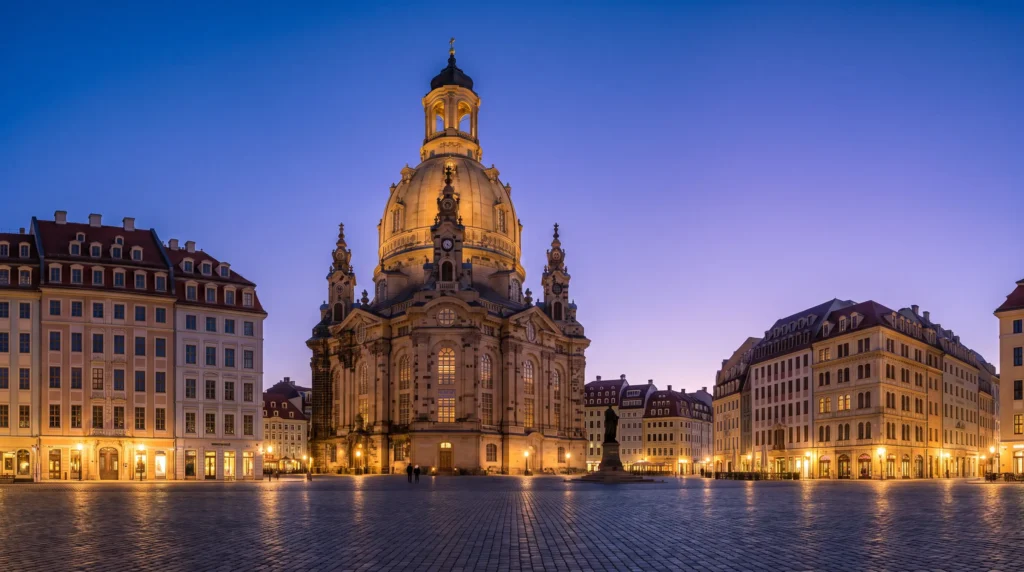
I’ll be honest about why I love Dresden: it shouldn’t look the way it looks. On the night of 13–14 February 1945, Allied bombing raids destroyed almost the entire historic center, and for decades the ruined shell of the Frauenkirche was left standing as a war memorial in what was then East Germany. Then, starting in the 1990s, the city rebuilt its Baroque core stone by numbered stone — the Frauenkirche reopened in 2005 using thousands of the original blackened blocks alongside new sandstone, and you can still see the patchwork on its facade if you look up. Today Dresden is a city of around 565,000 people on the Elbe River in Saxony, close enough to Prague and Berlin to fit into almost any Central Europe itinerary, with a skyline of domes and spires that looks like it belongs in an 18th-century oil painting because most of what you’re seeing was, quite literally, repainted. It’s not a perfect fairytale — I’ll get to the honest catches — but it’s one of the most moving urban rebuilding stories in Europe, and it comes with genuinely great Stollen.
In This Guide
- Overview — Why Dresden Is Germany’s Most Underrated City Break
- The Striezelmarkt — Germany’s Oldest Christmas Market
- Best Time to Visit Dresden (Season by Season)
- Getting There — DRS Airport, Rail & the Autobahn
- Getting Around — Trams, Ferries & Walkable Streets
- Dresden’s Neighborhoods — Altstadt, Neustadt & Beyond
- Culture & People — Saxon Baroque, Sorbian Roots & Rebuilding
- A Food Lover’s Guide to Dresden
- Off the Beaten Path
- Day Trips from Dresden
- Practical Information
- Budget Breakdown — What Dresden Actually Costs in 2026
- Frequently Asked Questions
Overview — Why Dresden Is Germany’s Most Underrated City Break
Dresden sits on the Elbe River in the state of Saxony, in eastern Germany, with a city population of roughly 565,000 and a wider metro area topping 1.3 million. For three centuries it was the seat of the Electors and Kings of Saxony, who poured fortunes into palaces, porcelain and art, earning the city the nickname “Florence on the Elbe” — a reputation the 1945 firebombing very nearly erased for good.
What makes Dresden worth your time now is the reconstruction itself. The Zwinger palace complex, the Semperoper opera house (reopened 1985), the Residenzschloss and the Frauenkirche (reopened 2005, rebuilt from 1994) were all painstakingly restored using historical plans, salvaged stone and, in the Frauenkirche’s case, computer-matched fragments of the original rubble. Walk the Neumarkt today and you’re standing in one of Europe’s most complete post-war reconstructions of a historic center — genuinely rare, and genuinely moving once you know the backstory.
Here’s the honest catch: Dresden also lost a UNESCO World Heritage designation. The Dresden Elbe Valley was inscribed in 2004, then stripped of the title in 2009 — the first delisting of a European World Heritage Site ever — after the city built the Waldschlösschen Bridge across the river despite UNESCO’s objections. Locals mostly shrug about it; the bridge eased traffic and the valley still looks stunning from a riverboat. But it’s a good reminder that “beautifully preserved” and “living, functioning city” don’t always pull in the same direction — and Dresden chose the second one.
The Striezelmarkt — Germany’s Oldest Christmas Market
If you can time a trip for late November through 24 December, do it. Dresden’s Striezelmarkt was first documented in 1434, making it one of the oldest continuously held Christmas markets in the world, predating most of its famous German rivals. It was originally a single-day meat market held the Monday before Christmas so Dresdeners could break their Advent fast — the name comes from “Strüzel,” an old word for the spiced yeast cake we now call Stollen.
The modern market spreads about 240 stalls across the Altmarkt square and draws roughly 3 million visitors over the season, centered on a giant Erzgebirge wooden Christmas pyramid and an enormous decorated Christmas arch. Come for the Stollen (buy the real Dresdner Christstollen, not the supermarket kind), the mulled wine, and the crowds — because crowds are exactly what a 590-year-old market earns.
Best Time to Visit Dresden (Season by Season)
May – September · Warm-weather peak
Long daylight, riverside terraces along the Elbe, and Dresden’s oceanic climate keeps July averages around a comfortable 19°C (66°F) — warm without the humidity of southern Europe. This is also when Elbe river cruises, beer gardens and the Filmnächte open-air cinema on the riverbank are all running. Book central hotels ahead for June’s Dresden Music Festival and August’s citywide events.
Late November – 24 December · Christmas market season
The Striezelmarkt and a dozen smaller markets take over the Altstadt. It’s cold, often grey, and absolutely worth it — just book accommodation months out, since this is peak demand for the whole region.
January – April · Low season
Dresden in winter is genuinely cold, with January averaging around 0.1°C (32°F), and many riverboat and outdoor attractions scale back. The upside: the museums, opera and shortest hotel queues of the year, at the lowest prices.
Getting There — DRS Airport, Rail & the Autobahn
Dresden Airport (DRS) sits about 9 kilometers north of the city center, with a direct road journey of roughly 20 minutes. It’s a modest airport by design — Lufthansa connects through Frankfurt and Munich, Eurowings runs from Düsseldorf and seasonal Mediterranean charter routes, and Swiss International Air Lines links to Zürich — so most visitors flying long-haul will connect through a bigger German hub first. From the terminal, the S2 S-Bahn line runs every 30 minutes straight to Dresden-Neustadt station (about 13 minutes) and Dresden Hauptbahnhof (about 23 minutes) — no taxi required.
Rail is genuinely the better option for most itineraries: Dresden Hauptbahnhof has direct high-speed and regional connections to Berlin (under two hours), Prague (around two hours, one of the prettiest train rides in Central Europe along the Elbe), Leipzig and Munich. If you’re already looping through Germany or the Czech Republic, there’s rarely a reason to fly in at all.
Getting Around — Trams, Ferries & Walkable Streets
Dresden’s Altstadt and inner Neustadt are compact enough to walk between the big sights in an afternoon, but the DVB tram network (Dresdner Verkehrsbetriebe) is dense, frequent and covers the rest of the city efficiently, including out to Blasewitz, Pieschen and the Elbe hillside villages. Single tickets and day passes cover trams, buses and the S-Bahn under one fare system.
For something more scenic, Dresden runs one of the world’s oldest fleets of paddle-steamer river craft on the Elbe, and small Elbe ferries still shuttle across the river at several points for the price of a tram ticket — a lovely, cheap way to see the Blaues Wunder bridge and the Elbe hillside villas from the water. Cycling is popular and mostly flat along the riverside paths, though the cobblestones in the historic core are unkind to rental bikes with skinny tires.
Dresden’s Neighborhoods — Altstadt, Neustadt & Beyond
Altstadt (Historic Center)
The postcard Dresden: the Frauenkirche, the Zwinger’s art museums and porcelain collection, the Semperoper opera house, the Residenzschloss and the Fürstenzug — a 102-meter porcelain-tile mural of Saxon rulers on horseback. This is where the reconstruction story is most visible, and where nearly every first-time visitor spends most of their time.
Brühl’s Terrace
The elevated riverside promenade above the Altstadt, nicknamed “the Balcony of Europe” for its Elbe views. Beautiful at sunset — and also the most tourist-trap-dense stretch in the city, so pick your restaurant here carefully and expect inflated prices for the view.
Äußere Neustadt (Outer Neustadt)
Dresden’s alternative, bohemian counterpart to the Baroque Altstadt — narrow streets packed with bars, street art, secondhand shops and the surreal, sculpture-covered Kunsthofpassage courtyards. It largely escaped the 1945 bombing, so the pre-war building stock is original rather than rebuilt. Great by day for wandering; loud and party-heavy by night on weekends, which won’t suit everyone staying nearby.
Innere Neustadt (Inner Neustadt)
The quieter, more manicured Neustadt district closest to the river and the Japanisches Palais, with a calmer, more residential feel than its “Äußere” neighbor across Bautzner Strasse.
Blasewitz & Loschwitz
Elegant villa districts along the Elbe’s eastern bank, connected by the graceful steel Blaues Wunder (“Blue Wonder”) bridge and Europe’s oldest funicular and one of its oldest suspension railways climbing the hillside vineyards above. A postcard-quiet contrast to the Altstadt crowds.
Pieschen
A formerly industrial district north of the river that’s become Dresden’s up-and-coming creative quarter — cheaper rents, indie galleries and a younger crowd, without the party-hostel reputation of the Äußere Neustadt.
Culture & People — Saxon Baroque, Sorbian Roots & Rebuilding
Dresden’s cultural identity is inseparable from the Wettin dynasty’s 18th-century obsession with art and craftsmanship — Augustus the Strong’s court founded the Meissen porcelain works and filled the Zwinger’s galleries with Old Masters, and that same aesthetic ambition still defines the city’s museums, opera and architecture. Just east of Saxony, in the Lusatia region, the Sorbs — a recognized Slavic-speaking minority — maintain their own language, dress and festivals, and Dresden’s museums include Sorbian cultural collections.
The other current running through Dresden’s culture is memory: 13 February, the anniversary of the 1945 bombing, is marked citywide each year with commemorations, a human chain around the Altstadt, and church bells — a solemn, low-key day rather than a tourist event, but worth knowing about if you’re visiting in mid-February. Dresden is also a serious university and semiconductor-industry city (nicknamed “Silicon Saxony”), which gives the Neustadt’s bar and gallery scene a younger, more international energy than the Baroque skyline might suggest.
A Food Lover’s Guide to Dresden
The signature export is Dresdner Stollen (Christstollen) — a dense, butter-and-marzipan-studded Christmas bread dusted in powdered sugar, protected by its own certification mark and best bought fresh from the Striezelmarkt or a proper bakery rather than a supermarket shelf. Year-round, look for Sächsische Sauerbraten (Saxon-style marinated pot roast, often with a gingerbread-thickened sauce), hearty Kartoffelsuppe (potato soup), and Eierschecke, a layered custard-and-cheesecake that’s the local answer to Käsekuchen.
Dresden also sits at the edge of one of Germany’s smallest and northernmost wine regions, the Saxon vineyards climbing the Elbe hillsides around Radebeul and Meissen — worth a tasting if you’re doing the river-valley day trip. For beer, the regional standard-bearer is Radeberger Pilsner, brewed just outside the city. The Neustadt’s bar and café scene leans craft coffee and natural wine; the Altstadt leans traditional Ratskeller-style beer halls.
Off the Beaten Path
Kunsthofpassage
A cluster of interconnected courtyards in the Äußere Neustadt, each themed differently — one famous for its rain-activated musical drainpipes (“Hof der Elemente”). Free to wander, easy to miss if you don’t know to duck off the main street.
Pfunds Molkerei
A 19th-century dairy shop lined floor-to-ceiling in hand-painted Villeroy & Boch tiles, often billed as one of the most beautiful shops in the world. Small and touristy at peak hours, but genuinely stunning early in the day.
Militärhistorisches Museum
A striking Daniel Libeskind-designed wedge cut through a historic arsenal building, and one of Germany’s most thoughtfully curated military history museums — unflinching about the Dresden bombing and the wider costs of war, without the crowds of the Zwinger.
Loschwitz’s funicular and suspension railway
Two of Europe’s oldest mountain railways, still in daily public transit use, climbing from the Elbe hillside villas up to the Weisser Hirsch vineyards for a view over the valley that most day-trippers never bother to see.
Day Trips from Dresden
Saxon Switzerland National Park
A dramatic Elbe Sandstone Mountains landscape roughly 35–40 minutes from Dresden by regional train, covering about 93.5 square kilometers and protected as a national park since 1990. The Bastei rock formation and its stone bridge, offering the classic postcard view over the river gorge, is the park’s most-photographed and most-visited spot — arrive early to beat the tour buses.
Meissen
About 25 kilometers northwest of Dresden and a short train ride away, Meissen is where European porcelain was born — the Royal-Polish and Electoral-Saxon Porcelain Factory was founded here in 1710 under Augustus the Strong and still gives factory tours. The hilltop Albrechtsburg castle (built 1472–1525, considered the first castle built as a royal residence in the German-speaking world) and the small, striking Gothic Meissen Cathedral sit side by side above the Elbe.
Moritzburg Castle
A yellow Baroque hunting palace set on an artificial lake northwest of Dresden, famous as a filming location for the classic fairy-tale film “Three Wishes for Cinderella” — hugely popular with German and Czech visitors around Christmas, much less known to international tourists.
Pillnitz Palace
A Saxon royal summer palace right on the Elbe, reachable by the historic paddle steamers from central Dresden — a relaxed half-day combining a river cruise with palace gardens rather than a full excursion.
Practical Information
Money. Germany uses the euro. Cards are accepted almost everywhere in hotels, restaurants and shops, but Dresden — like much of Germany — still has plenty of small cafés, market stalls and Neustadt bars that are cash-preferred or cash-only, so carry some euros.
Safety. Germany carries a Level 2 “Exercise Increased Caution” advisory from the US State Department, driven mainly by a general elevated terrorism risk across Europe rather than anything specific to Dresden; the more common real-world issue is pickpocketing around train stations, markets and crowded tourist sites. Check current advisories before you travel.
Health. No special vaccines are required for entry; routine and travel vaccines (MMR, polio boosters, hepatitis A) follow standard CDC recommendations for travel in Europe, and tap water in Dresden is safe to drink.
Entry & connectivity. The EU’s new Entry/Exit System (EES) for non-EU arrivals is rolling out at Schengen borders through 2026, adding biometric registration at first entry — build a little extra time into airport and land-border crossings while it beds in. An EU-compatible eSIM covers data cleanly; free Wi-Fi is common in cafés and on regional trains. Plugs: European two-pin (Type C/F), 230V. Time zone: Central European Time (UTC+1), UTC+2 in summer.
Budget Breakdown — What Dresden Actually Costs in 2026
Dresden is noticeably cheaper than Munich, Frankfurt or western German cities, and a fraction of the cost of London or Paris for comparable quality.
Budget (US$70–110/day): Hostel or budget guesthouse in the Neustadt, bakery lunches and imbiss street food, tram day pass, free walking tour and self-guided Altstadt wandering.
Mid-range (US$140–230/day): Central three-star hotel, sit-down Saxon restaurant dinners, museum entry to the Zwinger’s collections, a Semperoper performance and a Saxon Switzerland day-trip train ticket.
Luxury (US$350+/day): Riverside or Altstadt boutique hotel, private guided tours of the Frauenkirche dome and Green Vault treasury, chef-led Saxon tasting menus, chauffeured day trips to Meissen and Moritzburg.
Expect a modest city tourist tax added to hotel bills, and remember tipping in Germany is rounding up 5–10%, not the US-style 20%.
Planning Your First Trip to Dresden
Three nights is enough for the Altstadt highlights, a wander through the Neustadt, and one day trip to Saxon Switzerland or Meissen; five nights lets you add Moritzburg and a slower pace through the museums. Dresden pairs naturally with a wider Central Europe loop: it’s a fast, scenic train ride from Prague along the Elbe, under two hours from Berlin, and an easy rail add-on if you’re already covering our broader Germany travel guide. Travelers extending further south often continue on to Vienna for the next leg of a classic Germany–Austria–Czech Republic circuit.
Frequently Asked Questions
Is Dresden safe for tourists in 2026?
Yes, broadly — Germany sits at a general Level 2 “Exercise Increased Caution” from the US State Department, mostly reflecting Europe-wide terrorism risk rather than anything Dresden-specific. Day-to-day, the main real risk is pickpocketing at the Hauptbahnhof, on trams, and in Christmas market crowds.
Do I need a visa to visit Dresden?
US, UK, Canadian and Australian passport holders can enter the Schengen area, which includes Germany, visa-free for stays up to 90 days within any rolling 180-day period. Confirm current requirements for your nationality before you fly, since rules vary outside these countries.
Is the Frauenkirche the “real” original building?
It’s a careful reconstruction, not the original structure. The 18th-century church collapsed after the 1945 bombing and stood as rubble for decades; rebuilding ran from 1994 to 2005 using historical plans plus thousands of the original charred stones, visible today as the darker blocks mixed into the lighter new sandstone.
Dresden or Leipzig?
Choose Dresden for Baroque grandeur, palaces, and the Elbe valley scenery; choose Leipzig for a grittier, more indie music-and-arts energy and a lower price point. Many visitors do both — they’re under an hour apart by train.
What’s the deal with the UNESCO delisting?
The Dresden Elbe Valley was named a UNESCO World Heritage Site in 2004, then became the first European site ever stripped of that status in 2009, after the city pushed ahead with the Waldschlösschen Bridge over UNESCO’s objections that it would harm the valley’s landscape integrity. The valley is still beautiful — you just won’t see the UNESCO plaque.
What’s the cheapest way to do Dresden’s highlights?
Walk the free Altstadt route (Neumarkt, Frauenkirche exterior, Brühl’s Terrace, Fürstenzug), pick one paid museum rather than a multi-museum pass, and eat lunch at a bakery or Imbiss rather than a Brühl’s Terrace restaurant.
Ready to Explore Dresden?
A skyline rebuilt from ash, a 590-year-old Christmas market, and a river valley pretty enough to lose a UNESCO title over a bridge — Dresden earns its “Florence on the Elbe” nickname honestly. Go for the Baroque domes, stay for the Stollen, and don’t skip the Neustadt just because the Altstadt is prettier in photos.
Explore More
- Germany Travel Guide — the full country picture beyond Saxony
- Berlin City Guide — under two hours north by train
- Prague City Guide — a scenic Elbe-valley rail ride away
- Vienna City Guide — extend south into Austria
How this guide was built
Published as part of Facts From Upstairs’ city guide series. Built from authoritative sources — Wikipedia entity pages for Dresden, the Dresden Elbe Valley UNESCO history, Dresden Airport, Striezelmarkt, Saxon Switzerland National Park and Meissen; the EU’s official Schengen entry-rules page; the US State Department’s Germany travel advisory; the UK FCDO’s Germany travel advice; and the US CDC’s Germany traveler health page. Numeric claims carry inline citations.
Sources cited on this page
- Wikipedia — Dresden
- Wikipedia — Dresden Elbe Valley (UNESCO delisting)
- Wikipedia — Striezelmarkt
- Wikipedia — Dresden Airport
- Wikipedia — Saxon Switzerland National Park
- Wikipedia — Meissen
- European Union — Your Europe: Schengen entry rules
- US State Department — Germany
- UK FCDO — Germany
- US CDC — Germany traveler page
More city guides you might like

Plan your trip to Dresden
The booking tools we use ourselves. FFU may earn a commission at no extra cost to you.
Plan & book your trip to Dresden
Booking through these searches supports our guides at no extra cost to you.