
Languages of Kuwait
All languages of Western Asia →fluent beta classical · classes by phone with Maya at ranas.ai/maya
Kuwait Travel Guide — Skyline, Souq & the Gulf’s Most Overlooked Capital
Kuwait is the country most travelers fly over, not into — squeezed on a map between Iraq and Saudi Arabia, easy to mistake for a layover rather than a destination. That’s a shame, because Kuwait City is one of the Gulf’s most walkable, least try-hard capitals: a genuinely old souq trading dates and oud beside a genuinely new skyline, a corniche built for evening strolls, and a hospitality culture that will feed you long before it tries to sell you anything. It is also, right now, a country you need to research properly before you book — regional tensions have pushed official travel advisories higher than they’ve been in years, and I’m not going to bury that under postcard talk. This guide gives you the real Kuwait: the skyline, the souq, the machboos worth the flight — and the honest caveats you need before you land.
In This Guide
- Overview — Why Kuwait Deserves More Than a Layover
- National Day & Liberation Day — Kuwait’s Biggest Party
- Best Time to Visit Kuwait (Season by Season)
- Getting There — KWI, Terminals & Visas
- Getting Around — Taxis, Ride-Hailing & the Metro That Isn’t Yet
- Top Regions — City, Coast & Failaka
- Culture & People — Bedouin Roots, Gulf Hospitality
- A Food Lover’s Guide to Kuwait
- Off the Beaten Path
- Practical Information
- Budget Breakdown — What Kuwait Actually Costs in 2026
- Frequently Asked Questions
Overview — Why Kuwait Deserves More Than a Layover
Kuwait sits at the head of the Persian Gulf on the northeastern tip of the Arabian Peninsula, bordered by Iraq to the north and Saudi Arabia to the south, with Iran facing it across the water. It’s small — about 17,800 square kilometres, smaller than New Jersey — and overwhelmingly urban, with the vast majority of its roughly 5.1 million residents packed into and around Kuwait City. Of that population, citizens are actually a minority; the country runs on one of the highest ratios of foreign residents anywhere in the Gulf, which shows up everywhere from the restaurant scene to the languages you’ll hear on the corniche.
Oil, discovered here in February 1938, funded everything that followed: a “golden era” of rapid modernization from the mid-1940s onward, and eventually the world’s first sovereign wealth fund, the Kuwait Investment Authority. That history has a harder chapter too — the Iraqi invasion and occupation of 1990–91, still visible in a handful of memorials and museum exhibits, and still the reason Liberation Day is a bigger deal here than in almost any other country’s calendar.
What you actually get as a visitor is a compact, walkable capital: a restored heritage souq a few minutes from a Burj Khalifa-adjacent skyline, a Gulf-front corniche built for evening strolls once the heat breaks, and some of the best seafood and grilled meat in the region, at prices that will remind you this is not a budget destination. Kuwait doesn’t market itself as a tourist country the way Dubai or Doha do — there’s no theme-park ambition here — and that’s arguably the appeal: it’s real Gulf life, not a stage set for one.
National Day & Liberation Day — Kuwait’s Biggest Party
Time a February trip around two consecutive dates: 25 February, National Day, and 26 February, Liberation Day, marking the anniversary of the 1991 end of the Iraqi occupation. The back-to-back holidays turn the whole country into a street party: convoys of cars decorated in Kuwait’s red-white-green-black flag colors cruise the ring roads, families spray each other with foam and silly string (locals call the whole custom “Feb spray”), and the corniche and Gulf Road fill with fireworks, live music and food stalls after dark.
It also happens to land in the single best month weather-wise, so you get comfortable daytime temperatures, a genuinely festive city, and a rare look at Kuwaiti patriotism at full volume — a useful counterweight if all you’ve heard about the country is oil and geopolitics.
Best Time to Visit Kuwait (Season by Season)
November – March · Cool season (best)
Daytime highs drop into the pleasant range, evenings can be genuinely cool, and this is when Kuwaitis themselves are out on the corniche, at desert camps, and at Souq Al-Mubarakiya’s outdoor cafés. It’s also peak season for “kashta” — weekend desert camping trips locals take between roughly October and April, when the sand is finally bearable to sit on.
April – May & October · Shoulder
Warming up or cooling down; still workable for city sightseeing if you keep midday indoors, with noticeably fewer visitors and no premium on hotel rates.
June – September · Extreme heat
Kuwait’s desert climate turns brutal in summer, with the country regularly recording some of the highest temperatures on Earth. Malls, museums and hotels are built around this — the Avenues Mall and the Scientific Center effectively become the city’s public life — but outdoor sightseeing, the souq, and Failaka day trips are miserable to unworkable. If you must travel in summer, plan around air-conditioned interiors and short outdoor bursts at dawn or after sunset.
Getting There — KWI, Terminals & Visas
Kuwait International Airport (KWI), about 15.5 kilometres south of the city centre in Farwaniya Governorate, is the country’s only real international gateway, hubbing Kuwait Airways and budget carrier Jazeera Airways alongside dozens of foreign airlines connecting the Gulf, wider Middle East, South Asia and Europe. The airport has been mid-expansion for years — Kuwait Airways and Jazeera each run their own dedicated terminals, with a large new Terminal 2 slated to open in late 2026. Check your terminal carefully when booking; it changes as construction progresses, and both the UK and US governments have noted reduced schedules and terminal shuffles amid the current regional situation.
Most nationalities can apply for Kuwait’s official e-Visa online in advance, or in many cases obtain a visa on arrival — typically valid around 90 days for tourism and costing roughly 3 Kuwaiti dinars (about US$10). Apply well before travel: processing is usually a few working days but can stretch longer if extra checks are triggered. Passports need at least six months’ validity from your arrival date, and US citizens specifically should also bring proof of a return ticket and accommodation address.
Getting Around — Taxis, Ride-Hailing & the Metro That Isn’t Yet
Kuwait City has no metro or light rail — plans have circulated for years, but for now this is a car-and-taxi city, full stop. Ride-hailing apps (Careem and Uber both operate here) are the easiest option for visitors: cheap by Western standards, air-conditioned, and they sidestep the haggling that comes with flagging a street taxi.
Rental cars are an option if you want to reach Failaka’s ferry terminal, the desert camps north of the city, or the southern beach resorts at Khiran independently — roads are wide, well-signed and generally excellent, though driving styles can be fast and assertive. Within the city core, Kuwait City, Salmiya and the Gulf Road corniche are genuinely walkable in cooler months, with wide pedestrian promenades along the water. In summer, plan to walk between air-conditioned buildings and let the car or taxi handle everything else.
Top Regions — City, Coast & Failaka
Kuwait City & the Corniche
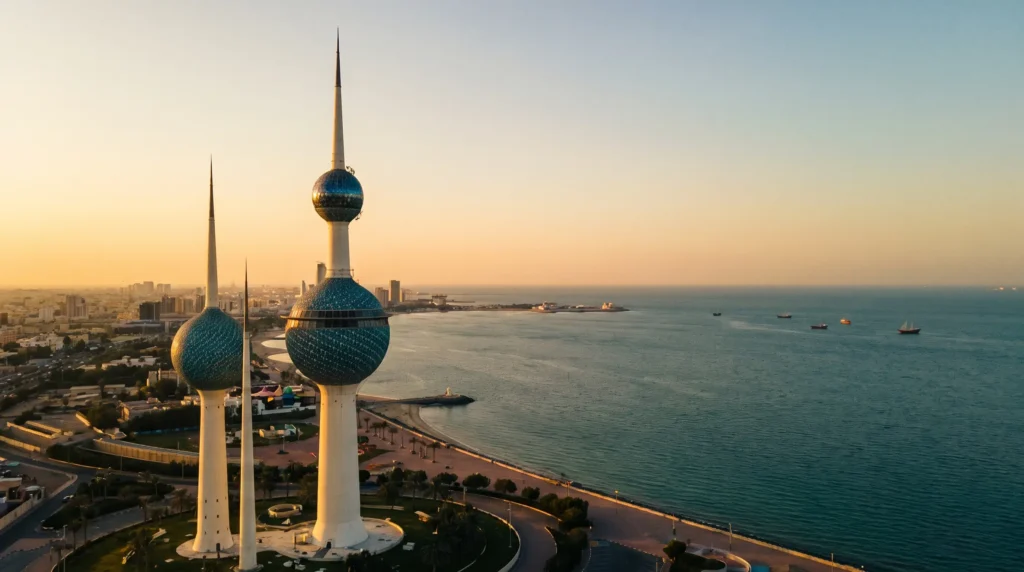
The obvious base: Kuwait Towers on their Gulf-front promontory — the taller of the pair reaches 187 metres and holds a rotating restaurant near the top — plus the Grand Mosque, the National Assembly, and a corniche built for the evening stroll that locals call “the walk.” Base yourself near here or in Salmiya for easy access to everything else.
Souq Al-Mubarakiya
Kuwait’s oldest market, trading for at least two centuries and predating the oil economy entirely. Expect dates, spices, gold, Persian carpets, oud and musk perfume stalls, working-class diners serving machboos and grilled fish, and shisha cafés that run late. A 2022 fire destroyed part of the market and reconstruction has continued since, so expect some sections mid-renovation.
Salmiya & The Avenues
Kuwait’s shopping and dining engine — Salmiya’s seafront strip for casual life, and The Avenues Mall (one of the region’s largest) for the air-conditioned version of the same thing. This is where most visitors spend their evenings, especially in summer.
Failaka Island
A roughly 20-kilometre ferry ride from Kuwait City into genuinely deep history: Mesopotamian traders settled here around 2000 BC, Alexander the Great’s forces reportedly renamed it Ikaros for its resemblance to an Aegean island, and archaeologists have since uncovered Hellenistic temples and Bronze Age settlements across multiple excavation seasons. The island was evacuated and heavily damaged during the 1990–91 occupation and still shows it — rows of abandoned pre-invasion homes sit alongside the low-key Wanasa Beach resort, which now runs horseback riding, canoeing and water sports for day-trippers. Kuwait added Failaka to UNESCO’s World Heritage tentative list in January 2025, so its profile is only rising. Read our full Failaka Island day-trip guide for ferry operators, prices and the safety rules.
Al Jahra & the Northern Desert
Kuwait’s historic western gateway, home to the Red Fort and Mutla Ridge, the country’s high point at around 306 metres. This is also where the country’s winter “kashta” desert-camping culture is most visible on weekends — but see Practical Info below on landmines in the desert areas further north toward the Iraqi border, which are a genuine and specifically flagged hazard, not a generic warning.
Khiran & the Southern Coast
Kuwait’s answer to a beach resort strip, an hour or so south of the city, with gated waterfront chalets and calmer, cleaner water than the city corniche. It’s a domestic weekend-getaway spot more than an international one, which is exactly why it’s pleasant.
Culture & People — Bedouin Roots, Gulf Hospitality
Kuwaiti society blends a historic Bedouin and seafaring-merchant heritage — pearl diving and dhow trade were the economy before oil — with a modern population where citizens are outnumbered by foreign residents from South Asia, other Arab states, and beyond. Islam shapes daily rhythm noticeably more than in Dubai or Doha: expect the call to prayer five times a day, businesses that pause briefly around prayer times, and a genuinely conservative social baseline outside international hotels and malls.
Hospitality is taken seriously and personally — being offered Arabic coffee (gahwa) and dates on arrival anywhere, from a shop to a family home, is standard, and refusing outright can read as rude; a light sip and a polite “no more, thank you” is the graceful way to decline a refill. Modest dress is expected for both men and women in public, more so outside malls and hotel districts; women don’t need to cover their hair, but shoulders and knees covered is the safe baseline. Ramadan changes the whole rhythm of the country — daytime eating, drinking, and smoking in public are restricted for everyone regardless of faith, and many restaurants only open after sunset.
A Food Lover’s Guide to Kuwait
The national dish is machboos — mutton, chicken or fish slow-cooked over fragrant spiced rice, the Gulf’s answer to biryani and the dish to order at any traditional restaurant. Seafood is central given the coastline: look for hamour (grouper), safi (rabbitfish) and sobaity (sea bream), often grilled whole and served with khubz, the large sesame-topped flatbread, alongside mahyawa, a tangy fermented fish sauce that’s a genuine Kuwaiti specialty.
Other dishes worth seeking out: harees, a comforting wheat-and-meat porridge often eaten during Ramadan, and Kuwaiti-style biryani, distinct from its South Asian cousins. For drinks, gahwa (cardamom-scented Arabic coffee) and karak (spiced, heavily sweetened milk tea) are everywhere, best had at a Souq Al-Mubarakiya café. Remember: Kuwait is dry — no alcohol is sold or served anywhere in the country, including international hotels, so build your food itinerary around coffee culture and mocktails instead.
Off the Beaten Path
Failaka’s Hellenistic Ruins
Beyond Wanasa Beach’s day-tripper zone, Failaka’s excavated sites — Greek-style temple foundations, Bronze Age settlement layers, a Byzantine-era church — see a fraction of the visitors Failaka’s beach draws, and even fewer of the international tourists who’ve heard of Kuwait at all.
Sheikh Abdullah Al-Salem Cultural Centre
A sprawling museum and performing-arts complex on the waterfront that most visitors skip entirely in favor of the Towers — worth the detour for anyone interested in natural history, space, or Islamic art away from the crowds.
Souq Al-Mubarakiya After Dark
The souq by day is commerce; the souq after the dinner rush is card games, shisha smoke and karak tea with locals who’ve been coming to the same stall for decades. Go back a second time, later.
Boubyan Island
Kuwait’s largest island, mostly marshland and mudflats important for migratory birds, now on the country’s UNESCO tentative list alongside its marine reserve. Access is limited and largely restricted — this is one to admire from research rather than attempt to visit independently.
Practical Information
Safety — read this one carefully. As of mid-2026, the US State Department has Kuwait at Advisory Level 3, “Reconsider Travel,” citing the risk of armed conflict, landmines, and crime, following hostilities between the United States and Iran earlier in the year; the UK Foreign Office similarly warns that Iran has carried out attacks on Kuwait and could do so again at short notice, and urges travelers to stay away from military facilities and know shelter procedures. This is a genuinely fluid situation, not routine boilerplate — check both advisories again in the days before you fly, enroll in your country’s traveler alert program, and build in flexibility around flight schedules. Separately and permanently: landmines and unexploded ordnance remain in desert areas north of Mutla Ridge and near the Iraqi border, and a specific crime advisory applies to the Jleeb Al-Shuyoukh neighborhood near the airport — both are easy to simply avoid.
Money. The Kuwaiti dinar is the world’s highest-valued currency unit, worth roughly US$3.25, and is managed by the Central Bank of Kuwait against an undisclosed basket of currencies rather than freely floated. Cards are widely accepted in the city; carry small dinar notes for the souq and taxis, and declare cash over 3,000 KD at the border.
Laws. Alcohol and recreational drugs are strictly illegal, with serious penalties for possession — this applies to visitors as much as residents. Public displays of affection, revealing dress, and photographing government or military buildings can all cause problems; when in doubt, be conservative.
Health. The CDC recommends up-to-date routine vaccines plus Hepatitis A, Hepatitis B and typhoid for most travelers to Kuwait; stick to bottled or filtered water. Connectivity: a local SIM or eSIM is cheap and 4G/5G coverage is excellent nationwide. Plugs: UK-style three-pin (Type G), 230V. Time zone: Arabia Standard Time, UTC+3, no daylight saving.
Budget Breakdown — What Kuwait Actually Costs in 2026
Kuwait is not a budget destination — there’s no backpacker circuit, no hostel scene to speak of, and the strength of the dinar makes everything feel pricier than the sticker suggests.
Budget (US$70–120/day): a simple hotel or serviced apartment, souq and food-court meals, ride-hailing over rental cars, free sightseeing along the corniche and Souq Al-Mubarakiya.
Mid-range (US$180–320/day): a business-class hotel in Salmiya or the city centre, restaurant dinners, a Failaka Island day trip with ferry and Wanasa Beach activities, a rental car for a couple of days.
Luxury (US$500+/day): Gulf-front five-star hotels, private drivers, fine-dining rooftop restaurants, and the kind of mall shopping The Avenues was built for.
No alcohol spend to budget for anywhere in the country. Tipping 10% is appreciated in restaurants though rarely mandatory; taxis and ride-hailing don’t expect it.
Planning Your First Trip to Kuwait
Kuwait works best as a short, focused visit rather than a two-week trip: three or four nights covers Kuwait Towers, the Grand Mosque, a full day at Souq Al-Mubarakiya, and a day trip out to Failaka Island, with an evening or two left over for Salmiya’s corniche and food scene. Because it’s small and centrally located in the Gulf, it also pairs naturally with a longer regional itinerary — many visitors combine it with our Qatar guide for Doha, our Saudi Arabia guide for Riyadh or AlUla, or our UAE guide for Dubai or Abu Dhabi. Given the current advisory picture, build in a flexible itinerary and confirm your flight status close to departure rather than locking in a rigid multi-country plan months out. If you only have a layover rather than a dedicated trip, our Kuwait City layover guide covers 6/8/12-hour plans, and our honest 2026 verdict weighs whether a dedicated trip is right for you.
Frequently Asked Questions
Is Kuwait safe to visit right now, in 2026?
Be honest with yourself about this one before booking. As of mid-2026 the US State Department rates Kuwait Level 3, “Reconsider Travel,” citing armed conflict risk, landmines and crime, and the UK FCDO separately warns that Iran has struck Kuwait before and could again with little notice. This isn’t a “check the box and go” situation — read the current advisories in full close to your travel date, register with your government’s traveler program, and have a flexible itinerary. Our honest Kuwait verdict for 2026 weighs this advisory picture against what the country does well. Day-to-day street crime in tourist areas is low; the concern here is regional and geopolitical, not petty theft.
Do I need a visa for Kuwait?
Most nationalities can apply through Kuwait’s official e-Visa portal or get a visa on arrival, typically valid around 90 days for tourism and costing about 3 KD (roughly US$10). Apply in advance where possible and keep your passport valid at least six months past arrival.
Can I drink alcohol in Kuwait?
No — Kuwait is a fully dry country, with no legal alcohol sales anywhere, including five-star hotels. Bringing alcohol into the country, even for personal use, is against the law and taken seriously.
What should I wear in Kuwait?
Modest, breathable clothing covering shoulders and knees works everywhere; women don’t need to cover their hair as tourists, but a light scarf is worth carrying for mosque visits. Malls and international hotels are more relaxed than the souq or residential neighborhoods.
Kuwait or Dubai for a first Gulf trip?
Choose Dubai for polished mega-tourism infrastructure and a bigger first-timer safety net; choose Kuwait for a smaller, more authentic slice of Gulf daily life, a genuinely old souq, and far fewer other tourists. Given the current advisory picture, first-time regional visitors with no strong pull toward Kuwait specifically may find Dubai or Doha the easier starting point in 2026. See our full Is Kuwait Worth Visiting? verdict for the fuller Kuwait-vs-Doha-vs-Dubai comparison.
What’s the best time of year to go?
November through March, when temperatures are comfortable and National Day and Liberation Day (Feb 25–26) turn the whole city into a celebration. Avoid June through September unless you’re prepared to live an almost entirely indoor, air-conditioned schedule.
Ready to Explore Kuwait?
A rotating restaurant 187 metres above the Gulf, a 200-year-old souq that still smells like cardamom coffee and oud, and a ferry ride to ruins Alexander’s soldiers reportedly named after a Greek island — Kuwait rewards travelers willing to do their homework first. Check the current advisories, pack modestly, skip the alcohol section of your packing list entirely, and go see the Gulf capital most people never think to visit.
Explore More
- Qatar Travel Guide — Doha and the Gulf’s newest showcase capital
- Saudi Arabia Travel Guide — AlUla, Riyadh and the peninsula’s biggest opening-up story
- United Arab Emirates Travel Guide — Dubai and Abu Dhabi’s Gulf mega-cities
- Dubai City Guide — the region’s most-visited urban hub, an hour’s flight away
How this guide was built
Published as part of Facts From Upstairs’ country guide series. Built from authoritative sources — Wikipedia entity pages for Kuwait, the Kuwaiti dinar, Kuwait Towers, Failaka Island, Kuwait International Airport, Souq Al-Mubarakiya, Kuwaiti cuisine and Kuwait’s public holidays; UNESCO’s list of Kuwait’s World Heritage tentative sites; the Central Bank of Kuwait; Kuwait’s official Ministry of Interior e-Visa portal; the US State Department’s Kuwait travel advisory; the UK FCDO’s Kuwait travel advice; and the US CDC’s Kuwait traveler health page. Numeric and checkable claims carry inline citations. Given the fast-moving regional security situation, always verify current advisories directly before booking.
Sources cited on this page
- Wikipedia — Kuwait
- Wikipedia — Kuwaiti dinar
- Wikipedia — Kuwait Towers
- Wikipedia — Failaka Island
- Wikipedia — Kuwait International Airport
- Wikipedia — Souq Al-Mubarakiya
- Wikipedia — Kuwaiti cuisine
- Wikipedia — Public holidays in Kuwait
- Wikipedia — List of World Heritage Sites in Kuwait (UNESCO tentative list)
- Central Bank of Kuwait
- Kuwait Ministry of Interior — official e-Visa portal
- US State Department — Kuwait
- UK FCDO — Kuwait
- US CDC — Kuwait traveler page
More country guides you might like
Plan your trip to Kuwait
The booking tools we use ourselves. FFU may earn a commission at no extra cost to you.
Plan & book your trip to Kuwait
Booking through these searches supports our guides at no extra cost to you.