
Languages of Lesotho
All languages of Southern Africa →fluent beta classical · classes by phone with Maya at ranas.ai/maya
Lesotho Travel Guide — The Sky Kingdom Where Every Road Runs Above 1,000 Metres
Lesotho breaks the map before you even land. It is entirely surrounded by South Africa, one of only three countries on Earth that sit wholly inside another nation’s borders, and it is the only independent state where every square metre of territory sits above 1,000 metres in elevation — its lowest point, at roughly 1,400 metres, is the highest “lowest point” of any country in the world. Basotho herders ride sturdy mountain ponies wrapped in thick wool blankets against the cold, not for the tourist photo but because at this altitude, even in midsummer, the nights bite. I went in expecting a quick detour from a South Africa trip and stayed twice as long as planned — for the waterfalls, the empty mountain roads, and the strange thrill of being somewhere so few travellers ever bother to go. The catch is real, though: infrastructure is thin, some roads demand a proper 4×4, and you should read the safety section before you book anything.
In This Guide
- Overview — Why Lesotho Is Southern Africa’s Strangest, Most Rewarding Detour
- Africa’s Only Ski Season — Snow in the Maluti Mountains
- Best Time to Visit Lesotho (Season by Season)
- Getting There — MSU, Border Posts & the Sani Pass
- Getting Around — 4x4s, Ponies & Mountain Passes
- Top Regions — Maseru, the Highlands & the South
- Culture & People — Blankets, Ponies & the Basotho Nation
- A Food Lover’s Guide to Lesotho
- Off the Beaten Path
- Practical Information
- Budget Breakdown — What Lesotho Actually Costs in 2026
- Frequently Asked Questions
Overview — Why Lesotho Is Southern Africa’s Strangest, Most Rewarding Detour
Lesotho (pronounced luh-SOO-too) is a landlocked kingdom of roughly 30,355 square kilometres tucked entirely inside South Africa — one of only three sovereign enclaves on the planet. Locals call it the “Kingdom in the Sky,” and it earns the nickname: this is the only country in the world where every inch of territory sits above 1,000 metres, with mountain peaks pushing past 3,000 metres in the Maluti and Drakensberg ranges. It became a British protectorate in the 1860s under King Moshoeshoe I and gained full independence on 4 October 1966, keeping its own monarchy — today King Letsie III reigns as head of state alongside an elected prime minister.
The population is small, roughly 2.3 million people, and remarkably homogeneous: about 99.7% identify as Basotho, giving the country a cultural coherence you rarely find on a continent this diverse. Sesotho and English share official status, so getting around linguistically is easier than the remoteness suggests.
What actually draws travellers here is the landscape: the Maloti-Drakensberg Park, a UNESCO World Heritage Site shared with South Africa, protects some of the most dramatic mountain scenery and the densest concentration of San rock art in Africa. Add a 192-metre waterfall, a dam higher than almost any other in Africa, pony trekking through villages that still run on subsistence farming and remittances, and a ski resort — yes, in Africa — and you have a country that rewards travellers who are willing to leave the coast behind.
Africa’s Only Ski Season — Snow in the Maluti Mountains
If you’re reading this in the Southern Hemisphere winter, you’re inside Lesotho’s strangest travel window: Afriski Mountain Resort, sitting at roughly 3,050 metres in the Maluti Mountains near Oxbow, is one of only two operating ski resorts in Sub-Saharan Africa and the only one in Lesotho, running its slopes from around June through August with snowmaking supplementing natural falls. It’s a modest setup — a single main run, a beginner slope, two lifts — but skiing beneath the African sun at this latitude is a genuine novelty, and the resort fills with weekenders driving up from Johannesburg.
Outside the snow window, the same high passes deliver a different show: the road to Oxbow and the Sani Pass area sit near or above freezing most winter nights, and the region above Semonkong and Katse regularly dusts white after cold fronts even outside the official ski season. Whatever month you land, pack for four seasons in one day — Basotho blankets exist for a reason.
Best Time to Visit Lesotho (Season by Season)
April–May & September–October · Shoulder seasons (best overall)
Clear skies, cooler but manageable temperatures, and the least rain and cloud on the highland passes — this is the sweet spot for pony trekking, hiking to Maletsunyane Falls and driving the Sani Pass without a mud fight. Late September and early October also bring the Morija Arts & Cultural Festival, the country’s biggest cultural gathering.
June–August · Winter, ski season
Cold, dry, and the only time Afriski operates lifts. Nights in the highlands regularly drop below freezing and snow can close mountain passes, including the 4×4-only Sani Pass, for days at a time. Days are usually bright and dry, which makes this a good window for lowland sightseeing even if you skip the mountains.
November–March · Summer, rainy season
Warm days, green valleys, and Lesotho’s share of one of the world’s highest lightning-strike rates, according to US State Department guidance — afternoon thunderstorms are a real hazard for anyone hiking exposed ridgelines. Roads can wash out and river crossings swell, so this is not the season for ambitious 4×4 routes without local advice.
Getting There — MSU, Border Posts & the Sani Pass
Moshoeshoe I International Airport (MSU), about 18 kilometres southeast of Maseru near Mazenod, is Lesotho’s only international airport, and its only scheduled route is the short hop to and from OR Tambo in Johannesburg on Airlink — currently more than a dozen flights a week each way, taking roughly an hour in the air. Most travellers actually fly into Johannesburg or Durban and cross overland — it’s cheaper and lets you see the Free State or KwaZulu-Natal countryside on the way.
The main crossing is Maseru Bridge, open 24 hours and linking Maseru directly with Bloemfontein-side Ficksburg traffic; Ficksburg Bridge (Maputsoe) and Caledonspoort are the other standard-vehicle crossings into the northern highlands, both generally open 06:00–22:00. The legendary alternative is the Sani Pass from Underberg in KwaZulu-Natal — spectacular, but 4×4-only by law, weather-dependent, and only open roughly 08:00–16:00.
Getting Around — 4x4s, Ponies & Mountain Passes
Lesotho’s road network is improving but still thin, and the country’s defining geography — deep river gorges and a highland plateau over 3,000 metres — means the most memorable routes (Sani Pass, the road to Katse Dam, the Semonkong track) are gravel, switchback-heavy, and best tackled in a proper 4×4, especially after rain or snow. A 2WD sedan is fine for Maseru and the lowland towns along the South African border.
Shared minibus taxis link Maseru to district capitals and are the backbone of local transport, cheap but slow and not timetabled — flexibility is the price of admission. For the highlands, hiring a driver-guide or a self-drive 4×4 out of Maseru is the standard tourist approach. And for the last mile into villages with no road at all, Basotho ponies remain a genuine mode of transport, not just a photo op — multi-day pony trekking between mountain villages is one of the country’s signature experiences.
Top Regions — Maseru, the Highlands & the South
Maseru
The capital and by far the largest city, sitting right on the South African border along the Caledon River. It’s more transit hub than destination — banks, the airport link, a handful of markets — but it’s also the easiest place to arrange highland tours, hire a 4×4, or change money before heading up.
Thaba Bosiu
A flat-topped sandstone mountain about 24 kilometres east of Maseru, roughly 1,804 metres high, and the single most important historical site in the country. King Moshoeshoe I fortified this plateau in 1824 as a refuge during the Difaqane wars, and it became the founding capital of the Basotho nation; he and his successor Moshoeshoe II, buried here in 1996, both rest on the mountain today. It was declared a national monument in 1967 and remains a living pilgrimage site, not a museum piece.
Semonkong & the South
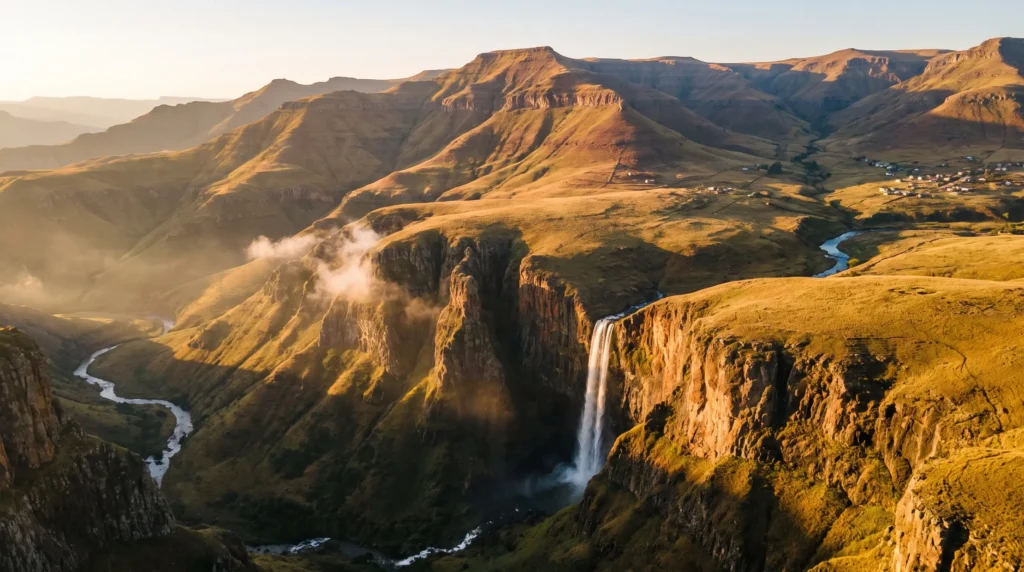
Semonkong (“Place of Smoke”) takes its name from the mist thrown up by Maletsunyane Falls, a 192-metre single-drop waterfall on the Maletsunyane River and one of the tallest single-drop falls anywhere in Africa. Guided hikes and pony treks to viewpoints above the falls are the main draw, alongside village homestays deep in the southern highlands.
The Central Highlands & Katse Dam
Katse Dam, part of the Lesotho Highlands Water Project — Africa’s largest water-transfer scheme — rises about 185 metres and ranks among the tallest dams on the continent, holding back a reservoir that supplies water to South Africa’s Gauteng industrial heartland while generating hydropower for Lesotho. The drive up via Caledonspoort and the A3 winds through some of the plateau’s most dramatic scenery, past Bokong Nature Reserve.
Oxbow & the Northern Maluti
Home to Afriski Mountain Resort and the country’s coldest, snowiest terrain — the road up from Butha-Buthe climbs through switchbacks that feel more Alpine than African.
Sani Pass & the Southeastern Escarpment
The dramatic 4×4 route up the Drakensberg escarpment from KwaZulu-Natal tops out at Sani Mountain Escape, home of the self-styled “highest pub in Africa” at roughly 2,874 metres, a favourite finish line for the crossing and gateway to Sehlabathebe National Park further along the escarpment.
Sehlabathebe National Park
Lesotho’s oldest national park, established in 1969 in the remote Qacha’s Nek District, protects sandstone formations, alpine grassland and prehistoric San rock art as part of the cross-border Maloti-Drakensberg World Heritage Site. Very few visitors make it this far — which is exactly the appeal.
Culture & People — Blankets, Ponies & the Basotho Nation
Lesotho is one of Africa’s most ethnically unified countries, with the Basotho people making up nearly the entire population and Sesotho spoken almost universally alongside official English. The most visible cultural symbol is the Basotho blanket — a thick woven wool wrap in bold geometric patterns, worn daily against the mountain cold and given at weddings, births and initiations. Paired with the conical mokorotlo hat, said to echo the shape of a mountain peak near Thaba Bosiu, it’s a genuinely functional national dress rather than a costume trotted out for photographs.
Horses are woven into everyday life at this altitude in a way few other African countries can match — sure-footed Basotho ponies carry riders, mail and goods along mountain paths that no vehicle can reach, and organised pony-trekking routes let visitors experience village life the way most highland Basotho still do. The Morija Arts & Cultural Festival, held in the historic mission town of Morija, is the country’s flagship celebration of music, crafts and heritage.
A Food Lover’s Guide to Lesotho
Lesotho’s food is hearty highland fare built for cold nights. The staple is papa (a stiff maize porridge, close cousin of South African pap), served with moroho (wild greens, often morogo or spinach), beans, or a stewed meat like chicken, mutton or beef — mutton and lamb in particular reflect the country’s sheep-farming economy at altitude. Sesotho beer (home-brewed sorghum beer, also called joala) is a genuine village institution, brewed and shared communally rather than sold in bottle shops.
In Maseru, South African-influenced cafés and braai (barbecue) spots fill the gap between traditional meals, and bakeries turn out fat cakes (deep-fried dough, called magwinya across the border) as a breakfast staple. Because Lesotho shares a currency and much of its supply chain with South Africa, don’t be surprised to find South African chain restaurants and supermarket brands alongside village-cooked papa and moroho.
Off the Beaten Path
Ha Kome Cave Village
A cluster of centuries-old sandstone-and-mud dwellings built beneath an overhanging cliff, still partly inhabited, offering a rare look at pre-colonial Basotho architecture without a paved parking lot in sight.
Bokong Nature Reserve & Lepaqoa Falls
A high-altitude reserve on the road to Katse known for its ice formations in deep winter and for bearded vulture sightings — a real draw for birders willing to make the drive.
Sehlabathebe National Park, the far edge
Already Lesotho’s most remote protected area, and the least-visited corner of the entire Maloti-Drakensberg World Heritage Site — trout streams, San rock art panels and total silence.
Village homestays via pony trek
Multi-day treks arranged through lodges in Malealea or Semonkong overnight in Basotho villages with no road access — as close as most travellers will get to daily highland life, sorghum beer and all.
Practical Information
Money. The loti is pegged 1:1 to the South African rand, and rand notes and coins circulate freely alongside loti — you rarely need to convert. Cards work in Maseru’s banks and bigger hotels; carry rand cash for the highlands, minibus taxis and village stalls.
Safety. The US State Department rates Lesotho Level 2, “Exercise Increased Caution,” citing armed robbery and carjacking incidents and citing reports of assault against foreign visitors in some cases; it also flags inadequate healthcare infrastructure outside Maseru. Stick to registered tour operators for highland driving and pony trekking, avoid isolated areas after dark, and check your own government’s current advisory — the UK FCDO maintains a separate, regularly updated assessment.
Health. The CDC recommends routine vaccines plus hepatitis A for all travellers, hepatitis B and typhoid for longer or rural stays, and pre-exposure rabies vaccination is worth considering since infected dogs are found in Lesotho; yellow fever vaccination isn’t required for entry. Bring strong DEET-based repellent, avoid swimming in untreated freshwater (schistosomiasis risk), and buy travel insurance that explicitly includes medical evacuation — mountain rescue is not a given here.
Connectivity. Mobile data works reasonably well in Maseru and district towns; expect dead zones in the high passes and around Sehlabathebe. Plugs: South African-style (Type M, and increasingly Type D/N), 220–230V. Time zone: UTC+2, no daylight saving.
Budget Breakdown — What Lesotho Actually Costs in 2026
Because the loti tracks the rand one-for-one, Lesotho prices roughly like rural South Africa — cheap by Western standards, a little pricier once you factor in guided 4×4 transport and pony treks. These ranges are our own editorial estimate, not a cited statistic — verify current rates with operators before booking.
Budget (roughly $35–65/day): guesthouse or backpacker lodge in Maseru or Malealea, papa-and-moroho meals, shared minibus taxis, self-guided day hikes.
Mid-range (roughly $100–180/day): a lodge in Semonkong or the highlands, a hired driver-guide with 4×4, a guided day hike to Maletsunyane Falls or a half-day pony trek, meals at Maseru’s better restaurants.
Luxury (roughly $300+/day): multi-day pony-trek village circuits with full support staff, private 4×4 charters to Katse Dam and Sani Pass, a winter weekend at Afriski.
Fixed costs to plan for: 4×4 rental or a driver-guide day rate for anything past the lowlands, and park or reserve entry fees at Sehlabathebe and Bokong.
Planning Your First Trip to Lesotho
Lesotho works best as a highland add-on to a longer Southern Africa trip rather than a standalone flight-and-hotel destination. The classic route: cross overland from Johannesburg or the Free State via Maseru Bridge, base two nights in Maseru or nearby Thaba Bosiu, then push into the mountains — Semonkong for Maletsunyane Falls and a pony trek, or Oxbow and Katse if you’re travelling in winter for snow. Adventurous drivers with a 4×4 can exit via the spectacular Sani Pass straight into the Drakensberg side of South Africa, pairing neatly with a Cape Town or Kruger itinerary. Five to seven days covers the highlights without rushing; budget extra time in the rainy season for washed-out roads.
Frequently Asked Questions
Is Lesotho safe for tourists in 2026?
The US State Department rates it Level 2, “Exercise Increased Caution,” citing armed robbery, carjacking and some reports of assault against foreigners, plus weak health infrastructure outside Maseru. Most organised tourism — lodges, guided treks, the main highland routes — operates without major incident, but use registered operators, avoid isolated areas after dark, and check your government’s current advisory before you go.
Do I need a visa?
US citizens can enter visa-free for stays up to 180 days, usually stamped for 30 days on arrival and extendable at the Office of Immigration in Maseru. Rules differ by nationality, so confirm with a Lesotho mission or your carrier before booking, and note that transiting South Africa may have its own separate entry requirements.
Do I need a 4×4 to visit Lesotho?
Not for Maseru or the lowland border towns, but yes for the Sani Pass, which is legally restricted to 4×4 vehicles, and strongly recommended for the Katse Dam road, Semonkong and most highland routes, especially outside the dry shoulder seasons.
Can I really ski in Africa?
Yes — Afriski Mountain Resort near Oxbow runs a modest lift-served ski season roughly June through August, using snowmaking to supplement natural snowfall at altitude. It’s small by international standards, but the novelty of skiing this far south is the whole point.
Lesotho or a straight South Africa itinerary?
Choose Lesotho as an add-on, not a replacement — it has neither South Africa’s coastline nor its safari infrastructure, but it offers mountain scenery, pony trekking and cultural depth you won’t find across the border. Most visitors are glad they carved out three or four extra days for it.
What’s the easiest way to see the highlights without a rental 4×4?
Book a driver-guide out of Maseru for a loop covering Thaba Bosiu, Katse Dam and either Semonkong or Malealea for a pony trek — it removes the road-condition risk and usually costs less than a self-drive 4×4 rental once insurance is factored in.
Ready to Explore Lesotho?
A country entirely above 1,000 metres, waterfalls that roar out of basalt cliffs, ponies that still carry the mail, and — for a few winter weeks — actual skiing under the African sun. Lesotho isn’t a place you stumble into; it’s a place you deliberately choose, and that’s exactly why it still feels untouched.
Explore More
- South Africa Travel Guide — the country that surrounds Lesotho on every side
- Cape Town City Guide — extend the trip to the Cape
- Botswana Travel Guide — pair the mountains with the Kalahari and Okavango
- Namibia Travel Guide — more of Southern Africa’s big-sky landscapes
How this guide was built
Published as part of Facts From Upstairs’ country guide series. Built from authoritative sources — Wikipedia entity pages for Lesotho, the Lesotho loti, Maloti-Drakensberg Park, Sehlabathebe National Park, Maletsunyane Falls, Katse Dam, the Lesotho Highlands Water Project, Thaba Bosiu, Moshoeshoe I International Airport, Afriski, the Morija Arts & Cultural Festival, and the Lesotho–South Africa border; UNESCO’s Maloti-Drakensberg Park World Heritage inscription; the World Bank’s Lesotho population data; the Lesotho Tourism Development Corporation’s Visit Lesotho site; Airlink’s published Johannesburg–Maseru schedule; and the US State Department, UK FCDO and US CDC traveler pages for Lesotho. Numeric and checkable claims carry inline citations; budget figures are editorial estimates, not sourced statistics.
Sources cited on this page
- Wikipedia — Lesotho
- World Bank — Lesotho population data
- UNESCO — Maloti-Drakensberg Park
- Wikipedia — Maloti-Drakensberg Park
- Wikipedia — Sehlabathebe National Park
- Wikipedia — Lesotho loti
- Wikipedia — Maletsunyane Falls
- Sani Mountain Escape — Highest Pub in Africa
- Wikipedia — Afriski
- Wikipedia — Katse Dam
- Wikipedia — Lesotho Highlands Water Project
- Wikipedia — Thaba Bosiu
- Wikipedia — Moshoeshoe I International Airport
- Wikipedia — Morija Arts & Cultural Festival
- Wikipedia — Lesotho–South Africa border
- Visit Lesotho — Lesotho Tourism Development Corporation
- Airlink — Johannesburg to Maseru schedule
- US State Department — Lesotho
- UK FCDO — Lesotho
- US CDC — Lesotho traveler page
More country guides you might like
Plan your trip to Lesotho
The booking tools we use ourselves. FFU may earn a commission at no extra cost to you.
Plan & book your trip to Lesotho
Booking through these searches supports our guides at no extra cost to you.