
Languages of Libya
All languages of Northern Africa →fluent beta classical · classes by phone with Maya at ranas.ai/maya
Libya Travel Guide — Roman Cities, Saharan Oases, and a Country Currently Under a Do-Not-Travel Advisory
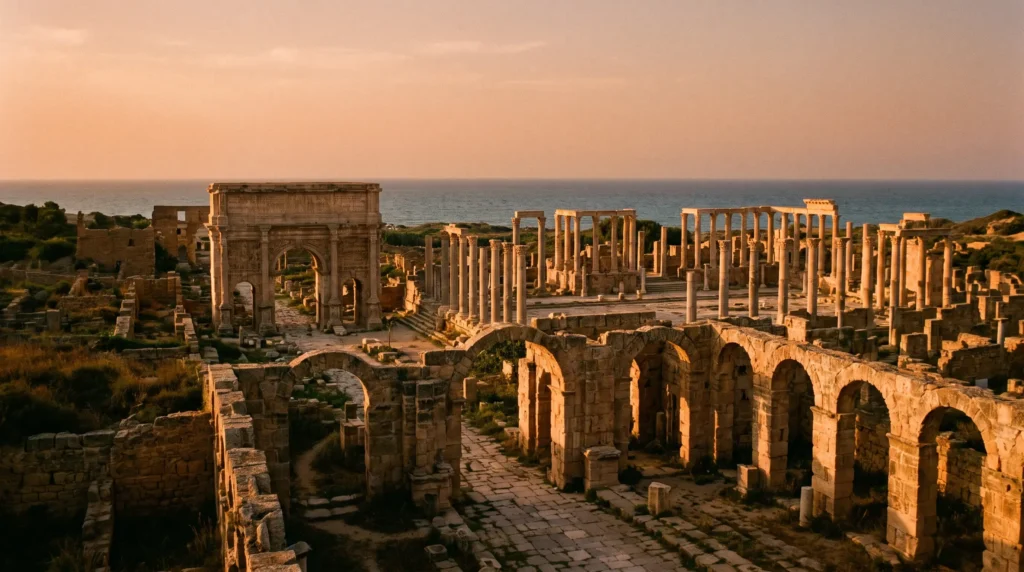
I write these guides to get people out the door, and this is another one where I have to open by telling you not to book the flight. Libya holds some of the best-preserved Roman ruins anywhere on Earth — a coastal city that once held around 100,000 people, its marble streets still standing largely intact — plus a mud-brick oasis town UNESCO calls the “pearl of the desert” and rock art in the Sahara dating back some 14,000 years. None of that heritage has gone anywhere. What has changed is that Libya has spent much of the last fifteen years without a single, stable government, and current advisories reflect that reality. This guide exists to help you understand the country, its regions, and what a future visit might look like — not to talk anyone into a trip this year.
In This Guide
- Overview — A Mediterranean Coast and Roman Cities, Currently Closed to Casual Visitors
- Yennayer — The Amazigh New Year in the Nafusa Mountains
- Best Time to Visit Libya (Climate, Season by Season)
- Getting There — Mitiga Airport and the Overland Reality
- Getting Around — Checkpoints, Escorts and Desert Distances
- Top Regions — Tripoli, Leptis Magna, Ghadames, Cyrene and the Fezzan
- Culture & People — Arab, Amazigh, Tuareg and Toubou
- A Food Lover’s Guide to Libya
- Off the Beaten Path
- Practical Information
- Budget Breakdown — Why “Cost Per Day” Doesn’t Really Apply Right Now
- Frequently Asked Questions
Overview — A Mediterranean Coast and Roman Cities, Currently Closed to Casual Visitors
Libya sits along the middle of North Africa’s Mediterranean coast, bordered by Egypt and Sudan to the east, Chad and Niger to the south, and Algeria and Tunisia to the west — the fourth-largest country in Africa by land area at roughly 1.76 million square kilometres, the overwhelming majority of it Saharan desert. That geography made it a prize for a long list of empires: Phoenician trading posts, Greek colonies in the east, Roman cities that grew wealthy on trans-Saharan gold, ivory and grain, Arab and Ottoman rule from the seventh century onward, and Italian colonization from 1911 until the Second World War. The layered result is a coastline holding some of the best-preserved Roman archaeology in the Mediterranean, a Berber-built desert town of stacked mud-brick towers, and Saharan rock art stretching back roughly fourteen thousand years.
Libya became independent as a kingdom in 1951, then spent 1969 to 2011 under Muammar Gaddafi’s rule following his coup. The 2011 uprising and NATO-backed intervention that toppled and killed Gaddafi was followed by a second civil war from 2014 to 2020, and while a ceasefire has held since 2020, the country remains split between rival governing authorities, and reunification has not been completed. That instability is precisely why Western governments currently advise against travel — not because the archaeology or the desert stopped being extraordinary.
What follows describes Libya as it exists: its regions, its five UNESCO World Heritage Sites (four of them currently on the World Heritage in Danger list), its food and people, and the practical realities for the narrow set of travelers who do currently operate here with professional risk management. If that isn’t you, read this as the guide it’s meant to be for now — context, not a checklist.
Yennayer — The Amazigh New Year in the Nafusa Mountains
Libya’s Amazigh (Berber) communities — concentrated in the Nafusa Mountains southwest of Tripoli and the coastal town of Zuwara — mark Yennayer, the Amazigh New Year, on 12 January, a date fixed thirteen days off the Gregorian calendar from its roots in the old Julian calendar. It’s celebrated across Amazigh communities from Morocco to Egypt’s Siwa Oasis, and in Libya it’s closely tied to rain and agricultural fortune: rainfall on Yennayer is traditionally read as a blessing for the year ahead, and households prepare dishes like tamoqtal, wheat cooked in a dark, peppery sauce with peas and lentils, alongside rituals meant to bless children with fertility and protection for the year to come.
It’s a genuinely distinct thread of North African culture that most outside visitors never hear about — Libya isn’t only Arab and isn’t only coastal, and the Nafusa Mountains’ Amazigh towns keep a calendar, language and set of customs that predate the Arab conquest by a long way. Whether or how openly Yennayer is celebrated in any given year varies with the country’s political situation; this is a cultural note, not a claim about current public access to the region.
Best Time to Visit Libya (Climate, Season by Season)
This section is a climate reference, included for completeness and for the day advisories change — it is not a recommendation to travel now. Coastal Libya runs a hot semi-arid to Mediterranean climate, while the Saharan interior that makes up most of the country’s territory is true desert.
March – May · Spring
The most comfortable stretch on the coast, with Tripoli’s mild winter (average 9–18°C) giving way to warm, dry days before summer heat sets in; still cool enough at night in the Fezzan’s desert interior for overland travel, in principle.
June – August · Summer
Coastal cities like Tripoli regularly exceed 38°C (100°F) in scorching, dry heat, while daytime desert temperatures in the Fezzan and Sahara run considerably hotter — this is the season to avoid even in a hypothetical future trip.
September – November · Autumn
Temperatures ease back toward spring levels along the coast, with date harvests underway in the southern oases; annual rainfall across Libya stays under 400mm even in the wettest coastal areas, so this remains a largely dry season everywhere.
December – February · Winter
Mild by regional standards on the coast (Tripoli averages roughly 9–18°C) but desert nights in the interior swing cold; this is also when Yennayer falls in the Nafusa Mountains.
Getting There — Mitiga Airport and the Overland Reality
Tripoli’s main functioning gateway is Mitiga International Airport, which took over as the capital’s primary airport after Tripoli International Airport was destroyed during fighting in 2014 and has not reopened. International commercial service has been intermittent and limited to a handful of regional carriers and routes, and the FAA has specifically restricted US commercial aviation operations in Libyan airspace over safety concerns — there is no scenario in which a US or UK carrier currently flies you in directly.
Overland, Libya borders Egypt, Sudan, Chad, Niger, Algeria and Tunisia, but crossings open to foreign travelers are limited, subject to closure without notice, and require far more coordination and paperwork than a routine land border — and, per current guidance, essentially no consular support is available if something goes wrong at any of them, since neither the US nor UK maintains in-country embassy operations.
Getting Around — Checkpoints, Escorts and Desert Distances
Libya is enormous and overwhelmingly desert, so distances between the coastal cities and the southern Fezzan region are substantial by any measure — this is a country where “off the beaten path” can mean days of driving through empty Sahara. Under current conditions, any movement between regions controlled by different authorities involves checkpoints operated by a range of armed groups, and route availability changes with the security situation on short notice.
Tourism entry, where it is permitted at all, currently requires a registered local sponsor or tour operator and a mandatory tourist-police escort — independent, self-directed road-tripping in the style of a typical FFU guide simply isn’t the operating reality here right now. Any current travel between cities is, in practice, a security and logistics decision made by professional fixers and specialist operators, not a matter of renting a car.
Top Regions — Tripoli, Leptis Magna, Ghadames, Cyrene and the Fezzan
Tripoli
The capital and largest city, home to just over a million people and a Mediterranean waterfront old town, the Medina, that preserves Ottoman-era mosques, caravanserais, hammams and courtyard houses dating from the 16th century onward. The Red Castle Museum (Assaraya al-Hamra), a sprawling palace complex, and Martyrs’ Square — the palm-lined waterfront plaza renamed after the 2011 uprising — anchor the historic center. Under current UK guidance Tripoli sits among the very few Libyan cities where even “essential” travel is contemplated at all, and even that guidance tightened further in June 2026.
Leptis Magna
Roughly 130 kilometres east of Tripoli near Al-Khums, Leptis Magna is one of the best-preserved Roman cities anywhere on the Mediterranean — birthplace of Emperor Septimius Severus, who lavished the city with monuments, and once home to around 100,000 people at its early-third-century peak. Inscribed by UNESCO in 1982, it has been on the World Heritage in Danger list since 2016 due to instability from the civil war, and as a coastal site it also faces long-term climate risk from sea-level rise and erosion.
Ghadames — the “Pearl of the Desert”
A Berber oasis town roughly 462 kilometres southwest of Tripoli near the Algerian and Tunisian borders, with a population of around 10,000 and one of the most distinctive vernacular building traditions in the Sahara: ground floors for storage, family living quarters above connected by covered alley-passageways, and open-air rooftop terraces reserved for women. Inscribed by UNESCO in 1986, Ghadames was placed on the danger list in 2016 alongside Libya’s other four sites, but was removed from that list in 2025 following restoration work by local authorities and partners — genuinely good news, though it says nothing about current visitor access, which remains governed by the advisories above.
Cyrene
In Libya’s northeast, near the city of Shahhat, Cyrene was one of the principal Greek — Hellenic — cities of the ancient Mediterranean world, later absorbed into the Roman world alongside Leptis Magna and Sabratha. Inscribed in 1982 and on the danger list since 2016, it sits in Cyrenaica, the eastern region whose largest city is Benghazi — another of the three cities where the UK’s advisory contemplates even essential travel.
Sabratha
West of Tripoli on the coastal road toward Tunisia, Sabratha began as a Phoenician trading post before its Roman-era rebuilding, and today its ruined theatre remains one of the most photogenic Roman structures in North Africa. Inscribed in 1982, it too has carried World Heritage in Danger status since 2016, reflecting the area’s exposure to the country’s broader instability.
Tadrart Acacus & the Fezzan
Deep in Libya’s southwestern desert near the Algerian border, the Tadrart Acacus mountains hold thousands of rock-art panels spanning an extraordinary range of styles and dates, from roughly 12,000 BC through to around 100 AD. Inscribed in 1985 and on the danger list since 2016, it’s among the most remote UNESCO sites on Earth even before factoring in current security realities, and it sits within the wider Fezzan region — Libya’s vast southern desert, home to Tuareg and Toubou communities living around scattered oasis towns.
Benghazi
Libya’s second city and historic capital of the east, at the heart of the 2011 uprising against Gaddafi. Along with Tripoli and Misrata, it’s one of the three cities where UK guidance contemplates only “essential” travel rather than a blanket “all travel” warning — a narrower exception, not an endorsement.
Culture & People — Arab, Amazigh, Tuareg and Toubou
Libya’s population of roughly 7.4 million is overwhelmingly Arab and Muslim — around 96.6% of the country identifies as Muslim, the large majority Sunni — with Arabic as the official language and Libyan Arabic the everyday vernacular. Beneath that surface, though, Libya is more ethnically layered than it first appears: Amazigh (Berber) communities in the Nafusa Mountains and Zuwara maintain their own language and the Yennayer calendar described above; Tuareg communities in the southwest and Toubou communities in the far south and southeast, straddling borders with Algeria, Niger and Chad, bring distinct desert traditions and languages of their own into the national mix.
Hospitality runs deep across Libyan and North African Amazigh, Arab and desert cultures alike, and conservative dress and social norms are expected of visitors of any gender, in line with the country’s Islamic majority. Given the current political fragmentation, cultural and religious practice — including how openly minority traditions like Yennayer are marked in any given year — can vary significantly by region and by which authority controls it; this is worth understanding as background, not as a current visitor’s itinerary.
A Food Lover’s Guide to Libya
Libyan cooking sits at a Mediterranean-meets-Saharan crossroads, built on North African staples with Italian-era influence still visible from the colonial period. The everyday national dish is bazin — a firm, kneaded barley-flour dough mounded on a plate and served with a rich meat-and-tomato sauce, often lamb, spooned around it. Couscous, steamed and topped with vegetables and stewed meat, is another staple shared with neighboring Tunisia and Algeria.
Look for shakshuka at breakfast — eggs poached in a spiced tomato and pepper sauce — and usban, a stuffed-tripe dish similar to dishes found across the wider Maghreb. Dates from the southern oases, including Ghadames and the Fezzan, are a staple sweet and gift food, and mint tea, poured strong and sweet, anchors both everyday meals and hospitality rituals in Amazigh, Tuareg and Arab households alike.
Off the Beaten Path
Tadrart Acacus Rock Art
Already covered above as a top region, but worth repeating on its own: fourteen millennia of rock art in one of the most remote mountain-desert landscapes in the Sahara, reachable historically only via organized 4×4 expeditions out of the Fezzan.
Ghat & the Far Southwest
An old Tuareg caravan town near the Algerian border, historically one of the launch points for Acacus expeditions and Saharan caravan routes — a genuine edge-of-the-map destination even in more stable times.
Nafusa Mountains
The Amazigh highland belt southwest of Tripoli, home to Yennayer traditions, hilltop granary fortresses (qasr) built for grain storage and defense, and a slower, older thread of Libyan culture than the coastal cities usually show visitors.
Sabratha’s Theatre
Already noted above, but the Roman theatre here — with its three-tiered, richly carved stage backdrop — is arguably the single most photogenic Roman structure in the country, in a coastal setting far quieter than Leptis Magna’s.
Practical Information
Safety. This bears repeating in its own right, not just in the advisory box above: current guidance from the US State Department (Level 4, Do Not Travel) and UK FCDO (advises against all travel except essential travel to Tripoli, Benghazi and Misrata) cites terrorism, kidnapping, unexploded landmines and ordnance, civil unrest and near-total absence of consular support inside the country. Check your own government’s current page before making any decision, and note that travel insurance is commonly invalidated when taken against explicit government advice.
Money. The Libyan dinar (LYD) is issued and regulated by the Central Bank of Libya; official and black-market rates were unified around 4.48 dinars to the US dollar in 2021 after years of divergence, though further devaluation was reported amid ongoing political instability in 2025 — verify current rates before any transaction. International card networks and ATMs are not a reliable option for foreign visitors; cash, handled carefully, is the practical reality.
Health. The CDC rates Libya at its standard “practice usual precautions” travel health level, but recommends Hepatitis A and, for many travelers, Hepatitis B, typhoid and rabies pre-exposure vaccination — dogs carrying rabies are commonly found in Libya, and treatment availability is limited. Leishmaniasis, leptospirosis and schistosomiasis in freshwater sources are additional regional risks; medical facilities outside a handful of Tripoli hospitals are limited and not equivalent to Western trauma or emergency care.
Visa & entry. Almost every nationality needs a visa — only Algerian and Tunisian citizens currently enter visa-free. An eVisa system launched in March 2024 offers a 90-day-validity, single-entry tourist visa for stays of up to 30 days, but tourism entry additionally requires a registered local sponsor or tour operator, and a tourist-police escort is mandatory while traveling as a tourist with an operator. Citizens of several countries, including Pakistan, Iran, Syria, Bangladesh, Sudan, Yemen and Israel, are not permitted entry at all under current rules.
Budget Breakdown — Why “Cost Per Day” Doesn’t Really Apply Right Now
Every other guide on this site gives you budget, mid-range and luxury daily costs. Libya doesn’t fit that model at the moment, and inventing numbers would be more misleading than useful. There is essentially no independent backpacker or mid-range tourism infrastructure operating for foreign visitors — the hostels, walk-in tour desks and casual visa-on-arrival systems a normal “budget traveler” section would describe don’t really exist here right now, and tourism entry is gated behind a mandatory local sponsor and police escort in any case.
In practice, anyone currently entering Libya for anything resembling tourism goes through a small number of specialist operators who bundle permits, security assessment, fixers, private vehicles, mandatory escorts and pre-vetted accommodation into a single quoted package, priced well above typical regional travel because of the logistics and risk management involved — not hotel star ratings. If and when the advisory picture changes meaningfully, this is the section we’ll rewrite first, with real, current numbers.
Planning Your First Trip to Libya
Right now, the honest planning advice is: don’t, independently — and if you’re traveling through professional, journalistic or humanitarian channels, you already have a security team handling this, not a blog. For everyone else, the most useful thing this guide can do is point you toward the neighboring region you can actually visit today. Tunisia, right across Libya’s western border, shares the same Roman-and-Amazigh heritage in a fully open, well-set-up destination — its own Roman sites at Dougga and El Jem echo Leptis Magna and Sabratha directly. Egypt to the east offers a deeper, equally accessible dose of ancient history along the Mediterranean and Nile. Further south and west, Morocco is the easiest place to experience thriving, openly celebrated Amazigh culture — including Yennayer — without any of Libya’s current risk. Bookmark this guide; revisit it if the advisory picture changes.
Frequently Asked Questions
Is it safe to travel to Libya in 2026?
According to current guidance, no government considers it safe for ordinary tourism. The US State Department rates Libya Level 4, Do Not Travel — its highest level — and the UK FCDO advises against all travel to the country except essential travel to Tripoli, Benghazi and Misrata. Always check your own government’s current page rather than relying on any single source, including this one.
Do I need a visa?
Yes, for almost every nationality — only Algerian and Tunisian citizens currently get visa-free entry. Libya’s eVisa system, launched in March 2024, issues 90-day-validity tourist visas for stays up to 30 days, but tourism additionally requires a registered local sponsor and a mandatory tourist-police escort while traveling.
How many UNESCO World Heritage Sites does Libya have?
Five: the archaeological sites of Cyrene, Leptis Magna and Sabratha (all inscribed 1982), the Rock-Art Sites of Tadrart Acacus (1985), and the Old Town of Ghadamès (1986). All five were placed on the World Heritage in Danger list in 2016 due to civil-war instability; Ghadames was removed from that list in 2025 following restoration work, while the other four remain listed as endangered.
What’s the currency and can I use cards?
The Libyan dinar (LYD), issued by the Central Bank of Libya, was unified at roughly 4.48 to the US dollar in 2021 after years of split official and black-market rates, with further devaluation reported in 2025. International card networks and ATMs aren’t a reliable option for foreign visitors; cash is the practical necessity, and rates should be verified immediately before any trip.
What happened to Leptis Magna and Sabratha during the conflict — are they still standing?
Both sites remain physically standing and are still described as among the best-preserved Roman remains in the Mediterranean; the World Heritage in Danger listing since 2016 reflects the risk posed by Libya’s broader instability — looting risk, lack of resourced conservation management, and proximity to conflict-affected areas — rather than reported large-scale destruction of the monuments themselves.
Libya or Tunisia for Roman ruins and Amazigh culture?
Tunisia, without question, for now — it shares the same Roman archaeological tradition (Dougga, El Jem, Carthage) and the same Amazigh threads in its south, in a country with functioning tourism infrastructure and no do-not-travel advisory. Libya’s sites are arguably even more spectacular in isolation, but “arguably more spectacular” isn’t worth the current risk profile.
A Guide for Understanding, Not Booking — For Now
Libya holds a Roman city that once housed 100,000 people, a mud-brick oasis town UNESCO calls the pearl of the desert, and Saharan rock art older than the pyramids. It also holds, right now, a Level 4 Do Not Travel advisory and a country still split between rival authorities more than a decade after its revolution. We’ll keep this guide updated as the advisory picture changes. Until then, treat it as a window into the country, not an itinerary.
Explore More
- Tunisia Travel Guide — the same Roman and Amazigh heritage, fully open today
- Egypt Travel Guide — deeper ancient history along the Mediterranean and Nile
- Morocco Travel Guide — thriving, openly celebrated Amazigh culture without the risk
- Jordan Travel Guide — another Mediterranean-adjacent crossroads of ancient empires
How this guide was built
Published . Because Libya currently carries the highest-level travel advisories from multiple governments, this guide was built with an explicit safety-first brief: verify the advisory status first, from primary government sources, and write every other section honestly around that reality rather than around a typical destination-guide template. Sources consulted include the US State Department’s Libya travel advisory, the UK FCDO’s Libya travel advice, the US CDC traveler health page for Libya, Libya’s official eVisa portal, UNESCO’s list of Libya’s World Heritage Sites, Britannica’s Libya overview, and Wikipedia entity pages for Libya, Tripoli, Leptis Magna, Ghadames, the Libyan dinar, and Yennayer. Numeric and checkable claims carry inline citations.
Sources cited on this page
- US State Department — Libya Travel Advisory
- UK FCDO — Libya Travel Advice
- US CDC — Libya traveler page
- Libya eVisa — Official Portal
- Wikipedia — List of World Heritage Sites in Libya
- Wikipedia — Libya
- Wikipedia — Tripoli, Libya
- Wikipedia — Leptis Magna
- Wikipedia — Ghadames
- Wikipedia — Libyan Dinar
- Wikipedia — Yennayer
More country guides you might like
Plan your trip to Libya
The booking tools we use ourselves. FFU may earn a commission at no extra cost to you.
Plan & book your trip to Libya
Booking through these searches supports our guides at no extra cost to you.