
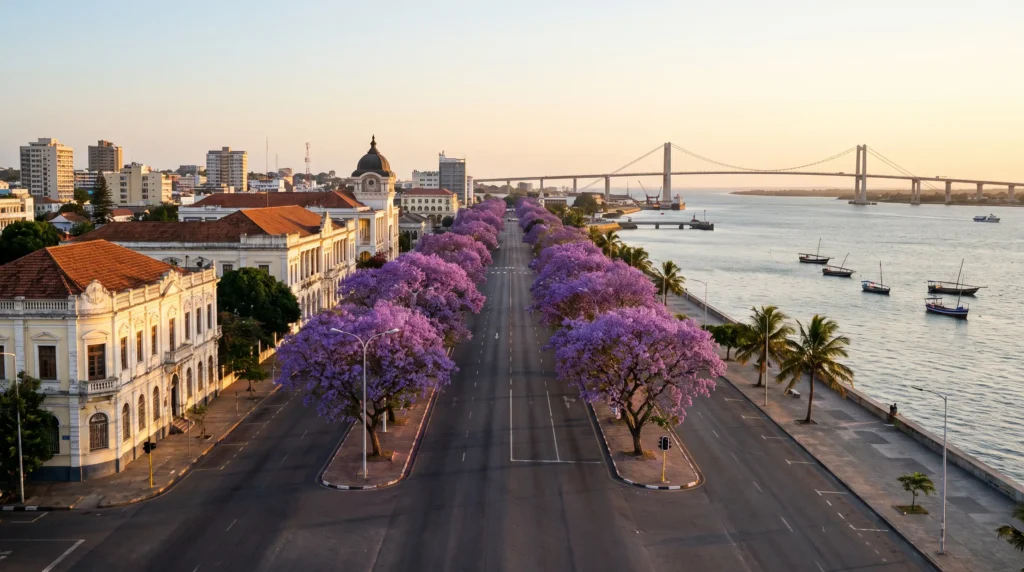
Maputo Travel Guide — Mozambique’s Jacaranda-Lined Capital on the Indian Ocean
I will be honest with you upfront: almost nobody puts Maputo on a bucket list, and that is precisely why I keep telling people to go. This is a capital of over a million people built by Portuguese colonists who clearly missed home enough to lay wide, jacaranda-shaded avenues and raise an Art Nouveau train station so grand it is routinely mistaken for a Gustave Eiffel design. Independence came in 1975 and a brutal civil war followed, but the Maputo I have walked through is a city rebuilding with real style — sidewalk cafés serving espresso next to prego rolls, live marrabenta guitar drifting out of bars at 11pm, and a brand-new bridge across the bay that is, without exaggeration, the longest suspension bridge on the entire African continent. It is not an easy trip — the visa process got more complicated this year, street crime needs real respect, and there is no lazy beach-resort version of this city waiting for you. But if you want Southern Africa’s most underrated capital, with some of the best seafood I have eaten anywhere and an elephant park now recognized by UNESCO practically at its back door, Maputo delivers.
In This Guide
- Overview — Why Maputo Is Southern Africa’s Sleeper Capital
- Dry Season (Jul–Oct) — Best Game Viewing at Maputo National Park
- Best Time to Visit Maputo (Season by Season)
- Getting There — MPM Airport & Overland Borders
- Getting Around — Chapas, Taxis & the Katembe Bridge
- Neighborhoods — Baixa, Polana, Costa do Sol & Beyond
- Culture & People — Marrabenta, Markets & a Portuguese Afterlife
- A Food Lover’s Guide to Maputo
- Off the Beaten Path
- Day Trips — Inhaca Island & Maputo National Park
- Practical Information
- Budget Breakdown — What Maputo Actually Costs in 2026
- Frequently Asked Questions
Overview — Why Maputo Is Southern Africa’s Sleeper Capital
Maputo was founded as a Portuguese fort in 1781, became a town in 1876 and a city in 1887 under the name Lourenço Marques, before independence in 1975 brought the renaming to Maputo. That colonial-then-revolutionary layering is everywhere: wide Parisian-style avenues laid out by the Portuguese now carry Marxist-era street names honoring Kim Il Sung, Mao Tse Tung and Ho Chi Minh, a quirk of Mozambique’s post-independence socialist alignment that still surprises first-time visitors reading a taxi receipt.
The city sits on Maputo Bay on the Indian Ocean at a modest 47 meters of elevation, within roughly 120 kilometers of both the South African and Eswatini borders — which is exactly why so many of its weekend visitors arrive by car from Johannesburg or Nelspruit rather than by plane. It’s a genuinely Portuguese-inflected capital: nearly half the population speaks Portuguese as a first language, pastelarias serve custard tarts alongside piri-piri prawns, and Portuguese football scores get discussed as seriously as local ones.
What Maputo does not have is a tourism machine. There’s no beach strip, no all-inclusive resorts, no queue of tour buses. What it has instead is a walkable, human-scale downtown with genuine Art Deco and Art Nouveau bones, some of the best-value seafood on the continent, and — as of 2025 — a UNESCO-listed wilderness with 400-plus elephants an hour’s drive from your hotel. You have to want it a little more than you’d want Cape Town or Zanzibar. I think that’s part of the appeal.
Dry Season (July–October) — Best Game Viewing at Maputo National Park
If you’re reading this in July, you’re already in the sweet spot. Maputo’s dry winter runs roughly June through August, and it stretches the wildlife-viewing window at nearby Maputo National Park (formerly the Maputo Special Reserve) well into October, when thinning bush and animals clustering at waterholes make sightings far easier than in the sodden, mosquito-thick summer.
This matters more than usual right now: in July 2025, UNESCO’s World Heritage Committee formally extended South Africa’s iSimangaliso Wetland Park across the border to include Maputo National Park, creating a nearly 400,000-hectare transboundary World Heritage property — one of the largest protected coastal wilderness areas in Africa. The park’s roughly 400 elephants are themselves a conservation comeback story, repopulated partly through natural migration from South Africa’s Tembe Elephant Park since 2014 after the civil war had all but wiped the reserve’s wildlife out. Go see it while the dry season lasts and before word gets out further.
Best Time to Visit Maputo (Season by Season)
May – October · Dry season (recommended)
Cooler, drier, far less humid, and the best window for both city walking and day trips to Maputo National Park or Inhaca Island. Nights can dip cool enough for a light jacket in June and July.
November – April · Hot, wet season
Maputo’s tropical savanna climate turns muggy and rain-prone from December through March, coinciding with the Southwest Indian Ocean cyclone season — Mozambique’s coast, including areas south of Maputo, has taken direct cyclone hits in recent years, so check forecasts and buy travel insurance that covers weather disruption if you’re traveling January through March.
Shoulder months
April and late October/November split the difference — warm, greener than peak dry season, and before the heaviest rains, with noticeably fewer visitors than the July–August high season among the South African weekend-drive crowd.
Getting There — MPM Airport & Overland Borders
Maputo International Airport (MPM) sits just 3 kilometers northwest of downtown, making it one of the more conveniently placed capital-city airports anywhere — a taxi into the Baixa or Polana district takes fifteen minutes outside rush hour. LAM Mozambique Airlines hubs here with regional routes to Johannesburg, Beira, Dar es Salaam and Nairobi, and international carriers including Ethiopian Airlines, Kenya Airways, Qatar Airways and TAP Air Portugal connect Maputo to Addis Ababa, Nairobi, Doha and Lisbon respectively. There is no nonstop service from North America; most travelers connect through Johannesburg, Doha or Addis Ababa.
Overland, the Lebombo/Ressano Garcia border crossing from South Africa’s Mpumalanga province is the busy one — roughly a five-hour drive from Johannesburg — and it’s a popular self-drive or shuttle-bus route. A second crossing links Mozambique with Eswatini (Lomahasha/Namaacha) for travelers combining the two countries. Land border queues can run long on weekends and Mozambican holidays, so budget extra time either direction.
Getting Around — Chapas, Taxis & the Katembe Bridge
Central Maputo — the Baixa and the leafy avenues around Polana — is genuinely walkable in the cooler dry-season months, with wide colonial-era sidewalks and enough shade trees to make midday strolling bearable. For anything further, the city runs on chapas, shared minibus taxis that are cheap and go everywhere but are crowded, driven aggressively, and not the easiest first introduction to the city — most visitors start with metered taxis or ride-hailing apps instead and graduate to chapas once they’ve got their bearings.
The single biggest recent change to getting around is the Maputo–Katembe bridge, a suspension bridge with a 3,041-meter total span that opened in November 2018 and is now the longest suspension bridge on the African continent. It replaced a slow vehicle ferry across Maputo Bay and now puts the southern suburb of Katembe, and the road toward Ponta do Ouro and the South African border, within a fifteen-minute drive of downtown. Car rental is straightforward for day trips, though I’d stick to daylight driving — road conditions and lighting deteriorate fast outside the city center.
Neighborhoods — Baixa, Polana, Costa do Sol & Beyond
Baixa (Downtown)
The historic commercial core and the reason to bring a camera: Praça da Independência and Maputo City Hall, the leafy Tunduru Botanical Gardens, and the CFM Railway Station, whose green dome and ironwork are so refined that a persistent (if unproven) local legend credits Gustave Eiffel’s studio with the design. The Fortress of Maputo and the Central Market round out a compact, walkable sightseeing loop.
Polana
The genteel, jacaranda-shaded diplomatic and hotel district, anchored by the grand old Polana Serena Hotel. This is where most mid-range and upscale visitors base themselves — quiet at night, close to good restaurants, an easy walk or short taxi from the Baixa.
Sommerschield
Leafy embassy row next to Polana, heavy on high-walled villas and a handful of excellent expat-favorite restaurants. Not much to “see,” but a useful reference point for accommodation searches.
Costa do Sol
Maputo’s beachfront strip northeast of downtown, better for its string of open-air seafood restaurants — grilled prawns with a bay view — than for swimming; the water here is a working harbor, not a resort beach.
Museu district
Home to the National Art Museum and several private galleries — a good half-day if you want Mozambican contemporary art and the famous Chissano-family carved wood sculpture beyond the souvenir-stall version.
Katembe
Across the bay via the new bridge, a quieter, still-developing southern suburb and the road corridor toward the Maputo National Park and Ponta do Ouro. Worth the crossing just to see the bridge from the water side.
Administratively the city divides into seven municipal zones — KaMpfumo (which contains the Baixa and Polana), Nlhamankulu, KaMaxaquene, KaMavota, KaMubukwana, KaTembe and KaNyaka — though visitors will mostly navigate by neighborhood name rather than zone number.
Culture & People — Marrabenta, Markets & a Portuguese Afterlife
Maputo’s culture runs on a distinctly Mozambican fusion: Portuguese colonial architecture and language layered over Tsonga/Changana and other Bantu traditions, with a strong current of Marxist-era pan-African solidarity still visible in street names and public murals from the post-1975 period. Marrabenta — Mozambique’s signature guitar-and-dance music genre, born in Maputo’s mid-20th-century suburbs — still fills live-music bars on weekend nights, alongside newer Afro-house and kizomba scenes.
The FEIMA handicrafts market and the Central Market are the places to see everyday commerce and pick up capulana fabric, wood carving and basketry directly from makers rather than tourist-shop markups. Mozambican Independence Day (25 June) is the year’s biggest patriotic date nationwide, with parades and public events concentrated in the capital. Dress remains fairly modest and conservative outside beach areas, and greetings matter — a brief exchange before getting to business is expected and appreciated.
A Food Lover’s Guide to Maputo
Start with the dish Maputo does better than almost anywhere: piri-piri prawns, grilled and doused in Mozambique’s own chili-garlic-lemon sauce, best eaten at a plastic-chair seafood shack on the Costa do Sol with the bay in view. Matapa — cassava leaves stewed with peanut sauce, crab or shrimp, and coconut milk — is the closest thing to a national dish, and caril de caranguejo (crab curry) shows the same Indian Ocean spice-trade influence.
Portugal’s culinary fingerprint is everywhere: pastelarias serve pastéis de nata and strong espresso, prego rolls (steak sandwiches) are a lunch staple, and the local beer, 2M, is practically a national symbol, alongside Laurentina. Mozambican piri-piri sauce itself is one of the country’s best-known exports, and cashews — Mozambique has long been a major producer — turn up roasted, in sauces and in local liqueurs. Book a seafood dinner in Polana or Costa do Sol on a weekend night; reservations matter more than the low prices suggest.
Off the Beaten Path
FEIMA Handicrafts Market
A cooperative craft market where prices are fixed and fair and the makers are often on-site — a better souvenir experience than the tourist-trap stalls near the big hotels.
Núcleo de Arte
A cooperative artists’ studio-gallery housed in a converted colonial-era garage — working sculptors and painters, informal and unpolished in the best way.
Marrabenta live-music nights
Ask a local guesthouse where marrabenta and Afro-jazz are playing that week rather than picking from a tourist listing; the scene moves between a handful of small venues and changes often.
Maputo’s Marxist-era street art and monuments
A self-guided walk past murals and monuments from the post-1975 socialist period — a genuinely unusual layer of 20th-century political history hiding in plain sight on ordinary street corners.
Day Trips — Inhaca Island & Maputo National Park
Inhaca Island
A short boat or light-aircraft hop across Maputo Bay, Inhaca is a low-key island of lodges, coral-reef snorkeling and diving, and roughly 300 recorded bird species, plus dolphins and sea turtles offshore. It’s popular with both ecotourists and researchers, and it makes an easy full-day or overnight escape from the city without the logistics of a safari.
Maputo National Park
Roughly 100 kilometers southeast of the city and reachable via the Katembe bridge road, this 1,718-square-kilometer park merges the historic Maputo Special Reserve — created in 1932 specifically to protect coastal elephants — with the Ponta do Ouro Partial Marine Reserve, and now forms the Mozambican half of a UNESCO World Heritage transboundary property shared with South Africa’s iSimangaliso Wetland Park. Expect elephants, kudu, zebra, giraffe and reintroduced spotted hyena inland, plus beach and marine turtle nesting toward the coast — book a guided vehicle rather than self-driving unless you know the sand-track terrain.
Ponta do Ouro
A laid-back surf-and-dive beach town near the South African border, popular with weekenders driving down from Johannesburg for whale-watching season and easy diving.
Practical Information
Money. The Mozambican metical floats freely against the dollar, trading around 63–64 MZN per US$1 in 2026. Cards work at upscale hotels and restaurants in Maputo but cash is still king for chapas, markets and smaller eateries; ATMs are reliable downtown.
Visas. Mozambique tightened its entry rules in 2026: US, UK, EU and Canadian travelers generally need an electronic travel authorization (ETA) or full eVisa arranged before departure rather than relying on visa-on-arrival, which has become slower and less predictable at the border. Apply well ahead of your trip and carry printed confirmation.
Safety. The US State Department rates Mozambique Level 2 (Exercise Increased Caution) as of mid-2025, specifically flagging street muggings in Maputo at all hours and naming areas to avoid, including stretches of the Marginal and certain wooded roadsides. The UK FCDO similarly advises against all but essential travel to specific northern provinces, though it does not flag Maputo itself with the same restrictions. Use registered taxis after dark, don’t walk isolated stretches alone at night, and check current advisories before you go.
Health. Malaria risk exists countrywide, so prescription prophylaxis is recommended; hepatitis A/B and typhoid vaccination are commonly advised, and cholera vaccination is worth considering given active transmission in the country. Stick to bottled or treated water and avoid swimming in untreated freshwater due to schistosomiasis risk.
Connectivity & logistics. An eSIM or local SIM covers the city well; hotel Wi-Fi in Polana-area properties is generally solid. Plugs: Type C/F/M, 220–230V. Time zone: Central Africa Time, UTC+2, no daylight saving.
Budget Breakdown — What Maputo Actually Costs in 2026
Maputo runs cheaper than Cape Town or a Zanzibar beach resort, but it isn’t Southeast-Asia-cheap either — imported goods and hotel-grade dining carry a real premium.
Budget (US$40–70/day): Guesthouse or backpacker room, chapa transport, market and street-stall meals, walking the Baixa and Tunduru Gardens for free.
Mid-range (US$100–200/day): Polana-area hotel, metered taxis or a rental car, a seafood dinner on the Costa do Sol, a day trip to Inhaca Island or a half-day Maputo National Park excursion.
Luxury (US$300+/day): Historic hotel suite, private guided game drive in Maputo National Park with a proper 4×4, chartered flight or boat to Inhaca, fine-dining Portuguese-Mozambican tasting menus.
Factor in the ETA/eVisa fee (roughly US$48–50) as a fixed pre-trip cost, and budget 10% or so for tipping at restaurants where service isn’t already included.
Planning Your First Trip to Maputo
Three or four nights covers Maputo comfortably: a day for the Baixa’s colonial architecture and markets, a day trip to Maputo National Park for elephants and coastline, and a half-day or overnight on Inhaca Island for reef and beach time. Many travelers pair Maputo with a longer Southern Africa loop — combine it with our South Africa guide for the short overland hop through Kruger country, or continue north to the beaches and dhows of our Zanzibar guide for the Indian Ocean’s other classic.
Frequently Asked Questions
Is Maputo safe for tourists in 2026?
Central, well-lit areas by day are generally manageable, but street muggings are a real and specifically flagged risk, especially at night and in isolated spots along the Marginal and certain side streets. Use registered taxis after dark, keep valuables minimal, and check your government’s current advisory before traveling.
Do I need a visa for Mozambique?
Yes — as of 2026, US, UK, EU and Canadian citizens need to arrange an electronic travel authorization (ETA) or eVisa before departure; visa-on-arrival has become unreliable and airlines may deny boarding without pre-approval. Apply at least several days ahead.
How many days do I need in Maputo?
Two full days covers the city center comfortably; add a third or fourth to include Maputo National Park and/or Inhaca Island, which are the two experiences that make the trip more than a city stopover.
Is Maputo worth visiting if I’ve already done Cape Town or Zanzibar?
Yes, for a different reason — Maputo isn’t a resort destination, it’s a lived-in, architecturally interesting capital with excellent, inexpensive seafood and a genuinely uncrowded UNESCO-listed wilderness nearby. Go for the city and elephants, not the beach.
Can I see elephants near Maputo without a full safari trip?
Yes — Maputo National Park is roughly a 100-kilometer drive from downtown and doable as a long day trip or overnight, with around 400 elephants along with kudu, zebra and giraffe. Book a guided vehicle rather than self-driving the sandier tracks.
What’s the easiest way to combine Maputo with South Africa?
Fly into Johannesburg and either self-drive or take a shuttle across the Lebombo/Ressano Garcia border — about five hours — or fly directly into Maputo International Airport, which sits just 3 kilometers from downtown.
Ready to Explore Maputo?
Grilled prawns on the bay, an Art Nouveau train station rumored to be an Eiffel design, live marrabenta guitar drifting through Polana’s jacaranda-lined streets, and elephants an hour away in a park UNESCO only just recognized — Maputo rewards travelers willing to do a little more homework than a beach-resort trip requires. Sort the visa early, book a guide for the park, and go before the rest of Southern Africa catches on.
Explore More
- South Africa Travel Guide — Kruger, Cape Town and the overland route to Maputo
- Cape Town City Guide — Southern Africa’s other essential city
- Zanzibar City Guide — more Indian Ocean coast and dhow culture
- Nairobi City Guide — pair with an East African safari extension
How this guide was built
Published as part of Facts From Upstairs’ city guide series. Built from authoritative sources — Wikipedia entity pages for Maputo, Mozambique, Maputo International Airport, the Maputo–Katembe bridge, Maputo Special Reserve, Inhaca Island, iSimangaliso Wetland Park and the Visa Policy of Mozambique; the US State Department and UK FCDO Mozambique advisory pages; the US CDC traveler page for Mozambique; and Xe’s live currency converter for the metical exchange rate. Numeric and checkable claims carry inline citations.
Sources cited on this page
- Wikipedia — Maputo
- Wikipedia — Mozambique
- Wikipedia — Maputo International Airport
- Wikipedia — Maputo–Katembe bridge
- Wikipedia — Maputo Special Reserve / Maputo National Park
- Wikipedia — Inhaca Island
- Wikipedia — iSimangaliso Wetland Park
- Wikipedia — Visa policy of Mozambique
- US State Department — Mozambique
- UK FCDO — Mozambique
- US CDC — Mozambique traveler page
- Xe — USD to MZN currency converter
More city guides you might like
Plan your trip to Maputo
The booking tools we use ourselves. FFU may earn a commission at no extra cost to you.
Plan & book your trip to Maputo
Booking through these searches supports our guides at no extra cost to you.