
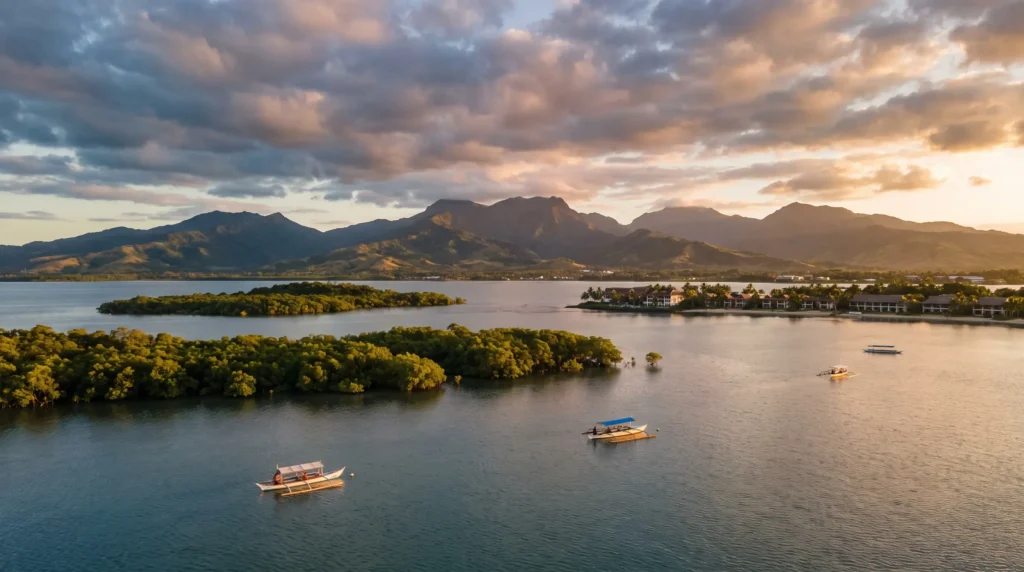
Nadi Travel Guide — Fiji’s Front Door, and Why You Shouldn’t Rush Through It
Almost everyone who visits Fiji lands in Nadi and almost everyone treats it as a layover — a place to shower off the flight before the boat to a private island. I get the instinct, but I think it’s a mistake, and I’ve made it myself. Nadi is a real, unpolished, multiracial Fijian town of around 12,000 people where the call to prayer from the mosque overlaps with temple bells from the largest Hindu temple in the Southern Hemisphere , where you can be shoulder-deep in volcanic mud by 10am and snorkeling a coral reef by 2pm, and where the airport that 97% of international visitors pass through sits ten minutes from a jungle full of orchids planted by a Hollywood actor. It’s also, honestly, a little scruffy around the edges near the market and the main strip gets its share of pushy souvenir touts — I’ll tell you where those are so you can enjoy the rest of it without the hassle.
In This Guide
- Overview — Why Nadi Deserves More Than a Layover
- Bula Festival & the Dry-Season Sweet Spot
- Best Time to Visit Nadi (Season by Season)
- Getting There — NAN Airport & Onward Transfers
- Getting Around — Taxis, Buses & Rental Cars
- Neighborhoods — Denarau, Nadi Town, Martintar & the Valley
- Culture & People — A Town Built by Everyone
- A Food Lover’s Guide to Nadi
- Off the Beaten Path
- Day Trips — Islands, Coast & Volcanic Mud
- Practical Information
- Budget Breakdown — What Nadi Actually Costs in 2026
- Frequently Asked Questions
Overview — Why Nadi Deserves More Than a Layover
Nadi sits on the drier, western side of Viti Levu, Fiji’s largest island, which is the whole reason it became the country’s tourism engine: while Suva on the windward coast gets soaked, Nadi bakes in a rain shadow with a genuine dry season from July into August and lighter rain most other months. The town proper is small — about 12,000 people — but the wider Nadi district (locally, the Tikina) is home to roughly 59,700, and it punches enormously above its weight because Nadi International Airport, sitting nine kilometres away, handles the overwhelming majority of everyone who flies into Fiji.
What that means in practice: Nadi is Fiji’s most international town, and also its most workaday. This isn’t a resort built for tourists — it’s a real market town of Indo-Fijian and Indigenous Fijian families, sugar cane farmers, airline crew, and a constantly rotating cast of backpackers and honeymooners, all sharing a few kilometres of main road. You’ll find the largest Hindu temple in the Southern Hemisphere a few blocks from a mosque and a Methodist church, and that layering is the actual story of Fiji, condensed into one town.
The catch, and I’ll say it up front: central Nadi’s shopping strip is not beautiful, and the touts outside the handicraft stores can be relentless — a firm “no thank you” and continued walking works fine, but first-timers sometimes get talked into overpriced “duty-free” watches or fake urgency about “today only” deals. Once you’re past that stretch, though, you’re minutes from mangrove-lined rivers, orchid gardens, and a marina that puts you on a boat to some of the most photographed water on Earth by mid-morning.
Bula Festival & the Dry-Season Sweet Spot
If you can time it, land in Nadi during July or August. This is the heart of the dry season on the western side of Viti Levu , and it also lines up with the Bula Festival, a long-running Nadi street celebration (typically staged in July) with float parades, food stalls, live music and a genuinely local, un-touristy energy along the main strip that otherwise sells you sarongs all day. It’s a good antidote to the “airport town” reputation — for one week the whole community turns the main road into a party.
This window also overlaps with humpback whale migration season in Fijian waters and the calmest, clearest conditions out at the Mamanuca and Yasawa islands, so a July or August trip genuinely stacks the deck in your favor — good land festival, good weather, good diving and snorkeling visibility.
Best Time to Visit Nadi (Season by Season)
May – October · Dry season (peak)
The most reliable weather of the year, with July–August the driest stretch. This is also peak pricing for flights and resorts, especially around the July school-holiday period in Australia and New Zealand, Fiji’s two biggest source markets — book accommodation and inter-island transfers well ahead.
November – April · Wet season, and cyclone season
Hot, humid, with heavier afternoon downpours, and this is officially tropical cyclone season for the southwest Pacific, running November through April with the statistical peak in January–March. Direct cyclone hits on Nadi itself are not an annual certainty, but travel insurance with cyclone/weather cover is non-negotiable in this window, and it’s worth watching the Fiji Meteorological Service’s outlook in the weeks before you fly. On the upside: this is the cheapest time to visit by a wide margin, and Nadi’s rain-shadow position means it often gets off lighter than Suva or the outer islands.
April & November · Shoulder
Genuinely the smart-money window — the crowds and prices of peak season haven’t arrived (or have just left), the weather is still mostly cooperative, and dive visibility is still good.
Getting There — NAN Airport & Onward Transfers
Nadi International Airport (NAN) is Fiji’s principal international gateway, located in Namaka, about 9–10 kilometres from Nadi town and roughly 192 kilometres northwest of the capital, Suva, on the other side of Viti Levu. It’s the hub for national carrier Fiji Airways and its domestic subsidiary Fiji Link, and it handles well over two million passengers a year across international and domestic routes, with something like 97% of Fiji’s international arrivals funneling through it. Direct flights connect Nadi to major hubs in Australia, New Zealand, the US West Coast, and other South Pacific islands.
From NAN, resort transfers, taxis and pre-booked shuttles line up outside arrivals — agree a fare (or confirm the meter) before you get in, since unmetered “flat rate” quotes to unfamiliar tourists can run high. Denarau Island’s marina and resort strip is about a 15-minute drive; central Nadi town is closer still. If your itinerary is island-bound from day one, most of the outer-island ferries and day-cruise boats depart from Port Denarau, not the airport itself, so budget time and a taxi or shuttle for that last short hop.
Getting Around — Taxis, Buses & Rental Cars
Nadi town itself is small enough to walk end to end in under twenty minutes, but the useful sights are spread along a corridor stretching from the airport through town to Denarau, so you’ll want wheels of some kind. Metered taxis are everywhere and cheap by Western standards — just confirm the meter is running or agree the fare first, especially from the airport or resort ranks where “special” tourist pricing tends to appear.
Local buses run the main Queens Road corridor between the airport, Nadi town, Martintar and Lautoka for a few Fijian dollars and are a genuinely fun, if slow, way to see ordinary Fijian life — open-sided, breeze-cooled, and full of school kids and market-bound aunties. Rental cars open up Sabeto Valley, Natadola Beach and the Coral Coast at your own pace; driving is on the left, and roads outside the main corridor can be narrow and pothole-prone. For most travelers whose whole trip is Nadi plus an island stay, a combination of resort shuttles, the odd taxi, and one rental-car day for the mud pools and gardens covers everything.
Neighborhoods — Denarau, Nadi Town, Martintar & the Valley
Denarau Island
A reclaimed, gated resort peninsula a short drive from town, ringed with international hotel chains, a golf course, a marina, and Port Denarau — the departure point for almost every Mamanuca and Yasawa island cruise, ferry and day trip. It’s polished, walkable within its own bubble, and about as far from “authentic Fiji” as this guide gets, but it’s also where you’ll likely start or end an island-hopping itinerary.
Nadi Town centre
The commercial heart: the produce and handicraft market, the main shopping strip, and the Sri Siva Subramaniya Temple at the southern end of the main road — a genuinely striking three-part Hindu temple complex with Dravidian-style architecture, ornate carvings and colourful festivals, and the largest of its kind in the Southern Hemisphere. Modest dress and a small entry donation are expected; shoes off before entering.
Martintar
The budget-traveler strip between the airport and town proper — backpacker hostels, mid-range guesthouses, curry houses and a cluster of bars. Less scenic than Denarau, more useful if you’re on a tight budget and want to walk to dinner.
Namaka
The airport’s own district, mostly business hotels and warehouses, useful for a single-night crash before an early flight but not a place to linger.
Sabeto Valley
North of the airport, a lush agricultural valley in the foothills of the Sabeto mountain range — home to both the geothermal mud pools and hot springs that draw a steady stream of day-trippers, and the Garden of the Sleeping Giant, a roughly 20-hectare orchid garden started in 1977 by Hollywood actor Raymond Burr (of Perry Mason fame) to house his personal orchid collection, now home to more than a thousand orchid species. The valley takes its popular nickname from the silhouette of the mountains, said to resemble a sleeping giant on his back.
Wailoaloa & Newtown Beach
Nadi’s own patch of sand, a short drive from town — not the postcard turquoise of the outer islands (the water here is siltier, closer to the river mouths), but a cheap, low-key sunset spot with beach bars, popular with backpackers who don’t want to pay island-resort prices for a sundowner.
Culture & People — A Town Built by Everyone
Fiji’s population is around 926,000, and its two largest communities are Indigenous Fijians (iTaukei) and Indo-Fijians, descendants of indentured labourers brought by the British to work sugar plantations from the 1870s onward — Nadi’s own economy still leans on sugar cane alongside tourism. English, Fijian and Fiji Hindi are all recognized national languages, and you’ll hear all three within a single walk down Nadi’s main street.
Fiji became independent from Britain on 10 October 1970 and is today a parliamentary republic — Fiji Day in October is celebrated nationally. In Nadi specifically, that dual heritage shows up as a genuinely unusual religious skyline for a town this size: a major Hindu temple, mosques, and Methodist and Catholic churches all within a few minutes of each other. If you’re invited into a village or to a kava (yaqona) ceremony, dress modestly, remove your hat and sunglasses, and follow your host’s lead on the seated, communal drinking ritual — it’s a cornerstone of Fijian hospitality, not a tourist performance, even where it’s offered at resorts.
A Food Lover’s Guide to Nadi
Nadi’s food scene reflects its population split more than any single “national dish.” On the Indo-Fijian side, expect proper curry houses doing goat curry, roti and dhal, often better and cheaper than anything you’ll find at a resort buffet — Martintar and the streets around the market are the place to look. On the Indigenous Fijian side, look for kokoda (fish marinated in citrus and coconut milk, Fiji’s answer to ceviche) and lovo, food slow-cooked in an underground earth oven, typically wrapped in banana leaves — most commonly served at resort feast nights or village celebrations rather than as everyday street food.
Nadi’s produce and fish market in the town centre is worth a wander even if you’re not buying — Fijian chilies, root vegetables, and reef fish laid out each morning. Wash it all down with kava, the mildly numbing, earthy ceremonial drink made from ground pepper-plant root, offered almost everywhere from village halls to resort bars, or a cold Fiji Bitter or Fiji Gold lager, both brewed locally.
Off the Beaten Path
Sabeto Hot Springs & Mud Pool
A short drive north of the airport in the Sabeto Valley: coat yourself in warm volcanic mud, let it bake dry in the sun, then rinse off through a series of geothermal pools of varying temperature. It’s touristy in the sense that everyone photographs it, but it’s genuinely a natural feature, not a manufactured one, and it’s cheap relative to almost anything else on a Fiji itinerary.
Garden of the Sleeping Giant
Raymond Burr’s orchid legacy, tucked into the Sabeto foothills — a peaceful, unhurried walk through jungle canopy, lily ponds and more than a thousand orchid varieties, usually taking about ninety unrushed minutes. Combine it with the mud pools in one half-day loop; most tour operators and taxi drivers already package the two together.
Momi Bay
South of Nadi toward the Coral Coast, Momi Bay holds a pair of British-built coastal defense guns from the Second World War, still in position overlooking the Malolo Passage — a quiet historical footnote most tourists never see, with a genuinely good view over the Mamanucas as a bonus.
Nadi’s back streets and market
Skip the souvenir strip and walk instead through the produce market in the early morning, or the residential streets around the temple, for a version of Nadi that has nothing to do with the tourism economy at all.
Day Trips — Islands, Coast & Volcanic Mud
Mamanuca Islands
The classic Nadi day trip: catamarans and ferries leave Port Denarau each morning for a string of small, reef-fringed islands, some of them familiar from film and TV. Closer islands are a short hop; the furthest are most of a morning away. Day packages typically bundle a boat transfer, beach time, snorkeling and a buffet lunch — genuinely the easiest way to get a “Fiji postcard” day without booking an overnight island stay.
Yasawa Islands
A longer, more dramatic chain further north, reached via a dedicated daily ferry service from Port Denarau. Doable as a very long single day if you’re determined, but the Yasawas reward an overnight stay far more than the closer Mamanucas do — consider it a preview trip to plan a return.
Coral Coast & Natadola Beach
South along the coast toward Suva, Natadola is regularly cited as one of Fiji’s best mainland beaches — a long, golden, swimmable crescent with none of the boat logistics an island day trip requires. Good for travelers who want a beach day without the marina queue.
Sabeto Valley loop
Mud pools plus the Garden of the Sleeping Giant, done as a half-day loop by rental car or taxi, easily paired with a late lunch back in Nadi town.
Practical Information
Money. The Fijian dollar (FJD) is pegged by the Reserve Bank of Fiji to a weighted basket of the Australian and New Zealand dollars, US dollar, Japanese yen, British pound and euro, with the official daily rate set each morning. Cards are widely accepted at resorts and in Nadi town; carry cash for the market, buses and smaller eateries, and confirm the current rate before you exchange rather than relying on any number printed here.
Visa. Citizens of the US, UK, most EU countries, Australia, New Zealand and Canada don’t need a visa in advance — you receive a visitor’s permit on arrival, generally valid up to four months, provided you hold a passport valid at least six months beyond your stay and a return or onward ticket. Always check the current exempted-country list before you fly, since policy can change.
Safety. Fiji overall sits at “exercise normal precautions” on the US State Department’s advisory scale, but both the State Department and the UK Foreign Office flag real, specific risks worth knowing: increased reports of assault against female tourists in some areas, and advice against solo travel after dark in unfamiliar spots. Check current advisories close to your travel dates, use licensed taxis, and treat Nadi’s tourist strip with the same street sense you’d use anywhere unfamiliar.
Health. The US CDC recommends being up to date on routine vaccines plus Hepatitis A and Typhoid for most travelers to Fiji; there’s no vaccine for dengue, so mosquito bite prevention (repellent, covering up at dawn/dusk) is the main defense. Tap water is generally treated in Nadi and resort areas, but bottled water is a safe default outside them.
Connectivity & practicalities. A local SIM or eSIM is cheap and easy at the airport; resort Wi-Fi ranges from decent to slow. Plugs: Type I (Australian/NZ style, three flat pins), 240V. Time zone: UTC+12, with Fiji observing daylight saving in the Southern Hemisphere summer in some years — double-check before booking transfers.
Budget Breakdown — What Nadi Actually Costs in 2026
Nadi itself is one of the more affordable bases in Fiji — it’s the outer-island resorts and day cruises layered on top that push a trip’s total cost up.
Budget (US$35–70/day): Martintar hostel dorm or basic guesthouse, curry-house meals, local buses, Wailoaloa Beach for sunset instead of a resort day-pass.
Mid-range (US$100–220/day): A comfortable hotel in Nadi town or a modest Denarau property, restaurant meals, a rental car day for the Sabeto loop, and one Mamanuca day-cruise package with lunch included.
Luxury (US$350+/day): A Denarau beachfront resort, a private charter or premier catamaran to the outer islands, spa treatments, and fine dining on the marina.
Fixed costs to plan for: airport departure formalities are included in your ticket, but budget separately for island day-cruise or ferry fares (these scale with distance — closer Mamanuca islands cost less than the Yasawas), and tip 5–10% at resorts where it isn’t already added, though tipping is not deeply embedded in local custom the way it is in North America.
Planning Your Trip to Nadi
The classic first-timer split is land plus islands: land at NAN, spend one or two nights in Nadi town or Martintar to shake off jet lag, do the Sabeto mud-pool-and-garden loop, then head to Port Denarau for a Mamanuca island stay of three to five nights. If you have more time, add the Yasawas or the Coral Coast before flying home. Nadi also makes sense as a stopover if you’re continuing on through the Pacific — check our Fiji country guide for the bigger regional picture, or our Bora Bora guide if you’re chaining together more than one Pacific island stop.
Frequently Asked Questions
Is Nadi safe for tourists in 2026?
Broadly yes — Fiji sits at the US State Department’s lowest advisory tier, “exercise normal precautions” — but both the State Department and UK FCDO specifically flag incidents against tourists, including assaults, in certain areas, and advise against walking alone after dark in unfamiliar spots. Stick to licensed taxis, keep valuables out of sight on the main strip, and check current advisories before you travel.
Do I need a visa for Fiji?
Most Western passport holders — US, UK, EU, Australia, New Zealand, Canada — get a visitor’s permit on arrival, typically valid up to four months, provided your passport has at least six months’ validity left and you hold a return or onward ticket. Always confirm current requirements for your nationality before flying.
How many days do I need in Nadi?
One to two nights covers the town itself — temple, market, mud pools, orchid garden. Most of what people actually come to Fiji for, though, is the islands beyond Nadi, so budget your real time there and treat Nadi as the gateway it is.
Is Nadi worth visiting, or should I go straight to the islands?
Both, ideally. Skipping Nadi entirely means missing the temple, the mud pools, the orchid gardens and a slice of everyday Fijian life you won’t see on a resort island — but nobody should spend their whole trip here either. A day or two, then onward.
What’s the weather actually like, and when should I avoid?
May through October is the reliable dry season; November through April is wetter and also official cyclone season for the region, peaking January–March. It’s not a reason to avoid Fiji outright, but it is a reason to buy proper travel insurance and watch the forecast.
Fiji or the Cook Islands / French Polynesia?
Choose Fiji for the widest range of budgets, the easiest flight connections in the South Pacific, and a genuinely warm, multicultural mainland town in Nadi to explore before or after the islands; choose French Polynesia if overwater bungalows and a smaller, more curated luxury scene are the priority.
Ready to Explore Nadi?
Volcanic mud by morning, a Hindu temple with 70 tonnes of Italian marble by lunch, and a boat pulling away from Port Denarau toward reef-fringed islands by mid-afternoon — Nadi packs an absurd amount into what most people budget as a one-night layover. Give it a little more time than that, and let the islands be the second half of the story, not the whole thing.
Explore More
- Fiji Travel Guide — the bigger picture beyond Nadi’s town limits
- Bora Bora Travel Guide — pair Fiji with French Polynesia’s overwater icons
- Sydney Travel Guide — the most common gateway city for Fiji-bound flights
- Auckland Travel Guide — combine Nadi with a New Zealand stopover
How this guide was built
Published as part of Facts From Upstairs’ city guide series. Built from authoritative sources — Wikipedia entity pages for Nadi, Nadi International Airport, Fiji and the Sri Siva Subramaniya Temple; Tourism Fiji’s official visa guidance; the Reserve Bank of Fiji’s exchange-rate page; the US State Department and UK FCDO Fiji advisory pages; the US CDC traveler page for Fiji; the Fiji Meteorological Service’s tropical cyclone outlook; and the Garden of the Sleeping Giant’s official history page. Numeric claims carry inline citations.
Sources cited on this page
- Wikipedia — Nadi, Fiji
- Wikipedia — Nadi International Airport
- Wikipedia — Fiji
- Wikipedia — Sri Siva Subramaniya Temple
- Tourism Fiji — Visa requirements
- Reserve Bank of Fiji — Exchange rates
- US State Department — Fiji
- UK FCDO — Fiji
- US CDC — Fiji traveler page
- Fiji Meteorological Service — 2025–26 Tropical Cyclone Outlook
- Garden of the Sleeping Giant — About Us
More city guides you might like
Plan your trip to Nadi
The booking tools we use ourselves. FFU may earn a commission at no extra cost to you.
Plan & book your trip to Nadi
Booking through these searches supports our guides at no extra cost to you.