
Nafplio Travel Guide — Greece’s First Capital, a Venetian Harbor & the Best Base in the Peloponnese
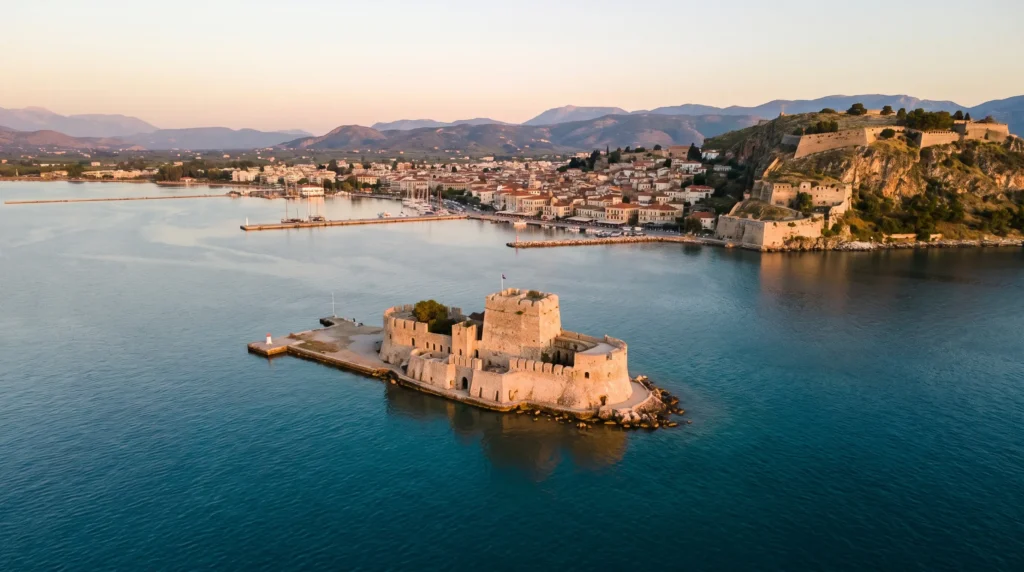
I keep sending people to Nafplio and they keep coming back slightly annoyed at me for not making it sound like a bigger deal. It was Greece’s first capital, from 1827 to 1834, and it looks the part: a Venetian old town of marble lanes and bougainvillea, a fortress on a cliff, and a tiny island castle sitting in the middle of the harbor like it wandered off a film set. What nobody tells you up front is that Nafplio is also the best base in Greece for ruins — Mycenae, Epidaurus and Tiryns are all within a 30-minute drive, which means you can sleep in a boutique hotel with sea views and be standing at Agamemnon’s Lion Gate before your coffee wears off. It’s touristy on weekends, it’s an easy day-trip target for Athenians, and I still think it’s one of the most underrated overnights in the country.
In This Guide
- Overview — Why Nafplio Is the Peloponnese’s Best Base
- The Epidaurus Festival — Ancient Drama Under the Stars
- Best Time to Visit Nafplio
- Getting There — Athens Airport, Buses & the Coastal Drive
- Getting Around — Walking, Cars & Taxis
- Neighborhoods — Old Town, Pronoia & the New Town
- Culture & People — A Capital That Stepped Back
- A Food Lover’s Guide to Nafplio
- Off the Beaten Path
- Day Trips — Mycenae, Epidaurus, Tiryns & Nemea
- Practical Information
- Budget Breakdown — What Nafplio Actually Costs in 2026
- Frequently Asked Questions
Overview — Why Nafplio Is the Peloponnese’s Best Base
Nafplio sits on the Argolic Gulf in the northeastern Peloponnese, a coastal town of roughly 33,000 people in its wider municipality. Venetians held it twice, most consequentially from 1686 to 1715, and it was the Ottomans who controlled it in between and after — a tug-of-war that left the old town looking more Italian than Greek in places, all shuttered pastel facades and marble-paved lanes. After a brutal year-long siege during the Greek War of Independence, the town fell to Greek forces and became, briefly, the capital of the newly independent nation from 1827 to 1834, before the seat of government moved to Athens.
That short stint as capital is why Nafplio feels more elegant than towns twice its size — neoclassical mansions, a proper central square, and fortifications on three levels: the ancient acropolis walls of Akronafplia, the hilltop Venetian fortress of Palamidi, and the tiny island castle of Bourtzi anchored in the middle of the harbor.
The real headline, though, is what surrounds it. Within a half-hour’s drive sit Mycenae and Tiryns, joint UNESCO World Heritage Sites since 1999 and the two great citadels of Bronze Age Greece, plus the Sanctuary of Asklepios at Epidaurus, a UNESCO site since 1988 and home to the best-preserved ancient theatre in the country. No other town in Greece lets you combine a genuinely charming overnight base with this much ancient history on the doorstep — which is exactly why Athenians treat it as their go-to weekend escape, and why it deserves to be more than a day trip for everyone else.
The Epidaurus Festival — Ancient Drama Under the Stars
If you can time a summer trip around one thing, make it the Athens Epidaurus Festival, which stages ancient Greek tragedy, comedy and opera at the 2,300-year-old theatre of Epidaurus, roughly 30 kilometers from Nafplio. The 2026 season runs from June through August, with performances beginning around sunset and running into the night — Aeschylus’s The Persians, Euripides’s Alcestis and The Trojan Women among the productions confirmed for July.
The theatre itself, built around 340–300 BCE and holding an estimated 13,000–14,000 spectators, is famous for acoustics so precise that a coin dropped on the central stone can reportedly be heard from the back row — test it yourself before showtime. Nearly everyone attending bases themselves in Nafplio, which means hotel rooms sell out well ahead on performance nights — book early if a show lines up with your dates, and expect a slow drive back after curtain call as everyone leaves at once.
Best Time to Visit Nafplio
April – June · Spring sweet spot
Wildflowers on the drive to Mycenae, comfortable ruin-hopping temperatures, and the Epidaurus Festival kicking off in June. This is the window locals recommend to first-timers, and it’s the one I’d pick too.
July – August · Peak summer
Hot — expect high 80s to mid-90s Fahrenheit — and busy with both Greek and international visitors, plus the full Epidaurus Festival calendar. Book the Old Town’s boutique hotels well in advance; the harbor promenade at sunset is unbeatable but crowded.
September – October · The other sweet spot
Sea still warm enough for a swim at nearby Karathona beach, ruins less scorching, festival crowds thinning. Many consider this the best all-round month.
November – March · Quiet season
Cool, occasionally rainy, and genuinely peaceful — you’ll have Palamidi’s ramparts mostly to yourself. Some island boat trips to Bourtzi run less frequently and a handful of seasonal tavernas close.
Getting There — Athens Airport, Buses & the Coastal Drive
There’s no airport in Nafplio itself. Nearly everyone arrives via Athens International Airport (ATH), Greece’s largest, about 30 kilometers east of central Athens by road. From there, it’s roughly a two-hour drive southwest via the Corinth Canal and Argos, or a direct KTEL bus that takes about two to two-and-a-half hours from central Athens.
Renting a car at the airport is the easiest option if you plan to visit Mycenae, Epidaurus and Tiryns independently — the roads are good modern highway most of the way. If you’re not driving, private transfers and organized day tours from Athens are widely available and reasonably priced, and several companies run direct Athens–Nafplio coaches timed around the Epidaurus Festival’s performance schedule.
Getting Around — Walking, Cars & Taxis
The Old Town is entirely walkable and, frankly, best experienced that way — cars aren’t allowed into most of its marble-paved core, and the whole peninsula from Syntagma Square to the Bourtzi waterfront takes maybe 20 minutes end to end on foot.
You’ll want a car, though, for the archaeological sites: Tiryns is a five-minute drive, Mycenae about 25 minutes, Epidaurus around 30, and the Nemea wine region roughly 45 minutes north. Taxis are available for single trips if you’d rather not drive, and a small boat ferries visitors out to Bourtzi castle from the harbor for a short, cheap crossing. Parking in the New Town just outside the Old Town’s pedestrian zone is straightforward and free in most spots.
Neighborhoods — Old Town, Pronoia & the New Town
The Old Town (Palia Poli)
The postcard Nafplio: narrow marble lanes, Venetian and Ottoman-era buildings, neoclassical mansions, and Syntagma Square at its heart, ringed by the old mosque-turned-cultural-center and the Archaeological Museum. Boutique hotels occupy converted 19th-century townhouses; this is where you want to sleep.
The waterfront & Akti Miaouli
The harbor promenade curling from the port toward Arvanitia beach, lined with cafés and the departure point for the little boat out to Bourtzi. Best at golden hour, when Palamidi lights up above and Bourtzi glows mid-harbor.
Akronafplia
The oldest fortified section, a rocky promontory above the Old Town with walls dating to antiquity and layered with Byzantine, Frankish, Venetian and Ottoman additions. Quieter than Palamidi and reachable on foot or by a short drive, with sweeping gulf views.
Palamidi Hill
Not a neighborhood so much as the town’s dominant landmark: a Venetian fortress built between 1711 and 1714, 216 meters above the sea, reached by 857 stone steps from the Old Town (locals still call it “the 999 steps,” a myth that refuses to die). Climb at dawn or take the road up and walk down.
Pronoia
The hillside residential district above and east of the Old Town, mostly modern, with a handful of hotels that trade Old Town charm for sea-view balconies and easier parking.
New Town (Nea Poli)
The functional, lived-in part of Nafplio beyond the tourist core — supermarkets, the bus station, everyday tavernas at everyday prices. Worth a wander if you want to see how residents actually live alongside the postcard version.
Karathona
A sandy beach a short walk or drive over the headland from Arvanitia, backed by pine trees, popular with both visitors and locals for a proper swim rather than a photo op.
Culture & People — A Capital That Stepped Back
There’s a specific kind of civic pride in Nafplio that comes from having been the country’s capital, however briefly, and then gracefully accepting Athens took the job instead. Nafpliots take their heritage seriously — restoration of the Venetian and Ottoman-era buildings is meticulous, and the Archaeological and Peloponnesian Folklore Foundation museums both draw a steady stream of Greek school groups, not just foreign tourists.
Sunday mornings still mean church bells and family lunches lasting well into the afternoon; the town empties out a little after Easter week and the August religious holidays as locals head to family villages inland. Name days matter more than birthdays here, and a taverna owner who learns yours will remember it next visit.
A Food Lover’s Guide to Nafplio
The Argolic plain around Nafplio is some of Greece’s most productive citrus country, and the oranges here — squeezed into fresh juice at every café — are genuinely a cut above. Seafood tavernas along the waterfront serve the day’s catch simply grilled; inland, look for slow-cooked goat, wild greens (horta), and the region’s excellent olive oil.
Don’t skip the sweets: Nafplio is known for its diples (fried honey pastry) and candied fruit shops selling orange, walnut and cherry preserves that make better souvenirs than anything in a gift shop window. For wine, the town sits at the southern edge of the Nemea appellation, roughly 45 minutes north, where the indigenous Agiorgitiko grape produces some of Greece’s best-known reds — several wineries offer tastings as an easy half-day trip.
Off the Beaten Path
Bourtzi at night, from the water
Most visitors just photograph Bourtzi from the promenade. Built in 1471 by the Venetian architect Antonio Gambello and later used, grimly, as the town executioner’s residence before becoming a hotel and restaurant, the little island fortress is worth the short boat crossing for the view back at Nafplio itself, especially after dark.
Akronafplia’s quiet ramparts
Everyone climbs Palamidi; almost nobody bothers with Akronafplia’s older walls just above the Old Town, which are free to wander and nearly empty even in August.
Sarteneja-style backroads to Nemea
Skip the tour bus and drive yourself into the Nemea hills — small family wineries here will pour you a tasting with none of the crowds of the bigger Santorini or Mykonos wine circuits.
Karathona’s far end
Walk past the main stretch of Karathona beach toward its quieter southern end for a swim without the sunbed rows.
Day Trips — Mycenae, Epidaurus, Tiryns & Nemea
Mycenae
About 25 minutes from Nafplio, Mycenae was the dominant center of Bronze Age Greece, inscribed as a UNESCO World Heritage Site alongside Tiryns in 1999. Walk through the Lion Gate, descend into the beehive-shaped Treasury of Atreus, and see the shaft graves where Heinrich Schliemann’s 1876 excavations uncovered the gold funerary mask popularly (if inaccurately) linked to Agamemnon.
Epidaurus
Around 30 minutes away, the Sanctuary of Asklepios was ancient Greece’s foremost healing center, UNESCO-listed since 1988, and home to the extraordinary Ancient Theatre with its famously perfect acoustics. Go for the theatre alone if you have to choose one site near Nafplio.
Tiryns
Barely five minutes outside Nafplio, Tiryns is the closer, smaller, and far less crowded half of the joint UNESCO listing with Mycenae — its Cyclopean walls, built from stone blocks so massive that ancient Greeks credited them to the mythical Cyclopes, are worth the short detour.
Nemea
A 45-minute drive north brings you to Greece’s best-known red wine region, built around the Agiorgitiko grape, plus the ancient Sanctuary of Zeus and its own (much smaller) stadium and temple ruins. Combine it with a winery lunch for an easy half-day.
Practical Information
Money. Greece uses the Euro; cards are widely accepted in the Old Town’s hotels, restaurants and shops, though smaller tavernas and the candied-fruit stalls may prefer cash.
Safety. Greece sits at Level 1 — “Exercise Normal Precautions” — on the US State Department’s advisory scale as of late 2025, with petty theft at tourist sites and on transit the main concern rather than violent crime; Nafplio itself is a low-key, relaxed town.
Health. No special vaccines are required beyond staying current on routine shots; the CDC recommends Hepatitis A for those eating street food or visiting rural areas, standard bug-bite precautions against ticks and sand flies, and care around any standing or floodwater.
Connectivity. An EU-roaming or regional eSIM covers Nafplio fine; Old Town hotel Wi-Fi is generally solid. Plugs: European two-pin (Type C/F), 230V. Time zone: Eastern European Time, UTC+2, shifting to UTC+3 for summer daylight saving.
Budget Breakdown — What Nafplio Actually Costs in 2026
Nafplio runs mid-pack for Greece — pricier than inland Peloponnese towns, cheaper than Santorini or Mykonos in high season.
Budget (US$70–110/day): Guesthouse or simple hotel outside the Old Town core, taverna lunches, self-driven day trips splitting a rental car among a group, walking everywhere in town.
Mid-range (US$150–260/day): Boutique Old Town hotel, waterfront dinners, a rental car for the archaeological circuit, entry fees for Mycenae, Epidaurus and Tiryns, a Nemea wine-tasting afternoon.
Luxury (US$400+/day): Design hotel with a sea-view balcony, private guided tours of the UNESCO sites, premium tickets to an Epidaurus Festival performance, chef-led tasting menus on the harbor.
Fixed costs to plan for: separate entry tickets at each archaeological site (a combined Argolis ticket can save money if you’re doing all three), and a small optional fee for the Bourtzi boat crossing. Tipping 5–10% is appreciated but not obligatory.
Planning Your Trip to Nafplio
Two nights covers the town and its ruins comfortably: one day for the Old Town, Palamidi and Bourtzi, one day for Mycenae, Tiryns and Epidaurus. Three or four nights lets you add a Nemea wine day and a proper swim at Karathona without rushing. Most people combine Nafplio with a few nights in Athens before or after, or extend the trip with a ferry hop to Santorini or Mykonos for the classic ruins-then-islands itinerary.
Frequently Asked Questions
Is Nafplio worth an overnight, or just a day trip from Athens?
Overnight it if you can. Most Athens-based tours treat Nafplio and its ruins as a rushed single day; staying one or two nights lets you see Palamidi at sunrise, the harbor at sunset, and still have a relaxed morning for Mycenae or Epidaurus before heading back.
Do I need a visa to visit Greece?
Greece is part of the Schengen Area. US, UK, Canadian and Australian passport holders typically get visa-free entry for up to 90 days within any 180-day period; EU/Schengen citizens travel with just a national ID card. Always confirm current rules for your nationality before flying.
How many days do I need for Mycenae, Epidaurus and Tiryns?
One full day covers all three comfortably if you drive yourself and start early, since Tiryns is five minutes from town, Mycenae about 25, and Epidaurus around 30. Add a second day if you want an unhurried few hours at each plus a wine stop in Nemea.
Is Nafplio safe?
Yes — Greece overall sits at the US State Department’s lowest advisory tier, “Exercise Normal Precautions,” and Nafplio is a quiet, walkable town where the main risk is the usual pickpocket caution at busy tourist sites.
Can I climb Palamidi Fortress if I’m not in great shape?
The 857 steps are steep and shadeless in summer — go at dawn or take the access road by car or taxi to the top gate and walk the interior at your own pace instead.
Nafplio or Athens as a home base for the Peloponnese?
Athens if you’re only doing a single rushed day trip; Nafplio if ruins, wine and a slower pace matter more than nightlife — you’ll spend far less time in the car and far more time actually looking at things.
Ready to Explore Nafplio?
A Venetian harbor town that used to run the country, a castle you climb on 857 steps, and three UNESCO-worthy ruins within a half-hour’s drive — Nafplio is the rare Greek destination that rewards slowing down instead of rushing to the next island ferry. Give it two nights and you’ll understand why Athenians keep coming back.
Explore More
- Greece Travel Guide — the full country overview
- Athens City Guide — pair Nafplio with the capital
- Santorini City Guide — continue on to the islands
- Mykonos City Guide — the classic ruins-then-islands combo
How this guide was built
Published as part of Facts From Upstairs’ city guide series. Built from authoritative sources — Wikipedia entity pages for Nafplio, Palamidi, Bourtzi Castle, Mycenae, the Ancient Theatre of Epidaurus, Athens International Airport and Greece; UNESCO’s listings for the Archaeological Sites of Mycenae and Tiryns and the Sanctuary of Asklepios at Epidaurus; the official Athens Epidaurus Festival schedule; the US State Department and US CDC Greece traveler pages; and travel-industry sources on the Nemea wine region and Argolis’s citrus production. Numeric and factual claims carry inline citations.
Sources cited on this page
- Wikipedia — Nafplio
- Wikipedia — Palamidi
- Wikipedia — Bourtzi Castle
- Wikipedia — Mycenae
- Wikipedia — Ancient Theatre of Epidaurus
- Wikipedia — Athens International Airport
- Wikipedia — Greece
- UNESCO — Archaeological Sites of Mycenae and Tiryns
- UNESCO — Sanctuary of Asklepios at Epidaurus
- Athens Epidaurus Festival — 2026 schedule
- US State Department — Greece
- US CDC — Greece traveler page
- WineTourism.com — Nemea wine region
- National Geographic — Nafplio
More city guides you might like
Plan your trip to Nafplio
The booking tools we use ourselves. FFU may earn a commission at no extra cost to you.
Plan & book your trip to Nafplio
Booking through these searches supports our guides at no extra cost to you.